Antibiotic use for acute respiratory tract infections (ARTIs) in the United States varies by geographic region, with the lowest prescribing rates seen in the Pacific Region and highest prescribing rates seen in the East South Central Region. Reference Hersh, Shapiro, Pavia, Fleming-Dutra and Hicks1 Although this finding might lead to public health interventions targeting specific geographic regions, the extent to which this variability is driven by prescribers versus patients (ie, patient demand or expectations) has not previously been assessed.
Direct-to-consumer (DTC) telemedicine is a relatively new sector of US healthcare, and its importance has risen exponentially during the coronavirus disease 2019 (COVID-19) pandemic. The objective of this study was to leverage the DTC virtual practice setting in which patients and physicians are not necessarily in the same geographic location, to examine the association between antibiotic prescribing for upper respiratory infections (URIs) and bronchitis (ie, conditions for which antibiotics are not indicated) and to examine the association between geographic region of the patient versus that of the physician.
Methods
Setting
Doctor On Demand is a national direct-to-consumer video visit medical practice providing primary care and mental health services via an employed physician practice. Patients are connected to an on-shift physician licensed in the state in which the patient is physically located. Clinicians document the encounter with a proprietary electronic health record system.
Study population
In this cross-sectional, observational, retrospective study, video visits were identified between January 1 and December 31, 2017 with an International Classification of Diseases, Tenth Edition (ICD-10) code of URI or bronchitis, as previously categorized. Reference Fleming-Dutra, Hersh and Shapiro2 Encounters with a concurrent diagnosis for which antibiotics would be indicated were excluded based on definitions used for the avoidance of antibiotics for acute bronchitis Health Effectiveness Data and Information Set (HEDIS) measure. 3,6 Visits with missing data on clinician location, patient age, or location were excluded.
Exposures and outcomes
Independent variables collected from the medical records included patient age (ie, age < 2 years, 2–4 years, 5–17 years, 18–44 years, 45–64 years, >65 years), patient gender, patient US census region (ie, South, Midwest, Northeast, West), physician gender, physician US census region, and visit duration (ie, 5 minutes, 5–10 minutes, >10 minutes). The primary outcome was whether an antibiotic was prescribed. This study was approved by the Institutional Review Board of the George Washington University. Because all data were deidentified, individual informed consent was waived.
Statistical analysis
Univariate associations between independent variables and the outcome of antibiotic prescribing were evaluated using χ2 tests. Multivariate models evaluated the association between physician and provider region on antibiotic prescribing using a mixed-effects logistic regression with a logit function to account for clustering at the physician level, adjusted for patient age group, patient gender, physician gender, diagnosis, call duration, and diagnosis. Normality assumptions of residuals were examined. Analyses were conducted using SAS version 9.4 software (SAS Institute, Cary, NC), and 2-sided P < .05 was considered to indicate statistical significance.
Results
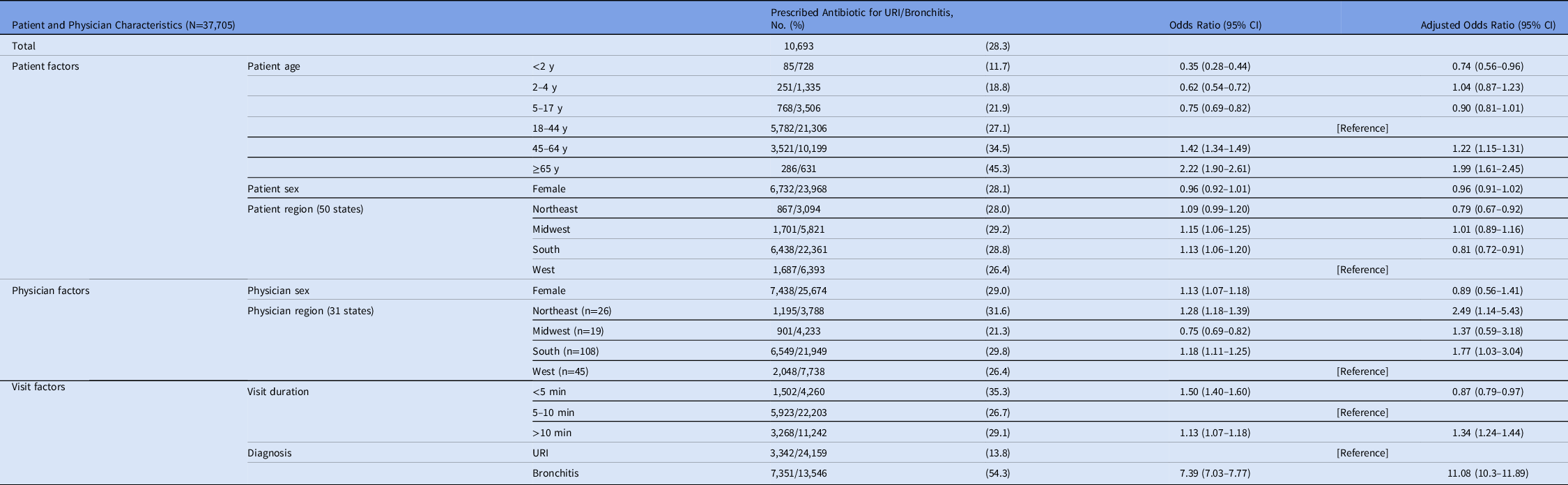
During the study period, we identified 37,705 visits with diagnoses of URI or bronchitis by 194 unique physicians. Antibiotic prescribing rates for URI or bronchitis was 28.3% overall: 54.3% for bronchitis and 13.8% for URI. The geographic distribution of patients and providers is listed in Table 1.
Patient, Physician, and Visit Characteristics

a Physician region different from patient region in 39%.
Note. URI, upper respiratory infection; SD, standard deviation.
In an adjusted analysis, provider geographical location was a bigger driver than patient geographical location. The adjusted odds ratios (aORs) of a URI/bronchitis visit resulting in an antibiotic were 2.49 (95% CI, 1.14–5.43) for physicians in the Northeast and 1.77 (95% CI, 1.03–3.04) for physicians from the South, compared to physicians in the West. In contrast, variations in URI/bronchitis antibiotic prescribing ranged from an aOR of 0.79 for patients in the Northeast (95% CI, 0.67–0.92) to an aOR of 0.81 (95% CI, 0.72–0.91) for patients in the South, compared to patients in the West (Table 2).
Association of Patient and Physician Characteristics with Odds of the URI or Bronchitis Visit Resulting in an Antibiotic Prescription

Note. URI, upper respiratory infection; CI, confidence interval.
Clinical diagnosis, patient age, and visit duration were also significantly associated with variability in prescribing after adjusting for provider and patient geographical locations. Patients with a diagnosis of bronchitis were significantly more likely to receive an antibiotic than patients with a diagnosis of URI (aOR, 11.08; 95% CI, 10.3–11.89). Older patient age was significantly associated with receiving an antibiotic, with an aOR of 1.99 (95% CI, 1.61–2.45) for age ≥65 years and an aOR of 1.22 (95% CI, 1.15–1.31) for those aged 45–64 years, compared to those aged 18–44 years. Children aged <2 years were least likely to receive an antibiotic (aOR 0.74; 95% CI, 0.56–0.96). Visits lasting >10 minutes were more likely to be associated with an antibiotic prescription (aOR, 1.34; 95% CI, 1.24–1.44), and visits <5 minutes were less likely to be associated with an antibiotic (aOR, 0.87; 95% CI, 0.79–0.97), compared to visits lasting 5–10 minutes.
Discussion
In this retrospective cohort study of 37,705 encounters from a national DTC telemedicine practice in which 39% of physicians were in a different region from their patients, we found that the variability in antibiotic prescribing for URI and bronchitis was far greater by physician location (range, 21.3%–31.6%) than by patient location (range, 26.4%–29.2%). Adjusting for other factors, a patient calling in to the practice with a URI or bronchitis was 2.5 times more likely to receive an unnecessary antibiotic if their physician resided in the Northeast than if their physician resided in the West. Also, patients residing in the Northeast and South were ˜20% less likely to be prescribed an antibiotic for bronchitis or URI, and the magnitude of association with antibiotic prescribing was much greater for physician region than for patient region. These findings suggest that a regional culture of prescribing is a far greater predictor of unnecessary antibiotic prescribing than any factor specific to the patient. Physicians often cite patient expectations for antibiotics as a driver leading to unnecessary antibiotic prescribing, Reference Mangione-Smith, McGlynn, Elliott, McDonald, Franz and Kravitz7 which may be reflected in the smaller degree of variability in antibiotic prescribing by patient location.
Previous studies using nationally representative data from office-based practices have similarly shown that antibiotic use varies substantially throughout the United States; prescribing is highest in the South followed by the Northeast. Reference Hersh, Shapiro, Pavia, Fleming-Dutra and Hicks1,Reference King, Bartoces, Fleming-Dutra, Roberts and Hicks4 In this telemedicine cohort, antibiotics were prescribed for 28.3% of URI or bronchitis visits. These rates are comparable to those in emergency departments (25%) but lower than in urgent care centers (46%) and higher than in medical offices (17%). Reference Palms, Hicks and Hersh5 The DTC telemedicine setting is unique in many ways and differs from traditional medical practices with in-person relationships and interactions. As such, these findings specific to telemedicine providers may not be generalizable to clinicians across other ambulatory care settings.
Additional limitations to this analysis include the risk of misclassification by relying on diagnostic codes. Because prescriptions data were not linked to diagnosis data, we were unable to confirm that the antibiotic prescribed was intended for the URI or bronchitis; however, we expect that excluding concurrent infectious diagnoses would address this potential limitation. Physician region was determined by state of current residence, which may not reflect a culture of prescribing learned from location of training or prior employment. Smaller numbers for subgroups of physicians (ie, Midwest, n = 19) may have influenced the reported regional prescribing rates and may have precluded adequate analysis of all provider–patient location combinations. Multiple social and behavioral factors not captured by this database could be unmeasured confounders affecting patient and physician knowledge and attitudes regarding antibiotics.
Acknowledgments
The authors would like to acknowledge Melody Fung, MPH for her support of this project.
Financial support
The authors received no financial support for the research, authorship, or publication of this article.
Conflicts of interest
K.D., J.T., and I.T. are employed at Doctor On Demand. L.Y. was an intern at Doctor On Demand from January to April 2016.