


1 Introduction
Health authorities have traditionally been concerned with the implementation of policies that guarantee access to innovative drugs that improve population health being at the same time affordable for public budgets. Many of the administrative actions related to drug regulation take place in a context of uncertainty, mainly related to efficacy and effectiveness, safety, rate of substitution of other drugs, size of the population of potential patients, as well as the growth of the prevalence rate of the disease. All these issues clearly have important economic consequences that must be foreseen and taken into account in the process of decision-making on price and reimbursement.
Health authorities have dealt with the problems derived from uncertainty in different ways not existing, so far, a universal solution: in some countries they have attempted to fix low prices for new drugs (to reduce the risk of having an uncontrolled budget) although with a limited success (France, Spain, Italy); others, such as the United Kingdom opted to establish some constraints that guarantee efficiency before the decision on reimbursement is adopted (for instance, accepting only those drugs with a cost-effectiveness ratio below a given threshold); in Germany they allow free prices but reimbursement has been based on health outcomes for many years; other countries and regions negotiate some price rebates (once the drug has been traded and proved in current medical practice); France maintains a review process of the original price after experiencing the prescription success of the new drug (checking by experience a set of features such as effectiveness, safety, substitution of other drugs or medical procedures and total sale purchases, etc.), and, even, by requiring donations to health R+D national funds when total sales surpass a given ceiling, as done in Spain during the last decade.
From a methodological perspective, there have been some efforts to improve the management of health risk due to uncertainty in the decision-making processes applied to new drugs. In this sense, several studies (Claxton et al., Reference Claxton, Ginelly, Sculpher, Philips and Palmer2004; Fenwick et al., Reference Fenwick, Claxton and Sculpher2008) have applied the value of information analysis to reduce the level of uncertainty and to recommend spending some resources ex-ante to gather more information for health technology assessments. Yokota and Thompson (Reference Yokota and Thompson2004) carried out a review of the literature on the value of information analysis applied to medical decision-making and concluded that most of the studies demonstrated the usefulness of this approach although there was a lack of applications to actual management decisions.
Besides these new approaches and policies, drug budgets have experienced large increases, frequently over the GDP growth rates and over the initial approved figures. Drug budget control has driven health authorities to explore new approaches to maintain access to better drugs reimbursed by public funds. Until now, health authorities born most of the risk derived from the uncertainties related to safety and effectiveness of the treatments as they usually paid for the treatments regardless of the final health outcomes. An alternative approach to general drug policies is to translate some of the risks to the firms by paying them according to health outcomes.
Since the 90s of the last century, this kind of behaviour has been formally conceptualised and some risk-sharing contracts have been signed between pharmaceutical firms and public administrations when regulating drug issues. For instance, in New Zealand, Pfizer and PHARMAC (Pharmaceutical Management Agency) signed a price-volume agreement for atorvastatin (Begg et al., Reference Begg, Sidweel, Gradiner, Nicholls and Scott2003) by which the firm committed to pay for the drug if sales exceeded a fixed threshold. A similar agreement for etenarcept, a drug for the treatment of rheumatoid arthritis, was reached in Australia between the manufacturer and the health authorities (Lu et al., Reference Lu, Williams, Day, March, Sansom and Bertouch2004). In the United Kingdom, the case of the treatment of multiple sclerosis (Department of Health, 2002) and the outcome-guarantee agreement between Pfizer and the NHS for the treatment of hyperlipaemia (Chapman et al., Reference Chapman, Reeve, Rajaratnam and Neary2003) deserve to be mentioned. The agreement for the treatment of multiple sclerosis involved a detailed monitoring of a cohort of patients to confirm the cost-effectiveness of the treatment. This is a very interesting agreement as it established a link between risk-sharing and the results of the economic evaluation of health technologies. The agreement ensured that the treatment was cost-effective for the NHS, by fixing a threshold cost per QALY of £36,000. Regarding the agreement for the treatment of the hyperlipaemia, it has been reported the beneficial results for both purchasers and drug firms (Chapman et al., Reference Chapman, Reeve, Price, Rajaratnam and Neary2004). In some countries (Sweden, The Netherlands and some jurisdictions of the United Kingdom) where economic evaluation reports are available previously to the adoption of decisions on price and reimbursement for new drugs, the use of risk-sharing contracts is suggested for drugs whose efficiency ratio is above a given threshold and also when some uncertainties exist in key variables (Oliva et al., Reference Oliva, Antoñanzas and Rivero-Arias2008).
In general, the application of these risk-sharing contracts is not simple at all and it requires a close administrative follow-up. The practical results of these contracts do not always come out as expected for the parties concerned and some contracts have raised controversy that even reached the courts. In the case of the aforementioned multiple sclerosis agreement, as described by Mzarek (Reference Mzarek2002) and Sudlow and Counsell (Reference Sudlow and Counsell2003), costs for the UK health system were much higher than expected with rather low health outcomes.
In any case, these examples reflect a change of paradigm. As Pouvourville (Reference Pouvourville2006) mentions, ‘both parties adopt advantageous strategies during the life-cycle of a drug. Risk-sharing implies that companies will spend more resources on producing ex-ante good knowledge on the expected value of their products, and purchasers will be forced to more transparency in decision-making over time’. However, some authors (Duerden et al., Reference Duerden, Gogna, Godman, Eden, Mallison and Sullivan2004) consider these initiatives mainly as a way of controlling costs and are not very useful for framing uncertainty.
As Puig-Junoy and Meneu (Reference Puig-Junoy and Meneu2005) indicate, any contract where the revenues of the pharmaceutical firm are linked to some previously agreed target of volume, utilisation or results can be considered a risk-sharing contract. Thus, some risk-sharing contracts refer to price-volume agreements (e.g. if a fixed sales ceiling is reached, prices will be lowered for the next period), or to reimbursement-efficacy agreements (e.g. if a given efficacy rate is not reached, manufacturers will return the money) and even to the efficiency of the utilisation of the drug (e.g. fixing a cost-utility ratio over which the price of the drug will be lowered). Likewise, Towse and Garrison (Reference Towse and Garrison2010) identify four reasons for a risk-sharing contract: budget impact, price discounting, outcomes uncertainty and subgroup uncertainty. Under the access with evidence development approach (AED) depicted by Stafinski et al. (Reference Stafinski, McCabe and Menon2010) there are schemes based on health outcome and financial outcome guarantees that would lead to some ‘terms of agreement’, that is, to a risk-sharing contract. Clearly, the recent literature remarks the uncertainty as a core issue in the utilisation of these risk-sharing agreements.
As the existence of these agreements influences the economic decisions of the manufacturers, some authors have developed theoretical models to analyse the financial risk-sharing schemes. Zaric and O'Brien (Reference Zaric and O'Brien2005) present a model based on the total budget impact of marketing a new drug. Lilico (Reference Lilico2003) shows in a simple model with risk-averse payers how risk-sharing contracts can increase both profits for firms and health benefits for patients. Pita Barros (Reference Pita Barros2007) framed this behaviour in a highly stylised model and characterised the conditions under which risk-sharing agreements were advantageous for both health authorities and drug firms. However, the theoretical literature on risk-sharing contracts is scarce and no other references have been found.
In this paper, we present a theoretical model based on Pita Barros (Reference Pita Barros2007) that captures some of the relevant aspects that arise in the relationship between a pharmaceutical firm and the health authority. This model highlights the relevant variables that should be considered when designing a risk-sharing contract and would help to understand the context where this type of contracts could be used. The model intends to characterise the risk-sharing contracts that health authorities can design when they face a regulatory decision on drug pricing and reimbursement under uncertainty referred to the effectiveness of the drug. Health authority must design economic incentives (prices) to balance health outcomes (cured patients) and budget.
In particular, we focus on two types of contracts: one, with payments to the firm independent of health outcomes, and the other, that makes payments contingent upon the observed ex-post effectiveness. In our analysis, we study the conditions under which each type of contract will be preferred by the health authorities and the firm.
The paper is structured as follows. We describe the model in section 2 and characterise the conditions under which each reimbursement policy is preferred. In section 3, we discuss the model and the results. Finally, we present the conclusions in section 4.
2 The model
We consider a model with a health authority, a pharmaceutical firm and a population of patients with a specific disease whose size has been normalised to one. Patients are indexed by their probability of cure π when they are treated with a new drug produced by the pharmaceutical firm. We assume that π is distributed in the interval [0, 1] with a distribution function F(π) and a density function f(π). The health authority and the pharmaceutical firm know the distribution of π. Let b > 0 be the utility a patient enjoys when she is cured. We assume that there is no disutility from either treatment failure or no treatment. Introducing a positive disutility does not provide additional insights as qualitative results hold. Without loss of generality, we assume that the utility is equal for all patients but the probability of cure differs across them.
The drug is produced by a monopolistic firm being w the marginal production cost and p the price. We assume that b > w.
Prescription is done by physicians. Physicians observe the probability of cure of the patient and prescribe taking into account the expected therapeutic benefits. That is to say that, unless the health authority sets clinical guidelines determining which patients must be treated, physicians will prescribe the drug to all patients.
There are two available reimbursement policies: either the reimbursement does not depend on the observed efficacy (i.e. effectiveness) of the drug or, by contrast, the reimbursement is contingent upon effectiveness (a risk-sharing contract). In the first policy, the health authority pays a price per treated patient, regardless of whether the patient is cured or not. In the second policy, the firm is paid only when the patient is cured.
There are two types of administrative costs associated to the reimbursement policies. When the reimbursement is made only for the cured patients, it is necessary to assess whether the treated patients were cured. Therefore, we assume that there is a monitoring cost m > 0 per patient. In addition, it is necessary to know the number of treated patients. Therefore, we consider that there is an administrative cost c > 0 per treated patient. Notice this administrative cost is incurred under both reimbursement policies. We assume that b > w + c + m. Otherwise, the problem is trivial. The highest expected benefit must be above total costs.
In some real world risk-sharing agreements (e.g. the multiple sclerosis agreement in the United Kingdom), the patients eligible to be included in the programme as well as the clinical guidelines are specified first by the health authorities. The way health authorities use to pre-specify patients is establishing some health parameters that would guarantee a higher expected success from treatments. Within the framework of our model, this is equivalent to fix a threshold value for π. Patients with a probability of cure above such a threshold value are eligible for the risk-sharing scheme.
Reimbursement policies differ in three aspects: (1) how the firm is paid; (2) who determines the demand for the treatment; and (3) the costs needed to be taken into account to implement the policy.
Under both policies, the health authority and the firm negotiate the price. The agreed price will depend on the reimbursement policy, the demand for the treatment and the type of negotiation. We assume that the agreed price is the Nash bargaining solution. Let α∈(0, 1) be the bargaining power of the health authority. In real world, the distribution of bargaining powers between the health authority and the firm will depend on the expected benefits derived from the drug and on the set of patients suitable to receive it.
The objective function of the firm is given by its expected profits, while the objective function of the health authority is the expected aggregate utility of the patients net of both payments to the firm and administrative costs.
The timing of the game is as follows. First, the health authority decides the reimbursement policy. If the reimbursement is based on treated patients, the health authority and the firm, taking into account the demand for treatment decided by physicians, set the price bargaining à la Nash. If the reimbursement to the firm is based on cured patient, the health authority decides the threshold value for the probability of cure, and next, the health authority and the firm, taking into account the eligible patients, set the price bargaining à la Nash. The optimal reimbursement policy maximises the objective function of the health authority, given the price. We solve the game by backward induction, as usual, and we find the sub-game perfect equilibrium.
2.1 The no risk-sharing policy
Let us find the expected aggregate net utility with the no risk-sharing policy. Physicians base their prescribing activity on expected therapeutic benefits. Therefore, they prescribe to all patients as πb ⩾ 0 for all π.
For the health authority, the expected aggregate net utility is given by:

where  is the expected value of the probability of cure. With this policy, the health authority pays the firm the price per treated patient and incurs the administrative costs. The expected benefit of the firm is B(p) = p − w.
The health authority and the firm choose the price that solves the Nash bargaining problem:

The first-order condition of problem (1) is:

The aggregate net utility and the firm's expected profits are given by:
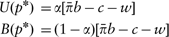
Social welfare is  The health authority and the firm share the expected social welfare according to their bargaining powers.
Notice that patients with a relatively low probability of cure obtain a negative net utility. In particular, for patients whose probability of cure is below 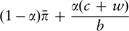 , the expected utility is smaller than the price. In terms of efficiency, these patients should not have been treated. The remaining patients get a positive net utility, and in aggregate, net utility is positive as long as the average probability of cure
 is above
 , which is implicitly assumed. Notice that the firm's expected profits are also positive.
2.2 The risk-sharing policy
Let us now suppose that the health authority considers a reimbursement policy where the firm is paid per cured patient. In this case, there are a monitoring cost m and an administrative cost c. In addition, we allow the health authority to choose the eligible patients to be treated. In other words, physicians can only treat to those patients whose probability of cure is equal or above the threshold fixed by the health authority. Implicitly, it is assumed that physicians follow the prescription guidelines. Given the threshold value π for the probability of cure, the health authority and the firm choose the price that solves the Nash bargaining problem.

In this case, the treated patients are those with a probability of cure above π. The expected utility of each patient is πb, but the health authority pays the price p with probability π, the monitoring cost m and the administrative cost c. Firm's expected revenues per patient are πp − w.
The first-order condition of problem (4) is given by:

Thus, the optimal price as a function of π is

From (5), we can analyse the behaviour of the optimal price with respect to π. Differencing with respect to π yields:

The effect in the optimal price of a change in the threshold value for the probability of cure depends on the sign of  , which can be positive or negative.
In this case, the expected aggregate net utility is:

Now, the health authority selects the threshold value for the probability of cure that solves:

Under a reimbursement policy based on risk-sharing, less patients are treated. In this case, the aggregate expected utility is given by:

Notice that this expression is strictly positive. As before, the health authority and the firm share the expected social welfare according to their bargaining powers. The expected social welfare of the patient with probability of cure  is zero.
2.3 The best policy
The health authority compares the expected aggregate net utility under both reimbursement policies and chooses the policy with the highest expected net utility. From (3) and (6), we have:
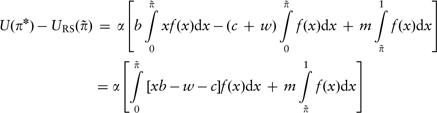
The first element in this expression measures the expected social welfare enjoyed by the patients left untreated if the risk-sharing policy were adopted. The second element measures the total monitoring costs for the patients treated under the risk-sharing policy. The sign of this expression can be positive or negative. It depends on the characteristics of the distribution of π and the parameters of the problem. Under the no risk-sharing policy, there are patients that should not have been treated as their net utility is negative. Under the risk-sharing policy, less patients are treated and there are also monitoring costs. The decision hinges upon the relative importance of these elements. The lower the monitoring costs, the more likely the risk-sharing policy is preferred. A necessary condition for the risk-sharing agreement to be preferred is that the patients left untreated under this policy enjoy a negative expected social welfare. Otherwise, a no risk-sharing agreement will be chosen by the health authority.
Remark: This ambiguous result rests upon the expected social welfare enjoyed by the patients that would remain untreated if a reimbursement policy based on risk-sharing were used. The way we have modelled the behaviour of all the involved parties implies that this expected social welfare may be negative, and so a risk-sharing policy might be preferred. However, if we allow the health authority to set also the clinical guidelines for the no-risk-sharing policy, the ambiguity is no longer present. In this case, the expected social welfare enjoyed by the excluded patients would be strictly positive, and the no-risk-sharing policy would always be preferred. A proof of this result is available upon request.
3 Discussion
The analytical framework that we have developed allows to determine the conditions under which a risk-sharing agreement may be offered by the health authority to a pharmaceutical firm under uncertainty regarding the effectiveness of a drug. The model highlights the relevant variables that should be taken into account when a decision on reimbursement must be adopted. Intuitively, health authorities should pay attention to the well-being of the treated patients and how costly is to achieve it. Patient's welfare depends on the effectiveness of the drug and on personal characteristics. Although there would not be uncertainty on the effectiveness of the drug on average, still there would be uncertainty derived from the specific characteristics of the patients. We have modelled such uncertainty with a random variable representing the probability of cure. We think it is a simple way to incorporate uncertainty into the model, while, at the same time, it captures the type of uncertainty faced by health authorities and firms.
In real world, the effectiveness in clinical practice differs from the efficacy found in the clinical trial. What is known before considering reimbursement policies is either the efficacy rate from the clinical trial if the drug has not been yet authorised, or effectiveness in real clinical practice if the drug has been prescribed for a while. In both situations, uncertainty remains. In the first case, it is unknown how the drug will perform in real clinical practice. In the second case, the drug will be administered to a different population of patients and its effectiveness may differ from the previous one. For each patient, we have a probability distribution for the probability of cure. When the disease has different levels of severity, we may have a probability distribution defined over the levels of severity. For the sake of simplicity, we have assumed that the treatment either cures or fails. A richer and more realistic model should have considered that the treatment has a gradual impact on the disease, and that although the patient is not completely cured, her level of disease may be reduced. There is always a trade-off between reality and analytical tractability. We have opted for a simple analysis to obtain some general insights that can be useful to adopt decisions on reimbursement policies for specific drugs.
To keep the model simple, we have assumed an equal benefit from treatment for all patients. Introducing different benefits does not add much to the model, and, qualitatively speaking, the results hold. The same applies to monitoring and administrative costs.
We have modelled the interaction between the health authority and the firm to set the price as a negotiation allowing different bargaining power for both parties. This has been motivated by the casual observation that in real world, both parties bargain over the price. Depending on the specific drug and on the population of patients, bargaining power may differ across parties.
Alternatively, we could have modelled the interaction between the health authority and the pharmaceutical firm in a dynamic way that continuously updates the parameters of the model with new information. This relates to the value of information literature that deals with the value of complete information in a context of uncertainty (i.e. by expending more resources in getting more precise information on a given issue, the uncertainty is reduced and firms and health authorities could improve their decisions). The value of information analysis as the Access with Evidence Development approach do not eliminate all uncertainty but rather help managing those situations under uncertainty and assess the value of gathering new information. Hence, a decision under uncertainty must be made no matter whether the value of information analysis is carried out or not. In that sense, a static approach such us the one followed in our model would still be adequate to frame decisions processes taken under uncertainty. Notice that under a risk-sharing agreement the payments are fixed ex-ante and are contingent on information that will be learnt ex-post. The value of information analysis consists of collecting ex-ante information and then set the payments based on that information.
In our framework, the value of information approach would require either a delay of the decision until new and more accurate information were obtained or to fix price and reimbursement conditions – for an initial period – and simultaneously to request the firm to run a post-authorisation observational trial so that new and real world information on the effectiveness and safety of the drug could be used in a renegotiation of the initial conditions. As it is known, these trials do not impose any restrictions on the prescription of the drugs to the patients and the reimbursement is maintained regardless of the sales volume. Only, a clinical register of the patients is required for assessing the health outcomes during the observational period. This is becoming a current practice in France for some new compounds and more recently in Spain. However, this way of dealing with uncertainty is different from a risk-sharing strategy because payments are not contingent upon health outcomes – at least in the first period during the observational trial. Hence again, our static model captures adequately how the risk is shared between the health authority and the firm during the first period and it could potentially be extended to more periods by updating the parameters based on the new health information learnt at the end of that first period.
Our results are intuitively sound. There are two forces pulling in different directions. On the one hand, the no risk-sharing agreement saves monitoring costs, but too many patients are treated, and for some of the them, the expected benefits from treatment are lower than treatment costs. On the other hand, the risk-sharing agreement incurs the monitoring costs but less patients are treated. For all the treated patients, the expected benefits net of treatment costs are non-negative. The optimal decision depends on the relative importance of both the costs imposed by the patients that should not have been treated in the non-risk-sharing agreement and the monitoring costs in the risk-sharing agreement. We believe that the principle that emerges from the model has a general applicability.
Our model pursues to illustrate the relevant variables that should be taken into account in the relationship between health authorities and a pharmaceutical firm to design a risk-sharing agreement based on health outcomes. As a theoretical model, it does not pretend to fully describe all specific situations related to any drug. We are aware that maybe, for a particular drug a different approach could also be followed.
Our model intends to be a contribution to the stream of theoretical literature dealing with risk-sharing agreements. As it was mentioned in the introduction, this literature is scarce. The works by Lilico (Reference Lilico2003) and Zaric and O'Brien (Reference Zaric and O'Brien2005) approached this type of contracts in a different way and their results are not comparable to ours. Our model is based on Pita Barros (Reference Pita Barros2007) but it differs in the way the price is determined. In Pita Barros (Reference Pita Barros2007), the price was chosen by the firm (while in our model the price is set through a negotiation between the health authority and the firm). In addition, in his analysis, the price does not change across reimbursement policies. We believe more realistic to allow the price to be different when the reimbursement policy changes. Both approaches, Pita's and ours, end up with ambiguity regarding the optimal policy. In real practice, even though there are several experiences with this type of risk-sharing agreements there is not yet a clear conclusion about the efficiency of using this way of handling uncertainty. As Towse and Garrison (Reference Towse and Garrison2010) highlight, due to the lack of empirical evidence on the success of these agreements, it is still early to conclude whether these arrangements will become in the future a trend or a fad. The lesson to be learned is that one must be careful when designing this kind of contracts because social welfare can be lower if a wrong decision is adopted.
4 Conclusions
In this paper, we have developed a stylised model to describe the relationship between the health authority and a pharmaceutical firm when there is uncertainty about the real efficacy of the drug manufactured by the firm. We have considered two types of contracts differing on the way the firm is reimbursed. Under a reimbursement policy based on risk-sharing less patients are treated than with an agreement based on payments per treated patients. The optimal contract depends on the trade-off between the monitoring costs, the production costs and the expected utility derived from treatment. A non-risk-sharing agreement will be preferred by the health authority when patients that should not be treated impose a relatively low cost to the health system. When this cost is high, the health authority would prefer a risk-sharing agreement for relatively low monitoring costs.
Under the no risk-sharing policy, there are patients with a low probability of cure that should not have been treated as their net utility is negative. As the model showed, a necessary condition for the risk-sharing agreement to be preferred is that the patients left untreated under this policy enjoy a negative net expected utility. Otherwise, a no risk-sharing agreement will be chosen by the health authority.
Under a reimbursement policy based on risk-sharing all treated patients obtain a non-negative net utility. The key issue of this agreement is the selection of the threshold of the probability of cure, which is based not only on the marginal production costs and the utility obtained by the patients but significantly on the monitoring and administrative costs. Under both reimbursement policies the health authority and the firm share the expected social welfare according to their bargaining powers.
In a static framework, monitoring costs are essential for the implementation of these contracts; notice that, as mentioned earlier, these monitoring activities would also allow to reduce initial uncertainties and to reformulate the initial agreement if a dynamic approach were adopted.
In real world, parameters needed for the implementation of risk-sharing contracts may be calculated from a field study applied to the specific disease and therapeutic area or estimated on a subjective way in absence of other possibility. The scenario of outcomes depicted in the model when real world parameters are included would help to adopt the decision on the implementation or not of the risk-sharing contract. Initially, we suggest that health authorities should select a drug where these parameters are easier to estimate and where the final health outcome is straightforwardly measured. That will ease the use of the model for obtaining an answer that would clear the way to the agreement with the firms.
Finally, we suggest that the basic model could be extended in several directions: physicians may take into consideration price drugs when prescribing, benefits from successful treatment can vary across patients, monitoring costs could be also partially borne by firms, untreated and uncured patients may have a negative utility, among others. We could also extend the model in a rather dynamic way to integrate both the value of information approach and the risk-sharing agreements. We hope to explore these issues in future research.
Acknowledgements
We greatefully acknowledge the suggestions made by two anonymous referees and the editor.


