FOCUS POINTS
• Current monoaminergic antidepressants have relevant clinical limitations, such as presence of side effects which can lead to early discontinuation, persistence of residual symptoms, low rates of remission, frequent relapses and long time for the onset of the antidepressant effect with increased suicide risk.
• There is preclinical and clinical support for glutamate involvement in the pathophysiology of depression.
• The high-affinity noncompetitive NMDA receptor antagonist Ketamine has shown rapid and consistent antidepressant and anti-suicidal effect.
Introduction
Depression is a common psychiatric condition characterized by affective, cognitive, psychomotor and neurovegetative symptoms, which more frequently include depressed mood; feelings of hopelessness, guilt, and worthlessness; irritability; restlessness; fatigue and decreased energy; anxious or empty feelings; difficulty concentrating and making decisions; alterations of sleep and appetite; and persistent aches, pains, and headaches. These symptoms interfere with a person's ability to work, study, deal with interpersonal relationships, and enjoy once-pleasurable activities.
New-generation antidepressants, and in particular selective serotonin (5-HT) reuptake inhibitors (SSRIs) and 5-HT norepinephrine (NE) reuptake inhibitors (SNRIs), are currently considered the first line pharmacological agents for the treatment of depression and are preferred to the older antidepressants.Reference Davidson1, Reference Gelenberg2 Although the introduction of SSRIs and SNRIs has allowed us to improve the quality of life of depressed patients, especially in terms of side effects and tolerability, there are still relevant clinical limitations. Future-generation antidepressants should lack the side effects that more commonly lead to discontinuation, e.g., sexual dysfunctions and weight gain, and they should also have a faster onset of action, especially to avoid early discontinuations due to lack of efficacy and to more promptly reduce the risk of suicide.Reference Stahl3 Further, a subset of depressed patients does not respond to the available antidepressants or relapses after the initial response or remission, even if the drug is continued. In fact, although the treatment of depression has consistently improved during the last three decades, the prognosis of the disorder is far from being satisfactory, and depression remains one of the major causes of morbidity and disability worldwide.Reference Kessler, Berglund and Demler4, 5
A number of strategies have been proposed recently in order to treat depressed patients who do not adequately respond to the standard treatment protocols, including augmentation or combination with lithium or atypical antipsychotics, combination of two antidepressants with different pharmacological actions, electroconvulsive therapy, transcranial magnetic stimulation, and deep brain stimulation. However, in some cases the results are promising, and in others they are disappointing.Reference Vieta and Colom6
In parallel to the aforementioned novel treatment strategies, new lines of pharmacological research have been developed in order to discover novel antidepressant agents. For years, the only pharmacodynamic mechanisms that have been explored in the search of new antidepressants were those related to the 3 monoamines: 5-HT, NE, and dopamine (DA).Reference Kintscher7 However, given the difficulties in finding strong evidence to support the postulated depression-related monoamine alterations, the focus of research moved from monoamines toward other molecular mechanisms, including glutamate (Glu) and melatonin neurotransmission, neuropeptide system (substance P, corticotrophin-releasing factor, neuropeptide Y, vasopressin and oxytocin, galanin, and melanin-concentrating hormone), glucocorticoids, opioid and cannabinoid receptors, and inflammatory and neurodegenerative pathways, as well as the intracellular processes involved in the signal transduction cascades.Reference Catena-Dell'Osso, Marazziti, Rotella and Bellantuono8–Reference Marazziti and Catena-Dell'Osso12
Among these new approaches, research on the Glu system, which is involved in several central nervous system (CNS) physiologic functions, including cognition, memory and learning, and in the modulation of neurogenesis and neurodegeneration, has led to the development of novel compounds that have been evaluated in both preclinical and clinical studies with different results.Reference Coyle, Leski and Morrison13, Reference Zarate, Machado-Vieira and Henter14 N-Methyl-D-aspartate (NMDA) antagonists, for example, which are thought to be neuroprotective through the inhibition of voltage-gated cation channels and through the subsequent decrease of neurotransmitter release enhancing astrocyte uptake of extracellular Glu, seem to be very promising. Unfortunately, although the NMDA receptor antagonists have shown rapid and consistent antidepressant action, the presence of relevant psychomimetic side effects limits their use.Reference Preskorn, Baker and Kolluri15 This narrative review aims to provide a comprehensive overview of the current knowledge on the relationships between the Glu system and mood disorders with a particular focus on preclinical and clinical implications. MEDLINE and PubMed databases were searched for English language articles using the keywords glutamate (Glu), antidepressants, depression, N-Methyl-D-aspartate (NMDA) antagonists, riluzole, and ketamine.
Glutamate Synthesis and Localization
The most abundant neurotransmitters in the CNS are two amino acids: Glu, which is the major excitatory neurotransmitter in the mammalian brain, and gamma-aminobutyric acid, which serves as the principle neurotransmitter for inhibitory transmission.Reference Coyle, Leski and Morrison13 In the human brain, Glu is ubiquitous and is present at levels of 8–10 mmol/kg of brain tissue. Glu neurons project within the cortex and to subcortical regions, such as locus coeruleus, raphe nucleus, and substantia nigra, where they modulate monoaminergic systems. The Glu system is involved in several physiologic functions, including memory, learning and other cognitive tasks, modulation of neurogenesis/neurodegeneration, and induction of neuronal plasticity.Reference Coyle, Leski and Morrison13
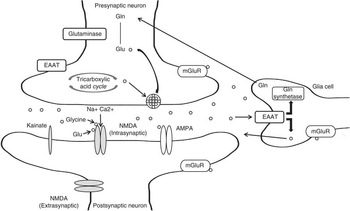
Glu acts through the so-called tripartite glutamatergic synapse—an integrated neuronal-glial synapse that allows pre- and postsynaptic neurons and glia to interact with each other (Figure 1).Reference Machado-Vieira, Manji and Zarate16 In particular, upon depolarization of the presynaptic neuron, vesicular Glu is released in a calcium-dependent manner into the synaptic cleft where it can bind to its receptors. Glu is removed from the extracellular space by excitatory amino acid transmembrane transporters (EAATs), which are located on glial cells and are responsible for protecting neurons from the detrimental effects of excessive synaptic levels of Glu. Within glial cells, Glu is recycled through a Glu/glutamine (Gln) metabolic cycle by the enzyme Gln synthetase into Gln, which, in turn, is transferred to the presynaptic neurons. Here, Gln is converted back into Glu and packaged into the presynaptic vesicles. In fact, within neurons, there are two primary kinds of Glu production: synthesis ex novo from glucose through transamination of the tricarboxylic acid cycle intermediate alpha-oxoglutatrate, and the conversion of Gln into Glu by glutaminase located in neuronal mitochondria (Figure 1).
Glutamatergic synapse. Glu: Glutamate; Gln: glutamine; mGluR: metabotropic glutamate receptor; EAAT: excitatory amino acid transporter; NMDA: Nmethyl-D-aspartate; AMPA: α-amino-3-hydroxy-5-methyl-isoxazole-4-propionic acid; Na+: sodium; Ca2+: calcium ion.

Glutamate Receptors
Glu can bind two different kinds of receptors: ionotropic and metabotropic. Ionotropic receptors, which include α-amino-3-hydroxyl-5-methyl-4-isoxazole-propionate (AMPA), NMDA, and kainate receptors, are ligand-gated, nonselective cation channels that allow the flow of K+, Na+, and Ca2+. The NMDA receptors play an important role in memory formation and neuroprotection. In particular, those located in the synapse modulate synaptic efficacy and promote pro-survival events, whereas the extrasynaptic NMDA receptors are coupled to cell death pathways.Reference Manev, Favaron, Guidotti and Costa17, Reference Markowitz, White, Kolson and Jordan-Sciutto18 Under physiological conditions, Glu activates synaptic NMDA and AMPA receptors, with subsequent activation of intracellular signal transduction, which involves trophic downstream effectors, such as cyclic adenosine monophosphate response element-binding protein (CREB) and brain-derived neurotrophic factor (BDNF), and preserves neuronal viability. On the contrary, when Glu is overproduced, the activation of extrasynaptic NMDA receptors antagonizes the activated pathway by the synaptic receptors, and inhibits CREB and BDNF. The overstimulation of NMDA receptors leads to neurodegeneration through a process called excitotoxicity. In fact, in the presence of excessive levels of Glu, the overactivation of NMDA receptors, including the extrasynaptic ones, causes an excessive influx of Ca2+ into the postsynaptic neuron.Reference Dubinsky19 The excessive cytosolic Ca2+ concentrations, in turn, activate a number of cellular degradation processes, including proteases, lipases, nitric oxide synthase, and other enzymes that lead to cell death.Reference Hardingham and Bading20 Excitotoxicity triggered by overstimulation of glutamate receptors also contributes to intracellular oxidative and nitrosative stress.Reference Vanhoutte and Bading21
Metabotropic Glu receptors (mGluR), which belong to the family of G protein-coupled receptors, are divided into three groups, with a total of eight subtypes. These receptors indirectly activate ion channels on the plasma membrane and can both increase or decrease the excitability of the postsynaptic neurons. In particular, group II mGluRs, which are present in pre- and postsynaptic neurons, are able to decrease NMDA receptor activity and the risk of cellular excitotoxicity.
Evidence Linking the Glutamate System to Mood Disorders
Since its identification as a neurotransmitter in 1959, Glu has been hypothesized to be involved in the pathophysiology of a number of neurological disorders, including epilepsy, stroke, Alzheimer's disease, amyotrophic lateral sclerosis, and Huntington's disease.Reference Javitt and Zukin22 More recently, it has been suggested that alterations of Glu homeostasis may induce a generalized brain dysfunction that underlies various psychiatric conditions, including mood disorders.Reference Machado-Vieira, Salvadore, Ibrahim, Diaz-Granados and Zarate23 The involvement of Glu in the pathophysiology of mood disorders was first hypothesized after the early reports describing the action of antidepressants on Glu receptors and the presence of elevated Glu concentrations in serum, plasma, and cerebrospinal fluid from patients with major depressive disorder (MDD).Reference Kim, Schmid-Burgk, Claus and Kornhuber24–Reference Mitani, Shirayama and Yamada28 However, other authors reported decreased Glu levels in cerebrospinal fluid of MDD subjects, or did not find alterations in the baseline Glu levels.Reference Frye, Tsai, Huggins, Coyle and Post29–Reference Maes, Verkerk, Vandoolaeghe, Lin and Scharpe31 Controversial data have also come from neuroimaging studies, which have observed complex and regional differences in Glu neurotransmission. In fact, while increased Glu levels have been reported in the occipital cortex of 29 medication-free MDD patients,Reference Sanacora, Gueorguieva and Epperson32 decreased Glu levels in the anterior cingulate cortex of MDD patients were reported as well.Reference Auer, Putz and Kraft33–Reference Hasler, van der Veen and Tumonis35 It seems that the MDD-related dysfunctions of Glu neurotransmission are more complex than the simplistic view of increase or decrease of the overall activity of the system.
Recent data from postmortem studies have supported the hypothesis that mood disorders are characterized by altered Glu receptor expression.Reference Zarate, Du and Quiroz36 In fact, increased Glu levels and decreased mGluR2 or mGluR3 receptor levels have been observed in the prefrontal cortex of MDD patients,Reference Scarr, Pavey, Sundram, MacKinnon and Dean37, Reference Hashimoto, Sawa and Iyo38 and in the dorsolateral prefrontal cortex (DLPFC) of bipolar patients.Reference Beneyto and Meador-Woodruff39 The glycine binding site, measured with [3H]CGP-39653, was found to be reduced in suicide victims.Reference Nowak, Ordway and Paul40 Similarly, a significant decrease in the NMDA receptor density was reported in both bipolar and unipolar depression.Reference Nudmamud-Thanoi and Reynolds41, Reference McCullumsmith, Kristiansen and Beneyto42 In particular, it seems that overstimulation with upregulation of the NMDA NR2A receptor subtype could play a relevant role in the pathophysiology of MDD.Reference Boyce-Rustay and Holmes43, Reference Sanacora, Zarate, Krystal and Manji44 However, whether these alterations are primary disturbances, epiphenomena, or consequences of the presence of the disorder remains to be clarified.
Other postmortem studies have shown decreased expression of Glu transporters EAAT1 and EAAT2 and of Glu synthetase in the frontal areas of MDD patients.Reference Choudary, Molnar and Evans45, Reference Valentine and Sanacora46 Similarly, decreased levels of EAAT3, EAAT4, and mRNA expression have been described in the striatum of patients with mood disorders.Reference McCullumsmith and Meador-Woodruff47 Cortical glial cell loss and reduced glial density have been well-documented in patients with mood disorders.Reference Rajkowska and Miguel-Hidalgo48 The impairment of glial cell activity can lead to increased Glu system activation and neural toxicity, especially at extrasynaptic sites.Reference Soriano and Hardingham49 The excessive levels of extracellular Glu may trigger excitotoxicity processes and neurodegeneration; under conditions of Glu spillover, the activation of extrasynaptic group II mGlu receptors pathologically dampens the stimulated presynaptic release of Glu. The decreased synaptic availability of Glu, in turn, will cause lowered CREB activity and BDNF expression, with subsequent decrease of neuroplasticity and cellular resilience.Reference Hardingham and Bading20, Reference Hardingham50
Glutamate Receptor Ligands in the Treatment of Unipolar and Bipolar Depression
The involvement of the Glu system in the pathophysiology of mood disorders is also supported by preclinical and clinical evidence that has demonstrated that Glu receptor ligands have consistent and rapid antidepressant effects.Reference Machado-Vieira, Salvadore, Ibrahim, Diaz-Granados and Zarate23
Preclinical studies
Compounds that primarily impact Glu receptors such as NMDA receptor antagonists, mGlu receptor agonists and antagonists, and positive modulators of AMPA receptors have demonstrated antidepressant properties, with a potential common trophic downstream mechanism of action.Reference Zarate, Du and Quiroz36, Reference Paul and Skolnick51, Reference Owen52
NMDA receptor antagonists are a class of anesthetics that bind and inhibit the NMDA receptors, and that are used as inductors of dissociative anesthesia for animals and, less commonly, for humans. They have been classified into four categories: competitive antagonists, which block the binding site of the neurotransmitter Glu; glycine antagonists, which block the glycine site; noncompetitive antagonists, which inhibit NMDA receptors by binding to allosteric sites; and uncompetitive antagonists, which block the ion channel by binding to a site within it. NMDA receptor antagonists have shown antidepressant-like effects in animal models of depression, such as chronic mild stress, learned helplessness, footshock-induced aggression, and olfactory bulbectomy.Reference Paul and Skolnick51 Although, in rodents, NMDA receptor antagonists have been found to cause neurotoxicity and brain damage (Olney lesions), such damage has never been reported in primates such as humans.Reference Olney, Labruyere and Price53
In rats exposed to chronic mild stress, memantine, a low-affinity NMDA receptor antagonist, was reported to reverse anhedonia and increase adrenal gland weight, corticosterone levels, and BDNF protein concentrations in the prefrontal cortex.Reference Réus, Abelaira and Stringari54 In forced-swimming and open-field tests, both memantine and imipramine significantly reduced immobility time of rats, as compared to the control group, without affecting locomotor activity.Reference Réus, Stringari and Kirsch55
Other preclinical studies using animal models of depression involved ketamine, a high-affinity, noncompetitive NMDA receptor antagonist. In rats exposed to chronic mild stress, treatment with ketamine reversed anhedonia-like behavior and increased adrenal gland weight, promoted regain of body weight, and normalized corticosterone and adreno cortico tropic hormone (ACTH) levels.Reference Garcia, Comim and Valvassori56 In addition, acute administration of ketamine and imipramine were compared in forced-swimming and open-field tests. Both ketamine and imipramine reduced immobility time, as compared to the control group, without affecting locomotor activity.Reference Garcia, Comim and Valvassori57 In another study, the co-administration of imipramine with ketamine was found to induce a more pronounced antidepressant effect than treatment with each antidepressant alone. In addition, ketamine induced stronger increases of CREB and BDNF protein levels in the prefrontal cortex, hippocampus, and amygdala, and a greater PKA and PKC phosphorylation in the hippocampus, amygdala, and prefrontal cortex.Reference Réus, Stringari and Ribeiro58 The acute administration of ketamine at a high dose, but not imipramine, was found to increase BDNF levels in the rat hippocampus, which is considered crucial for the rapid onset of the antidepressant action induced by ketamine.Reference Garcia, Comim and Valvassori57 Other studies seem to show that the effect of ketamine is dependent on the activation of the BDNF/TrkB signaling pathway.Reference Monteggia, Gideons and Kavalali59 In particular, the fast antidepressant action of ketamine requires a rapid protein translation, which is the crucial step preceding the increase of dendritic BDNF levels. The eukaryotic elongation factor 2 kinase (eEF2K), a Ca2+/calmodulin–dependent serine/threonine kinase that phosphorylates eEF2 and modulates protein translation, has been proposed as the main molecular substrate involved in the rapid antidepressant effect of ketamine. In fact, the inhibition of NMDA receptors induced by ketamine leads to inhibition of eEF2 kinase and consequent dephosphorylation of eEF2 and increase of BDNF synthesis.Reference Monteggia, Gideons and Kavalali59
As far as mGlu receptors ligands are concerned, there is evidence that mGlu receptor agonists have anxiolytic, antidepressant-like, and neuroprotective properties in animal models of depression.Reference Palucha, Tatarczynska and Branski60, Reference Li, Need, Baez and Witkin61 Interesting results have also come from the research on group II mGlu receptor antagonists. In particular, MGS0039 was effective in the learned helplessness model of depression and led to enhanced hippocampal proliferation in mice.Reference Yoshimizu, Shimazaki, Ito and Chaki62, Reference Yoshimizu and Chaki63 In addition, LY341495, another group II mGlu receptor antagonist, was found to have antidepressant-like effects in a rat forced-swim test and in a mouse tail-suspension test.Reference Chaki, Yoshikawa and Hirota64 Interestingly, the antidepressant-like effect of LY341495, as in the case of ketamine, seems to be related to the activation of the BDNF/TrkB signaling pathway. In fact, pretreatment with K252a, a TrkB tyrosine kinase inhibitor, was found to block the sustained (more than 24 hours) antidepressant-like effect of LY341495.Reference Koike, Fukumoto, Iijima and Chaki65
AMPA receptor-positive modulators are a novel class of drugs that includes a number of compounds, such as CX-516, cyclothiazide, piracetam, aniracetam, and LY392098. They do not activate AMPA receptors themselves, but decrease the rate of receptor desensitization and deactivation in the presence of an agonist.Reference Black66, Reference Bleakman and Lodge67 These compounds have demonstrated antidepressant-like effects, either in monotherapy or as adjunctive treatment, in animal models of depression, including exposure to inescapable stressors, the forced-swim test, the tail-suspension/induced-immobility test, and learned helplessness models.Reference Zarate, Singh and Manji68
Clinical studies
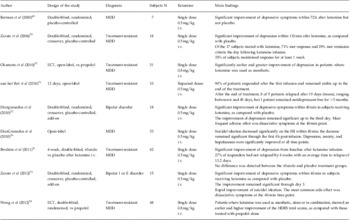
In humans, ketamine has shown consistent and rapid, although transient, antidepressant effect after a single intravenous injection (0.5 mg/Kg) in two placebo-controlled studies carried out in MDD patients (Table 1).Reference Berman, Cappiello and Anand69, Reference Zarate, Singh and Carlson70 In fact, the antidepressant effect occurred within 110 minutes after injection and lasted for about 1 week.Reference Zarate, Singh and Carlson70 Euphoria and psychotomimetic side effects were observed acutely, but were temporally distinct from the improvement of depressive symptoms, which persisted for 1 week. In another study, carried out in 10 treatment-resistant MDD patients who received between 1 and 6 injections of ketamine over a 12-day period, the response criterion [a decrease of 50% or more from the baseline total score of the Montgomery-Asberg Depression Rating Scale (MADRS)] was met by 90% of patients after the first infusion, and it remained stable up to the end of the treatment.Reference aan het Rot, Collins and Murrough71 The decrease of MADRS scores after the last ketamine infusion was of 85%. After the end of the treatment, 8 of 9 patients relapsed after 19 days (mean), ranging between 6 and 45 days, but 1 patient remained antidepressant-free for >3 months.
Summary of open-label and randomized-controlled trials on the efficacy of ketamine in the treatment of depression

MDD: Major Depressive Disorder; i.v.: intravenous; ECT: electroconvulsive therapy; HDRS: Hamilton Depression Rating Scale; SSI: Scale for Suicide Ideation.
In addition, there is evidence that ketamine can be useful in the treatment of bipolar depression (Table 1).Reference Diazgranados, Ibrahim and Brutsche72–Reference Cusin, Hilton, Nierenberg and Fava75 In a randomized, placebo-controlled, double-blind, crossover, add-on study, 18 treatment-resistant, bipolar depressed patients treated with mood stabilizers received an intravenous infusion of either ketamine or placebo; depressive symptoms significantly improved in subjects who received ketamine, as compared with placebo, and the improvement of depression, which occurred within 40 minutes from the intravenous infusion of ketamine, remained significant up to the third day.Reference Diazgranados, Ibrahim and Brutsche72 Ketamine was generally well tolerated; the most frequent adverse effect was dissociative symptoms at the 40-minute point. This result was replicated by subsequent work of the same group of researchers, which involved 15 bipolar I or II depressed patients treated with mood stabilizers. A single intravenous infusion of ketamine led to a rapid (within 40 minutes) and robust improvement of depressive symptoms, which was also accompanied by the resolution of suicidal ideation.Reference Zarate, Brutsche and Ibrahim73 Similarly, in another study, which was carried out in 33 MDD patients, a single ketamine infusion was able to dramatically reduce suicidal ideation within 40 minutes, and the improvement lasted for up to 4 hours post-infusion.Reference DiazGranados, Ibrahim and Brutsche76 In a more recent study, 25 bipolar depressed subjects taking mood stabilizing drugs were treated with a single ketamine infusion. More than 50% of subjects responded to treatment, and about 50% achieved remission after 14 days. These data support the potential of ketamine infusion as add-on therapy to mood stabilizers in bipolar depression resistant to current antidepressants.Reference Rybakowski, Permoda-Osip, Skibinska, Adamski and Bartkowska-Sniatkowska74 In addition, a report has recently been conducted on two patients with bipolar II disorder who responded to intramuscular (i.m.) ketamine augmentation.Reference Cusin, Hilton, Nierenberg and Fava75 The first patient was treated with 50 mg i.m. every 4 days for 5 months until she relapsed; then, the dose was increased to 70 mg every 4 days, and she remained asymptomatic for another 4 months. Similarly, the second patient showed a long-term good response to i.m. ketamine, which remained effective for several months and was well tolerated; the main adverse effects were moderate anxiety, irritability, dissociative feelings, and headache.
Other data supporting the antidepressant properties of ketamine come from research regarding electroconvulsive therapy (ECT) (Table 1). In one study, 31 inpatients with treatment-resistant MDD were assigned to receive propofol or ketamine as anesthetic and underwent 8 ECT sessions. The Hamilton Depression Rating Scale (HDRS) scores, which were evaluated before ECT and after the second, fourth, sixth, and eighth ECT sessions, improved significantly earlier in the ketamine group, which suggests the possible contribution of ketamine in the resolution of depression.Reference Okamoto, Nakai and Sakamoto77 In a more recent ECT study, 48 MDD patients were randomly divided into 3 groups: a propofol group, a ketamine group, and a propofol plus ketamine group. Patients treated with ketamine, alone or in combination, showed an earlier and higher improvement of the HDRS total scores, as compared with those treated with propofol alone.Reference Wang, Chen and Zhou78 In addition, in 30 patients with treatment-resistant MDD, a significant positive correlation was found between the baseline pattern of slow wave activity of the first two non-REM episodes (as revealed by the delta sleep ratio) and the improvement of depression after a single open-label infusion of ketamine.Reference Duncan, Selter, Brutsche, Sarasso and Zarate79
Among the other NMDA receptor antagonists, the low-affinity noncompetitive memantine (oral dose) did not show any antidepressant effect.Reference Zarate, Singh and Quiroz80 In fact, it seems that the extent of the affinity for NMDA receptors, as well as the method of administration, are fundamental for the antidepressant action of NMDA antagonists.
Riluzole (2-amino-6-trifluoromethoxy benzothiazole) is a neuroprotective drug that is the only FDA-approved medication for amyotrophic lateral sclerosis. In open-label studies, riluzole has shown antidepressant efficacy in patients with treatment-resistant MDDReference Zarate, Payne and Quiroz81, Reference Sanacora, Kendell and Levin82 and bipolar depression.Reference Zarate, Payne and Singh83, Reference Zarate, Quiroz and Singh84 More recently, among 26 drug-free MDD patients who received a single ketamine injection, 17 (65%) met the response criteria (50% reduction from baseline on the MADRS) after 24 hours and 14 patients (54%) met the response criteria after 72 hours. These latter patients were enrolled in a 32-day, randomized, double-blind, placebo-controlled, flexible-dose continuation trial of riluzole (100–200 mg/d). Unfortunately, no significant differences in the time-to-relapse between riluzole and placebo groups were detected.Reference Mathew, Murrough, aan het Rot, Collins, Reich and Charney85
Conclusion
The pharmacological treatment of MDD is far from being satisfactory, and its optimization remains one of the major challenges worldwide for researchers in the field of psychopharmacology. Current monoaminergic antidepressants have relevant clinical limitations, including the presence of side effects that can lead to early discontinuation, persistence of residual symptoms, low rates of remission, frequent relapses, and long time for the onset of the antidepressant effect with increased suicide risk.
Glu is the major excitatory neurotransmitter in the mammalian brain, where it is involved in several physiologic functions, including cognition, memory, and learning, and in the modulation of neurogenesis and neurodegeneration. While Glu system abnormalities have been found in mood disorders, a number of compounds acting at this level, including NMDA receptor antagonists, mGlu receptor agonists and antagonists, and positive modulators of AMPA receptors, have been produced and tested in animals and in humans.
The high-affinity noncompetitive NMDA receptor antagonist ketamine, which has shown rapid and consistent antidepressant action with a good tolerability profile in both preclinical and clinical studies, is the compound that showed the most promising results. The preferential blockade by ketamine of extrasynaptic NMDA receptors, which promotes excitotoxicity and decreases cellular resilience, may account for its neuroprotective and antidepressant action.Reference Duman and Aghajanian86 However, several factors need to be considered in interpreting the clinical data on the use of NMDA receptor antagonists, in particular ketamine, in the treatment of unipolar and bipolar depression. Although there are several case reportsReference Cusin, Hilton, Nierenberg and Fava75, Reference Liebrenz, Stohler and Borgeat87, Reference Messer, Haller, Larson, Pattison-Crisostomo and Gessert88 and some open-label studies,Reference aan het Rot, Collins and Murrough71, Reference DiazGranados, Ibrahim and Brutsche76, Reference Okamoto, Nakai and Sakamoto77 the number of double-blind, randomized, placebo-controlled trials (Table 1) is scarce and presents several limitations. First, the sample sizes of most of these studies, which are relatively small, limited the statistical power of the analyses and the strength of the results. Second, the transitory dissociative disturbances developed by patients treated with ketamine may have compromised the study blinding, potentially confounding the results. Future studies should take into account the difficulty in maintaining the study blinding, and both raters and patients should be evaluated in order to clarify the strength of the blinding. Another factor that needs to be considered is that the patients involved in these studies are usually affected by treatment-resistant mood disorders, and the results may not be generalizable to patients with different forms of depression.
Overall, the clinical data on the effectiveness of ketamine in the treatment of unipolar and bipolar depression are promising. A single dose (0.5 mg/Kg i.v.) of ketamine seems to produce a rapid and consistent antidepressant and anti-suicidal effect that has not been reported with the current antidepressant. However, the length of mood improvement after a single dose of ketamine remains to be clarified, as well as the efficacy and tolerability of repeated administrations for the long-term maintenance of recurrent unipolar and bipolar depression. Further double-blind, randomized, placebo-controlled/active comparator studies, involving larger samples of patients possibly in long-term treatment, are needed to better understand the real clinical potential of ketamine and the other NMDA receptor antagonists in the treatment of mood disorders.
In addition, given their acute psychotomimetic side effects, selective subtype NMDA receptor antagonists, such as those binding the NR2B receptor subtype, deserve to be investigated.Reference Zarate, Charney and Manji89 The NR2B receptor antagonist Ro 25-6981, for example, showed antidepressant-like properties in the forced swim test with good tolerability.Reference Maeng, Zarate and Du90 From a safety perspective, this compound has not been associated with brain damage (vacuolization) in rodents, in contrast to the reversible vacuolization at high doses observed with other NMDA receptor antagonists, such as ketamine and dizocilpine.Reference Olney, Labruyere and Price53
Finally, preclinical neurobiological data demonstrated that the rapidity of the antidepressant action of ketamine may be linked to the activation of the BDNF/TrkB signaling pathway with subsequent increase of BDNF levels in the hippocampus.Reference Monteggia, Gideons and Kavalali59 In particular, a rapid protein translation, which results in the increase of hippocampal BDNF levels, seems to be crucial to having the fast antidepressant action. The main molecular substrate involved in this effect is the eEF2K, which phosphorylates eEF2 and modulates protein translation. This molecule, as well as other intracellular substrates involved in the BDNF/TrkB signaling pathway and in the physiology of the tripartite Glu synapse, may provide molecular targets for the development of novel fast-action antidepressants.