Introduction
On 7 October 2010, Greenpeace activists climbed flag poles in front of the European Parliament (EP) and raised banners that read ‘Nuclear waste, no solution’.Footnote 1 In addition, dozens of volunteers handcuffed themselves and blocked the passage of Members of the European Parliament (MEPs). The demonstration was widely discussed in the newspapers and intended to influence the European Commission’s (EC) proposal for a directive on the management of radioactive waste [COM(2010)618]. Meanwhile, the European Atomic Forum (FORATOM), the organization representing the European nuclear industry, was lobbying on the same issue. While Greenpeace relied on protest activities in addition to its private meetings with European Union (EU) officials, FORATOM refrained from a visible public campaign and almost exclusively relied on direct contact with policymakers.
The case of Greenpeace and FORATOM illustrates two distinct advocacy strategies (Kollman, Reference Kollman1998; Beyers, Reference Beyers2004; Binderkrantz, Reference Binderkrantz2005; Hanegraaff et al., Reference Hanegraaff, Beyers and De Bruycker2016). The first, used by Greenpeace, is outside lobbying, which comprises tactics that indirectly address policymakers through mobilizing and raising the awareness of a broader audience. Outside lobbying includes the use of public communication channels rather than direct exchanges with policymakers, and involves tactics such as contacting journalists, issuing press releases, establishing public campaigns, and organizing protest demonstrations. The second strategy, as exemplified by FORATOM, is known as inside lobbying, and involves direct exchanges with policymakers through private communication channels, such as face-to-face meetings, telephone calls, or e-mail exchanges. These forms of advocacy largely take place behind the scenes and out of view of the public.
This article seeks to clarify how the use of inside and outside lobbying affects the extent to which organized interests realize their policy goals. More specifically, we analyze under which conditions outside lobbying leads to higher or lower levels of policy success when compared to inside lobbying. Many scholars have analyzed the extent to which advocates adopt a particular strategy (Kollman, Reference Kollman1998; Binderkrantz, Reference Binderkrantz2005; Kriesi et al., Reference Kriesi, Tresch and Jochum2007; Dür and Mateo, Reference Dür and Mateo2013; Weiler and Brändli, Reference Weiler and Brändli2015; Hanegraaff et al., Reference Hanegraaff, Beyers and De Bruycker2016) or have sought to explain the varying levels of policy success (Smith, Reference Smith2000; Burstein and Linton, Reference Burstein and Linton2002; Klüver, Reference Klüver2013; Dür et al., Reference Dür, Bernhagen and Marshall2015), but few have investigated the link between advocacy strategy and policy success (exceptions include Mahoney, Reference Mahoney2007; Baumgartner et al., Reference Baumgartner, Berry, Hojnacki, Leech and Kimball2009). As a result, there is a lack of understanding of whether and how lobbying strategies affect policy outcomes.
The study of inside and outside lobbying lies at the heart of interest group politics and representation. While inside lobbying privatizes conflict and restricts its scope, outside lobbying aims at socializing conflict by publicly involving a larger audience of stakeholders. As Schattschneider (Reference Schattschneider1960: 7) articulated, ‘there has been a long-standing struggle between the conflicting tendencies toward the privatization and socialization of conflict’. Inside lobbying is widely considered to be the preferred interaction mode for lobbyists (Milbrath, Reference Milbrath1960; Culpepper, Reference Culpepper2010). In the EU in particular, known for its technocratic and complex policymaking procedures, lobbyists generally prefer direct interactions with policymakers to convey policy information (Eising, Reference Eising2007). In contrast, outside lobbying is often considered a weapon of the weak or a measure of last resort (Gais and Walker Jr., Reference Gais and Walker1991; Della Porta and Diani, Reference Della Porta and Diani1999). Nonetheless, studies on EU lobbying have demonstrated that many organized interests rely in varying degrees on outside lobbying (Beyers, Reference Beyers2004; Chalmers, Reference Chalmers2013). Thus, it is possible that outside lobbying may have become an effective strategy to influence EU policy decisions in response to the increased politicization and public scrutiny of EU policymaking (Kriesi et al., Reference Kriesi, Tresch and Jochum2007; Hooghe and Marks, Reference Hooghe and Marks2009).
This article examines if the choice of inside or outside strategies affects lobbying success. Tackling this question can provide important insights into the nature of EU interest representation. The systematic effectiveness of inside lobbying would reflect a technocratic and apolitical nature of EU policymaking. In contrast, successful outside lobbying would resonate with the notion of the EU as a political system that is receptive to public pressure. This article presumes that EU policymaking combines features of both technocratic and public responsiveness, and hypothesizes that neither inside nor outside lobbying is comparatively more successful. Indeed, we demonstrate that the success of inside and outside lobbying largely depends on two key conditions under which these strategies are implemented: compatibility with other lobbying tactics, and the characteristics of the policy issues on which a lobbyist seeks influence.
The remainder of the article is structured as follows. The first section elaborates a conceptual framework that develops and specifies these two conditions. The empirical analysis subsequently relies on an extensive media analysis and a data set of more than 200 expert interviews on 78 legislative proposals adopted by the EC between 2008 and 2010. Finally, the Results section outlines that outside lobbying can lead to policy success, especially if the lobbyist’s policy position receives popular approval within media debates and if she engages in a coalition with other organized interests.
Lobbying strategies and success
In order to analyze the success of a lobbying strategy, it is critical to first determine what success constitutes. In this article, success is defined as the extent to which the policy objectives of an interest organization are realized (Bernhagen et al., Reference Bernhagen, Dür and Marshall2014). Success is distinguished from influence through its broad scope, as success does not necessarily require the use of political resources, coordinated action, or advocacy. That is, success can also be the result of exogenous factors or even lucky coincidence (e.g., support from policymakers, economic changes, technological advancements). For example, some groups might see their goals attained through no action of their own, while others may be unsuccessful because their lobbying coincided with an exogenous event that affected outcomes in an unfavorable way (or vice versa) (Mahoney, Reference Mahoney2007; Bernhagen et al., Reference Bernhagen, Dür and Marshall2014; Dür et al., Reference Dür, Bernhagen and Marshall2015).
The existing evidence on the use of lobbying strategies does not effectively address success or influence. In some cases, lobbyists are very active, but their strategies do not substantially impact policy outcomes. Meanwhile, in other cases, lobbyists exert limited efforts to influence policy outcomes, but due in part to some external event (e.g., support from policymakers or a favorable public opinion), policy outcomes ultimately correspond well with the lobbyist’s interests. The notion of influence implies behavior, namely the mobilization of political resources (e.g., mobilizing members and constituencies, addressing the public, supplying policy information). In response to the lobbying of A, policymaker B moves the policy outcome closer to a position that corresponds better with A’s objectives (Dahl, Reference Dahl1961). As a result, the policy distance between A and B decreases. The core of interest group influence therefore lies in the combination of advocacy strategies and policy success (preferred policy outcomes), and developing a deeper insight into the relationship between strategies and success is crucial to understanding interest group influence (Mahoney, Reference Mahoney2007). In order to analyze the relation between strategies and policy success, the analysis specifically focuses on the impact of inside and outside lobbying (Kollman, Reference Kollman1998; Beyers, Reference Beyers2004; Binderkrantz, Reference Binderkrantz2005; Hanegraaff et al., Reference Hanegraaff, Beyers and De Bruycker2016).
In line with the literature, ‘inside lobbying’ is defined as advocacy activities that are directly aimed at policymakers. Such political activities do not generate much public exposure and are usually not visible to a broader audience or individual citizens. Inside lobbying can take many forms, such as face-to-face meetings, telephone calls, e-mail exchanges, or participation in expert committees. While each of these tactics is different in their own respect, they all address policymakers directly through communication channels that generally do not enjoy a broad public exposure. Interest group scholars generally understand inside lobbying from an information-based exchange perspective (Denzau and Munger, Reference Denzau and Munger1986; Greenwood et al., Reference Greenwood, Grote and Ronit1992; Bouwen, Reference Bouwen2002; Klüver, Reference Klüver2013): advocates exchange relevant information with policymakers, and in return, hope to gain access and policy success.
Meanwhile, ‘outside lobbying’ can take the form of press releases and conferences, contacts with journalists, public campaigning, social media advertising, or protest events. What these tactics share in common is that they address policymakers indirectly and are geared at raising the awareness of a broader audience by communicating through various forms of public media (Schattschneider, Reference Schattschneider1960; Kollman, Reference Kollman1998; Grant, Reference Grant2001). By signaling a high level of public support and drawing a larger audience of stakeholders into a policy debate, lobbyists aim to exert pressure on policymakers and convince them to act accordingly. Not complying with such pressure can constitute the risk of losing face or suffering electoral damage (Bentley, Reference Bentley1995; Kollman, Reference Kollman1998; Smith, Reference Smith2000).
Although extensive research has focused on explaining the usage of inside or outside lobbying, limited works have analyzed the extent to which inside or outside lobbying shapes policy outcomes (exceptions include Mahoney, Reference Mahoney2007; Baumgartner et al., Reference Baumgartner, Berry, Hojnacki, Leech and Kimball2009). Mahoney (Reference Mahoney2007; see also Eising, Reference Eising2007), for example, found a negative relationship between outside strategies and lobbying success. Chalmers (Reference Chalmers2013), on the other hand, concluded that inside and outside lobbying are equally effective in gaining access. Various scholars have suggested that outside lobbying is a measure of last resort or a weapon of the weak, which explains why citizen groups more often rely on such strategies while business interests generally favor inside lobbying (Gais and Walker, Reference Gais and Walker1991: 105; Kollman, Reference Kollman1998: 107–8; Della Porta and Diani, Reference Della Porta and Diani1999: 168–69). The underlying presumption of this perspective is that inside strategies are generally more successful than outside strategies. However, several analysts have concluded that outside lobbying is often conducted by powerful and resourceful actors, as the skillful use of media tactics is demanding in terms of resources (Danielian and Page, Reference Danielian and Page1994; Binderkrantz, Reference Binderkrantz2005; Thrall, Reference Thrall2006). Moreover, certain scholars have also posited that the effectiveness of lobbying tactics is contextually dependent. Scholars such as Kollman (Reference Kollman1998) and Smith (Reference Smith2000), for example, have argued that the success of outside lobbying depends on factors such as issue salience and/or the support that organized interests enjoy among the broader public. This article builds on these insights and argues that the success of outside or inside lobbying is contingent on the specific policy that the lobbyist aims to influence and on the overall strategic repertoire that she adopts.
Research hypotheses
Beyond outside lobbying, interest organizations face additional strategic opportunities to expand the scope of conflict and convey a credible signal of public support. One such option is forming a coalition, which refers to explicit agreements between interest organizations aimed at coordinating lobbying efforts. Although coalitions are often acknowledged as a key ingredient of policy influence, the existing literature does not reveal a clear impact of coalition formation on lobbying success and some previous studies have even reported negative effects (Heinz et al., Reference Heinz, Laumann, Nelson and Salisbury1993; Gray and Lowery, Reference Gray and Lowery.1998; Mahoney, Reference Mahoney2007). While the effect of lobbying coalitions on success remains ambiguous, previous research has demonstrated that coalition success is heavily dependent upon the conditions under which coalitions are established. For example, Nelson and Yackee (Reference Nelson and Yackee2012) found that coalition size and composition affect the success of coalitions. In addition, Klüver (Reference Klüver2013) demonstrated that organizations belonging to coalitions with a larger market share and which enjoy more citizen support are more successful. We add to these insights by arguing that outside lobbying can amplify the political support signaled by advocacy coalitions, improving the coalition members’ chances of lobbying success.
As previously stated, outside lobbying aims to expand the scope of conflict and to signal to policymakers that the organized interest enjoys powerful public approval. The credibility of this signal can be strengthened when various organizations – representing different societal subgroups – join forces and publicly articulate their demands in concert. As such, outside lobbying and coalescing are highly compatible strategies, as both serve a scope-expanding purpose. If many organizations publicly voice the same demands in concert, then policymakers will more likely perceive these demands as widely approved. For this reason, it is expected that the outside lobbying of an individual group will be more successful when the group joins a coalition.
This article specifically expects outside lobbying to be more successful when combined with coalitions that are capable of signaling the preferences of diverse and contrasting societal interests, that is, coalitions that involve both business and non-business interests. Such heterogeneous coalitions – which rely on a diverse and representative constituency – can exert a more credible and encompassing signal of societal support when compared to coalitions consisting of a narrower set of organized interests (e.g., only environmental NGOs or only business interests). Heterogeneous coalitions can mobilize a more diverse set of political resources, and may be capable of addressing a broader policymaker audience. Policymakers will therefore be more sensitive to outside lobbying efforts exerted by groups involved in heterogeneous alliances compared to those in homogeneous coalitions or those that lobby alone. While coalescing is highly compatible with outside lobbying, it does not necessarily facilitate information-based exchanges via inside lobbying. When coalitions mobilize publicly, they expand the audience of their political demands to non-expert elites, to other relevant stakeholders, and to the broader public. Their demands are thus more consequential, as policymakers will not only consider the coalition’s constituencies, but also the pressures from expanded audiences (De Bruycker, Reference De Bruycker2018). Coalitions may also signal political pressures via inside lobbying and may even reduce the costs of inside lobbying. However, outside lobbying amplifies and expands signals of support to wider audiences, while inside lobbying confines these signals to audiences already involved in the policy conflict. The following hypotheses concern the conditions under which coalescing with other interests leads to more success:
H1a: Organized interests that more often use outside lobbying (relative to inside lobbying) are more successful when lobbying in a coalition.
H1b: Organized interests that more often use outside lobbying (relative to inside lobbying) are more successful when lobbying in a heterogeneous coalition compared to lobbying in a homogeneous coalition or lobbying alone.
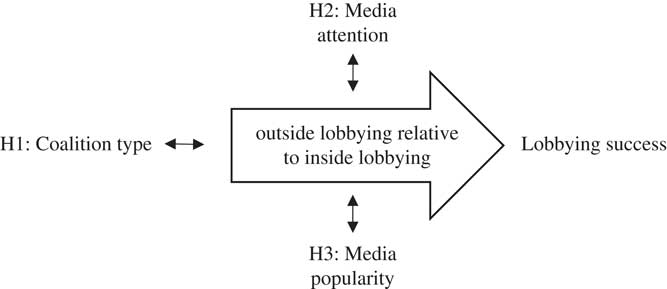
H1a and H1b present coalescing and outside lobbying as mutually reinforcing conditions for lobbyists to achieve their policy goals (see Figure 1). While it is true that an uncoordinated collection of actors advocating a similar policy view might be relevant, coalitions are considered to be superior to such lobbying ‘sides’ (Baumgartner et al., Reference Baumgartner, Berry, Hojnacki, Leech and Kimball2009). Coalitions signal unity and consensus across different societal interests. As different interests visibly coordinate their efforts and adopt joint policy positions, coalitions can benefit from and more coherently signal the broader political support they enjoy. These efforts otherwise remain scattered and signals of support appear less consensual or pervasive. Moreover, by combining their resources, networks and expertise, coalitions can establish high-profile media campaigns to expand the exposure of their policy views. Although policymakers may be sympathetic to a diversity of uncoordinated voices, they will be less likely to acknowledge the voices, as it may require more effort to identify the relevant actors and their corresponding policy demands. As one of the respondents in this research summarized, ‘coalitions make life easier for the decision makers’.
Overview of the hypotheses and presumed causal relationships.

The success of inside and outside lobbying is not simply a matter of the compatibility of these strategies with coalition behavior. Success also depends on the policy context a lobbyist faces. For example, among the sample of 125 legislative cases, the EC’s proposal on nuclear waste [COM(2010)618] was evidently a strongly politicized issue, which attracted considerable protest and lobbying from Greenpeace and other NGOs. In contrast, the proposal for setting emission performance standards for light commercial vehicles [COM (2009) 593] was considerably less visible in the media and attracted little outside lobbying. Nonetheless, in this case, environmental NGOs, such as Greenpeace and Transport & Environment, were actively engaged in inside lobbying. It is apparent that while outside lobbying is valuable for some issues, other issues call for inside lobbying. Therefore, to grasp the success of inside vs. outside lobbying, it is critical to account for the specific context of each legislative issue on which lobbyists are active. The analysis specifically distinguishes between (1) the media attention around policy issues and (2) the support for policy positions within public debates.
In regards to media attention, most EU legislative issues stay under the radar and are of little interest to the news media or broader public. Only a small subset of issues ultimately attract media attention and substantial mobilization (De Bruycker and Beyers, Reference De Bruycker and Beyers2015; Wonka et al., Reference Wonka, De Bruycker, De Bièvre, Braun and Beyers2018). If policymakers’ decisions in such cases are not widely endorsed, they risk scrutiny by journalists, which can lead to a loss of face or electoral damage. In such cases, outside lobbying is more suitable than inside lobbying. If policy debates occur in the public sphere, organized interests cannot limit themselves to winning the hearts and minds of policymakers, but must also achieve broader support for their policy positions. In contrast, when issues attract little media attention and coverage, outside lobbying is less useful compared to inside lobbying. Under these conditions, information exchanges more often occur behind closed doors; policymakers can thereby make decisions under the radar and are less threatened by public pressures.
H2: Organized interests that more often utilize outside lobbying (relative to inside lobbying) are more successful when issues attract considerable media attention.
Moreover, we expect that the extent to which policy positions gain support in the media arena, not just the amount of media attention, is an important contextual factor for explaining the success of different lobbying strategies. A lobbyist may succeed in expanding the audience interested in a policy issue, but such attention may be irrelevant if the policy position does not gain substantial endorsement from this expanded audience, or indeed if it encounters substantial disapproval. When a position is widely debated and supported in the media, policymakers are incentivized to listen and to take these policy positions into account, while policymakers adopting unpopular measures risk the loss of credibility and support (De Bruycker, Reference De Bruycker2018). On the one hand, media support is arguably less of a concern in the EU, where many policies are established by unelected policymakers. On the other hand, due in large part to the EU’s contested democratic legitimacy, policymakers may be especially sensitive to policy positions that gain broad approval in the media. It is precisely because such media cues are scarce that policymakers may be sensitive to them when they arise.
Hence, we expect that outside lobbying will be more successful when organized interests defend policy positions that receive support in the media. In utilizing outside lobbying, interest organizations contribute to the attention of widely supported policy views, and in doing so, increase the pressure on policymakers. Thus, outside lobbying, media attention, and widely supported positions are factors that mutually reinforce the chance of policy success. Conversely, when organized interests defend less widely supported views, they should refrain from outside lobbying, as too much attention for their cause may invite counteractive lobbying and increase pressure to the benefit of more widely supported positions. These interest organizations are therefore tempted to work behind the scenes and avoid drawing attention to the issues they aim to influence. In short, outside lobbying will be more successful when it supports a widely approved position, but also outside lobbying will reinforce or strengthen such a position.
H3: Organized interests that more often use outside lobbying (relative to inside lobbying) are more successful when advocating widely approved policy views.
H2 and H3 conceive of media attention and popularity as factors which exogenously shape lobbying practices. This reflects our goal to analyze the conditions under which outside lobbying is successful, not to what extent interest groups themselves try to influence or are affected by media attention or support. In reality, these factors are not purely exogenous and entirely unmalleable conditions, as they can to some extent be the result of lobbying (Klüver et al., Reference Klüver, Braun and Beyers2015). Although full exogeneity cannot be presumed, media attention and popularity are not only (or not at all) shaped by organized interests (see Online Appendix). While a small number of lobbyists may seek media attention, they are not necessarily successful in these attempts and media attention can only be to a limited extent (if at all) an effect of interest group lobbying, as many other actors undeniably shape the public agenda (such as journalists, governments, and political parties). Moreover, media attention largely depends on the policy agenda promoted by policymakers, which, in turn, attracts interest groups who start lobbying in response (Baumgartner and Jones, Reference Baumgartner and Jones2014). The processes that produce the context within which individual groups operate (which includes how much attention a policy issue gains) are generally experienced by individual lobbyists as an external constraint with which they are confronted and to which they must adapt. We do not adopt a firm stance on the precise causal direction regarding whether media attention and popularity are the result or the cause of outside lobbying. Rather, this work presumes that media attention/support and outside lobbying are mutually reinforcing, and that outside lobbying has more success potential, compared to inside lobbying, when issues gain more media attention and/or when lobbyists defend more popular positions. Figure 1 presents an overview of the hypotheses and the presumed causal relationships. The smaller double-sided arrows represent the mutually reinforcing relations between outside lobbying and the hypothesized conditions (coalitions, media attention, and public support). The larger arrow represents the presumed unidirectional relationship between outside lobbying under the hypothesized conditions and lobbying success.
Research design
The data utilized to test the hypotheses are part of a larger project on EU legislative lobbying (Beyers et al., Reference Beyers, Dür, Marshall and Wonka2014a). The overall approach is equivalent to the procedure adopted by Thomson and his colleagues in their research on EU legislative politics (2011) (see Bueno de Mesquita and Stokman, Reference Bueno de Mesquita and Stokman1994; Thomson, Reference Thomson2011). To produce the sample, all EC proposals for regulations (n = 427) and directives (n = 111) between 2008 and 2010 were mapped. For each proposal, keywords were identified based on the proposal title and additional desk research. On this basis, all media coverage in five media outlets (European Voice, Frankfurter Allgemeine Zeitung, Agence Europe, Le Monde and Financial Times) related to these proposals was subsequently identified. Evidence on media attention and public consultation was used in order to establish a stratified sample of 125 proposals (for details see Online Appendix and the project website www.inteuro.eu).
For the purpose of this research, 95 interviews were conducted with EC experts (Dür et al., Reference Dür, Bernhagen and Marshall2015), 38 with officials in the EP (Baroni, Reference Baroni2014), and 143 with interest groups officials (Beyers et al., Reference Beyers, Braun, Marshall and De Bruycker2014b). Some groups were interviewed more than once if they were identified as crucial actors for several proposals. In selecting respondents, the aim was to interview EU-level interest organizations on each side of the conflict dimensions identified for each proposal. Each interview was used in order to map and identify specific issues at stake in 78 of the sampled proposals.Footnote 2 Issues are specific aspects of a legislative proposal on which stakeholders adopted conflicting positions and disagreed on the preferred policy outcome. In total, 339 conflictual issues were identified. From the 111 interviewed lobbyists, 86% represent EU-level interest organizations; in cases where no EU-level organizations were active, national or international lobbyists were interviewed. The largest portion (64%) of the respondents represents business associations, 29% represent NGOs, and the remaining 8% represent professional organizations, firms, or labor unions.
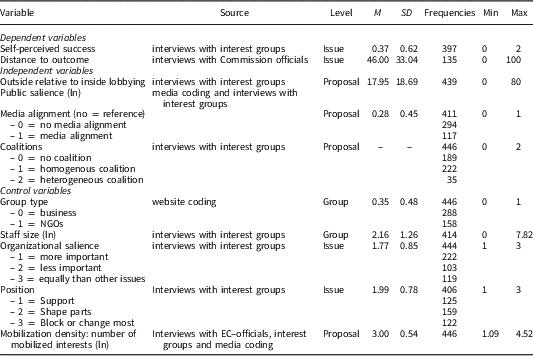
The analyses include two measures of success: one based on the judgement of EC officials and another on the lobbyist’s self-perception (see Table 1 for an overview of variables). The first success measure is based on 95 interviews with EC officials implemented during the first stage of the interview process (for details, see Bernhagen et al., Reference Bernhagen, Dür and Marshall2014; Dür et al., Reference Dür, Bernhagen and Marshall2015). The EC experts were invited to position, on a scale ranging from 0 to 100, each mobilized organized interest on a one-dimensional scale vis-à-vis each other. Each EC official then had to situate the initial proposal of the EC, the eventual outcome, and the reversion point of the issue on this scale. We use the distance-to-outcome measure, which presumes that the proximity of an actor’s position vis-à-vis the final outcome indicates the amount of success. According to this measure, the success of actor i with regard to issue j equals  ${\rm }s_{{ij}} {\equals}Q{\minus}\left| {x_{{ij}} {\minus}O_{j} } \right|$, where
 $Q$ is the distance between the minimum and the maximum of the scale, x ij is the position or ideal point of actor i, and O j is the outcome on the issue. This measure was adopted because it is conceptually equivalent with the selected success measure (‘whether the outcome is consistent with the lobbyist’s initial preferences’).Footnote 3
Overview of dependent, independent, and control variables

The second measure concerns self-perceived success and was also measured at the issue level. Based on interviews with EC officials and interest organizations, 292 distinct issues were identified in relation to 78 proposals. In each interview with interest group representatives during the second stage of the interview process, we asked about the group’s success with respect to different aspects of a proposal.Footnote 4 The specific questions were as follows:
To what extent is the outcome on the different issues consistent with your organization’s initial preferences? Is this outcome identical to your initial preferences (1); close to, but not identical to your initial preferences (2); a long way from your initial preferences (3); or the exact opposite of your initial preferences (4)?
Success measures based on self-assessment have inherent advantages and disadvantages. One important advantage lies in their simplicity, which allowed us to estimate success across a large sample of organizations active on a wide set of policies (Dür, Reference Dür2008). Another advantage is that self-assessment measures capture both formal and informal channels of influence, while measures relying on formal sources do not take stock of oral and informal evidence of success (Pedersen, Reference Pedersen2013). However, there are also some disadvantages, such as the potential over- and underestimation of success by respondents. Interviewees may, for strategic reasons, misrepresent their success, and measurements may depend on the type of actors assessed (Fowler et al., Reference Fowler, Heaney, Nickerson, Padgett and Sinclair2011; Pedersen, Reference Pedersen2013). For example, business respondents might downplay their success because they would prefer to prevent an image of business that dominates public policymaking, while EC officials might be inclined to underestimate the success of business (or other) interests as they may want to avoid being portrayed as being ‘captured’ by lobbyists.
Although not all such disadvantages can be avoided, this research adopted several control methods. Firstly, when different lobbying camps opposed each other with respect to a specific policy, organized interests from both sides were interviewed in order to avoid a one-sided or biased view of success. Secondly, the success measures were based on different sources, including the lobbyists’ self-perception and how EC officials evaluate success. Using multiple success measures provides a unique opportunity to test and check the robustness of the findings, and to understand how different measures of success agree or disagree (see below).
The first independent variable included was the relative use of inside and outside strategies, which was measured with one key interview question (Hanegraaff et al., Reference Hanegraaff, Beyers and De Bruycker2016):
With respect to the same legislative proposal, roughly what percentage of your efforts consisted of activities that were addressed to the public and media and what percentage concerned efforts to gain direct access to policymakers?
An interviewee could respond, for example, that she focused 25% of her efforts on outside strategies and 75% on inside strategies. The analyses below focus on the share of outside lobbying relative to inside lobbying. Advocates with a high score use relatively more outside tactics, which often include media strategies and seek to increase public visibility. Advocates with a low score demonstrate a higher propensity to seek direct contact with policymakers. Respondents faced no notable challenges when answering this question and could easily indicate a relative emphasis on inside or outside lobbying strategies. Although one of the advantages of this measure is its relative and straightforward nature, it is rather crude and says little about the concrete tactics used. Therefore, in order to assess the measure’s validity, we tested to what extent the responses correspond with the usage of concrete tactics (see Table A1, Online Appendix). Indeed, respondents who invested relatively more in outside lobbying were more likely to use concrete tactics such as organizing press conferences, staging protest activities, or taking part in media debates. In contrast, those who were less active in outside lobbying were more likely to seek direct contacts with officials in the EC, the EP, and the member–state governments. As expected, inside lobbying is more prominently used by EU lobbyists compared to outside lobbying. The mean percentage of activities devoted to outside lobbying is 18% (SE = 18.69).
In order to measure coalition behavior, during the interviews, we asked respondents to identify organized interests with whom they were in a coalition. This information was used in order to code whether a lobbyist was in a coalition or not (1 = no coalition), whether the coalition consisted only of NGOs or business (2 = homogeneous coalitions), or whether it included both NGOs and business (3 = heterogeneous coalitions). In most cases (58%), lobbyists had established coalitions, but the coalitions were heterogeneous in only 35 cases (8%) (for details, see Beyers and De Bruycker, Reference De Bruycker2018).
Furthermore, in order to estimate the media attention of an EC proposal, we counted the total number of articles that reported on the 78 proposals within six media outlets (Agence Europe, European Voice, Euractiv, Le Monde, The Frankfurter Allgemeine Zeitung and The Financial Times). The same data was also used for measuring media support. All articles discussing the 125 sampled legislative proposals in the six media outlets were archived, and 4258 statements made by any actor (such as MEPs, interest groups, firms, journalists, and regulatory agencies) about a specific proposal were identified. For each statement, we coded whether advocates sought to (1) support the proposal, (2) shape small parts of the proposal, or (3) radically change or block the proposal (De Bruycker and Beyers, Reference De Bruycker and Beyers2015). To determine the most widely supported position, we utilized the modal position, or simply, the position that gained most media prominence. The policy position that an organized interest adopted could then be compared with the most widely approved position on that policy in the media. On this basis, a dummy variable measuring whether the interest group aligned with the most widely approved policy position (1) or not (0) was established.
Various control variables were integrated to account for alternative explanations, with particular attention to the resource capacities of interest organizations. Firstly, business can generally be considered more powerful, while civil society interests are often deemed less powerful, and therefore less successful in advocating their causes (Danielian and Page, Reference Danielian and Page1994; Dür and De Bièvre, Reference Dür and De Bièvre2007; but see Dür et al., Reference Dür, Bernhagen and Marshall2015). To control for this possible effect, all organizations were coded, on the basis of both the interview data as well as the website of the organization, as either civil society groups or business interests. Secondly, resources, in particular staff resources, are expected to lead to higher levels of professionalization and to have a positive impact on success. Therefore, to measure staff size (logged because of its skewed distribution), we combined two sources: (1) inquiring during interviews how many full-time staff the organization employs in its Brussels’ office and (2) reviewing organizational websites in order to cross-validate the responses.Footnote 5 Thirdly, interest organizations spend lobbying resources in relation to the importance attached to particular issues. Interest organizations invest more in issues that are considered more important, and this extra investment can positively affect success. Therefore, we included a measure of organizational salience that captures the importance of an issue for a specific organized interest (Beyers et al., Reference Beyers, Dür and Wonka2018). To do so, respondents were asked whether the issue was more (1), equally (2), or less (3) important compared to other issues they work on. Moreover, previous research has demonstrated that groups that seek policy change or oppose the status quo are less likely to achieve their goals (Baumgartner et al., Reference Baumgartner, Berry, Hojnacki, Leech and Kimball2009). This research therefore controlled for whether an interest organization supported a proposal (1), sought to shape some parts of a proposal (2), or sought to block or change most of the proposal (3). Finally, success depends on the intensity of interest mobilization on an issue, as this points at the amount of other like-minded (or competing) lobbyists that are active. Therefore, the number of organized interests identified per proposal was added as an additional control variable.
Results
Before examining the multivariate tests, it is important to explore the distribution of the dependent variable. Lobbyists who reported on their self-perceived success produced 446 judgements. With regard to this measure, most respondents indicated that the policy outcome was ‘close’ to their initial preferences (n = 213, 48%), and for 15%, the outcome was ‘identical’ with their preferences (n = 68, 15%). Seven percent (n = 30) indicated that the outcome was ‘a long way from’ their initial preferences, and 19% (n = 86) argued that the final outcome was ‘opposite to’ their initial preferences. In 11% (n = 49) of cases, respondents did not know whether their goals were attained or refused to answer.
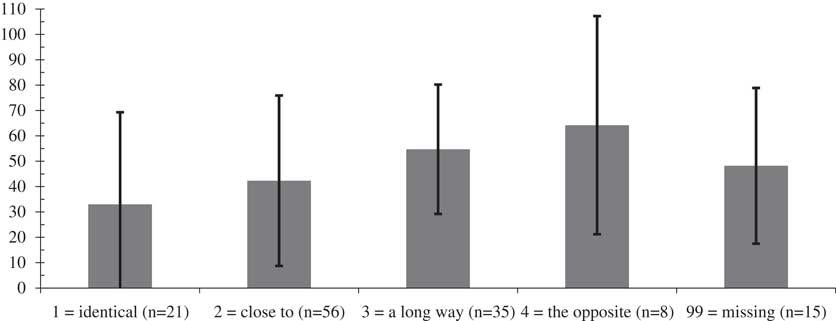
As self-reported success can be biased, we compared self-measured success with a measure that is exogenous to the respondents’ self-perception: estimation by EC experts. For 135 of the 446 issues (30%), we compared self-perceived success with the success that EC experts attributed to the interest organizations. From the one-way analysis of variance (ANOVA) (Figure 2), it is clear that lobbyists who perceived themselves as unsuccessful have a significantly higher mean for the ‘distance-to-outcome’ measure compared to those who perceived themselves as successful (F = 2.31, df = 4, P = .00). The two variables gauging success are thus significantly related, but they do not correlate perfectly. One reason for this could be the inclination among lobbyists to be reluctant to admit lost causes. In addition, as previously indicated, EC officials may have a propensity to underestimate the success of organized interests, as they want to avoid the portrayal of being ‘captured’ by lobbyists. It is notoriously difficult, even for policy experts, to grasp the genuine goals of lobbyists, as lobbyists are often in large numbers and because they can be tempted to strategically adopt more (or less) extreme positions than their true positions. Notwithstanding these important limitations, both self-perceived assessments and the EC evaluations are positively related, which indicates a similar underlying construct. However, it was not possible to establish a reliable scale combining both measures, because the two variables still differ considerably. This research therefore analyzed how each measure relates to strategies in its own right, and tested two separate models with each success measure.Footnote 6
Comparing the means of two success measures with one-way analysis of variance (ANOVA) (n = 135; with 95% confidence intervals (CIs)). Note: vertical axis is the distance-to-outcome measure, F = 2.31, P = 0.06; Spearman’s ρ = 0.28, P = 0.00.

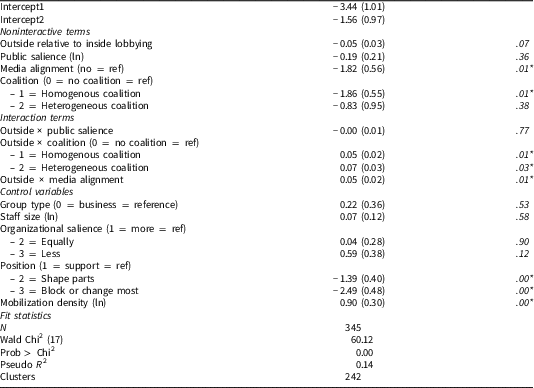
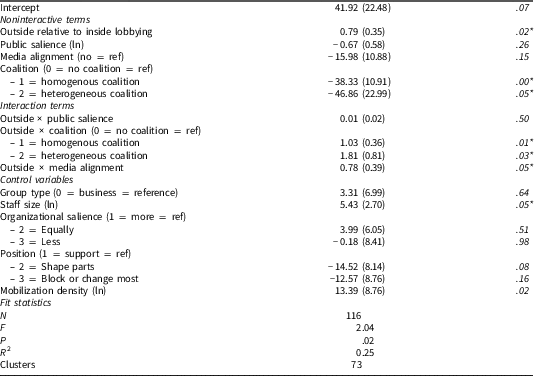
This research utilized one regression model with the self-perceived success measure as dependent variable and a second model using the distance-to-outcome measure (see Tables 2 and 3). Both success measures were inverted; thus, positive values denote higher levels of success. As some issues were associated with multiple respondents, clustered standard errors were used for evaluating the parameter estimates. In addition, self-perceived success was modelled with an ordered logistic regression. Because the Brant test demonstrated a violation of the parallel odds assumption for a model with four ordinal categories, the ordinal scale was recoded by collapsing the first two categories.Footnote 7 The resulting scale modelled the likelihood that the outcomes were perceived to be ‘close/identical to’, ‘a long way from’, or ‘opposite to’ the lobbyist position. Distance was modelled with an ordinary least squares regression. According to the Shapiro–Wilk W test for non-normality, the hypothesis that distance-to-outcome follows a normal distribution cannot be rejected (P = 0.79). To test the hypotheses, interaction terms with outside lobbying and the following variables were added: (H1) whether the organized interest lobbied alone, in a homogeneous, or heterogeneous coalition; (H2) the media attention around each policy; and finally, (H3) the alignment of the organized interest’s position with the most widely supported position in the media.Footnote 8
Predicting self-perceived success

Note: Results of an ordered logistic regression with cell entries are the estimated coefficients, clustered standard errors in parenthesis, and two-sided P values referring to H 0 that β = 0 in italics. Coefficients that are significant at the 0.05 level are indicated with a*.
Predicting proximity-to-outcome

Note: Results of an ordinary least squares (OLS) regression with cell entries are the estimated coefficients, clustered standard errors in parenthesis, and two-sided P values referring to H 0 that β=0 in italics. Coefficients that are significant at the 0.05 level are indicated with a*.
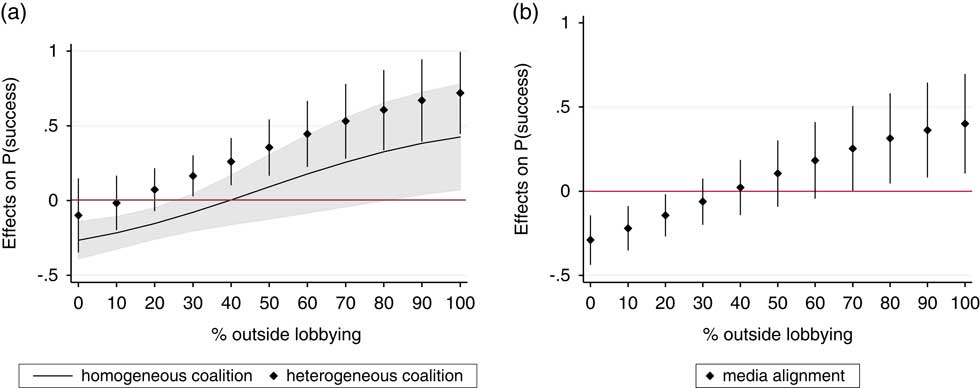
Table 2 presents the results with self-perceived success as the dependent variable. Firstly, this study anticipated that if lobbyists engage in a coalition they are more successful when engaging more often in outside lobbying (H1). The positive interaction coefficients – 0.05 for homogeneous and 0.07 for heterogeneous coalitions – demonstrate that as lobbyists increase their use of outside strategies in combination with coalitions, their self-perceived success increases (meaning a higher category on the ordinal scale). This finding is confirmed by the marginal effects (Figure 3a). When lobbyists engage in a homogeneous coalition and invest 100% in outside lobbying, the chances that the outcome of a legislative act is close to/identical to its goals is 67% (SE = 0.14) (and 97% for heterogeneous coalitions, SE = 0.07), but only 25% (SE = 0.04) when the lobbyists do not engage in a coalition.
Average marginal effects of outside lobbying, media alignment and engaging in a coalition with 95% confidence intervals (CIs) (self-perceived success). (a) represents outside lobbying × coalitions and (b) outside lobbying × media alignment.

The model with the EC-based measure of success produced similar results, supporting the robustness of this hypothesis (Table 3).Footnote 9 As shown in Figure 4a, lobbyists who spend 70% of their efforts in outside lobbying will on average increase the proximity between their ideal position and the final outcome by 62 (SE = 30.27) if they engage in a heterogeneous coalition and by 34 (SE = 18.27) if they belong to a homogeneous coalition (on a scale ranging from 0 to 100). This effect works in the opposite direction for lobbyists not engaged in outside lobbying: when lobbyists lobby alone, the proximity between the ideal position and the outcome decreases. In short, coalescing is especially helpful in combination with higher levels of outside lobbying.
Average marginal effects of outside lobbying, media alignment and engaging in a coalition with 95% confidence intervals (CIs) (proximity-to-outcome). (a) represents outside lobbying × coalitions and (b) outside lobbying × media alignment.

In Figures 3a and 4a, the y-axis represents discrete differences, or the expected change in the probability that an interest organization is successful when it engages in a heterogeneous/homogenous coalition (compared to when it does not). The x-axis represents the use of inside relative to outside lobbying. For both models, more investment in outside lobbying results in a higher probability of perceived success or a decreasing distance-to-outcome when lobbying in a coalition (compared to no coalitions). Both models indicate that lobbyists in a coalition should at least invest more than 30% in outside lobbying to be successful. If one relies predominantly on inside lobbying, it is better to lobby alone.
Hypothesis 2 posited that cases that gain considerable attention are more successfully lobbied if the advocate relies strongly on outside lobbying. Based on the results of the models with the two dependent variables, this hypothesis is rejected. This was an unexpected result, as media attention is likely to be a catalyzer for outside lobbying. However, one explanation is that it is not media attention as such, but rather the extent to which positions are publicly supported that critically impacts policy success.
In response to Hypothesis 3, both models demonstrated, as expected, that lobbyists adopting positions that resonate with the most widely approved position in the media are more successful if they increase their relative use of outside lobbying. This finding was confirmed in all models and can therefore be considered robust. The x-axis in Figures 3b and 4b presents the change in the probability of success when defending positions that gain most public endorsement. Interest organizations advocating a less visibly supported position are more successful than those defending a more supported position, as long as they invest less than 40% of their efforts in outside lobbying. In order words, when lobbying for a position that gains less visible support in media outlets, it is better to refrain from outside lobbying and spend relatively more resources on inside lobbying. Both models agree that investing relatively more in outside lobbying results in higher success rates when defending a broadly supported position. According to the model with self-perceived success, lobbyists defending such positions should spend more than 70% of their efforts on outside lobbying to be significantly more successful (compared to lobbyists who do not defend widely supported positions). Furthermore, the distance-to-outcome model indicates that this investment should be at least 60%.
There are several previous cases that effectively illustrate this result. For example, in 2010, the EC proposed a directive to block websites displaying child pornography at the source [COM (2010) 94]. Some organizations, such as European Digital Rights (EDRi), did not agree with the proposal and tried to block it. While they were very actively lobbying the EC, they refrained from any media-related tactics, as the position to prohibit blocking child pornographic websites did not resonate with the prevailing media discourse. Nonetheless, by intensively working behind the scenes, EDRi managed to achieve their objective. If EDRi, or one of their allies, had gone public, they could have mobilized a broader audience against their cause. Alternatively, if their opponents had invested more in outside lobbying, they might have been able to counter EDRI’s inside lobbying activities. As a lobbyist from a children’s rights group articulated, ‘We underestimated our opponents; we thought we had an easy case’.
Regarding the control variables, the goals of interest organizations – supporting completely, supporting partially, or amending most/blocking – proved to be significantly related to self-perceived success, but not to distance-to-outcome. Interest organizations supporting an EC proposal are more likely to indicate a higher level of self-perceived success. This finding aligns with the work of Baumgartner et al. (Reference Baumgartner, Berry, Hojnacki, Leech and Kimball2009) and Mahoney (Reference Mahoney2008), who found that actors seeking policy change experience more difficulties in being successful. Furthermore, the results demonstrated that group type has no significant impact on success; the success of business is not substantially larger than the success of non-business interests. Both models reject the popular view that EU legislative politics is generally biased towards business interests (see Dür et al., Reference Dür, Bernhagen and Marshall2015). Success is also unrelated to the amount of staff resources or how much-organized interests care about a specific issue (organizational salience). However, the amount of organized interests that lobby does have some effect: namely, proposals that attract more lobbyists render higher degrees of success. Although this observation deserves further follow-up research, one explanation might be that EU lobbying is rarely adversarial; more mobilization does not necessarily mean more conflict among different group types, but often means more interest groups pushing for policy change in the same direction (Wonka et al., Reference Wonka, De Bruycker, De Bièvre, Braun and Beyers2018). As such, it is not only the lobbying coalition that matters, but also the size of the mobilized interest group community or the lobbying camps that mobilize (Baumgartner et al., Reference Baumgartner, Berry, Hojnacki, Leech and Kimball2009; Klüver, Reference Klüver2013; Mahoney and Baumgartner, Reference Mahoney and Baumgartner2015).
The analyses with two different measures of success generally yielded highly similar results. A comparison of the residuals of the models reported in Tables 2 and 3 reveals that while the two success measures are positively and significantly correlated (see Figure 1), the residuals of the two models are uncorrelated (r = −.09, P = .37). This indicates that the explanatory framework grasps the variance shared by the two success measures, while sources of measurement errors differ across measures (see Table A2, Online Appendix). In short, success is less affected by how many resources lobbyists can mobilize (what they have) or the type of interests represented (who they are). Instead, the results reveal that success is a matter of how lobbyists spend their resources (what they do; H1) and how well their position resonates in the media (what they want; H3). By carefully combining complementary tactics and applying them in an appropriate setting, lobbyists can significantly increase their policy success.
Some caution is appropriate with respect to the causal nature of these results. The observational nature of the data implies that reciprocal causation cannot be ruled out. Firstly, outside lobbying may be endogenous to other factors related to lobbying success, such as media salience, popularity, and coalition strategies, or to the political goals advocated for, which means that the results are potentially responses to spurious relationships. For example, media salience can foster both more outside lobbying and increased rates of lobbying success. To assess these relationships, the Online Appendix presents a correlation matrix with potential endogenous variables (Table A3), which indicates that outside lobbying does not show significant or substantial correlations with the hypothesized confounding factors. Moreover, the only variable directly related to success is membership in a coalition, but this is a negative correlation. Based on this evidence, we can conclude that the significant interaction effects are unlikely to be caused by an underlying spurious correlation. Secondly, concerns about reversed causation are also warranted. For example, advocacy groups may be more likely to use outside lobbying after having realized their preferences, to showcase or justify their victories. This should, however, not present a problem with the data, as respondents were asked to report on their lobbying strategies before the Council approved the EC proposal as law. The observation of lobbying strategies thus precedes the measurement of lobbying success.
Conclusion
Scholars generally identify two different ways to influence EU policymaking. The first strategy involves exerting pressure through outside lobbying, while the second route centers on direct informational exchanges through inside lobbying (Kollman, Reference Kollman1998; Binderkrantz, Reference Binderkrantz2005; Kriesi et al., Reference Kriesi, Tresch and Jochum2007; Dür and Mateo, Reference Dür and Mateo2013; Weiler and Brändli, Reference Weiler and Brändli2015; Hanegraaff et al., Reference Hanegraaff, Beyers and De Bruycker2016). The conceptual framework and the related hypotheses developed for this research aimed to identify why interest organizations should go public or lobby behind the scenes. Outside lobbying can facilitate lobbying success when it is combined with tactics that are geared at sending pervasive signals of political support, such as coalitions among diverse stakeholders. Moreover, compared to inside lobbying, outside lobbying is more successful in a context that amplifies the political support that lobbyists seek to convey.
The evidence demonstrates that the success of outside lobbying depends on additional lobbying tactics adopted by interest organizations as well as the issue context in which lobbyists are embedded. Firstly, some tactics – such as coalition formation – that are combined with outside or inside lobbying can depress or facilitate success. For example, forming a coalition with other interest groups, especially with a diverse set of groups or a heterogeneous coalition, leads to higher levels of success when using more outside lobbying (relative to inside lobbying). Secondly, the policy context mediates whether inside or outside lobbying will be more successful. Outside lobbying results in more success (compared to inside lobbying) when defending a position that gains broad approval in the public sphere. When advocating positions that lack broad approval in media debates, in contrast, lobbyists can increase success if they primarily rely on inside lobbying (but decrease success when engaging more often in outside lobbying).
This article contributes in several ways to interest group scholarship on strategies and influence. Various scholars have recently tried to explain why organized interests adopt a particular lobbying strategy (Kollman, Reference Kollman1998; Beyers, Reference Beyers2004; Binderkrantz, Reference Binderkrantz2005; Kriesi et al., Reference Kriesi, Tresch and Jochum2007; Dür and Mateo, Reference Dür and Mateo2013; Weiler and Brändli, Reference Weiler and Brändli2015; Hanegraaff et al., Reference Hanegraaff, Beyers and De Bruycker2016), and some have sought to analyze policy success (Smith, Reference Smith2000; Burstein and Linton, Reference Burstein and Linton2002; Klüver, Reference Klüver2013; Dür et al., Reference Dür, Bernhagen and Marshall2015); however, very few previous studies have systematically examined which lobbying strategy contributes to success or influence (for instance Mahoney, Reference Mahoney2007; Baumgartner et al., Reference Baumgartner, Berry, Hojnacki, Leech and Kimball2009). This article argues that a significant relationship between the actions (or strategies) of interest groups and their success, for which we can reasonably presume a causal link, is an indication of influence. Combining strategies and success can therefore unravel pathways of interest group influence. This article demonstrates that interest group influence is more likely when group strategies unfold in a favorable context. The innovation of this article lies not only in developing new expectations, but also in the systematic testing based on a large number of policy cases and in combining different measures of success. That the two analyses yield highly similar results underpins the robustness of the conclusions. Moreover, instead of focusing on whether inside or outside lobbying is inherently more successful, our contribution is proving that it is much more meaningful to examine the conditions under which different lobbying strategies lead to success.
These findings are relevant for understanding EU interest representation more broadly. EU policymaking cannot be reduced to a purely technocratic endeavor; however, EU policymakers display some sensitivity to popular demands and lobbying strategies articulated in the media. The EU political system is therefore inclined to amplify policy views that enjoy public support (for a related argument, see Rasmussen et al., Reference Rasmussen, Carroll and Lowery2014). Nonetheless, it is important to not overstate the results presented in this article. The endorsement of policy views in the media should not be confused with citizen support, as we did not control for the extent to which media sources adequately articulate public opinion. Nonetheless, it remains important to understand how policies are publicly debated and whether lobbyists can benefit from the extent to which their policy views enjoy approval in media debates. In order to act effectively, groups must hold a strong awareness of the potential support they may enjoy in the public arena.
Acknowledgements
The research presented in this article was made possible by research grants of the European Science Foundation (461-10-519), the Research Foundation-Flanders (G.A.171-11N) and the European Research Council (ERC-2013-CoG 616702-iBias). Iskander De Bruycker gratefully acknowledges support of ACCESS Europe and the Research Foundation Flanders - FWO [Post doc Grant Nº. 12N1417N].The authors thank Marcel Hanegraaff and the anonymous reviewers for their constructive comments which helped improve the article considerably. Earlier versions of the article were presented at various conferences including the Midwest Political Science Association Annual Conference (April 2016, Chicago) and the European Consortium of Political Science General Conference (September, Prague 2016).
Supplementary material
To view supplementary material for this article, please visit https://doi.org/10.1017/S1755773918000218