





IntroductionFootnote *
Hippocamps most commonly served as the equine companions for anthropomorphic marine divinities. Yet these imaginary animals resided in a curiously low-profile position in the Graeco-Roman cultural imagination, never taking centre stage as the focal point of any particular myth, nor did they possess any narrative role at all.Footnote 1 Accordingly, although they were pervasive within ancient visual media as mounts for the Nereids, or harnessed to the chariot of Poseidon, we find only fleeting mentions of them in ancient textual sources. This gulf between visual and textual representations in the extant evidence has, in turn, resulted in their neglect in scholarship. While hippocamps are by no means an obscure creature to modern observers, they have only rarely been the direct focus of scholarly assessments. Modern scholars have generally recognized the position of hippocamps as ‘background’ figures, certainly part and parcel of the iconographic repertoire of marine deities but have tacitly written them off as hardly worth direct attention in their own right.Footnote 2 Nevertheless, hippocamps offer a unique opportunity to examine a particular strand of the Graeco-Roman cultural imagination. Befitting of their hybridity, they also sit between two subfields: mythological studies and ancient animals studies. This liminal quality allows them to be a particularly useful case study for how Graeco-Roman culture generated and utilized imaginary animals.
This article, accordingly, assesses the profile of hippocamps in the Graeco-Roman imagination, along with that of other mythical marine Mischwesen (such as the so-called pardalocamp, or sea panther). As I demonstrate, this group of imagined creatures illustrates one mechanism for the genesis of imaginary animals in ancient culture. They are born, not from oral myths or literary contexts, but as a result of artistic trends and the pervasive cultural logic that the sea is reflective of the terrestrial world. The generally reflective quality of the ancient sea is discussed elsewhere in scholarship and, though evident in earlier centuries, is most directly embodied by Pliny the Elder’s statement that ‘what is born in any part of Nature exists also in the sea, alongside many things, which do not exist elsewhere’ (HN 9.1).Footnote 3 Hippocamps, then, emerge out of a distinctively Graeco-Roman cultural desire to visually represent the sea’s reflectivity: horses exist on land (and are central to human societies), therefore, some marine equivalent ought to exist in the sea. Hippocamps can be described as ‘mythical’ only in the sense of being ‘non-real’. They were never bound to a specific myth, simply because they did not originate from a narrative source, as was perhaps the case for other mythical creatures. One prominent example of that tendency can be seen with the Minotaur, a creature tied to the myth of Pasiphaë’s encounter with Poseidon’s bull, a narrative reflex that functions to explain its hybridity.
Hippocamps, moreover, never fully made the leap from artistic media into narrative contexts proper, resulting in their considerable rarity in textual sources. Even their name in ancient Greek, ἱππόκαμπος (and the Latinized hippocampus), tends to refer to the real animal of the sea horse, the tiny species of segmented fish with which they probably bore some connection, as discussed below. Perhaps a natural supposition is that the ancient Greeks and Romans must have regarded sea horses as the infantile version of the animal that would grow into the adult hippocamps. Although an alluring theory, it is an incautious one, since no ancient author ever states this explicitly.Footnote 4 I demonstrate instead that this gulf between the two can be explained by the different ways in which Graeco-Roman culture conceptualized the real animal versus the mythical counterpart. In antiquity, the term ἱππόκαμπος/hippocampus was more predominantly applied to the real animal, and only rarely associated with the mythological creature of ancient art, with which the term has become synonymous in our modern imagination. The same imaginative impulse that fashioned hippocamps, in turn, also gave birth to a variety of other marine Mischwesen from Hellenistic art onwards that cannot be said to have been wholly derived from the natural world alone.
(Inter)relation with the Graeco-Roman kētos and terrestrial horses
In assessing hippocamps and the other marine Mischwesen of the Graeco-Roman imagination, we should begin by foregrounding a defining feature of their marine halves. It is, moreover, this feature that binds these imaginary figures together and forms a key aspect for interpreting them. Habitually, modern scholars have described hippocamps as half-horse and half-fish.Footnote 5 This is manifestly true with regard to their equine upper half, but a close examination of the available ancient sources will show that we may be more precise about the nature of their lower half. Although the hippocamps are not positioned as monsters-to-be-slain in Graeco-Roman art, they do partake in physical similarities with the primary sea monster of the ancient world, the κῆτος (pl. κήτη).Footnote 6 While κήτη themselves certainly exhibit piscine elements, they also take on the serpentine influences of the ancient δράκων (‘dragon’), particularly with their own lower half, in artistic media.Footnote 7 Accordingly, κήτη are often depicted with gills and fins, yet their own lower half is often not a generically fishy half, but a twisting, serpentine tail that is distinctive in ancient art.Footnote 8 It is the lower half of a κῆτος that ancient artists have grafted onto the top half of a horse to form the hippocamps. Thus, we can more precisely describe these creatures as half-horse and half-κῆτος. That this anatomical portion of the hippocamp is the lower half of a κῆτος specifically was recognized by at least one ancient author. Pausanias, describing statues at a Corinthian temple to Poseidon, speaks of a ‘horse similar to a κῆτος from the chest onwards’ (ἵππος ϵἰκασμένος κήτϵι τὰ μϵτὰ τὸ στέρνον, Paus. 2.1.9). In ancient art, this lower half is also the same κῆτος tail seen with the iconographic form of other hybrids like Scylla and the Tritons. These two mythical creatures are found in earlier textual sources and myths that predate their earliest appearances in art,Footnote 9 and only later come to possess a κῆτος lower half. The hippocamp, by contrast, emerges from the media of ancient art directly. They appear most commonly as figures that serve to complement the anthropomorphization of sea gods themselves. Those human-in-form deities are suitably accompanied, like terrestrial mortal humans, by equine companions of their own, while the lower half of these sea monsters represents the marine qualities of these sea steeds.Footnote 10
In recognition of this prominent feature, we may coin a new term to describe such a category of creature: mixokētos (pl. mixokētē). This is similar in function to Emma Aston’s term mixanthropos (pl. mixanthropoi) to denote mythical figures that are part human.Footnote 11 This term is inspired, first and foremost, by Pausanias’ reference to a hippocamp being half-κῆτος, as well as by the features we see in art with overlap between the two creatures, as expressed most directly in the similarities of their tails. While this term could also encompass figures that are half-κῆτος and half-human, such as the Tritons,Footnote 12 I use it here as a category to refer to the hippocamps and the other forms of marine versions of terrestrial animals (sea panthers, sea bulls, etc.).
Yet, for hippocamps themselves we should also comment briefly on what their equine upper half contributes to such imaginary animals. As Mark Griffith has rightly stressed, horses (and other equids) were much more omnipresent for all social classes of the ancient world than they are for modern industrialized countries, wherein most people do not regularly encounter them.Footnote 13 Griffith further notes a class dimension to horse ownership, given the expenses of equine maintenance, which were, accordingly, often regarded as signs of high status.Footnote 14 We occasionally see in ancient literature the divine recognition of how valuable horses were to mortals and that the gods possessed (and prized) such luxury animals themselves. One such example comes from the Homeric Hymn to Aphrodite, where Zeus gifts a Trojan couple with divine horses, ‘such as those that carry the immortals’, which was evidently considered a fair compensation for his abduction of their son, Ganymede.Footnote 15 Just as Zeus’ divine terrestrial horses function as a sign of his divine grandeur, so too would the presence of noble sea steeds alongside anthropomorphic marine divinities mirror the prestige and high status allocated to human owners of horses.
But, at the same time, the close human-equine relationship of antiquity and the value accorded to terrestrial horses did not mean that they were wholly free of any potential for negative associations. Rather, they could still be considered frightening and dangerous animals themselves, an effect of the association of horses with Poseidon as a figure who was himself linked to the destructive elements of the sea and earthquakes, while the child-snatching bogey Mormo has sometimes been associated with horses.Footnote 16 These more negative valences of terrestrial horses through Poseidon and other figures may have impacted the representations of hippocamps as well. Just as terrestrial horses could be associated with dangerous supernatural forces and, therefore, simultaneously be seen in a negative light, so too was the equine portion of hippocamps also not free from the potential for negative associations. Moreover, their generally hybrid nature between κῆτος and horse may itself have been another source of negative associations. It perhaps elicited a sense of unease, since such hybridity signifies a failure to adhere to normative categories, as emphasized most famously by Jeffery Jerome Cohen’s monster theory.Footnote 17 Additionally, the marine divinities that hippocamps routinely appear alongside, Poseidon, Nereids, and Tritons, were not wholly benevolent figures either, and sometimes threatened the lives of mortals themselves.Footnote 18 So too, then, we should not assume that their sea steeds were perceived by contemporaries in a wholly positive manner.
With these two primary constituent animal parts in mind, this article will then proceed by establishing an overview of hippocamps in art, which, though being extant in hundreds of representations, can be succinctly summarized owing to the remarkable consistency of such figures throughout Graeco-Roman antiquity. This, however, can be followed by an exhaustive examination of the extant material in textual sources, a side of the hippocamps rarely commented on in previous scholarship. The other mixokētic figures will be the focal point of the last section as essentially Hellenistic variations on the hippocamp that carry on into the Roman world. The conclusion, then, offers some thoughts on the genesis of such figures in cultural imaginations.
Hippocamps in Graeco-Roman art
The earliest extant depiction of a hippocamp in the Graeco-Roman world is on a Thasian tripod dated to the end of the seventh century ʙᴄ,Footnote 19 while they also become particularly prevalent in Etruscan art from the sixth century ʙᴄ onwards.Footnote 20 Shepard has noted the similarities to the earlier iconography of sea horses from Minoan seals,Footnote 21 theorizing that, therefore, the hippocamps may have been influenced by the depictions of the real sea animals, which had become creatively refashioned into a marine horse. An alternative, though not necessarily mutually exclusive, theory is the suggestion that their form was influenced by Poseidon’s associations as both the god of the sea and of horses.Footnote 22 This can, in turn, be supported by the strong associations of κήτη themselves with Poseidon,Footnote 23 thereby being a suitable blend of the god’s ties to both horses and sea monsters. The central difference between these two theories lies in whether one wishes to attribute to Poseidon a meaningful role in the assimilation of horses and κήτη, or whether they developed independently of the sea god as an extrapolation of real sea horses.
Hippocamps, nonetheless, functioned as an embodiment of the sea’s reflectivity of the terrestrial world and become pervasive in ancient Greek art by the classical period. They are occasionally ridden by male figures, though this is a rarity after the sixth century ʙᴄ.Footnote 24 One Attic lekythos shows a bearded figure wielding a trident, identified as either Poseidon or Nereus, riding atop a hippocamp.Footnote 25 Another trio of depictions feature hippocamps being ridden by a bearded figure identified as Nereus with a trident,Footnote 26 and a pair of engraved gems do show Eros riding on the back of a hippocamp.Footnote 27 Unlike κήτη, though, which are outfitted only rarely with reins, this is a common feature of hippocamps, mimicking the reins of actual horses.Footnote 28 In contrast to the rarity of being featured with male figures, the hippocamps were more commonly attached to the Nereids,Footnote 29 most often as mounts.Footnote 30 Nereids always ride hippocamps in a side-saddle fashion, as with the example of a Nereid riding a hippocamp on a fourth-century-ʙᴄ Apulian pelike.Footnote 31
The essential form of hippocamps in ancient art as half-horse, half-κῆτος never substantially deviates, though there are minor variations. As seen also with Scylla and the Tritons in art, hippocamps are occasionally given the addition of wings. We see an ideal example of a winged hippocamp on one fourth-century-ʙᴄ Apulian red-figure plate.Footnote 32 Here, the hippocamp is perhaps intended to represent all three elements of the natural world (land, sea, and air), as each aspect (equine, piscine, and avian) takes up a roughly equal portion of the depiction. Such occasional depictions could be found later in Roman art, as with the two golden hippocamps that appear with silver cornucopias, decorating a fresco from a first-century-ᴀᴅ villa at Boscoreale (Figure 1).
Decorative winged hippocamps from Boscoreale Villa, first century ᴀᴅ (Wikimedia Commons Image).

We may further note two other slight variations. The first occurs primarily in Roman art, where there was a discernible tendency, especially in mosaics, to depict hippocamps with more of their equine bodies preserved. Thus, the κῆτος half frequently tends to be delayed, now beginning from where the horse’s hind legs would normally be, with their equine back now entirely preserved. This is seen most clearly on a second-century-ᴀᴅ mosaic from Ephesus, depicting a hippocamp between a Nereid, reclining upon its coiled tail, and a Triton who holds its reins (Figure 2).
Mosaic at Ephesus, second century ᴀᴅ (Wikimedia Commons Image).

In other Roman depictions, hippocamps are yoked to the chariot of Neptune,Footnote 33 or sometimes leading the sea god through the water without a chariot, as in one mosaic from Ostia Antica.Footnote 34 Here, the relatively flat backs of these hippocamps stand out in contrast to the winding, serpentine-like body of hippocamps sometimes featured in earlier Greek art. The second variation for hippocamps is the occasional swapping of their distinctively equine hooves for flippers, which sometimes also appear on κήτη. The most elegant example of this comes from a pair of figurines, dated to the fourth or third century ʙᴄ.Footnote 35 Elsewhere, it is only the hooves that have been exchanged for the webbed feet more befitting of a marine creature.Footnote 36 Thus, in ancient art, we may summarize the position of the hippocamps as being thoroughly tied to marine divinities in one manner or another, with an unsurprising, though important, feature as a defining characteristic for these creatures.
Hippocamps in ancient literature
While their form was prominent in ancient art, we may note that in such visual media there was the lack of an inscribed name on any extant depiction of them, a feature that also leads into their rarity within textual sources. Here, again, we may note a profound difference with other mythical creatures. The half-human mixokētic figures of Scylla and Triton occasionally had their names inscribed on classical Greek vases,Footnote 37 but there is no extant example of this with hippocamps in similar media. The lack of this term being inscribed on classical Greek vases may, therefore, be a result of the fact that ἱππόκαμπος/hippocampus seems to have been more strongly associated with sea horses instead.
Shepard’s theory that hippocamps were influenced by sea horses, then, perhaps finds support in ancient medical sources referring to a small animal by the same name, discussed below. Thus, even centuries after an iconographic divergence, both perhaps retained a common name. Yet whether the word ἱππόκαμπος itself was initially a term for the mythical creature or for a real sea horse is uncertain. Evidence for the former is found with Lycophron’s use of the word κάμπος to refer to a sea monster (Alex. 32), indicating that ἱππόκαμπος could effectively mean ‘horse-like sea monster’ and affirming its mixokētic nature. Further support for this comes with Hesychius’ statement that the word κάμπη was used by an earlier author to refer to a κῆτος.Footnote 38 However, another, though perhaps more tenuous, etymological possibility presents itself, as the word κάμπη can also be used to refer to a caterpillar.Footnote 39 Such an insect could only be generically similar to a sea horse as a result of their similarly diminutive sizes, making the term mean effectively a ‘horse-like caterpillar’. As with the theories for influences on the hippocamps discussed above, these etymologies can only provide speculative evidence at best concerning the latter half of the term, which resists any firm identification as to its ultimate source.Footnote 40
Whatever the etymological origin of the term, there was a remarkable lag between the advent of hippocamps in visual media and the first appearance of the term in extant textual sources. Although hippocamps are found in Greek art from as early as the seventh century ʙᴄ, it is not until centuries later that we have it in a text. This comes from a fragment of Menander (341–290 ʙᴄ), wherein the full context is unknown, making it indeterminate whether it is used to refer to a hippocamp or a sea horse. The fragment reads: ‘This hippocamp was not in the aether’ (οὐχ οὗτος ἱππόκαμπος ἦν ἐν αἰθέρι).Footnote 41 The phrase ἐν αἰθέρι might point to this being a reference to a constellation, though, there is no ancient tradition of a hippocamp constellation, and it is perhaps even the purpose of this line to specify that there was no such constellation.Footnote 42 It is not until a fragment of the Latin poet Laevius (fl. first century ʙᴄ) that we find a reference to a hippocamp with a context manifestly appropriate to their iconographic role. That fragment, though, reads only: ‘With the rough vehicles yoked with hippocamps and a dolphin’ (delphine cinctis vehiculis hippocampisque asperis),Footnote 43 presumably a reference to animals that draw the chariot of Poseidon.
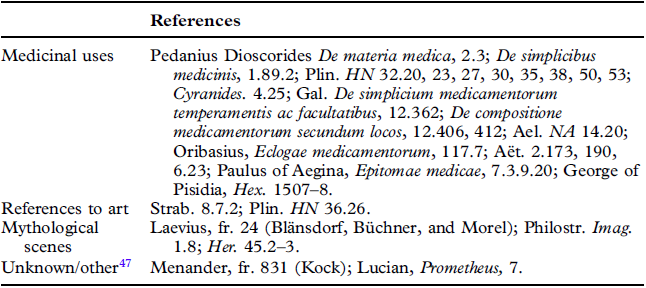
From here, the word ἱππόκαμπος/hippocampus is startlingly rare in ancient Greek and Latin texts, with only twenty-eight passages up the eighth century ᴀᴅ that contain one or more use of the word. These can be meaningfully categorized into three groups: medical remedies, references to art, and mythological scenes (Table 1).
Passages with ἱππόκαμπος/hippocampus in ancient Greek and Latin texts up to the eighth century ᴀᴅ

Table 1 Long description
A table categorizing references to the word hippocampus in ancient Greek and Latin texts up to the eighth century. The table has four rows and three columns. The columns are labeled Medicinal uses, References to art, and Mythological scenes. Row 1: Medicinal uses, Pedanius Dioscorides De materia medica, 2.3; De simplicibus medicinis, 1.89.2; Plin. HN 32.20, 23, 27, 30, 35, 38, 50, 53; Cyranides. 4.25; Gal. De simplicium medicamentorum temperamentis ac facultatibus, 12.362; De compositione medicamentorum secundum locos, 12.406, 412; Ael. NA 14.20; Oribasius, Eclogae medicamentorum, 117.7; Aet. 2.173, 190, 6.23; Paulus of Aegina, Epitomae medicae, 7.3.9.20; George of Pisidia, Hex. 1507–8. Row 2: References to art, Strab. 8.7.2; Plin. HN 36.26. Row 3: Mythological scenes, Laevius, fr. 24 (Blansdorf, Buchner, and Morel); Philostr. Imag. 1.8; Her. 45.2–3. Row 4: Unknown/other, Menander, fr. 831 (Kock); Lucian, Prometheus, 7.
Out of these sparse extant uses of the word ἱππόκαμπος/hippocampus, the majority can be identified as probably referring to sea horses, rather than this imaginary animal, a feature noted in passing in previous scholarship.Footnote 44 This usage of the term features predominantly in ancient medicine as we see the earliest use from Pedanius Dioscorides (fl. first century ᴀᴅ), describing the hippocamp as a ‘small sea animal’ (θαλασσιόν ἐστι ζῷον μικρόν), whose ashes can be mixed with liquid pitch as a cure for baldness.Footnote 45 Pliny the Elder reports a similar cure for hair loss with one ingredient being the ashes of these creatures (HN 32.23).Footnote 46 Other remedies imply that it is a creature small enough to be tied to the bodies of those suffering a fever or used in a similar manner as an aphrodisiac (HN 32.38, 50).Footnote 48 They are likewise mentioned occasionally throughout the medical works of Galen and Oribasius.Footnote 49 Aelian furnishes one of the more elaborate descriptions of sea horses in medical uses. He describes how the stomachs of these animals, when boiled in wine, create a potent poison. Those who survive ingesting this poison remain possessed by an unnaturally strong desire for water, often now spending much time near water sources and swimming, a hydrophilic property that can be used to cure the hydrophobia of rabies (NA 14.20).Footnote 50
It seems, then, that for the ancient Greeks and Romans, the word was more likely to conjure up images of tiny sea horses, while uses of it to refer to the imaginary animal were far less known. In this regard, we may recall the aforementioned reference from Pausanias to a hippocamp. There, he seems to struggle for a term to even record the sight of this sculpture, describing it awkwardly as he does, rather than simply calling it a ἱππόκαμπος. It is not implausible to suggest that Pausanias and others in the ancient world may have been unaware that the word was sometimes used as such, knowing it instead as only a term for the smaller real animal.Footnote 51
Nevertheless, some authors in antiquity evidently did link the term to hippocamps as we know them today, though they were a clear minority. Aside from the fragment of Laevius, only four other instances of the word in ancient texts can be securely identified as referring to the hippocamps themselves. Significantly, all four references occur within the contexts of describing art, material culture, or ekphrastic scenes. Strabo preserves a fragment of the poet Eratosthenes concerning a sunken temple to Poseidon near Helice where a local ferryman saw ‘A bronze Poseidon, standing upright, holding a hippocamp in his hand, and that it posed danger to those fishing with nets’ (Strab. 8.7.2).Footnote 52 Pliny the Elder, in describing the sculpture group of Skopas states that there are Nereids ‘seated upon dolphins, κήτη (cete), or hippocamps’ (HN 36.26).Footnote 53 Philostratus the Elder also furnishes us with an ekphrastic scene based on Poseidon’s journey over the sea in the Iliad:
I think you have encountered Poseidon going across the sea in Homer, when he goes to the Achaeans from Aegae, and the sea is calm, escorting him with its horses and κήτη. For there they follow and fawn upon Poseidon as here. There, I think you imagine land horses for they are ‘bronze-hooved’, ‘swift-running’, and ‘struck with the lash’. But here it is hippocamps drawing the chariot, which are wet-hooved, swimmers, blue-eyed, and, by Zeus, just like dolphins (Imag. 1.8).
In his Heroicus, we have another scene that, though not wholly ekphrastic, is, nevertheless, still allusive to the scenes we find in visual media, which includes a reference to a sea goddess riding a hippocamp (Her. 45.2–3). The hippocamps, then, even when called by their proper name in textual sources, do not often deviate from the roles that they play within art as steeds for the marine divinities.
The only other identifiable textual references to hippocamps occur, not through explicit use of the word ἱππόκαμπος/hippocampus, but where we have descriptions of them detailed enough to identify these marine equine figures as being other than ordinary (sea) horses. Such references are further indicative of the term’s rarity to signify hippocamps in antiquity. One such instance can be seen with the description of a demon in the pseudepigraphal Testament of Solomon. Like Pausanias, the anonymous author seems uncertain of a word to describe the creature that a demon has taken the form of, remarking that it inhabits ‘the form of a horse in front and a fish in back’ (τὴν μορφὴν ἔμπροσθϵν ἵππου, ὄπισθϵν δὲ ἰχθύος).Footnote 54
This tendency to describe the bodies of hippocamps, rather than name them as such, then, occurs commonly within Latin poetry. Thus, Vergil describes the chariot of Proteus being pulled by ‘bipedal horses’ (bipedum … equorum, G. 4.389), a phrasing that was picked up by later Latin authors to emulate Vergil.Footnote 55 Statius, likewise, includes a pair of hippocamp references in his works when describing the horses that pull Neptune’s chariot: ‘There, Neptune leads his horses, feeble from the Aegean depths, into the harbour. In front their hooves dig up the sand, in back their fishy parts unravel into the water (postrema solvuntur in aequora pisces, Theb. 2.45–7), and ‘From their chests they gather up a foamy course, behind they swim and they wipe away the tracks of their feet with their tails’ (Achil. 1.59–60). Both of Statius’ passages emphasize the hybridity of the hippocamps, drawing attention to the dual nature of their bodies. Other likely allusions to hippocamps occur when horses are described with sea-colours or called marine horses, such as Ovid’s reference to a Triton traversing the water with ‘caerulean horses’ (caeruleis … equis, Epigr. 7.50), and Nonnus’ reference to Poseidon’s ‘sea-bred horses’ (βυθίων … ἵππων, Dion. 32.267). Although known to utilize Pliny the Elder’s Natural History in his own work, and, therefore, presumably aware of the word hippocampus, Isidore of Seville describes them with language allusive to Statius, as only ‘marine horses (equi marini), which are in the front part horse, and from behind unravel into fish’ (postrema solvuntur in piscem, Etym. 12.6.9). Similarly, Rabanus Maurus refers to them only as equi marini, also using a portion of the above quote from Statius’ Thebaid to describe them.Footnote 56 This dominant tendency in textual sources to describe, rather than name, hippocamps perhaps further reinforced the barrier between any identification of the mythical creature and the real animal.
Other mixokētē in ancient art and literature
While hippocamps themselves suffered from an imbalance in their position in ancient visual media relative to textual sources, this issue is even more acute for their mixokētē cousins. It is only from around the fourth century ʙᴄ onwards that hippocamps begin to be complemented by visual representations of other marine versions of terrestrial animals, including the panther, ram, lion, and others.Footnote 57 Hellenistic artists had evidently innovated upon the basic notion of a marine version of a horse to creatively imagine similar forms. One of the most common of these is the sea panther, leading to scholarly speculation that this emerging trend was also influenced by the Dionysiac thiasos since ordinary panthers feature so prominently among Dionysus’ retinue.Footnote 58
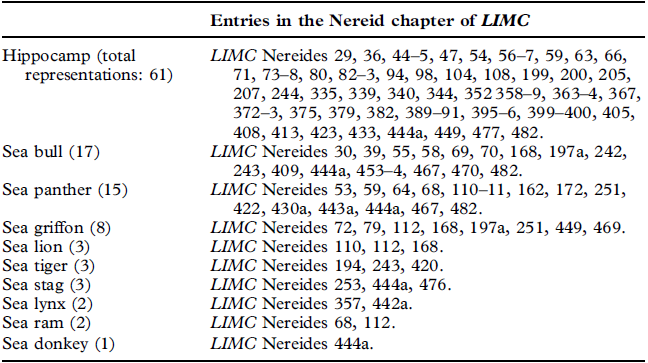
The advent of these mixokētē is further bound up with the acquisition of forelegs for the κῆτος in the same century, whereby Hellenistic artists effectively appropriate the torso of the hippocamps for both κήτη and mixokētē. Footnote 59 In such cases, the distinctively equine legs of the hippocamps are replaced with generically mammalian forepaws, illustrating a commonality of bodily forms below the neck for these mixokētē. An ideal example of such figures occurs on a second-century-ᴀᴅ marble sarcophagus, where four Nereids ride a sea panther, a sea griffon, a sea ram, and a sea lion, all of which possess identical bodies and tails that wind upward in a fashion seen elsewhere with κήτη on sarcophagi.Footnote 60 These mixokētē serve almost exclusively as mounts for the Nereids in art, and an examination of the LIMC entry for the Nereids suffices to indicate the relative prevalence of each type (Table 2).
LIMC instances of hippocamps and mixokētē with the Nereids

Table 2 Long description
A table listing LIMC entries of Nereids with various sea creatures. The table has 11 rows and 2 columns. The first column lists the types of sea creatures and their total representations, while the second column lists the corresponding LIMC Nereides entries. The sea creatures listed include Hippocamp (61 representations), Sea bull (17), Sea panther (15), Sea griffon (8), Sea lion (3), Sea tiger (3), Sea stag (3), Sea lynx (2), Sea ram (2), and Sea donkey (1). Each row provides specific LIMC Nereides entries associated with each type of sea creature.
After hippocamps themselves, sea bulls and sea panthers were clearly the most popular. Individual artists could craft their own innovations on the basic idea of such imaginary animals, as we see with the unique example of a sea donkey on a fourth-century ᴀᴅ mosaic which seems intended to exemplify the variety of mixokētē (representing seven different types in total).Footnote 61 Another seemingly unique type is a sea leopard, ridden by a Nereid on a fragment of a second-century-ᴀᴅ mosaic, now in the Archaeological Museum of Sousse. Suitable for its marine environment, the ordinarily yellow fur has been exchanged for a caerulean coat, though its distinctive spots remain (Figure 3). While already a rarity for hippocamps, there are no extant examples of any mixokētē with identifiably male riders, presumably a result of their emergence at only a later date. It is only seldom that they are even depicted in art functioning in any context that departs from the usual iconographic repertoire of hippocamps.Footnote 62 Some do occasionally appear by themselves without being ridden by a Nereid, as with a similarly caerulean sea stag from a first-century-ᴀᴅ Roman mosaic, now in the Museum of Alba (Figure 4). But, in most cases, they are, like hippocamps, found alongside the anthropomorphic marine gods in artistic media. Thus, hippocamps provided the basic visual template of a terrestrial animal that possesses a marine version for Hellenistic (and later) artists to innovate upon for the forms of κήτη and mixokētē in subsequent centuries.
Fragment of a Roman mosaic second century ᴀᴅ (Wikimedia Commons Image).

Roman fresco, first century ᴀᴅ (Wikimedia Commons Image).

Turning, again, to the textual sources, we may first note that, whereas the word ἱππόκαμπος/hippocampus itself was only rarely used to refer to these mythical creatures, these other mixokētē seem to have entirely lacked contemporary terms to describe them. Scholars have occasionally offered up terms such as ‘pardalokampoi’Footnote 63 or ‘taurocamps’Footnote 64 to describe sea panthers and sea bulls, respectively. But, these are purely modern inventions; no such words are ever extant in ancient texts. This lack of searchable terms creates a further challenge in identifying them. In the rare instances when such creatures are referred to, they are typically known only by the names for their terrestrial counterparts, or being sea-coloured versions of them. Ovid, for instance, portrays a creature reminiscent of a mixokētos with the head of a bull. He describes it, similar to Pausanias’ hippocamp description in the next century, with reference to its lower half: ‘There was a bull, a miraculous monster, born of mother earth, which had the body of a serpent (serpens) for its posterior half’ (Fast. 3.799-800). Such serpentine language here salutes the snake-like qualities of κήτη. A more extended description, then, comes with the sea bull from Seneca’s Phaedra:
The lofty bull (taurus), carrying its caerulean neck, with a tall mane rising from its verdant brow; its shaggy ears standing upright, the varying colours for its eyes, both those that a ruler of a wild herd would have and those of a being born under the waves. Hence, the eyes spew forth flames,Footnote 65 and they also glow with a remarkable caerulean quality. The thick neck raises its hard muscles and the nostrils, being broad and gaping, snort with its breathings. Its chest and skin on its neck are verdant with clinging moss. Its long sides are scattered with red seaweed. Then, the portions behind its back converge into a monster (in monstrum), an immense beast (belua), carrying an immense scaled part. Such is the sea monster (pistrix) that swallows down or smashes swift boats (Phaed. 1036–49).
Notably, Seneca’s description depends on terms associated with sea monsters themselves, such as pistrix Footnote 66 and belua, to portray this creature, deliberately placing an emphasis on the serpentine nature of a figure otherwise referred to as a taurus.
This type of extended description for a single mixokētos, which makes the creature easily identifiable, is a rarity in ancient poetry. A more subtle instance comes in Valerius Flaccus’ description of Neptune’s chariot being pulled by ‘half-wild wolves’ (semiferum … luporum).Footnote 67 This peculiar phrase has led to the puzzlement of modern scholars,Footnote 68 but this specific wording can be explained as another effect of the associations of hippocamps with κήτη. As I have demonstrated elsewhere, there are also strong canine associations within the cultural conceptions of κήτη, which are frequently referred to as dogs themselves,Footnote 69 and probably explain the appearance of such canines in a marine context. The adjective semiferus in this phrase, then, simply functions to denote the hybridity of such animals.Footnote 70 Thus, the creatures here pulling Neptune’s chariot are not ordinary terrestrial wolves, but imaginary sea wolves, thereby placing such creatures in a role ordinarily ascribed to hippocamps. Valerius Flaccus, in using the two creatures interchangeably, further signifies the conceptual closeness of hippocamps and the sometimes canine κήτη in ancient thought. Other scenes from ancient poetry can also be brought forth as examples of a tendency to portray ekphrastic scenes of mixokētē in their other major role from ancient art – as mounts for the Nereids. Moschus, for instance, succinctly refers to Nereids riding on the backs of ‘κῆτος-like’ (κητϵίοις) beasts when they accompany Europa being led across the water (Mosch. Europa 119). Centuries later, Claudian also describes Nereids riding on the backs of various beasts (feris), including a tiger (tigris), a ram (aries), a caerulean lioness (caeruleae … leaenae), and a calf (iuvencum).Footnote 71
By the Roman period, these forms of mixokētē evidently also sometimes broke out of the mould of such ekphrastic scenes, and departed from their traditional position of serving as mounts for the Nereids. Such a feature is first glimpsed with the passing mention by Diodorus Siculus that Arabia breeds ‘κῆτος-like land animals and dimorphous animals’ (ζῷα κητώδη χϵρσαῖα καὶ δίμορφα, 2.54.5). A more descriptive pair of references from the works of ancient naturalists, then, claim such figures to be live animals in distant spaces. Pliny the Elder states that in India ‘There are beasts (beluae), resembling domestic animals that come out onto land and, having grazed on roots and shrubs, they return to the sea. And there are some with the heads of horses, donkeys, and bulls, which graze on such crops’ (HN 9.2). Aelian, relying on a fragment of Megasthenes that had probably influenced Pliny as well, refers to similar creatures. He, however, furnishes us with more details, describing how such animals crawl out of the sea and graze on the shores (specifying that they do this only at night). Crucially, he names them explicitly as types of κήτη and that they too ‘have the heads of lions, leopards, wolves, and rams, and still other wonders’.Footnote 72 The mixokētic pets of the Nereids in ancient art had evidently been recast as wild beasts imagined here to dwell in distant exoticized spaces. These references are, then, illustrative of an occasional feature wherein artistic creatures were imported into the pages of naturalistic texts, thereby becoming an object of interest also for ancient animal studies.
Aelian’s statement that these animals are types of κήτη also grants us a plausible explanation for how the ancient Greeks and Romans probably referred to such mixokētic figures since they seem to have lacked specific terms for them. An enterprising individual, wishing to direct an artist on which representation to include in a commissioned mosaic, could simply have described the figures he desired to be portrayed as a ‘lion-headed κῆτος’ or a ‘panther-headed κῆτος’ in a similar (albeit inverted) fashion to Pausanias’ description of a hippocamp as a horse with the body of a κῆτος. Such thought, after all, can also be seen to have continued for centuries with the Byzantine Suda defining κῆτος as a ‘sea beast of many forms’ (θαλάσσιον θηρίον πολυϵιδές), and listing several types, among which are the lion (λέων), panther (πάρδαλις), and ram (κριός).Footnote 73 By the middle Byzantine era, then, the word κῆτος itself could be defined with reference to such variations on its basic form, variations which ultimately stemmed from the place of hippocamps in the ancient imagination.
Conclusion
We may, then, summarize the main features of hippocamps and other mixokētē in three interrelated points: (1) the debt of these figures to κήτη; (2) the vestigial links between the hippocamps and sea horses in terms of their name; (3) the later Hellenistic and Roman imagining of them as creatures that do exist in distant spaces. It is possible that, while hippocamps started out as exaggerated sea horses, as per Shepard’s theory, they came to fall under the influence of and association to the monstrous κήτη as a result of ancient artists using a common model for the lower half of several imaginary animals. Thus, hippocamps begin life in the art of the seventh century ʙᴄ with their strong association with supernatural divinities, but ultimately wind up in the pages of naturalistic texts such as Aelian’s De natura animalium. It is their lack of a narrative role in a particular myth that perhaps helped guide them towards becoming imagined as actual animals, albeit fantastical ones, in faraway lands.
The hippocamps and the other mixokētē, then, are illustrative of the underlying imaginative reflexes behind some imaginary animals in Graeco-Roman thought, and such figures would also persist well into the medieval world and beyond. For instance, they still thrived throughout Byzantine art, as with the example of a bronze hippocamp (or other mixokētic animal) that was reportedly looted from the spina of the hippodrome in Constantinople when the city was sacked in 1204.Footnote 74 Their distinctly hybrid nature affords them such a unique place as beasts both at home within the sea, though eerily reminiscent of the terrestrial world. We may contrast this with the frequent supposition of modern scholars that such mythical figures arise only out of misapprehensions of the natural world. This occurs, for instance, throughout Otto Keller’s multivolume Die Antike Tierwelt (1980). Keller ascribes Pliny’s and Aelian’s creatures that I have discussed above to being mere distorted sightings of actual animals in India, hastily declaring that ‘from the somewhat embellished report, it is clear that this is the dugong’.Footnote 75 This tendency towards such historization of mythical creatures can, moreover, be seen elsewhere with merpeople habitually being rationalized as sightings of dugongs.Footnote 76 Such a rationalist mode of analysis, which has been widespread in the twentieth century as a result of the influence of figures such as Robert Graves,Footnote 77 accords almost no role for the human imagination, seeing myth as fundamentally distorted history and imaginary animals as purely misconceptions of real animals.
Yet this rationalist form of interpretation falls short in that it entirely omits the cultural influences within such mythical constructions. Hippocamps do have a passing resemblance to sea horses as well as a genetic link through their name in Greek. But it is hardly credible to think that these figures come from mere distortion of those tiny sea horses alone, nor of the misapprehension of animals such as dugongs. The more salient point is to examine, instead, the ideological forces that directed such ideas to form in the first place, and how they are received within such cultures, particularly given the effects of their hybridity, a feature they share with other ancient Mischwesen. Indeed, as mentioned in the introduction as part of Jeffery Jerome Cohen’s Monster Theory, and a feature similarly stressed in cognitive studies,Footnote 78 this formation from different animal parts is effectively a monstrous category failure between two animals. To modern eyes, it may not seem quite right to categorize hippocamps as themselves being ‘monstrous’, at least as we use such a term today. Their distinctively marine, yet equine, nature does not seem to elicit a feeling of unease as with most classical monsters. It seems difficult to look at the reined hippocamp of the Ephesus mosaic (Figure 2), for instance, and consider it as anything other than the precise equivalent of our own domesticated horse. But this perspective is, in part, a result of our modern sensibilities about horses themselves, which we hardly associate with other malevolent forces. There was, after all, as Griffith has emphasized, a wide gulf between modern and ancient Greek ideas about horses.Footnote 79 It may also be, then, that our modern views on equine nature overwhelmingly dominate our perspective of hippocamps more so than their κῆτος-like qualities, precisely because of the lack of familiarity with the κῆτος itself in the modern world. The result is a modern tendency to feel primarily affection for them as we would for our terrestrial equine companions.
In interpreting such imaginary animals we should also, however, keep in mind the more negative Graeco-Roman associations with horses discussed in the introduction, along with the monstrousness of their hybridity, which may have cultivated a different set of associations with such images to ancient viewers. Divinities in the form of sea people thrived in the Graeco-Roman cultural imagination, and it seems only natural that they should possess sea steeds, just as actual humans do. Human in form though they may be, these divinities were not without their potential for malevolence and threats to humans themselves, and so we should not expect their sea steeds to have been received in the same way we see them as playful, wholly positive figures like our own domesticated equines in the contemporary world.
The major significance of hippocamps and other mixokētē for ancient animal studies is that they illustrate the creative capacities of artistic media to generate and popularize new types of animals within a cultural imagination by projecting radically different creatures into the marine environment. It is that impact of the cultural imagination that needs to taken into account more fully in such assessment of imaginary animals. Before such creatures became live animals, considered by Aelian and others to dwell into the distant waters of India, these were appearing as the creative companions of marine divinities in the visual media of the Graeco-Roman world. Cultural concepts routinely precede such real-world contexts as we have them in many ancient textual sources. It was the particular thought patterns and cultural ideologies about the sea and its animals that formed the generative elements out of which such creations emerged. In this case, such imaginary animals first took shape within artistic media and only later came to be perceived within natural environments alongside other animals.




 Open access

