Acquiring knowledge of words is an important aspect of language learning. Young children seem to acquire lexical knowledge very rapidly, and even children who have been raised in a language other than the language used at school seem to expand their vocabulary rather quickly. Lexical knowledge is one of the key factors in reading comprehension (Tannenbaum, Torgesen, & Wagner, Reference Tannenbaum, Torgesen and Wagner2006) that in turn is fundamental to school success (Carlo et al., Reference Carlo, August, McLaughlin, Snow, Dressler and Lippman2004; Vermeer, Reference Vermeer2001). Several studies have shown that bilingual children who receive less input at home in the society's dominant language lag behind their monolingual peers in lexical knowledge. Differences have been reported for vocabulary size (Appel & Vermeer, Reference Appel and Vermeer1998; August, Carlo, Dressler, & Snow, Reference August, Carlo, Dressler and Snow2005; Verhoeven & Vermeer, Reference Verhoeven and Vermeer1993). For example, Umbel and colleagues found that first-grade, bilingual Hispanic children in the United States have poorer receptive knowledge of second-language (L2) words than their age mates who speak English as their first language (L1; Umbel, Pearson, Fernandez, & Oller, Reference Umbel, Pearson, Fernandez and Oller1992).
Striking differences have also been reported for the kind of knowledge monolingual and bilingual children have of seemingly familiar words. Verhallen (Reference Verhallen1994; Verhallen & Schoonen Reference Verhallen and Schoonen1993) compared 9- to 11-year-old Turkish–Dutch and monolingual Dutch children. She investigated their semantic word knowledge as reflected by meaning assignment to words in an extended definition task. She found that the bilingual children consistently attribute fewer meaning aspects even to very simple Dutch words and that their knowledge is also more context specific. Cross-sectional data collected from fourth-grade Spanish-speaking and English-only students from four schools in the United States corroborate that English-language learners not only know fewer English vocabulary words but that their knowledge of word meaning is lacking as well (August et al., Reference August, Carlo, Lively, Lippman, McLaughlin and Snow1999). Two tasks examined children's understanding of the multiple meanings of words in both production and comprehension. The data showed a clear gap in scores to the advantage of the monolingual children.
Together with differences in lexical knowledge, significant delays in reading comprehension skills of bilingual children are signaled despite their having received the same education as monolingual children. In a review of research August and colleagues (Reference August, Carlo, Dressler and Snow2005) report that children speaking English as a second language who experience slow vocabulary development are less able to comprehend text at grade level than their English-only peers. They mention large and persistent gaps between the reading comprehension of language-minority and English-only children as a result (see also Proctor, Carlo, August, & Snow, Reference August, Carlo, Dressler and Snow2005). In a longitudinal study with Hispanic English-language learners Nakamoto, Lindsey, and Manis (Reference Nakamoto, Lindsey and Manis2007) found that the students’ reading comprehension but not their word decoding began to fall behind the native English-speaking sample, starting in the third grade (~9 years old). Smits and Aarnoutse (Reference Smits and Aarnoutse1997) also found that throughout primary education bilingual students do not fail in decoding skills such as spelling and word reading, but they do lag behind in comprehension skills such as reading comprehension and vocabulary. Word decoding and reading comprehension have been shown to become less correlated as children progress through elementary school (Curtis, Reference Curtis1980; Sticht & James, Reference Sticht, James and Pearson1984; Verhoeven, Reference Verhoeven1990), but at the same time early word reading is a good predictor of later reading comprehension (Mancilla-Martinez & Lesaux, Reference Mancilla-Martinez and Lesaux2010; Nakamoto, Lindsey & Manis, Reference Nakamoto, Lindsey and Manis2008). More recently, Droop and Verhoeven (Reference Droop and Verhoeven2003) showed significant delays in reading comprehension but not decoding for a group of third- and fourth-grade minority children when compared to monolingual Dutch children. Finally, in a large-scale study in the Netherlands on word knowledge, reading, and writing literacy, Verhoeven and Vermeer (Reference Verhoeven and Vermeer2006) found Mediterranean minority children's competence in meaning assignment to written words increasingly lags behind those of their native Dutch peers with a delay of two to three school years by grade four (Dutch Grade 6, ~10 years old). While decoding differences between children were small, they found major delays in reading skills of ethnic minority groups in comparison to their native peers.
Delays in reading comprehension and vocabulary are extremely difficult to overcome. Aarnoutse, Van Leeuwe, Voeten, and Oud (Reference Aarnoutse, Leeuwe, Voeten and Oud2001) report a 2-year delay between Dutch proficient and less proficient reading comprehenders that persists throughout elementary school. In a study conducted in Canada, Farnia and Geva (Reference Farnia and Geva2007) show that even after years of schooling, ethnic minority children do not catch up with their monolingual age mates. In line with this is the finding that early gaps in word knowledge persist throughout elementary school (Biemiller, Reference Biemiller, Hiebert and Kamil2005). Although the connection between lexical knowledge and reading comprehension is evident (cf. Mancilla-Martinez & Lesaux, Reference Mancilla-Martinez and Lesaux2010; Nakamoto et al., Reference Nakamoto, Lindsey and Manis2008; Proctor et al., Reference Proctor, Carlo, August and Snow2005), the exact nature of the relationship and which aspects of lexical knowledge are involved is not altogether clear. Cromley and Azevedo (Reference Cromley and Azevedo2007) suggested that limitations in lexical knowledge are causally related to reading comprehension failure.
In sum, differences in lexical knowledge between monolingual and bilingual children are not restricted to vocabulary size but also hold for knowledge of word meaning. Reported delays in lexical knowledge run parallel to delays in reading comprehension. This raises the question to what extent individual differences in lexical (semantic) knowledge and processing can explain individual differences in reading comprehension. To understand the relationship between these differences, a closer look at the acquisition of lexical knowledge and some of the processes involved is in place.
MULTIDIMENSIONALITY OF WORD KNOWLEDGE
Although lexical knowledge is most commonly thought of and assessed as number of words known, or breadth of vocabulary, it is now increasingly clear that richness of the representation of the individual words known is also a crucial dimension of variability (Ordóñez, Carlo, Snow, & McLaughlin, Reference Ordóñez, Carlo, Snow and McLaughlin2002; Wesche & Paribakht, Reference Wesche and Paribakht1996). This dimension is often referred to as depth or quality of lexical knowledge. Depth of word knowledge comprises several dimensions referring to the levels that any lexical representation consists of, such as phonological, semantic, syntactic, and, in written language, orthographic information (Nagy & Scott, Reference Nagy, Scott, Mosenthal, Kamil, Pearson and Barr2000; Nation, Reference Nation1990; Read, Reference Read, Harley and Hulstijn2004). All these aspects can be known to varying degrees. Although different frameworks distinguish different aspects of lexical knowledge or ability (Aitchison, Reference Aitchison2003; Chapelle, Reference Chapelle1994; Henriksen, Reference Henriksen1999; Laufer, Reference Laufer, Schmitt and McCarthy1998; Nation, Reference Nation1990), virtually all approaches concur in stressing the distinction between breadth and depth of lexical knowledge. In addition, Chapelle's (Reference Chapelle1994) framework includes a processing component, needed to gain access to lexical knowledge. Similarly, Nagy and Scott define knowing a word as being able to “recognize it in connected speech or in print, to access its meaning, to pronounce it—and to be able to do these things within a fraction of a second” (2000, p. 273). In this paper depth refers only to the semantic level, that is, to knowledge of word meaning, and not, for example, to syntactic knowledge. Accessibility of semantic word knowledge is considered a separate component.
The recognition of a breadth and a depth dimension of lexical knowledge is seen in models of the mental lexicon. Following Levelt, Roelofs, and Meyer (Reference Levelt, Roelofs and Meyer1999), vocabulary storage involves lexical representations of the stored phonology or sound patterns of words within the lexicon, along with semantic representations of word meaning. Current (multilingual) models of lexical access such as the adapted bilingual interactive activation model (Dijkstra & Van Heuven, Reference Dijkstra, Heuven and Jacobs1998; Reference Dijkstra and Heuven2002) and the revised hierarchical model (Kroll & Stewart, Reference Kroll and Stewart1994) also distinguish a lexical (form) and a semantic (meaning) level. Meara and Wolter (Reference Meara and Wolter2004) distinguish between vocabulary size and organization in which organization reflects the complexity of the lexical network. The models show that the mental lexicon is an active system: new links are perpetually being formed with implications for the organization of the whole network. From this follows that the development of breadth and depth of word knowledge is interrelated and that words do not have meanings in isolation.
SEMANTIC VERSUS CONTEXTUAL WORD KNOWLEDGE
The acquisition of word meaning is an incremental process. Nelson (Reference Nelson1977, Reference Nelson and Moscovitz1984) proposed that young children represent information in generalized event-based scripts (e.g., “getting dressed in the morning” or “eating lunch”), maintaining the spatial and temporal relationships between objects. Initially, word knowledge is idiosyncratic and limited to the specific contexts in which words are encountered. From this script-based knowledge, Nelson hypothesizes that children gradually abstract and refine category information. This happens through repeated encounters with concepts, words, and related concepts and words. In this way children develop their personal and sometimes idiosyncratic meanings into more conventional and so-called shared meanings of words (Nelson, Reference Nelson2007). In line with this, Petrey (Reference Petrey1977) showed that in word association tasks young children are more likely to respond with contextually related words (“episodic responses”) than with semantic associations: “Young children associate primarily to the stimulus word's perceived contexts, older subjects to its abstract semantic content” (p. 57). A child will normally have a more or less context-independent, abstract understanding of many words some time within the 5- to 9-year-old age range (Nelson, Reference Nelson1977; Petrey, Reference Petrey1977). Thus, by the end of elementary school (around the age of 11), children may be expected to have both a firmly rooted contextual knowledge of words and a well-developed context-independent, semantic knowledge of words.
In this study we distinguish between contextual and semantic word knowledge, a distinction that is consistent with the opposition between episodic and semantic memory used by Petrey (originating from Tulving, Reference Tulving, Tulving and Donaldson1972). The distinction is similar to De Groot's (Reference De Groot1980) distinction between subjective and objective semantic relations; it diverges from the much used word-class based syntagmatic–paradigmatic distinction (e.g., Cronin, Reference Cronin2002). The term semantic word knowledge will refer to knowledge that is inherent to the word's meaning and not limited to any context in which a word can occur (e.g., knowing that a dog is an animal rather than knowing that it is cute). In that sense semantic refers to more abstract knowledge or a shared meaning of words (cf. Nelson, Reference Nelson2007). Because cute is not part of the core meaning of dog but is only indirectly or circumstantially related to its meaning in a certain context, such knowledge will be called contextual. Verhallen (Reference Verhallen1994; Verhallen & Schoonen, Reference Verhallen and Schoonen1993) showed that bilingual children associate qualitatively different meaning aspects with words than their monolingual peers. Bilinguals have less rich semantic representations of simple words: they showed more contextual word knowledge (nose—to wash your nose) and less semantic, hierarchical word knowledge (nose—body part, to blow your nose) and mentioned fewer defining characteristics of words. Of course there is no absolute but a gradual difference between semantic and contextual word knowledge. The distinction simplifies the actual continuum that exists as we go from more semantically to more contextually related words. The relation between robin and bird seems to have more semantic content than the relation between wing and bird, which again is more semantic than the relation between tree and bird.
We store and retrieve both semantic and contextual information about words. When encountering the word dog, the semantically related word animal and the contextually related word cute may both be needed and become activated, depending on the situation, the speaker's intention, or the task at hand. As knowledge of word meaning becomes more abstract, words can be used more flexibly and their meaning can be more readily accessed within multiple contexts (Anderson & Freebody, Reference Anderson, Freebody and Guthrie1981; Beck, McKeown, & Kucan, Reference Beck, McKeown and Kucan2002). Because of its context-independent nature semantic word knowledge may be particularly useful in reading comprehension.
As word meanings become well established through frequent exposures, the time it takes to access them decreases (Wolf, Miller, & Donnelly, Reference Wolf, Miller and Donnelly2000). In this paper we use accessibility as a neutral term for speed (reflecting ease) of access to word meaning. Accessibility does not refer to the quality of the lexical network per se. Yet it is the interconnectedness of lexical–semantic information on which accessibility builds (Perfetti & Hart, Reference Perfetti, Hart, Verhoeven, Elbro and Reitsma2002). Explaining their lexical quality hypothesis Perfetti and Hart (Reference Perfetti, Hart and Gorfein2001) state: “High-quality [lexical] representations are what drive rapid processing” and they “are responsible for automaticity (or at least efficiency) of word identification, which is what allows processing resources to be devoted to higher level comprehension” (p. 76). Thus, fast access to word knowledge, be it semantic or contextual, enables comprehension. Less clear is whether readers differ in the accessibility of their semantic word knowledge and whether that has its own effect on reading comprehension.
WORD KNOWLEDGE AND READING
The unique role of semantic word knowledge in reading comprehension has been shown repeatedly. Qian (Reference Qian1999a, Reference Qian1999b, Reference Qian2002) used a depth of vocabulary knowledge test measuring knowledge of synonymy, polysemy, and collocations and tested English L2 university students. He found that scores on the depth test uniquely contributed to the prediction of reading comprehension levels. He even concluded that depth and breadth of lexical knowledge are equally important in predicting reading comprehension. Nation and Snowling (Reference Nation and Snowling2004) found that performance of young children on semantic tasks predicted a substantial amount of variance (15.1%) in reading comprehension when entered into separate regression models following age, nonverbal intelligence, and phonological skills. Ouellette (Reference Ouellette2006) reported a unique contribution of semantic representation beyond vocabulary size, age, nonverbal IQ, decoding, and visual word recognition in fourth-grade readers. Schoonen and Verhallen (Reference Schoonen and Verhallen1998) found a unique contribution to reading comprehension of children's semantic, context-independent word knowledge as reflected in their performance on the word association task (WAT).
Yet the exact link between semantic word knowledge and reading comprehension is not understood in a clear way even now, by virtue of its complexity. Research testifies to the recurrent nature of component interactions (e.g., Beck, Perfetti, & McKeown, Reference Beck, Perfetti and McKeown1982). Word knowledge allows comprehension, comprehension allows reading practice, reading practice strengthens word knowledge, and so forth. Ease of accessing semantic word knowledge is important because semantic word knowledge may play a role in both the identification of words (at least in nontransparent orthographies) and comprehension (Perfetti, Landi, & Oakhill, Reference Perfetti, Landi, Oakhill, Snowling and Hulme2009). Perfetti and colleagues (Reference Perfetti, Landi, Oakhill, Snowling and Hulme2009) posit that “[t]his dual role of word meanings places lexical semantics in a pivotal position between word identification and comprehension” (p. 241). Longitudinal studies with young Spanish-speaking learners of English have shown that both word decoding fluency and vocabulary knowledge at a younger age are predictive of later reading comprehension proficiency (Mancilla-Martinez & Lesaux, Reference Mancilla-Martinez and Lesaux2010; Nakamoto et al., Reference Nakamoto, Lindsey and Manis2008; Proctor et al., Reference Proctor, Carlo, August and Snow2005). Such mechanisms are reflected in intervention studies. Beck and colleagues (Reference Beck, McKeown and Kucan2002) suggested that accessibility to word meanings may be an important factor in explaining differences in outcomes from vocabulary training studies. They showed that instruction that involves multiple repetitions helps improve the speed of accessing the word's meaning. Studies that provided this rich vocabulary instruction showed gains in both word knowledge and comprehension of text containing the words taught (Beck, McCaslin, & McKeown, Reference Beck, McCaslin and McKeown1980; Beck & McKeown, Reference Beck and McKeown1983; McKeown, Beck, Omanson, & Perfetti, Reference McKeown, Beck, Omanson and Perfetti1983). Vocabulary instruction that does not produce sufficient fluency of access was found to not generalize to reading comprehension (cf. Jenkins, Pany, & Schreck, Reference Jenkins, Pany and Schreck1978).
Accessing or activating words is easier when they are related. In addition to being more or less semantically related, words may be associated. Association strength between two words springs from their common co-occurrence in language use and is reflected in people's free word associations. The greater the association strength between two words, the easier they activate one another (Fitzpatrick, Reference Fitzpatrick2007). Words may be weakly associated yet semantically similar (e.g., radish–beets) and they may also be highly associated yet semantically dissimilar (e.g., coat–rack; examples from Thompson-Schill, Kurtz, & Gabrieli, Reference Thompson-Schill, Kurtz and Gabrieli1998). In general, word recognition studies show more coactivation between related words (priming) when words are not only semantically but also associatively related (e.g., dog–cat) as compared to purely semantically related words (e.g., apple–lemon): the so-called associative boost (Abad, Noguera, & Ortells, Reference Abad, Noguera and Ortells2003). Controlling for association strength between stimuli allows one to measure sensitivity to purely semantic information, for example, during reading.
There is mounting psycholinguistic evidence that children less proficient in comprehension have problems with semantic processing (Nation & Snowling, Reference Nation and Snowling1998, Reference Nation and Snowling1999, Reference Nation and Snowling2004; Ricketts, Nation, & Bishop, Reference Ricketts, Nation and Bishop2007). In a study with 10- to 11-year-old children, Nation and Snowling (Reference Nation and Snowling1999) found that both proficient and less proficient comprehenders showed priming for function-related words (e.g., broom–floor), but for the category coordinates (e.g., airplane–train), less proficient comprehenders only showed priming if the category pairs also shared high association strength. They conclude that in the absence of explicit co-occurrence less proficient comprehenders are less sensitive to abstract semantic relations. Furthermore, less proficient comprehenders were found to be slower to generate semantic category members (but not rhymes) than proficient comprehenders. Less proficient comprehenders also scored lower on a synonym judgment task (Do boat and ship mean the same thing?), although not on a rhyme judgment task (Do rose and nose rhyme?; Nation & Snowling, Reference Nation and Snowling1998). Semantic variables such as concreteness also distinguish proficient from less proficient readers. Using recall tasks, Nation, Adams, Bowyer-Crane, and Snowling (Reference Nation, Adams, Bowyer-Crane and Snowling1999) found that less proficient comprehenders showed normal sensitivity to phonological manipulations (length and lexicality) but, consistent with their semantic weaknesses, their recall of abstract words was poor. Considering that word knowledge develops from contextual to more abstract, less proficient comprehenders’ limited sensitivity to semantic relations may hint at a delay in word knowledge development, which in itself might be due to less exposure to (academic) language. The research reviewed suggests that children's comprehension problems may be associated with reduced semantic word knowledge and less effective semantic processing, or reduced accessibility of semantic knowledge.
THE PRESENT STUDY
In this study, we investigated to what extent semantic word knowledge supports reading comprehension. We teased apart two important aspects of semantic word knowledge: availability, the knowledge itself, and accessibility, the speed with which that knowledge is activated. This information may help better explain the existing differences between proficient and less proficient comprehenders and between monolingual and bilingual children.
First, if both the availability and the accessibility of semantic word knowledge play a role in reading comprehension, we expect measurements of both constructs to be related to measurements of reading comprehension. Second, if semantic word knowledge is more easily accessible in the lexicon of monolingual than of bilingual children, monolingual children will show a stronger inclination toward semantically related words (as opposed to contextually related words) than bilingual children. Moreover, monolingual children will display shorter response times (RTs) to semantically related words than bilingual children. Third, if the accessibility of semantic word knowledge plays a role in reading comprehension, individual differences in accessibility ought to help predict individual differences in reading comprehension. If accessibility of semantic meaning aspects is an additional dimension of word knowledge, it will predict individual differences in reading even after individual differences in the availability of semantic knowledge have been taken into account.
METHOD
To investigate differences between children in reading comprehension and in accessibility of semantic word knowledge, and the relationship between these constructs, several tests were administered to monolingual and bilingual children. Performance regarding the following constructs was measured: reading comprehension, availability of semantic word knowledge (both a paper-and-pencil task and a computer task), accessibility of semantic word knowledge (reaction times in the computer task), and word decoding. A word decoding test was included as a control variable, because word decoding fluency influences performance on the accessibility measure (reaction times). Children's language background was assessed in a questionnaire.
Participants
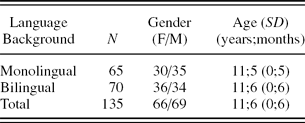
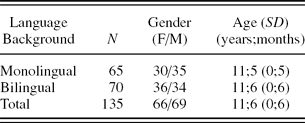
Data were collected from a total of 156 children. Of these, 21 children were excluded: 6 due to dyslexia and 15 due to missing data on (some of) the tests. This resulted in a final sample of 135 children (66 girls, 69 boys). The children were recruited from Grade 5 (Dutch Grade 7, the prefinal year of primary education) of nine primary schools in the western part of the Netherlands: eight schools were located in cities, one in a smaller town. Socioeconomic status of school populations was intermediate to low. The age ranged from 10 years 7 months to 12 years 9 months, which means that a number of children (16%) were older than is usual for this grade. However, this percentage is in line with the distribution of age in national surveys (i.e., 20%), and there was no statistically significant age difference between the two language groups we distinguished (F < 1). The sample consisted of children who spoke Dutch as their only language (monolingual children) and children who spoke Dutch in addition to a minority language (bilingual children). This latter group consisted of children from families with an immigrant background who spoke a range of non-European languages as their L1 or L2, the two main languages spoken being Moroccan (Arabic and Berber; N = 24) and Turkish (N = 16). The use of Dutch at home ranged from no Dutch spoken at all to mostly Dutch. Children who spoke European languages (e.g., English) in addition to Dutch were excluded. In total, 12 children were born outside the Netherlands (mean age of arrival = 3.3); 3 children arrived in the Netherlands after kindergarten (ages 6, 7, and 8, respectively). All participants were free from diagnosed language disorders or speech impediments. For each participant, permission to take part was obtained through the school. Table 1 provides an overview.
Description of the participants
Note: F, female; M, male.
Materials
Reading comprehension (RC)
RC was measured using a standardized Dutch reading test for children in the final years of primary education (Dutch Grades 6, 7, and 8), Begrijpend Lezen 678 (Aarnoutse & Kapinga, Reference Aarnoutse and Kapinga2006). The test has been normed nationally on a sample of 42 schools. Validity and reliability are reported as satisfactory (reliability in terms of Cronbach α = 0.83). The test correlates well with other standardized tests of reading comprehension. It comprises an answer sheet and a booklet containing seven different reading passages, ranging in length from 122 words to 288 words. Each passage is accompanied by 6 or 7 questions: 3 or 4 multiple-choice questions and 2 to 4 true/false statements, resulting in a total of 44 questions. Four questions are word-level questions; the other questions are above word level, including literal and inferential questions and overview questions of larger scope. In this sample, the distribution of reading comprehension scores did not deviate significantly from normality: skewness was –0.088 (SE = 0.209) and kurtosis –0.608 (SE = 0.414). Internal consistency reliability, Cronbach α, in this sample was 0.75.
Semantic word knowledge
To test the availability of semantic knowledge of words the WAT (Schoonen & Verhallen, Reference Schoonen and Verhallen2008) was administered. This forced-choice task is based on Read's format (Reference Read1993) and has been developed for children from 9 to 12 years old. In this paper-and-pencil task, children have to connect a stimulus word (e.g., vegetable) with three out of six related words. These related words are either semantically related in meaning to the stimulus word (e.g., plant, lettuce, food) or they are more contextually related or unrelated to the stimulus word (e.g., plate, warm, strong). Children are asked to identify the three semantically related words by drawing lines from the stimulus word to the three words that “really belong to it.” The distinction between semantic and contextual relations is a gradual one: children have to weigh and compare relations (vegetable–plant vs. vegetable–strong), reject too indirect, that is, contextual, relations, and recognize content-based, semantic relations. Selecting the semantically related words is seen as an indication of well-developed semantic word knowledge (Schoonen & Verhallen, Reference Schoonen and Verhallen2008). The WAT was administered in each class. As part of the instruction, two examples were worked out and explained in class. Two versions of the task were created (with a different ordering of the items) and randomly assigned to the children. An item was scored correct only if all three semantic relations had been identified. A correct item received 1 point, and an incorrect item received 0 points.Footnote 1 WAT scores were slightly skewed: –0.579 (SE = 0.209); kurtosis did not deviate significantly from normality: 0.341 (SE = 0.414). Internal consistency reliability in this sample was 0.74.
Semantic word knowledge and its accessibility
To test the accessibility of semantic word knowledge, a computerized semantic decision task (C-WAT), was designed. The task is inspired by Schoonen and Verhallen's WAT (Reference Schoonen and Verhallen2008) and presents participants with a stimulus word followed by two instead of six words: one semantically related word (the target) and one contextually related word (the distracter). The participant is required to identify the semantically related word as quickly as possible. The RTs reflect the speed of accessing the word's meaning. RTs to targets are recorded; RTs to distracters are discarded. The task also records response accuracy (whether the semantic or contextual relation is chosen) reflecting availability of semantic word knowledge like the WAT does. Because accessibility of knowledge (RTs) is the primary focus of this task, response accuracy needs to be high in order to get enough valid RT data. Thus, the task was made relatively easy, compromising the accuracy measure.
Like in the WAT, the distinction between targets and distracters is a gradual one. Targets are related to stimulus words either through hyponymy (flower–tulip), hypernymy (apple–fruit), synonymy (steal–rob), or meronymy (candle–wick), or they are a defining characteristic of the stimulus word (cigar–tobacco). Contextually related words (distracters) are not directly related in meaning to stimulus words. However, for distracter words to be appealing, they had to be associated to the stimulus words as well. To control for association strength, free word associations for the stimulus words were collected in a separate study from over 300 students in the target age (Cremer, Schoonen, Dingshoff, & De Beer, Reference Cremer, Schoonen, Dingshoff and De Beer2011). Only strong association responses that were not semantically related to the stimulus word qualified as distracters. In addition, the child association responses were used to ensure that target words were not (strong) associates of the stimulus words. In all but four cases, targets did not occur as association response. In these four cases, association strength between stimulus words and distracters was greater than association strength between stimulus words and targets. This procedure resulted in 69 items consisting of a stimulus word, a semantically related, nonassociated target, and an associated, contextually related distracter. The test consisted of 69 test items preceded by six practice items.
Word frequency was controlled in that all words were highly frequent, to ensure children's familiarity with them, and in that distracters were higher in frequency than targets. Word frequency data was used from a Dutch elementary school word corpus (Schrooten & Vermeer, Reference Schrooten and Vermeer1994). Overall word length of targets and distracters was equal. Word class of targets and distracters was kept as balanced as possible. Item order was randomized; target position (left or right, see Figure 1) was balanced in the task and across participants. The C-WAT was piloted with several adults and children and was found to work satisfactorily.
A computerized word association task example item.

The target fruit is inherently related to the meaning of the stimulus word apple, irrespective of context. The distracter health is contextually related to apple, but the two are strongly associated.
Item analyses showed that some items received accuracy scores not significantly different from chance, which had not been the case in the pilot. Because of this, the stimulus set was reevaluated retrospectively by a larger group of 18 adults. Fourteen items were identified as not unanimously agreed upon by the adults and were excluded. This is rather strict because we wanted to be confident that the correct answers were clear. The resulting item set consisted of (69 – 14 =) 55 items and was used for further analysis. The distributions of accuracy scores and mean RT scores (for 55 items) did not deviate significantly from normality: for accuracy, skewness was –0.013 (SE = 0.209) and kurtosis –0.779 (SE = 0.414); for mean RT scores, skewness was 0.210 (SE = 0.209) and kurtosis –0.297 (SE = 0.414). It is common practice to transform RT scores logarithmically or to take the inverse (Ratcliff, Reference Ratcliff1993) to avoid problems with the assumption of normal distributions. However, given the current distribution of our RT scores, we refrained from transforming the RT scores. Checks showed that the RT scores correlated between .89 and .99 with the transformed scores. In the final analyses these effects were only noticeable in the third decimal. Internal consistency reliability of the accuracy data was 0.52. This low reliability is largely due to the relative easiness of the test. The reliability, as expressed by Cronbach α of the 55 RT scores, was 0.93.
Word decoding
A standardized test of decoding skill was administered: the Drie Minuten Toets (Verhoeven, Reference Verhoeven1992), which has a good reliability and validity. Children were asked to read two word listsFootnote 2 out loud. The first list consisted of 150 monosyllabic existing Dutch words (consonant–consonant–vowel–consonant–consonant [CCVCC]); the second list consisted of 120 multisyllabic words: 60 two-, 30 three-, and 30 four-syllable words. There is a break between the two lists. For each list the score is the number of words read correctly in 1 min. The two measurements in this study are strongly correlated (Pearson r = .829) and show a high split-half reliability of 0.905; therefore, the two list scores are combined (summed) to derive a single score for word decoding that is used in further analyses. The distribution of the observed word decoding scores deviates somewhat from normality: skewness is –0.653 (SE = 0.209) and kurtosis 1.735 (SE = 0.414).
Language background
Participants’ language background was determined by administering a questionnaire on language use at home and at school outside the classroom and by conducting an interview with each participant and with the teachers. In the individual interviews, participants were asked about language use at home and outside school (i.e., which language is spoken to parents, siblings, other family members, and friends). Through the questionnaire, background information was also obtained about such things as country and date of birth and time of residence in the Netherlands.
Procedure
Children were tested in their schools, on a regular school day. The WAT and reading comprehension task were administered in class; C-WAT and word decoding were done individually. Testing in class started in the morning and lasted approximately 45 min. Individual sessions took approximately 25 min. Individual testing was done by one of two trained test assistants or the first author. Instructions followed a strict protocol. Tasks were administered to all children in the same order. Testing started with the WAT. When all children had finished, the reading comprehension task was administered. Children who had finished the second task were asked to go with one of the test administrators to take the two individual tasks. The individual session started with the word decoding task, which lasted about 3 min. Next, the C-WAT was administered. C-WAT data were collected on two identical laptop computers; the task was run in E-prime Version 1.1 (Schneider, Eschman, & Zuccolotto, Reference Schneider, Eschman and Zuccolotto2002). Before starting the C-WAT, the test assistants explained the task by means of five example items on paper boards. The assistants used the wording of the instruction as given in the test (see below) as well as various paraphrases. The importance of responding as quickly but accurately as possible was stressed. The task began with an on-screen instruction and six practice items. On-screen instruction was the following: “You will see a +, followed by a word. Below that word, two words will appear. Of the two words, choose the word that really belongs to the upper word.”Footnote 3 A fixation cross appeared on the screen for 500 ms and was followed by a stimulus word. After 800 ms the target and the distracter appeared side by side under the stimulus word: the three words on the screen formed a triangle (see Figure 1). This triad stayed on the screen until a response was made by pressing either the m (for the word to the right) or the z (for the word to the left) key on the keyboard, which are located directly above the space bar, to the right and left, respectively. If no response was detected after 10000 ms, the screen went blank. The interitem interval was 2000 ms. Time settings were based on pilot runs with children. After the child had completed the C-WAT, the participant questionnaire was administered. As part of this questionnaire the researchers conducted a short interview about language dominance.
Analyses
Item analyses for the WAT and reading comprehension test did not result in changes to the data set. The word decoding test yields the number of words read; therefore, no item analysis was done. The C-WAT data set was examined for outliers and missing data (i.e., no response detected). We adopted a lenient criterion for outliers to prevent the removal of too many (valid) RTs. Outliers were defined as RTs that were 3 SD above or below the item mean. Missing data constituted only 0.5% of the data. The percentage of incorrect responses was 19%. Outliers and RTs for incorrect trials were replaced by missings. Fifteen out of 150 participants were excluded from the analyses because they had 30% or more missing RT data. In the RT data set, missing data were imputed with R (Van Buuren & Oudshoorn, Reference Van Buuren and Oudshoorn1999). This was done five times. Means were calculated in the five imputed data sets and were averaged into an overall mean RT score for each participant.
After psychometric properties of the tests had been established, analysis of variance procedures were used to test for overall group differences. Correlations between measures were computed, and hierarchical regression analyses were used to identify which of the measures best account for variance in reading comprehension skill. A path analysis confirms the final regression model as an adequate description of the data.
RESULTS
Descriptives
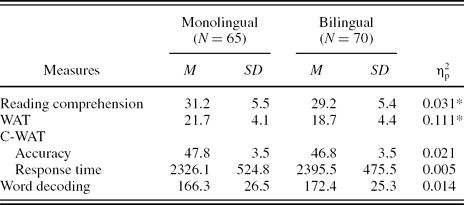
In Table 2 the means, standard deviations, and reliabilities for the tests of reading comprehension, availability of semantic word knowledge (WAT and C-WAT), accessibility (C-WAT RTs) of semantic word knowledge, and word decoding are presented. None of the tests reached ceiling. All tests were reliable, with the exception of the C-WAT accuracy measure. This measure had little variance because too difficult items had been removed from the task to ensure high accuracy performance and to allow for a reliable measure of RTs (see Materials Section).
Measures and descriptive statistics (N = 135)

Note: Items are the number of test items. Rel., reliability (Cronbach alpha, and for word decoding split-half reliability); WAT, word association task; C-WAT, computerized WAT.
Monolingual and bilingual children
Analyses of variance revealed significant group differences for measures of reading comprehension and availability of semantic word knowledge. Monolingual children performed significantly better at both the reading comprehension task, F (1, 133) = 4.201, p = .042, effect size partial eta squared (η2p) is 0.031, and at the WAT, F (1, 133) = 16.608, p = .000, η2p = 0.111. Differences in availability as measured in the C-WAT were not statistically significant, F (1, 133) = 2.907, p = .091, η2p = 0.021. Regarding the accessibility measure, Table 3 shows that monolingual children seem to have been faster at identifying semantically related words, but this difference is not statistically significant, F (1, 133) = 0.649, p = .422, η2p = 0.005, probably due to the relatively large individual differences (see standard deviations). For word decoding, scores on the combined measure showed that the bilingual group outperformed the monolingual group, but this difference is not statistically significant, F (1, 133) = 1.841, p = .177, η2p = 0.014. As was mentioned above, word decoding speed may affect the accessibility RT measure and hence word decoding differences could possibly mask accessibility differences. However, an analysis of covariance of the accessibility scores with word decoding as a covariate still shows no significant difference between the two groups, F (1, 132) = 1.777, p = .185, η2p = 0.013. The effect size, η2p, is slightly more than the typical small effect according to Cohen (Reference Cohen1988).
Means and standard deviations for mono- and bilingual children and effect sizes
Note: WAT, word association task; C-WAT, computerized WAT.
*p < .05.
Relationships between reading comprehension and aspects of word knowledge
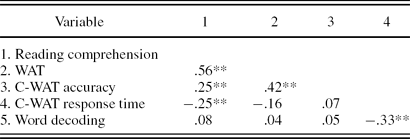
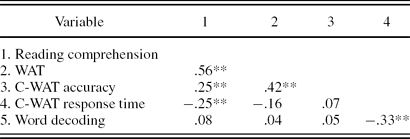
Reading comprehension scores correlate with both measures of availability of semantic word knowledge (r = .56 and .25, respectively; see Table 4), the two of which are correlated, as expected (r = .42). The correlation between reading comprehension and availability as measured in the C-WAT is relatively weak due to the low reliability of the C-WAT accuracy measure (see Descriptives). Reading comprehension is inversely correlated to accessibility of semantic word knowledge, showing that better reading comprehension is related to faster identification of semantically related targets. Word decoding shows no significant correlation with reading comprehension. Fast word decoding is part of accessibility as is indicated by the significant (negative) correlation.
Intercorrelations for all measures
Note: N = 135. WAT, word association task; C-WAT, computerized WAT.
**p < .01 (two tailed).
Contribution of accessibility of semantic knowledge to reading comprehension
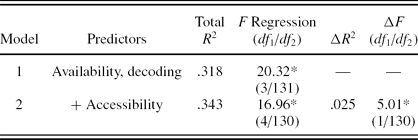
A regression analysis was done to determine whether there is a (unique) contribution of accessibility of semantic word knowledge to reading comprehension over and above the roles of availability of that knowledge and word decoding. Measures of availability of semantic word knowledge and word decoding were entered first in the regression model; accessibility of semantic word knowledge was entered in a second step. The model showed that 31.8% of variance in reading comprehension was accounted for by word decoding and the two measures of availability of semantic word knowledge (WAT and C-WAT accuracy) most of which was attributable to the WAT. Adding the accessibility measure (C-WAT RTs) to the model explained an additional 2.5%, resulting in a total of 34.3% of variance accounted for. The increase in variance due to accessibility was small but significant given that the variance accounted for by the three other tests was already taken into account, ∆R 2 = .025; ∆F (1, 130) = 5.01, p = .027. Table 5 displays the contribution of aspects of word knowledge to the prediction of reading comprehension.
Variance accounted for by aspects of word knowledge in the prediction of reading comprehension
*p < .05.
In the Introduction it was suggested that the reading comprehension delays of bilingual children could be related to differences in the availability of semantic word knowledge and possibly the accessibility of this knowledge. We explored this suggestion in a regression analysis of reading comprehension. In the first step availability (WAT) and accessibility (C-WAT RTs) were entered, and in the second step language background (monolingal vs. bilingual) was entered. It turned out that language background no longer showed an effect on reading comprehension, ∆R 2 = .000; ∆F (1, 131) < 1; p = .83. Another regression analysis showed that the effect of language background also “disappears” when in the first step only availability is entered. When language background is entered in addition to accessibility, it can still make a small but nonsignificant contribution to reading performance.
A path analysis conducted in Lisrel (Jöreskog & Sörbom, Reference Jöreskog and Sörbom1996) shows that the effect of language background indirectly affects reading comprehension, which is via children's semantic word knowledge. In this analysis, the two measures for the available semantic knowledge are combined, accommodating the differences in reliability of the two measures. The model as depicted in Figure 2 fits the data fairly well, χ2 (9) = 11.08, p = .27, comparative fit index = 0.98, root mean square error of approximation = 0.039. The effect of language background runs via children's semantic knowledge. An additional direct effect of language background on reading comprehension is redundant and does not significantly improve the model, Δχ2 (1) = 0.24, p = .62.
The path model for the interrelationships of word decoding, language background, accessibility, and availability of semantic knowledge and reading comprehension. [A color version of this figure can be viewed online at http://journals.cambridge.org/aps]
Subgroups
To determine whether the contribution of availability and accessibility of semantic word knowledge to reading comprehension is the same for monolinguals and bilinguals, two additional regression analyses were carried out, each with in the final step a term for the interaction between language background and one of the predictor variables. In none of the analyses did the interaction term significantly explain any additional variance in reading comprehension.
A division in subgroups can also be made in terms of reading proficiency. Students scoring at or below the median on the reading comprehension test were categorized as less proficient readers (M = 25.8, N = 70, 57% bilingual), students scoring above the median were considered proficient readers (M = 34.9, N = 65, 46% bilingual). A multigroup analysis shows that the path model (Figure 2) fits the data of both proficiency groups with equal regressions across groups, χ2 (29) = 29.41, p = .44, comparative fit index = 0.99, root mean square error of approximation = 0.00.Footnote 4 However, the model significantly improved when the explained variance in reading was allowed to differ between the groups, Δχ2 (1) = 5.12, p = .02. Comparing the standardized solutions of the two groups indicated that for the proficient comprehenders, measures of availability and accessibility explain 31% of variance (the standardized regression weights being 0.52 and –0.20, respectively), whereas for the less proficient comprehenders the measures of availability and accessibility explain only 20% of the individual differences in reading (the standardized regression weights being 0.41 and –0.16, respectively).
The results can be summarized as follows. For measures of reading comprehension and availability of semantic word knowledge, monolingual children outperformed bilingual children. No statistically significant group differences were found for accessibility of semantic word knowledge. Bilingual children scored higher on the word decoding test, but this difference was not significant. Reading comprehension performance was correlated to both measures of availability of semantic word knowledge; it was inversely correlated to accessibility of semantic word knowledge, showing that better reading comprehension is related to faster identification of semantically related targets. Word decoding also showed an inverse correlation with the accessibility measure: reading more words per minute was related to faster identification of semantically related targets, as could be expected.
A regression analysis showed that the availability of semantic word knowledge, word decoding, and accessibility of semantic word knowledge together explain over 34% of individual differences in reading comprehension scores. Accessibility in terms of RTs accounts for (a small amount of) variance in reading comprehension that cannot be accounted for by scores on word decoding and availability of semantic word knowledge. Differences in reading comprehension between monolingual and bilingual children “disappear” when we take into account individual differences in availability of semantic word knowledge. Although the general pattern of relationships holds for both proficient and less proficient readers, multigroup analyses show that the predictive power of the lexical–semantic measures is relatively larger for the proficient than for the less proficient comprehenders.
DISCUSSION AND CONCLUSION
The present study set out to assess differences in reading comprehension and to relate those to differences in several aspects of word knowledge of Dutch monolingual and bilingual children in order to investigate some of the mechanisms underlying reading comprehension differences.
Research shows that superficially knowing frequent words is not enough to fully comprehend texts: It is also important to have semantic knowledge of those seemingly familiar words (Qian, Reference Qian1999b; Schoonen & Verhallen, Reference Schoonen and Verhallen1998). In this study, we corroborated that availability of semantic knowledge is an important factor in reading proficiency. Moreover, the ability to access that semantic knowledge quickly as proposed by Nagy and Scott (Reference Nagy, Scott, Mosenthal, Kamil, Pearson and Barr2000) and Perfetti and Hart (Reference Perfetti, Hart, Verhoeven, Elbro and Reitsma2002) may have added value. The importance of availability and to a lesser extent accessibility of semantic word knowledge for reading comprehension is evidenced by their correlation with and their distinguishable contribution to reading comprehension differences. Both lexical–semantic knowledge (availability) and fluency (accessibility) play a role in comprehending text: having semantic knowledge about words and being able to activate that knowledge quickly. As such, accessibility supports reading comprehension as a separate, measurable component. However, the importance of fast access to semantic word knowledge seems to be limited in the sample of students we studied.
The finding that bilingual children lag behind their monolingual peers in reading comprehension and in availability of semantic word knowledge confirms earlier findings (August et al., Reference August, Carlo, Lively, Lippman, McLaughlin and Snow1999; Schoonen & Verhallen, Reference Schoonen and Verhallen2008). The bilingual children have less semantic knowledge about words available than their monolingual peers. However, no significant differences between the two groups were found for accessibility of semantic word knowledge. A path analysis showed that group differences in reading could be perceived as differences mediated by semantic knowledge differences. Controlling for semantic knowledge made the language background differences “disappear.” Evaluating a potential difference in predictive power of availability and accessibility in each group, we did not find significant interaction effects of language background and the semantic variables.
Furthermore, we compared path models for proficient and less proficient readers. This comparison demonstrated that, in absolute terms, regression weights for availability and accessibility of semantic knowledge were equal, but that due to a difference in the variance of reading comprehension, the standardized regression weights were different for the two reader groups. The less proficient group was somewhat more heterogeneous in reading proficiency. This larger variance in reading might be due to factors other than the ones we have measured, such as comprehension monitoring or inferencing skills.
Although there were no statistical differences for word decoding, the bilingual children were found to outperform monolingual children slightly (η2p = 0.014). For monosyllabic words, bilingual children were significantly faster than their monolingual peers, but not for multisyllabic, orthographically more complex words. This is in line with previous research reporting comparable or faster decoding by bilingual minority students. Droop and Verhoeven (Reference Droop and Verhoeven2003) tested students across Grades 3 and 4: bilingual minority low socioeconomic status students decoded at the same level as Dutch low socioeconomic status students, for multisyllabic words. For monosyllabic (CVCC) words, the bilingual minority and the monolingual Dutch children obtained comparable scores in Grade 3, but the bilingual minority children obtained higher scores in Grade 4. For monosyllabic (CVC) words, bilingual minority children obtained higher scores in both grades (Droop & Verhoeven, Reference Droop and Verhoeven2003, p. 86). An explanation for this finding may be that bilingual children read the words more superficially and hence faster. Such differences warrant our inclusion of word decoding as a control variable. However, the predictive power of word decoding for reading success at a later age (Mancilla-Martinez & Lesaux, Reference Mancilla-Martinez and Lesaux2010; Proctor et al., Reference Proctor, Carlo, August and Snow2005) does not seem to pay off for the bilingual children, since their decoding fluency does not result in high levels of reading proficiency. As Nakamoto and colleagues, (Reference Nakamoto, Lindsey and Manis2008) showed, it is the interaction between decoding and “oral language” (including vocabulary knowledge) that is beneficial to reading. Good word decoding skills might be a prerequisite to benefit from vocabulary knowledge while reading.
The distinguishable relations that availability and accessibility of semantic word knowledge have with reading comprehension strengthens the importance of depth as a theoretical construct in its own right, next to a dimension such as breadth (Ouellette, Reference Ouellette2006; Qian, Reference Qian1999a, Reference Qian1999b, Reference Qian2002; Schoonen & Verhallen, Reference Schoonen and Verhallen1998). In addition to the unique contribution of availability of semantic word knowledge, the present study indicates the unique contribution of accessibility of semantic word knowledge. Altogether this seems to add up to what Daller, Milton, and Treffers-Daller (Reference Daller, Milton, Treffers-Daller, Daller, Milton and Treffers-Daller2007) call the “lexical space,” a three-dimensional concept of vocabulary size (breadth), depth of word knowledge (availability), and fluency (accessibility). Distinguishing the three dimensions is sometimes difficult because the three dimensions probably grow at a similar rate due to language exposure.
Additional data from longitudinal research and training studies are necessary to explore how these dimensions relate to each other and might be affected by language input and eventually contribute to children's reading proficiency. One example is training studies focusing on quality of word knowledge (e.g., Carlo et al., Reference Carlo, August, McLaughlin, Snow, Dressler and Lippman2004) and on access to word relations the relevance of which was already suggested by Beck and colleagues (Reference Beck, McKeown and Kucan2002). Furthermore, future studies testing other modalities could provide insights. For example, Betjemann and Keenan (Reference Betjemann and Keenan2008) tested children with reading problems using an auditory measure of semantic word knowledge. Their results suggest that semantic deficits are not confined to reading but are a more general comprehension problem. Finally, psycholinguistic studies using subconscious paradigms such as (masked) semantic priming are needed to firmly establish the role of accessibility of semantic word knowledge in reading comprehension.
In conclusion, our data show that semantic word knowledge and fast access to it underlie differences in reading comprehension. This supports the pivotal role of semantics between word identification and comprehension mentioned in the Introduction. Fast access to semantic word knowledge seems to allow it to be used efficiently in higher order reading processes such as integrating information, inferencing, and monitoring. However, much still needs to be learned about the causal mechanisms that explain the role of semantic word knowledge in reading comprehension.
ACKNOWLEDGMENTS
This work was supported by the Amsterdam Centre for Language and Communication. We are most grateful to the staff and pupils of the nine participating schools for their assistance. Special thanks go to Jolien Janson and Iske Bakker for their help in collecting the data. We thank three anonymous reviewers for their helpful discussion and comments.