Introduction
Rice has been cultivated since ancient times in tropical countries and is the most widely consumed staple food in Asian countries. In the nineteenth century, British rule in India, Singapore, and Hong Kong (pinyin: Xianggang) had established a large free-trade area in Asia that provided the market base for the considerable expansion of the rice trade, for which Singapore and Hong Kong developed into key redistribution centres. In these and other port cities, Chinese merchants could be found at all levels of the highly competitive rice export trade acting as buying agents, millers, and shippers. For Western financial and agency institutions as well as importers and exporters, Chinese dealers also operated as compradors (middlemen) collecting goods and managing business. The important role of the Chinese as intermediaries between the Europeans and the indigenous people of Southeast Asian countries and regions was made possible by their high degree of adaptation to different geographical and social circumstances. Most of them had come as migrants from southern China, predominantly from Amoy (pinyin: Xiamen), Swatow (pinyin: Shantou), and Canton (pinyin: Guangzhou), and established Chinese family firms that were closely connected with each other through personal relationships. The social structure and commercial organization of overseas Chinese and the long history of Chinese trade with Southeast Asia are the most important explanatory factors for the economic predominance of the Chinese and the patronage they enjoyed from Western elites. In Saigon (Sài Gòn, currently Ho Chi Minh City; Vietnamese: Thành phố Hồ Chí Minh), Haiphong (Hải Phòng), Hong Kong, and other ports in China and Southeast Asia, Chinese merchants or ‘hongs’ (factories or warehouses) dominated the rice trading industry, providing business services and connections. These included their links to foreign shipping companies and serving as transport providers for shipments of rice and other bulk cargoes overseas.
When taking into account the very frequent contact between foreign and Chinese merchants over a long period of time, which had been established on the basis of mutual interests (the main feature of such business interactions), it is astonishing to note that there are only a few studies on this topic. The main reason is probably the dearth of primary sources, especially company and government records dealing with the microeconomic aspects of ‘on the spot’ daily interactions as well as their inaccessibility. By presenting a case study in the wider context of the transnational, maritime, and business history of East Asia, this article intends to present a more nuanced picture of the range of interactions between European tramp shipping companies and Chinese rice merchants on the level of material connections—in this case, shipping—and on the level of business interactions—in this case, cooperation as a routine occurrence but also conflicts, in the form of boycotts, as exceptional events.
First, this article aims to provide insights into the important role of European tramp shipping companies as service providers for the transport needs of Chinese merchant networks in port cities around Asia. It will use the examples of two companies operating medium-sized steam tramps in East Asian waters from the 1880s until the First World War—one from French Indochina based in Haiphong and one from Germany with its fleet based in Hong Kong—to highlight that, in the long run, business relations with Chinese merchants were conducted on a routine and cooperative basis framed by mutual interests. A shipping boycott was an unusual event, as in the case of 1895–96, when Chinese shippers in Hoihow and Pakhoi tried to break the temporary monopoly of the French Tonkin Shipping Company by chartering ships from the German M. Jebsen Shipping Company.
Second, the article will discuss the development and importance of Haiphong as a major port of Tonkin and the role and position of local Chinese merchants in the rice exporting industry and their practice of frequently shipping large cargoes on chartered vessels belonging to European tramp shipping companies. Third, based on archival evidence, the Haiphong shipping boycotts of 1907 and 1909–10 will be studied in detail, as will the agreement of 10 May 1910, which terminated the last boycott. Finally, the historical context in which the boycotts occurred will be explained and some general conclusions will be drawn from these business interactions, which may be instructive to better understand the ways in which both sides cooperated and came into conflict with each other under sometimes harsh market economy conditions. What becomes obvious is that the driving force of the Haiphong boycotts of 1907 and 1909–10 was a purely business one, namely, the desire to prevent higher freight charges. Furthermore, the case study presented here does not support arguments about the dynamics of Western imperial power and Chinese resistance but demonstrates the non-involvement of European powers at this level of imperial relations in the east. Rising Chinese anti-imperialism and nationalism, combined with an ongoing public discourse on shipping rights recovery, in employing economic instead of political means, created an atmosphere in which imperial power relations in China altered significantly. Beginning in 1908, a new generation of small private Chinese shipping companies, strongly committed to shipping nationalism, emerged, mostly operating on small inland rivers. Financed by Chinese capital and flying the Chinese flag, these firms made an argument for shipping autonomy by demonstrating that China could fulfil its own shipping needs without foreign involvement. The discourse of shipping rights recovery went hand in hand with similar efforts in other arenas, such as railways and mining, signalling the beginning of a new anti-imperialist era in China.
The case study presented here illuminates an almost unknown episode in East Asian economic history and its transnational dimensions. The reasons for the obscurity of this episode are perhaps twofold: first, as German and French interests (rather than British) were primarily involved, there is scarcely any relevant documentation in the British consular files or Hong Kong government files; second, the German and French government files appear to have seldom been consulted by historians working on the maritime or business history of East Asia.Footnote 1
Tramp shipping in East Asia before the Second World War
Until the Second World War, East Asian rice shipping markets were dominated by foreign shipping companies, which, according to statistics, held the largest share of ocean-going and river shipping activities.Footnote 2 Shipping rights in coastal and inland waters were usually unilaterally denied to foreigners, but China was forced to grant them due to a series of unequal treaties signed with Western powers during the nineteenth century. The strong position of Western shipping in Chinese and other Asian waters in the nineteenth century was, and is, still regarded as a symbol of foreign imperialism. The steamship in particular became not only a symbol of modernity in transportation but also a ‘tool of empire’, the ‘spearhead of penetration’ in opening up Chinese and other East Asian markets or expressing the ‘politics and processes of semi-colonialism’.Footnote 3
In their study on Western enterprise in China and Japan, George C. Allen and Audrey G. Donnithorne present a more nuanced picture, emphasizing the participation of Western ships in the coastal and river trade of China. Foreign technological superiority in shipping was the main reason for the extensive use of foreign ships as carriers of Chinese-owned goods and met the existing transport requirements of Chinese merchants. In this area, Chinese and foreigners worked in close cooperation, resulting in the greater part of the cargoes of foreign vessels engaged in China's domestic trade being carried on the behalf of Chinese merchants.Footnote 4
In his study on Hong Kong's development into a global metropolis, David R. Meyer introduced the term ‘trade services’ to define the various services provided by well-capitalized firms to unspecialized, small-scale commodity trades, mostly of Chinese merchants, in the nineteenth century. Such trade services, for example, those of the British company Butterfield and Swire after 1880, included a shipping line, shipping agencies for other lines, insurance, sales, and banking agencies, which provided increasing profits for the firm until 1900. These large gains became possible because most Chinese firms had insufficient capital to specialize in trade services, especially in owning and operating steamships. In contrast to traditional Chinese junks, which dominated shipments of inexpensive, bulk commodities,Footnote 5 steamships offered competitive transport for both low- and high-value commodities, sufficient insurance, and reliable timetables almost independent of weather conditions, sea currents, or other unpredictable natural events.Footnote 6
Around 1900, the enormous amount of capital required for purchasing, running, and renewing fleets of steamships was rarely available in China. The most noteworthy exception was the China Merchants Steam Navigation Company founded in 1873.Footnote 7 The general impoverishment of China and Southeast Asia (pinyin: Nanyang; lit.: Southern Ocean) and the insignificant growth of China's economy from 1860 to 1910 resulted in services or, more specifically, transport or shipping services, being provided by foreign shipping companies. Beginning in the 1870s, the China Navigation Company of Butterfield and Swire and the Indo China Steam Navigation Company of Jardine, Matheson and Co. almost monopolized coastal steam shipping markets in East Asia for many years. In the 1880s, major German shipping companies—the North German Lloyd and the Hamburg-Amerika Line—began operating coastal steamers in these waters. Furthermore, at the beginning of the twentieth century, Scandinavian, especially Norwegian, shipping companies sent steam tonnage to the Far East, adding to the already highly globalized Asian shipping markets. Japanese shipping companies became increasingly active in these markets after the end of the Sino-Japanese War (1894–95) and on an even greater scale after the Russo-Japanese War (1904–05). They created stiff competition by establishing several coastal and river shipping lines, operating proprietary ships or chartered vessels under different flags. The main clients of the shipping companies, namely, low-cost Chinese merchant firms with limited capital, were part of well-functioning domestic and international social networks of capital in Asia. They competed well in the unspecialized, small-scale commodity intra-Asian trades for which regular and irregular transport such as small and medium-sized steam coasters were chartered.Footnote 8
Such vessels were usually steam tramps capable of picking up freight and passengers at widely scattered ports and transporting them around different regions. These ships were particularly important in bulk trades, such as rice, coal, tea, sugar, beans, grains, and other commodities. In view of steam tramps’ important role in cabotage (coastal trade), it is remarkable that there seems to be no comprehensive study on the subject and very few case studies to provide a fuller picture.Footnote 9 In this article, two tramp shipping companies and their steam tramp operations in East Asia will be more closely evaluated: the Tonkin Shipping Company, an affiliate of the partnership firm of Marty et d'Abbadie based in Haiphong, which mainly operated in the wider Gulf of Tonkin region,Footnote 10 and the M. Jebsen Shipping Company, whose Hong Kong-based fleet operated along the China coast and its vicinity.Footnote 11
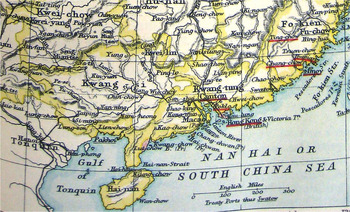
In the wider Gulf of Tonkin region—the northwestern part of the South China Sea stretching between the Red River delta (also called the Tonkin delta) of French Indochina and the Pearl River delta of South China (see Figure 1)—the two shipping companies embodied Western dominance in shipping in China. The maritime region was, around 1900, thickly interconnected by a multitude of ships plying between five main ports: Haiphong (Hải Phòng), the shipping hub of Tonkin, with its major rice exporting industry; Pakhoi (pinyin: Beihai) and Hoihow (pinyin: Haikou), the open Chinese ‘treaty ports’, mainly exporting vegetables and cattle to Hong Kong and South China; Canton (pinyin: Guangzhou), the traditional commercial hub of South China and a treaty port; and Hong Kong, the British crown colony at the mouth of the Pearl River, with its important international free port serving as an economic turnstile at the crossroads of intercontinental and interregional shipping routes. One of the most important bulk cargoes frequently transported from French Indochina to Hong Kong was rice. It was produced and harvested primarily in the region around the Mekong delta, with Saigon as the main export centre, and on a smaller scale in the more densely populated regions of Annam and Tonkin, the northern parts of Indochina.
Detail of a map of China showing the wider Gulf of Tonkin region in the early twentieth century.

In the 1880s, Marty's firm in Hong Kong also frequently chartered tramps under the German (including vessels from Jebsen's fleet) and Danish flags.Footnote 12 The chartering of steam tramps occurred on the basis of trip (or voyage) charters or time charters: in the first case, the charterer (or shipper) hired the vessel for only one voyage to carry his cargo at an agreed rate per ton; in the second case, the shipowner provided the crew and all other requirements to operate the ship. The charterer became the disponent owner and was usually allowed to send the vessel in any direction and load it with all kinds of permitted merchandise, as was typical in tramp shipping. There were no fixed fares for passengers or cargoes, but the rates for freight depended on the conditions of the market. Tramping was, as maritime historian Michael M. Miller explains, ‘a constant struggle to position ships where freight was abundant and competitors’ ships were not, where rates therefore were high not low, where voyages contracted would not undercut arrival in time for seasonal trades, where going for a “spot loading” was better than fixing a cargo in advance’.Footnote 13
As research into the operations of the two aforementioned tramp shipping companies in the period from the 1880s to 1914 reveals, routine dealings with Chinese shippers and charterers were conducted on a well-functioning, professional basis. Friendly relations were only strained when outside factors became imminent, such as political-imperialistic considerations. Such an instance occurred in 1895–96 when, during the Sino-Japanese War (1894–95), the Tonkin Shipping Company exploited the temporary lack of available steam tonnage for rice shipments on the Haiphong-Hong Kong run and attempted to monopolize the coastal steaming routes in the wider Gulf of Tonkin region. Marty's attempt prompted Chinese shippers in port cities to form a charter syndicate to effectively boycott his ships.
Instead of Marty's ships, the Chinese chartered steamers from the M. Jebsen Shipping Company. This event resulted in an agreement about the joint organization of shipping services between the Chinese shipping company Yuen Cheong Lee and Co. (源昌利) in Hong Kong, owned by the Hainan-born merchant Chau Kwang Cheong (周昆章), and the M. Jebsen Shipping Company, represented by Jebsen and Co., paving the way for close cooperation between the firms for many years. Although the French succeeded in inducing the Qing government to compensate Marty, his business relations with Chinese shippers were ruined for some time. Strong backing by an imperialist power such as France was not necessarily advantageous for foreign business in China. Marty's attempt to monopolize the highly profitable rice shipping route was not in the interest of Chinese shippers, in whose view the unilateral action of the French shipowner destroyed a mutually beneficial relationship.Footnote 14
Similar incidents were the Haiphong shipping boycotts of 1907 and 1909–10. In this case, Chinese charterers in Haiphong again formed a charter combine and even founded their own shipping company to effectively boycott a German, a French-Indochinese, and a British tramp shipping company. In consular files, business correspondences, and contemporary newspapers, the said events are exclusively referred to as ‘shipping boycotts’ or just ‘boycotts’, terms that are also used in this article to characterize these conflict-laden business interactions. Early local boycotts in China—often called ‘taboos’ in English-language sources—were not directed against the ships of a particular nation but against those of a particular company. In this respect, such boycotts were different from the well-known greater boycotts used by the Chinese to target Japan, the United States, and Britain in particular from the 1840s to the 1930s. The early boycotts can be regarded as the weaponry of one of the most powerful and organized social groups in late Qing China, namely, the Chinese merchant guilds. Guild members entered into agreements that involved ceasing to purchase or deal in goods or abstaining from the use of ships belonging to the boycotted country.Footnote 15 A similar practice, but with the aim of targeting a specific shipping company, can be observed when looking at the 1895–96 boycott in the wider Gulf of Tonkin region. The same pattern was applied in the Haiphong shipping boycotts of 1907 and 1909–10, when boycotts by Chinese rice merchants were directed against three European tramp shipping companies after they unilaterally increased freight rates.
Haiphong and the Chinese rice merchants
Haiphong, situated in the northeastern coastal area of the Indochinese peninsula, is currently the third-largest city in Vietnam and a major industrial centre. In the mid-nineteenth century, Haiphong was merely a native village with a market located at the confluence of the Song Cua Cam (Forbidden River; in Vietnamese: Sống Của Cảm) and the Song Tam Bac (Sống Tâm Bắc) in Lower Tonkin, a region that at the time formed part of Vietnam and was ruled by emperors of the Nguyen dynasty. Since the Song Cua Cam is interlinked with the Red River (Sông Hồng), the main waterway of Tonkin, Haiphong was the gateway to Hanoi (Hà Nội) when French military forces entered the region in the 1870s. After the French had occupied Hanoi and other strategic sites in the delta, the treaty of 15 March 1874, among other stipulations, compelled the Vietnamese emperor to make Haiphong a French concession. The village was opened to foreign commerce, a French consul appointed, and a mixed French-Vietnamese customs office set up. A few French export firms were established in the new concession that shipped rice to Hong Kong, but export figures remained on a small scale. At the time, only approximately 850 Chinese were estimated to reside in Haiphong. The main reason for the weak presence of Chinese merchants—the traditional controllers of Indochina's rice trading industry—was the commercial policy of the Vietnamese government: between 1876 and 1880, it issued a series of bans on the export of rice from Haiphong. This move was obviously designed to disadvantage the French concession of Haiphong and to favour exports from neighbouring Nam Dinh (Nam Định), which was under Vietnam's full control.Footnote 16
Chinese people have migrated to the Indochinese Peninsula since the earliest times, often as a result of population pressure and political upheavals in China. The frequent immigration waves resulted in the creation of a new Sino-Vietnamese ruling class and in strong influences of Chinese culture and thinking on Vietnam. In the economic sector, the Chinese were active in agriculture and trade, benefiting, as Alain G. Marsot explains,
from the greater cultural and commercial sophistication of their mother country, in terms of its very size and greater economic development, compared to the small and scattered societies of Southeast Asia. Furthermore, those Chinese merchants continued to maintain close ties with their families and kinship organizations in China, and in general with the trading communities there, thereby occupying a naturally privileged position as intermediaries between the South China markets and those of Southeast Asia. They were to maintain that position throughout the European period.Footnote 17
What seems to have further contributed to the strong position of the Chinese in Vietnam were certain human capacities, most importantly flexibility and great adaptability. Compared to the Vietnamese, as Marsot states, ‘they often shared the qualities of the local people, though to a higher degree perhaps, combining them with greater astuteness, obstinacy and method’.Footnote 18 In his doctoral law thesis of 1910, René Dubreuil laid out that ‘the Chinese indeed behave in Indochina as a kind of germ stimulating production and through that creating wealth’, whereas the Vietnamese ‘do neither possess the initiative nor the mental curiosity honed by the lure of profit, something that drives the Chinese to searching for new products which are likely to provide them with a profit’.Footnote 19
As a result of the Sino-French War (1884–85) and the subsequent treaties with the Vietnamese and Chinese governments, French control was fully established in Annam and Tonkin. With the constitution of French Indochina, or of the Indochinese Union (in French: Union de l'Indochine française), enacted by decree on 11 November 1887, the protectorates of Annam and Tonkin, with a resident superior at the top, became part of the new political unit administered exclusively by the French Ministry of Colonies and under the direct authority of a governor-general. Haiphong, having served as a port of debarkation and supply for the French expeditionary force during the military operations, became the centre of the French navy in northern Indochina. Among the first private companies, founded in Haiphong near the naval shipyard, was the aforementioned partnership firm of Marty et d'Abbadie, which developed into one of the pioneering enterprises of colonial Tonkin.Footnote 20
With the Sino-French treaty of 9 June 1885, Chinese settlers were granted the right of free entry and were allowed to run commercial operations in Indochina. In the same year, an immigration office and information bureau were set up in Haiphong to tackle the influx of foreigners. With that step, the French continued the practice of the Vietnamese emperors, who had given a privileged status to Chinese residents. Following the French occupation of Indochina, which established order and security and stimulated economic activity, Chinese immigration was further encouraged, especially from the southern Chinese provinces of Kwangtung (pinyin: Guangdong), Fukien (pinyin: Fujian), and the island of Hainan, to foster commercial relations between Tonkin and South China. Upon their arrival, Chinese immigrants were admitted into a congregation (French: congrégation), a self-administered Chinese community, based on their dialect and/or province of origin in China.Footnote 21 In Vietnam, the number of Chinese rose from 44,000 in 1873 to 142,000 in 1910, but in northern Vietnam, the Chinese were not nearly as numerous as they were in the south: in 1910 there were 22,000 Chinese in Tonkin, of which 2,000 were people of mixed Chinese-Vietnamese origin called Minh-Huong (French: métis).Footnote 22 This trend was largely due to the overpopulation of the Tonkin and Annam deltas and the subsequent relatively small export of agricultural products, one of the greatest economic interests of the Chinese. In Haiphong, the number of Chinese increased from 5,300 in 1902 to 8,532 in 1913, which constituted 15 per cent of the local population in the latter year.Footnote 23
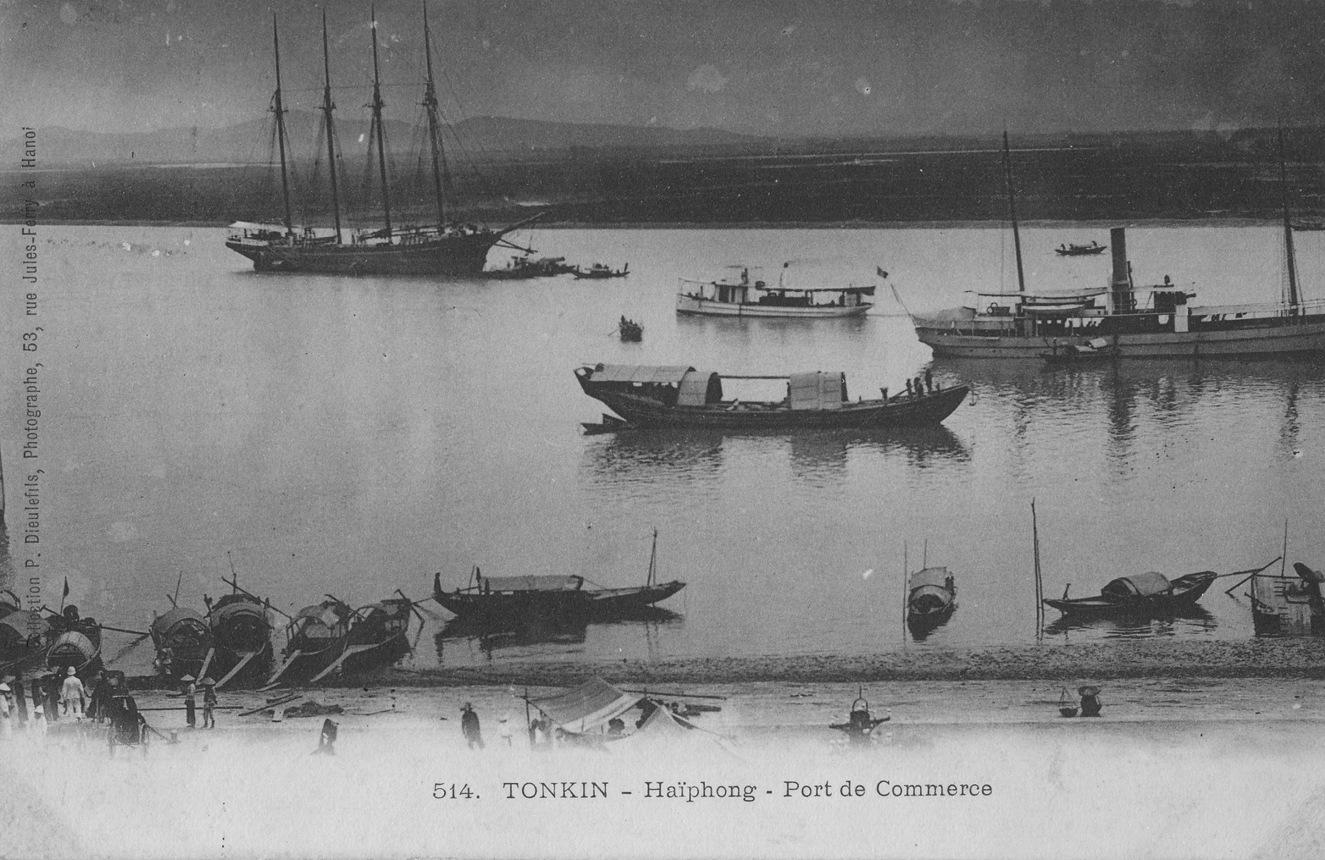
Immediately after the occupation of Tonkin, the French authorities set up customs depots in Haiphong, Hanoi, and Nam Dinh, and, in November 1884, decreed that all rice exported from Tonkin should be channelled through Haiphong and that overseas shipping of rice should be limited to the period from December to March each year when rice was available in larger quantities.Footnote 24 The restriction of rice exports to Haiphong as the prime outlet contributed enormously to the development and prosperity of the town and helped to transform its harbour into the major port of Tonkin (see Figure 2).Footnote 25
The port of Haiphong, around 1900.

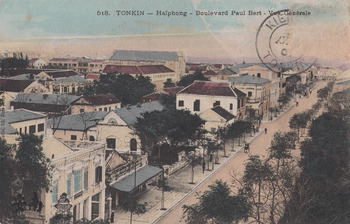
By the early twentieth century, the port had undisputedly become the most important commercial outlet of Tonkin, being well connected to its hinterland by river shipping services and railway lines, and overseas via coastal and ocean-going shipping links. Rice exports from Haiphong profited from the long period of political peace and stability in Asia, which only ended with the outbreak of the Second World War. Increasing the prosperity of the port were the frequent water regulation and improvement works undertaken in the Red River delta, the construction of modern and steam-driven rice mills, the availability of sufficient and efficient steam shipping tonnage for the bulk transportation of rice, and, last but not least, the installation of telegraphs for the rapid ordering of rice shipments (see Figure 3).Footnote 26
Haiphong centre with Boulevard Paul Bert and the cathedral, around 1900.

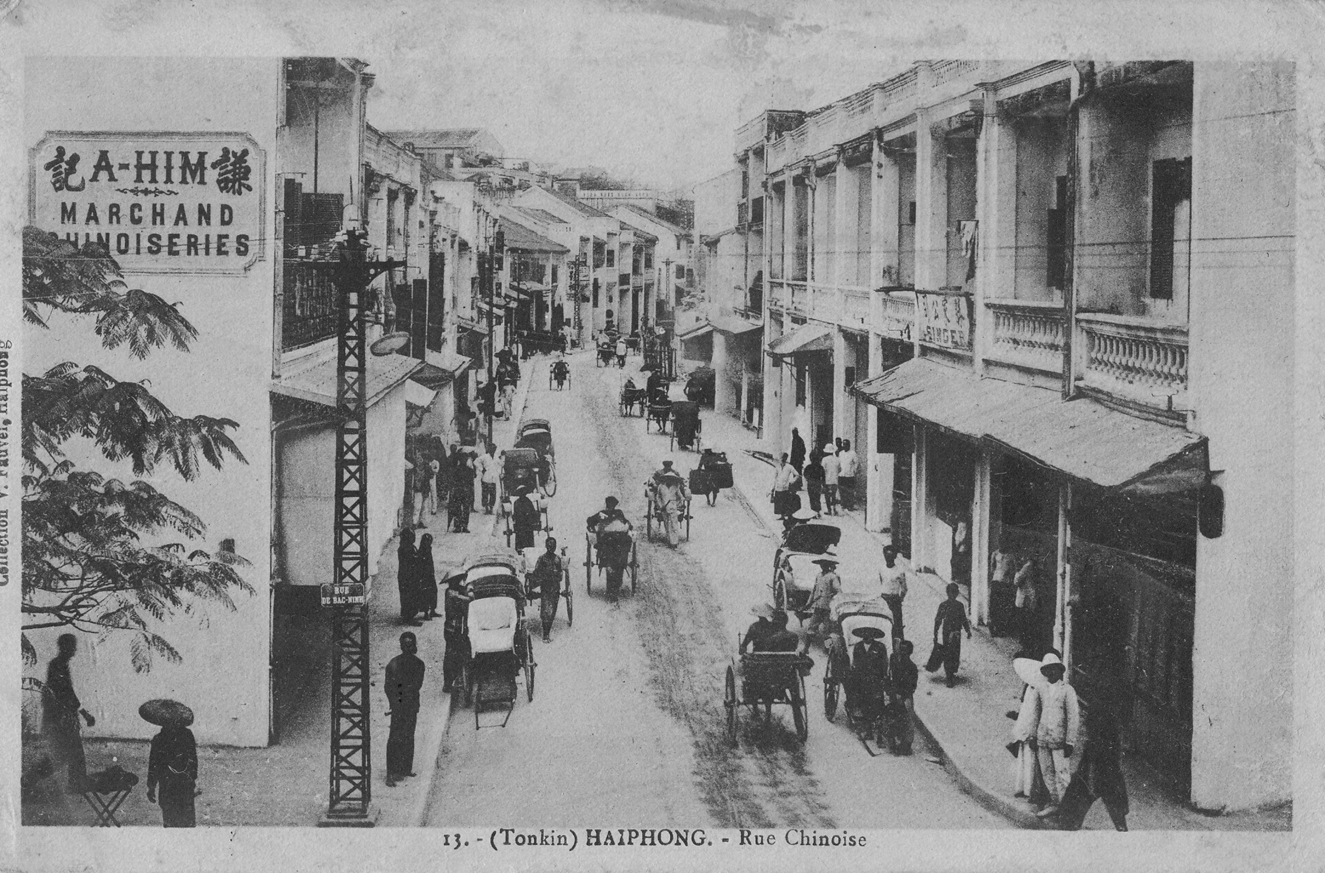
Rice was the French colony's most important export product, and its production was divided between a very large number of Vietnamese peasants. In the early twentieth century, exports from Haiphong were dominated by local Chinese merchants, most of them Cantonese, essentially assuring the commercial success of the port. In 1901, 23 Chinese rice merchants were listed in the official records of Haiphong, all but one of whom were located in the Rue Chinoise (Chinese Street; see Figure 4), in close proximity to the Chinese port.Footnote 27 Their dominant position in the local rice trading industry was highlighted in early 1903 in an article in The Hongkong Telegraph, which was critical of the French Indochinese government's position towards the Chinese in Tonkin: ‘It can be fairly maintained that the organization of Chinese rice buyers and shippers in Tongking [Tonkin] is one of the best in the East, and the real commerce of that place, both import and export, depends mainly on the enterprise and industry of the Celestial [Chinese].’ The writer praised the ‘proverbial integrity of the Chinese merchant’ in Tonkin, concluding with the statement that ‘for truly they are the strength of the land, this hard-working uncomplaining race’.Footnote 28
Chinese Street in Haiphong, around 1920.

From 1897 to 1900—a period of relatively good rice harvests—122,000 tons of rice on average were exported from Haiphong, while in the same period Saigon exported 722,000 tons; Saigon's rice export was generally five to six times higher than that of Haiphong and this pattern continued until the 1930s. With catastrophic weather conditions destroying large quantities of rice in Tonkin between 1902 and 1906, exports from Haiphong reached their nadir in the latter year, with only 60,600 tons exported, the lowest figure since 1896. Most rice exports went to Hong Kong, which further enhanced its superior position as the prime distribution centre in the South China Sea. Economically, Haiphong, to a large extent, entirely depended on its connections with Hong Kong.Footnote 29
With their dominant position in the Haiphong rice trade, the Chinese rice merchants also controlled the bulk of rice shipments, which were conducted by shipping hongs, with trading and shipping typically carried out by the same firm. These Chinese shipping hongs arranged transport, which made them comparable to freight forwarders in other parts of the world. As Michael B. Miller established when evaluating the business operations of Butterfield and Swire in Asia, ‘The range of services’ of Chinese hongs, ‘from banking to documentation, was so comprehensive that few shippers were prepared to save on commissions and negotiate directly with foreign shipping companies’.Footnote 30 In this way, hongs located in major trading centres provided business services and connections when managing shipments from Haiphong to Hong Kong and other destinations. These services enhanced their already powerful economic position within the local Chinese community of Haiphong and among other rice traders.
The first Haiphong shipping boycott, 1907
Compared to the often relentless competition in other shipping markets in the Far East, the situation of that in the wider Gulf of Tonkin region was in some ways privileged: until early 1907, the firms of Jebsen and Marty shared between themselves almost all the traffic.Footnote 31 By a kind of tacit agreement, the freight and passage prices of their steam tramps were more or less equal, preventing ruinous competition against each other.Footnote 32 Such an arrangement between tramp shipping companies was somewhat similar to the agreements—so-called conferences—among liner companies in overseas shipping running to a fixed schedule in a particular trade. However, since steam tramps usually ‘did not ply one regular route but rather worked whatever cargo and route was available, making mutual pricing a nightmare’, tramp conferences ‘were unlikely to succeed’, explains maritime historian John Armstrong.Footnote 33 In this light, the tacit agreement between Jebsen and Marty was a special case, but it certainly prevented a price war. Whether the existing situation was to the disadvantage of Chinese merchants chartering the ships of Jebsen and Marty or instead helped to preserve stable market conditions with two competitors still in the field remains an open question.
The expectation that serious competitors would not emerge was violated with the sudden appearance of the China Navigation Company, the shipping arm of Butterfield and Swire, at the time generally regarded as the most powerful shipping company in East Asia.Footnote 34 Until then, the firm was mainly active in northern China, where it competed with Japanese shipping companies for lucrative freights. Since the company papers of that specific business during this period are not available,Footnote 35 the concrete reasons for the firm's decision to send its ships to southern China remain unclear. However, two factors certainly played an important role: first, by mid-1907, the worst recession in decades had hit the world's shipping industry, severely affecting shipping companies operating in East Asia as falling freight rates increased competition among them. Second, in September 1906, the Japanese government initiated the merger of four Japanese shipping companies operating on the Yangtze River (pinyin: Chang Jiang) into the newly formed firm Nisshin Kisen Kaisha (Japan-China Steamship Company), which soon dominated the Yangtze business. The appearance of this strong competitor had severe consequences for Butterfield and Swire, as business historian William D. Wray explains: ‘it seems to have greatly reduced their profits, which were already heading downward as a result of the depression. Between 1907 and 1910, the China Navigation Company [of Butterfield and Swire] did not earn enough to cover depreciation charges on its fleet and could not pay a dividend.’Footnote 36 Contemporary observers speculated that the increasingly strong position of the Japanese flag after the end of the Russo-Japanese War (1904–05), which put other flags out of business, and the expectation of Butterfield and Swire obtaining higher profits in this new market triggered the decision to open up a new shipping service between Hong Kong, Hoihow, and Haiphong. The British firm officially informed Jebsen and Co. about the planned step beforehand in April 1907, and asked for confidential information about the German firm's freight tariffs, which it received. At the time, Jebsen and Marty had fixed the freight rate on rice at 25 cents per rice bag (equivalent to one Chinese picul or 82 kilograms) and granted shippers the return commission of 10 per cent on the amount of the freight, to be paid at the end of every year.Footnote 37
As a result of Butterfield's approach, both companies set up a temporary contract for identical lower rates for their rice shipments, namely, a reduction from 25 cents to 20 cents per rice bag. With a decrease of 20 per cent, the British firm obviously expected to quickly find sufficient transports to position itself firmly in the rice shipment market in the Gulf of Tonkin, and to stave off the much-feared competition from Japanese shipping companies.Footnote 38 However, the new agreement became another step towards a full-scale shipping conference after Jebsen agreed to the deal, fearing a ruinous price war with the British company should he, with his smaller firm, not consent. The agreement was valid until Marty decided whether he wanted to join it. Although the Frenchman was considered relatively unfit for business and his days with his firm almost at the end, Jebsen feared that if Marty was pushed out of business in this market, France would replace his firm with a stronger rival that, with the help of French subsidies, would be able to drive Jebsen out of the market, especially if the French combined with the British.Footnote 39
After this agreement with Jebsen was made and Marty had agreed to join it, the British shipping company officially announced that it would launch the new service in early June 1907.Footnote 40 The joint agreement worked smoothly, but the relatively low freight rate of 20 cents per rice bag, as agreed upon by the three companies, negatively affected Marty's company, which suffered from increasing losses. Marty's firm worked less economically than Jebsen's and Butterfield's as the latter two possessed larger and more modern fleets of steamships, which provided them with greater flexibility and more profitable businesses.Footnote 41 However, no additional agreements, such as on the number of ships that each firm was permitted to put on the service, were made.
Freight rates during 1907 remained relatively low, as had been agreed upon by the three companies, resulting in continuously low profits. Obviously at Marty's initiative, on 10 November 1907, the three firms came to a new joint agreement on a revised uniform freight rate of 25 cents per rice bag. This actually restored the rate to the same level as before Butterfield had entered the market some months earlier. However, Chinese rice shippers in Haiphong regarded this decision as unacceptable and immediately decided to boycott the ships of the three firms. The first ship affected was Butterfield and Swire's Singan, which did not receive any freight on 20 November 1907 and lay idle in the port of Haiphong; shortly afterwards, the same fate befell vessels belonging to Jebsen and Marty. The Hong Kong Telegraph, when reporting on the incident and its background, was convinced that the tactics of ‘eminent practical common sense’ adopted by the Chinese rice merchants in Haiphong would ‘certainly go to show their determination to fight the Conference’.Footnote 42 The newspaper also made it known that the Shun-Tai rice company at Haiphong, through its Hong Kong agent Po Hing Tai, had instead chartered two steamers—the Fritjof and the Dagny—in Hong Kong under the Norwegian flag,Footnote 43 offering rice shippers the cut-rate price of 19 cents per rice bag. However, with high demand for rice in Hong Kong, large stocks of rice in Haiphong, and only a small number of steamers available for shipments, it seemed clear to observers that the boycott would only last for a few weeks.Footnote 44
Furthermore, with the Chinese employing Norwegian steamers, it became obvious that the major Japanese shipping company Nippon Yusen Kaisha (N.Y.K.) was a powerful competitor in the market. In 1907, 136 entries of Norwegian ships sailing from Southeast Asian ports were registered in the port of Hong Kong, of which 44 were of the four Norwegian steamers chartered by the N.Y.K.; 77 entries into Hong Kong were of ships from South Chinese ports. According to P. Tournois, the administrative mayor of Haiphong, in his later report on the incident, the N.Y.K. had offered to provide the Chinese with all the tonnage they needed for their exports to China and imports to Tonkin; in such a case, the Japanese company may have been induced to establish itself in Tonkin.Footnote 45 However, the severe business recession and strong competition seem to have affected such expansionist plans: the N.Y.K. line from Hong Kong to Bangkok, which had been launched in May 1906, soon faced huge losses due to competition from the North German Lloyd. This situation finally resulted in the decision made in December 1907 to withdraw from the line, bringing about the temporary end of N.Y.K. activities in Southeast Asia.Footnote 46
Around the same time, in the first days of December 1907, a joint conference of concerned shipowners and principal rice merchants was held in Hong Kong, during which both sides tried to find an amicable solution to the crisis. The Hong Kong Telegraph reported that ‘no definite settlement could be reached, although it was apparent that there would be no disinclination on the part of owners and shippers alike to meet each other half way’. With the compromise finally ‘arrived at as the only practical solution of the problem in order to remove the deadlock’, the newspaper announced, the three shipping companies agreed to reverse the price increase, which ended the Chinese boycott of their vessels. Thus, the freight rate on rice was again fixed at 20 cents per rice bag, with business returning to normal in December 1907.Footnote 47
The first Haiphong shipping boycott of 1907 demonstrated that Chinese rice shippers reacted sharply to what they regarded as unfair business practices. Their reaction certainly became even stronger under the negative perception of being confronted with the powerful combination of three shipping companies united in a conference. The boycott seemed to be effective but was short-lived because compelling economic reasons forced Chinese shippers to withdraw their punitive action. However, the lesson from the 1895–96 incident—the boycotting of Marty's ships—was reiterated, namely, that the practice was a strong economic weapon when other steam tramps were available for charter and provided alternative shipping options.
The second Haiphong shipping boycott, 1909–10
In 1908, the route between Hong Kong, Hoihow, and Haiphong was frequently served by six to eight Jebsen, two to three Butterfield, and two Marty steamers. The Haiphong port authorities registered 82 entries of British ships that year, the highest number ever and a clear reflection of Butterfield's strong position in the market.Footnote 48 However, after their failed attempt to increase the freight rate, the firms again faced low profits on the run, especially Butterfield, whose profits were always less than Jebsen's and sometimes even lower than Marty's. Confronted with such a negative trend, on 23 March 1909, the British firm initiated a conference in Hong Kong with its two rivals, in which it was agreed that the freight rate on rice shipped on the Haiphong-Hong Kong run should be increased to 26 cents per rice bag. The decision resulted in an increase in the freight rate of more than 23 per cent.Footnote 49
Additionally, it was agreed that each of the three firms should put only a certain number of ships on the line to avoid an oversupply of tonnage. The step was obviously directed against Jebsen, who often put a large number of ships on the run to secure the lion's share of the market. He was therefore only permitted to regularly employ six ships and occasionally another two (which the firm used for shipments of emigrants (‘coolies’) to Dutch East India).Footnote 50 Butterfield was allowed to have four ships on the run, and Marty was permitted to employ all three ships in his fleet and to charter another one if needed. The three shipping companies were confident that the Chinese rice shippers in Haiphong, whether they liked it or not, would accept the increased freight rate when faced with both the coming rich rice harvest of spring 1909 and the difficulty of employing alternative steamers for their rice shipments.Footnote 51
Such hopes were promptly frustrated. ‘No sooner was this announced than the rice exporters in Haiphong began to show their old-time resentment,’ reported The Hong Kong Telegraph on 17 April 1909. The paper even speculated on the motivation of the Chinese merchants: ‘Encouraged also, probably, by the success of their 1907 campaign, the Chinese dealers took up the gauntlet and presented quite as bold a front as they did eighteen months ago.’Footnote 52 For the new boycott, six large rice trading firms based in Haiphong formed a syndicate or charter combine and subsequently established the Lien Yi Chinese Steamship Company (聯益華輪公司). In Hong Kong the firm initially chartered three Norwegian steamers on trip charter and the Victoria under the Swedish flag on time charter for $5,000 per month. The Chinese combine collected approximately $100,000 from its member firms, which allowed it to offer a cut-rate price of ten cents per rice bag, a considerable decrease (over 61 per cent) of the price fixed by the three European firms. According to information from Jebsen, the minimum price to make such shipments profitable was 12 cents per rice bag.Footnote 53 On 14 April 1909, the journal L'Avenir du Tonkin, after questioning a Chinese merchant about the case, reported that the current low selling price for rice was one of the reasons for rejecting the increased freight rate. Reporting on the founding of the Chinese combine, called ‘Société du riz’ (Rice Company) in the article, which was charged with chartering steamers for shipping imports and exports for Chinese merchants in Haiphong, the paper expressed trepidation about the possible negative consequences for the French flag should the number of charted vessels flying the Chinese flag increase in the port of Haiphong.Footnote 54
The initiator of the Lien Yi Chinese Steamship Company was the major Chinese rice merchant Tam Sec Sam (譚植三), the founder and owner of the rice company Shun-Tai (順泰), headquartered in Hong Kong with a branch in Haiphong, as well as the company Chu Ho (聚合) in Nam Dinh, the Pao Hing Tin Ore Company (寶興錫礦公司) in Mengtze (the Chinese treaty port in Yunnan Province near the border of Tonkin), and the company Pao Hing Tai (寶興泰) in Hong Kong. Tam, who also served as president of the Chinese Chamber of Commerce in Haiphong, frequently called meetings with other major local Chinese rice merchants to discuss boycotting measures.Footnote 55
On 9 May 1909, after questioning a number of rice merchants, L'Avenir du Tonkin published a lengthy article on the boycott. According to the information obtained by the newspaper, Haiphong's mayor had discussed the matter with the head and the sub-head of one of the Chinese congregations, who guaranteed him that the boycott would not happen and that the Chinese charter combine had not obliged Vietnamese rice farmers to sell rice exclusively to this syndicate. Nevertheless, the journal urgently called on the government-general to provide more support to Marty's shipping company, with strong warnings that the French flag would be entirely driven out of Indochina as a result of the current economic struggle of the Chinese rice merchants.Footnote 56
However, despite such fears, from the beginning, three major factors worked against the Chinese combine in Haiphong. First, at their meeting on 23 March 1909 in Hong Kong, the three firms had agreed that if a boycott similar to the one in December 1907 occurred, they would immediately dispatch their ships after unloading at Haiphong so that they could find other profitable businesses and they would not be laid up at this port. For example, to compensate for the lack of rice shipments, Jebsen instructed his vessels to load other cargo, such as coal and cement, being shipped to Hong Kong and Canton from Haiphong and Hongay (Hon Gay), the site of coal mines on the Tonkin coast operated by a French-Indochinese firm. They also withdrew ships from the run entirely and transferred them to shipping markets in northern China, where high freight rates were available.Footnote 57 Second, the Victoria had been chartered during an unusual lull in the freight markets. This lull soon ended, and in May 1909, the charter rates for comparable ships increased by more than 10 per cent. Such an increase would make chartering ships costlier for the charter syndicate and result in lower profits for them. Third, the steamers chartered by the Lien Yi Chinese Steamship Company returned to Haiphong without being able to find any sizeable cargoes in Hong Kong or Hoihow. Local Chinese shippers in these ports had continued loading on vessels belonging to the three firms. On 23 April 1909, The Hong Kong Telegraph also hinted at this problem: ‘There is the question of return cargoes to be weighted, for if the entrants in the trade have to bring their vessels back to Haiphong in ballast the venture may prove to be an exceedingly costly one for them. Therein lies the power of the three shipping firms against whose interest the boycott has been instituted.’ Consequently, the actual freight rate of the Lien Yi Chinese Steamship Company for the round trip increased to approximately 15 cents per rice bag.Footnote 58
In June 1909, the boycott was in full swing after the Haiphong rice shippers time-chartered the Victoria under the Swedish flag for three months and the Fri under the Norwegian flag, along with (on trip charter) the Landrat Scheiff of the German trading firm Siemssen and Co. in Hong Kong. The Chinese position was complicated by the fact that freight rates in shipping markets in northern China were tending to fall, causing shipments from this region to Hong Kong to become less profitable for the boycotted shipping companies. Therefore, the rice shippers were not prepared to enter into any agreement but instead time-chartered another Norwegian steamer, the Fritjof. Faced with the ongoing boycott, Jebsen and Butterfield decided to lower their freight rate to ten cents per rice bag and even granted a return commission of 10 per cent on the amount of the freight at the end of every year. It was clear to the firms that with this cut-rate price, it would be difficult to turn a profit; however, they hoped to undercut prices and to ultimately defeat the rival ships of the Chinese charter combine.Footnote 59
Such hopes seemed to pay off when Shun-Tai and two other rice trading firms decided to leave the charter combine and to again provide freight to vessels from the three shipping companies. With the withdrawal of Shun-Tai, it became obvious that profitability mattered particularly to this company. This decision of the major Chinese rice company resulted in an angry reaction: in August 1909, Shun-Tai received an anonymous threatening letter, written in Chinese, accusing the firm of destroying the boycotting union and being a traitor. Although Tam Sec Sam was not mentioned by name in this letter and other subsequent correspondence (only the name of his company was referred to), it was doubtless he who was targeted. The letter and its French translation was channelled to Marty, who took the opportunity to directly approach Governor-General Antony W. Klobukowski about the matter. Hinting that the note was the work of the Chinese in the boycott society (called in Marty's letter ‘la societé de boycottage’), the French shipowner regarded the document as clear proof that a Chinese boycotting combine really existed and intended to severely harm the three shipping companies. It is obvious from Marty's wording that the government-general had not made its own enquiries into the matter, something that seems to have been promised by the governor-general, as L'Avenir du Tonkin reported on 9 May 1909.Footnote 60 Marty tried to make the events more publicly known by announcing that he had sent another copy of the letter to the prosecutor of the French Republic in Haiphong. He hoped that this initiative, as he said in his accompanying letter, would prompt a serious investigation into the actions of the boycott society and would lead the French authorities to end the boycott.Footnote 61
Governor-General Klobukowski handed the case over to Resident superior Jules Simoni, the highest French official in the protectorates of Annam and Tonkin, who informed the prosecutor-general and charged the administrative mayor of Haiphong with urgently investigating the matter.Footnote 62 Mayor P. Tournois acted promptly, questioning the receiver of the threatening letter, who declared he was not afraid and considered the message merely as an attempt at intimidation; nevertheless, the mayor initiated discreet surveillance by secret police agents to better protect this Chinese merchant. He also contacted the head of the Canton congregation in Haiphong, whom he suspected of being interested in the boycott society, warning that he held him politically responsible for any actions of the members of his congregation. After collecting sufficient information from different sources, Tournois produced a lengthy, six-page report, with an extra page that listed 15 members of the Chinese society. In the report, he described in detail the events that had occurred between June 1907 and late September 1909. He concluded his account by stating that this particular case did not constitute a boycott in the true meaning of the term and consequently could not constitute an offence according to the penal code. Furthermore, he pointed to the fact that the threatening letter to Shun-Tai had been anonymous and was not taken seriously by the receiver. Therefore, Tournois advised the shipping companies to take suitable measures to combat their opponents in the field of free competition.Footnote 63 The Haiphong mayor's point of view was shared by Simoni, who advised the governor-general and the prosecutor-general accordingly.Footnote 64 Since the consulted files do not contain any statement by Governor-General Klobukowski, it seems that the case was regarded as settled.Footnote 65
After the Shun-Tai rice company had left the Chinese charter combine, the Lien Yi Chinese Steamship Company was reorganized, with $300,000 in capital. In August and September 1909, the firm once again time-chartered the Victoria (for $4,500 per month) and the Fritjof. Jebsen countered this by frequently sending one of its vessels to Haiphong just before the chartered steamers called into port, which resulted in getting approximately 1,500 rice bags (very few compared to several thousand bags before) for a freight rate of ten, nine, or even only eight cents per bag. The extremely low freight rates were partly compensated for by other shipments, mainly of cattle on the Hoihow-Hong Kong run, which was almost monopolized by Jebsen. Its strong position in this export trade enabled the firm to hold on and to severely undercut the freight rates of ships chartered by the Chinese combine. Another factor working against the Haiphong syndicate was that, due to rice harvests being spoiled by heavy flooding in the summer of 1909, there was a profound fall in rice shipments, which caused the government-general of Indochina to issue an export prohibition on rice.Footnote 66 As a result, the two chartered vessels of the Lien Yi Chinese Steamship Company shipped only approximately 8,000 rice bags from Haiphong to Hong Kong. Furthermore, Jebsen put strong pressure on cattle exporters in Hoihow to ensure that none of the combine's ships could load any livestock at this port.Footnote 67 The shortage of available cargo led to severe financial losses for the charter combine, which seemed to crumble when a number of smaller Haiphong rice merchants met with Jebsen's comprador Chau Yue Teng (周雨亭) to discuss the serious situation.Footnote 68 The South China Morning Post, published in Hong Kong, commented on the behaviour of the Chinese merchants as follows: ‘Although they are now losing heavily as a result of an ill-conceived commercial move, they are continuing in order to “save face” with their own nationals.’Footnote 69
When the rice harvests of late autumn 1909 proved to be abundant and the official export prohibition was lifted, the Lien Yi Chinese Steamship Company time-chartered not only the Victoria and the Fritjof but also the Fri and continued boycotting the three firms.Footnote 70 According to Michael Jebsen, ‘the Chinese had again declared war on us which will cost them the most. […] The endurance of the Chinese in this fight is admirable although they lose money with every voyage.’Footnote 71 As he further noted, members of the Chinese combine had meetings in Hong Kong almost every evening, in which two merchants from the larger Chinese rice trading companies still pushed for the continued boycott of the three firms. Although smaller shareholders in the charter combine were dissatisfied with the financial results achieved, they were suppressed by the power of the two major companies. Under these circumstances, Jebsen kept to his extremely low cut-rate price of ten cents per bag, which secured him small shipments from rice shippers that had not joined the charter combine. By January 1910—according to information from the German consul in Pakhoi—the members of the Chinese combine had lost $30,000–$40,000 as a result of the boycott and only kept going in order to save face in the hopes of finally winning the fight.Footnote 72
Such hopes seemed to be in vain when, in April 1910, the Victoria was rechartered, this time for the even higher rate of $5,000 (previously $4,400) because of generally increasing charter rates. Again fearing substantial losses, the Chinese were cautious enough to refrain from also chartering the other two Norwegian steamers. With only one vessel, it was clear that the expected abundant rice shipments could not be realized and that profits were in danger. Along with drained financial resources, these three factors together were sufficient motivation for the Chinese to back down.Footnote 73 However, through their show of power, the Chinese merchants were able to negotiate more advantageous conditions from European shipping companies than had existed before the boycott.
The agreement of 10 May 1910
In May 1910, and with the agreement of Butterfield and Marty that he should take the lead in joint negotiations, Johann Heinrich Jessen, the co-owner of Jebsen and Co., paid a visit to Haiphong to meet the rice shippers. In a personal letter, his partner Jacob Jebsen, who was in Germany at the time, wished him ‘favourable impressions’ in Haiphong, lamenting that ‘this good business is so entirely ruined’. According to Jessen's later report to the German minister in Peking, he succeeded in convincing the Chinese to give up the boycott and to again provide their rice shipments to the European steamers.Footnote 74 The agreement of 10 May 1910 between the three shipping companies and six Haiphong rice shipping companies, representing another 12 rice exporting firms—in all 18 ‘rice hongs’, as they were called in the agreement—fixed freight rates on rice at 22 cents per bag. The three firms also granted the shippers the return commission of 5 per cent ordinary and another 5 per cent extraordinary for a total of 10 per cent on the amount of the freight, to be paid at the end of every year. Compared to the price fixed in March 1909, which had ignited the boycott, this resulted in a more than 15 per cent decrease in the freight rate on rice, which was obviously sufficient for the Chinese shippers. The three shipping companies attached conditions to the extraordinary return commission of 5 per cent, which was treated as an extra rebate when, for example, rice exporters refrained from shipping on ships other than those belonging to the three firms. The most important clause was that the rice shippers promised not to charter any other steamer or steamers for the Haiphong-Hong Kong run while the agreement was in force. They also agreed that a restricted number of steamers belonging to the three firms should operate on the run so that competition would be reduced and freight rates could be maintained at the same level. Only when rice exports accelerated could more ships be put on the run. Since Jebsen was permitted to occasionally operate two extra steamers in addition to his already strong fleet, it was his firm that kept the lion's share of this market.Footnote 75
While the agreement allowed Chinese rice shippers to feel like they were the winners of the boycott, having achieved a more than 15 per cent decrease in the freight rate on rice, the charter combine—with its invested capital used in the chartering of ships—had actually suffered direct financial losses. The three boycotted shipping companies, however, had not lost their own capital, only their profits.Footnote 76 Therefore, both sides had suffered, making it a moot point to speak of winners or losers. The Hong Kong Telegraph had arrived at the point, commenting, ‘Whatever the outcome of the present struggle may be, one thing is certain—that it demonstrates the capabilities of the Chinese to make a stand for themselves when they consider their interests assailed—whether rightly or wrongly.’Footnote 77 In the end, it was Jebsen who defended his strong market position after Butterfield consented to put only two ships on the run in return for Jebsen's promise to commission Butterfield with the dockyard works of four of his steamers in Hong Kong. Marty's active fleet had already been reduced to just three ships in August 1909, after the French shipowner chartered his steamer Hailan to another French firm in Indochina.Footnote 78 These facts resulted in Jebsen's even larger share in the run, which was to be dominated by his steamers in the future. However, the low freight rate on rice, as agreed upon in May 1910, resulted in less profit for the firm.Footnote 79
The second Haiphong shipping boycott of 1909–10 demonstrates that in the rice shipping trade between Haiphong and Hong Kong, Chinese shippers facing joint agreements (conferences) between foreign tramp shipping companies on freight rates were principally prepared to accept such arrangements only when there were no other competitors. Consensus broke when shipping companies unilaterally increased freight rates to a level that was seen as unfair by shippers. In the highly globalized world of the early twentieth century, it was not difficult for the Chinese shippers to find other European shipowners willing to charter ships to them. Boycotting the shipping companies concerned and forming a rival charter syndicate, a charter combine, or even a shipping company were powerful tools that shippers used to apply pressure on tramp shipping companies. Such a reaction in the form of boycotting was regarded as a punitive action by European shipping companies, as contemporary sources clearly make evident. However, as demonstrated in this case study, boycotts required large amounts of capital for shippers to charter ships and to put them on a run. Without sufficient experience and expertise in the shipping business, this proved to be extremely costly and threatened financial losses, especially because shippers had almost no opportunity to engage their chartered ships in trade or shipping markets dominated by other tramp shipping companies. However, if carried out for long enough, boycotting proved to be an effective means to push for reductions and better arrangements with shipping companies.
Conclusion
In the period from the 1870s until the Second World War, Chinese economic power in Southeast Asia grew rapidly in terms of both volume and diversity. Chinese merchant houses provided a range of international shipping and other services. These services formed part of a wide variety of commercial activities, ranging from banking to documentation, insurance, and domestic and external trade. In French Indochina's main ports of Saigon and Haiphong, Chinese rice merchants were in control of the bulk of rice shipments, the major export product of Vietnam. Their presence was due to the long history of Chinese immigration to neighbouring regions on the South China Sea, which had made Chinese traders prominent in all trade ports along Southeast Asian coasts. When France took control of central and northern Vietnam—Annam and Tonkin—in the mid-1880s, Chinese merchants, as an integral part of local Vietnamese societies, constituted a local commercial power that managed local retail trade and often served as concessionaries and middlemen vis-à-vis the Vietnamese people. In contrast to the Vietnamese, however, Chinese merchants displayed similar business practices to Western foreigners, and there was presumably a comparable mentality among Chinese merchants in their drive for success.
In the late nineteenth and early twentieth centuries, East Asian rice shipping markets were dominated by foreign tramp shipping companies, accounting for the largest share of ocean-going and river shipping activities. Foreign flag vessels moved approximately two-thirds of the coastal trade between open or treaty ports on the Chinese coast and between Chinese port cities and ports in Southeast Asia. Although this trade by foreign vessels had been imposed upon China by Western imperial powers, the foreigners’ technical superiority in shipping fulfilled the existing transport requirements of the Chinese traders, which explains the dominance of foreign shipping in China and in surrounding regions of Southeast Asia. Therefore, the participation of Western ships in regional trade was, to a large extent, to the mutual benefit of foreign shipowners and the Chinese merchants prominent in almost all ports-of-call in China and Southeast Asia. As statistical data frequently demonstrate, the greater part of the cargoes of foreign vessels were shipped for Chinese merchants active in domestic and coastal trades.
The study of the organization and conduct of coastal and river shipping businesses sheds valuable light on relations between Chinese and foreign enterprises in the period leading up to the Second World War. Since shipping markets in China and in surrounding Southeast Asian regions were entirely open to competition, Chinese traders in port cities had the freedom to charter ships or load cargo of all kinds on ships under all flags. Chinese shippers employed foreign steam tramps to safely and efficiently ship goods around the region. The organization of shipping services was a field in which Chinese and foreigners were accustomed to cooperate closely, as archival files make evident. In this business, tramp shipping companies competed with each other in offering their services to Chinese shippers. However, they also made agreements on freight tariffs—so-called conferences—that were tools to avoid ruinous competition or even freight wars between them. In this respect, competition was limited in the interest of keeping several firms in the market and to avoid monopolies, which was respected by the parties concerned, both shipping companies and shippers alike. This form of cooperation was, in the early twentieth century, also present in the rice shipping trade between Haiphong and Hong Kong. This important trade in a life-sustaining product was managed both by Chinese traders in French Indochina and Hong Kong, who controlled sourcing and distribution, and European tramp shipowners, who provided the means of carriage. In normal business years, the two cooperated to their mutual benefit, and this cooperation made possible the relatively smooth flow of surplus Indochinese rice to Chinese markets. However, when Europeans sought greater profits at the expense of their Chinese suppliers, the Chinese traders struck back with boycotts. The consular and business correspondences and newspapers consulted clearly reveal that such large-scale conflicts were unusual events and were thus more carefully recorded and commented on by consuls, shipowners, and journalists, something that tends to give an incorrect impression of the contemporary reality in historical retrospect.
When, in 1895–96, Auguste Raphael Marty, owner of the French Tonkin Shipping Company based in Haiphong, attempted to monopolize coastal steam shipping routes, this prompted Chinese rice shippers to form a syndicate that effectively boycotted his ships. Despite the fact that the French government was able to obtain a considerable compensation payment from the Chinese government on behalf of the French shipping company, the ruthless competition displayed by Marty destroyed his business relations with Chinese traders for many years. Imperial force majeure, not economic performance, decided the outcome of this business struggle backed by France as an imperial power. In this case, the Chinese were forced to back down.
In the years to come, the unequal imperial power relations between the West and China increasingly underwent changes. The decade-and-a-half following the Sino-Japanese War (1894–95) proved to be a very turbulent era in China, in which the old intellectual, social, and economic order increasingly altered and the new one became increasingly visible. The Boxer Uprising of 1900 was a strong warning to imperial powers that anti-imperialism and nationalism in China were on the rise. Another token of the awakening of national sentiments was the public discourse started by Chinese nationalist activists on shipping rights recovery, focusing on eradicating foreign shipping power in Chinese waters and replacing it with self-sufficient Chinese shipping companies. In 1908, a new generation of small, private Chinese shipping companies strongly committed to shipping nationalism emerged, mostly operating on small inland rivers. Financed by Chinese capital and flying the Chinese flag, these firms made an argument for shipping autonomy by demonstrating that China could fulfil its own shipping needs without foreign involvement. The discourse of shipping rights recovery went hand in hand with similar efforts in other arenas, such as railways and mining, signalling the beginning of a new anti-imperialist era in China.Footnote 80 These developments made it clear that economic instead of political means were employed by the Chinese in their struggle against foreign domination.
In light of the general paucity of data on the imperial relationships of Chinese with foreign businesses, this article mainly employed seldom-used French and German archival documents to provide a more nuanced story of the range of business interactions between European tramp shipping companies and Chinese rice merchants. At first glance, in the years preceding the Chinese Revolution of 1911, the pattern of the 1895–96 boycott seems to have been repeated. Moreover, at this time, the struggle of the Chinese was with three foreign companies instead of only one, something that should have triggered the imperial governments concerned—France, Germany, and Britain—to actively support their respective national shipping companies. Although, the Chinese merchants went a step further in 1909–10 in setting up their own shipping company by chartering vessels under other European flags, their action did not provoke the intervention of Western powers. Even the French colonial power in Indochina was not prepared to back the claims of the French Tonkin Shipping Company against Chinese traders in Haiphong. The consulted government files make it clear that French and German officials regarded the boycotts as purely economic struggles in which they saw no reason to intervene. In contrast to the boycott of 1895–96, the incidents of 1907 and 1909–10 reveal a different scheme of Sino-foreign business interaction, clearly reflecting profound changes in the dynamics of imperial power and Chinese reactions. In the latter case, although the Europeans prevailed in the final struggle, the Chinese shippers won concessions from them. This outcome makes evident that in those years when imperial relations between the West and China were undergoing profound changes, power struggles did still occur but not along an imperial power axis. Economic, not imperial force majeure, determined the outcome of the struggles.