INTRODUCTION
The protozoan parasites, Cryptosporidium and Giardia are ubiquitous and infect a wide range of vertebrates, including humans and domestic animals, often causing diarrhoea. Cryptosporidium and Giardia are shed in faeces as oocysts and cysts, respectively, and can be transmitted via the faecal/oral route for example by contaminated food or water. Whereas some species/genotypes are host-specific, others are potentially zoonotic (Cacciò et al. 2005). Oocysts and cysts have been found in run-off from agricultural areas, which thus constitute potential routes of transmission through contamination of drinking and recreational waters. While such effluents have been associated with outbreaks of cryptosporidiosis in humans (Barwick et al. 2003; Fayer, 2004; Thurston-Enriquez et al. 2005), this route of transmission of Giardia from animals to humans remains controversial (Thompson, 2004; Thompson and Monis, 2004).
At present, besides the 15 recognized Cryptosporidium species, a number of distinct genotypes have been described and several seem to be host specific (Cacciò et al. 2005; Fayer et al.). Most human infections are caused by the anthroponotic C. hominis and the zoonotic C. parvum (cattle genotype), but other species have also been reported to infect humans including, e.g. C. suis (Xiao et al. 2004). Previous reports have shown that pigs can be infected with the host-adapted C. suis and pig genotype II (Ryan et al. 2003, 2004) as well as C. parvum (cattle genotype) (Morgan et al. 1999). Besides C. parvum (cattle genotype) cattle can be infected with C. andersoni, C. bovis and Cryptosporidium deer-like genotype (Fayer et al. 2005; Olson et al. 2004; Santín et al. 2004).
The genus Giardia comprises 6 species. However, the only known species to cause human infections is Giardia duodenalis (synonym for G. intestinalis; G. lamblia). Isolates of G. duodenalis, which cannot be distinguished based on morphology, are commonly divided into different groups/genotypes (Assemblage A, B, C etc.) and subgroups/subgenotypes (A1, A2, BIII, BIV) based on genetic differences (Cacciò et al. 2005; Thompson and Monis, 2004). The host range of Assemblage A and B isolates include a wide variety of mammals, whereas isolates from the other groups are more host-specific, like the livestock genotype, Assemblage E. So far, only isolates from Assemblage A and B have been associated with human infections, and the zoonotic potential is still uncertain (Cacciò et al. 2005).
In Denmark, both parasites are known to occur in dairy cattle (Henriksen and Krogh, 1985; Iburg et al. 1996), and lately, Cryptosporidium has also been found in pigs (Enemark et al. 2003). Most recently, a large survey was undertaken, both to acquire local data on the prevalence within different age groups of production animals and, to acquire more insight into which herd management factors might be pivotal for the occurrence of these protozoan parasites (Maddox-Hyttel et al. 2006).
So far, few molecular studies of Cryptosporidium in Danish cattle and pigs have been made (Enemark et al. 2002a,b; Enemark et al. 2003) but none concerning Giardia. In order to assess the genetic diversity of Cryptosporidium spp. and G. duodenalis from Danish dairy cattle and pigs and thereby the zoonotic potential, an extensive study was made to determine the genotypes and subgenotypes of the two parasites obtained in the survey by Maddox-Hyttel et al. (2006), and most importantly, the distribution related to host age was examined. The distribution of the wide variety of novel and well-known species/genotypes of both parasites are described in the present study.
MATERIALS AND METHODS
Study design
The final study population comprised 50 dairy herds and 50 sow herds. Herds were selected from the Danish Central Husbandry Register using simple random sampling. Only herds with a minimum size of 50 reproducing female animals were selected. Each herd was visited once for the collection of faecal samples. On each farm, rectal faecal samples were collected from different age groups of animals, i.e. 5 lactating cows or sows, 10 calves less than 1 month (‘young’) or 10 suckling piglets (2 from each sow), and 10 calves 3–12 months (‘older’) or 10 pigs 8–30 kg (‘weaners’). In order to only examine fresh samples in the laboratory, the farm visits were extended over a period of 1 year (August 2003–July 2004). At the laboratory, samples were kept at 5 °C until examination (for further details see Maddox-Hyttel et al. 2006). Samples were labelled according to animal species (cattle or pig), farm number (1–50) and animal number (1–25), e.g. cattle sample K3612 or pig sample S3021.
Parasitological techniques
Purification and quantification of Giardia cysts and Cryptosporidium oocysts were carried out as described by Maddox-Hyttel et al. (2006). For each sample, 1 g of faeces was subject to purification resulting in a 2–3 ml suspension, which was used for further analysis. Based on immunofluorescence microscopy, the total numbers of oocysts (Cryptosporidium) and cysts (Giardia) were determined according to morphology.
DNA isolation and species/genotype assignment
Following purification and enumeration, 1·0–1·5 ml of the purified suspension from selected samples (for details on selection of samples for genotyping see Statistical analysis) was centrifuged at 8000 g for 2 min and total DNA was isolated from the pellet using the QIAamp® DNA Stool Mini Kit (QIAGEN GmbH, Hilden, Germany). The manufacturer's directions were followed except that the lysis temperature was increased to 95 °C, and the DNA was eluted with only 100 μl of Buffer AE.
For molecular typing of Cryptosporidium (species/genotypes), partial nucleotide sequences were obtained by polymerase chain reaction (PCR) amplification and sequencing of the small subunit ribosomal RNA gene (18S rDNA locus) (approximately 925 bp) and the HSP70 gene (325 bp) according to Enemark et al. (2002a) and Morgan et al. (2001) with slight modifications. C. parvum (cattle genotype) isolates were further analysed by PCR amplification and sequencing of the microsatellite, ML1, according to the methods of Cacciò et al. (2000).
Molecular typing of G. duodenalis was performed by PCR and partial sequencing of the 18S rDNA locus (Read et al. 2002) and the gdh gene (Read et al. 2004) with modifications (see below).
PCR amplification
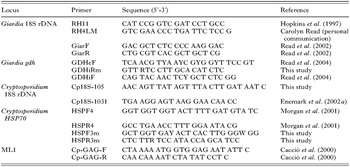
For all 5 loci, the PCR mix contained 1× PCR Gold Buffer, 1·5–2·0 mM MgCl2, 1–2 units of AmpliTaq Gold® DNA Polymerase (Applied Biosystems, Branchburg, New Jersey, USA), 120–160 μM dNTP and 12·5 pmol of each primer (primer sequences are shown in Table 1) in a total volume of 25 μl. The PCR mix included 1–5 μl of purified DNA as template for primary steps and 1 μl of primary PCR product for secondary steps. In addition, both the primary and the secondary step of the nested PCR of Giardia 18S rDNA contained approximately 5% dimethyl sulfoxide (DMSO), whereas the primary step of the semi-nested PCR of Giardia gdh and the PCR mix for Cryptosporidium 18S rDNA both contained 0·16% (w/v) bovine serum albumin (BSA).

The PCR was carried out in a Biometra T3 Thermocycler (Biometra GmbH i. L., Göttingen, Germany) with an initial hot start (95 °C for 10 min) and a final extension (72 °C for 7 min). In the case of Cryptosporidium, the 18S rDNA locus was amplified by 45 PCR cycles (94 °C for 60 sec, 57 °C for 25 sec, 72 °C for 50 sec), the nested PCR of the HSP70 gene by 30 cycles (94 °C for 30 sec, 58 °C for 20 sec, 72 °C for 30 sec) in the primary step and 45 cycles (94 °C for 25 sec, 60 °C for 18 sec, 72 °C for 25 sec) in the secondary step, whereas the microsatellite, ML1 was amplified by 40 cycles (94 °C for 30 sec, 53 °C for 30 sec, 72 °C for 25 sec). The nested PCR of the Giardia 18S rDNA locus was carried out with 40 and 45 cycles (95 °C for 30 sec, 59 °C for 20 sec, 72 °C for 20 sec) in the primary and secondary step, respectively, and for gdh 40 cycles (94 °C for 30 sec, 57 °C for 30 sec, 72 °C for 30 sec) was used in the primary step and 45 cycles (94 °C for 30 sec, 56 °C for 25 sec, 72 °C for 30 sec) for the secondary step. Positive and negative controls were included with every reaction.
Purification and sequencing of PCR products
PCR products were purified either directly from the PCR reaction or from 1·5–2·0% agarose gels after electrophoretic separation using High Pure PCR Product Purification Kit (Roche Diagnostics GmbH, Mannheim, Germany). The purified PCR products were sequenced in both directions by MWG-BIOTECH AG, Ebersberg, Germany. Sequences were analysed using BioEdit version 5.0.9 (Hall, 1999) and compared with already known Cryptosporidium spp. or Giardia spp. sequences obtained from GenBank using ClustalX version 1.8 (Thompson et al. 1997). For several samples, the sequencing chromatogram showed evidence of mixed infections and was further examined. In many instances, this resulted in assignment of 2 different species/genotypes, which subsequently each represented 1 isolate. When the involved species/genotypes could not be defined, the samples were excluded from the analysis. Nucleotide sequences obtained in this study, which were not identical to sequences already published in GenBank, have been deposited in GenBank under the Accession numbers DQ182597 to DQ182611. The designation of isolates, which were characterized as novel genotypes or subgenotypes, was according to the sample labelling system.
Phylogenetic analyses
The phylogenetic analyses of Cryptosporidium 18S rDNA, HSP70 and Giardia gdh were based on alignments obtained from ClustalX with lengths of 812, 287, and 411 nucleotides, respectively. The analyses were performed using TREECON for Windows version 1.3b (Van de Peer and De Wachter, 1994), and the distance estimations were carried out using different equations: Jukes and Cantor (1969), Tajima and Nei (1984) and Jin and Nei (1990) (Kimura two-parameter model with a=1, 2 or 0·5). The phylogenetic trees were constructed using neighbour-joining (NJ) algorithm. For each calculation, branch reliability was assessed using bootstrap analysis (1000 replicates). Trees resolved with different equations were compared to assure consensus of topologies.
Statistical analyses
All data analyses were stratified by age groups, due to large variation in prevalence and genotype distribution among the groups. Collected data were analysed using the procedure SURVEYMEANS in the software SAS®, version 8 (Statistical Analysis System, 1999), utilizing methods for analysis of complex survey samples.
When estimating the prevalence of infected animals the complex sample design was taken into account. Because selected animals were clustered into selected herd (herd was the primary sampling unit and animal the second sample unit) the variance of the prevalence of infected animals was estimated from the variation among the herds.
To take the unequal sample probability of animals (a result of a fixed number of animals being selected, within each herd, irrespective of herd size) into account, each observation was assigned the weight of the inverse sample probability in the estimation, which was defined as (1/(1/herd size)).
In order to estimate the distribution of genotypes, a subsample of the isolates was analysed by sequencing. Isolates for genotyping were selected successively within each herd, until at least 2 isolates per age group within each herd were sequenced. Because isolates were obtained from animals clustered into herds, the variance of the distribution of genotypes was estimated from the variation among the herds. In order to take the unequal sample probability of isolates into account (a fixed number of isolates was genotyped within each herd, irrespective of number of positive animals), each observation was assigned the weight of the inverse sample probability of the isolate to be genotyped, which was defined as (1/(number of genotyped isolates within an age group within a herd/number of isolates within an age group within a herd)).
The method of successive sampling of isolates for genotyping might introduce a bias in the estimated distribution of genotypes because samples with a high concentration of (oo)cysts might have a higher probability of a successful sequencing compared to samples with lower concentration. Therefore, an association between genotype and concentration of (oo)cysts will result in an overestimation of the occurrence of genotypes, which give rise to high (oo)cyst concentrations. To investigate whether or not this bias was present, we estimated (1) the association between selection for genotyping and the concentration of (oo)cysts in the sample (logistic regression), (2) the association between successful genotyping and the concentration of (oo)cysts in the sample (logistic regression), and (3) the association between genotype and concentration of (oo)cysts in the sample (Wilcoxon rank test).
Regarding subgenotyping using ML1, the degree of longitude and latitude were ascertained for 70 C. parvum (cattle genotype) isolates corresponding to 32 dairy herds, and the localities plotted on a map of Denmark. A spatial cluster analysis, using SaTScan version 4.0 (Kulldorff, 2003), was performed to evaluate possible geographical clustering of any of the 3 subgenotypes.
RESULTS
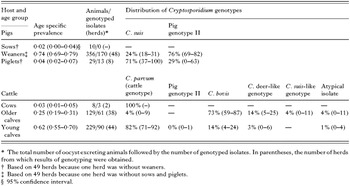
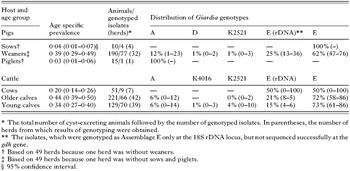
Initially, 1237 faecal samples from pigs and 1150 faecal samples from dairy cattle were analysed for the presence of Giardia spp. and Cryptosporidium spp. (Maddox-Hyttel et al. 2006). The estimated prevalences of animals of different age groups infected by Cryptosporidium and Giardia are presented in Table 2 and Table 3, respectively, to provide relevant background information for the genotyping results. The prevalence of Cryptosporidium oocyst excreting animals varied considerably between the different age groups, both for pigs and cattle. Also, for pigs the prevalence of Giardia cyst excreting animals varied considerably between the different age groups, whereas for cattle the age dependency was less prominent with 20% of the cows and 44% of the young calves excreting cysts. For details of within-herd prevalence of animals infected with Cryptosporidium and Giardia, see Maddox-Hyttel et al. (2006).


In order to examine the genetic diversity of both Cryptosporidium spp. and G. duodenalis in cattle and pigs, a number of (oo)cyst containing samples from animals of different age groups were selected for genotyping. Statistical analyses revealed no significant association between samples selected for genotyping and the concentration of (oo)cysts in the sample neither for pigs nor for cattle (data not shown). In addition, there was no significant association between successful genotyping and the concentration of (oo)cysts in the sample (data not shown).
Genotyping of Cryptosporidium
In this study, 183 pig and 154 cattle isolates of Cryptosporidium were successfully analysed by sequencing of the 18S rDNA locus and/or of the HSP70 gene. As a result, the previously described species/genotypes C. suis, pig genotype II, C. parvum (cattle genotype), C. bovis and Cryptosporidium deer-like genotype, as well as a novel genotype here referred to as C. suis-like genotype (i.e. C. sp. K4515 in GenBank) were identified. The age specific distributions of the Cryptosporidium species/genotypes are presented in Table 2. The number of isolates obtained from adult animals was low, and genotyping of isolates obtained from sows was unsuccessful. The three genotyped isolates from cows were all C. parvum (cattle genotype). Within each age group there was a dominating genotype, and this was not the same when comparing piglets to weaners or young to older calves. For example while pig genotype II was the most prevalent in weaners, the majority of piglets were infected with C. suis. Finally, the zoonotic C. parvum (cattle genotype) was most prevalent in young calves, while it was not detected in pigs of any age group.
Several pigs seemed to be infected with both C. suis and pig genotype II, whereas very few cattle samples exhibited a mix of infections. For 3 cattle samples, the rDNA locus was identical to that of C. bovis, whereas HSP70 was identical to that of C. parvum (cattle genotype). Based on the sequencing chromatograms, none of these samples seemed to contain a mix of infections and are therefore referred to as ‘Atypical isolate’ in Table 2.
A novel C. suis-like genotype was identified in 3 calves originating from 2 different herds. It showed 99% and 98% nucleotide identity to C. suis at the 18S rDNA and HSP70 loci, respectively. Besides, 1 young calf was infected with pig genotype II.
Both in piglets and weaners there was a significant association between species/genotype and concentration of oocysts in the sample. Thus, the concentration was significantly (P<0·05) higher in samples genotyped as C. suis (range for piglets was 3600 to 5920000 oocysts per gramme faeces (OPG) and for weaners 200 to 1480000 OPG) than in samples genotyped as pig genotype II (range for piglets was 400 to 28600 OPG and for weaners 200 to 228800 OPG). In cattle there was no association between genotype and concentration of oocysts in any of the age groups.
For most C. parvum (cattle genotype) isolates the sequencing of the 18S rDNA locus revealed the presence of the 2 different alleles, Type A and Type B (99% nucleotide identity). For the phylogenetic analyses, the sequence of the allele Type A was used (Fig. 1). In general, the predominant allele was Type A; however, the sequencing chromatogram from 4 isolates revealed purely Type B. In addition, the 18S rDNA sequence of at least 4 of the 15 isolates of the Cryptosporidium deer-like genotype showed evidence of multiple alleles. For this genotype, the amplification at the HSP70 gene was mostly unsuccessful, presumably due to sequence differences at the priming sites.

Fig. 1. Phylogenetic relationship of Cryptosporidium isolates using partial 18S rDNA sequences. The evolutionary distances were calculated with the Jukes and Cantor model and used to construct the neighbour-joining tree. Bootstrap values (>500) out of 1000 are indicated at each node. Accession numbers for sequences obtained from GenBank are given in parentheses. The sequence of Plasmodium falciparum was used as an outgroup. The distance scale indicates 0·02 substitutions/site.
C. parvum (cattle genotype) were obtained from 33 different dairy herds. In total, 70 isolates from 32 herds were further subgenotyped using the microsatellite, ML1 and revealed the presence of the alleles ML1-238, ML1-226 and ML1-223 previously named C1, C2 and C3, respectively. Only 1 allele was detected in any single herd. Regarding the geographical distribution, the spatial cluster analysis revealed no significant geographical clustering of any of the subgenotypes (data not shown).
Phylogenetic relationship of Cryptosporidium
The phylogenetic analyses of the 18S rDNA and the HSP70 gene are largely consistent, but there are some differences between the obtained trees (Figs 1 and 2). The location varies for both C. baileyi and C. meleagridis in addition to the C. canis/C. felis group, which most likely can be explained by low branch support. In both the 18S rDNA and the HSP70 tree, one of the conserved groups is made up of pig genotype II, C. bovis and Cryptosporidium deer-like genotype, whereas within the group that includes C. suis and C. parvum (cattle genotype) the relationship is more uncertain. As expected, the novel C. suis-like genotype groups relates most closely with C. suis in both phylogenetic trees.

Fig. 2. Phylogenetic relationship of Cryptosporidium isolates using partial nucleotide sequences of the HSP70 gene. The evolutionary distances were calculated by Jukes and Cantor model and used to construct the neighbour-joining tree. Bootstrap values (>500) out of 1000 are indicated at each node. Accession numbers for sequences obtained from GenBank are given in parentheses. The sequence of Plasmodium falciparum was used as an outgroup. The distance scale indicates 0·02 substitutions/site.
Genotyping of Giardia
In total, 227 Giardia isolates were analysed at the 18S rDNA locus and/or the gdh gene. It was possible to obtain the gdh sequence for 168 isolates. The gdh gene, which is less conserved than the 18S rDNA locus, can be used for subgenotyping. Therefore, the final assignment of genotype/subgenotype was preferentially based on the gdh sequence. Otherwise the genotype was defined by the 18S rDNA. The age specific distributions of genotypes are presented in Table 3, whereas details on subgenotypes are described below. Mostly, there was a correlation between the sequencing results of the 18S rDNA locus and the gdh gene, but for some isolates this was not the case.
In this study, 2 novel genotypes, K2521 and K4016, were found. When isolates, which were characterized as K2521 based on the gdh gene, were analysed at the 18S rDNA locus they seemed to belong to Assemblage E. According to the phylogenetic relationship of the gdh sequences these isolates did not belong to Assemblage E (Fig. 3). The contradiction between the results from the 18S rDNA and gdh sequences was most likely caused by the lack of variation at the 18S rDNA locus. Isolates that were only analysed at the 18S rDNA locus and found to belong to Assemblage E could in principle either truly belong to Assemblage E or be identical to K2521. Therefore, these isolates were referred to as Assemblage E (rDNA) (Table 3).

Fig. 3. Phylogenetic relationship of Giardia duodenalis isolates using partial nucleotide sequences of the gdh gene. The evolutionary distances were calculated by the Jukes and Cantor model and used to construct the neighbour-joining tree. Bootstrap values (>500) out of 1000 are indicated at each node. Accession numbers for sequences obtained from GenBank are given in parentheses. The sequence of Giardia ardeae was used as an outgroup. The distance scale indicates 0·02 substitutions/site. The shaded box indicates the Assemblage E group.
All 4 genotyped isolates from sows belonged to the Assemblage E (Table 3). This was also the most frequent among weaners, which additionally had 12% of the isolates belonging to the Assemblage A. In all age groups of cattle, the Assemblage E was the predominant. The pattern of distribution of Giardia genotypes among young and older calves was similar to that of weaners, including 6% of the isolates from young and older calves belonging to Assemblage A. Similar to sows, no potential zoonotic genotypes were found in cows.
In pigs there was no association between genotype and concentration of cysts in any of the age groups (data not shown). In cows and young calves there was a significant association between genotype and concentration of cysts in the sample (P<0·05), whereas the same association was only marginally significant in older calves (P=0·06). In particular, the concentration was much higher in the Assemblage E group (range for cows was 600 to 1200 cysts per gramme faeces (CPG); range for young calves was 400 to 6000000 CPG; range for old calves 200 to 2100000 CPG) and lower in the Assemblage E (rDNA) group (range for cows was 200 to 400 CPG; for young calves 1000 to 320000 CPG; and for old calves 200 to 179200 CPG) than expected when assuming no association.
Phylogenetic relationship and subgenotypes of Giardia
The gdh sequences of the different subgenotypes found in this study were compared to already known sequences obtained from GenBank (Fig. 3). The large Assemblage E group is comprised of subgenotypes that only differ by few nucleotides. For cattle more than 90% of the isolates belonging to this group were either K3612 or K2609, whereas for pig isolates roughly 60% were ‘E, pig’ and more than 20% were S2225. Interestingly, only 1 isolate identical to S2225 was found in cattle. Likewise, K3612 was only found in 4 different pig herds and no pig isolates were identical to K2609.
The 2 novel genotypes, K2521 and K4016, were closely related to Assemblage A (Fig. 3); K2521 was found in 3 different cattle herds and a single pig herd, whereas only 1 cattle isolate was characterized as K4016. Giardia isolates belonging to Assemblage A were found in both cattle and pig herds. While all subgenotyped pig isolates were A1, all subgenotyped cattle isolates were identical to the previously identified ferret isolate, GF-1 (Fig. 3). Two pig isolates from the same herd were genotyped at the rDNA locus as Assemblage D (Table 3), but confirmation at the gdh gene was unsuccessful. Both pigs had very low excretion of cysts, and the possibility of passive transfer as a result of coprophagy cannot be excluded. In this study, no isolates belonging to Assemblage B or C were found.
DISCUSSION
Hitherto, little was known about the genetic diversity of Cryptosporidium spp. and especially G. duodenalis in Danish dairy cattle and pigs. This is a substantial study, and besides the widespread occurrence of the 2 parasites, it reports the distribution of the genetic variations in a large number of animals from many different herds.
In the case of Cryptosporidium, our study has shown that there is an age-related change in the species/genotypes infecting animals, thereby supporting observations from similar studies (Santín et al. 2004; Fayer et al. 2006). For pigs, we observed higher oocyst concentration in samples genotyped as C. suis than in samples genotyped as pig genotype II. In addition, we found that pig genotype II was the most prevalent in weaners whereas the majority of piglets were infected with C. suis. This is in contradiction to a previous Australian study in which 28 Cryptosporidium isolates from pigs were genotyped revealing equal numbers of C. suis and pig genotype II. No correlation between genotype and host age was found, but some pigs infected with pig genotype II seemed to have high excretion of oocysts (Ryan et al. 2003).
In this study, pigs were commonly infected with more than 1 species/genotype. In contrast, mixed infections seemed less common in cattle similar to findings by Santín et al. (2004) and Fayer et al. (2006), who observed a single case of mixed infection and none, respectively. Nevertheless, previous Danish findings revealed 7% (13 out of 193) mixed infections in Cryptosporidium isolates from cattle (Enemark et al. 2002a). Likewise, Scottish results have demonstrated the presence of 8–26% infections containing more than 1 genotype in ruminants (Mallon et al. 2003). In both of these studies results were obtained by separation of micro-satellites using an ABI sequencer and GENESCAN software, indicating that the technique is of significance for the identification of mixed parasite populations.
Earlier findings by Xiao et al. (2002b) indicated that C. bovis was not prevalent in cattle. Our study and the studies by Santín et al. (2004) and Fayer et al. (2006) have proven otherwise. As mentioned by Santín et al. (2004) this is most likely due to the fact that this species is found in animals older than those most often examined. This clearly shows the importance of broader studies. In our study, C. bovis caused 14% and 73% of the infections in young and older calves, respectively. In comparison, Santín et al. (2004) reported 9% of the positive specimens from pre-weaned calves to be infected with C. bovis, which was also the case in 55% of positive specimens from post-weaned calves. In the most recent study by Fayer et al. (2006), C. bovis caused 35% of the Cryptosporidium infections in 1 to 2-year-old calves. Equal to our observations for the older calves, the latter study reported that the Cryptosporidium deer-like genotype accounted for another 15% of the infections. C. andersoni, which was found previously in Danish cattle (Enemark et al. 2002b), was not detected in the present study. This is probably explained by the fact that C. andersoni is primarily found in older animals (Olson et al. 2004), and that only 3 isolates from cows could be successfully genotyped in the present study. Interestingly, 1 young calf was infected with pig genotype II, which until now has appeared to be pig-specific. As seen by the phylogenetic analysis, pig genotype II most likely represents an individual species yet to be described. Furthermore, the C. suis-like genotype was isolated from 3 older calves. In comparison, 1 calf was infected with C. suis in the study by Fayer et al. (2006). The presence of the pig genotype II and the C. suis-like genotype in cattle cannot be explained by proximity between pigs and cattle, since pigs were not present on any of the 3 involved cattle farms.
In the case of C. parvum (cattle genotype), no significant clustering of the subgenotypes of ML1 was observed in this study, even though clustering of ML1-238 has previously been detected in Denmark (Enemark et al. 2002a).
The HSP70 gene could only be amplified for 2 out of 15 isolates of the Cryptosporidium deer-like genotype, corresponding to previous descriptions of a lack of amplification at this locus (Ryan et al. 2005). Even though the degenerate primers were further modified in our study, extensive interspecies variation in the primer regions could still cause insufficient annealing. In addition, the heterogeneity in the primer regions can cause differences in amplification efficiency, which in the case of mixed infections can lead to underestimation of some species/genotypes.
The outcome of the phylogenetic analyses was in agreement with results from other studies, including differences between the 18S rDNA and the HSP70 loci like for C. baileyi (Ryan et al. 2005; Fayer et al. 2005).
One purpose of this study was to examine the distribution of potentially zoonotic Cryptosporidium isolates. Presently, C. parvum (cattle genotype) is recognized as zoonotic, but for most of the other isolates found in this study the information on zoonotic potential remains limited. However, the fact that C. suis has been identified in immunocompetent humans (Xiao et al. 2002a) and the recent detection of pig genotype II in secondary sewage (Ryan et al. 2005), along with the widespread occurrence of C. parvum (cattle genotype) infection all suggest that pig and/or cattle faeces, if used as untreated manure on open fields, could be a concern in the transmission of potentially zoonotic Cryptosporidium to the environment and, thus, recreational waters.
The high prevalence of Giardia in both cattle and pigs in Denmark allowed genotyping of a couple of hundred isolates. Thus, this is the largest study of Giardia in pigs, and comparable to the extensive studies of cattle by Trout et al. (2004, 2005).
Because Giardia belonging to Assemblage A was observed in Danish cattle, they represent the potential for zoonotic transmission. From all over the world, similar observations have been reported in several other studies (O'Handley et al. 2000; van Keulen et al. 2002; Huetink et al. 2001; Appelbee et al. 2003; Trout et al. 2004, 2005; Itagaki et al. 2005; Lalle et al. 2005), with the exception of Becher et al. (2004), who only recovered cattle isolates belonging to Assemblage E. As in the studies by Trout et al. (2004, 2005), we found that the level of Assemblage A was relatively constant (6%) in young and older calves. Thus, we did not see a host age related change in distribution of zoonotic genotypes as was the case of Cryptosporidium.
In all age groups of cattle there was a significant association between genotype and concentration of cysts in the sample. In particular, the concentration was much higher in the Assemblage E group and lower in the Assemblage E (rDNA) group (those genotyped only at the 18S rDNA locus) than expected when assuming no association. The lack of amplification at the gdh gene might be related to low concentration of cysts and thereby could explain the above association. A correlation between specific subgroups and host origin was observed within Assemblage E. This indication of some subgenotypes being more or less host adapted is similar to the report by Monis et al. (2003), who observed host-specific substructuring within Assemblage E, when analysing isolates from sheep, calves and pigs by allozymic analysis.
In the case of the isolate K2521, discrepancy was observed between the results obtained at the 18S rDNA locus and the gdh gene. Similarly, Read et al. (2004) found that several of their Giardia isolates, which grouped with the non-zoonotic genotypes at the 18S rDNA locus, conversely grouped with the potentially zoonotic isolates at the gdh gene. Because the gdh gene is less conserved and the sequence is longer than the 18S rDNA, the gdh allows the discrimination between the various subgenotypes of Giardia. These observations emphasize the importance of more consistent methods for Giardia genotyping in the future. For example, in the attempt to elucidate the heterogeneity of G. duodenalis it is important that different laboratories use the same set of molecular markers in order to compare the results. Thereby, identical subgenotypes could be named according to a common nomenclature.
While isolates of the G. duodenalis A1 group are potentially zoonotic, most isolates of the A2 group have been found to infect only humans; however more recently, also isolates from cattle, dogs and horses have been placed in this group (Traub et al. 2004, 2005; Lalle et al. 2005). For cattle, the GF-1 (Abe et al. 2005) groups with the A2 subgenotype in the phylogenetic analysis. The GF-1 isolate has previously been placed in the A1 group (Abe et al. 2005) and a likely explanation for the inconsistency of the results is low branch support in the phylogenetic analyses. Regardless of subgenotype, the Danish cattle are infected with Giardia belonging to Assemblage A and, furthermore, the Danish pigs with Giardia of the A1 subgenotype, thus also with regard to Giardia there may be reason for public health concern when spreading manure on the open fields.
At present, a project on genotyping human isolates of Giardia and Cryptosporidium is being conducted in our laboratory and will provide the opportunity to compare results from both the human and the livestock population. If the genotypes found are identical, it may shed light on potential zoonotic species/genotypes and possible routes of transmission.
The authors thank L. Eiersted, C. D. Juel, P. Olsen and B.-T. T. Pham for their interest, suggestions, and help with this project. This work has been supported by the Danish Agricultural and Veterinary Research Council, grant number 23-02-0059.