Introduction
Car seat tolerance screening is a common pre-discharge requirement for certain infants, predominantly from the neonatal ICU setting. The primary indication for car seat testing, per recommendation by the American Academy of Paediatrics, is for premature infants born < 37 weeks’ gestational age.Reference Davis, Hoffman and Eichenwald1 Moreover, almost half of nurseries and neonatal ICUs also have low birth weight (birth weight < 2.5 kg) as an inclusion criterion for car seat tolerance screening, regardless of gestational age.Reference Davis2 To this end, there have been publications regarding the clinical characteristics and outcomes of car seat tolerance screening in infants with prematurity.Reference Davis, Condon and Rhein3,Reference Magnarelli, Solanki and Davis4 A generally accepted failure rate for premature infants has been estimated at ∼ 4.2% based on a multi-centre study looking at 7,899 infants across 788 hospitals.Reference Jensen, Foglia and Dysart5
There is minimal literature regarding car seat testing in patients with CHD. Nevertheless, car seat tests are still routinely performed on these patients at many major paediatric heart centres throughout the country—regardless of gestational age or birthweight, the two major criteria used to determine need for car seat testing in routine newborn and neonatal ICU care. It is not known if the failure rate in infants with CHD differs from that of premature or low birthweight infants. Additionally, the criterion of CHD includes a wide variety of cardiac physiologies, which may impact the ability of an infant to tolerate different positioning as necessary for car seat testing. In this study, we aim to evaluate the rate of car seat tolerance screening failure in infants with CHD, as well as the influence of cardiac physiology, surgical history, and comorbidities on car seat test failure. We also assessed the impact of a failed test, specifically on the patient’s length of stay and its potential to predict readmission.
To our knowledge, there have been only two studies looking at car seat tolerance screening in a CHD infant cohort. Simsic et al, published in 2008, retrospectively reviewed 66 infants—all of whom had undergone surgery for CHD.Reference Simsic, Masterson, Kogon, Kirshbom and Kanter6 Four of the 66 (∼ 6%) failed car seat tolerance screening, all secondary to oxygen desaturation. They found no relationship between birthweight, duration of mechanical ventilation, feeding abnormalities, age at hospital discharge, or cardiac surgical procedure with car seat test failure. Ultimately, they concluded that it may be beneficial to extend the American Academy of Paediatrics recommendations for car seat tolerance screening to include infants discharged from the hospital following cardiac surgery. More recently, Sangillo et al reviewed a cohort of 171 infants with CHD who underwent car seat tolerance screening.Reference Sangillo, Pryal and Davis7 They similarly found a failure rate of ∼ 6% with no statistically significant differences in cardiac lesion type or clinical characteristics between passing and failing groups.
In our study, we set out to investigate the background characteristics that might influence a failure, such as cardiac physiology, the coexisting presence of genetic, respiratory, or neurologic pathology, and the impact that this may have on the overall hospital length of stay.
Methods
This is a single-centre, Institutional-Review-Board-approved, retrospective chart review analysis of 193 infants with repaired, palliated, and unrepaired CHD discharged home from the general cardiology service between November 2020 and November 2024. Infants discharged from the neonatal ICU, general paediatric floor, or our affiliated skilled nursing facility were excluded from analysis, as to limit any potential variations in nursing execution of the car seat test that could affect the failure rate.
Patient demographic and clinical data were obtained by extraction from the Paediatric Cardiac Critical Care Consortium (PC4) and the Paediatric Acute Care Cardiology Collaborative (PAC3) registries. Additional clinical details and car seat tolerance screening results were obtained through medical record review.
Car seat tolerance screening is performed by nurses on the cardiology service following an institutional algorithm, which is also utilised in the neonatal ICU, nursery, and inpatient floor settings. This algorithm follows American Academy of Paediatrics guidelines, and the car seat test is required within 72 hours of discharge. The infant is placed in a personal car seat on the floor (at a 45-degree angle) with the harness strap in proper position below the shoulders with the retaining clip at the nipple/armpit level but not close to the neck. For small or premature infants, the protocol details the use of blanket rolls as needed on either side of the infant to support the head in a midline position, thus reducing the risk of airway obstruction. The infant is then monitored for a minimum of 90 minutes or the estimated travel time from the hospital to arrival at home, whichever time is greater. The maximum duration of a test is 120 minutes. The infant is placed on a cardiorespiratory monitor and pulse oximeter. Car seat test failure is defined as one of the following: apnoea for ≥ 20 s, bradycardia (< 80 bpm that is prolonged or recurrent), or oxygen desaturation with good pulse oximetry signal quality ≥ 20 s (saturation less than the lower limit of parameter goal, i.e. < 90% in a typical patient). Many infants with CHD do not have normal saturations at baseline, so their individualised oxygen saturation goal is used as the threshold for the test. At our institution, if the infant fails the car seat test using a standard car safety seat, the test is repeated in 12–24 hours with a focus on positioning. If the infant fails for a second time, the test is repeated in a hospital-issued car seat or car bed, or the infant is recommended to have continued hospitalisation for further medical assessment. If repeated failures are secondary to desaturation, there is consideration of a repeat car seat test on nasal cannula with planned discharge on supplemental oxygen.
Inclusion criteria at our institution for car seat tolerance screening is as follows: < 37 weeks gestational age, birthweight < 2.5 kg, infants discharged on supplemental oxygen, infants at risk for obstructive apnoea, bradycardia, or oxygen desaturation, infants with micrognathia, neuromuscular disorder, Down syndrome, severe hydrocephalus, or those after tracheostomy or congenital heart surgery. Car seat tolerance screening is also performed on any infant who, in the opinion of the healthcare provider, is at high risk for complications associated with placement in a standard infant car seat. At our institution, this includes all infants with first-time discharge from the cardiology service with any congenital cardiac malformation or arrhythmia.
Cardiac physiology was divided into categories of single ventricle with or without a shunt, and biventricular repaired or unrepaired. The shunted single ventricle group included patients who had undergone surgical Norwood palliation, hybrid procedure, or patent ductus arteriosus stent placement. The non-shunted group included those with Glenn physiology who had remained hospitalised during the interstage period, those after pulmonary artery banding, or those with well-balanced circulations.
Regarding the clinical factors associated with passed and failed car seat tests, infants with seizures included those discharged on anti-epileptic drugs. Similarly, infants with gastroesophageal reflux disease included infants discharged on a histamine-2 blocker and/or a proton pump inhibitor.
This study was approved by the Institutional Review Board at our institution (IRB#19050115).
Statistical methods
Data are presented as medians and interquartile ranges for continuous variables, and as frequencies and percentages for categorical variables. Characteristics were compared between patients who passed car seat tolerance screening and those who failed using Wilcoxon-Mann–Whitney tests for continuous variables, and chi-square or Fisher’s exact tests for categorical variables, as appropriate. Differences were considered significant at a p-value of ≤ 0.05.
Results
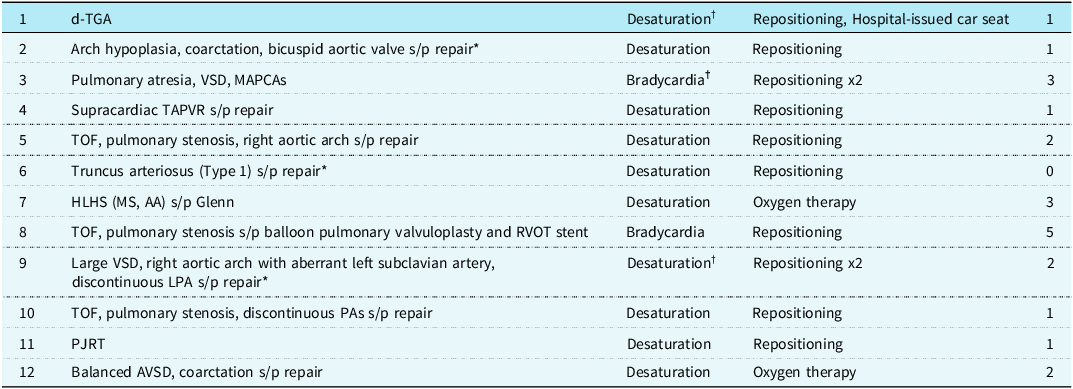
Twelve of the 193 infants failed the initial car seat tolerance screen, giving an overall failure rate of the cohort of 6.2%. The cardiac pathologies and surgical status in these 12 patients were varied, including severe coarctation, ventricular septal defect, atrioventricular septal defect, D-transposition of the great arteries, truncus arteriosus, total anomalous pulmonary venous return, hypoplastic left heart syndrome, permanent junctional reciprocating tachycardia, and Tetralogy of Fallot. Three of these patients had discontinuous pulmonary arteries / major aortopulmonary collateral arteries. Characteristics of the 12 patients who failed the initial car seat tolerance screen are detailed in Table 1. Two of the 12 failures were due to bradycardia, while the other 10 failures were secondary to desaturation below the patient’s saturation goal. Of the two patients who failed due to bradycardia, one was on beta-blocker therapy for treatment of supraventricular tachycardia. Seven of the 12 initial failures passed the repeat car seat test with simple repositioning and retest within 24 hours, while two had their second car seat test on supplemental oxygen and were discharged on nasal cannula. The remaining three failed their repeat test despite repositioning; of these, one passed the third car seat test when given a hospital-issued car seat, and two passed the third car seat test with continued focus on repositioning.
Characteristics of the 12 patients who failed initial car seat tolerance screening

* These patients also carry the diagnosis of DiGeorge Syndrome.
† These patients also failed their repeat car seat test for the same reason as their first.
Each patient with repeat failure had the same accommodation, except for Patient 1 who was issued a hospital car seat for the third test. Length of stay (LOS) after car seat test represents the delay in hospital discharge after the initial car seat test failure.
D-TGA = dextro-transposition of the great arteries; VSD = ventricular septal defect; MAPCAs = major aortopulmonary collateral arteries; TAPVR = total anomalous pulmonary venous return; TOF = Tetralogy of Fallot; HLHS (MS, AA) = Hypoplastic left heart syndrome (mitral stenosis, aortic atresia); RVOT = right ventricular outflow tract; LPA = left pulmonary artery; PAs = pulmonary arteries; PJRT = Permanent Junctional Reciprocating Tachycardia; AVSD = atrioventricular septal defect.
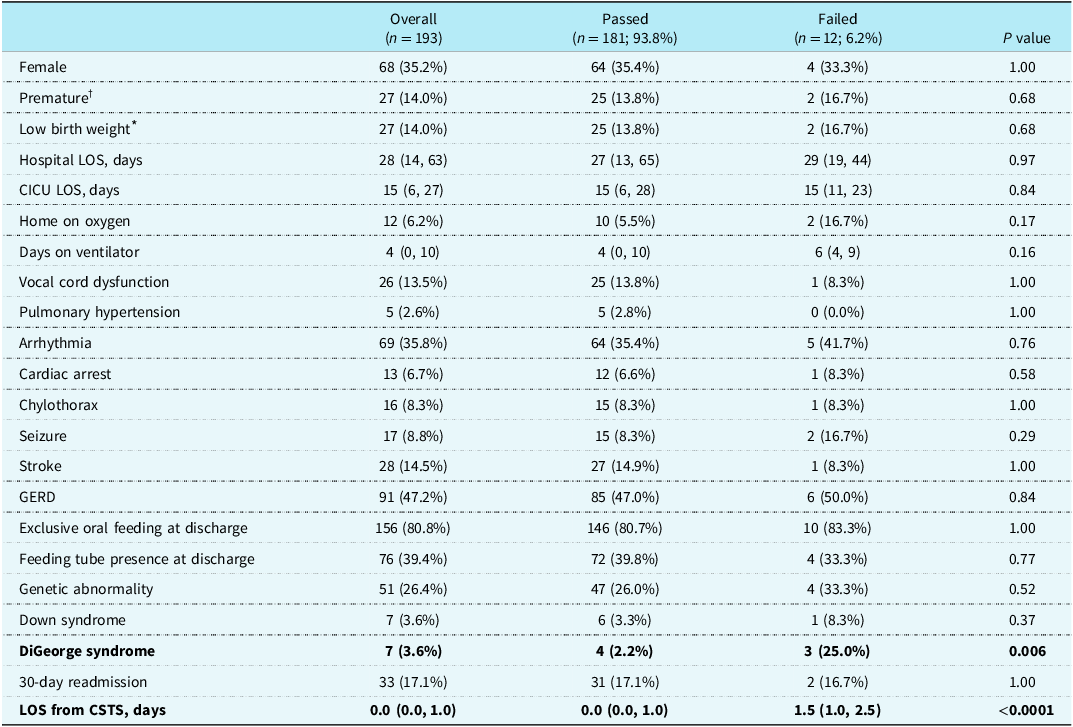
Of the 193 infants, 68 (35.2%) were female, and sex was not statistically different between passing and failing groups (p = 1.00). The median hospital length of stay was 28 days (14–63 days) for the total cohort, with a median CICU length of stay of 15 days (6–27 days)—neither of which was statistically different between passing and failing groups (p = 0.97 and p = 0.84). Neither median birthweight (3.2 kg vs. 3.3 kg, p = 0.68) nor the rate of prematurity (13.8% vs. 16.7%, p = 0.68) differed significantly from those who passed to those who failed. Demographics and clinical factors associated with passed and failed car seat tolerance screening are represented in Table 2.
Demographics and clinical factors associated with passed and failed car seat tolerance screening

Data are represented as frequency (%) or median (interquartile range), as appropriate. Bolded entries denote statistical significance at p<0.05.
† Prematurity is <37 weeks gestational age.
* Low birth weight is <2.5 kg.
LOS = length of stay; CICU = cardiac intensive care unit; GERD = gastroesophageal reflux disease.
There was no statistically significant difference in the percentage of patients discharged with supplemental oxygen between those who passed car seat testing (5.5%) and those who failed (16.7%) (p = 0.17). There was also no difference in the percentage of patients with vocal cord dysfunction between the passing and failing groups (13.8% vs. 8.3%, p = 1.00). The duration of mechanical ventilation in the CICU was similar between passing and failing groups: 4 days (0,10) in the passing group as compared to 6 days (4,9) in the failing group (p = 0.16).
There was no statistically significant difference in pulmonary hypertension rates in the passing group (2.8%) as compared to the failing group (0%) (p = 1.00). There were also no differences in rates of arrhythmia (35.4% vs. 41.7%, p = 0.76) or cardiac arrest (6.6% vs. 8.3%, p = 0.58) between passing and failing groups. The rates of chylothorax in the passing and failing groups were identical at 8.3% (p = 1.00).
There were no statistically significant differences in the rates of seizure (8.3% vs. 16.7%, p = 0.29) or stroke (14.9% vs. 8.3%, p = 1.00) in the passing group compared to the failing group.
There was no significant difference in the presence of gastroesophageal reflux disease in the passing group (47.0%) and the failing group (50.0%) (p = 0.84). There were also no meaningful differences in the rates of exclusive oral feeding at discharge (80.7% vs. 83.3%, p = 1.00) or the rates of feeding tube presence at discharge (39.8% vs. 33.3%, p = 0.77) between passing and failing groups.
There was no significant difference in the rate of Down syndrome between passing and failing groups (3.3% vs. 8.3%, p = 0.37). However, those in the failing group had significantly higher rates of DiGeorge Syndrome (at 25.0%) compared to those in the passing group (at 2.2%) (p = 0.006). Other unspecified genetic abnormalities were similar between the passing and failing groups (26.0% vs. 33.3%, p = 0.52).
There was no difference in rates of readmission to the hospital within 30 days between the passing group (17.1%) and the failing group (16.7%) (p = 1.00). However, a failed car seat test delayed initial hospital discharge by a median of 1.5 days (1.0, 2.5).
Cardiac physiology
When divided into cardiac physiology, the “single ventricle, shunted” group included 30 patients who were discharged with single ventricle physiology after Norwood procedure, hybrid procedure, or patent ductus arteriosus stenting. Specific details regarding this group are provided in Table S3A. The “single ventricle, non-shunted” group included 24 infants—19 of whom were status post Glenn procedure, four of whom were non-palliated but clinically well-balanced, and one who was palliated with pulmonary artery banding. Details regarding this group are provided in Table S3B.
Catheter-based procedures such as balloon pulmonary and aortic valvuloplasties that resulted in adequate biventricular circulation were included in the “biventricular, repaired” category. Within this category of 102 infants, 11 were discharged after balloon pulmonary valvuloplasty (including six patients with congenital pulmonary stenosis and five patients with pulmonary atresia and intact ventricular septum), and one was discharged after balloon aortic valvuloplasty—none of whom had surgery prior to discharge. Table S3C details the distribution of anatomy and corresponding repair within this group. The “biventricular, unrepaired” group included 37 infants: 30 with structural heart disease, six with rhythm abnormalities, and one with myocarditis. Table S3D shows the specific distribution of cardiac pathology within this group.
There was no relationship between the patient’s cardiac physiology (biventricular repaired, biventricular unrepaired, single ventricle shunted or non-shunted) and car seat test failure (p = 0.39). Among biventricular patients, there was no meaningful difference in failure rates between repaired (8.8%) and unrepaired (5.4%) patients (p = 0.73). Similarly, among single ventricle patients, there was also no difference in the rate of failure between non-shunted and shunted patients (4.2% vs. 0.0%, p = 0.44). Figure 1 details the car seat tolerance screening failure rate (%) based on cardiac physiology.
Car seat tolerance screening failure rate (%) based on cardiac physiology. The biventricular repaired group included 102 infants, nine of whom failed initial car seat testing. The biventricular unrepaired group included 37 infants, two of whom failed initial car seat testing. The single ventricle non-shunted group included 24 infants, one of whom failed initial car seat testing. All of the 30 shunted single ventricle patients passed their initial car seat test.

Discussion
Car seat tolerance screening has been recommended by the American Academy of Paediatrics for premature infants and those with low birth weight since 1991.8 This was seen to be a practical attempt to “reduce the frequency and severity of cardiorespiratory events experienced by preterm infants seated in car safety seats to minimise potential neurodevelopmental sequelae.”Reference Bull and Engle9 Given the vulnerability and high-risk nature of infants with CHD, many institutions have opted to perform car seat tests on this population for similar reasoning; however, there is limited data available to support the need for this testing in the CHD population.
The two prior publications regarding car seat tolerance screening in infants with CHD utilised similar approaches but with important differences from our study. As compared to Simsic et al,Reference Simsic, Masterson, Kogon, Kirshbom and Kanter6 our study investigates a larger cohort including unrepaired CHD as well as the impact of a failed test. And, as compared to Sangillo et al,Reference Sangillo, Pryal and Davis7 our study focuses more on the potential for cardiac physiology to impact car seat test results—as opposed to cardiac lesion type alone. Moreover, Sangillo et al evaluated car seat tolerance screening in the neonatal ICU, paediatric ICU, and newborn nursery. Here, we focus exclusively on car seat testing in acute care cardiology.
The overall car seat tolerance screening failure rate of 6.2% in our cohort of patients with CHD is higher than the failure rate in the premature population (∼ 4.2%)Reference Jensen, Foglia and Dysart5—but similar to the rate that has been reported in the two other studies of infants with CHD.Reference Simsic, Masterson, Kogon, Kirshbom and Kanter6,Reference Sangillo, Pryal and Davis7 On the surface, therefore, our results might support the continued utilisation of car seat testing as a screening test in the CHD population—that is, if the American Academy of Paediatrics continues to recommend it for premature infants or those with low birth weight. However, our initial car seat test failure rate may be misleading, because only 3 of the 12 failures truly required intervention upon discharge—either a hospital-issued car seat (in the case of patient #1 in Table 1) or discharge on supplemental oxygen (in the cases of patients #7 and #12 in Table 1). The other nine infants who failed their initial car seat test ultimately passed repeat testing when there was an emphasis on repositioning. This suggests that a focus on infant positioning in a car seat outside of true car seat tolerance screening may have similar value. Nevertheless, because there were no specific cardiac diagnoses, physiologies, or comorbidities that were associated with a failed test (including prematurity and low birth weight), a targeted screening approach within the CHD population does not seem feasible. In fact, in the perceived most vulnerable group of shunted single ventricle patients, all 30 infants passed their initial car seat test.
The higher failure rate of DiGeorge Syndrome in our cohort has not been described in the two prior studies. None of the three patients with DiGeorge Syndrome who failed car seat testing in our cohort carries a diagnosis of craniofacial malformation that could predispose to airway obstruction during the test. Infants with DiGeorge Syndrome often exhibit hypotonia,Reference Sobin, Monk, Kiley-Brabeck, Khuri and Karayiorgou10 which could lead to poor head control, obstruction, and hypoventilation during the car seat test. However, we would also have expected this difference in the Down Syndrome subgroup as well if hypotonia were the explanation for the higher rate of failure. It is also interesting that 3 of the 12 failures (25%) had discontinuous branch pulmonary arteries with major aortopulmonary collateral arteries. These patients may be more prone to desaturation regardless of car seat testing, given inherent limitations to pulmonary blood flow and propensity towards V/Q mismatching, although more investigation is warranted in this respect.
Moreover, of the two infants with car seat test failure secondary to bradycardia, one infant (patient #3 in Table 1) was on beta-blocker therapy for treatment of supraventricular tachycardia. This infant also failed their repeat car seat test—again due to bradycardia. This could make the case for establishing individualised heart rate parameters, in addition to the existing individualised saturation goals, when performing car seat tests in our complex population.
Regardless of the failure rate, there remains a debate on the value and utility of car seat testing as a standard pre-discharge assessment—whether that discharge is from the neonatal ICU, nursery, or cardiology floor. One study found that discontinuation of car seat tolerance screening in a large integrated health care network was not associated with a change in 30-day post-discharge adverse outcomes—including death, 911 call-triggered transports, or readmissions.Reference Braun, Kaempf and Ho11 In our own cohort, the readmission rate within 30 days was also not meaningfully different between passing and failing groups. However, hospital discharge was delayed by 1.5 days—which has a considerable financial and psychosocial impact on families, in addition to impacts on the hospital system. Certainly, to catch infants who are at risk of serious adverse events in a car seat, the screening test needs to be highly sensitive; however, the impact of a false positive should also be considered. Therefore, future studies might focus on whether intervention after consecutive car seat test failure (discharge in a car bed or on supplemental oxygen, with structured parental education) truly affects post-discharge adverse outcomes.
If car seat tolerance screening is to continue for infants with CHD, then our data would support screening infants without targeting certain anomalies, physiologies, or comorbidities. Larger studies should be performed to evaluate the impact of these same factors that our study may not have been powered to detect, as targeted car seat tolerance screening could help identify the most at-risk patients and decrease the impact of false-positive initial test failures. Our study is limited by the size of the cohort and the relatively low rates of certain conditions, including genetic diagnoses. Comorbidities such as Down syndrome, seizures, days on a ventilator, and need for oxygen therapy upon discharge trended towards statistical significance; however, the power of our study could have been a limitation in this regard. Future research should include multiple centres to evaluate a larger population and identify predictors of car seat test failure that could allow for more targeted testing. Moreover, by excluding infants discharged from the NICU, nursery, or our institution’s associated skilled nursing facility, our study likely captured a more complex CHD group, which could have overestimated the true car seat test failure rate of CHD patients.
Finally, if car seat testing is to continue in the acute care cardiology setting, our results highlight the substantial impact of proper infant positioning on car seat test failure. Protocols for the execution of a car seat tolerance screen should include additional guidance to ensure proper positioning. A focus on nursing competency in executing the car seat test could reduce false positives and unnecessary discharge delays. Following this study, our centre is now initiating a quality improvement project with an effort to reduce our car seat test failure rate by implementing a new user-friendly protocol that focuses on proper infant positioning in a car seat as detailed by the American Academy of Paediatrics.
Conclusion
The car seat tolerance screen failure rate of our CHD cohort (6.2%) is higher than the published failure rate for premature infantsReference Jensen, Foglia and Dysart5— however, 9 of the 12 infants who failed their initial car seat test ultimately passed repeat testing with a focus on repositioning. There was no relationship between cardiac physiology and car seat test failure. There was no relationship between the analysed neurologic, respiratory, or gastroenterological pathologies and car seat test failure. DiGeorge Syndrome was associated with an increased car seat test failure rate; however, Down Syndrome and other genetic abnormalities were not. Therefore, our results suggest that, if car seat tolerance screening is to continue for infants with CHD, screening should be performed without a targeted approach. Nevertheless, the ultimate value and utility of car seat tolerance screening remains debatable. There was no meaningful difference in 30-day readmission between passing and failing groups in our cohort, which is similar to other studies.Reference Sangillo, Pryal and Davis7,Reference Braun, Kaempf and Ho11 And yet, the implication of a failed test includes delay in hospital discharge (median of 1.5 days in our cohort), which carries financial implications as well as psychosocial stressors on the family.
Given the recent exploration of car seat tolerance screening in single-centre studies, we believe a multicentre analysis would be the appropriate next step in order to provide a more formal recommendation for screening in our CHD population. Regardless, in the interim, it is important for heart centres performing car seat tolerance screening on infants with CHD to have protocols in place that emphasise proper infant positioning in the car seat, as to reduce false positives and unnecessary discharge delays.
Supplementary material
The supplementary material for this article can be found at https://doi.org/10.1017/S1047951125110731.
Acknowledgements
The authors listed received no financial support for the research, authorship, and/or publication of this article.
Financial support
This research received no specific grant from any funding agency, commercial, or not-for-profit sectors.
Competing interests
The authors declare no competing interests.
Ethical standard
This study is a retrospective review and did not involve any prospective experimentation, human subject intervention, or animal research. Institutional policies regarding the use of patient data were followed, and all data were handled in compliance with ethical standards.
Previous presentation
Barresi NV, Schiff, Roberts FW, Brooks S, Frosch O, Morell E. Pre-discharge Car Seat Tolerance Screening in Infants with Congenital Heart Disease: A Single Center Review. Presented at PC4/PAC3 Spring 2025 Conference, April 15th, 2025, Washington D.C.