INTRODUCTION
Atmospheric carbon dioxide (CO2) concentration has increased by >35% since Industrialization, to the current level of 385 ppmv (Keeling et al. Reference Keeling, Piper, Bollenbacher and Walker2009) and may reach twice the Pre-Industrial concentration by the middle of the 21st century (IPCC 2007). CO2 enrichment directly affects just two physiological processes of plants, photosynthesis and stomatal conductance to water vapour, but may increase plant productivity and influence many other ecosystem processes via these effects. For reasons that are not fully understood, CO2 responses vary widely among ecosystems. For example, increasing CO2 to 680–720 ppmv increased the productivity of shortgrass steppe by 95% during a dry year (Morgan et al. Reference Morgan, Pataki, Körner, Clark, Del Grosso, Grünzweig, Knapp, Mosier, Newton, Niklaus, Nippert, Nowak, Parton, Polley and Shaw2004b), but had no effect on or even reduced biomass of annual grassland when productivity was high (Shaw et al. Reference Shaw, Zavaleta, Chiariello, Cleland, Mooney and Field2002; Dukes et al. Reference Dukes, Chiariello, Cleland, Moore, Shaw, Thayer, Tobeck, Mooney and Field2005).
Following a brief review of the influence of CO2 on plant physiology, the question of why CO2 impacts on productivity and other processes vary among ecosystems will be explored. A conceptual framework is applied to interpret this variability. The focus will be on rangeland ecosystems, defined as natural or semi-natural herbaceous formations composed mostly of grasses (Polley Reference Polley1997), but the framework described may be applied to any ecosystem. Rangelands and other grazing lands together form the largest and most diverse land resource on Earth and support livestock industries worldwide (Follett & Reed Reference Follett and Reed2010). In the USA alone, grazing lands support more than 60 million cattle and 8 million sheep (National Agricultural Statistics Service of USDA Reference Chapman and Petrone2006).
Leaf and plant responses to CO2
Net photosynthesis of C3 plants usually increases almost linearly from sub-ambient CO2 to the current CO2 concentration when measured at high light intensity (Pearcy & Ehleringer Reference Pearcy and Ehleringer1984). Typically, C3 photosynthesis continues to increase, albeit at a lesser rate, at greater-than-present CO2 levels. At full illumination, net photosynthesis tends to be greater in C4 than C3 leaves at sub-ambient CO2, but C4 photosynthesis approaches saturation at the current CO2 concentration.
An increase in CO2 usually reduces stomatal conductance to water vapour, especially among herbaceous species (Field et al. Reference Field, Jackson and Mooney1995; Wand et al. Reference Wand, Midgley, Jones and Curtis1999). Conductance declines by a similar proportion in C3 and C4 plants (Wand et al. Reference Wand, Midgley, Jones and Curtis1999). Transpiration per unit of leaf area may decline as a result, although feedbacks at the canopy and higher scales typically lessen the anti-transpiration effect of reduced conductance (McNaughton & Jarvis Reference McNaughton and Jarvis1991). When transpiration rates do decline, effects may include slower rates of soil water depletion by plants, improved plant water relations, and greater biomass production on rangelands and other water-limited ecosystems (Fredeen et al. Reference Fredeen, Randerson, Holbrook and Field1997; Owensby et al. Reference Owensby, Ham, Knapp, Bremer and Auen1997; Niklaus et al. Reference Niklaus, Spinnler and Körner1998; Morgan et al. Reference Morgan, LeCain, Mosier and Milchunas2001, Reference Morgan, Pataki, Körner, Clark, Del Grosso, Grünzweig, Knapp, Mosier, Newton, Niklaus, Nippert, Nowak, Parton, Polley and Shaw2004b; Grünzweig & Körner Reference Grünzweig and Körner2001; Polley et al. Reference Polley, Johnson and Derner2002a).
There is often a strong correlation between physiological sensitivity and growth response to CO2 when plant densities are low and resources such as light and nitrogen (N) are plentiful. That correlation weakens when plant densities are high or conditions are less than optimal for growth. Thus, stand-level responses to CO2 often depend as much on exogenous factors as on physiological sensitivity to CO2. As a consequence, CO2 effects on productivity have been found to vary widely among grasslands and other rangelands. The effects of experimentally increasing CO2 concentration range from no change or even a decrease in aboveground biomass of annual grassland when productivity is high (Shaw et al. Reference Shaw, Zavaleta, Chiariello, Cleland, Mooney and Field2002; Dukes et al. Reference Dukes, Chiariello, Cleland, Moore, Shaw, Thayer, Tobeck, Mooney and Field2005) to a 95% increase in aboveground biomass during a dry year on shortgrass steppe (Morgan et al. Reference Morgan, LeCain, Mosier and Milchunas2001, Reference Morgan, Mosier, Milchunas, LeCain, Nelson and Parton2004a). Why is sensitivity to CO2 so variable among ecosystems and years on a given ecosystem? More specifically, what regulates the sensitivity of productivity and other ecosystem processes to CO2? Do the constraints on ecosystem processes that are evident in short-term (years to decades) experiments operate indefinitely with little change? Or, do changes associated with CO2 enrichment feed back to affect ecosystem sensitivity to CO2? If so, long-term responses of ecosystems to CO2 may not match short-term dynamics.
The interactive controls framework for assessing variability in CO2 responses
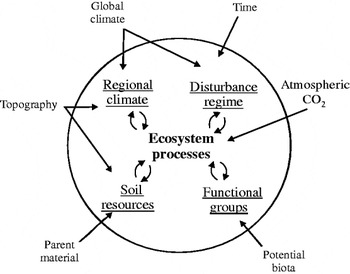
Chapin et al. (Reference Chapin, Torn and Tateno1996) noted that ecosystem processes are regulated by both internal and external factors (Fig. 1). External factors or ‘state factors’, as the descriptors imply, are external to and independent of ecosystem processes. External factors include parent material, global climate, topography, potential biota and time (Jenny Reference Jenny1941), and may be regarded as static over an ecological timescale of decades. Chapin et al. (Reference Chapin, Torn and Tateno1996) suggested that ecosystems also are regulated by internal factors that are dynamic over ecological timescales. These dynamic, internal regulators of ecosystems were termed ‘interactive controls’ and include regional climate, soil resource supply, major functional groups of organisms (where functional groups are defined as organisms that have similar effects on ecosystem processes) and disturbance regime. Unlike state factors, interactive controls both regulate and respond to ecosystem processes. Interactive controls are constrained by state factors, but interact dynamically with ecosystem processes.
Conceptual relationships between state factors (listed outside the circle; i.e. Parent Material and Potential Biota), interactive controls (underlined; i.e. Soil Resources and Functional Groups) and ecosystem processes. State factors are static over ecological time scales and constrain interactive controls. Interactive controls both regulate and respond to ecosystem processes. Like state factors, atmospheric CO2 concentration is determined by factors that are largely external to and independent of ecosystem processes at the local scale. Unlike state factors, atmospheric CO2 concentration is not static. Rather, the continuing increase in CO2 concentration represents a chronic and cumulative change in the availability of an essential resource for plants (Smith et al. Reference Smith, Knapp and Collins2009). The figure is adapted from Chapin et al. (Reference Chapin, Torn and Tateno1996).

Atmospheric CO2 concentration has changed through geological time (Jouzel et al. Reference Jouzel, Barkov, Barnola, Bender, Chappellaz, Genthon, Kotlyakov, Lipenkov, Lorius, Petit, Raynaud, Raisbeck, Ritz, Sowers, Stievenard, Yiou and Yiou1993; Petit et al. Reference Petit, Jouzel, Raynaud, Barkov, Barnola, Basile, Bender, Chappellaz, Davis, Delaygue, Delmotte, Kotlyakov, Legrand, Lipenkov, Lorius, Pépin, Ritz, Saltzman and Stievenard1999), cycling between 180 and 300 ppmv during the past 650 000 years (Jansen et al. Reference Jansen, Overpeck, Briffa, Duplessy, Joos, Masson-Delmotte, Olago, Otto-Bliesner, Peltier, Rahmstorf, Ramesh, Raynaud, Rind, Solomina, Villalba, Zhang, Solomon, Qin, Manning, Marquis, Avert, Tignor, Miller and Chen2007). However, atmospheric CO2 has remained virtually constant for all but the most recent 200 of the last 12 000–15 000 years. For much of the recent past then, atmospheric CO2 concentration may be regarded as static. Photosynthesis and respiration by terrestrial and other ecosystems influence the global growth rate of atmospheric CO2 concentration (Heimann & Reichstein Reference Heimann and Reichstein2008), but at local and regional scales, ecosystem processes have little influence on long-term values of atmospheric CO2. At these spatial scales, CO2 concentration may be regarded as external to and independent of ecosystem processes. In contrast to state factors, however, CO2 concentration is no longer static over ecologically relevant timescales. Atmospheric CO2 concentration has increased by >35% since Industrialization, exceeding 300 ppmv for the first time in more than 650 000 years during the middle of the 20th century (Jansen et al. Reference Jansen, Overpeck, Briffa, Duplessy, Joos, Masson-Delmotte, Olago, Otto-Bliesner, Peltier, Rahmstorf, Ramesh, Raynaud, Rind, Solomina, Villalba, Zhang, Solomon, Qin, Manning, Marquis, Avert, Tignor, Miller and Chen2007), and is currently increasing at the rate of almost 2 ppmv per year (Canadell et al. Reference Canadell, Le Quéré, Raupach, Field, Buitenhuis, Ciais, Conway, Gillett, Houghton and Marland2007). Rising CO2 represents a chronic and cumulative change in the availability of an essential resource for plants (Smith et al. Reference Smith, Knapp and Collins2009).
Ecosystem responses to CO2 enrichment are ultimately constrained by state factors. For example, the response of plant productivity to CO2 enrichment depends on pool sizes and cycling rates of essential elements such as phosphorus (Smith et al. Reference Smith, Knapp and Collins2009), which in turn depend on characteristics of the parent material from which soil was derived. Within limits imposed by state factors, however, proximal responses of ecosystems to CO2 will be governed by dynamic relationships between ecosystem processes and interactive controls. Interactive controls regulate CO2 effects on ecosystems, but the magnitude and nature of this regulation depends partly on how interactive controls respond to or are affected by CO2. Ecosystem responses to CO2 will be dampened if changes caused by CO2 enrichment intensify negative effects or reduce positive effects of interactive controls on CO2 responses. Conversely, ecosystem responses to CO2 will be amplified if changes at elevated CO2 reduce negative effects or amplify positive feedbacks of interactive controls on CO2 responses.
Global change experiments, including those with CO2 treatments, are usually designed to determine how treatment effects on primary productivity and other processes depend on soil resource levels, climatic variables and plant species composition. That is, most experiments are designed to determine how interactive controls regulate ecosystem responses to CO2 and other treatments. Less frequently addressed is the critical question of how interactive controls respond to CO2 and whether changes in controls caused by CO2 exert a positive or negative feedback on the rate and magnitude of ecosystem responses to atmospheric change. As an ecosystem's response to CO2 increases, so does the perceived sensitivity of that ecosystem to CO2.
Considered in the sections that follow are ways in which (1) regional climate, soil resources, disturbance regime and functional groups of organisms may regulate ecosystem responses to CO2 and (2) feedbacks resulting from the response of controls to CO2 may affect ecosystem sensitivity to CO2 enrichment. It is important to recognize that the amount by which a given interactive control responds to CO2 and regulates ecosystem sensitivity to CO2 will depend on changes in other interactive controls. Human intervention in ecosystems is pervasive, with effects that often operate independently of changes in CO2. The present paper focuses on dynamic interactions between CO2 levels and interactive controls, but it is recognized that anthropogenic changes in controlling factors can substantially alter ecosystem processes and their responses to CO2 concentration.
REGULATION OF CO2 RESPONSE
Regional climate
Rangeland productivity is governed largely by the effects of the spatial and temporal distribution of precipitation on soil water availability and the climatic effects on evaporative demand (Campbell et al. Reference Campbell, Stafford Smith and Mckeon1997; Morgan Reference Morgan, Reynolds and Frame2005; Fay et al. Reference Fay, Kaufman, Nippert, Carlisle and Harper2008; Heisler-White et al. Reference Heisler-White, Blair, Kelly, Harmoney and Knapp2009). Most rangelands, but especially those on which productivity is strongly water-limited, should be sensitive to the positive effects of CO2 enrichment on soil water content and plant water relations. Unless stomatal closure is compensated by atmospheric or other feedbacks, such as an increase in leaf area, CO2 enrichment should slow canopy-level water loss (Polley et al. Reference Polley, Johnson, Fay and Sanabria2008) and the rate or extent of soil water depletion (Owensby et al. Reference Owensby, Ham, Knapp, Bremer and Auen1997; Polley et al. Reference Polley, Johnson and Derner2002a; Nelson et al. Reference Nelson, Morgan, LeCain, Mosier, Milchunas and Parton2004) and increase leaf and plant water use efficiency (Polley et al. Reference Polley, Johnson and Derner2002a; Fay et al. Reference Fay, Kelley, Procter, Hui, Jin, Jackson, Johnson and Polley2009). Indeed, variability in water availability may be the single most important factor mediating the biomass response of rangeland vegetation to CO2 (Morgan et al. Reference Morgan, Pataki, Körner, Clark, Del Grosso, Grünzweig, Knapp, Mosier, Newton, Niklaus, Nippert, Nowak, Parton, Polley and Shaw2004b).
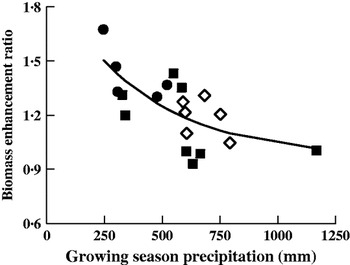
Positive effects of CO2 enrichment on productivity generally increase as precipitation and water availability decline, especially when water is saved at elevated CO2 while plants are active. In general, then, the CO2 stimulation of biomass should be proportionally greater or more consistent on semi-arid than mesic ecosystems and, for a given ecosystem, during dry than wet years (Morgan et al. Reference Morgan, Pataki, Körner, Clark, Del Grosso, Grünzweig, Knapp, Mosier, Newton, Niklaus, Nippert, Nowak, Parton, Polley and Shaw2004b). For example, CO2 enrichment increased biomass production proportionally more on semi-arid shortgrass steppe (Morgan et al. Reference Morgan, Mosier, Milchunas, LeCain, Nelson and Parton2004a) than on mesic tallgrass prairie (Owensby et al. Reference Owensby, Ham, Knapp, Bremer and Auen1997) and calcareous grassland in Switzerland (Niklaus & Körner Reference Niklaus and Körner2004) and, for each ecosystem, during relatively dry than wetter years. Morgan et al. (Reference Morgan, Pataki, Körner, Clark, Del Grosso, Grünzweig, Knapp, Mosier, Newton, Niklaus, Nippert, Nowak, Parton, Polley and Shaw2004b) found that the ratio of aboveground biomass production at elevated CO2 to production at ambient CO2 (biomass enhancement ratio) increased across these three grasslands as growing season precipitation declined from c. 750 mm to 250 mm (Fig. 2).
The ratio of aboveground plant biomass at elevated compared to ambient CO2 (biomass enhancement ratio) in Kansas tallgrass prairie (closed square), Colorado shortgrass steppe (closed circle) and Swiss calcareous grasslands (open diamond) as a function of yearly precipitation. The fitted line has an R 2 of 0·48, P=0·005. The figure is adapted from Morgan et al. (Reference Morgan, Pataki, Körner, Clark, Del Grosso, Grünzweig, Knapp, Mosier, Newton, Niklaus, Nippert, Nowak, Parton, Polley and Shaw2004b).

Positive effects of CO2 enrichment on productivity do not consistently extend to arid ecosystems, however. CO2 enrichment increased plant biomass in the Mojave Desert in the western USA only during a wet year, when the total precipitation was 2·4 times the long-term average for the site (Smith et al. Reference Smith, Huxman, Zitzer, Charlet, Housman, Coleman, Fenstermaker, Seemann and Nowak2000). These findings imply that a minimum level of precipitation or soil water availability exists below which CO2 has little influence on productivity (Morgan et al. Reference Morgan, Pataki, Körner, Clark, Del Grosso, Grünzweig, Knapp, Mosier, Newton, Niklaus, Nippert, Nowak, Parton, Polley and Shaw2004b; Nowak et al. Reference Nowak, Ellsworth and Smith2004). CO2 effects are negligible during most years in arid environments partly because a significant fraction of water loss is not under plant control. Much of precipitation probably is lost to evaporation rather than transpiration in arid and semi-arid ecosystems because evaporative demand of the atmosphere is high, plant cover is sparse, vegetation often must recover from extended periods of drought in order to appropriate water for growth, and most precipitation events are small (e.g. Sala & Lauenroth Reference Sala and Lauenroth1982; Wythers et al. Reference Wythers, Lauenroth and Paruelo1999).
Soil resources
Low N availability frequently limits plant productivity on rangeland ecosystems (e.g. Seastedt et al. Reference Seastedt, Briggs and Gibson1991) and may reduce or even eliminate any benefit of CO2 enrichment for plant growth (Owensby et al. Reference Owensby, Auen and Coyne1994; Reich et al. Reference Reich, Hobbie, Lee, Ellsworth, West, Tilman, Knops, Naeem and Trost2006). Productivity is probably limited more often by N than by insufficiencies in other elements, but limits on the availability of any essential element of plants could constrain CO2 effects on productivity.
Soil water content is a critical determinant of plant productivity, both because of its direct effect on plant water status and activity and its indirect effect in stimulating decomposition, mineralization, nutrient cycling and mass flow of elements to roots (Burke et al. Reference Burke, Lauenroth and Parton1997; Dijkstra et al. Reference Dijkstra, Pendall, Mosier, King, Milchunas and Morgan2008). The water-relations benefit of CO2 to plant growth may result in part from an increase in N mineralization rates in wetter soils (Morgan et al. Reference Morgan, Pataki, Körner, Clark, Del Grosso, Grünzweig, Knapp, Mosier, Newton, Niklaus, Nippert, Nowak, Parton, Polley and Shaw2004b; Dijkstra et al. Reference Dijkstra, Pendall, Mosier, King, Milchunas and Morgan2008).
Disturbance regime
Many rangeland ecosystems are sustained in their current states by disturbances, the two most influential of which are grazing and fire. Disturbances, like other interactive controls, regulate CO2 responses both directly and indirectly, the latter by affecting other controlling factors. Grazing and fire directly modify plant growth and physiology by removing plant tissues. Grazers can also serve as a vector for seed dispersal in faecal deposits (Kramp et al. Reference Kramp, Ansley and Tunnell1998; Brown & Archer Reference Brown and Archer1999), with the potential for profound changes in plant community structure. Many of the other effects of these disturbances on ecosystem processes are indirect, mediated through changes in soil resource levels or the biota.
Grazers strongly influence plant productivity on rangelands, but our understanding of how defoliation regulates productivity in response to changes in CO2 levels is limited. It might be expected that defoliation would enhance the effects of changes in CO2 levels on plant growth and speed plant recovery from defoliation by stimulating photosynthesis, at least in C3 species. Recent results confirm this expectation (D. J. Augustine, personal communication). Defoliated plants of Pascopyrum smithii recovered more rapidly when grown at elevated levels of CO2 than at ambient levels. Photosynthesis rates were doubled in defoliated compared to non-defoliated plants grown at 780 ppmv CO2, but not in the plants grown at 400 ppmv CO2. Similarly, increasing CO2 to 235 ppmv above ambient levels enhanced the production of vegetation growing in monoliths extracted from semi-natural grassland in Wales when plants were defoliated six times per year (Harmens et al. Reference Harmens, Williams, Peters, Bambrick, Hopkins and Ashenden2004). CO2 treatment had no effect on production of plants defoliated just twice per year. In contrast, results from other studies do not support the view that defoliation magnifies CO2 effects on plant growth. For example, re-growth following defoliation was no greater at elevated than at ambient levels of CO2 for a C3 forb (Fajer et al. Reference Fajer, Bowers and Bazzaz1991) or a C4 grass (Wilsey et al. Reference Wilsey, McNaughton and Coleman1994). Plants of three grass species from each of three grassland ecosystems showed similar responses to CO2 when clipped and not clipped (Wilsey et al. Reference Wilsey, Coleman and McNaughton1997), as did vegetation on shortgrass steppe (Milchunas et al. Reference Milchunas, Mosier, Morgan, LeCain, King and Nelson2005) and a New Zealand pasture subjected to sheep grazing (Newton et al. Reference Newton, Allard, Carran, Lieffering, Nösberger, Long, Norby, Stitt, Hendrey and Blum2006). Herbivory may even reduce plant sensitivity to CO2. Clipping reduced aboveground biomass of Arabidopsis thaliana more at elevated than at ambient CO2, for instance (Lau & Tiffin Reference Lau and Tiffin2009).
Grazing may indirectly influence CO2 effects on productivity by contributing to seed dispersal, seedling recruitment and, ultimately, vegetation change. Elevated CO2 has been found to enhance seedling establishment on rangeland (Morgan et al. Reference Morgan, Mosier, Milchunas, LeCain, Nelson and Parton2004a) and mesic pasture (Edwards et al. Reference Edwards, Clark and Newton2001), but evidence for an effect of grazers is limited because of the difficulty of incorporating large animals into manipulative CO2 experiments. In a rare CO2 experiment with animals, Newton et al. (Reference Newton, Allard, Carran, Lieffering, Nösberger, Long, Norby, Stitt, Hendrey and Blum2006) found that grazing by sheep enhanced aboveground production of two important Trifolium species in CO2-enriched New Zealand pasture. Enhanced recruitment under grazing appears to have been an important factor in the CO2 response of one of the species, T. subterraneum.
Fire indirectly affects CO2 response via changes in soil resources and vegetation. Fires volatilize substantial quantities of N (Seastedt et al. Reference Seastedt, Briggs and Gibson1991), hence frequent burning may constrain ecosystem responses to CO2 by reinforcing N limitations on plant growth. Fire also can affect ecosystem processes by changing plant abundances or composition. Henry et al. (Reference Henry, Chiariello, Vitousek, Mooney and Field2006) found that summer wildfire removed the suppressive effect of elevated CO2 on primary productivity of annual grassland by increasing production of forb species. Conversely, spring burning favours C4 grasses at the expense of C3 forbs on tallgrass prairie (Howe Reference Howe1994), potentially diminishing biomass response to CO2. By increasing plant growth, CO2 enrichment may also lessen the time period during which woody seedlings or saplings are most susceptible to fire and enhance woody incursion into grasslands (Bond Reference Bond2008), with potential consequences for future CO2 response.
Functional groups
Results from several studies have shown that the response of productivity to CO2 is regulated by the number or identities of species or species groups present in plant assemblages (Leadley et al. Reference Leadley, Niklaus, Stocker and Körner1999; Niklaus et al. Reference Niklaus, Leadley, Schmid and Körner2001; Reich et al. Reference Reich, Tilman, Naeem, Ellsworth, Knops, Craine, Wedin and Trost2004). Increasing the number of species or functional groups of species enhanced positive effects of CO2 enrichment on aboveground and total biomass of herbaceous communities (Reich et al. Reference Reich, Tilman, Naeem, Ellsworth, Knops, Craine, Wedin and Trost2004). Similarly, Niklaus et al. (Reference Niklaus, Leadley, Schmid and Körner2001) reported a positive correlation between the diversity of grassland communities and biomass enhancement at high CO2. Biomass may respond more to CO2 in diverse than in depauperate communities simply because diverse communities are more likely to contain responsive species (Niklaus et al. Reference Niklaus, Leadley, Schmid and Körner2001). Alternatively, increasing diversity may increase CO2 effects on biomass by maximizing plant capture of N, light and other resources that are required for greater production (Reich et al. Reference Reich, Tilman, Naeem, Ellsworth, Knops, Craine, Wedin and Trost2004).
Summary – regulation of CO2 response
Results from manipulative experiments demonstrate that three interactive controls, regional climate, soil resources and functional groups of plants, strongly regulate CO2 effects on rangeland productivity. The effects of the disturbance regime on CO2 responses are variable in direction and are often inconsequential. The benefits of CO2 enrichment for productivity generally increase as precipitation (regional climate) declines and species diversity (functional groups) increases, and decline as N availability decreases (soil resources). Consequently, differences in regional climate, functional groups and soil resources among rangeland ecosystems and among years for a given ecosystem contribute to variability in CO2 effects on productivity. However, we must ask whether these controls on the response of a given ecosystem operate indefinitely without variation, or whether changes in controls caused by alterations in levels of CO2 might feed back to amplify or dampen ecosystem sensitivity to CO2.
FEEDBACKS ON CO2 RESPONSES FROM CHANGES IN INTERACTIVE CONTROLS
Regional climate
Elevated CO2 can lead to changes in canopy-level and local climatic factors that reduce water savings from a decrease in stomata conductance and, hence, the benefits of CO2 enrichment for water-limited ecosystems. One of these negative feedbacks involves stomatal effects on leaf temperature. Partial stomatal closure reduces the transpiration rate and latent heat flux, leading to a rise in leaf temperature (Idso et al. Reference Idso, Kimball, Akin and Kridler1993; Kimball et al. Reference Kimball, Pinter, Garcia, LaMorte, Wall, Hunsaker, Wechsung, Wechsung and Kartschall1995). The saturation vapour pressure of air increases as temperature rises, causing an increase in the leaf-to-air vapour pressure gradient. This increase in the driving gradient for water loss tends to offset effects of reduced conductance on transpiration. Higher canopy temperatures and reduced transpiration contribute to a second negative feedback on plant regulation of transpiration. The vapour pressure deficit of air within and immediately above vegetation depends partly on transpiration. Slower transpiration tends to dry air in the canopy boundary layer, further increasing the vapour pressure gradient for transpiration. Bunce et al. (Reference Bunce, Wilson and Carlson1997) simulated these and other processes that regulate transpiration with a model calibrated using crop species. Simulations indicated that elevated CO2 increased leaf temperature and the vapour pressure difference between leaves and air. This feedback, together with other feedbacks operative at regional scales, almost completely negated effects of a 20–60% decrease in canopy conductance on water loss. Negative feedbacks also have been shown to attenuate stomatal effects on rangeland transpiration. Elevated CO2 often reduces leaf conductance to 20–50% of that measured at ambient CO2, but rarely reduces evapotranspiration on grasslands by greater than 20% (Morgan et al. Reference Morgan, Pataki, Körner, Clark, Del Grosso, Grünzweig, Knapp, Mosier, Newton, Niklaus, Nippert, Nowak, Parton, Polley and Shaw2004b). Elevated CO2 also may reduce the tolerance of photosynthesis to acute heat stress, especially among C4 species and plants grown at supra-optimal temperatures (Hamilton et al. Reference Hamilton, Heckathorn, Joshi, Wang and Barua2008).
Any process that reduces the influence of plants on the amount of soil water that is returned to the atmosphere or the rate at which water is depleted from soil will limit the response of rangeland productivity to CO2. These processes include those regulated by other interactive controls, such as soils and disturbance regimes. Drainage of water below the rooting zone of plants represents a negative feedback on biomass response to CO2 that depends, in turn, on soil texture. Deep drainage almost doubled at elevated compared to pre-industrial CO2 in model grassland assemblages of Israel during the wet part of the growing season (Grünzweig & Körner Reference Grünzweig and Körner2001). Similarly, CO2 enrichment increased water storage at 0·75–1·05 m depth in semi-arid shortgrass steppe (Nelson et al. Reference Nelson, Morgan, LeCain, Mosier, Milchunas and Parton2004). Disturbances also can reduce plant regulation of water loss by reducing the cover of plants relative to bare soil.
Soil resources
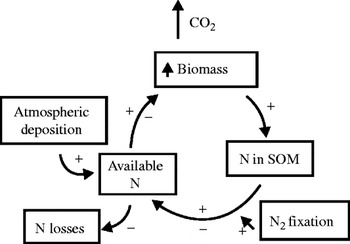
Most terrestrial N occurs in organic forms that are not readily available to plants, hence rangeland responses to CO2 depend partly on how quickly N cycles between organic and inorganic N compounds and whether changes associated with CO2 enrichment accelerate or slow N cycling. The Progressive N Limitation (PNL) hypothesis holds that changes associated with CO2 enrichment will create or reinforce N limitations on production by reducing N recycling to inorganic forms (Luo et al. Reference Luo, Su, Currie, Dukes, Finzi, Hartwig, Hungate, McMurtrie, Oren, Parton, Pataki, Shaw, Zak and Field2004). According to the PNL hypothesis, CO2 enrichment may lead to N limitation of productivity even in ecosystems in which N availability does not currently prevent a growth response to CO2. The PNL hypothesis arises from the observation that organic matter, whether in plants or soil, contains N and other elements in rather fixed ratios to C. To the extent that CO2 enrichment increases plant production and C accumulation in ecosystems, it also increases the sequestration of N and other elements in organic matter (Fig. 3). As more N is sequestered over time, the availability of mineral N to plants could decline and limit CO2 effects on productivity. It is the progressive decrease in N availability to plants, rather than the initial amount of available N, that distinguishes the PNL hypothesis. Consistent with the PNL hypothesis, two differently configured ecosystem models, G'DAY and DAYCENT, predict that CO2-stimulation of net ecosystem production on tallgrass prairie and shortgrass steppe will decline over a 100-year period because of a decline in soil N availability (Pepper et al. Reference Pepper, Del Grosso, McMurtire and Parton2005).
Possible feedback effects of an increase in plant growth at elevated CO2 on ecosystem N pools and N availability to plants. By increasing plant production, higher CO2 increases N sequestration in plant biomass, litter pools and eventually SOM. CO2 enrichment may increase or decrease the net rate at which N in SOM is mineralized to plant-available forms depending on whether microbial activity is ‘primed’ or inhibited by the extra C input to soil at elevated CO2. Increasing CO2 also may increase the pool of available and total N by stimulating N2 fixation, reducing gaseous or liquid losses of N, or increasing retention of atmospheric N deposition.

Elevated CO2 has been found to reduce soil N availability (Reich et al. Reference Reich, Hobbie, Lee, Ellsworth, West, Tilman, Knops, Naeem and Trost2006), but results from most experiments indicate that various processes operate at elevated CO2 to reduce the strength of this negative feedback by either delaying the onset of N limitation or enhancing N accumulation in soil/plant systems. Nitrogen limitation may be delayed by maximizing the amount of C sequestered per unit of N, that is by maximizing the C:N ratio of organic matter. Organic matter accumulation is increased, for example, by transferring N from soil organic pools with relatively low C:N ratios to plants with higher C:N ratios, as demonstrated recently on mesic grassland (Gill et al. Reference Gill, Polley, Johnson, Anderson, Maherali and Jackson2002, Reference Gill, Anderson, Polley, Johnson and Jackson2006) and semi-arid shortgrass steppe (Pendall et al. Reference Pendall, Del Grosso, King, LeCain, Milchunas, Morgan, Moiser, Ojima, Parton, Tans and White2003). On mesic grassland, microbes mineralized resident soil organic matter (SOM) to meet their nutritional needs at high CO2. The N released by decomposition of SOM contributed to an increase in total N content of plant tissues (Gill et al. Reference Gill, Anderson, Polley, Johnson and Jackson2006) and sustained an increase in plant productivity at high CO2 (Polley et al. Reference Polley, Johnson and Derner2003). In the absence of additional N required to stabilize organic C in soil pools, however, much of the extra organic C that was added to soil at elevated CO2 was dissipated through rapidly cycling soil pools and did not accumulate (Gill et al. Reference Gill, Polley, Johnson, Anderson, Maherali and Jackson2002). Decomposition rates of resident SOM more than doubled at elevated CO2 on shortgrass steppe in Colorado (Pendall et al. Reference Pendall, Del Grosso, King, LeCain, Milchunas, Morgan, Moiser, Ojima, Parton, Tans and White2003). The N released by more rapid decomposition of SOM reduced N limitations on growth and contributed to an increase in productivity at elevated CO2 (Dijkstra et al. Reference Dijkstra, Pendall, Mosier, King, Milchunas and Morgan2008).
Various other processes may increase N accumulation in soil/plant systems and contribute to a positive feedback on CO2 responses. These processes include increased biological fixation of N, greater retention of atmospheric N deposition, reduced losses of N in gaseous or liquid forms, and more complete exploration of soil by expanded root systems (Luo et al. Reference Luo, Su, Currie, Dukes, Finzi, Hartwig, Hungate, McMurtrie, Oren, Parton, Pataki, Shaw, Zak and Field2004; Fig. 3). Perhaps the most rapid and direct manner by which CO2 enrichment could increase N accumulation on rangelands is by stimulating fixation of atmospheric N2 by the legume-Rhizobium symbiosis. The absolute amount of plant-available N that can be derived from additional N2 fixation at elevated CO2 is large. For example, enrichment to 600 ppmv CO2 was found to increase the annual N yield of mixed grass/legume swards by 9–13% (Zanetti et al. Reference Zanetti, Hartwig, van Kessel, Lüscher, Hebeisen, Frehner, Fischer, Hendrey, Blum and Nösberger1997). All additional N at elevated CO2 was derived from enhanced N2 fixation. Similarly, increasing CO2 by 80–150% above the ambient concentration increased N2 fixation by the woody legume Acacia smallii Isely (huisache) by a factor of 3–4 (Polley et al. Reference Polley, Johnson and Mayeux1997). Elevated CO2 stimulated N2 fixation by increasing both the mass of root modules per plant and fixation per unit of nodule mass. In the absence of large N input from legumes, the N concentration of leaves or aboveground tissues declined on shortgrass steppe, tallgrass prairie, and mesic grassland at elevated CO2 and on tallgrass prairie with warming, but total N content of aboveground tissues increased as plant biomass increased on these ecosystems and on annual grasslands (Owensby et al. Reference Owensby, Coyne and Auen1993; Hungate et al. Reference Hungate, Chapin, Zhong, Holland and Field1997; King et al. Reference King, Mosier, Morgan, LeCain, Milchunas and Parton2004; Wan et al. Reference Wan, Hui, Wallace and Luo2005; Gill et al. Reference Gill, Anderson, Polley, Johnson and Jackson2006; Dijkstra et al. Reference Dijkstra, Pendall, Mosier, King, Milchunas and Morgan2008). The implication is that plants accessed more, rather than less, N at elevated CO2, thereby delaying the onset of N limitation to productivity. Pepper et al. (Reference Pepper, Del Grosso, McMurtire and Parton2005) point out that a modest and gradual increase in soil N may be sufficient to overcome PNL in the long term.
Disturbance regime
CO2 enrichment may change the behaviour of grazers and possibly the intensity of grazing by altering forage quality (Polley et al. Reference Polley, Morgan, Campbell, Stafford Smith, Reddy and Hodges2000), with potential feedback effects on plant responses to CO2. Plant N concentration usually declines at elevated CO2 (Owensby et al. Reference Owensby, Coyne and Auen1993; Cotrufo et al. Reference Cotrufo, Ineson and Scott1998; Morgan et al. Reference Morgan, Mosier, Milchunas, LeCain, Nelson and Parton2004a), implying that CO2 enrichment will reduce the crude protein content of forage. Conversely, elevated CO2 may improve forage quality by increasing tissue concentrations of non-structural carbohydrates (Read et al. Reference Read, Morgan, Chatterton and Harrison1997). On shortgrass steppe, CO2 enrichment reduced the crude protein concentration of autumn forage below critical maintenance levels for livestock in 3 out of 4 years and reduced the digestibility of forage by 14% in mid-season (Milchunas et al. Reference Milchunas, Mosier, Morgan, LeCain, King and Nelson2005). Significantly, the grass most favoured by CO2 enrichment also had the lowest crude protein concentration. In addition, the unpalatable shrub Artemisia frigida exhibited the largest biomass increase of all plant species, a 40-fold increase during 5 years at elevated CO2 (Morgan et al. Reference Morgan, Milchunas, LeCain, West and Mosier2007). The magnitude and even sign of the feedback of changes in forage quality on CO2 responses will probably depend on whether changes in forage quality result in an increase or decrease in grazing intensity.
Increased CO2 could increase fire frequency or intensity (Sage Reference Sage, Körner and Bazzaz1996) and thereby reinforce the effects of fire on ecosystem processes by increasing plant production, fuel load, or fuel flammability. The flammability of plants should increase if, as often observed, CO2 enrichment increases the accumulation of non-structural carbohydrates in plant tissues (Read et al. Reference Read, Morgan, Chatterton and Harrison1997). Conversely, rising CO2 could reduce the intensity or frequency of fires by delaying soil water depletion during dry periods (Morgan et al. Reference Morgan, Pataki, Körner, Clark, Del Grosso, Grünzweig, Knapp, Mosier, Newton, Niklaus, Nippert, Nowak, Parton, Polley and Shaw2004b) and increasing the water content of fuel or the ratio of live to dead tissues in plant stands. This suppressive effect of CO2 on fire will probably be most important for rangelands on which dry intervals are relatively brief (Sage Reference Sage, Körner and Bazzaz1996). A delay of days to weeks in canopy senescence would probably have little effect on fire in rangelands which regularly experience extended periods of drought. Plant growth appears to be particularly responsive to CO2 among several fire-adapted annual grasses, including Bromus tectorum and Avena barbata (Smith et al. Reference Smith, Strain and Sharkey1987; Jackson et al. Reference Jackson, Sala, Field and Mooney1994; Ziska et al. Reference Ziska, Reeves and Blank2005), evidence that CO2 enrichment can promote a positive feedback on productivity by enhancing flammability or fuel load. On the other hand, more frequent fires may dampen CO2 effects on productivity by reducing N availability to plants (Seastedt et al. Reference Seastedt, Briggs and Gibson1991) or increasing the fraction of water that is lost to evaporation.
Functional groups
CO2 enrichment has been shown to alter plant abundances, and thus the potential response of productivity to CO2, in most experiments with multi-species communities (Körner et al. Reference Körner, Diemer, Schäppi, Niklaus and Arnone1997; Niklaus et al. Reference Niklaus, Leadley, Schmid and Körner2001; Polley et al. Reference Polley, Johnson and Derner2003; Morgan et al. Reference Morgan, Milchunas, LeCain, West and Mosier2007). It might be predicted that CO2 enrichment would increase the size or abundance of legumes and favour potentially more responsive C3 over C4 species, but CO2 effects vary among ecosystems. Legumes were more abundant at elevated than ambient CO2 in New Zealand pasture and Mediterranean grasslands (Edwards et al. Reference Edwards, Clark and Newton2001; Joel et al. Reference Joel, Chapin, Chiariello, Thayer and Field2001), but as a group responded little to CO2 in calcareous grassland (Leadley et al. Reference Leadley, Niklaus, Stocker and Körner1999). Similarly, as predicted by differences in photosynthetic pathway (Polley Reference Polley1997), elevated CO2 enhanced productivity of C3 over C4 grasses in shortgrass steppe (Morgan et al. Reference Morgan, Milchunas, LeCain, West and Mosier2007), but did not benefit C3 grasses on C4-dominated tallgrass prairie (Owensby et al. Reference Owensby, Ham, Knapp and Auen1999). Several factors likely contribute to inconsistencies in CO2 effects on vegetation. First, the life stage of plants most affected by CO2 differs among experiments. In relatively closed canopies of perennial species, species change probably results mostly from differences in the growth responses of established plants to CO2. Over longer time periods or in other ecosystems, vegetation change results partly from differences in the responses of seed production (Edwards et al. Reference Edwards, Clark and Newton2001) or seedling recruitment and survivorship among species to CO2 (Smith et al. Reference Smith, Huxman, Zitzer, Charlet, Housman, Coleman, Fenstermaker, Seemann and Nowak2000; Morgan et al. Reference Morgan, Mosier, Milchunas, LeCain, Nelson and Parton2004a). Secondly, it is likely that CO2 effects on vegetation differ among ecosystems because factors that limit seedling establishment and plant growth differ among ecosystems or among years for a given ecosystem (Belote et al. Reference Belote, Weltzin and Norby2003). Species change in water-limited systems is often linked to CO2 effects on soil water content (Morgan et al. Reference Morgan, Pataki, Körner, Clark, Del Grosso, Grünzweig, Knapp, Mosier, Newton, Niklaus, Nippert, Nowak, Parton, Polley and Shaw2004b). CO2 enrichment changed species abundances in ecosystems as diverse as Swiss grassland and semi-arid shortgrass steppe by slowing soil water depletion and preferentially increasing seedling recruitment of certain species (Niklaus et al. Reference Niklaus, Leadley, Schmid and Körner2001; Morgan et al. Reference Morgan, Mosier, Milchunas, LeCain, Nelson and Parton2004a). In contrast, CO2 had little effect on species abundances in C4-dominated tallgrass prairie in Kansas, USA (Owensby et al. Reference Owensby, Ham, Knapp and Auen1999), presumably because the growth of the shorter C3 species was limited by low light or N availability, or C3 plants were incapable of exploiting the mid- to late-season improvement in soil water that occurred at elevated CO2.
If the plants that benefit most from CO2 enrichment are dominant species or become important contributors to communities, species change should increase the positive effect of higher CO2 on productivity (e.g. Stöcklin et al. Reference Stöcklin, Schweizer and Körner1998). The link between the change in relative abundance of a species and its growth response to CO2 should be strongest in communities that establish following disturbances and when plants of all species are of similar size. On the other hand, species change that is caused by factors other than CO2 may reduce CO2 effects on productivity. Elevating CO2 increased biomass of newly planted grassland communities by increasing the growth of ruderal species (Niklaus et al. Reference Niklaus, Leadley, Schmid and Körner2001). The response of community biomass to CO2 decreased over time, apparently because N availability declined following planting and favoured species that were more stress-tolerant but less CO2-responsive than ruderals.
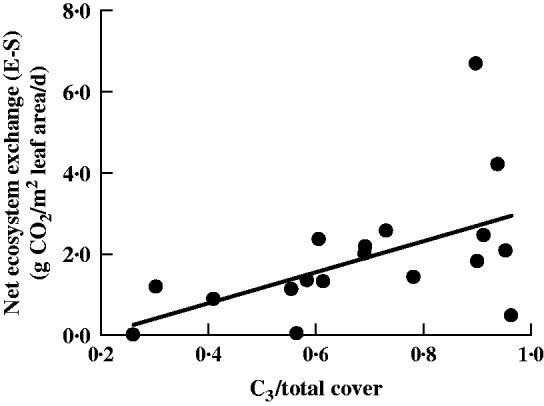
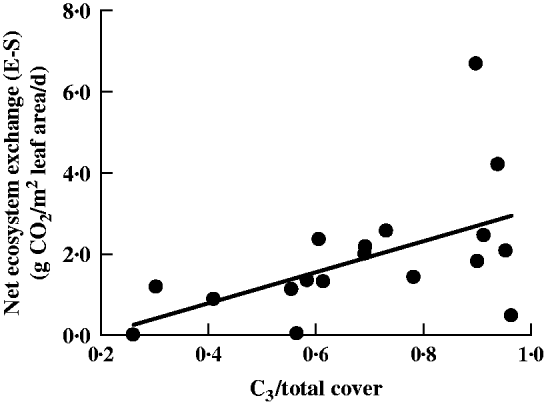
Unfortunately, there is little evidence from which to infer the impact of species feedbacks on productivity and other ecosystem processes. Biomass of C3 species increased at the expense of C4 grass biomass in mesic grassland, irrespective of CO2 treatment (Mielnick et al. Reference Mielnick, Dugas, Johnson, Polley and Sanabria2001; Polley et al. Reference Polley, Johnson and Derner2003). This shift towards C3 plants, physiologically more responsive than C4 plants (Anderson et al. Reference Anderson, Maherali, Johnson, Polley and Jackson2001; Maherali et al. Reference Maherali, Reid, Polley, Johnson and Jackson2002), would be expected to increase plant growth response to CO2 enrichment. Indeed, a temporary increase in CO2 of 150–200 ppmv increased net ecosystem uptake of CO2 more in C3- than C4-dominated vegetation (Fig. 4). The proportional increase in CO2 uptake increased from 0 to 26% as the contribution of C3 cover to total cover increased from 0·26 to 0·96 (Polley et al. Reference Polley, Dugas, Mielnick and Johnson2007). Species interactions also proved an especially strong mediator of the response of annual grassland to changes in the seasonality of precipitation (Suttle et al. Reference Suttle, Thomsen and Power2007). Feedbacks resulting from species shifts reversed the initial responses of productivity and plant and food web diversity to precipitation change within a few years.
The response of net ecosystem CO2 exchange (NEE) of grassland to a 1–2-day change in CO2 concentration of 175 ppmv. Mesic grassland was exposed for 3 years to a continuous gradient in CO2 spanning sub-ambient to elevated concentrations in elongated chambers. Daytime NEE was measured continuously in each of 18 plots, 5 m long and 1 m wide, along the gradient. The amount by which NEE of each plot was greater at elevated than sub-ambient CO2 following brief change in CO2 (E-S) increased linearly as the ratio of C3 plant cover to total cover increased. The graph is reproduced from Polley et al. (Reference Polley, Dugas, Mielnick and Johnson2007).
To the extent that species change reinforces CO2 effects on productivity, the current composition or relative abundances of species may be considered to constrain CO2 responses. There are at least two consequences of this constraint. First, the full response of ecosystem processes to CO2 may not be evident in the short-term. Secondly, factors that reduce the species pool, limit the dispersal of propagules, or reduce plant establishment could limit CO2 effects on productivity.
SYNTHESIS
Atmospheric CO2 enrichment is a chronic and cumulative perturbation that could lead to a sustained increase in primary productivity and changes in other ecosystem processes, such as hydrology and element cycling (Smith et al. Reference Smith, Knapp and Collins2009), unless constrained by regional climatic factors, soil resource levels, disturbance regimes, or the functional groups of organisms present (Fig. 1). Three of these interactive controls, regional climate, soil resources and functional groups, have been shown to regulate proximal effects of CO2 on rangeland productivity in fairly predictable fashion and thus to contribute to the variability in CO2 responses that have been observed among ecosystems or years. Because these controls interact dynamically with ecosystem processes, the magnitude and nature of the effect of controls on ecosystems may change as CO2 modifies ecosystem processes.
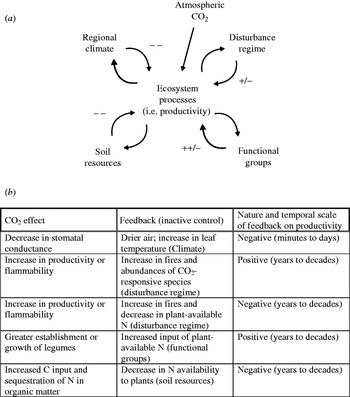
It would be expected that most feedbacks from CO2-caused changes in interactive controls are negative and thus dampen rangeland responses to CO2 (Fig. 5). Indeed, yields of even intensively managed crop species typically increase far less at elevated CO2 than is theoretically possible because negative feedbacks constrain benefits of CO2 enrichment for yield (Long et al. Reference Long, Ainsworth, Leakey, Nösberger and Ort2006). On most rangelands, plant growth is regulated by water availability. Productivity increases across broad geographic gradients on grasslands as annual precipitation increases (Sala et al. Reference Sala, Parton, Joyce and Lauenroth1988). Rangeland productivity and net CO2 exchange also vary with changes in precipitation (Knapp & Smith Reference Knapp and Smith2001; Heisler-White et al. Reference Heisler-White, Blair, Kelly, Harmoney and Knapp2009; Polley et al. Reference Polley, Emmerich, Bradford, Sims, Johnson, Saliendra, Svejcar, Angell, Frank, Phillips, Snyder, Morgan, Sanabria, Mielnick and Dugas2010). To a first approximation then, rangeland responses to CO2 will depend on the fraction of precipitation that plants transpire and the efficiency with which C is captured per unit of transpiration. Most feedbacks on CO2 effects on water use and water use efficiency are negative because they reduce the ratio of transpiration to other losses of water or lessen the increase in water use efficiency expected as CO2 rises. By reducing stomatal conductance, for example, higher CO2 increases leaf temperature and dries air within the canopy (local/regional climate), both of which tend to minimize changes in transpiration rates (Field et al. Reference Field, Jackson and Mooney1995; Bunce et al. Reference Bunce, Wilson and Carlson1997) and, ultimately, productivity. More frequent fires or other disturbances will negatively affect CO2 responses if they increase the amount of water that is lost to evaporation, runoff, or deep drainage by reducing canopy leaf area.
Hypothesized effects of CO2-caused changes in interactive controls of ecosystem processes on the response of rangeland productivity to CO2 enrichment. (a) Changes in regional and local climate, soil resources, disturbance regime and functional groups of organisms that result from CO2 effects on ecosystem processes may feed back to either dampen (−) or amplify (+) the initial response of productivity and other processes to CO2. Feedbacks resulting from CO2-caused changes in climatic factors and soil resources levels or cycling are hypothesized to strongly dampen CO2 effects on productivity, whereas changes in the composition or abundances of functional groups of plants may amplify CO2 effects on rangelands. (b) Examples of how CO2 effects on plant and ecosystem processes contribute to changes in interactive controls that feedback to affect the response of rangeland productivity to CO2 enrichment.

Positive feedbacks on CO2 responses are fewer and may develop more slowly than some negative feedbacks, but can sustain or even increase initial changes (Fig. 5). The greater is the impact of CO2 on interactive controls that provide positive feedback, the greater is the possibility that CO2 effects on productivity will exceed bounds documented in manipulative experiments. The most common source of positive feedbacks on CO2 responses appears to be through changes in plant species and functional group composition. For example, CO2 enrichment may relieve the N limitation on biomass response by increasing the relative abundance of legumes among plant functional groups (Edwards et al. Reference Edwards, Clark and Newton2001; Joel et al. Reference Joel, Chapin, Chiariello, Thayer and Field2001).
Although positive feedbacks amplify CO2 responses, CO2 enrichment probably will not lead to large and continuous changes in ecosystem processes in extensively managed systems such as rangelands, for two reasons. First, positive feedbacks may not become fully expressed when they depend on factors in addition to CO2. Vegetation change can enhance CO2 effects on productivity, but is mediated by aspects of plant demography over which CO2 has little or no influence. Second, atmospheric CO2 is increasing rapidly compared to the rate at which positive feedbacks from some interactive controls develop. CO2 may increase more rapidly than soil N accumulation in some ecosystems, for example. Constraints on positive feedbacks imply that rangeland responses to a given increase in CO2 may currently be limited more by plant composition, soil N availability, or other controls than during the geological past when CO2 concentration rose more slowly.
Positive feedbacks on CO2 responses can be exploited more fully in intensively managed ecosystems. Indeed, a primary goal of agricultural management is to lessen constraints of soil resources, disturbances and undesired plants on crop productivity. Several adaptive measures may be taken to maximize plant responses to CO2 enrichment and increase the resilience of production systems to variability in temperature and precipitation (Smith & Olesen Reference Smith and Olesen2010). The most easily implemented measure involves a change in the species or cultivar of crops that are grown. The magnitude and even direction of crop responses to CO2 enrichment are species or cultivar-specific (Baker & Allen Reference Baker and Allen1993; Ziska et al. Reference Ziska, Manalo and Ordonez1996). Other options for maximizing crop productivity at elevated CO2 include the addition of diversity to crop rotations and of legumes to cereal-based systems.
Interactive controls have been discussed as if they depended on state factors and interactions with ecosystem processes alone. In reality, human activities are contributing to large and directional changes in all interactive controls of rangeland processes: regional climate (land use changes), soil resources (N fertilization and deposition), disturbance regime (fire control and overgrazing) and functional groups of organisms (species introductions and simplification of biotic communities). Some of these changes have amplified impacts of higher CO2. For example, plant growth appears to particularly responsive to CO2 among annual grasses, such as Bromus tectorum (Smith et al. 1987; Ziska et al. Reference Ziska, Reeves and Blank2005), that proliferated on rangelands in western North America because of livestock movement and overgrazing (Mack Reference Mack, Mooney and Drake1986). Others, such as simplification of plant communities, may be depressing CO2 effects (Niklaus et al. Reference Niklaus, Leadley, Schmid and Körner2001; Reich et al. Reference Reich, Tilman, Naeem, Ellsworth, Knops, Craine, Wedin and Trost2004).
Higher CO2 concentration, together with directional changes in interactive controls, also are reducing the strength of negative feedbacks that sustained rangeland structure and functioning in the past. For example, positive effects of CO2 enrichment on establishment and growth rates of woody plants (Polley et al. Reference Polley, Johnson and Tischler2002b; Morgan et al. Reference Morgan, Milchunas, LeCain, West and Mosier2007), together with directional change in disturbance regimes on grass-dominated ecosystems (fire control and overgrazing), have contributed to tree encroachment on rangelands and to substantial changes in ecosystem structure and functioning (Bond Reference Bond2008).
The ‘interactive controls’ approach discussed earlier provides a framework for determining why CO2 effects on productivity vary among ecosystems and, importantly, how changes in interactive controls may feed back to affect ecosystem sensitivity to CO2. The approach is flexible enough to accommodate human influences, ecosystem processes other than productivity, and ecosystems in addition to rangelands. Using this approach, it is concluded that shifts in plant species composition will be required on most rangelands if CO2 enrichment is to continue to increase productivity. Vegetation change and, ultimately, rangeland responses to CO2 thus may depend on how quickly species that can best utilize CO2 in a given area will reach and colonize appropriate sites.