1 An unusual consonant in Hiw
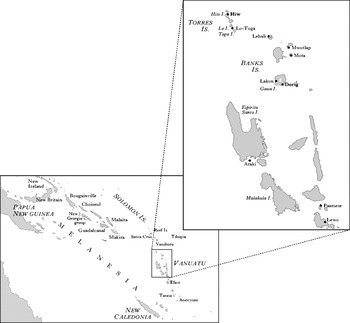
Hiw is an endangered Oceanic (Austronesian) language, spoken by 280 speakers on Hiw (IPA [hiw]), the northernmost island of the Vanuatu archipelago. The map in Fig. 1 situates Vanuatu within Island Melanesia, and locates the various languages mentioned in this paper.
A map of the northern Vanuatu archipelago, showing the location of several languages relevant to this study, including Hiw.

Compared to other members of its language family, Hiw shows a number of innovative features, including in its phonology. For example, we will see (§4) that Hiw licenses word-initial consonant clusters, e.g. /pt ɣt kŋʷ kʷj wt ws jw/, which are very rare within the Austronesian family, and uncommon within the world's languages more generally.
A typologically even more unusual feature of Hiw is the existence of a complex phoneme / /. Phonetically, this consonant can be described as the combination of a voiced velar stop [g] with a velar lateral approximant [l]. Only a small number of languages in the world – mostly located on the island of New Guinea – have been reported to have a similar segment in their inventory (see §6). In these languages, the consonant has been analysed in three different ways, depending sometimes on the researcher and sometimes on aspects of the language's phonological system. Under some accounts, the velar consonant [
 ] is analysed as a lateral affricate /
 /; in others, it is presented as a laterally released stop /gL/; still others describe it as a prestopped lateral approximant /
 /. Among these three equally plausible descriptions, the present study will identify which one fits best the phonological system of Hiw.
In order to address this issue, I shall examine how // patterns with regard to consonant clusters and to phonotactic constraints related to sonority. As we will see, tautosyllabic clusters are common in Hiw, and mostly comply with the Sonority Sequencing Principle (see e.g. Selkirk Reference Selkirk, Aronoff and Oerhle1984, Clements Reference Clements, Kingston and Beckman1990, Blevins Reference Blevins1995), albeit with some adjustments. These structural observations will provide us with the heuristic tools needed to identify the status of // in Hiw. I will show that the sonority status of this phoneme is that of a liquid, and that it is therefore best analysed as a prestopped velar lateral approximant //.
After an overview of Hiw phonology (§2), §3 will describe the phonetic properties of the complex consonant //, and underline its inherent ambiguity. In order to understand the velar lateral of Hiw within its system-internal context, I will then observe the general phonotactic rules governing consonant clusters in this language (§4); this observation will establish that Hiw – unlike its close relative Dorig – treats sonority as a relevant parameter in defining the well-formedness of its tautosyllabic clusters. Finally, the mapping of attested clusters onto the sonority scale (§5) will demonstrate that the complex segment // functions as a liquid – just like the apical trill /r/, with which // is associated historically and areally. In a short typological survey, §6 will review other languages of the world where similar segments have been reported, and show they have received varying phonological analyses. The general conclusion (§7) will highlight the potential ambivalence of complex segments, and discuss the methodological and theoretical implications of this ambiguity.
2 Overview of Hiw phonology
There is no published description of Hiw phonology or grammar. The data presented here have been collected by the author in various trips since 2003 on the languages of the Banks and Torres Islands, north of Vanuatu. François (Reference François2005) documents the phonological history of vowels in these seventeen languages, and the evolution of their phonotactic structures. François (forthcoming) reconstructs the history of the rhotic consonants *r and *R (see §5.2), in this area and elsewhere in Vanuatu. A grammar of Hiw is in preparation, based on a transcribed corpus of currently about 25,000 words.
2.1 Phoneme inventory
This overview presents the essential elements of Hiw's phonological system.
2.1.1 Consonants
The 14 consonants of Hiw are given in (1).
(1)


The consonant inventory of Hiw lacks voiced or prenasalised stops, which are common in the area, and reconstructable for Hiw's ancestors. Even though /ß/ and /ɣ/ are always voiced,Footnote 1 and /s/ always voiceless, voicing as such is not a relevant feature in the system.
While /w/ is a labial-velar glide (Ohala & Lorentz Reference Ohala and Lorentz1977), the two consonants /kʷ/ and /ŋʷ/ are phonetically velar stops accompanied by labial rounding. Despite their distinct phonetic nature, these three consonants form a single natural class, as they all condition the back rounded allophone [u] for certain vowels (§2.1.2). I shall thus refer to the three consonants /kʷ ŋʷ w/ with the umbrella term ‘labial-velars’.
Except in a few loanwords (see (19) below), Hiw has no rhotic, and also lacks the alveolar lateral /l/. The only liquid of the system is a prestopped velar lateral //, the focus of this paper (§3).
2.1.2 Vowels
The nine vowel phonemes of Hiw are all short monophthongs: /i i e ɵ ə a ʉ o ɔ/. Hiw has no diphthongs and no tones, and vowel length is not phonemic (see §2.3.2).
Three characteristics of vowels will be relevant to our discussion on phonotactics and consonant clusters. First, an underlying vowel /i/ followed by another vowel is systematically desyllabified to a glide /j/: e.g. /ja-i-ə/ ‘take him’ surfaces as [ˈjajə], homophonous with /jajə/ ‘trocus shell’; /ßatßi-ə/ ‘rescue him’ surfaces as [ˈßatßjə], with a sequence of three consonants.
Second, /ə/ is a genuine phoneme. In some of the world's languages (see e.g. Itô Reference Itô1989, Blevins Reference Blevins1995, Blevins & Pawley Reference Blevins and Pawley2010), [ə] lacks phonemic status, because its presence is entirely predictable from the phonotactics or morphophonemics of the system – e.g. it is used as an epenthetic vowel to break consonant clusters. This is not the case in Hiw, at least not synchronically.Footnote 2 As (2) shows, nothing in the context makes it possible to predict the presence vs. absence of /ə/. It is specified in the lexicon, just like any other phoneme.
(2)
In terms of vowel qualities, the contrastive status of /ə/ can be established with minimal pairs: e.g. /ßəjə/ [ßəˈjə] ‘pandanus leaf’ vs. /ßəjɵ/ [ßəˈjɵ] ‘grass’; /je/ ‘change’ vs. /jɵ/ ‘a bow’ vs. /ja/ ‘cup’ vs. /jə/ ‘who’.Footnote 3
Finally, the high back rounded vowel [u] occurs, but has no phonemic status. It is a conditioned allophone of two phonemes, namely /ə/ and /ʉ/, following a labial-velar consonant /kʷ ŋʷ w/. The two allophones of /ʉ/ are in strict complementary distribution: the high back rounded [u] after a labial-velar consonant (3) vs. the high central rounded [ʉ] everywhere else.
(3)
As for /ə/, its allophone [u] is restricted to pretonic syllables (following a labial-velar consonant), and is optional:
(4)
These allophony patterns justify the grouping of the labial-velar approximant /w/ and the two labialised velars /kʷ ŋʷ/ in a single emic class in the system, the labial-velars (§2.1.1).Footnote 4
2.2 Stress
Primary stress regularly falls on the last vowel other than /ə/:
(5)
One possible way to model stress in Hiw would be to posit right-aligned iambic feet, with all final schwas counting as extrametrical.
The only words licensing a stressed schwa are the very few which contain no other vowel. The position of stress is unpredictable for such words.
(6)
Starting from the syllable with primary stress, secondary stress normally falls on every second vowel to the left (including /ə/).
(7)
2.3 Phonotactics
2.3.1 Syllabic template CCVC
Only vowels can form the nucleus of a syllable. The minimal syllable is V, and the maximal is CCVC. Syllables are attested in any of the possible combinations: V, CV, CCV, VC, CVC, CCVC. Examples of CCVC include /ptɔɣ/ ‘(pull) off’, /ßsʉj/ ‘sunburnt’ and /wnɔt/ ‘parcel’ (see also §4.3.2). Heterorganic clusters are common in Hiw.
The template must be understood as applying on the phonological level rather than the phonetic forms. Thus, such phonetic strings as [tglɔɰ] ‘throw’, [tɔkw] ‘holy’, [gleŋw] ‘harvest’, [kwok ] ‘dream’ and [kwglɵɰ] ‘wooden club’ all superficially violate the CCVC template. However, considering that each coarticulated or complex phoneme /kʷ ŋʷ / occupies just one position, the underlying phonemic representations of these words – respectively /tɔɣ/, /tɔkʷ/, /eŋʷ/, /kʷo/ and /kʷɵɣ/ – all constitute well-formed syllables in Hiw.
Any consonant can form the coda of a syllable. Likewise, all consonants are attested both in the C1 slot and the C2 slot. However, there are restrictions on which consonants may cluster together at the onset of a syllable – see §4 below.
Finally, sequences of three consonants are attested word-medially, albeit rarely:
(8)
Because Hiw's syllabic template is CCVC, these clusters of three consonants are best understood as CCVC1.C2C3VC – where C1 forms the coda of the first syllable, while C2 and C3 form an onset cluster in the following syllable.
2.3.2 Gemination and lengthening
Hiw allows consonant gemination, both word-medially and word-initially.
This gemination may be stored in the lexicon as the segmental form of the word: e.g. /ttin/ ‘hot’ vs. /tin/ ‘buy’. These cases can be simply analysed as C1C2 consonant clusters in which C1 and C2 happen to be identical.
In addition, consonants (or vowels) are commonly lengthened for expressive purposes: thus /ne maßə/ ‘it's heavy’→[ne mːaßə] ‘it's so heavy!’; /ne ŋʷətoj/ ‘it's short’→[ne ŋʷətːoj] ‘it's very short!’ (see also Fig. 3 below).
Although gemination and consonant lengthening are phonologically distinct, they surface in phonetically similar forms.
3 The velar lateral of Hiw
I now turn to the phonetic description of the phoneme //. For the sake of convenience, I will occasionally refer to this phoneme as a ‘velar lateral’. I intend this term to be neutral with regard to the precise nature of this consonant (stop, affricate or approximant), an issue which will be resolved later (§5).
3.1 Articulatory properties
The articulation of the phoneme // can be described by observing the way it is produced by speakers, provided the surrounding vowels are open enough to allow visual observation. Additionally, I have taken into account the speakers' description of their own production process,Footnote 5 as well as my own understanding of this articulation once I was able to produce it in a manner perceived by native speakers to be accurate. The use of palatographic (EPG) technology would have been inconvenient for a number of reasons; furthermore, the closure of the consonant is too far back in the mouth to be observed by these means (Ladefoged & Maddieson Reference Ladefoged and Maddieson1996: 190).
The phoneme is articulated by bunching and raising the dorsum at the velum, in a way identical to the articulation of velar obstruents. The consonant's onset phase corresponds to a voiced velar stop [g] – a consonant otherwise absent from Hiw's inventory. This occlusive onset is unreleased; immediately after it, the bunched tongue lets the air flow on one (or both) side(s) of the dorsum, in the region of the back molars, thereby triggering a lateral release.Footnote 6
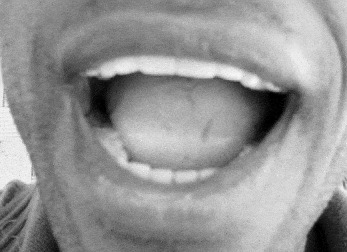
The shift from the onset phase (occlusive, central) to the release phase (approximant, lateral) is performed only by retracting the sides of the dorsum. It does not involve any movement of the apex, nor any change of position of the central ridge of the tongue, whether forward or backward: in other words, the point of articulation of the lateral release is neither alveolar/coronalFootnote 7 nor uvular, but remains velar. Figure 2 illustrates the position of the tongue during the lateral phase of the phoneme, for the meaningless sequence [aa]. More than any of its two phases (occlusion, release) considered alone, it is arguably the transition between them which is crucial to the production and perception of this consonant (see below).
Front view of the mouth, showing the tongue position of the prestopped velar lateral.

In sum, the complex segment [] of Hiw can be described phonetically as consisting of a velar plosive onset followed by a velar lateral release,Footnote 8 with no apical or laminal contact.
When the velar lateral of Hiw is pronounced without lengthening, the occlusive onset is at least as audible as the lateral release, and occasionally may even be perceived as auditorily more prominent. However, despite the importance of this onset, some younger speakers (roughly those under twenty years of age) show a tendency to drop it, thus pronouncing [l] rather than []. In fluent speech, this articulatory habit makes the sound dangerously similar to the other velar continuant of the system /ɣ/ ([ɣ~ɰ]), to the point where the phonemic contrast even seems to be fading out from these speakers' idiolects. Such minimal pairs as /ɣɵ/ ‘quick’ vs. /ɵ/ (/lɵ/) ‘decorate’, about whose existence elder speakers were adamant, are considered homophones by at least some younger individuals. Whenever these speakers taught me a new word containing a velar continuant, I had to double-check with elder speakers – or with those same-age peers who kept the distinction – what the ‘correct’ consonant should have been. This might be a sign that // and /ɣ/ are doomed to merge eventually.Footnote 9 However, at this stage, the two phonemes are still distinguished by the majority of speakers.
3.2 Acoustic properties
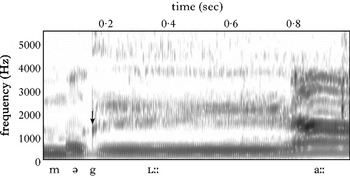
Acoustic analysis also shows that the velar lateral consists of two clearly distinct phases. When taken in a voiced environment, the occlusive onset [g] takes the form of a short depression of F1, described by Steed & Hardie (Reference Steed, Hardie and Bow2004: 348) as a ‘transient’. It is followed by a second phase, the lateral release, whose duration varies between 50 and 600 ms; this release is characterised by a relatively strong broadband noise above 1500 Hz, with its precise range depending on the immediate environment. When the segment is voiced, F1 forms a plateau, typically between 300 and 400 Hz.
These characteristics are displayed in Fig. 3, where the release phase of the phoneme is lengthened for pragmatic reasons (§2.3.2). During this lateral phase, F1 forms a stable plateau, at about 340 Hz for this speaker (male, aged 36). It can be seen that the plateau is preceded by a short depression (indicated by the arrow): this corresponds to the clearly audible plosive onset [g] preceding the lateral phase [l].
Spectrogram of the sequence [məˈːːaː], taken from the exclamatory utterance /ne məawə/ ‘That's great!’. Mean values for the first three formants during the middle section of the lateral phase: F1=335 Hz; F2=1737 Hz; F3=2285 Hz.

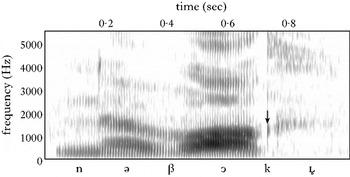
In coda position before a voiceless phoneme, or in word-final position before a pause, the consonant is optionally devoiced as [ ] or [
 ]: e.g. /titi/ ‘strong’ is realised as [titi]~[titi]~[titi]. In Fig. 4, the devoicing of the word-final consonant in /nəßɔ/ ‘hibiscus’ is visible from the absence of a voicing plateau, in contrast with Fig. 3. However, the contrast between the occlusive onset [k] and the lateral release [] remains perceptible from the absence vs. presence of turbulence in higher frequencies.
Spectrogram of the sequence /nəßɔ/ ‘hibiscus’. Due to its word-final position, the velar lateral is devoiced: [nəˈßɔk].

A thorough acoustic examination of Hiw's velar lateral is beyond the scope of the present study. These preliminary observations in Hiw appear to be consistent with the results presented in Ladefoged & Maddieson (Reference Ladefoged and Maddieson1996: 194) for Mid-Wahgi laterals, and in Steed & Hardie (Reference Steed, Hardie and Bow2004) for the voiceless allophone of the Kuman lateral ‘fricative’.
3.3 The phonemic ambiguity of complex segments
After this phonetic account of the segment, one question still needs to be addressed – namely, what its best description should be in phonological terms.
In principle, a complex segment consisting of a voiced velar stop+a velar lateral release could receive three phonologically different interpretations:
(9)
It could be argued that these analyses are all interchangeable from the phonemic point of view, and can be chosen arbitrarily. And in fact, we will see later (§6.3) that similar consonants in other languages have received a variety of descriptions in the literature. Several competing accounts can even be found for the same segment in one language. To take just one example, the velar lateral of the Papuan language Kuman (Chimbu family) has been described sometimes as an approximant (Lynch Reference Lynch1983, Ladefoged & Maddieson Reference Ladefoged and Maddieson1996: 194), sometimes as a fricative (Steed & Hardie Reference Steed, Hardie and Bow2004) and sometimes as a laterally released affricate (Piau Reference Piau1985). Such cases of discrepancy may be due to arbitrary choices on part of the describers. However, one may also want to look for positive evidence leading to favour one phonological analysis over the others. It is thus the purpose of this study to try and identify the phonemic status of the velar lateral consonant in Hiw on empirical grounds.
The phonological ambivalence of certain classes of segments has sometimes been pointed out, in particular by Mielke (Reference Mielke2005: 169):
While some sounds have attracted a broad consensus concerning their appropriate representation, the phonological ambivalence of others has led to disagreements in how they should be represented.
The sounds Mielke has in mind include laterals:
Flaps, trills and lateral liquids have been observed patterning as continuants with fricatives and also patterning as non-continuants with stops.
Numerous other studies have highlighted the fundamental ambiguity of complex segments (e.g. Campbell Reference Campbell1974, Anderson Reference Anderson1976, Ohala & Lorentz Reference Ohala and Lorentz1977, Ewen Reference Ewen, Hulst and Smith1982, Shaw Reference Shaw, Gerdts and Michelson1989, van de Weijer Reference Weijer1993), whether they show simultaneous coarticulation of two sounds or a sequence of two phases within a single phoneme. Consider, for example, a sequence oral stop+homorganic nasal: the segment [ ] is analysed as a postnasalised stop /tn/ in Nemi (New Caledonia; Rivierre Reference Rivierre1975, Ozanne-Rivierre Reference Ozanne-Rivierre1995: 54), but as a prestopped nasal /tn/ in Eastern Arrernte (Central Australia; Dixon Reference Dixon1980: 200, Henderson & Dobson Reference Henderson and Dobson1994, Butcher Reference Butcher, Harrington and Tabain2006).
Complex segments consisting of three phases raise similar questions. For example, Avava, another Oceanic language spoken on Malakula Island (Vanuatu), has two prenasalised voiced trills, one bilabial [ ], one alveolar [
 ] (Crowley Reference Crowley and Lynch2006: 26). One question which arises is whether these complex consonants are phonemically nasals with a trilled release, prenasalised trills (both involving predictable epenthesis) or stops, with both prenasalisation and a trilled release.
Just like the velar lateral in Hiw, such examples thus raise the question of which phase (stop, nasal, lateral, trill, …) defines the phoneme's status, and which should be understood as secondary. This question can also be formulated in terms of features: given a segment [], [] or [], which features should be assigned to it within the language's system: [continuant], [sonorant], [nasal] or something else?
3.4 Identifying the relevant domain of observation
In order to identify the status of such complex segments, one could carry out more detailed observation of its phonetic properties, whether in the articulatory or acoustic dimensions. For example, the question whether Hiw's lateral release should be analysed as a fricative [ ] or an approximant [l] could presumably be addressed based on an assessment of the raising of the tongue and narrowing of the vocal tract or on acoustic measurements of the turbulence produced by this release. Likewise, one might propose to discriminate between the stop /gL/ and the approximant // interpretations by measuring the relative prominence of the two phases, whether in terms of timing, intensity or other parameters.
This sort of phonetic approach is hinted at by Breen & Pensalfini (Reference Breen and Pensalfini1999: 20), in relation to the oral stop+nasal complex segments of the languages of Central Australia: ‘in the absence of a full instrumental study of these segments, prestopped nasals are best described as stops with a nasal release’. However, the assumptions underlying such a statement could be debated. Whatever a ‘full instrumental study’ might tell us about these segments' phonetics, it is doubtful whether it would provide us with any legitimate conclusion about their phonological status.Footnote 10 In principle, these are two distinct dimensions, which should be kept apart. The phonetic properties of each phase – timing, intensity, formant transitions, etc. – do not necessarily mirror the emic features which are relevant to account for their phonological behaviour in the system. There may be a correlation between phonetic prominence and phonemic status, but this must not be taken for granted, nor must one be a criterion for the other. It could well be that the two dimensions do not line up: this would be the case, for example, if the phase which is phonologically essential happened to be less prominent in the surface forms.
In sum, the only appropriate approach to identifying the phonological status of such complex segments should be based on system-internal structural rules and constraints. In the case of //, we need to discriminate between three interpretations: affricate, stop and approximant. The relevant constraints must therefore involve features involved in the definition of these three statuses. For example, if there is some test which distinguishes [+continuant] from [−continuant] consonants, and // patterns as [+continuant], then this would rule out the plosive interpretation, and leave the two other possibilities (affricate, approximant) open. Likewise, should some constraint involve the feature [sonorant], then it should help to discriminate between the approximant [+sonorant] reading and the other two possibilities, both of which are [−sonorant].
Obviously, such phonological constraints are language-specific, and a test which is available in one language may be irrelevant in another. Consider the case of the segment // of the Chimbu language Kuman, mentioned briefly above. In Kuman, the only acceptable consonants in syllable codas are [+sonorant], whether nasals or liquids, e.g. /m/ in /wam/ ‘fat’ or /ɾ/ in /iɾ/ ‘wind’ (Pfantz & Pfantz Reference Pfantz, Pfantz and Parker2005). The fact that the velar lateral // is also found in codas (e.g. /to/ ‘fence’, /pi/ ‘knife’) is a strong argument for analysing the phoneme in this language as [+sonorant]. This phonological test supports the interpretation of the velar lateral in Kuman as a (prestopped) lateral approximant // – in line with Lynch's description – rather than as a (laterally released) stop or a fricative. Crucially, this conclusion for Kuman contrasts with other languages such as Laghuu or Ekari, in which the same complex segment is best analysed as a laterally released stop /gL/ (§6.3).
However, the simple phonotactic test available for Kuman is not applicable in Hiw. The fact that Hiw also allows the velar lateral // to occur in syllable codas (e.g. /tɔ/ ‘bake’) cannot be taken as an argument for drawing any conclusions, because this distributional property does not distinguish it from other consonants. Indeed, we already know (§2.3.1) that Hiw allows any consonant, including stops, to occur in syllable codas (e.g. /tɔkʷ/ ‘holy’). A more elaborate criterion is needed before the phonological status of Hiw // can be defined on language-internal grounds.
In this paper I examine the behaviour of the velar lateral in tautosyllabic consonant clusters. This appears to be a domain where the distribution of consonants is sensitive to specific phonotactic constraints, in particular those subsumed under the concept of sonority. To use a metaphor from chemistry, I observe how the velar lateral ‘reacts’ to this particular environment, and use these observations as a diagnostic for assessing its nature within the system. This method will allow me to demonstrate the empirical status of this phoneme, on language-internal grounds, as a prestopped lateral approximant //.
But before we can arrive at this conclusion, it is necessary to observe in some detail the rules that govern tautosyllabic consonant clusters in Hiw.
4. Consonant clusters and sonority in Hiw
4.1 On the Sonority Sequencing Principle
A great number of phonological studies have proposed that the sounds of the world's languages can be organised along a universal scale of sonority (see, inter alia, Sievers Reference Sievers1881, Jespersen Reference Jespersen1904, Steriade Reference Steriade1982, Selkirk Reference Selkirk, Aronoff and Oerhle1984, Vennemann Reference Vennemann1988, Clements Reference Clements, Kingston and Beckman1990, Kenstowicz Reference Kenstowicz1994, Blevins Reference Blevins1995, Parker Reference Parker2002). The hierarchy in (10) constitutes a widely accepted version of this scale.
(10)
One domain where the notion of sonority typically proves relevant is in the observation of preference laws for syllabification – in particular, the Sonority Sequencing Principle (SSP; Jespersen Reference Jespersen1904, Selkirk Reference Selkirk, Aronoff and Oerhle1984, Clements Reference Clements, Kingston and Beckman1990, Blevins Reference Blevins1995).
(11)
Thus most languages favour those syllable onset clusters that follow a rising slope in terms of sonority (e.g. /pla/, where /l/ is more sonorous than /p/ and less than /a/).Footnote 11 The reverse combination (e.g. */lpa/), involving a ‘sonority reversal’, tends to be avoided (but see §4.2).
There is still debate about whether the notion of sonority is indeed a valid concept in phonology, especially considering that it has always been difficult to correlate it with empirical, physical properties of sounds. This has raised concerns that arguments based on sonority, when accounting for syllable shapes, may be circular: ‘terms such as sonority, etc., are just labels for the rank ordering of the segment types; they do not explain it’ (Ohala Reference Ohala1990: 320). Some authors have addressed this problem, and proposed to correlate sonority with empirical measures of the physical properties of sounds, whether articulatory (e.g. Lindblom Reference Lindblom and MacNeilage1983) or acoustic (Parker Reference Parker2002, Reference Parker2008). The sonority scale proposed by Parker (Reference Parker2002), based on measurements of ‘sound level protrusions’, is similar to (10), but offers a finer-grained distinction between classes of segments.
(12)
Another argument often put up against the notion of sonority is that it has exceptions (Ohala 1990, Wright Reference Wright, Hayes, Kirchner and Steriade2004). While some languages comply with the SSP, others allow for violations to the principle, either for specific segments or across their entire system.Footnote 12 This argument is not sufficient to discard the SSP altogether, however, especially in light of the overwhelming number of languages which confirm its relevance. Simply, like most proposed universals,Footnote 13 the sonority hierarchy must be understood as a solid statistical tendency rather than an unrestricted universal. Sonority can be understood as one among several operating principles that may or may not operate within particular systems, sometimes in conflict with other motivations. The sections below will compare Hiw – a language which essentially complies with sonority constraints – with its neighbour Dorig – a language which freely violates the sonority hierarchy in the organisation of its syllables.
Finally, a third argument sometimes put forward against sonority is that it leaves a number of phonological phenomena unexplained. The desire to identify a model capable of covering more ground has led to the useful proposal of alternative explanatory models, mostly based on acoustic and perceptual properties of sounds (Ohala Reference Ohala1990, Wright Reference Wright, Hayes, Kirchner and Steriade2004, Harris Reference Harris2006). The application of such models to the data of Hiw would potentially bring interesting results, and would eventually form welcome additions to the present study.Footnote 14 However, this article will restrict itself to the traditional approach to the sonority hierarchy. This will facilitate comparison with those phonological results which have been formulated in the same framework for other languages.
4.2 Dorig: a language which disregards the sonority hierarchy
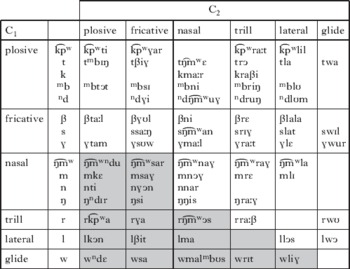
While most languages comply with the Sonority Sequencing Principle, this is far from being always the case (Clements Reference Clements, Kingston and Beckman1990: 288). Some language families violate the SSP more than others; sonority reversals appear to be particularly rare among Austronesian languages.Footnote 15 Interestingly, the language of Dorig [ndʊriɣ], spoken on Gaua (Banks Islands) in the vicinity of Hiw (see Fig. 1) and closely related to it, constitutes a notable exception to this universal tendency.
Table I illustrates the word-initial consonant clusters attested in Dorig (personal data), within a strict CCVC syllabic template similar to the one found in Hiw. Phonemes are ranked by order of increasing sonority, based on the scale in (12); the first consonant (C1) of the cluster is listed in rows, the second C2 in columns. Transcriptions are phonemic, but almost always correspond to the surface form.Footnote 16
Examples of word-initial consonant clusters in Dorig. Glosses for the examples are given in the Appendix.

The shaded areas in Table I correspond to sonority reversals. Evidently, Dorig freely violates the Sonority Sequencing Principle by allowing any sequence of sonority classes, ‘with no restriction whatsoever on the nature of the consonants that may cluster together’ (François Reference François2005: 471). Overall, constraints on sonority do not appear to play any role in the definition of well-formed consonant clusters in Dorig – a phenomenon which, incidentally, is in itself worthy of notice for the typologist.
Crucially, were Hiw to behave like its sister Dorig and allow any combination of consonants in clusters, we would be unable to take this domain as a touchstone for solving our problem – that is, we would be unable to identify the phonological status of // on the basis of the way in which it combines with other consonants. Consequently, before we start drawing any conclusion about the behaviour of the velar lateral in clusters, a preliminary step must be to establish whether the phonology of Hiw treats sonority as a relevant parameter at all. As the following section will show, the answer to this question is positive.
4.3 The Sonority Sequencing Principle in Hiw
In some cases, Hiw seems to violate the sonority hierarchy, as shown by words such as /ßti/ ‘star’ and /wte/ ‘small’. However, despite these examples, we will see that Hiw – unlike Dorig – does in fact follow sonority-based preference laws in the structure of its syllables, even though the way in which it does so calls for some language-specific adjustments to the typical sonority hierarchy.
4.3.1 Word-medial consonant clusters
As mentioned in §2.3, the syllabic template of Hiw is CCVC, with all consonants optional. Word-medial consonant clusters are common in Hiw, and examples of sequences of three consonants were given in (8). However, for historical reasons which I shall not detail here (but see François Reference François2005), such CCC clusters are rare in the language: all attested instances in my corpus were shown in (8). Much more common are word-medial clusters of two consonants – e.g. /kajakə/ ‘stand up’, /təkŋʷa/ ‘people’.
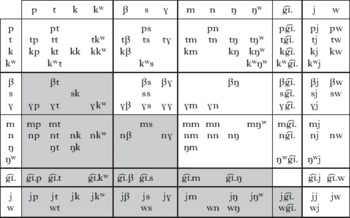
Table II lists the word-medial clusters attested in my corpus.
Word-medial consonant clusters in Hiw.

At first sight, Hiw allows virtually any combination of consonants, including sequences in which C1 is higher in sonority than C2 (the shaded cells in Table II). However, these should only be considered proper instances of ‘sonority reversals’ if these C1C2 sequences can unambiguously be assigned to a single syllable. Given that a syllable in Hiw may begin with a consonant cluster, the position of a word-medial syllable boundary in a -VCCV- sequence is unclear (cf. Kenstowicz Reference Kenstowicz1994: 262). For example, given that /pɔɣ/ ‘stow (pl)’ is a well-formed syllable in Hiw, how should we parse its reduplicated form /pəpɔɣ/: as /pəp.ɔɣ/ or as /pə.pɔɣ/? I will not attempt to answer this question here. But the fact that word-medial clusters may be separated by a syllable boundary may explain why there are essentially no sonority restrictions which affect them in Hiw. Because basically all combinations seem possible, word-medial clusters cannot provide the sort of domain we need to identify sonority constraints.
In order to avoid the difficult problem of knowing where to locate syllable boundaries with word-internal consonant clusters, I will now focus on word-initial clusters, as they can readily be assigned to a single syllable. Focusing on word margins also helps avoid the risk of circularity in statements about sonority (Ohala Reference Ohala1990: 320).
4.3.2 Word-initial clusters in Hiw
Tautosyllabic sequences of consonants are also common in Hiw, and show a great variety of combinations. However, not all combinations are attested.
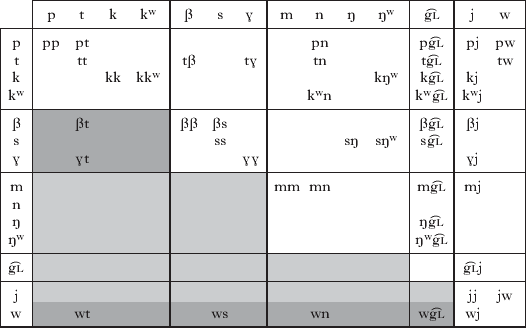
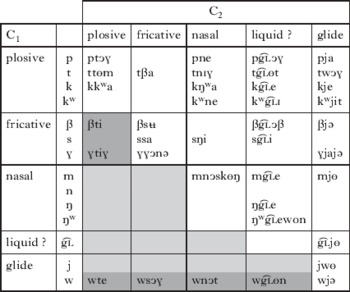
Table III lays out all word-initial clusters which are attested in my corpus, while Table IV exemplifies most of these clusters – at least one combination for each sonority class – with lexical items.
Word-initial consonant clusters in Hiw.
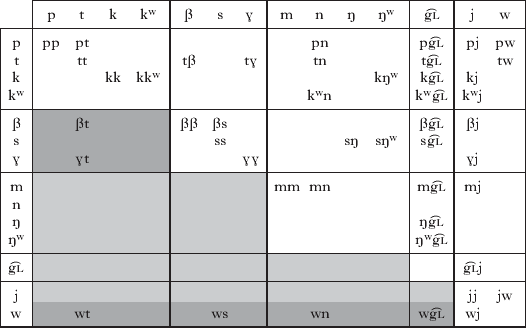
Examples of word-initial consonant clusters in Hiw. Glosses for the examples are given in the Appendix.

The question whether Hiw complies with universal sonority tendencies is not straightforward. At first sight, a number of these initial clusters (the darker areas: /ßt ws/, etc.) violate the Sonority Sequencing PrincipleFootnote 17 – see the discussion in §4.3.3. Does this mean that Hiw simply allows just any cluster of consonants, regardless of their sonority value, just like Dorig? The answer is negative. The data given in Tables III and IV suggest that Hiw does in fact obey some specific phonological constraints linked with sonority.
In some cases, a pattern may be lacking simply because it happens to be absent from my corpus, or from the lexicon. For example, it is likely that sequences such as /s/+plosive or /ß/+nasal are possible in Hiw, and might turn up in a wider corpus. This is suggested by the fact that other phonemes of the same sonority class, which otherwise behave in similar ways, are attested in these combinations.
But some combinations appear to be unattested for entire sonority classes; these are the lightly shaded cells in Tables III and IV. The nine combinations which are systematically unattested all correspond to cases where C1 is more sonorous than C2, so that a sequence C1C2V would have constituted a sonority reversal. The stair-like shape of the shaded areas in the tables is a logical consequence of this pattern. Judging by these cases, it appears that Hiw tends to avoid sonority reversals, in line with universal tendencies. For example, no cluster can consist of a nasal followed by an obstruent, whether plosive or fricative: while the word /pne/ ‘carry something by slinging it on one's shoulder’ is well-formed (because the sequence stop–nasal–vowel constitutes a steady rise in sonority), a word like */npe/ – or even homorganic */mpe/ – would be ill-formed, because a sequence nasal–plosive–vowel would violate the SSP. Likewise, the palatal glide /j/ can only be followed by another glide. (The case of // will be discussed in §5.) If we temporarily set aside the problematic case of the phonemes /ß ɣ w/ (discussed below), the internal structure of Hiw syllables can be said to comply with the Sonority Sequencing Principle (11).
Many of the world's languages require a minimal sonority distance between C1 and C2 (Steriade Reference Steriade1982, Selkirk Reference Selkirk, Aronoff and Oerhle1984) – e.g. French licenses /pla/, but not */pna/ or */pta/. Hiw is less strict in this regard. It allows C1 and C2 to be close in sonority (e.g. /tßa/ ‘cough’, /tɣo/ ‘stiff’) or even equivalent, i.e. from the same sonority class – hence the well-formedness of onsets consisting of two plosives (/ptɔɣ/ ‘(pull) off’), two fricatives (/ßsʉ/ ‘finger’), two nasals (/mnɔskɵŋ/ ‘chatterbox’) or two glides (/jwɵ/ ‘big (sg)’). These cases illustrate what Clements (Reference Clements, Kingston and Beckman1990: 288) labels ‘sonority plateaus’; they do not constitute violations of the SSP.
In sum, Hiw follows the same mechanism as the majority of the world's languages, inasmuch as it generally prohibits complex syllable onsets where C2 is less sonorous than C1. I now turn to the discussion of the apparent counterexamples.
4.3.3 Language-specific adjustments to the SSP
Two problems remain to be solved. One is the relation between fricatives and plosives; the other is the unexpected behaviour of /w/.
4.3.3.1 Fricatives and plosives
Authors who adopt a fine-grained formulation of the sonority scale suggest that fricatives should outrank in sonority their plosive counterparts. This was apparent from the detailed sonority scale proposed in (12) above, and partially reproduced in (13).
(13)
Under this scale, Hiw words such as /tßa/ ‘cough’ and /tɣo/ ‘stiff’ are well-formed; but /ßti/ ‘star’ and /ɣtiɣ/ ‘waist’ would constitute sonority reversals.
However, it is not always the case that individual languages distinguish between all sonority classes (Hume Reference Hume1998: 157, Parker Reference Parker2008). As Parker (Reference Parker2008: 61) puts it, ‘languages differ in terms of … which (adjacent) categories in the sonority hierarchy they systematically distinguish’. The fact that Hiw allows both fricative+plosive and plosive+fricative combinations shows that it does not treat fricatives and plosives as separate classes with regard to sonority. The only category which Hiw treats as emic with regard to sonority is an umbrella class of ‘obstruents’, which lumps together fricatives and plosives.
A version of the sonority hierarchy adapted to Hiw's phonology is given in (14). As it happens, the underspecification of the class ‘obstruents’ makes this version of the scale identical to the minimal version of the hierarchy in (10) above.
(14)
Under this new version of the hierarchy, words like /ßti/ and /ɣtiɣ/ are just as well-formed as /tßa/ and /tɣo/ within the system of Hiw. These are sonority plateaus, and do not constitute solid counterevidence to the suggestion that Hiw essentially complies with the Sonority Sequencing Principle.
4.3.3.2 The labial-velar glide /w/
Another issue, apparent from the last row of Table IV, is the unexpected behaviour of the labial-velar glide /w/. On the one hand, the palatal approximant /j/ obeys the SSP quite faithfully, in the sense that it can only be followed by another glide, and not by a lateral, a nasal or an obstruent. On the other hand, the labial-velar glide /w/ is commonly found as the first element of any consonant cluster, with apparently no restriction on sonority class: /wte/ ‘small’, /wto/ ‘buttocks’, /wtaɣə/ ‘Barringtonia edulis (nut sp.)’, /wsa/ ‘egg’, /wsɔɣ/ ‘snatch’, /wni/ ‘fruit’, /wnɔt/ ‘food parcel’, /wat/ ‘dodge’, /wɔɣ/ ‘through’, etc. Phonetically speaking, these examples clearly violate the SSP. How can we account for this exceptional behaviour of /w/?
It is a controversial issue whether the sonority scale should be considered universal and fixed, or whether languages have a certain degree of freedom in the assignment of their segments to sonority classes (Steriade Reference Steriade1982, Selkirk Reference Selkirk, Aronoff and Oerhle1984, Clements Reference Clements, Kingston and Beckman1990, Morelli Reference Morelli1999). In many Indo-European languages, for example, the fricative /s/ is famous for behaving differently from other obstruents (e.g. Cho & King Reference Cho, King and de Vijver2003: 185). To take just the example of English, /s/ is the only obstruent which may be followed by another obstruent (st, sp, …), by a nasal (sm, sn, …) or another consonant cluster (str, skr, …). These sonority reversals, however, do not mean that English treats sonority and the SSP as totally irrelevant; rather, it suggests that universal principles of sonority may have to leave some room for certain language-specific adjustments in otherwise powerful universal principles. Many proposals have been made to explain the particular case of English, which I will not discuss here.
A similar approach may be necessary to account for the non-canonical behaviour of /w/ in Hiw. Interestingly, it constitutes not only a counterexample to the sonority hierarchy, but also to some alternative models which have been proposed to replace it. For example, Wright (Reference Wright, Hayes, Kirchner and Steriade2004) chooses a perception-based approach, based on the relative auditory robustness of segments in the chain. Contrary to traditional approaches to sonority, his model manages to explain the frequent unorthodox behaviour of /s/:
In a Sonority Sequencing Constraint that is based on perceptual robustness, a stranded consonant (one without a flanking vowel, liquid, or glide) is dispreferred unless it has sufficiently robust internal cues to survive in the absence of formant transitions. … Segments that we expect to survive without the benefits of flanking vowels, and thus be found at syllable edges with intervening stops, are the sibilant fricatives, potentially other fricatives … and nasals (Wright Reference Wright, Hayes, Kirchner and Steriade2004: 51–52).
Glides thus do not belong to the list of consonants which Wright would describe as capable of ‘surviving’ in a ‘stranded’ position. In other words, the behaviour of /w/ in Hiw constitutes a problem both for the traditional approaches to the sonority hierarchy, and for the alternative perception-based model proposed by Wright.
One way to go would be to analyse this phoneme of Hiw as simply an exception to the SSP, with no further attempt at an explanation. However, I would like to put forward here a tentative hypothesis in order to account for its unorthodox distribution in consonant clusters.
Despite its clear phonetic nature as a glide, /w/ patterns syllable-initially as if it belonged to the class of obstruents. This unexpected phonological categorisation may result from what is a structural gap in the inventory of Hiw consonants (see (1)): while the system has four plosives (/p t k kʷ/) and four nasals (/m n ŋ ŋʷ/), it has only three fricatives (/ß s ɣ/). The missing category is one that would correspond to a ‘labial-velar fricative’ such as */ɣʷ/ (a rounded voiced velar fricative). The latter consonant does not exist in Hiw – not even as an allophone – yet its description is close enough to /w/Footnote 18 for the latter approximant to be structurally integrated, at an abstract level of representation, into the row of fricatives.Footnote 19
Although we should be prudent in applying ‘pigeonhole-filling’ arguments in phonological reasoning (Ohala & Lorentz Reference Ohala and Lorentz1977), these should probably be considered legitimate when they are supported by empirical patterns of a particular system, as is the case here. This structural explanation might explain why Hiw, which otherwise tends to obey the hierarchy of sonority in its consonant clusters, still licenses sequences of /w/ with any consonant. If one is prepared to admit that, from a system-internal point of view, Hiw treats /w/ as though it belonged to the class of obstruents, then a word like /wte/ ‘small’ becomes parallel with /ßti/ ‘star’. At some abstract level of representation, each of these two words arguably constitutes a sequence of obstruents – a sonority plateau which, again, ultimately complies with the SSP.
4.4 The diachronic evidence
Overall, Hiw mostly appears to comply with the Sonority Sequencing Principle in the licensing of its consonant clusters. This point can be established, as above, by observing the clusters attested in the modern language. But one can also take the historical perspective, and show that some illicit patterns were in fact actively avoided by the system.
Historically, word-initial consonant clusters arose through deletion of an unstressed, pretonic vowel in former three-syllable (or five-syllable) etyma (François Reference François2005: 469) – under one condition. The pretonic vowel was deleted if, and only if, it was a high vowel (*i, *u) or was higher (i.e. less sonorous, cf. (12)) than the stressed vowel that followed.Footnote 20 The typical result of unstressed vowel deletion is that a former three-syllable etymon became a CCVC monosyllable, e.g. Proto-Torres-Banks *ŋguˈla-ŋgu ‘my back’>/kjɔk/, as shown in (15).Footnote 21
(15)
The consonant clusters shown in (15) illustrate the most frequent case, namely when the modern consonants simply reflect the original sequence of their etymon: for example, the order of consonants in /kʷne/ is parallel to the order of consonants in the proto-form *mbuˈna-i. All these clusters were preserved in the modern language because they comply with the sonority hierarchy – at least the one defined in emic, language-internal terms.
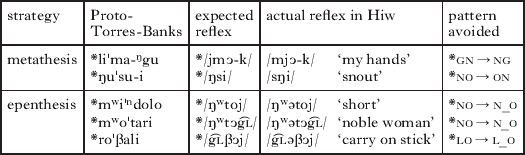
But what happened if unstressed vowel deletion would have produced a sonority reversal? The evidence shows that such ill-formed sequences were systematically avoided. For example, if regular correspondences applied, the etymon *liˈma-ŋgu ‘my hands’ should have yielded a form */jmɔk/. Such a sequence of glide+nasal would have violated the SSP. Hiw avoided such an illicit consonant cluster, by means of a metathesis: */jmɔk/→/mjɔk/.Footnote 22
Table V shows that two strategies were used to avoid illicit consonant clusters: metathesis and schwa epenthesis.Footnote 23, Footnote 24
Metathesis and epenthesis as two strategies to avoid illicit consonant clusters. O = obstruent; N = nasal; L = liquid; G = glide. The underline denotes vowel epenthesis.
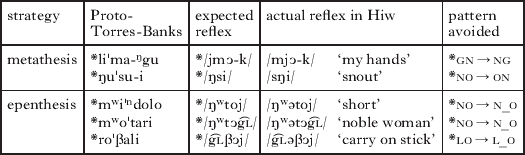
The comparison with the neighbouring language Dorig is instructive here. Dorig has cognate forms for the first two of these etyma: *liˈma-i>/lma/ ‘hand’; *ŋuˈsu-i>/ŋsi/ ‘snout’ (see Table I). Because sonority is not a relevant parameter in the phonology of Dorig, the sonority reversals of the modern forms were kept unchanged. By contrast, the Hiw system treated these reversals as ill-formed, and ‘rectified’ them by means of metathesis. This is again evidence that Hiw, unlike Dorig, treats the sonority hierarchy as an operational constraint in the definition of its well-formed consonant clusters.
5 The velar lateral in Hiw: synchrony and diachrony
5.1 Solving the synchronic puzzle
The preceding section showed that Hiw regularly complies with the Sonority Sequencing Principle in the formation of its consonant clusters. This parameter can now be used as a heuristic tool in solving the initial puzzle of the present study (§3.4) – that is, identifying the phonological status of the velar lateral //.
If we are dealing with a lateral affricate, or a (laterally released) stop, then this consonant should pattern in the same way as obstruents, as far as sonority is concerned. Conversely, if the consonant is to be analysed as a lateral approximant proper, then it should behave like a liquid – that is, it should fit between nasals and glides on the sonority scale. The answer to this question can be drawn from Table IV, combined with our knowledge of sonority-linked rules governing clusters.
In itself, the fact that // may be preceded by a stop (as in /kʷi/ ‘dolphin’) does not reveal the segment's status.Footnote 25 Given that Hiw licenses sonority plateaus (§4.3.2), such words would be well-formed whether the velar lateral is a liquid //, a stop /gL/ or an affricate //.
The existence of the sequence fricative+//, as in /ßɔß/ ‘cook’ and /ßiwanə/ ‘funny’, might have been regarded as an argument for ruling out the stop interpretation, because fricative+stop, in principle, constitutes a sonority reversal. However, we saw that Hiw does not distinguish stops from fricatives in its treatment of sonority, and distinguishes only one emic category of obstruents (§4.3.3.1). Consequently, a cluster like /ß/ parses as obstruent+//, and is thus ambiguous with regard to the sonority status which should be assigned to the velar lateral. The word-initial cluster /w/ (e.g. /wɵn/ ‘fetch’) does not prove much either, seeing that the labial-velar glide patterns as an obstruent in Hiw (§4.3.3.2).Footnote 26
The crucial evidence comes from combinations with nasals. Whereas obstruents can be followed by a nasal (e.g. /kʷne/ ‘smell’, /sŋi/ ‘snout’), the velar lateral // cannot: no syllable in Hiw can start with a cluster like */n/ or */ŋ/. Conversely, // can follow a nasal – e.g. /me/ ‘wrath’, /ŋʷewon/ ‘bush’.Footnote 27 This property again makes the velar lateral distinct from obstruents (as */mp/, */ns/, */ŋɣ/, … are illicit clusters). The only consonant attested to follow // is the glide /j/ – e.g. /jɵ/ ‘tail’, /je/ ‘sweep’.
This suggests that // is less sonorous than the glide /j/, but more sonorous than all other consonants, whether obstruents or nasals. In other words, within the sonority scale (14), the velar lateral // fits exactly into the slot for liquids.
The historical evidence cited in §4.4 confirms these synchronic observations. Whereas words like /si/ ‘bone’ and /ŋe/ ‘cape’ are well-formed in Hiw, a sequence like */ßɔj/ would involve an illicit liquid+obstruent cluster, which underwent epenthesis: /əßɔj/ (Table V).
This empirically grounded conclusion allows us to rule out two of the three phonological analyses (§3.3) which were theoretically possible for the phone []. Since this segment patterns like a liquid, it can be neither a lateral affricate nor a laterally released stop. The best phonological analysis is to assign it the status of a lateral approximant – more precisely, a velar prestopped lateral approximant.
Although the notation with the ligature // is still appropriate, an alternative is to use a superscript /g/. This choice of notation serves to indicate that the plosive phase is phonemically secondary, in the sense that it does not participate in the phoneme's behaviour within the system's structural constraints in terms of sonority. Such a notation would be parallel to the widespread use of superscripts for prenasalised (/mb, nd, …/), rounded (/mbʷ, ŋʷ, …/) and aspirated (/kʰ, pʰ, …/) consonants. In each case, the superscript symbol represents a phonetic element which is present, yet plays no role in the phoneme's status with regard to sonority: thus, /mb/ can normally be shown to behave like an obstruent rather than a nasal, and /ŋʷ/ as a nasal rather than a glide.
Finally, from a strict notational point of view, one could choose to represent the Hiw phoneme as simply /l/, especially since the prestopped velar lateral does not contrast with any plain lateral. However, I believe this fails to represent the complex nature of the consonant, whose plosive onset is recognised by conservative speakers as essential to its articulation and its auditory distinctiveness from the velar constrictive /ɣ/ (§3.1). I shall therefore transcribe the prestopped lateral consonant consistently as // in phonological transcriptions of Hiw below. The only reason that /l/ might constitute a more elegant representation would be if prestopping were shown to be an inherent feature of all velar laterals. While this indeed may be true (see §6.2), at this stage it has not been confirmed by cross-linguistically detailed research.
5.2 Historical origin of the velar lateral
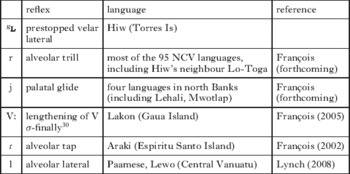
This synchronic study has thus established that the velar lateral of Hiw is phonologically a liquid – in fact, the only liquid of the system (§2.1.1). Interestingly, it can be shown that this phoneme, historically, also originates in a liquid, but of a very different sort. In all the words whose etymology is clear, // always reflects a former rhotic – what was probably an apical trill /r/ in the earlier history of the language.
A few brief notes may help situate the consonant of Hiw within the context of its language family. We know that Hiw is one of about 95 languages belonging to the ‘North Central Vanuatu linkage’ (Clark Reference Clark2009); the latter belongs to a larger set of about 450 Oceanic languages, which in turn form a well-defined subgroup within the large Austronesian family.
Proto-Austronesian and Proto-Oceanic, the ancestors of Hiw, are reconstructed with two different rhotics, represented as *r and *R (Milke Reference Milke1958, Ross Reference Ross1988, Reference Ross, Ross, Pawley and Osmond1998) – in addition to an alveolar lateral *l. Although the evidence for their phonetic realisation is scarce, Blust (Reference Blust2009: 582) suggests that the contrast *r vs. *R could have been originally a contrast between an alveolar flap and an alveolar trill respectively; however, this is still a matter of debate (François, forthcoming).
In fact, modern languages of Vanuatu never reflect *r and *R with different segments. Rather, what happens is that *r is regularly reflected by a segment, whereas the other rhotic, *R, has undergone patchy and unpredictable loss (*R> ) at an early stage, when the two rhotics were still distinct (Geraghty Reference Geraghty and Davidson1990, Lynch Reference Lynch, Adelaar and Pawley2009, François, forthcoming). In a subsequent phase, the surviving instances of *R merged with *r in all languages of Vanuatu, thereby suppressing evidence of their former contrast. These intricate issues of reconstruction need not concern us here. Suffice it to say, the two protophonemes *r and *R of Proto-Oceanic had demonstrably merged as an alveolar trill in Pre-Hiw – and this trill, in turn, is the source of the velar lateral [] of modern Hiw.
(16) provides a few examples of regular change from *r/*R to Hiw //. Protoforms are given either in Proto-Oceanic (POc) or Proto-North Central Vanuatu (PNCV; Clark Reference Clark2009), and are transcribed in IPA.
(16)
The only cases where // does not directly reflect a rhotic correspond to rules of metathesis or assimilation involving the two velar continuants of modern Hiw, // and /ɣ/. These historical processes of interferenceFootnote 28 between the two consonants (François Reference François2009, forthcoming) are regularly correlated with stress. Without going into the full detail of these rules, I will only cite three of them here (underscores represent vowel slots):
(17)
These regular processes account for more than 60 lexical items. Assuming that they somehow result from the property [velar continuant], shared by the two consonants, it is most likely that these rules arose once the apical trill *r had already changed into //.
5.3 From apical trill to velar lateral
Among all the Oceanic (indeed Austronesian) languages I know of, Hiw is the only one in which the rhotics became a (prestopped) velar lateral //. The most common reflexes of *r/*R in Oceanic languages are generally an apical trill /r/, but also often an alveolar lateral /l/. For example, *r/*R have come down as /l/ in the Temotu group of the Solomon Islands (Ross & Næss Reference Ross and Næss2007) and in some Polynesian languages.
A possible hypothesis might then be that the apical trill of Pre-Hiw may have first become an alveolar lateral *r>[l], before changing its place of articulation to velar, i.e. [].Footnote 29 However, this potential scenario is not clearly supported by the dialectological evidence observable in the vicinity of Hiw.Footnote 30
Table VI lists the reflexes of *r/*R in the North-Central Vanuatu subgroup to which Hiw belongs, from north to south. It shows that the original rhotics are only reflected as a lateral /l/ in languages such as Paamese and Lewo, at a considerable distance from Hiw (see Fig. 1). Several dozen languages intervene between Paamese and Hiw (Tryon Reference Tryon1976), none of which reflects *r/*R as a lateral. In terms of historical phonology, the dialectological evidence does not support the hypothesis that the velar lateral of Hiw should be derived from, or have any connection with, an alveolar lateral *l. It seems more likely that the velar lateral evolved directly from an alveolar trill.
Reflexes of the proto-rhotics *r/* R in some North Central Vanuatu languages.

It is unclear how exactly an originally apical trill *r would change into a prestopped velar lateral //.Footnote 31 A preliminary hypothesis might be as follows. While an apical trill [r] is primarily defined by the motion of the tongue tip against the alveolar ridge, it also entails vibration of the entire tongue body. A movement of the lower body (dorsum and root) is exactly what is involved in the articulation of [], in the transition between the occlusive onset phase and the lateral release (§3.1). It is possible that what was an apical trill [r] may, over time, have shifted its defining articulation from the tip to the root, in a similar fashion to the better-attested change [r]>[R]. Acoustic properties may also have played a part in the change from [r] to [], if the turbulence produced by [] was perceived to be similar to that formerly associated with [r], enough to ensure continuity in the identification of the phoneme. This hypothesis warrants further investigation.
5.4 Language contact and the velar lateral
The connection between the apical trill *r and the velar lateral of modern Hiw // is first and foremost a historical one, the former being reconstructable as the ancestor of the latter. As such, modern speakers would not be expected to be conscious of this link. However, Hiw speakers are constantly reminded of the connection through their exposure to the languages of the Torres and Banks Islands which have kept the alveolar trill (cf. Table VI). In particular, most Hiw speakers are bilingual in the neighbouring language Lo-Toga,Footnote 32 and are familiar with regular correspondences between /r/ and // in cognate forms (18).
(18)
Due to this regular correspondence between the velar lateral // of Hiw and the apical trill of neighbouring languages, the spelling system preferred by Hiw speakers uses a grapheme derived from <r>, with a diacritic. Thus /ßɔtʉ/ is spelled <vo tu>, /wiɣɔj/ is <wigoy>, /kʷɵɣ/ is <qög>, /ɵə/ is <öe>, etc.
The ongoing association between the velar lateral and rhotics is also partly apparent from the treatment of loanwords. Hiw has borrowed lexical items from several languages which have an alveolar trill in their inventory. This is true on the one hand of some of the neighbouring vernacular languages of the Torres and Banks Islands (especially Mota, the language of Christianisation during the 19th century), and on the other hand of the pidgin Bislama, which usually forms the bridge between European donor languages (French, English) and Hiw. Note that all Hiw speakers today are fluent in Bislama, and produce the apical trill of that language (and of Lo-Toga) with no difficulty.
When a lexeme contained an apical trill /r/ in the donor language, it has sometimes been preserved in Hiw, despite its absence in the native inventory of Hiw consonants, as shown in (19).
(19)
However, some loanwords – perhaps borrowed earlier – have undergone phonological nativisation. In loans containing a trill, this process triggered the change from /r/ to //.
(20)
The examples in (20) suggest that Hiw speakers still perceive a link between their own velar lateral and the rhotics of other languages.
6 A typological survey of velar laterals
I complete this study with a brief typological overview of velar lateral consonants.
6.1 A rare phoneme
Velar lateral phonemes are vanishingly rare amongst the world's languages – in fact, so rare that they were once considered impossible (Chomsky & Halle Reference Chomsky and Halle1968, Ladefoged Reference Ladefoged1971), or mere variants of more common coronal laterals. However, more recent research has proved their existence in a small number of languages (Ladefoged et al. Reference Ladefoged, Cochran and Disner1977, Blevins Reference Blevins1994, Ladefoged & Maddieson Reference Ladefoged and Maddieson1996: 190). To the best of my knowledge, Hiw is the only Austronesian language which is attested to have such a consonant.
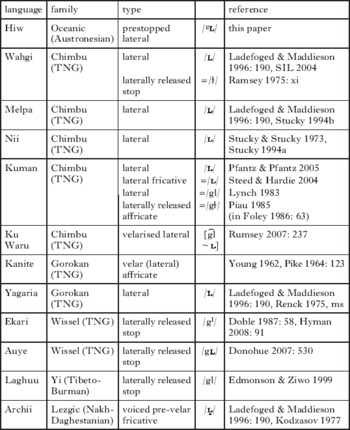
In his typological survey of lateral consonants, Maddieson (Reference Maddieson, Haspelmath, Dryer, Gil and Comrie2008) contrasts various types of languages, depending on whether they have lateral consonants at all (16·8% do not), and if they do, what their place of articulation is. The most common type (68·4% of his sample) is for a language to have only one lateral, the alveolar /l/. Hiw belongs to a minor category, that of languages with ‘laterals, but no /l/’; these form only 6·5% of his typological sample (37 languages out of 567). Together with Kanite and Yagaria (Blevins Reference Blevins1994: 314), Hiw belongs to the very small set of the world's languages whose only lateral segment – or indeed, whose only liquid – is a velar.
Table VII cites data from other languages of the world which possess – usually alongside the more common alveolar /l/ – a voiced velar consonant that is phonetically similar to the // of Hiw. The fourth column lists the phonological representation which is used by the authors, even in those cases where it is not consistent with their own description, or where it makes inaccurate use of IPA conventions. Although a few languages may be missing from Table VII, it is close to being comprehensive – this alone says much about the typological rarity of velar laterals.
Some languages with voiced velar laterals or similar phonemes. TNG = Trans-New Guinea.

Note that Table VII only cites phonemes which include, or may include, the voiced velar string [] as one of their surface forms. One might also want to enrich this list with other stop+lateral velar phonemes which are reported for some languages, but whose description clearly points to different phonetic forms. This is the case, for example, with the voiceless velar ejective affricate / / of Zulu (Blevins Reference Blevins1994: 312, Ladefoged & Maddieson Reference Ladefoged and Maddieson1996: 205) and with the voiceless velar plosive with alveolar lateral fricative release /
 / of Axluxlay, a Macro-Panoan language of Argentina (Stell Reference Stell1972).
Among its 91 consonants, the Caucasian language Archi is reported to have a set of velar lateral (voiceless and voiced) fricatives, as well as voiceless velar lateral affricates and ejectives. Among this rich inventory, the segment closest to Hiw // would be the voiced lateral fricative, transcribed // by Ladefoged & Maddieson (Reference Ladefoged and Maddieson1996: 128). However, this consonant, described by Kodzasov (Reference Kodzasov, Kibrik, Kodzasov, Olovyannikova and Samedov1977) as pre-velar rather than velar, has recently been reanalysed as a ‘palato-velar lateral fricative’, transcribed /ɮ/ (Chumakina et al. Reference Chumakina, Corbett and Brown2008). Besides, the strong degree of frication – audible from audio recordings – makes it phonetically quite distinct from the velar lateral of Hiw.
A careful distinction should be drawn between the velar lateral [l] and the velarised alveolar lateral approximant [ɫ] (Ladefoged & Maddieson Reference Ladefoged and Maddieson1996: 191), also known as ‘dark l’ – e.g. in English peel [pʰiːɫ]. These two lateral consonants show major differences, both in their articulation and in their auditory properties. A velar lateral [l] involves contact at the velar place of articulation, with the airstream flowing on the sides of the dorsum, close to the back molars (§3.1). By contrast, [ɫ] involves contact – and lateral airstream flow – at the alveolar ridge; the velarisation only consists in the raising of the dorsum towards the velum, without any actual velar contact. For [ɫ] to lose its alveolar gesture does not make it a velar lateral. Due to the loss of any contact of the tongue with the upper articulators, the segment loses its lateral status altogether, and typically becomes a back vowel or glide: e.g. European Portuguese [sɔɫ]>Brazilian Portuguese [sɔ ] ‘sun’ (Barbosa & Albano Reference Barbosa and Albano2004: 229). Velarised alveolar laterals are therefore not included in this typological survey of velar laterals.Footnote 33
6.2 The typical prestopping of velar laterals
One of the few families in the world where velar laterals are commonly found (Foley 1986: 63) is the Chimbu family of Trans-New Guinea languages, located in the highlands of Papua New Guinea. From the sources cited, it seems that most of these languages provide the velar lateral with a plosive onset, just like Hiw – even though, for some of these languages, the prestopping is reported as optional.
The possibility of prestopping the lateral is sometimes mentioned explicitly by researchers, and sometimes can be inferred from other clues, such as the language's orthography. For instance, Ladefoged & Maddieson (Reference Ladefoged and Maddieson1996: 194) describe the velar lateral of Mid-Wahgi as essentially an approximant /l/, which is ‘occasionally ‘prestopped’'; the convention to spell it <gl> or <kl> (Ramsey Reference Ramsey1975: xi, SIL 2004) tends to confirm that this prestopping is a typical feature of the phoneme. Another clue can be the terminology chosen by the describer: thus, Pike's description of Kanite's segment as a ‘velar lateral affricate’, with no further phonetic characterisation, suggests prestopping.
Likewise, Kuman has a velar lateral, which Pfantz & Pfantz (Reference Pfantz, Pfantz and Parker2005) transcribe as /l/. For the same language, Foley (1986: 63), citing Piau (Reference Piau1985), describes this consonant as a ‘laterally released velar affricate /gɫ/, voiceless finally [k ], voiced elsewhere [gɫ]’. This description suggests the velar lateral of Kuman, again, exhibits a plosive onset similar to the one found in Hiw. Despite the varying transcriptions used to represent the consonant, it seems that its phonetic properties essentially match those of Hiw []. This is confirmed by acoustic observations made by Steed & Hardie (Reference Steed, Hardie and Bow2004: 348), who consistently identify a transient at the initial phase of the Kuman lateral.
It would be interesting to see whether any language has a genuine velar lateral approximant [l] which does not include any prestopping among its variants. In the absence of such a comparative study, the available literature suggests that known velar lateral approximants typically involve prestopping. The motivation for such a tendency should be addressed by future research.
This typical prestopping distinguishes velar laterals from their more common alveolar counterparts, for which prestopping is extremely rare. Only a small number of the world's languages are reported to have prestopped laterals for other points of articulation – at least as allophones of plain lateral phonemes. Along with prestopped nasals, which are also common among Australian languages (see §3.3), Hercus (Reference Hercus1972) reports two prestopped laterals in Arabana-Waŋgaŋuru languages of Southern Australia, an alveolar [ ] and a dental [
 ]. Martuthunira, a now extinct language of Western Australia, also prestopped its four laterals syllable-finally: [
 ], [tl], [cʎ], [
 ɭ] (Dench Reference Dench1995: 27).
6.3 An ambiguous phonological status
Following the discussion on Hiw, it is useful to emphasise that the phonological status of prestopped velar laterals differs from one language to another. This variety is first suggested by the diversity of descriptive labels which have been proposed by the researchers themselves: what seems to be phonetically the same – or a similar – segment has been described as a stop in some languages, as an affricate in others and as a lateral approximant in yet others. In some cases, this terminological variety is not grounded on any empirical evidence, and is mostly an artefact of the researchers' arbitrary choice. This is especially true when descriptions differ for the very same language across authors (as for Kuman or Wahgi); or when a single author's representations suggest contradictory interpretations – as when Ramsey (Reference Ramsey1975) describes Wahgi's segment as a stop, yet uses the symbol for a lateral approximant.
But crucially, the variety of descriptions partly reflects an actual diversity of phonological statuses, as defined by each language's system. Without going into the detail of all languages mentioned in Table VII, I will only cite a couple of examples.
Thus, we saw that the Kuman consonant patterns as [+sonorant] because it is allowed in syllable codas – a position occupied only by sonorants in this language (§3.4).Footnote 34 This is clear evidence that the prestopped velar lateral of Kuman – despite its occasional description as an ‘affricate’ or a ‘fricative’ – has the status of a lateral approximant //, just as in Hiw.
In other languages, the segment [] is apparently best described as a stop. Thus the language Ekari (Wissel Lakes, another branch of TNG) has a consonant which Doble (Reference Doble1987: 58) describes as ‘laterally released [gl], the lateral being back in the velar position’; as far as its phonetic realisation is concerned, this consonant is thus exactly the same sound as the [] of Hiw.Footnote 35 However, Doble considers this to be just the surface realisation of a phoneme which she analyses as fundamentally a voiced stop /g/, belonging in the occlusive series /p t k b d _/.Footnote 36 Although this voiced velar /g/ happens to always have a lateral release, [gL], it regularly patterns with stops, and particularly with its voiceless (and non-lateralised) counterpart /k/. Thus, /g(L)/ and /k/ share the properties of leniting intervocalically (Mark Donohue, personal communication), and of becoming rounded after back vowels: e.g. /buka/→[bukʷa] ‘bow’; /euga/→[eugLʷa] ‘more’ (Doble Reference Doble1987: 58).
Similarly, Laghuu, a Tibeto-Burman language of the Yi branch, contrasts a series of plain voiced velar stops /k kh g ŋg/ with another series of laterally released stops, which Edmondson & Ziwo (Reference Edmondson and Ziwo1999) transcribe as /kl khɬ gl ŋkhɬ/. Although the authors' description of the phonological system remains brief, it seems that the best analysis of the voiced velar segment is as a laterally released stop – what I would represent as /gL/ – rather than as a lateral.
In order to determine the precise phonological status of the various segments [] represented in Table VII, one would need more detailed information on the way in which they pattern within each system's phonological constraints.
7 Conclusion: the ambiguity of complex segments
This article can be read at two different levels.
For one thing, this case study provides first-hand data on the phonology of Hiw, an undocumented and endangered Oceanic language of Vanuatu. I have discussed both the phonetic and phonemic properties of an unusual consonant of Hiw, a prestopped velar lateral approximant //. I then observed the way this phoneme behaves within the structural constraints of its system, particularly in the domain of tautosyllabic consonant clusters, and how these are regularly shaped by the sonority hierarchy. This perspective allowed me to define empirically the phonemic status of the velar lateral as a liquid, thereby ruling out alternate analyses (velar affricate, laterally released stop) which have been proposed for similar consonants of other languages. This result contributes to our knowledge of Hiw in particular, and of Oceanic languages more generally.
However, this study may also have some more universal relevance, due to the methodological and theoretical questions it raised. Although some of the following points may already receive wide acceptance, it is perhaps useful to illustrate and support them with the new evidence provided here from Hiw, as well as from the other languages cited in the present paper.
– Given a complex segment consisting of two distinguishable phases, it is typically the case that one of these two phases is phonemically definitional while the other phase is structurally secondary, in the sense that only one phase takes part in the definition of the segment's phonological status within the system (Campbell Reference Campbell1974, Anderson Reference Anderson1976, Ewen Reference Ewen, Hulst and Smith1982, Shaw Reference Shaw, Gerdts and Michelson1989).
– Two languages may have phonetically identical complex segments, yet assign them a different status within their phonological system. This paper illustrated this point with a homorganic velar consonant [], consisting of a stop+lateral approximant: in some languages, like Ekari (§6.3), the plosive phase is analysed as definitional and the lateral phase as secondary /gL/; but the situation is reversed in Hiw, where this segment was shown to pattern like a liquid //. A similar situation holds for the complex segment [], which some languages treat as a postnasalised stop /tn/ and others as a prestopped nasal /tn/ (§3.3).
– The phase which is phonemically definitional is not necessarily prominent phonetically (in terms of intensity, timing, perception, etc.). These two dimensions are two logically independent parameters, which may or may not coincide. Given such an ambiguous segment, the phonological hierarchy between its two phases (i.e. which one is definitional vs. secondary) should be determined empirically, by observing how the phoneme behaves within the phonological constraints of its own system.
– There is no universal method for defining a phoneme's status, because languages differ as to what phonological constraints they treat as operational. A key criterion in one language may be irrelevant in another (§3.4).
– Some languages may provide no way to discriminate between competing hypotheses. For example, if a system treats all obstruents identically without ever contrasting stops with fricatives, then a segment [ ] may remain ambiguous regarding its phonemic status as a stop or fricative. Conversely, some languages may provide more than one criterion for solving a given puzzle. Ideally these criteria should coincide; but of course there is also the possibility of conflict. That is, a segment [] could be found to pattern with stops under some constraints, but as nasals under other constraints, within the same language. There is no easy way out of such a situation (see Ohala & Lorentz Reference Ohala and Lorentz1977).
– Some universal tendencies, such as the Sonority Sequencing Principle, may be fully operative in some systems, but fully irrelevant in others (e.g. consonant clusters in Dorig; §4.2). Even in those languages where such a tendency proves operational, it may entail some language-specific adjustments. Thus we saw that the glide /w/ freely violates the rules of sonority in Hiw. This does not mean that the parameter of sonority is totally irrelevant in this system, but simply that it is regularly infringed by one phoneme. Ideally, these exceptions should be accounted for in the system – for example, it seems that /w/, for structural reasons, patterns as an obstruent rather than a glide (§4.3.3.2).
– The relevance of a phonological parameter in synchrony can sometimes be confirmed by historical evidence. Thus we saw that sonority-based constraints have historically resulted in processes of metathesis and epenthesis. This active avoidance of illicit clusters confirms that the sonority hierarchy – whatever its phonetic grounding may be ultimately – is relevant in accounting for attested consonant clusters of Hiw.
– Phonotactic constraints operate on the underlying (phonemic) representation rather than on surface (phonetic) output.Footnote 37 For example, surface forms such as [mgle] ‘wrath’, [ßɔk] ‘stingray’, [gleŋw] ‘harvest’, [wglat] ‘dodge’ and [kwglɵɰ] ‘wooden club’ all seem to violate both the CCVC syllable template and the Sonority Sequencing Principle. However, these all become well-formed syllables if one adopts a phonemic approach, and takes into account, for each complex segment, the internal hierarchy between its definitional vs. secondary phases. Thus /me/, /ßɔ/, /eŋʷ/, /wat/ and /kʷɵɣ/ are all well-formed monosyllables according to the phonotactic rules of Hiw.
In sum, languages may differ at virtually all levels in their process of categorisation – not only in how they group sounds into emic categories (phonemes), but also in the way their particular constraints group these phonemes into meta-categories (classes of phonemes). These constraints, in turn, have to be defined system-internally, even when they derive from such supposedly universal parameters as sonority. Haspelmath (Reference Haspelmath2007: 129) reminds us that ‘structural categories of language are language-particular, and we cannot take pre-established, a priori categories for granted’. Such a stance does not rule out the possibility of universal generalisations, but entails that they can only be based on the empirical study of language-internal structures and the acknowledgment of cross-linguistic diversity.
Appendix