

1. Introduction
“There is no tool for development more effective than the empowerment of women.”
– Kofi Annan, 7th UN Secretary GeneralDespite significant progress in every dimension of gender inequality, many low-income countries still struggle with substantial differences between men and women in education, economic opportunity, and voice within the household and society.Footnote 1 For example, school life expectancy is, on average, about one year higher for men in comparison to women in Sub-Saharan African countries.Footnote 2 It is important to address gender inequality for a number of reasons, including human rights and economic development [Duflo (Reference Duflo2012)]. Diebolt and Perrin (Reference Diebolt and Perrin2013) show that an improvement in gender inequality has a positive impact on long-run economic development.Footnote 3
Gender inequality is closely linked to issues related to women's empowerment [OECD (2015)]. Understanding factors that empower women is, therefore, a potential tool in devising strategies to close gaps in gender inequality. Although there is no consensus with regard to the definition of the term “empowerment,” most definitions in the literature emphasize control over one's own life and resources [Malhotra et al. (Reference Malhotra, Schuler and Boender2002)]. In this paper, I define empowerment as being equipped with the knowledge to gain control over one's own life. This definition encompasses two components. The first component refers to having the power to develop a critical awareness of the matters that impact one's well-being. The other component is related to having one's voice heard through involvement in decision making within the household, community, and political arenas.
There have been efforts to promote the empowerment of women through institutional reforms, which pertain to changes in the social, legal, or political frameworks aimed at providing women with opportunities and resources that were previously denied to them. Examples of these changes include policies designed to increase political and labor market participation and laws that give women rights to inheritance and land and asset ownership [Duflo (Reference Duflo2012)]. While pro-empowerment institutional reform can play a major role in empowering women, it is not a sufficient condition for empowerment, especially in the cases where women internalize their social status as a subordinate group. Unless the women themselves develop a critical consciousness to “move from a position of unquestioning acceptance of the social order to a critical perspective on it,” having access to opportunities and resources does not necessarily bring about empowerment for women [Kabeer (Reference Kabeer1999)]. Internal empowerment, that is the empowerment taking places within women and thus giving them the ability to recognize and utilize resources in their own interests, can help enhance the effectiveness of the institutional reforms [Malhotra et al. (Reference Malhotra, Schuler and Boender2002)].
Education has been shown to influence the formation of beliefs and preferences, ranging from religiosity [Hungerman (Reference Hungerman2014); Mocan and Pogorelova (Reference Mocan and Pogorelova2017); Cesur and Mocan (Reference Cesur and Mocan2018)], tolerance for immigration [Cavaille and Marshall (Reference Cavaille and Marshall2019); Margaryan et al. (Reference Margaryan, Paul and Siedler2019)], to attitudes toward traditional gender roles [Rivera-Garrido (Reference Rivera-Garrido2022)]. This paper uses data from Uganda to examine the causal relationship between education and women's empowerment. Drawing a causal effect of education on women's empowerment is complicated because unobserved determinants of education may be correlated with women's empowerment. The paper leverages an education reform, which went into effect in 1997 in Uganda, as a source of exogenous variation in educational attainment of women. The reform abolished school fees for primary school-age children. There is evidence that the reform boosted primary school access and enrollment, especially for girls [Deininger (Reference Deininger2003); Grogan (Reference Grogan2008); Nishimura et al. (Reference Nishimura, Yamano and Sasaoka2008)].
The main identification strategy employed in this paper to investigate the impact of education is an instrumental variable approach, similar to the one adopted by Cesur and Mocan (Reference Cesur and Mocan2018), Makate and Makate (Reference Makate and Makate2016), Tsai and Venkataramani (Reference Tsai and Venkataramani2015), and Grépin and Bharadwaj (Reference Grépin and Bharadwaj2015). I identify cohorts of women who were exposed to the reform based on their birth year and compare them to women who were not exposed to the reform. Women born between 1983 and 1990 constitute the treatment group, while the control group consists of those born between 1975 and 1982. I find that the elimination of primary school fees increases education for women who were 14 years old and younger in 1997, and therefore exposed to the reform, by an average of 0.63 years.
I employ eight variables to measure two aspects of women's empowerment as defined previously. All measures correspond to internal empowerment. To measure the first domain of women's empowerment, which is women's attitudes toward matters that impact their wellbeing, I employ five indicators that were constructed based on a set of questions about women's attitudes toward gender-based violence. These questions ask women whether it is justifiable for a husband to beat his wife in various situations, such as when she goes out without telling him, when she neglects the children, when she refuses to have sex with him, when she burns the food, and when she argues with her husband. Another domain of women's empowerment is women's involvement in household decision making. In some cultures, men can solely decide on household-related matters such as large purchases, issues related to wives’ and children's health care, and relative or family visits. I argue that being empowered is women having a voice in decision making within the household. If a woman can decide, whether solely or jointly with her husband, on issues regarding her own health, relative or family visits, and large household expenses, then this is considered an indication of women's empowerment. I also build an index for each dimension of women's empowerment and a composite index of women's empowerment using all eight indicators.
This paper adds to an intensive strand of research aiming to uncover the determinants of women's empowerment in developing countries.Footnote 4 The paper is also related to a number of studies that focus on the influence of education on preferences and attitudes [Mocan and Pogorelova (Reference Mocan and Pogorelova2017); Cesur and Mocan (Reference Cesur and Mocan2018); Cavaille and Marshall (Reference Cavaille and Marshall2019); Akyol and Mocan (Reference Akyol and Mocan2023)].Footnote 5 Only a few studies investigate the effect of education on women's empowerment as defined in this paper. While two papers find that educational attainment makes women less tolerant of the practices that harm their well-being [Cannonier and Mocan (Reference Cannonier and Mocan2018); Friedman et al. (Reference Friedman, Kremer, Miguel and Thornton2016)], Samarakoon and Parinduri (Reference Samarakoon and Parinduri2015) report that an increase in schooling has no effect on women's decision-making authority within the household, asset ownership, and community participation in Indonesia. One explanation for the mixed results in the literature is that women's empowerment is inherently context-specific, that is, shaped by socioeconomic, cultural, and political conditions [Malhotra et al. (Reference Malhotra and Schuler2005)]. Given a lack of consensus on the impact of education on women's empowerment, it is critical to examine this relationship in a different cultural and institutional setting.
The paper contributes to the existing literature in several ways. First, it documents the effect of increasing primary education for women on women's empowerment in Uganda, a country in which women are more marginalized than men in aspects of education and health, access to productive resources, and decision-making authority [UNFPA (2017)]. Second, it explores potential mechanisms through which increased education impacts women's empowerment. Samarakoon and Parinduri (Reference Samarakoon and Parinduri2015) do not examine potential pathways in their paper, while the mechanism remains unclear in Cannonier and Mocan (Reference Cannonier and Mocan2018)'s paper. Third, I use a principal component analysis (PCA) to extract information from a set of indicators of women's empowerment. The difficulty with measuring women's empowerment arises from the observation that there is no clear definition of women's empowerment in the literature. The use of PCA allows me to demonstrate the effect of education on more aggregate indicators of women's empowerment compared to those presented in the previous research. Finally, the paper finds that increased education has no impact on the acceptance of violence toward women in Uganda.
The rest of the paper is organized as follows. Section 2 introduces the education reform in Uganda. Section 3 provides a discussion of how women's empowerment is defined. Section 4 describes the data and how women's empowerment is measured. Section 5 describes the empirical strategy. In Section 6, the results are presented. Section 7 discusses potential mechanisms, Section 8 shows the robustness, and Section 9 concludes the paper.
2. Education reform in Uganda
Uganda is a developing country located in East Africa. Its GDP per capita was 1,868 USD in 2017. The population is about 41 million, and the fertility rate is 5.5 births per woman. There is a large gender gap in the literacy rate, with 70 percent of females and 82 percent of males being literate. Life expectancy at birth for women is 65 years, while life expectancy at birth for men is 60 years. The education system has not changed fundamentally since Uganda gained its dependence in October 1962 [Uganda Ministry of Education and Sports (1999)].
In 1987, the government of Uganda created the Education Policy Review Commission (EPRC), which was mandated to recommend policies for all levels of education. In 1989, the Commission recommended using the universal primary education program to achieve the transformation of the society and for accelerated growth of the economy. This program, however, was not pursued at that time. In the spring of 1996, the universal primary education program was brought up again during the presidential election by the current president Yoweri Museveni. After being elected, president Museveni announced the implementation of the universal primary education program in January 1997. Several campaigns were carried out before the 1997 school year started in February to notify parents about the program.
The government of Uganda pledged several policies with the introduction of the universal primary education program. One of the major policies was the removal of school fees for all primary grades simultaneously [Grogan (Reference Grogan2008)]. The government was committed to paying 5000 Ugandan Shillings (Ush) for each child per year in primary grades 1–3, and 8100 Ugandan Shillings for each student per year in grades 4–7 (about 5 USD and 8 USD in 1997 Dollars, respectively) [Uganda Ministry of Education and Sports (1999); Noreen and Khalid (Reference Noreen and Khalid2012)].Footnote 6 Prior to the reform, the average primary school fee was about 5000 Ugandan Shillings [Deininger (Reference Deininger2003)]. Other costs related to schooling such as transportation, uniforms, books, and school supplies remained the responsibility of parents. The universal primary education program also included other policies such as the construction of classrooms and teacher training [Uganda Ministry of Education and Sports (1999); Grogan (Reference Grogan2008)].
According to Uganda Ministry of Education and Sports (1999), in the first year following the reform, the number of students enrolled in primary schools increased by 58 percent. The gross enrollment rate increased dramatically, from 77 percent in 1996 to 137 percent in 1997. There was a substantial decrease in resources available per student and a large increase in the student–teacher ratio [Grogan (Reference Grogan2008)]. The increase in the number of schools did not keep up with the increase in the number of students. In 1980, there was one school for every 305 students, while in 1999, there was one school for every 722 students. The student–teacher ratio also increased substantially, from 37.62 in 1996 to 63.63 in 1999. Even though the number of trained teachers has improved after the introduction of the reform, the quality of teaching has been negatively affected by the significant increase in the student–teacher ratio [Uganda Ministry of Education and Sports (1999)]. Deininger (Reference Deininger2003) also suggested that there was a general decline in the quality of education following the introduction of the universal primary education program.
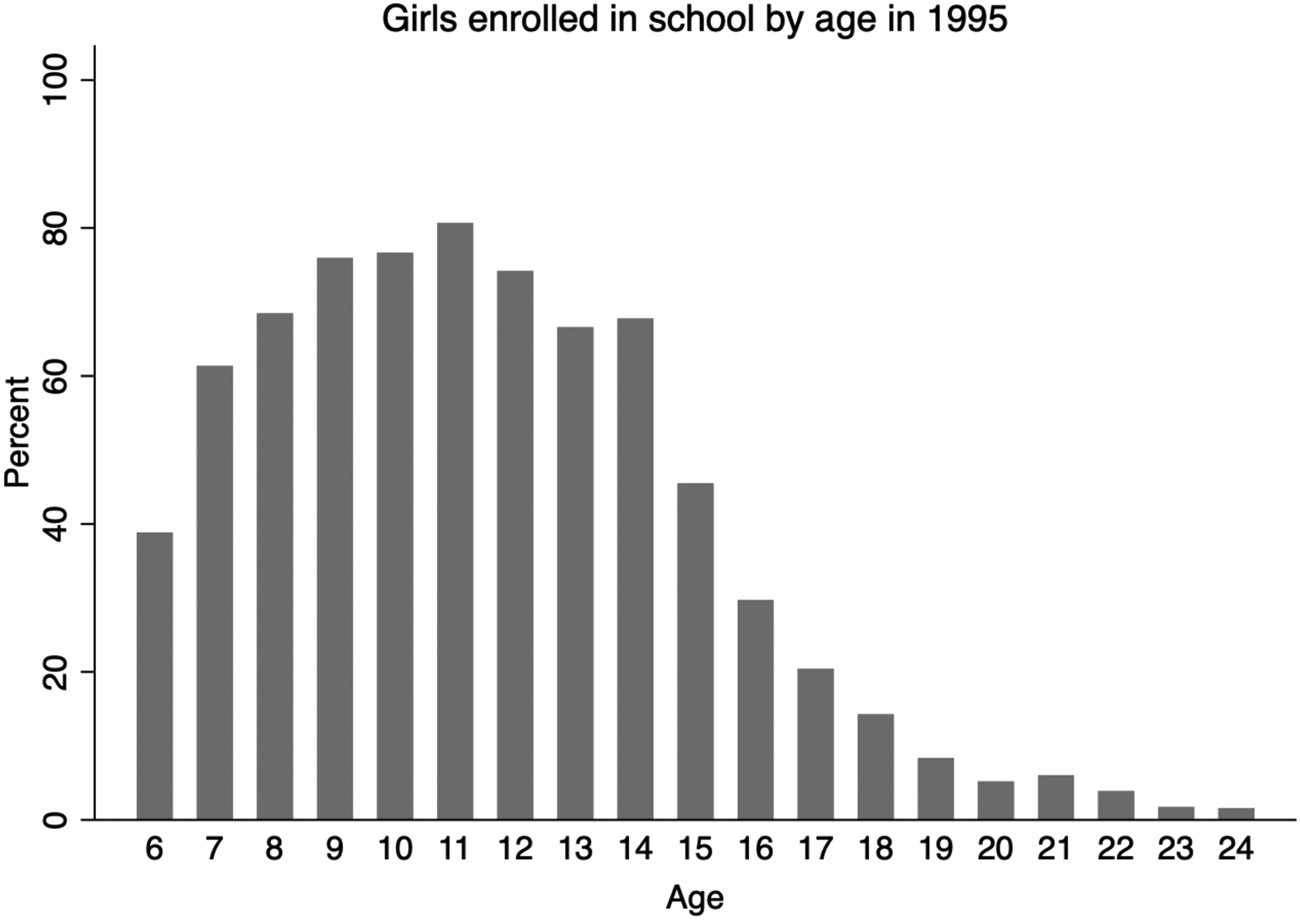
The public education system in Uganda consists of 7 years of primary school, 4 years of lower secondary school, and 2 years of upper secondary school. The academic year begins in February and ends in December, and the official school entrance age is 6 years. However, many children enter school at age 7 or 8, with the majority starting school at age 8. Appendix Figure 4 shows the fraction of girls who are enrolled in school by age group prior to the reform using the 1995 wave of Ugandan DHS. Less than 40 percent of girls aged 6 are enrolled in school. Most girls aged 15 and older had dropped out of school.
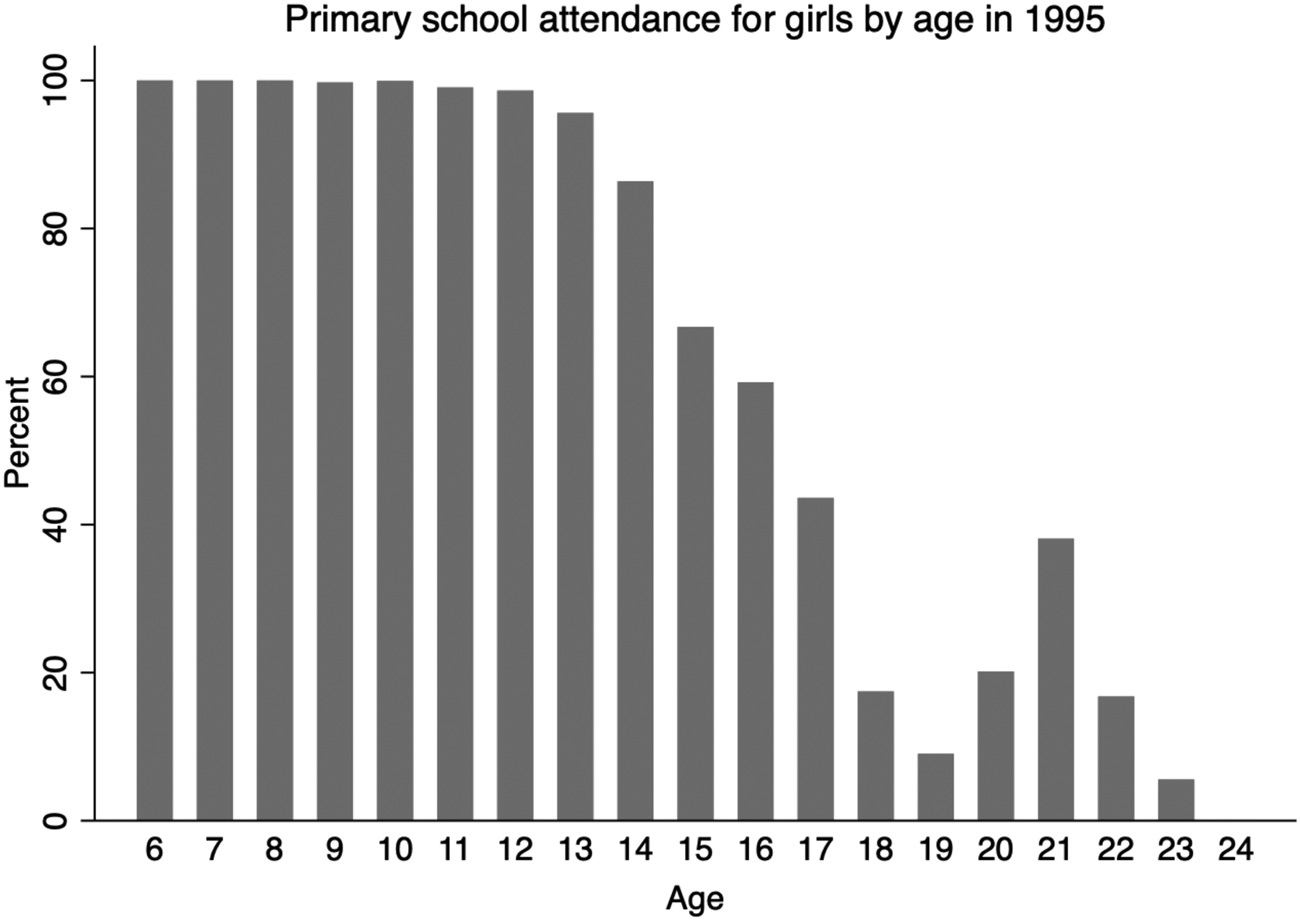
Appendix Figure 5 presents the percentage of girls by age group with incomplete primary education who are still enrolled in school in 1995. The gap in primary school attendance for girls between the ages of 14 and 15 is 20 percentage points (86 percent vs 66 percent). While the majority of girls aged 6–14 are still enrolled in primary school, there is a sharp drop in the likelihood of attending primary school for girls aged 15 and older. Given this pattern of primary school attendance prior to the reform, it is plausible that the reform had a differential effect on the educational attainment of girls by age, especially at the margin between the ages of 14 and 15. Thus, children aged 14 and younger would have most likely benefited from the abolition of primary school fees. Those aged 15 and older were less likely to have benefited from the reform. This pattern has also been confirmed by Keats (Reference Keats2018).
Prior to the reform, 68 percent of girls aged 15–24 who dropped out of primary school stated that the main reason for dropping was because they could not afford the fees [Uganda Bureau of Statistics and ORC Macro (1995)]. The gender differences in educational achievement was steep: 56 percent of women have ever attended primary school as opposed to 67 percent of men [Uganda Bureau of Statistics and ORC Macro (1995)].
3. Defining women's empowerment
Because of the contested nature of the concept, there are many definitions of empowerment in the literature.Footnote 7 These definitions can generally be grouped into three sets of thought. The first set of thought views empowerment in terms of the ability to make choices. Kabeer (Reference Kabeer1999) describes empowerment as “the expansion in people's ability to make strategic life choices in a context where this ability was previously denied to them.” The World Bank also stresses the importance of choices and defines empowerment as “the process of enhancing an individual's and group's capacity to make purposive choices and to transform those choices into desired actions and outcomes.” Alsop et al. (Reference Alsop, Bertelsen and Holland2006) perceives empowerment as “a group's or individual's capacity to make effective choices, that is, to make choices and then transform those choices into desired actions and outcomes.”
The second way of thinking about empowerment is in terms of an increase in power, which refers to control. According to Batliwala (Reference Batliwala1994), empowerment includes control over resources (physical, human, intellectual, and financial) and over ideology (beliefs, values, and attitudes). Rowlands (Reference Rowlands1997) suggests that power can be divided into four categories: power from within (the psychological strength residing in each person that is a basis for self-confidence), power to (the productive power, that is the capability to exert agency without domination), power with (the ability to act in a group), and power over (controlling power). Rowlands further shows that empowerment can be demonstrated within three dimensions: personal, relational, and collective. Personal empowerment refers to developing a sense of self and confidence. Relational empowerment is concerned with the ability to negotiate and influence the decisions made within one's network of relationships. Finally, collective empowerment is about cooperative actions to effect more changes than one could alone.
There are broader ways of understanding empowerment, which focus not only on the ability to act on one's choice, but also the relationship between individuals and institutions. Narayan-Parker (Reference Narayan-Parker2002) defines empowerment as “the expansion of assets and capabilities of poor people to participate in, negotiate with, influence, control, and hold account institutions that affect their lives.” Narayan emphasizes four elements of empowerment, including access to information, inclusion and participation, accountability, and local organizational capacity. This definition has two components: the first component focuses on the expansion of agency (the ability to act on behalf of what you value and have reasons to value) and the second component is related to the institutional environment, which offers people the opportunity to exert agency fruitfully [Ibrahim and Alkire (Reference Ibrahim and Alkire2007)].
In this paper, I define empowerment as having the knowledge to gain control over one's own life. Based on this definition, women's empowerment can be thought as the process by which women, through enhanced knowledge, become aware of their rights and power relations and how these can be altered. My definition is similar to Pinto [2001, as cited in Srivastava (Reference Srivastava2005)], who thinks of empowerment as an internal transformation of one's consciousness that enables one to overcome external barriers to accessing resources or changing traditional ideology. My definition of women's empowerment has two components. The first component refers to having the power to develop a critical awareness of the matters that impact one's well-being. This component focuses on psychological power, that is changes taking place within the person (similar to Rowlands’ power from within). The other component is related to having one's voice heard through involvement in decision making within the household. Essentially, this component is about relational power (similar to Rowlands’ power over), that is changes taking place in power dynamics between a woman and other people in her household.
4. Data
This paper uses data from four waves of Ugandan Demographic and Health Survey (UDHS), administered in 2000, 2006, 2011, and 2016. The UDHS belongs to a series of demographic and health surveys implemented in developing countries.Footnote 8 The UDHS is a repeated cross-sectional and nationally representative household survey.Footnote 9 Each round of the survey contains information regarding fertility, family planning, maternal health, child health and nutrition, and women's status for women aged 15–49. Each round of the UDHS also provides information on men aged 15–54 and children aged 5–25 who still live at home. The UDHS sample is selected in two stages. In the first stage, enumeration areas are randomly selected from census files. The second stage of sampling involves the random selection of households from the list of households within each enumeration area.
The UDHS surveys are nationally representative, although, in the 2000 wave, some districts in the Western and Northern regions of Uganda were not surveyed due to security problems.Footnote 10 The 2006, 2011, and 2016 waves cover the entire country. In the 2006 wave, portions of the Northern region of Uganda were oversampled to provide estimates for two special areas of interest: Karamoja and internally displaced persons camps. For these reasons, DHS sample weights are used in all regressions in this paper.
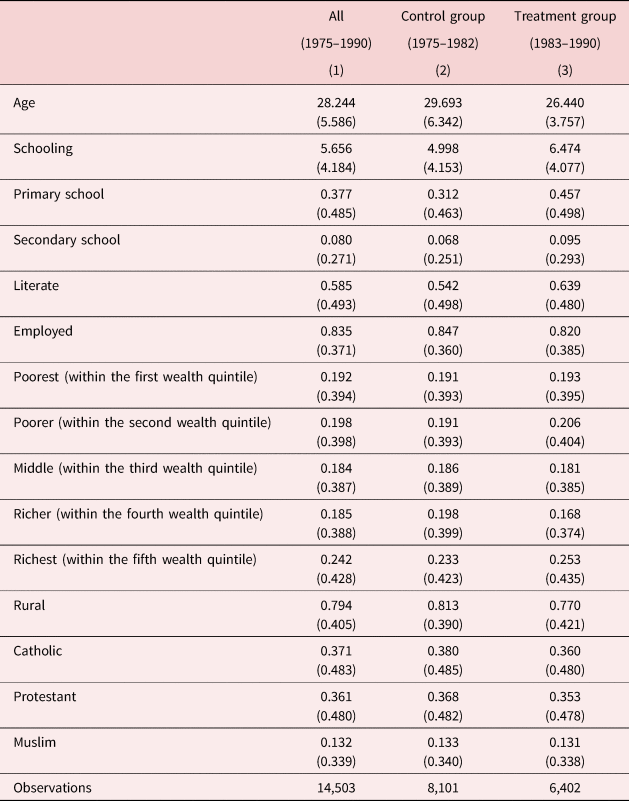
From each of the four surveys, data for all women born between 1975 and 1990 are extracted (i.e., these women were between the ages of 7 and 22 in 1997 when the reform was implemented). I discard women who were younger than 19 years old at the time of the survey, as it is difficult to determine their completed years of schooling. Because questions about decisions within the household are asked to partnered women only (those who are married or living with a man), I further restrict the sample to women who answered questions about decision making.Footnote 11 The description of the pooled data as well as data for treatment and control groups is reported in Table 1. Pooling across all four surveys, the sample consists of 14,503 women who are between the ages of 19 and 41. The average years of education completed for the women in the sample is 5.7 years. Women in the treatment group have more education (6.5 years) than women in the control group (5 years). Approximately 38 percent of women have completed at least primary education, 79 percent of women are in rural areas, and 73 percent of women in the sample are Catholic or Protestant.
Sample description - female sample

Note. The sample is restricted to women who answered questions about decision making (partnered women). These women are aged 19 or older at the time of the survey. The cohorts of women in this table were born between 1975–1990. The 2000 UDHS includes cohorts born between 1975–1982. The 2006 UDHS includes cohorts born between 1975–1987. The 2011 and 2016 UDHS have cohorts born between 1975–1990. Standard errors are in parentheses. Survey weights are used in all estimations.
4.1. Measuring women's empowerment
Alkire et al. (Reference Alkire, Meinzen-Dick, Peterman, Quisumbing, Seymour and Vaz2013) point out a number of issues to be taken into consideration when selecting indicators of empowerment, including whether to focus on measures that are direct or indirect; intrinsic or extrinsic; universal or context-specific; the level of application; and whether to include objective or self-reported measures. In this paper, I focus on direct measures of empowerment at the individual level that are more valid in the context of Uganda.
Eight variables are constructed to reflect the two aspects in my definition of women's empowerment: women's preferences regarding matters related to their well-being and women's voice within the household. The first five indicators seek to assess women's attitudes toward gender-based violence. Violence against women is a violation of basic human rights, and has serious impacts on well-being of women [OECD (2015)]. I use a set of questions asking women if they think it is justified for a man to beat his wife in various situations, such as when she goes out without telling him, neglects the children, argues with him, refuses to have sex with him, and burns the food. For each of these circumstances, I create a binary indicator that takes a value of one if a women disagrees that domestic violence against women is justified, and zero otherwise. To gauge women's involvement in decision making within the household, I use a set of questions asking women whether they have some final say over important decisions within the household, such as issues related to their own heath, large household expenses, and visits to family or relatives. I create a binary empowerment indicator for each of these three decisions and consider all women who, either solely or jointly with their husband, have final say over the decision process as being empowered, and other women as not being empowered.
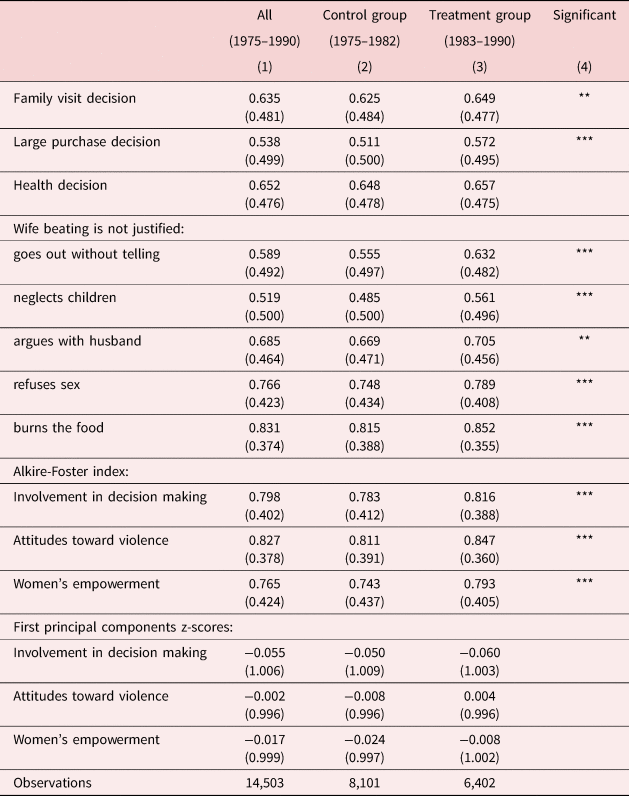
The summary statistics of the indicators of women's empowerment are displayed in Table 2. Women in the treatment group are more involved in household decisions on family and relative visits, large purchases, and their own health care than women in the control group. As for attitudes toward domestic violence, a lower fraction of women in the treatment group agrees with men's rights to beat their wives in all five situations. For example, about 63 percent of women in the treatment group think that it is not justified for a man to beat his wife if she goes out without telling him, as opposed to 56 percent for women in the control group.
Summary statistics of outcome variables - female sample

Note. The sample is restricted to women who answered questions about decision making (partnered women). These women are aged 19 or older at the time of the survey. The cohorts of women in this table were born between 1975–1990. The 2000 UDHS includes cohorts born between 1975–1982. The 2006 UDHS includes cohorts born between 1975–1987. The 2011 and 2016 UDHS have cohorts born between 1975–1990. Column (4) indicates statistically significant differences between control and treatment groups. Standard errors are in parentheses. Survey weights are used in all estimations.
*p < 0.10, **p < 0.05, ***p < 0.01.
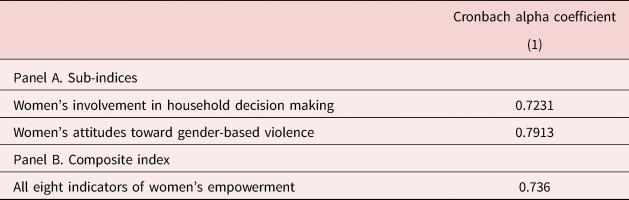
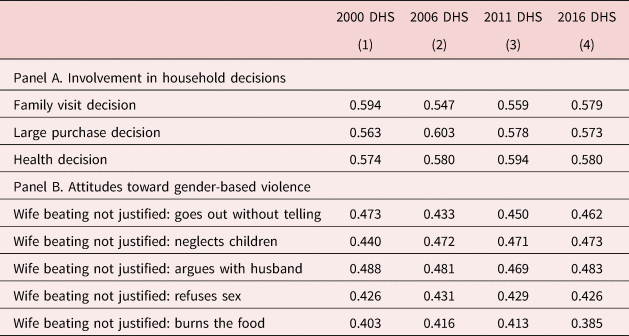
Each sub-index is built by combining indicators that measure the same dimension of women's empowerment. The statistical correlation between the indicators is tested using Cronbach alpha coefficient, which indicates how well a set of indicators describes a single dimension. Cronbach alpha coefficient of 0.65 or higher ensures that indicators are highly correlated and can be aggregated into a summary indicator [Nardo et al. (Reference Nardo, Saisana, Saltelli, Tarantola, Hoffman and Giovannini2005)]. Panel A of Appendix Table 1 reports the Cronbach alpha coefficients of each dimension of women's empowerment. The Cronbach alpha coefficients for women's involvement in household decisions and women's attitudes toward gender-based violence are 0.72 and 0.79, respectively. I also construct a composite index aimed at measuring women's empowerment by combining all eight indicators of empowerment. The Cronbach alpha coefficient for these eight indicators of women's empowerment is 0.74, as shown in Panel B of Appendix Table 1.
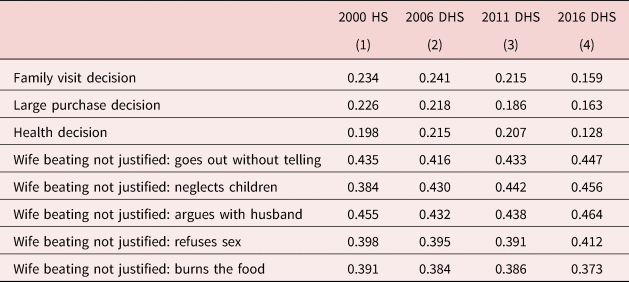
The first aggregation method used to formulate the sub-indices and composite index is principal component analysis (PCA).Footnote 12 The PCA allows me to aggregate the indicators using a data-driven weighting scheme [OECD (2015)]. The first principal component (FPC) of a set of variables is the linear combination of all variables that captures the largest amount of information that is common to all of the variables [Filmer and Pritchett (Reference Filmer and Pritchett2001)]. I perform PCA for each of the four surveys to check for consistency in terms of factor loading. Next, I create a sub-index for each dimension of women's empowerment as well as a composite index to measure the empowerment of women as a whole in each survey separately. The sub-index for women's involvement in household decisions is the first principal component of the three indicators of women's involvement in decision making within the household. Similarly, the sub-index for women's attitudes toward gender-based violence is the first principal components of five indicators measuring women's acceptability of domestic violence. The women's empowerment index is the first principal component of the eight indicators of women's empowerment. The results from the PCA showing factor loading on the first component for two sub-indices and the composite index are reported in Appendix Tables 2 and 3, respectively.
Although FPC is helpful in extracting common information contained in the indicators, the estimate of the regression using FPC as a dependent variable is hard to interpret. To ease interpretation, I construct z-scores for FPC sub-indices and composite index. In addition to PCA, as a robustness check, I construct sub-indices using Alkire-Foster (AF) method. In the first step, I transform the indicators into binary form, each of which takes a value of one if a woman is considered to be empowered, and zero otherwise. Each indicator is given a weight, and then an aggregated measure is created by computing the weighted sum of the indicators. In the second step, I choose a cut-off point to transform the aggregated indicator into an index to measure empowerment. The cut-off gives the index a value being either zero or one, thus making it easier for interpretation. To create the sub-index for women's involvement in household decisions, I give an equal weight to each indicator of this dimension and then sum across the three indicators. If the weighted sum is greater or equal to 33.33 percent, the sub-index takes the value of one, and zero otherwise. Essentially, this means that if a woman involves in one of three decisions, she is empowered, otherwise she is not. Similarly, if a woman says that it is not justified for a man to beat his wife in two out of five situations, the sub-index for women's attitudes toward gender-based violence is equal to one, and zero otherwise. The composite index for women's empowerment takes the value of one if the weighted sum of eight indicators is greater than or equal to 50 percent, and zero otherwise.
5. Empirical strategy
The objective of this paper is to investigate the impact of education on women's empowerment. Using OLS to estimate this relationship is likely to produce biased estimates due to unobserved factors that can affect both years of schooling and women's empowerment. In order to address this endogeneity issue, the paper exploits an exogenous shift in women's educational attainment induced by the education reform that eliminated primary school fees in 1997. Note that this reform only abolished primary school fees without making primary education mandatory. Thus, this type of reform generates the local average treatment effect (LATE) among women who chose to receive more education due to the lower costs of attending school. These women had a high desire to obtain additional education but could not do so because they were financially constrained.
I identify cohorts of women who were exposed to the reform using their birth year. As stated earlier, the official school entrance age is 6 years. However, many children delay school enrollment till the age of 8. Since it takes 7 years to complete primary education, women who were 14 years or younger at the time of the reform would have most likely benefited from the reform. Therefore, I consider those who were born between 1983 and 1990 as part of the treatment group. Women aged 15 and older were less likely to be treated by the reform. Thus, those who were born between 1975 and 1982 constitute the control group. Essentially, I compare the outcomes of women born between 1983 and 1990 who were exposed to the reform to those of older women born between 1975 and 1982 who did not benefit from the reform.
I use an instrumental variable approach to estimate the effect of education on women's empowerment, as shown in equations (1) and (2) below:


where i indexes women, b is birth cohort, t stands for year of the interview, and r is region of residence. Schooling ibtr denotes the number of years of schooling completed for woman i from cohort b residing in region r. Y ibtr represents one of the eight indicators of women's empowerment for woman i born in cohort b, as shown in Table 2. Treated b is a dichotomous variable which captures whether a woman was exposed to the reform (i.e., it takes a value of 1 if a woman was born between 1983 and 1990 and 0 if a woman was born between 1975 and 1982). The vector Xibtr consists of personal characteristics of woman i, including rural residence and indicators of religion. η t and μ r are year of survey and region of residence fixed effects, respectively. While the indicators of the region of residence (Northern, Central, Eastern, and Western) account for unobserved attributes of the region that are correlated with women's empowerment, the year of survey fixed effects control for effects from pooling data across four surveys.
I use a bandwidth of eight years, meaning eight cohorts on both sides of the cutoff cohort (born in 1983), although using other bandwidths does not significantly change the results, as shown in the Robustness section. The bandwidth is selected to be small enough to minimize the bias due to time trend, while still allowing for an adequate sample size. Yob i is the woman's year of birth. Treated b × (Yob i − 1983) and (1 − Treated b) × (Yob i − 1983) control for potentially differential trends in the outcomes of treatment and control groups. Standard errors are clustered by the enumeration census area-by-year of birth.
There are two assumptions that ensure the validity of the estimates of the instrumental variable approach. The first assumption is that the instrument is highly correlated with the number of years of schooling completed for women. I provide the F-statistics obtained from the first stage (Equation 1) to show the strength of the instrument. The second assumption, which is exclusion restriction, assumes that, conditional on other observables, the instrument only impacts the outcome variables through increasing education for women. I examine possible violations of this assumption in the Robustness section.
6. Results
The effect of the education reform on women's educational attainment.
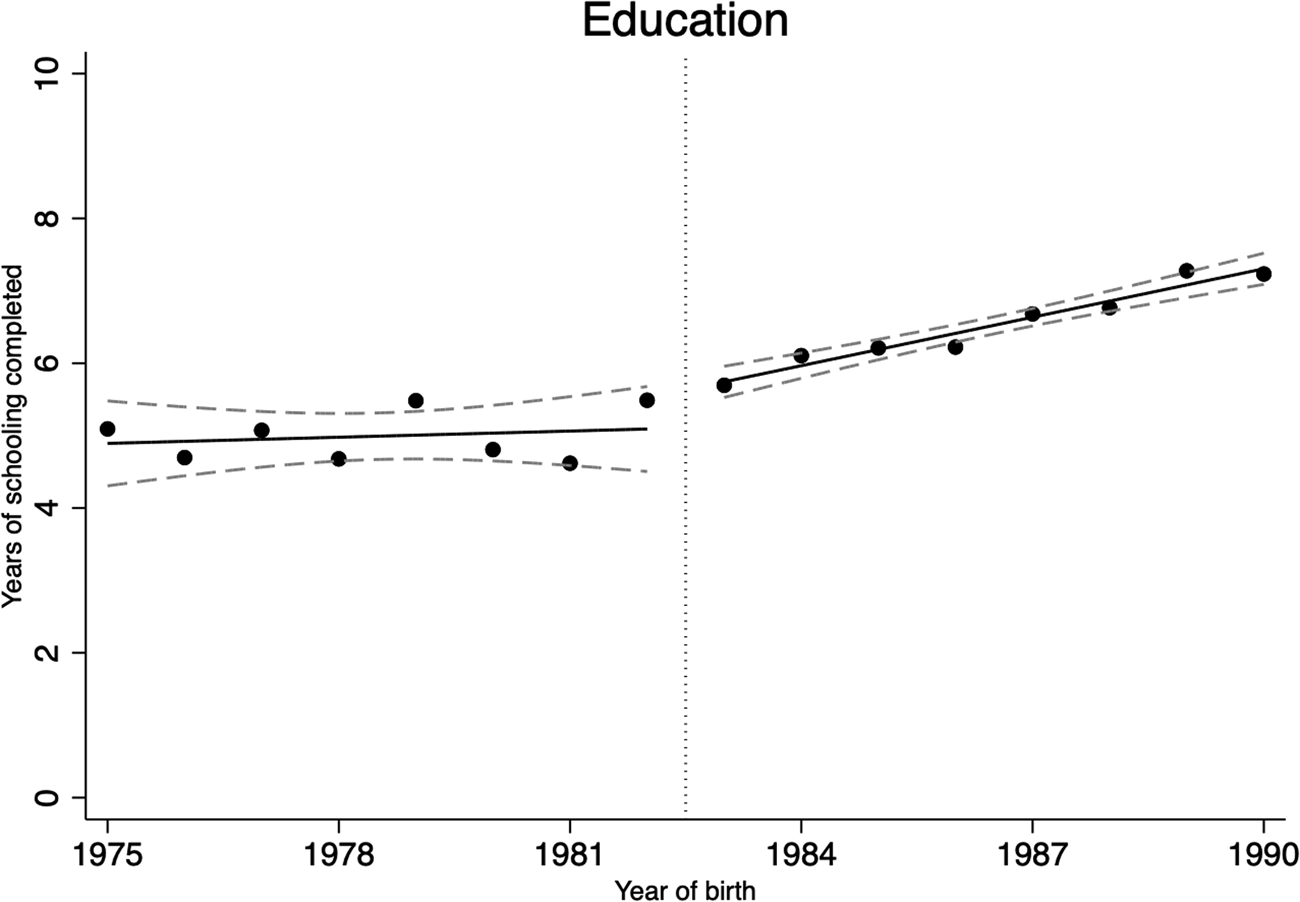
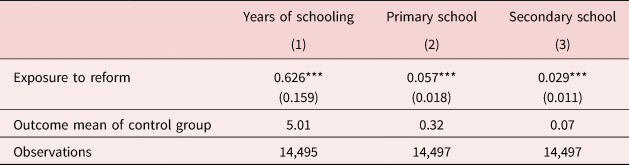
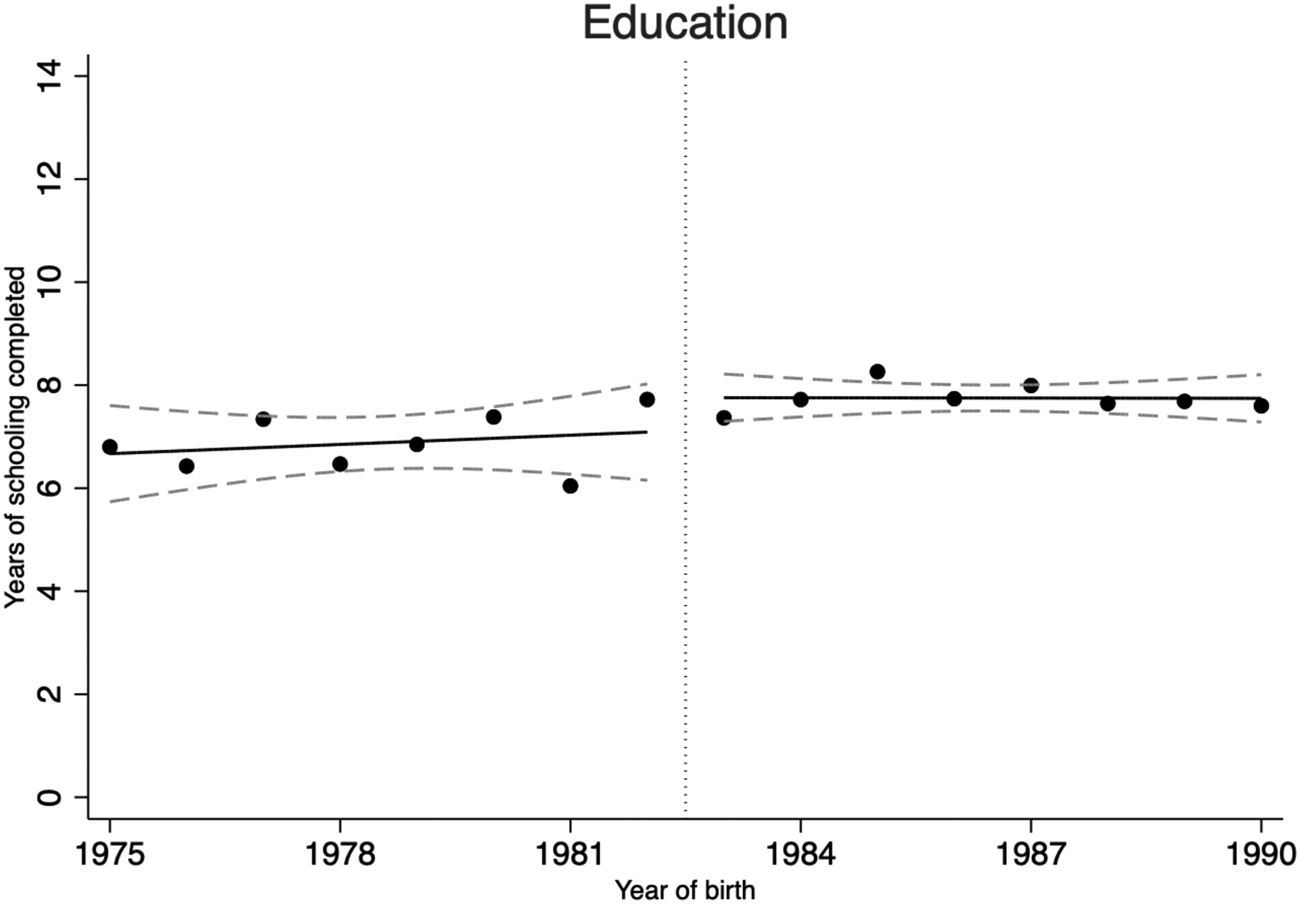
Figure 1 illustrates trends in years of education completed for women born between 1975 and 1990. There is a discontinuous increase in the average years of schooling for women born in 1983 and later. Table 3 presents the result obtained from estimating Equation (1), which is the first stage regression of the effect of the reform on education. Column 1 shows that the removal of primary school fees increases schooling for women who were exposed to the reform by an average of 0.63 years. This result is consistent with the one reported by Keats (Reference Keats2018), who analyzed the same Ugandan reform. Columns (2) and (3) display the impact of the reform on primary school and secondary school completion, respectively. Column (2) reveals that women who benefited from the reform are 5.7 percentage points more likely to have at least primary education. Exposure to the reform also increases women's probability of completing at least secondary education by 2.9 percentage points (Column 3). While the reform has a positive impact on women's education, I find that the same reform has no impact on men's educational attainment, as shown in the Robustness section. On average, men have 7.2 years of schooling (no increase after the reform), as opposed to 5.7 years for women (increase by 0.63 years after the reform). Thus, the reform resulted in closing of the gender gap in education.
Women's average years of schooling completed by birth cohort.

The impact of the reform on education - female sample

Note. The sample is restricted to women born between 1975 and 1990 who answered questions about decision making (partnered women). All regressions control for age trend differentiated by treatment status, rural residence, indicators of religion, and survey year and region of residence fixed effects. Standard errors, clustered by the census enumeration area-by-year of birth, are in parentheses. Survey weights are used in all estimations.
*p < 0.10, **p < 0.05, ***p < 0.01.
The effect of education on women's empowerment.
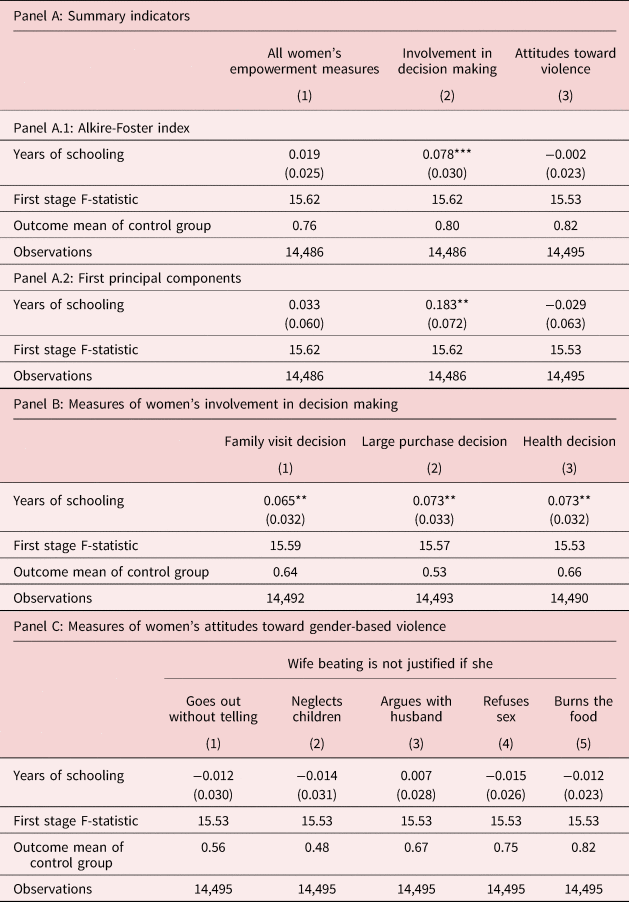
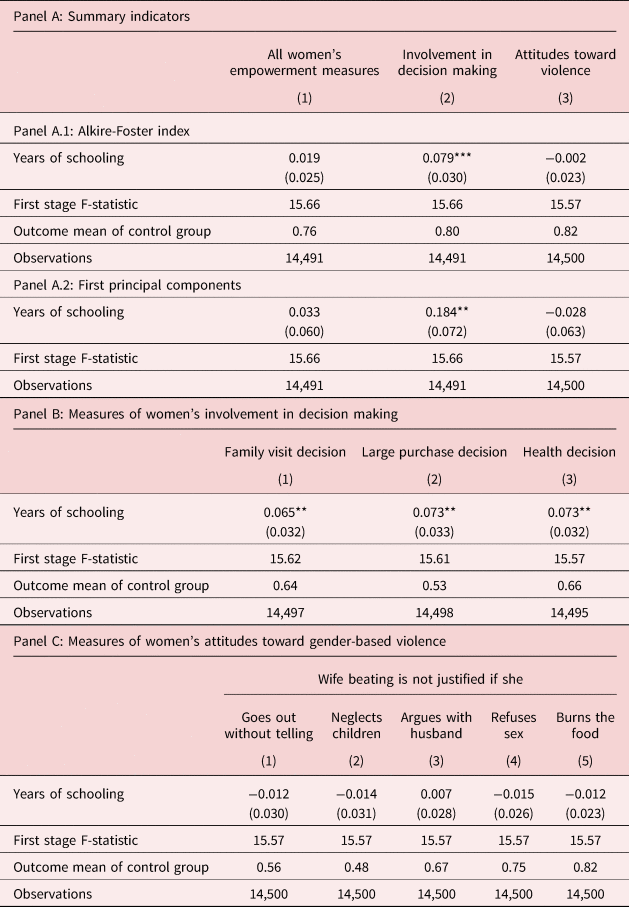
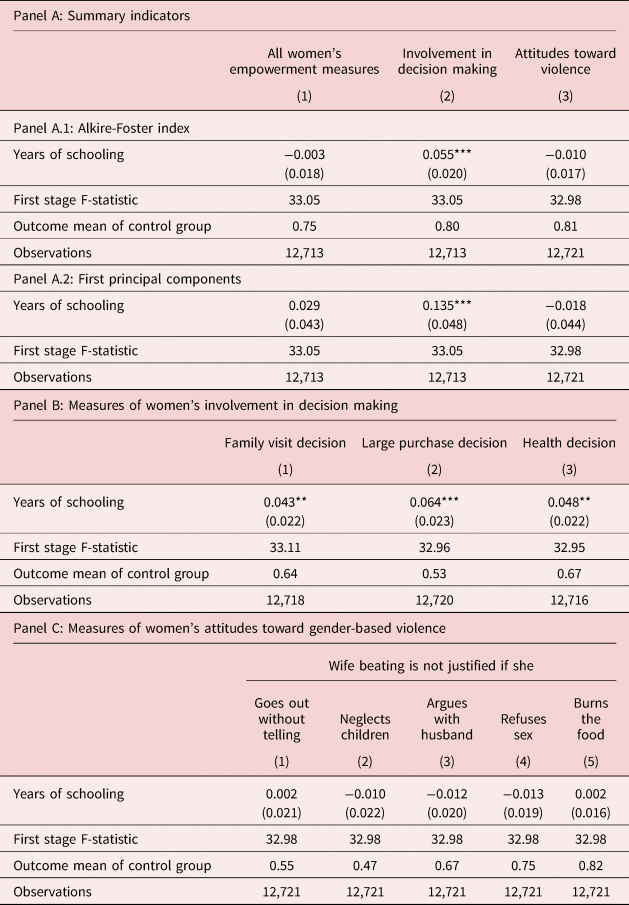
Panel A of Table 4 reports the instrumental variable estimates of the effect of education on sub-indices and composite index of women's empowerment. In Panel A.1 of Table 4, I find that one additional year of schooling increases women's propensity to involve in decision making within the household by 7.8 percentage points, as measured by a sub-index created using AF method (Column 2). Education has no effect on the AF sub-index of women's attitudes toward domestic violence (Column 3) and the AF composite index of women's empowerment (Column 1). Panel A.2 of Table 4 displays the impact of education on the first principal component of all measures of women's empowerment in Panels B and C (Column 1), first principal component of women's involvement in household decisions measures in Panel B (Column 2), and first principal component of measures of women's acceptance of domestic violence in Panel C (Column 3). The estimate in Column (2) confirms the positive impact of increased women's schooling on women's involvement in decision making within the household.
The impact of schooling on women's empowerment - female sample

Note. The sample is restricted to women born between 1975 and 1990 who answered questions about decision making (partnered women). All regressions control for age trend differentiated by treatment status, rural residence, indicators of religion, and survey year and region of residence fixed effects. Standard errors, clustered by the census enumeration area-by-year of birth, are in parentheses. Survey weights are used in all estimations.
*p < 0.10, **p < 0.05, ***p < 0.01.
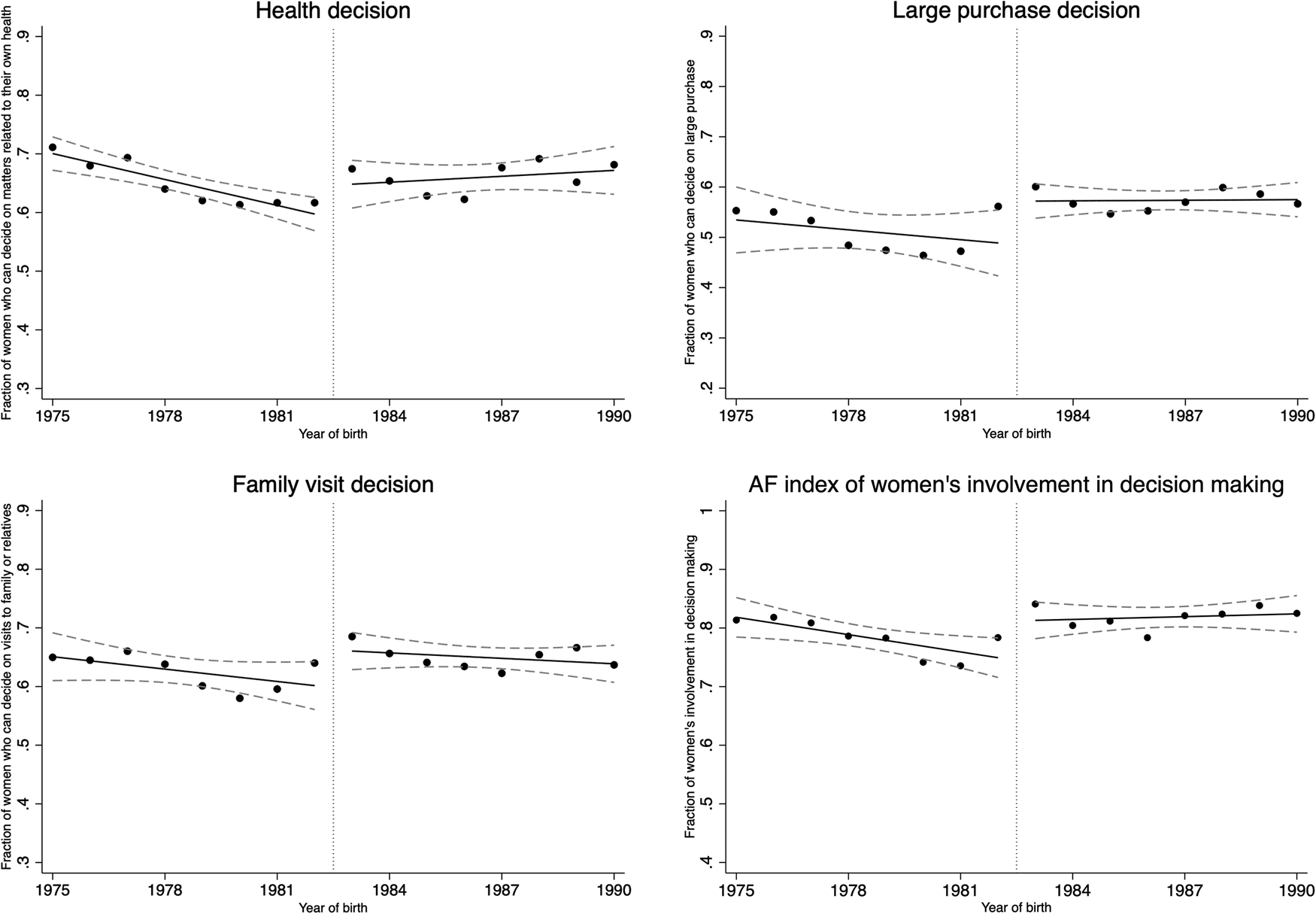
Figure 2 displays the link between women's exposure to the education reform and their propensity of having a final say on issues related to their health, regarding large household purchase, and over visits to family or relatives. The figure reveals an unambiguous improvement in women's involvement in decision making within the household for women born in 1983 and later. Panel B of Table 4 presents the instrumental variable (IV) estimates of the impact of years of schooling on women's involvement in household decisions. Columns (1)–(3) show that an additional year of schooling improves women's involvement in household decisions, as measured by whether women have a final say on visits to family or relatives (Column 1), regarding large purchase expenses (Column 2), and over issues related to their own health (Column 3). One more year of education increases the probability that women can decide, either solely or jointly with their husband, on family or relative visits by 6.5 percentage points, on large household expenses by 7.3 percentage points, and on issues related to their own health care by 7.3 percentage points. This translates to an increase in women's involvement in decisions within the household by 10 to 14 percent. The F-statistics, which are greater than 10, show a strong correlation between the reform and educational attainment for women.Footnote 13
The impact of the reform on indicators of women's involvement in household decisions.

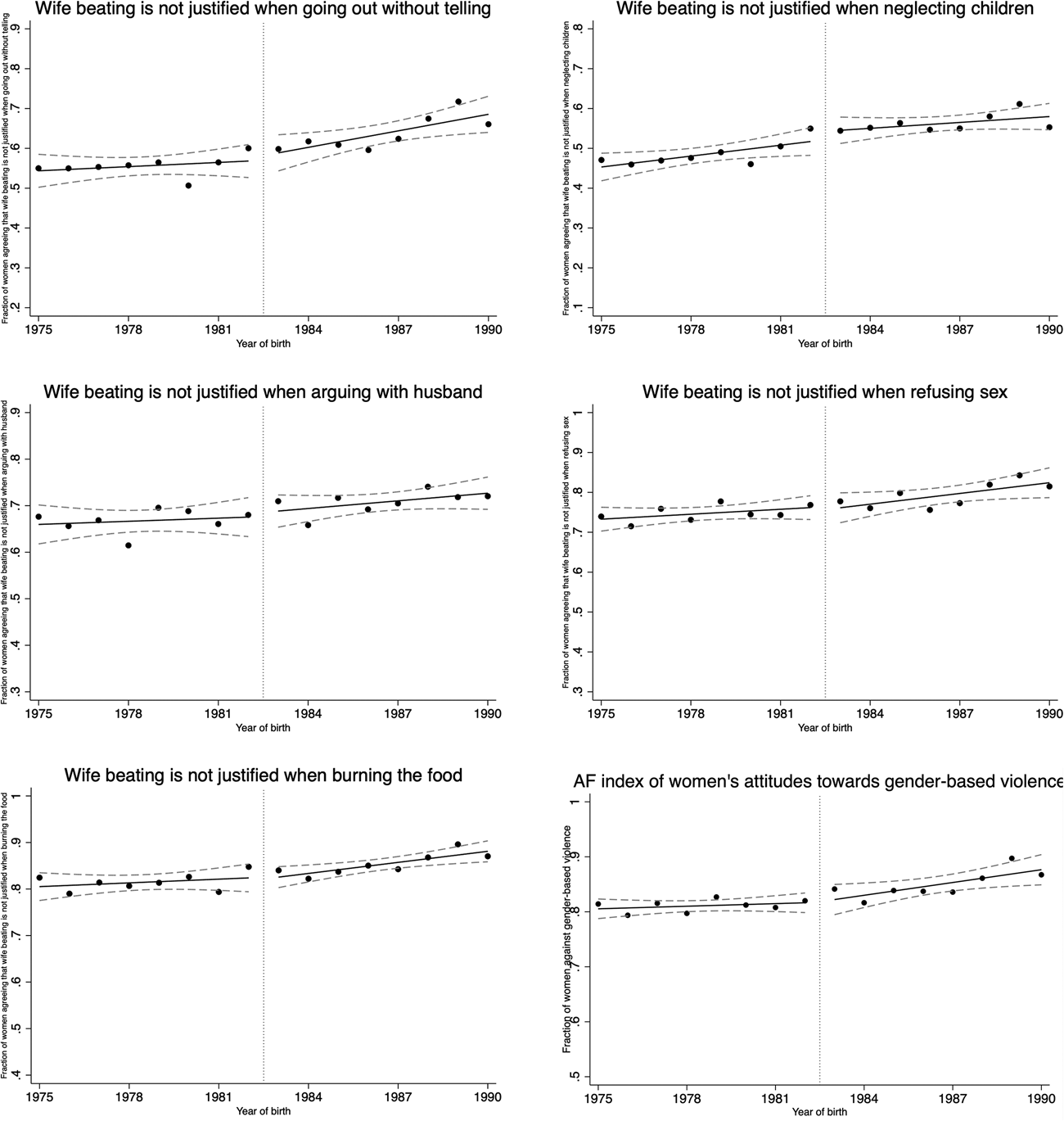
Next, I examine the effect of education on individual indicators of women's preferences regarding matters that impact their well-being. Figure 3 presents the relationship between the reform and indicators of women's attitudes toward domestic violence. The figure suggests no impact of the reform on women's acceptability of domestic violence against women. Panel C of Table 4 reports the instrumental variable estimates of the impact of education on women's attitudes. In Columns (1)–(5), I find no effect of education on women's acceptability of violence against women, since the estimates are not statistically significant. This finding might be country-specific. Cannonier and Mocan (Reference Cannonier and Mocan2018) find that increased education, induced by a reform that targeted primary school-age children in Sierra Leone, makes women less tolerant of violence against themselves. Friedman et al. (Reference Friedman, Kremer, Miguel and Thornton2016) report that increased access to secondary school in Kenya reduces women's acceptance of the right of men to beat their wives. In Uganda, there is a deep cultural belief that men need to use violence to discipline their wives and that a man beating his wife is a sign of love [Tanya (Reference Tanya2014)]. An increase in education, where the base in education is low, might not be able to alter this belief.
The impact of the reform on measures of women's attitudes toward gender-based violence.

Overall, the results suggest that an increase in education has a positive impact on one dimension of women's empowerment. Consistent with Iyigun and Walsh (Reference Iyigun and Walsh2007), I find that an increase in education improves women's involvement in decision making within the household by giving them a voice in household decisions. However, there is no evidence of the effect of education on the other dimension of women's empowerment, which is women's attitudes toward matters that impact their wellbeing.
7. Potential mechanisms
In this section, I explore potential channels that link women's education and women's empowerment. Existing literature offers a number of pathways through which increased schooling for women may affect women's empowerment. Education can improve women's cognitive ability, which enhances their ability to seek and understand information regarding their rights and the benefits of standing up for themselves [Glewwe (Reference Glewwe1999); Smith-Greenaway (Reference Smith-Greenaway2013)]. Alternatively, education can influence women's empowerment by providing women with access to information, either formally through books and teachers or informally through interactions with peers. As for peers, attending school helps create friendships with other girls, who can then share information. Education can empower women via other mechanisms, such as time preference [Becker and Mulligan (Reference Becker and Mulligan1997)] and increased labor market opportunities and wages [Psacharopoulos and Patrinos (Reference Psacharopoulos and Patrinos2004)]. In the area of decision making, education can increase the bargaining power of women within the household by improving their economic resources and by endowing them with the knowledge and skills to make informed choices that enhance their welfare [Duflo (Reference Duflo2012)]. Iyigun and Walsh (Reference Iyigun and Walsh2007) develop a model to show that the marital bargaining power over the household matters depends on the relative earnings of husband and wife. Moreover, an educated woman has a higher ability to prove her credibility in terms of being able to make good and informed decisions.Footnote 14 I explore the existence of some of these mechanisms.
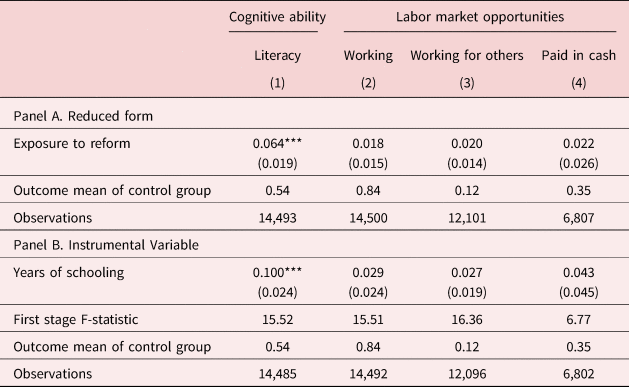
First, I examine the impact of education on women's cognitive ability, proxied by women's literacy. A dichotomous variable is generated based on the question that evaluates the reading ability of women by DHS. It takes a value of one if a woman was able to read the entire sentence or parts of the sentence and zero otherwise. As mentioned in the Education Reform in Uganda section, the sudden access shock triggered by the introduction of the reform has generally decreased the quality of education. Thus, it is plausible that the reform might not necessarily improve learning. For example, Cannonier and Mocan (Reference Cannonier and Mocan2018) find that the reform in Sierra Leone has no effect on women's literacy. Table 1 shows that 59 percent of women in the sample are literate. Column (1) of Table 5 reports the result of the effect of education on literacy. One extra year of education increases women's propensity to be literate by 10 percentage points. This translates to an increase in the probability of being literate by 17 percent.
Potential mechanisms - female sample

Note. The sample is restricted to women born between 1975 and 1990 who answered questions about decision making (partnered women). All regressions control for age trend differentiated by treatment status, rural residence, indicators of religion, and survey year and region of residence fixed effects. Standard errors, clustered by the census enumeration area-by-year of birth, are in parentheses. Survey weights are used in all estimations.
*p < 0.10, **p < 0.05, ***p < 0.01.
Second, I investigate the effect of education on women's labor market opportunities. I construct three variables to capture women's labor market outcomes. First, a binary variable, Working, takes a value of one if a woman was employed in the last twelve months and zero otherwise. Second, among women who were employed in the last twelve months, I create a dichotomous variable, Working for others, that equals one if a woman was employed by others and zero if a woman worked for a family member or was self-employed. Third, to measure women's types of earnings, I generate a dummy variable which takes a value of one if a woman who worked in the last twelve months received cash for her work and zero if a woman was paid in kind or not paid. Columns (2)–(4) of Table 5 show that women's schooling has no effect on their employment in the last twelve months, and that it has no effect on women's propensity to be employed by others, and that it has no impact on the probability that a woman is paid in cash for her work. It is possible that an increase in women's education, where the base level is low, has no impact on women's labor market opportunities. International Monetary Fund (2019) shows that secondary and higher education matter more when it comes to the probability of getting a job and having a paid job in Uganda.Footnote 15
8. Robustness
8.1. Threats to exclusion restriction
As mentioned in the empirical strategy section, the validity of the instrumental variable estimates relies on the exclusion restriction assumption, which assumes that the reform only affects women's empowerment through its impact on women's additional years of schooling completed. In this section, I consider potential exclusion restriction violations.
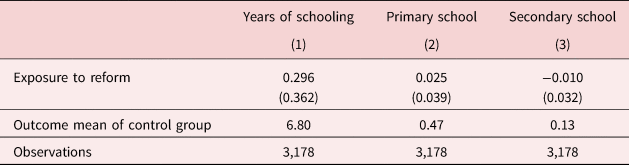
The first violation could happen if the reform changes women's preferences via increasing schooling for men. Panayotova and Brayfield (Reference Panayotova and Brayfield1997) note that education changes men's personal experience and promotes their awareness of gender-based issues. As men are enlightened, they might treat women better, causing women to alter their preferences. To test this possible violation, I examine the impact of the reform on educational attainment of men. The results are displayed in Appendix Table 4. Column (1) shows that the reform has no effect on men's number of years of schooling completed. Appendix Figure 6 reveals no apparent jump in the average years of schooling completed for men born in 1983 and later. In addition, the reform has no effect on the probably of a man completing at least primary school (Column 2) and at least secondary schooling (Column 3). These results are consistent with the ones reported by Keats (Reference Keats2018), who shows that the same Ugandan education reform has no impact on men's education.
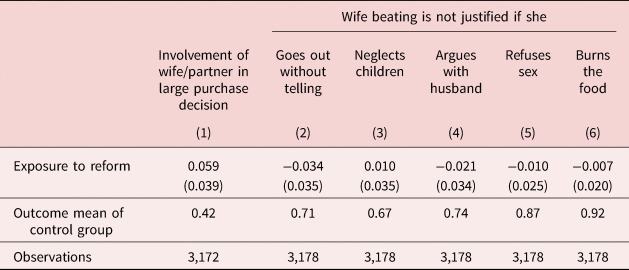
Although the reform has no effect on men's education, one concern is that it might alter men's attitudes toward issues of gender inequality. To test this theory, I perform a reduced-form estimation of the extent to which the reform changes men's attitudes toward women's involvement in household decisions and domestic violence against women. With regards to the former, only the question asking men about who should have a final say in large household purchases is available in four waves of DHS. As for the latter, the same set of questions about acceptance of domestic violence against women used in the female sample is also asked in the male sample. All regressions control for age trend differentiated by treatment status, rural residence, indicators of religion, and survey year and region of residence fixed effects. The results, presented in Appendix Table 5, indicate that the reform has no effect on men's attitudes toward women's empowerment. This evidence implies that the results found in this paper cannot be attributed to the impact of men.
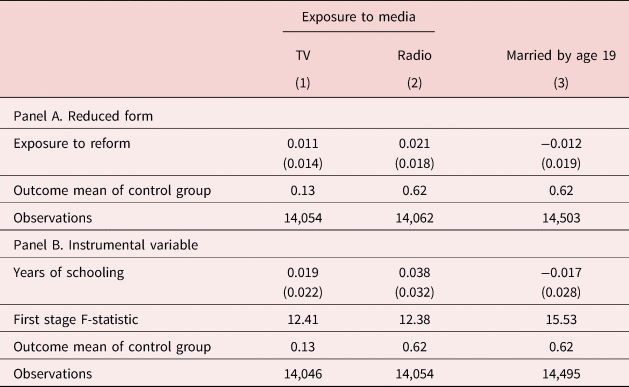
One might entertain the idea that exposure to media is the reason for the identified impact of education for women. The cohorts of women who were exposed to the reform are younger than the cohorts of women who were not exposed. Younger people might be more heavily exposed to media, which enables them to have access to information that can empower them to change their attitudes toward matters related to their well-being. For example, Jensen and Oster (Reference Jensen and Oster2009) find that exposure to cable TV significantly reduces the acceptability of domestic violence toward women. To address this concern, I examine whether the reform increases women's exposure to TV and radio. I construct two dummy variables, each of which takes a value of one if a woman's household has a TV or a radio and zero otherwise. The results, which are shown in Columns (1)–(2) of Appendix Table 6, report that the reform has no impact on women's exposure to media. Based on this evidence, exposure to media is unlikely to be the factor that drives the main results found in this paper.
The fourth violation of exclusion restriction could occur if the reform affects women's likelihood of getting married. I check this violation by investigating the extent to which the reform impacts women's propensity to get married by age 19. In Column (3) of Appendix Table 6, I find that the reform has no statistically significant effect on the probability that a woman gets married before reaching the age of 19. This suggests that delaying the age of marriage is unlikely to be the reason for the identified impact of education.
Another exclusion restriction concern is that the reform simultaneously improved the quality of education. As mentioned in the education reform in Uganda section, the schooling quality did not increase, but rather decreased following the introduction of the reform as schools were struggling to meet the dramatic increase in the number of students enrolled. As Grogan (Reference Grogan2008) mentioned, there was a substantial reduction in resources available per student, an initial decrease in qualified teachers, and a large increase in the student–teacher ratio. A decline in the quality of education, if anything, could potentially lead to underestimation of the effect of education on women's empowerment.
8.2. Robustness checks
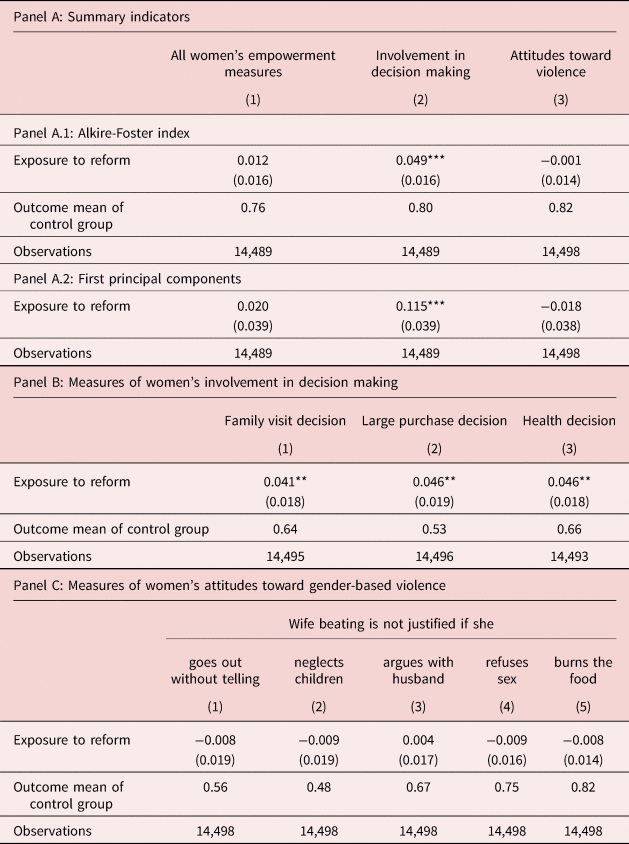
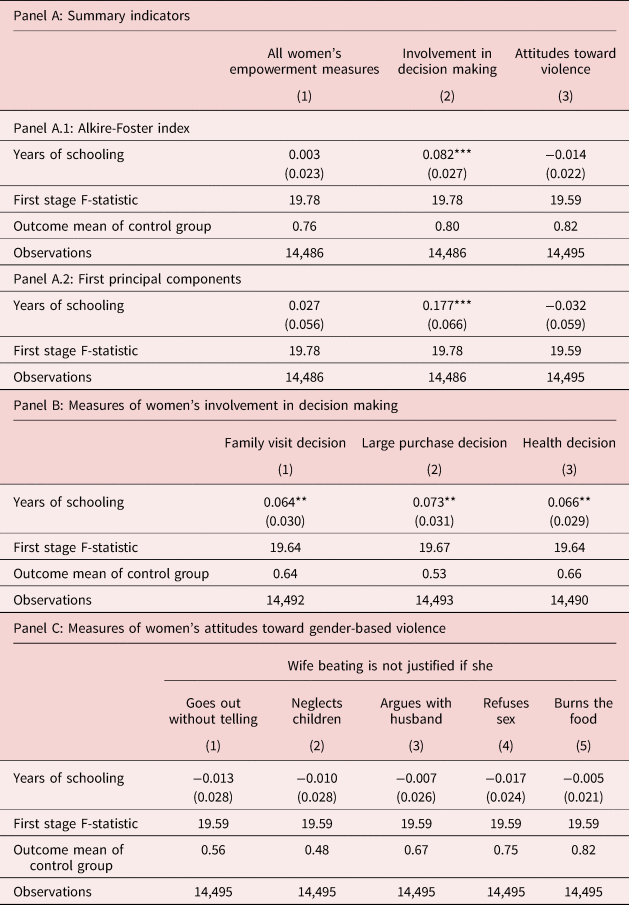
Several robustness tests are performed to ensure the validity of the results. First, I estimate reduced form regression, in which the indicators of women's empowerment are regressed on the treatment dummy and on other control variables. The reduced form estimates, presented in Appendix Table 7, are aligned with the main results. Second, I estimate the models allowing for the exclusion of indicators of religion as these control variables are potentially endogenous. I obtain very similar results to the main results both in terms of estimated coefficients and the standard errors, as shown in Appendix Table 8. Third, I check the sensitivity of the models by re-estimating them without using survey weights. The results of this exercise, reported in Appendix Table 9, are similar to the ones in Table 4.
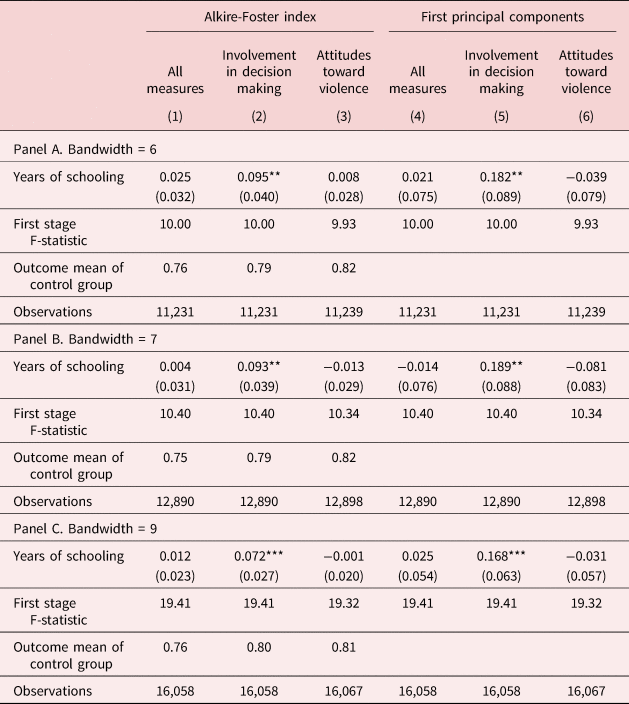
The paper uses a bandwidth of 8 years (8 cohorts on either side of the cutoff cohort) in the main model specification. To test whether the results are sensitive to this choice of bandwidth, as a fourth exercise, I estimate the models with other bandwidth sizes. Appendix Table 10 presents the results obtained from estimating the models of Table 4 using bandwidths of 6, 7, and 9 years. As the bandwidth size gets smaller, the sample size declines, which can decrease the precision of the estimates. On the other hand, the larger the bandwidth size, the less comparable the control and treatment groups become, although larger bandwidth windows improve the precision of the estimates. Nonetheless, the rather stable estimated coefficients in Appendix Table 10 show that changing bandwidth size does not meaningfully impact the results.
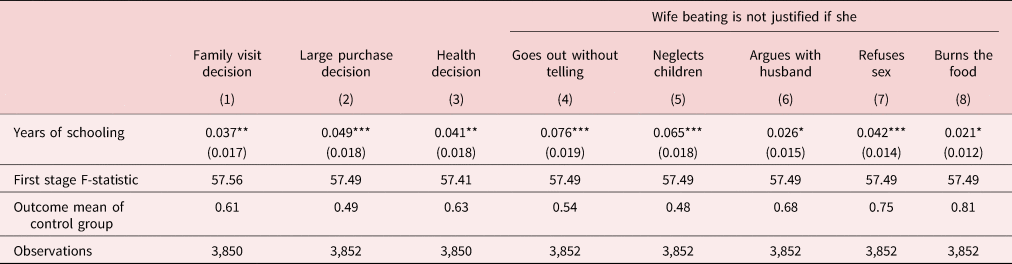
In the benchmark model, the treatment group consists of women born between 1983 and 1990, and those born between 1975 and 1982 constitute the control group. As mentioned earlier, the official school starting age in Uganda is 6 years. Nonetheless, when the reform started in 1997, children who were above the primary school age were allowed to enroll in school. Grade repetition is also possible, meaning that some women in the control group might have received the treatment. Therefore, I exclude those who were 14 to 15 when the reform was passed in 1997 since these cohorts are more likely to cross over the threshold. Specifically, I re-estimate the main regressions using cohorts born between 1984 and 1990 as part of the treatment group. The cohorts born between 1975 and 1981 are chosen as part of the control group because these older cohorts are less likely to have benefited from the reform. The results, which are shown in Appendix Table 11, are not considerably different from the main results.
The women in the treatment group (who were exposed to the reform) are younger than women in the control group. This might raise a concern that the identified results are due to the age differences between women in the treatment and control groups. To address this concern, I estimate the models using a narrower bandwidth of 2 years on either side (no linear trends differentiated by treatment status), excluding birth cohorts 1982 and 1983. Women born 1980–1981 belong to the control group, while those born 1984–1985 constitute the treatment group. The results of this exercise, presented in Appendix Table 12, do not change the inference of the paper.
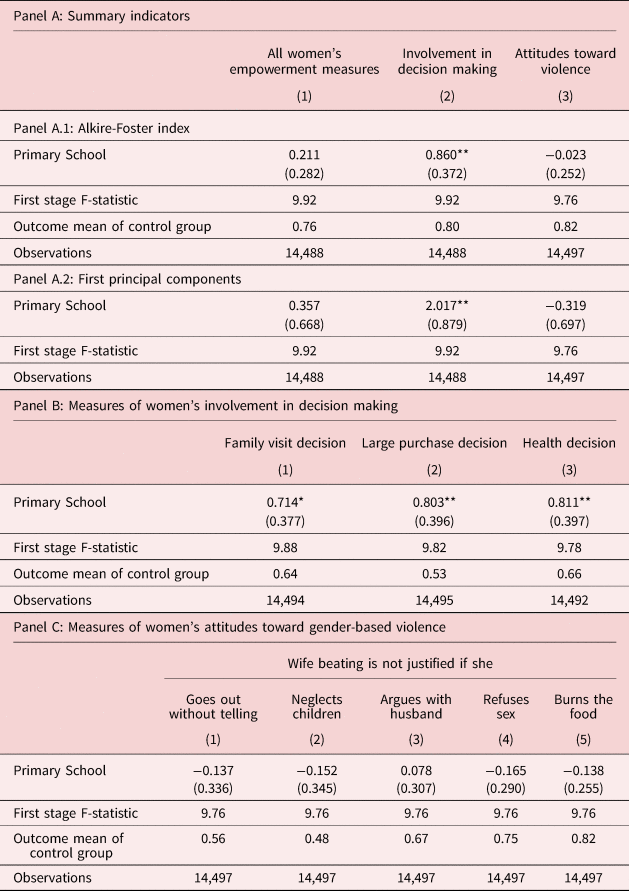
I use exposure to the reform as an instrument for the number of years of schooling completed in the main specification. Since the reform aims at improving primary school education for children, I check the sensitivity of the results to using the indicator of whether a woman has at least a primary school degree (7 years of schooling) as an instrumented variable. Table 3 shows that eliminating school fees increases the likelihood of completing at least primary education for women by about 5.7 percentage points. The results of the IV regression using an alternative instrumented variable, which are displayed in Appendix Table 13, support the main findings in Table 4.
9. Conclusion
Education has been used by policy makers as a conduit for economic development. Education improves earnings and health outcomes of individuals in both developed and developing countries. In addition, education has a positive impact on individuals’ attitudes and preferences. This paper examines the extent to which an increase in education affects women's empowerment, which is defined as women being equipped with the knowledge and power to change their preferences in matters that adversely impact their well-being and to gain agency in decision-making within the household. To solve the endogeneity issue of education, the paper exploits an exogenous shift in schooling triggered by the removal of primary school fees in Uganda. Using an instrumental variable approach, the paper finds that an increase in education, generated by this reform, has a positive impact on women's empowerment.
The results show that an increase in education enhances women's involvement in decision making within the household by increasing their likelihood of having a final say on issues related to their own health, about large household expenses, and regarding visits to family or relatives. However, the paper finds that education on this margin is unable to change a deeply rooted cultural belief that men can use violence to discipline their wives in Uganda.
Additional analysis reveals that women's schooling improves their cognitive ability, proxied by their literacy. Literacy can increase women's agency in decisions within the household by endowing them with the knowledge to make life choices that improve their welfare [Duflo (Reference Duflo2012)]. Similarly, literacy can induce women to make more informed choices to protect their well-being [Grossman (Reference Grossman2006)]. For example, literacy would permit women to read and learn about their rights and how to stand up for themselves.
The Ugandan education reform employed in this paper only abolished primary school fees without making primary education mandatory. Thus, this type of reform generates the local average treatment effect (LATE) among women who chose to receive more education due to the lower costs of attending school. These women had a high desire to obtain additional education but could not do so because they were financially constrained. This information might be important to take into consideration when designing a policy for education.
Overall, this paper finds that an increase in the quantity of education, even if the quality of education is low, can improve women's involvement in decision making within the household. These results suggest that expanding access to education for women might be an effective method to empower women, and therefore potentially reducing gaps in gender inequality. Previous studies have shown that mothers with increased education tend to have more educated daughters. Thus, it is possible that the change in women's preferences regarding issues related to their well-being can be transmitted to their daughters. Future research should explore this question.
Acknowledgements
I am grateful to Naci Mocan for his valuable guidance and thoughtful insights. I thank Barton Willage, Dan Keniston, and Areendam Chanda, and seminar participants at LSU for their helpful comments. I also thank two anonymous referees whose comments improved this manuscript. All errors and omissions are my own.
Appendix
Fraction of girls who are enrolled in school by age group prior to the reform.

Fraction of girls attending primary school, conditional on being enrolled in school, by age group prior to the reform.

Men's average years of schooling completed by birth cohort.

Cronbach alpha coefficient - female sample

Principal component analysis factor loading for each dimension of women's empowerment

Principal component analysis factor loading using all indicators

The impact of the reform on education - male sample

The impact of the reform on men's attitudes toward women's empowerment - male sample

The effect of the reform on exposure to media and marriage by age 19 - female sample

The impact of the reform on women's empowerment - female sample

The impact of schooling on women's empowerment - female sample - excluding religion

The impact of schooling on women's empowerment - female sample - excluding weight

The impact of schooling on women's empowerment - female sample - different bandwidth sizes

The impact of schooling on women's empowerment - female sample - excluding 1982 and 1983 cohorts

The impact of schooling on women's empowerment - female sample - narrowing the bandwidth

The impact of having at least primary schooling on women's empowerment - female sample