Ecological and morphological traits of fruiting trees, such as spatial distribution (Levey et al. Reference LEVEY, MOERMOND and DENSLOW1984), crop size (Howe & vande Kerckhove Reference HOWE and VANDE KERCKHOVE1981, Korine et al. Reference KORINE, KALKO and HERRE2000, Leighton Reference LEIGHTON1993, Murray Reference MURRAY1987), local availability of fruit (Sargent Reference SARGENT1990), seed size or pulp/seed mass ratio (Julliot Reference JULLIOT1996a, Leighton Reference LEIGHTON1993, McConkey et al. Reference MCCONKEY, ALDY, ARIO and CHIVERS2002, Russo Reference RUSSO2003, Stevenson et al. Reference STEVENSON, PINEDA and SAMPER2005) and nutritional value and concentration of secondary compounds (Leighton Reference LEIGHTON1993, Milton Reference MILTON1980, Sallabanks Reference SALLABANKS1993), influence fruit preference in animals. In general, frugivores maximize energy intake by consuming ripe fruit with smaller seeds, higher pulp/seed ratio, bigger crop size, more nutritional fruits or fruits with fewer secondary compounds (Howe & vande Kerckhove Reference HOWE and VANDE KERCKHOVE1981, Julliot Reference JULLIOT1996a, Korine et al. Reference KORINE, KALKO and HERRE2000, Leighton Reference LEIGHTON1993, Milton Reference MILTON1980, Murray Reference MURRAY1987, Russo Reference RUSSO2003, Stevenson et al. Reference STEVENSON, PINEDA and SAMPER2005).
It remains unclear, however, whether frugivorous vertebrates prefer or avoid ingestion of insect-infested fruits. Some studies have found avoidance of insect-infested fruits by many species of frugivore (Julliot Reference JULLIOT1996b, Manzur & Courtney Reference MANZUR and COURTNEY1984, Traveset et al. Reference TRAVESET, WILLSON and GAITHER1995, Utzurrum & Heideman Reference UTZURRUM and HEIDEMAN1991, Valburg Reference VALBURG1992a). Other studies have determined that avian and mammalian dispersers may preferentially consume insect-infested fruits (Redford et al. Reference REDFORD, BOUCHARDET DA FONSECA and LACHER1984, Valburg Reference VALBURG1992a, Reference VALBURG1992b). Therefore, the presence of insect larvae in fruits may deter or attract vertebrate dispersers. On the other hand, several studies have found that seed removal by frugivores is affected only by the phenological stage or traits that are correlated with tree age such as crop size (Erikson & Ehrlen Reference ERIKSON and EHRLEN1998, Russo Reference RUSSO2003).
The black-and-gold howler monkey (Alouatta caraya, Humboldt 1812, Primates, Atelidae) is the main and most effective seed disperser of Ocotea diospyrifolia in flooded forest of the Paraná River (Argentina). Eighty per cent of O. diospyrifolia seeds germinate and grow in howler latrines (Bravo Reference BRAVO2009, Reference BRAVO2012). In the study area, 16.5% of canopy trees are O. diospyrifolia, and it is the most abundant species (Bravo Reference BRAVO2003, Bravo & Sallenave Reference BRAVO and SALLENAVE2003). Behavioural observations of black-and-gold howler troops during 1998 and 1999 showed that, despite the fact that O. diospyrifolia were highly abundant in the monkeys’ territories, they frequently ingested fruits from only a subset of trees in the population. Troops usually feed on trees with an apparently higher availability of mature fruit. Since availability can decrease when trees are used over several days, troops will then use other trees to feed, and can re-use the original tree when the quantity of mature fruits increases again. However, there are trees with high quantities of fruits that are rarely used. In July 1998, the preferred trees of two troops had > 80% of their fruits infested by beetles (Heilipus sp.; Coleoptera, Curculionidae) larvae while other trees that were hardly ever fed upon had only 30% of their fruits infested (Bravo & Sallenave Reference BRAVO and SALLENAVE2003). Germination is not possible when seeds are infested by beetle larvae; however, larvae are killed by A. caraya digestion and seeds are then able to germinate if larvae have not reached an advanced stage of development (Bravo Reference BRAVO2008). Consequently, seed dispersal by A. caraya increases the possibility of reproduction of O. diospyrifolia, but not all O. diospyrifolia trees have the same success in attracting A. caraya troops. Is the success of a tree related to infestation? Are there other tree traits related to tree choice by A. caraya?
In previous studies of O. diospyrifolia seed dispersal and infestation (Bravo Reference BRAVO2008, Reference BRAVO2009) and feeding behaviour of A. caraya (Bravo & Sallenave Reference BRAVO and SALLENAVE2003), no other characteristics of trees or fruits were evaluated, nor were the characteristics of non-selected trees studied. To study the potential impact of A. caraya tree choice on the population dynamics of O. diospyrifolia, the choice of individual O. diospyrifolia trees by A. caraya troops was evaluated, as well as whether feeding time in laurel fruiting trees is related with differences in crown size, total fruit production, quantity of ripe fruit and infestation by arthropods.
The study was performed on Brasilera Island, located at the confluence of the Paraná and Paraguay Rivers in north-eastern Argentina, (27° 18′ S, 59° 40′ W). The island has an area of 280 ha, of which 66 ha are covered by mature forest. This forest represents an ingression of Atlantic Forest into Humid Chaco along the Paraná and Paraguay rivers (Daly & Mitchel Reference DALY, MITCHELL and Lentz2000). Climate is subtropical and annual precipitation is around 1300 mm; the wettest month is January (175 mm) and the driest is July (44 mm).
The higher stratum of the mature forest is dominated by O. diospyrifolia (Meisn.) Mez (Lauraceae) and Albizia inundata Mart. (Mimosaceae), the lower stratum is dominated by Eugenia punicifolia Kunth (Myrtaceae), Psychotria carthagenensis Jacq. (Rubiaceae) and O. diospyrifolia saplings (Bravo & Sallenave Reference BRAVO and SALLENAVE2003). Alouatta caraya density in this forest is 4.25 ind. ha−1, and the average troop size 11.25 individuals (Zunino et al. Reference ZUNINO, GONZALEZ, KOWALEWSKI and BRAVO2000). Home range size of troops is c. 2 ha (Bravo & Sallenave Reference BRAVO and SALLENAVE2003).
Ocotea diospyrifolia may produce fruit throughout the year; however, the highest fruit production occurs from March to May (Bravo & Sallenave Reference BRAVO and SALLENAVE2003). One individual tree may produce mature fruit for several weeks, but if it is used during several days consecutively by a howler troop the number of mature fruits can decrease sharply (Bravo pers. obs). Therefore, to evaluate the choice of trees by a troop, it is necessary to evaluate fruit availability of a tree the same day that monkeys use it.
To determine if there was a pattern to the selection of trees that troops foraged on every day, in May 2004 the behaviour of monkeys was recorded and the trees in five troop territories were characterized during the peak of O. diospyrifolia fruit production. Behaviour was recorded and the trees were characterized only over 3 d per troop in order to maximize the number of troops observed and to avoid changes in fruit availability. Troops of monkeys were followed from dawn to dusk, representing 140 observation h, 25 h of which consisted of troops feeding on O. diospyrifolia fruits. Two observers measured feeding time in different O. diospyrifolia trees, recording arrival and departure times from each tree for each individual of the troop. The feeding time on each tree was the sum of feeding times of every individual in that tree during 3 d of observations. The total time that each troop fed on O. diospyrifolia trees was estimated, and the proportion of feeding time corresponding to each tree was calculated. Trees with feeding-time proportions of less than 0.05 were excluded from analysis, because these trees were only used occasionally by a low-ranking individual that sometimes could not gain access to the tree where the rest of troop was feeding, such that they did not represent the tree selection made by the troop. Additionally, the removal rate for every tree was estimated averaging the feeding time over the 3 d of observation and multiplying by the ingestion rate. The ingestion rate was estimated by conducting a focal observation of 5 min on ten adult monkeys that were eating O. diospyrifolia fruit, and recording the number of fruits that each monkey ate per minute.
During the 3 d that a troop was followed, all fruiting O. diospyrifolia trees present along the routes followed by the troop were classified as used or unused by monkeys. In order to characterize the trees, two persons estimated several variables: crown size, total fruit production, ripe fruit and prevalence of infestation by arthropods. Seed: pulp ratio was not analysed because it exhibited very low variability during pilot sampling. The total available fruit in every tree was quantified by counting racemes in two different quarters of each tree crown. The mean number of the two estimates was multiplied by four to obtain the total number of racemes in the crown. To obtain the number of fruits per raceme in each sampled tree, the total number of fruits and ripe fruits in 20 racemes were counted. Racemes, unripe fruits and ripe fruits were easily viewed using binoculars. The total number of fruits and ripe fruits were calculated by multiplying the mean number of fruits per raceme by the number of racemes. The percentage of ripe fruit was calculated based upon this number. The width and length of the crown were also measured to calculate the area of the crown.
A previously unreported infestation of the fruits by moths (Lepidoptera) was found. Hence, the prevalence of moth infestation, and the prevalence of curculionid (Heilipus sp.) infestation of each tree were estimated as the percentage of infested fruits by each arthropod from a sample of fruits (c. 120 fruits for each tree) obtained directly from the tree crown.
To test the importance of measured tree traits (crown size, prevalence of infestation by moths, prevalence of infestation by curculionids, total fruit production and quantity of ripe fruit) on tree selection (used/unused), a MANOVA was used, followed by univariate ANOVAs on subgroups, because the MANOVA was significant. To determine if feeding time in a tree was correlated with the same trait that determined use of a tree, Spearman correlations of feeding time vs the traits determined as significant by the MANOVA were performed.
A total of 51 O. diospyrifolia trees (19 unused and 32 used) were surveyed, ten of which had a feeding time of less than 0.05. Used trees differed from unused trees (MANOVA F 5, 31 = 17.6; P < 0.00001), having high infestation by curculionids (mean ± SD = 78% ± 9% for used trees; and 55% ± 12% for unused trees; F 1, 35 = 11.6; P = 0.002), low infestation by moths (mean ± SD = 44% ± 10% for used trees; and 75% ± 17% for unused trees; F 1, 35 = 22.1; P < 0.00001), and high total fruit production (mean ± SD = 2574 ± 179 for used trees; and 1596 ± 355 for unused trees; F 1, 35 = 4.4; P = 0.04).
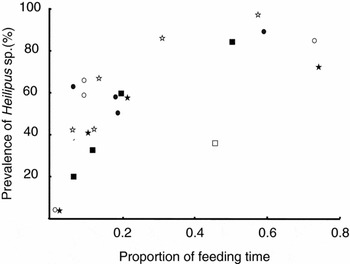
Feeding time among trees varied from 3 min to 2 h. Adult monkeys ate a mean of 9.4 fruits min−1. Accounting for feeding time spent in every tree, the removal rate among trees varied from 9 to 1073 fruits d−1. The only trait significantly correlated with the proportion of feeding time was the prevalence of curculionid infestation (Figure 1), with feeding time increasing with these infestations (r = 0.5; P = 0.02). The correlation coefficient (r) increased when one outlier was removed which showed higher feeding time than predicted by infestation (r = 0.7; P = 0.006). The proportion of feeding time was not correlated with total fruit production (r = 0.005; P = 0.98) or infestation by moths (r = 0.28; P = 0.20).
Correlation between the proportion of feeding time (total feeding time on a tree/total feeding time in all Ocotea diospyrifolia trees) spent in a tree by Alouatta caraya troops and the prevalence of curculionids. The trees used by each troop are represented by different symbols. The hollow square is the outlier tree that was used more than predicted only by total infestation.

Troops selected fruit in trees with high fruit production, which is a common pattern among mammal and bird frugivores (Blendinger et al. Reference BLENDINGER, LOISELLE and BLAKE2008, Howe & vande Kerckhove Reference HOWE and VANDE KERCKHOVE1981, Korine et al. Reference KORINE, KALKO and HERRE2000, Saracco et al. Reference SARACCO, COLLAZO, GROOM and CARLO2005, Stevenson Reference STEVENSON2004). Furthermore, howler troops selected trees with lower infestation by moths, but with higher curculionid infestation than trees they avoided. Feeding time on selected trees was also positively correlated with curculionid infestation. As a consequence, howler troops appeared to respond to the Heilipus sp./moth infestation ratio, because they removed fruits not only when there were fewer fruits infested by moths, but also when there were more fruits infested by Heilipus sp. In the study site, moth infestation occurs rarely, having been recorded once in 10 y of monitoring. In contrast, Heilipus sp. infestation is common and has been recorded every year since 1994 (pers. obs.). Therefore, the behaviour of howlers in relation to Heilipus sp. infestation is relevant to determine the potential impact of howler tree choice on the population of O. diospyrifolia.
Results of the present study increase the relevance of A. caraya as a cleaner of infested O. diospyrifolia seeds (Bravo Reference BRAVO2008), and confirm the apparent preference of troops for trees with higher levels of infestations by curculionids (Bravo & Sallenave Reference BRAVO and SALLENAVE2003). However these results raise new questions, such as: were trees used by A. caraya troops chosen because they had a high curculionid larvae infestation, or because they had low concentrations of secondary compounds and consequently a high level of infestation by curculionids? What is the selected trait? Is this trait heritable? Variation in the prevalence of infestation between trees also could be related to variation in the level of defence among trees.
In conclusion, the selection of O. diospyrifolia trees by the main and most effective disperser of their seeds was based on three traits: moth infestation, infestation by Heilipus sp. and crop size. Moth infestation is less common than curculionid infestation and correlated with the year of the study. Infestation by Heilipus sp. could be related to variation in the level of defence among O. diospyrifolia trees. Consequently, infestation by Heilipus sp. and crop-size traits are the potentially more relevant and promising from the perspective of disperser-mediated selection.
ACKNOWLEDGEMENTS
I am grateful to Douglas Levey, Víctor Cueto, Javier Lopez de Casenave, Cecilia Sagario, the Editor and the anonymous reviewer for their valuable comments on the manuscript. I am also grateful to Alex Jahn for help with English revisions and to several students who participated as field assistants. This study was funded by CONICET and IDEA WILD.