Introduction
Hypochondriasis is characterized by preoccupation with the fear that one has, or may contract, an illness (American Psychiatric Association, 2000). Hypochondriasis is the extreme form of health anxiety, which is conceptualized as a dimensional construct (Salkovskis and Warwick, Reference Salkovskis and Warwick1986). Evidence suggests that health anxiety may be an anxiety disorder, given its similarities to panic disorder and obsessive–compulsive disorder (e.g. Deacon and Abramowitz, Reference Deacon and Abramowitz2008).
Health anxiety can have deleterious effects on an individual's well-being and functioning. Individuals with high levels of health anxiety use the healthcare system (e.g. physician visits and diagnostic tests) at high rates (Fink et al., Reference Fink, Ørnbøl and Christensen2010). The health anxious individual is more likely to experience physical limitations, poor work performance, and greater occurrences of disability, anxiety, and depression (Noyes et al., Reference Noyes, Happel and Yagla1999). Given the negative impact of health anxiety on quality of life, understanding factors contributing to health anxiety is needed to improve assessment and treatment of health anxiety.
Cognitive–behavioral model of health anxiety
Salkovskis and Warwick (Reference Salkovskis and Warwick1986) offered a cognitive–behavioral model for understanding the development and maintenance of health anxiety, which emphasizes cognitive factors associated with the disorder. Though historically there have been other proposed theories to account for health anxiety (e.g. psychodynamic models), the cognitive–behavioral model has the greatest empirical support (Williams, Reference Williams2004). According to this model, health anxiety results from past experiences with illness. These experiences influence attention to illness information, such as hypervigilance to signs of an illness or dysfunctional information processing strategies (e.g. overestimating the severity of a symptom). The maintenance of health anxiety and the level of distress experienced by an individual involve the interaction of four factors: (a) perceived likelihood of the illness (illness likelihood), (b) perceived negative consequences of the illness (negative consequences), (c) perceived ability to cope with the illness (coping factors), and (d) availability of rescue factors, such as cures. Anxiety-related constructs have been examined in relation to health anxiety, but it is unclear how such factors map onto the cognitive–behavioral model in accounting for the development and maintenance of health anxiety.
Anxiety-related constructs and health anxiety
Because health anxiety shares characteristics with the anxiety disorders, factors associated with the anxiety disorders may account for the experience and presentation of health anxiety. Anxiety sensitivity (i.e. fear of anxiety-related symptoms, such as increased heart rate) is a predictor of some anxiety disorders (e.g. Deer and Calamari, Reference Deer and Calamari1998) and health anxiety (e.g. Olatunji et al., Reference Olatunji, Wolitzky-Taylor, Elwood, Connolly, Gonzales and Armstrong2009). Intolerance of uncertainty (i.e. the tendency to react negatively in unpredictable situations) has also been shown to relate to health anxiety (e.g. Deacon and Abramowitz, Reference Deacon and Abramowitz2008; Fergus and Valentiner, Reference Fergus and Valentiner2009). Both of these constructs have been conceptualized as trait-like characteristics that predispose one to develop anxiety (e.g. Reiss, Reference Reiss1991). Consequently, anxiety sensitivity and intolerance of uncertainty may predict illness likelihood, negative consequences, or both, as described in the cognitive–behavioral model of health anxiety.
Emotion regulation may also account for health anxiety. Examining emotion regulation in relation to health anxiety is especially important in light of lifespan developmental models of emotion regulation. For example, the Selective Optimization with Compensation (SOC) model (Baltes and Baltes, Reference Baltes, Baltes, Baltes and Baltes1990) indicates that, with age, individuals select personal goals, optimize their resources in pursuit of goals, and compensate for any limitations. Compensation may be achieved through emotion regulation. In another model, Heckhausen and Schulz (Reference Heckhausen and Schulz1995) suggest that individuals are driven to maintain control over their environment, which they accomplish through primary control strategies (i.e. changing characteristics of the environment) or secondary control strategies (i.e. changing one's thoughts or feelings about an event). These models suggest that, because one cannot easily change one's health status, use of emotion regulation strategies may become prominent.
The literature on emotion regulation in health anxiety is limited. Fergus and Valentiner (Reference Fergus and Valentiner2010) found that reappraisal (i.e. reducing the impact of the emotion by thinking differently) predicted disease conviction (i.e. illness likelihood), whereas suppression (i.e. inhibiting the expression of emotions) did not relate to health anxiety in a sample of young adults. A final variable that may account for health anxiety is perceived anxiety control (i.e. perceived ability to manage anxiety). The relations between health anxiety and perceived anxiety control have not been directly studied, but anxiety control has been explored in other anxiety constructs. For example, Gould and Edelstein (Reference Gould and Edelstein2010) demonstrated that greater anxiety control was associated with less reported worry among older and younger adults. Both emotion regulation and anxiety control can be conceptualized as coping factors and may alleviate distress associated with specific components of health anxiety.
Health anxiety and aging
The extent to which anxiety-related constructs predict health anxiety in older adults is largely unknown. Very few studies have examined health anxiety in older adults, which is remarkable given that older adults experience health problems and use the healthcare system at higher rates than other age groups (Administration on Aging, 2011). Boston and Merrick (Reference Boston and Merrick2010) found that older adults in New Zealand are as health anxious as younger individuals. These researchers did not directly compare young and older adult samples, but gathered data on older adults and compared results to previous studies on health anxiety among young adults. The study demonstrated that lower education levels and decreased physical functioning contributed to health anxiety. In another study, Bourgault-Fagnou and Hadjistavropoulos (Reference Bourgault-Fagnou and Hadjistavropoulos2009) found that high-frailty older adults (i.e. those most vulnerable to morbidity) had the highest levels of health anxiety when compared to low-frailty older adults and college students. After controlling for health problems, high-frailty older adults scored similarly to young adults on a measure of health anxiety. Low-frailty older adults had the lowest levels of health anxiety among the three groups. Yet, little is known about which variables, other than health, may contribute to health anxiety among older adults. Given that age-related differences have been found in the presentation of anxiety symptoms (Brenes et al., Reference Brenes, Knudson, McCall, Williamson, Miller and Stanley2008) and the physiological experience of anxiety (Teachman and Gordon, Reference Teachman and Gordon2009), age-related differences may also exist in health anxiety. Presently, few studies have examined whether health anxiety and factors contributing to health anxiety differ across older and young adults.
Little is known about which factors account for health anxiety in older adults and whether health anxiety differs in older and young adults. The present study examined anxiety-related constructs that may be related to health anxiety. First, we examined whether levels of health anxiety and related constructs differ in older and young adults. Then, we examined the extent to which anxiety sensitivity, intolerance of uncertainty, emotion regulation, and anxiety control predict two components of health anxiety described in the cognitive–behavioral model (perceived illness likelihood and negative consequences). We tested whether older and young adults differ in the extent to which each of these variables predicts specific aspects of health anxiety. We chose to focus only on illness likelihood and negative consequences as these are two frequently examined aspects of health anxiety. Additionally, measures of health anxiety do not assess coping and rescue factors, making it difficult to predict these components of the cognitive–behavioral model of health anxiety.
Methods
Participants
The present study was part of a larger study on health anxiety. Eighty-six older adults aged 60–90 years old and 119 young adults aged 18–30 years old participated in this study. Only participants between the ages of 18 and 30 years or between the ages of 60 years and above were eligible for this study. Two young adult participants were dropped from analyses due to failure to complete a sufficient percentage of the surveys, leaving a total of 117 young adult participants. There were 45 older adult females (52%) and 41 older adult males (48%), and 60 young adult females (51%) and 57 young adult males (49%). Mean age for the older adults was 69.94 years (SD = 8.11), and mean age for the younger adults was 20.42 years (SD = 2.13). Eighty-two older adults (95%) and 109 younger adults (93%) identified as Caucasian, which reflects the demographic makeup of the region.
Age groups significantly differed on years of education, t (198) = 2.37, p < 0.05, with older adults (M = 15.15, SD = 3.54) reporting slightly more years of education than young adults (M = 14.30, SD = 1.35). Older adults (M = 5.63, SD = 4.12) reported greater health problems than younger adults (M = 3.16, SD = 2.69), which was significant, t (199) = 5.14, p < 0.01. Significant differences were found for income level, as more young adults reported higher family incomes, χ2 (3, N = 203) = 25.06, p < 0.01.
Measures
Dependent variable
The Short Health Anxiety Inventory (SHAI; Salkovskis et al., Reference Salkovskis, Rimes, Warwick and Clark2002) is an 18-item self-report measure of symptoms of health anxiety across a range of severity (not at all anxious to hypochondriacal) for the past six months. The SHAI contains two factors: illness likelihood, or the extent to which one believes one has an illness, and negative consequences, the extent to which one believes a serious illness will impact one's life. In the present sample, Cronbach's α coefficients for the SHAI full scale (α = 0.90 for older adults and α = 0.86 for young adults), illness likelihood subscale (α = 0.89 for older adults and α = 0.87 for young adults), and negative consequences subscale (α = 0.76 for older adults and α = 0.66 for young adults) were adequate.
Independent variables
Each participant completed a demographics questionnaire regarding age, gender, ethnicity, marital status, years of education, and current job status. Participants were also asked to indicate all past and current health problems on a checklist of 50 diseases such as diabetes, cancer, thyroid problems, glaucoma, asthma, autoimmune diseases, and anemia. Participants were allowed to write-in illnesses that were not included on the list. Because the cognitive–behavioral model of health anxiety posits that health concerns can arise from past or current experience with illness, we felt it important to assess for any illnesses a person may have had.
The Anxiety Sensitivity Index (ASI; Reiss et al., Reference Reiss, Peterson, Gursky and McNally1986) is a 16-item measure of fear of anxiety symptoms. Participants rate their fear of various consequences resulting from anxious arousal, such as feeling nervous, short of breath, and shaky. Cronbach's α coefficients in this study were 0.91 for older adults and 0.91 for young adults.
The Intolerance of Uncertainty Scale (IUS; Freeston et al., Reference Freeston, Rhéaume, Letarte, Dugas and Labdoceur1994) is a 27-item measure assessing the extent to which a person feels that uncertainty or unpredictability is acceptable. In the present study, internal consistency was excellent (α = 0.95 for older adults and α = 0.97 for young adults).
The Emotion Regulation Questionnaire (ERQ; Gross and John, Reference Gross and John2003) is a 10-item measure of emotion regulation strategies: suppression (inhibiting the expression of emotions) and reappraisal (reducing the impact of the emotion by thinking about the event differently). In this study, Cronbach's α coefficients were 0.78 for reappraisal and 0.79 for suppression among older adults, and 0.87 for reappraisal and 0.76 for suppression among young adults.
The Anxiety Control Questionnaire (ACQ; Rapee et al., Reference Rapee, Craske, Brown and Barlow1996) is a 30-item self-report measure assessing one's perceived ability to control anxious events and emotional reactions to events. Internal consistency in this sample was adequate (α = 0.70 for older adults and α = 0.77 for young adults).
Procedure
Young adults from undergraduate psychology courses participated in the study and received extra credit as compensation. Young adult participants completed surveys on a Web-based agent operating under the auspices of the university. Participants were presented with a cover letter explaining the study and were immediately administered the surveys if they agreed to participate. Given the method by which data were collected, it is unknown how many participants declined to participate after reading the cover letter. The surveys were presented in a random order to diminish order effects.
Older adults were recruited from local senior centers and independent living facilities, and through cable television and email announcements. Advertisements indicated that the study was seeking adults of ages 60 years and older who would be interested in completing paper-and-pencil surveys about health concern and coping with these concerns. Interested older adult participants were mailed a packet of surveys, a consent form describing the study, and a pre-stamped and addressed return envelope. Surveys were mailed to 98 participants, and surveys from 86 participants were returned. Participants were compensated with $5 at the time the surveys were mailed. The order of the surveys was randomized.
Results
Missing data, outliers, and skew
Two young adult participants were dropped from analyses due to failure to complete at least 70% of the measures. Two older adult participants did not complete the ASI. For these participants, ASI scores were estimated via regression, in which ASI scores were predicted by the individual's scores on the other completed measures. Because less than 5% of the data were missing, missing scale items were replaced with each participant's mean for the items on each scale, which is an appropriate data replacement strategy when there are few data missing (Tabachnick and Fidell, Reference Tabachnick and Fidell2007).
Scores greater or less than 3.2 standard deviations from the mean were labeled as outliers (Tabachnick and Fidell, Reference Tabachnick and Fidell2007), and only a handful of scores qualified as outliers. Outliers were replaced with the highest or lowest value within 3.2 standard deviations from the mean. Each variable was examined for normality via a skewness statistic. Scale scores demonstrating problematic skew were transformed using either square root transformations (SHAI Illness Likelihood, ASI) or log transformations (SHAI negative consequences, IUS). All analyses were conducted twice, with transformed and non-transformed variables. No differences in the results were found and only results from analyses using non-transformed variables are presented.
Preliminary analyses
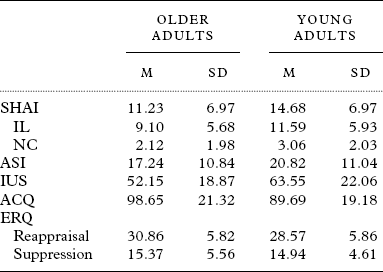
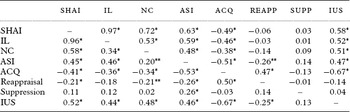
Descriptive statistics for the survey scores are presented in Table 1. To explore relations among the variables of interest and to examine potential problems with multicolinearity, Pearson correlation analyses were conducted. All correlation coefficients (see Table 2) for relations between the independent and dependent variables were lower than 0.80, indicating no issues with multicolinearity (Tabachnik and Fidell, Reference Tabachnick and Fidell2007).
Means and standard deviations of predictor and outcome variables by age group

Note: SHAI = Short Health Anxiety Inventory; IL = Illness Likelihood; NC = Negative Consequences; ASI = Anxiety Sensitivity Index; IUS = Intolerance of Uncertainty Scale; ACQ = Anxiety Control Questionnaire; ERQ = Emotion Regulation Questionnaire.
Intercorrelations among dependent and independent variables by age group

Note: Correlation coefficients for older adults are above the diagonal, and correlation coefficients for young adults are below the diagonal. SHAI = Short Health Anxiety Inventory; IL = Illness Likelihood subscale of SHAI; NC = Negative Consequences subscale of SHAI; ASI = Anxiety Sensitivity Index; ACQ = Anxiety Control Questionnaire; Reappraisal and Suppression are subscales of the Emotion Regulation Questionnaire; IUS = Intolerance of Uncertainty Scale. *p < 0.01; **p < 0.05.
To determine age differences in health anxiety severity, an independent-samples t-test was conducted on SHAI scores. Younger adults reported significantly higher levels of health anxiety than older adults, t (201) = 3.49, p < 0.01. Younger adults also had significantly higher scores than older adults on SHAI illness likelihood, t (201) = 3.01, p < 0.01, and SHAI negative consequences, t (201) = 3.31, p < 0.01. Additional t-tests revealed that young adults reported higher levels of anxiety sensitivity, t (201) = 2.30, p < 0.05, and intolerance of uncertainty, t (201) = 3.86, p < 0.01, whereas older adults reported higher perceived anxiety control, t (201) = 3.14, p < 0.01, and use of reappraisal, t (201) = 2.76, p < 0.01. No age-related differences were found with respect to suppression. Because suppression was not significantly correlated with health anxiety and there were no age-related differences in suppression, this variable was not included in the following analyses.
We conducted a post hoc power analysis to determine whether we had enough power to detect results. We used G*Power version 3 (Faul et al., Reference Faul, Erdfelder, Lang and Buchner2007) to compute our achieved power. With our total sample size of 203 and an α level of 0.05, our determined power was 0.99 in detecting an effect size of 0.39.
Predicting illness likelihood and negative consequences
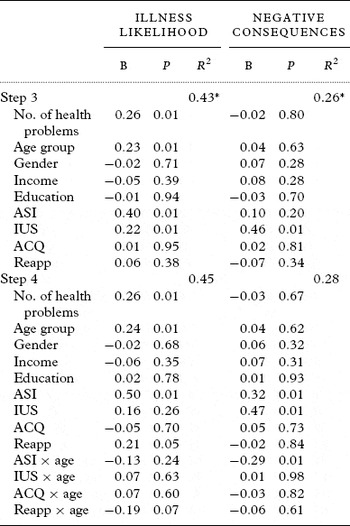
To determine the extent to which anxiety sensitivity, intolerance of uncertainty, reappraisal, and perceived anxiety control account for two components of health anxiety (illness likelihood and negative consequences), two hierarchical regression analyses were conducted. In the first step of the regression analyses, the number of health problems was entered to control for the influence of health on health anxiety. In step two, age group (older vs. younger), gender, income, and education were entered. Scores on the measures (ASI, ACQ, IUS, and reappraisal) were centered to reduce potential problems with multicolinearity. The centered variables were entered in step three. Then, each centered variable was multiplied by age group. These interaction terms were entered into step four of the hierarchical regression analysis. We chose the use of interaction terms as part of our statistical approach, as opposed to separate regression analyses for each age group, because interaction terms allow us to compare the extent to which each anxiety-related construct contributes to health anxiety significantly differs between age groups.
Results of the hierarchical regressions are presented in Table 3. Illness likelihood was the criterion variable in the first hierarchical regression analysis. The amount of variance in illness likelihood explained by the variables was considerable, R2 = 0.45, F(13, 11.18), p < 0.01. The number of health problems significantly predicted illness likelihood, β = 0.26, p < 0.01, suggesting that individuals with more health problems are more likely to perceive various body symptoms as indicative of an illness. Anxiety sensitivity, β = 0.50, p < 0.01, and reappraisal, β = 0.21, p < 0.05, significantly contributed to illness likelihood. None of the interaction terms were significant.
Results of hierarchical regressions predicting illness likelihood and negative consequences

Note: ASI = Anxiety Sensitivity Index; IUS = Intolerance of Uncertainty Scale; ACQ = Anxiety Control Questionnaire; Reapp = Reappraisal subscale of the Emotion Regulation Questionnaire.
* R 2 Δ is significant at p < 0.01.
Negative consequences subscale scores were then examined as the criterion variable in a hierarchical regression analysis. A moderate amount of variance in negative consequences was explained by the regression model, R2 = 0.33, F(13, 6.75), p < 0.01. Anxiety sensitivity, β = 0.32, p < 0.01, and intolerance of uncertainty, β = 0.47, p < 0.01, significantly predicted negative consequences. The interaction between age and anxiety sensitivity was significant, β = −0.29, p < 0.01, showing that older and young adults differ in the extent to which anxiety sensitivity predicted negative consequences. No other significant variables or interactions were found.
Because of the significant interaction between age and anxiety sensitivity, we explored the extent to which anxiety sensitivity predicts negative consequences in each age group separately. In step one, we entered the number of health problems. In step two, we entered gender, income, and education. In step three, we entered ASI, IUS, ACQ, and reappraisal scores. The overall model accounted for a considerable proportion of negative consequences scores in older adults, R2 = 0.37, F(8, 4.95), p < 0.01, and younger adults, R2 = 0.24, F(8, 5.55), p < 0.01. Anxiety sensitivity significantly contributed to negative consequences for older adults, β = 0.37, p < 0.01, but not young adults, β = −0.04, p = 0.68, indicating that the extent to which anxiety sensitivity contributes to negative consequences is significantly greater among older adults than young adults.
Discussion
The present study examined the extent to which anxiety-related constructs predict two components of health anxiety in older and younger adults and explored age-related differences in factors contributing to health anxiety. Young adults reported higher levels of overall health anxiety, illness likelihood, and negative consequences compared to older adults. The present results are consistent with those of Bourgault-Fagnou and Hadjistavropoulos (Reference Bourgault-Fagnou and Hadjistavropoulos2009), but stand in contrast to those of Boston and Merrick (Reference Boston and Merrick2010). However, Boston and Merrick examined health anxiety only among older adults and then compared health anxiety scores to data on younger adults obtained from previous studies (e.g. Salkovskis et al., Reference Salkovskis, Rimes, Warwick and Clark2002). Findings from research on the anxiety disorders (e.g. Wolitzky-Taylor et al., Reference Wolitzky-Taylor, Castriotta, Lenze, Stanley and Craske2010) are also consistent with the present findings and those of Bourgault-Fagnou and Hadjistavropoulos, that older adults report lower levels of anxiety than young adults.
Older adults reported greater use of reappraisal than younger adults in the present study, which is consistent with previous research that emotion regulation skills improve in late life (e.g. Blanchard-Fields et al., Reference Blanchard-Fields, Stein and Watson2004; Charles and Carstensen, Reference Charles, Carstensen and Gross2007) and that older adults use reappraisal more frequently and effectively than young adults (John and Gross, Reference John and Gross2004). In the present study, older adults reported greater perceived anxiety control than young adults, which is inconsistent with results from Gould and Edelstein (Reference Gould and Edelstein2010). This discrepancy in findings may be related to differences in the ages of the older adult samples in both studies. Overall, the present results fit with literature demonstrating enhanced regulatory processes in late life (e.g. Charles and Carstensen, Reference Charles, Carstensen and Gross2007).
Younger adults exhibited higher scores than older adults on measures of anxiety sensitivity and intolerance of uncertainty. Basevitz et al. (Reference Basevitz, Pushkar, Chaikelson, Conway and Dalton2008) found that older adults reported less intolerance of uncertainty than younger adults, which was supported by our findings. The present results for anxiety sensitivity are inconsistent with those of Teachman and Gordon (Reference Teachman and Gordon2009), who did not find age differences on ASI scores. The difference in results may be related to sample characteristics. Teachman and Gordon had many more females, and participants were excluded for significant health problems, leaving a relatively healthy sample. Young adults may experience greater anxiety sensitivity and intolerance of uncertainty relative to older adults in part because young adults use emotion-focused regulation skills less frequently (Blanchard-Fields et al., Reference Blanchard-Fields, Stein and Watson2004) and less effectively (Phillips et al., Reference Phillips, Henry, Hosie and Milne2008) than older adults. That young adults reported higher levels of predisposing characteristics, whereas older adults reported higher levels of coping factors, may explain the lower reported levels of health anxiety among older adults compared to young adults.
Age-related differences in health anxiety and anxiety-related constructs may also be understood in light of the SOC model (Baltes and Baltes, Reference Baltes, Baltes, Baltes and Baltes1990). In this model, successful aging includes differentially selecting personal goals, maximizing gains by optimizing resources put toward that goal, and compensating for any losses. In the case of health anxiety, older adults may select goals that focus on emotional well-being, rather than worrying about their health, and may put more effort toward achieving such goals. They may endorse less anxiety sensitivity and intolerance of uncertainty than young adults because they put more resources toward maintaining emotional well-being (i.e. opting not to focus on vague body sensations or uncertainty regarding their health). In addition, they may compensate for any difficulties by using effective emotion regulation strategies, which may explain higher rates of reported reappraisal use among older adults. The Heckhausen and Schulz (Reference Heckhausen and Schulz1995) model of primary and secondary control may also explain the observed age-related differences. Their model stipulates that older adults are more likely to utilize secondary control strategies to compensate for age-related restrictions on their pursuit of goals. Older adults are more likely to have health problems (a restriction on their goal of maintaining health), and may therefore be more likely to compensate for the lack of control over their health through the use of emotion-regulation strategies. These models suggest that rates of health anxiety may decrease across the lifespan due to age-related changes in goals and means of achieving goals.
Predictors of health anxiety
For both older and young adults, intolerance of uncertainty predicted negative consequences, which supports previous findings with young adults. Fergus and Valentiner (Reference Fergus and Valentiner2009) found that intolerance of uncertainty predicts symptom effects (disruptive effects of an illness), but not disease conviction (likeliness beliefs). Illness likelihood is conceptually similar to disease conviction, and symptom effects are similar to negative consequences. Though Fergus and Valentiner and the present study utilized different measures of health anxiety, and there is not perfect overlap between the constructs measured on the two scales, the present findings support findings from Fergus and Valentiner and extend these findings to older adults.
That anxiety sensitivity predicted illness likelihood in young and older adults was not surprising in light of previous research. The present study partially replicated the findings of Olatunji et al. (Reference Olatunji, Wolitzky-Taylor, Elwood, Connolly, Gonzales and Armstrong2009), who found anxiety sensitivity predicted scores on a measure of health anxiety in undergraduate college students. The present study also partially replicated the findings of Bravo and Silverman (Reference Bravo and Silverman2001), who found a link between health anxiety and anxiety sensitivity in older adults. This finding with older adults is also consistent with findings in the anxiety disorders (e.g. Deer and Calamari, Reference Deer and Calamari1998). These results indicate that anxiety sensitivity may predispose both older and young adults to regard illnesses as highly likely.
Anxiety sensitivity predicted negative consequences for older adults but not young adults, which is surprising given that young adults reported higher levels of anxiety sensitivity than young adults. Of note, both anxiety sensitivity and intolerance of uncertainty predicted negative consequences for older adults, whereas only intolerance of uncertainty predicted negative consequences for young adults. It may be the case that, given older adults’ strengths with respect to emotion regulation, high levels of both anxiety sensitivity and intolerance of uncertainty are needed to elevate older adults’ fear of negative consequences. On the other hand, intolerance of uncertainty may be a sufficient predisposing characteristic for fear of negative consequences among young adults, likely due to young adults’ poorer emotion regulation abilities (e.g. John and Gross, Reference John and Gross2004) or difficulties using other secondary control strategies (Heckhausen and Schulz, Reference Heckhausen and Schulz1995).
Reappraisal significantly predicted illness likelihood among older and young adults, though higher use of reappraisal was associated with greater illness likelihood. These results appear counterintuitive, as studies have shown that enhanced emotion regulation (e.g. reappraisal) reduces psychological distress (e.g. Gross and John, Reference Gross and John2003). To understand this finding, the Strength and Vulnerability Integration (SAVI) model (Charles, Reference Charles2010) may be helpful. According to SAVI, older adults have both strengths (e.g. emotion regulation skills) and weaknesses (e.g. physical vulnerabilities). Because of these strengths, older adults are generally able to manage stressors, however, if the stressors are too taxing, older adults may not be able to compensate for or overcome these stressors. Threats to health may be one situation in which individuals’ coping abilities are taxed, rendering some individuals unable to cope with stressors. Though this model exclusively describes older adults, it is possible that health-related fears may also overwhelm young adults’ ability to cope. Some research has shown that young adults are less experienced with reappraisal, and accordingly, using reappraisal can be costly for young adults in terms of cognitive load (Scheibe and Blanchard-Fields, Reference Scheibe and Blanchard-Fields2009). Another potential explanation is that older and young individuals with higher levels of illness likelihood engage in reappraisal frequently as a means of coping with anxiety; they report elevated levels of anxiety, but levels are more manageable due to reappraisal use.
Another emotion regulation strategy, suppression, was not associated with illness likelihood or negative consequences for older and young adults, which is consistent with the findings of Fergus and Valentiner (Reference Fergus and Valentiner2010). Current research suggests that suppression is not effective in regulating one's emotions (Gross and John, Reference Gross and John2003). Use of suppression can paradoxically increase negative emotions for individuals reporting high levels of negative affect (Dalgleish et al., Reference Dalgleish, Yiend, Schweizer and Dunn2009). Hofmann et al. (Reference Hofmann, Heering, Sawyer and Asnaani2009) found that individuals who suppressed their anxious emotions during a speech exhibited greater increases in heart rate compared to individuals who engaged in reappraisal of emotions. Older and younger adults do not appear to differ on the use of suppression (Phillips et al., Reference Phillips, Henry, Hosie and Milne2008), which was also supported by these data. It appears that suppression is not useful for reducing health anxiety, and older and younger individuals do not appear to employ this method frequently.
Anxiety control did not predict illness likelihood or negative consequences among both older and young adults. This finding was surprising, as enhanced self-regulatory processes relate to lower psychological distress (Gross and John, Reference Gross and John2003). Furthermore, in consideration of the Heckhausen and Schulz (Reference Heckhausen and Schulz1995) model, one might expect anxiety control to predict aspects of health anxiety among older adults, as the model stipulates that older adults are driven to maintain control over their environment. Though anxiety control did not predict components of health anxiety, the relation between anxiety control and health anxiety was significant in both age groups. Although no studies have examined perceived anxiety control in health anxiety, the significant correlations are consistent with findings from research on anxiety, which shows that anxiety control is associated with lower levels of worry in older and young adults (Gould and Edelstein, Reference Gould and Edelstein2010) and less social anxiety in adults aged 18–74 years (Hofmann, Reference Hofmann2005).
Implications for the cognitive–behavioral model of health anxiety
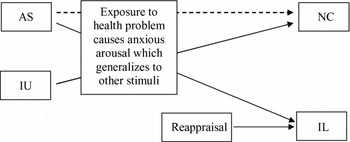
The results of this study bear on the cognitive–behavioral model of health anxiety (Salkovskis and Warwick, Reference Salkovskis and Warwick1986). A proposed model (based on present findings) of the relations among anxiety-related constructs and specific components of health anxiety is presented in Figure 1. For older and young adults, intolerance of uncertainty and anxiety sensitivity are predisposing characteristics for negative consequences and illness likelihood, respectively, though anxiety sensitivity also contributes to illness likelihood for older adults. If individuals with these predispositions are subjected to a serious health problem (either in the self or vicariously through others), anxious arousal occurs. When faced with these stimuli, older and younger adults consider the likelihood and negative consequences of an illness. When considering the likelihood of an illness, reappraisal (i.e. a coping factor) may help attenuate anxiety in both age groups. Overall, the present findings support and expand upon the cognitive–behavioral model by identifying particular variables (i.e. anxiety sensitivity and intolerance of uncertainty) that contribute to the illness likelihood and negative consequences components of health anxiety, and by specifying coping factors (i.e. reappraisal).
Proposed conceptual model accounting for health anxiety in older and young adults. Solid lines indicate that the variable predicts health anxiety for older and young adults. The dotted line indicates that the variable is a predictor of health anxiety for older adults only. Anxiety sensitivity and intolerance of uncertainty are predisposing characteristics for anxiety. Then, individuals are subjected to a serious health problem (in self, others, or the news), which causes anxiety-related symptoms. Anxious responding may then generalize to other illness-related stimuli. When faced with these stimuli, individuals consider perceived likelihood (IL) and negative consequences (NC) of an illness. Anxious thought patterns regarding IL are influenced by coping factors, such as reappraisal skills. The availability of rescue factors (e.g. cures) also impinges on the model, though this factor was not explored in the present study and is not presented above.

Implications for conceptualization, assessment, and treatment
Given the paucity of research on health anxiety among older adults, this study enhances our understanding of health anxiety with older adults. The present findings revealed that constructs with established relations to anxiety disorders contribute to components of health anxiety among older and young adults, suggesting that health anxiety shares features with the anxiety disorders. The nature of health anxiety appears to be similar in both age groups, though age-related differences in how anxiety sensitivity relates to negative consequences were found. Results indicate that anxiety sensitivity, intolerance of uncertainty, and reappraisal contribute to health anxiety. Therefore, clinicians would be well advised to assess for these constructs with clients reporting health anxiety and consider them as possible targets for intervention. For example, a therapist might teach skills such as cognitive restructuring (i.e. identifying and changing unhelpful thoughts) to a client, which may alleviate health-related concerns. Similarly, strengthening a client's emotion regulation skills, especially when working with young or older adults with poor emotion regulation skills, may impact levels of health anxiety.
Limitations
Demographic characteristics for both age groups are not representative of the general population. Both age groups were predominately white, and generalizations to other ethnic groups should be made with caution. The young adults were undergraduate students, and the older adult sample was well educated, so these results may not apply to less educated groups. The means by which older and young adults were recruited for the study differed, which may have resulted in differences across the groups that may have affected results. Though we attempted to account for health problems in our analyses, we were unable to adequately control for whether participants had legitimate health concerns. This issue especially concerns older adults, and remains a significant problem in diagnosing severe health anxiety (i.e. hypochondriasis). This study relied solely on self-report surveys, and data were collected at a single point in time, which limits the conclusions that can be drawn from this study. Given the sample size, regression analyses were used to explore relations among the variables of interest; more sophisticated tests of the relations among the variables, such as structural equation modeling, could not be used.
Future directions
The nature of health anxiety and its presentation in clinically and ethnically diverse samples could be explored with a similar method. Additional methods (e.g. physiological recordings of autonomic arousal) or study designs (e.g. longitudinal studies) may offer new insights into our understanding of health anxiety in various age groups. Similarly, this study could be replicated with a larger sample size, and the relations among the variables could be explored using structural equation modeling. A richer understanding of health anxiety might be achieved through examining other anxiety-related constructs (e.g. somatic amplification) in relation to specific components of health anxiety. Furthermore, it may be prudent to examine the extent to which the relation between anxiety-related constructs and health anxiety may change as a function of health status. Because the present study was one of the first (see Bourgault-Fagnou and Hadjistavropoulos, Reference Bourgault-Fagnou and Hadjistavropoulos2009; Fergus and Valentiner, Reference Fergus and Valentiner2010) to examine the relation between emotion regulation and aspects of health anxiety, additional strategies for regulating the experience of health anxiety could be explored to understand how young and older adults manage health anxiety. Tests and further development of the cognitive–behavioral model for older and young adults proposed here are warranted as a next step in understanding health anxiety in these age groups.
Conflict of interest
None.
Description of authors' roles
L. Gerolimatos designed the study, collected data, conducted statistical analyses, and wrote portions of the paper. B. Edelstein helped design the study, supervised data collection, and assisted with writing portions of the paper.
Acknowledgments
This work was supported by a grant from the West Virginia University Student Research Fund. This research was conducted as partial fulfilment of the first author's requirements for a Master of Science degree at West Virginia University. The authors thank Kevin Larkin, PhD, and Aaron Metzger, PhD, for comments and suggestions as thesis committee members. We also thank Christine Gould, PhD, for comments on earlier drafts of the manuscript. Portions of these data were presented at the 45th Annual Scientific Meeting of the Association of Behavioral and Cognitive Therapies.