Fighters and weapons are mobilized during wars and conflicts. So, too, is spectacle. The struggle for material, literal dominance in war is accompanied by what the French art historian and philosopher Marie-José Mondzain calls a ‘war of images’.Footnote 1 Mondzain examines how the capacity of visual spectacle to allure and seduce is enlisted in war, in order to promote the respective ideologies of competing sides. She notes that even regimes that reject imagery, icons and figurative culture exert power through the manipulation of visual spectacle. In Le commerce des regards (The Commerce of Gazes (2003)), she recalls how the Taliban, who ruled Afghanistan from 1996 until 2001 when they were deposed in a US-led invasion, practised a fundamentalist version of Islam which dictated that they must reject and destroy all figurative imagery. In their zealous mission to free their nation from sacrilegious icons, in 2001 they levelled the Buddhas of Bamiyan, which dated back to the sixth century. Just like the self-styled Islamic State of Iraq and the Levant (ISIL), who since 2015 have destroyed many of the ancient Syrian city of Palmyra's two-thousand-year-old Roman remains and artefacts, the Taliban recognized that the spectacle of destruction they produced would become an iconic symbol of their power. Mondzain stresses, therefore, that even the most supposedly ‘aniconic’ regimes are ‘iconophiles’, exerting their power through the manipulation of icons. As such, any attempt at military conquest necessarily involves the conversion of visual spectacle into a ‘currency’ that can enter the ideological exchange economy.Footnote 2 Moreover, while archaeology scholar Zainab Bahrani has traced the earliest visual representations of war back to Mesopotamia in 653 BCE, describing the ‘image power’ illustrated in engravings of the Battle of Til-Tuba, in which the Assyrian cavalry and infantry are seen to overwhelm Elamite archers, the power of spectacle in the context of armed conflict has accelerated dramatically in recent decades.Footnote 3
It is in this context that one might appreciate visual-culture theorist Nicholas Mirzoeff's claim that two of the most urgent issues to emerge since the start of the new millennium are the globalization of war and the globalization of spectacle.Footnote 4 The media coverage of the 2001 attacks on New York and Washington (9/11) rendered them the most spectacular, spectacularized and mass-spectated event in history. The unavoidable footage of planes colliding into the Twin Towers of the World Trade Center on 9/11; images of the attacks’ mastermind, the al Qaeda leader Osama bin Laden, whether depicted as evil villain or spiritual leader; subsequent events such as the invasions of Afghanistan and Iraq waged as revenge for the attacks and the lynching of the former Iraqi dictator Saddam Hussein; the beheadings of civilians by ISIL; and the waves of refugees fleeing from these conflicts across the Mediterranean on unseaworthy vessels have become some of the most abiding and ubiquitous images of the twenty-first century to date. These dramatic, arresting spectacles are disseminated by government and anti-state groups alike in order to ‘win hearts and minds’ or to terrorize populations. Or else they are manufactured by the media in order to sell newspaper, television, radio or online advertising space – ‘War sells . . . war has to be sold’, affirms war reportage expert Susan Carruthers.Footnote 5 Sensationalized, slick, simplified and snappy spectacles have become an indissociable part of contemporary conflict.
The use of theatricalized spectacle by those who wage war or who manage perceptions of war poses particular challenges for theatre-makers. Mise en scène, choreography, scenography and spectacle have been coopted as essential weapons in modern warfare. Theatre and media spectacles alike select, frame and stage bodies, objects, places and events, in order to make sense of them, and to present them in ways that affect audiences. This is a point taken up by numerous theatre-makers since the turn of the millennium in the UK and elsewhere, as a brief survey of indicative examples reveals. Mark Ravenhill's Crime and Punishment, included in his 2008 play cycle Shoot/Get Treasure/Repeat, which was shown at various site-based locations and in theatres around London, relates the real-life episode when, during the first days of the US-led occupation of Iraq in 2003, an iconic televisual moment was stage-managed. Crowds of Iraqis were herded into the Baghdad square where a statue of Saddam Hussein was being pulled down, in order to convince global audiences that the Iraqi nation was united in its celebration of the US-led invasion of its country, an event the veteran Middle East journalist Robert Fisk describes as the ‘most staged photo-opportunity since Iwo Jima’, and Mirzoeff alludes to as ‘a carefully controlled media event’.Footnote 6 In an example focusing on the management of spectacle ‘back home’, Hayley Squires's Vera Vera Vera (2012) is set on the occasion of the funeral of Bobby, a British serviceman in his mid-twenties killed during the recent war in Iraq.Footnote 7 A woman from a television channel has called his family to say that cameras might record the funeral for broadcast. Bobby's sister Emily goes to significant lengths to make herself presentable, and changes her brother's eulogy in order to create an account of his heroism and her family's dignified grief that will impress television audiences.Footnote 8 Since, as accounts of Bobby's life reveal, there was nothing obviously heroic about him, and his pre-army civilian life could, in conservative terms, be considered to have been a failure, he does not conform to the expectations of the television producers. In spite of his sister Emily's best attempts to transform his life and death into a public spectacle, therefore, the television cameras never arrive. A third example, American playwright George Brant's Grounded (2012), takes on the spectacularization of combat itself. The play stages a female fighter pilot who is ‘grounded’ from operations in the Middle East when she becomes pregnant, and downgraded to the role of drone operator in the Nevada desert.Footnote 9 Contemporary warfare fought at a distance via precision-guided air sorties or drone strikes, the intelligence for which is supplied by high-tech satellite imagery, is referred to as ‘virtual war’, or ‘spectacle warfare’.Footnote 10 Since ‘spectacle warfare’ is supposedly precise and causes minimal damage, the military and governments portray it as ‘smart’ or ‘clean’. By exposing civilian deaths, notably those of children, Grounded illustrates how the spectacles depicted by digitized screen warfare will never fully conceal the destruction wrought by armies.
Beyond these plays, which have commented on the weaponization of spectacle in war by means of theme, discussion and dialogue, a number of theatrical pieces in the past decade have sought to expose spectacularization by the aesthetic or formal means that are unique to theatre. In this article, I take the example of Lola Arias's MINEFIELD/CAMPO MINADO (2016), revealing how it dismantles the spectacles of power, patriotism, military virtuosity and heroism that are habitually produced and sold by states and the dominant media during wars. I frame my remarks with reference to the essay ‘Image and Violence’ (2003) by philosopher Jean-Luc Nancy. In that essay, Nancy proposes how the artist can present ‘violence without violence’ by foregrounding the construction of spectacles self-consciously, rather than attempting simply to present and propagate their ideologies. Devised with Argentinian and British veterans of the Guerra de las Malvinas/Falklands Conflict (1982) in the director's home city of Buenos Aires, and staged in the UK (where I saw it in London), and then in Argentina, I suggest that MINEFIELD is exemplary in its exposure and explosion of the spectacles that are coopted in times of armed conflict.Footnote 11
Lola Arias, MINEFIELD (2016)
The ten-week Malvinas/Falklands Conflict began on 2 April 1982 when Argentina invaded and occupied two sets of islands three hundred miles off the Argentinian coast in the South Atlantic, which in English are referred to as the Falklands Islands and the South Georgia and South Sandwich Islands. After passing through French, Spanish and Argentinian hands in the eighteenth century on account of their strategic location on the shipping route between the Americas and Europe, the islands became British Crown Colonies in 1840, with Britain sending settlers to the islands to secure its sovereign claim. In the early 1980s, the military dictatorship that had brutally tyrannized Argentina since 1976 was facing increasing internal dissent and international condemnation. The invasion of the islands was in some respects born of a bid to whip up nationalist fervour and boost the dictatorship's popularity.Footnote 12 On 5 April the government of British prime minister Margaret Thatcher, whose popularity was also at an all-time low, owing in no small part to her sustained dismantling of the public sector, dispatched a naval task force to the invaded islands, and after launching an amphibious assault, the British armed forces reclaimed sovereignty, precipitating an Argentinian surrender on 14 June. This led eventually to the downfall of the Argentinian military government. Thatcher, on the other hand, was re-elected on a wave of patriotism the following year. The seventy-four days of the conflict – during which neither state actually declared war – claimed the lives of 649 Argentinian and 255 British troops and three civilians, and left many hundreds of army personnel on both sides injured and traumatized. It also left the islands littered with over a hundred minefields which only began to be cleared in 2009, and which, on a literal level, explain the title of Arias's play. While the Falklands Conflict has been treated in television documentaries such as Simon's War (1983) and in films such as Paul Greengrass's Resurrection (1989) and Shane Meadows's This Is England (2006), it has received little treatment in UK theatre, a notable exception being Steven Berkoff's damning satire of Thatcher's belligerence, Sink the Belgrano! (1986).
War and trauma have never been far from the work of Arias, who was born in 1976, the year of Argentina's military coup. In Mi vida después (My Life After (2009)), Arias viewed the Argentinian dictatorship from the perspective of the children of those who had lived through it as a guerrilla activist, an exiled intellectual or a police officer working for the military junta.Footnote 13 Another play, El año en que nací (The Year I was Born (2011)), staged Chileans exploring their families’ experiences of living through Augusto Pinochet's dictatorship (1976–84). While conflict may be a thematic constant in Arias's work, her creative processes today are collective and collaborative. Having started out in 2001 writing and directing plays according to broadly Euro-American conventions, since Mi vida después she has workshopped shows with teams of non-professional performers whose narratives of lived experience she values as living documents of historical events. For instance, The Art of Making Money (2013) was made and performed by beggars, sex workers and street musicians from Bremen in Germany, and The Art of Arriving (2015) was made and performed by Bulgarian children who had recently begun new lives in Germany.Footnote 14 Today, she is an internationally celebrated artist, who has performed at major venues such as the Festival d'Avignon in France, Festival Theaterformen and Spielart Festival in Germany, and Under the Radar in the USA.
MINEFIELD originated in a video installation, After the War, which was shown at the Battersea Arts Centre as part of an event organized by the London International Festival of Theatre (LIFT) in 2013. The video featured pieces on the consequences of war by twenty-five artists from around the world. Since the Malvinas/Falklands Conflict was the only war in which Argentina fought in the twentieth century, Arias chose to focus on it in her contribution, interviewing veterans, asking them to re-enact their war memories in the form of flashbacks, and filming them. This prompted her to ask what might happen if she interviewed British veterans from the same conflict.Footnote 15
First staged at the Brighton Festival in 2016, MINEFIELD transferred to the Royal Court Theatre during LIFT in the same year.Footnote 16 The performance combined documentary theatre, re-enactment, archival film, photographs, live-feed video, live music and song, and live foley.Footnote 17 It was devised by Arias in collaboration with six veterans from the two opposing sides in the Malvinas/Falklands Conflict – three Argentinian performers and three from the UK, including Sukrim Rai, a Gurkha originally from Nepal. In the show, the Argentinian performers spoke in Spanish with English surtitles; and the British and Nepali performers spoke in English with Spanish surtitles. The presence of a Gurkha who had defended a British colony added another layer of complexity to the show, since the Gurkhas’ involvement with the British Army is in itself a legacy of colonialism dating back to the early nineteenth century. Arias remarked, too, how the fact that Sukrim arrived for rehearsals in Buenos Aires a week after the other British performers owing to visa issues highlighted how, in spite of his service to the British Army, he was not recognized in the same way as the other ex-servicemen.Footnote 18
Rather than depicting official versions of history, insists Arias, she wanted to stage the veterans’ personal experiences, memories and stories.Footnote 19 How, then, did Arias's MINEFIELD succeed in doing this? ‘Image and Violence’, which features in Nancy's collection of essays The Ground of the Image, provides a useful means with which to demonstrate how MINEFIELD staged not only the violence of war, but also the violence of official spectacles of war as they are projected by states, by the military and often by conventional historical accounts.
‘Violence without violence’
In his essay, Nancy seeks to ‘interrogate what can link, in a particular way, the image to violence and violence to the image’.Footnote 20 He begins by identifying literal forms of violence. Physical violence – for instance, wars and other forms of conflict – is ‘the application of a force that remains foreign to the dynamic or energetic system into which it intervenes’.Footnote 21 The six veterans’ experiences of the physical carnage and waste of war were explicitly evoked in MINEFIELD, as my examples will illustrate. What interests me here, though, is Arias's exposure of the violence of spectacles of war. Like Mondzain and others, Nancy identifies the violence that is inherent in all ideological systems. Ideologies are violent because they seek to impose their authority by refusing dialogue, argument and reason.Footnote 22 Ideological truths are violent, and impose themselves via ‘the display and “show of force”’, which underscores the performative violence that ideologies commit.Footnote 23 ‘[V]iolent and violating violence reveals and believes that it reveals absolutely’, writes Nancy.Footnote 24 Arias explains that she was only five years old when the Malvinas/Falklands Conflict broke out, so has no memories of it. However, she recalls how every Argentinian child is shown on a map that the Malvinas are Argentinian; and every 2 April the nation commemorates those who valiantly lost their lives in the conflict.Footnote 25 She demonstrates in MINEFIELD how this ‘display’ and ‘show of force’ that accompanies violently imposed ideological spectacles of power and nationalism were apparent on both sides in the Malvinas/Falklands Conflict.
Official spectacles of conflict were challenged throughout the show, which, rather than presenting a linear storyline, comprised scenes in which fragments of the six army veteran-performers’ memories, experiences, opinions and sensations both from the conflict and from the present were depicted. For instance, near the start of the show, two performers dressed up as the wartime leaders – Thatcher and Argentinian president General Leopoldo Galtieri – and enacted what Nancy might describe as ‘violent’ spectacles of defiant military might and absolute conviction in their own sabre-rattling. Thatcher had been a democratically elected leader, in contrast to Galtieri, who was the last president of the military junta, a regime of terror responsible for the deaths and disappearances of many thousands of Argentinian civilians. Nonetheless, both leaders were shown in the play to resort to the kind of ideological rhetoric – colonial claims over a far-off land on Thatcher's part, and nationalistic aggression on Galtieri's – that Nancy identifies as violent. In archival footage projected at different moments during the show, both Thatcher and Galtieri defiantly claimed sovereignty over the islands. Both declared the legitimacy of the war they waged, and both praised their troops’ fighting spirit. Equally, the audience of MINEFIELD saw footage of thousands of Union flag-waving Brits adorning the quays of Southampton in England to welcome the return of the Marines, and multitudes of Argentinians in Buenos Aires singing ‘Argentinos a vencer’ (‘Victory to Argentina’). Rather than simply replicating these ideologically violent spectacles, however, Arias exposed the processes that construct them, as I show presently.
Not only all ideologies, but also all images, spectacles or representations participate in a process that Nancy describes as violent. The work of art, for example, reduces, by force, ‘as if with claws and pincers’, the perpetual flux, ‘the absolute non-unity’, the disparate and dispersed multiplicity of the world into a synthetic unity.Footnote 26 As Judith Butler remarks in Frames of War, the framing process of any discourse provides a necessary focus for perception, but inevitably ‘imposes constraints on what can be heard, read, seen, felt, and known, and so works to undermine both a sensate understanding of war, and the conditions for a sensate opposition to war’.Footnote 27 Art's task at its most basic – illustrated literally by the picture frames, proscenium arches, lenses, beginnings and ends by which it is recognized as art – is to fix and to frame. According to Nancy, this can be violent and exclusionary.
However, the image can achieve a ‘violence without violence’ by ‘opening onto groundlessness’; in other words, by foregrounding self-consciously the precise fact that it is founded in no absolute truth, ideology or system of value other than its own artistic artifice.Footnote 28 In itself, this opening is violent, according to Nancy: the image tears itself away from the world and must therefore ‘bear within itself the mark of this tearing away’.Footnote 29 The synthesis of life's disarray into an artwork is a violent act, but if this violent act itself explodes the seams which hold it together, as the title of Arias's MINEFIELD suggests, it can enable ruptures or openings that prevent its violence from being ideologically oppressive. Toward the end of ‘Image and Violence’, Nancy writes, ‘Violence without violence consists in the revelation's not taking place, its remaining imminent. Or rather it is the revelation of this: that there is nothing to reveal’.Footnote 30 Whereas physical or ideological violence causes a loss of consciousness, forestalling reflection, the image can engage consciousness by means of thought, critique and judgement.
These ideas provide a framework for approaching MINEFIELD, which brought together historical enemies to create and perform a piece of theatre together, thereby fracturing spectacles of nationalist hostility. These jingoistic discourses were disseminated widely on both sides of the conflict by politicians in power and by the media, and even continue today. Standing to attention in an interview, Arias demonstrated how children must sing the Malvinas anthem, ‘La Marcha de las Malvinas’, each year on the anniversary of the conflict. And just about every time England and Argentina play each other at football, British tabloid newspapers seize the opportunity to reignite animosity with often racist references to Argentina's supposedly dirty on-pitch antics.
By contrast, the show challenged the simplistic binary opposition between enemies in multiple ways. Lou Armour, one of the veterans, recounted how at the start of the war he was captured by the Argentinians and put on an aeroplane. While all he could think about was the state-sponsored terrorism of Argentina's Dirty War, with its policy of ‘disappearing’ dissidents by throwing them from planes into the Atlantic, he described how, on landing at an unknown destination, he and his fellow prisoners were taken to a hotel where they spent their time in the bar drinking beer. His perception of the enemy had thus, early on in the war, been readjusted. Reciprocally, the production showed how the Argentinian perception of the British enemy was modified. Sukrim recounted how the Gurkhas had been portrayed in the Argentinian press as savages who cut off the enemy's ears with their traditional kukri knives, and ate them.Footnote 31 This representation was confirmed by one of the Argentinian veterans, Marcelo Vallejo, who explained how he had hoped to come across a Gurkha so he could ‘beat the crap out of him’.Footnote 32 These spectacles of animosity and barbarism were dispelled when Sukrim told of how, when capturing an enemy soldier at the Battle of Goose Green during the conflict, the soldier took out his wallet and showed him a photograph of his family. Sukrim treated the soldier with the respect owed to a prisoner of war and when the two met years later at a reunion, the Argentinian presented Sukrim with a wallet as a gift and said, ‘I'm alive because of you’. A far less edifying tale was told by Lou, who shot an Argentinian in the face just before realizing that he had probably wanted to surrender. Lou took the man's family photograph out of his wallet, only, unlike Sukrim, he had killed the father of that family. He explained how he spent the next thirty years stricken with guilt at having wept in a television documentary for this man (Peter Kosminsky's 1987 film Falklands War: The Untold Story), when he should have shed tears over lives lost by his compatriots.
One of the advantages of theatre as opposed to most cinema and television is that, because it can be realized with modest means, it can respond rapidly to current affairs.Footnote 33 Conversely, Arias remarks with reference to MINEFIELD, ‘this piece needed time. It needed 34 years’.Footnote 34 In MINEFIELD, personal testimonies, memories and emotions from the present blew apart the kinds of official history from the past trumpeted by Galtieri and Thatcher and their countries’ respective tabloid presses, and the past burst into the present.Footnote 35 This is particularly significant, Arias explains, because there is a perception that the Argentinians would have suffered more in the conflict because, unlike the British soldiers who were professionals, they were predominantly untrained and poorly equipped conscripts. However, the show illustrates how, over time, war ravaged the British as well as the Argentinians.Footnote 36 Unlike the ‘violent’ spectacles of enmity, ideology and certainty portrayed by states and the press during the conflict, over thirty years of experiences, sentiments and memories, narrated by the veterans, folded together the perceived oppositions between friend and enemy, showing acts of courage, bravery, stupidity and atrocity on both sides.
Nor did MINEFIELD replace the spectacle of opposing enemies with untroubled spectacles of harmony. Rubén Otero, who survived the sinking of the Argentinian navy cruiser the ARA General Belgrano by British torpedoes, and now plays in the Get Back Trio, a Beatles tribute band, recounted how, after the war, he travelled on a pilgrimage to the Beatles’ home town of Liverpool. He mentioned that he and another band member constructed a trench between the twin beds in their hotel bedroom which they draped with the Argentinian flag and, when in London, they sang the Malvinas anthem (the one that Arias was made to sing as a child) outside the Queen's residence, Buckingham Palace. ‘The tension will always be there’, says Arias. ‘This isn't about reconciliation but about being able to live with disagreement. So far, we've been able to do something together – and that's much more than our countries have managed’.Footnote 37 Diplomatic relations were in fact restored between the UK and Argentina in 1990. However, animosity was reignited under the presidency of Cristina Fernández de Kirchner (2007–15), and the Union flag is periodically burnt in protest at the UK's occupation of the Malvinas, most recently in October 2016 outside the British Embassy in Buenos Aires. The protesters are then portrayed by the right-wing press in the UK as vandals.Footnote 38 In MINEFIELD, as fast as these kinds of antagonistic opposition between enemies were constructed, Arias dismantled them. Lou told the audience of how, when rehearsing in Buenos Aires and recalling the slaughter he had participated in during the war, he suffered from flashbacks, sleepless nights and stress. Fellow British soldier David Jackson also mentioned to the audience the post-traumatic stress disorder (PTSD) that he endured after the war, as did Marcelo, who had subsequently become an alcoholic and cocaine addict, and had attempted suicide. A key scene, acted out by David and Marcelo, depicts a therapy session that Lou attended when in Buenos Aires. In the scene, David, who trained as a psychotherapist after the war and now counsels war veterans and their families, played the Argentinian therapist, while Marcelo played Lou, who was suffering from anxiety. Supposedly opposing categories of Argentinian and British, friend and enemy, were breached. The British veteran traumatized by the war against the Argentinians, and who had in fact been treated well by them when he was captured, was played by an Argentinian ex-soldier who had fought against him in the war, and who was equally battle-scarred. A British therapist played an Argentinian therapist. All of the ex-soldier-performers made candid admissions of their former hatred of the enemy, while simultaneously performing alongside that former enemy. The official spectacles of enmity to which I have referred were shattered, as national and individual identities were opened, shared and contested.
The politics of Arias's bricolage aesthetic
These examples illustrate how MINEFIELD contested official spectacles of the conflict via the veterans’ narrated stories. Significantly, the show also challenged the ways in which war is represented within dominant discourses, and how these representations are mobilized to aggressive ends during war, using its formal, aesthetic properties.
In Nancy's terms, Arias most notably ‘opened onto the groundlessness’ of the image, and ‘bore within itself the mark of this tearing away’, via what can be termed her bricolage aesthetic, which is key to her theatre-making.Footnote 39 She often employs collages of television footage and newspaper cuttings projected onto screens, juxtaposed with a mass of objects onstage. In Mi vida después, the performers re-enacted their family histories by drawing from a heap of their parents’ clothes in the middle of the stage. Arias's shows are devised not only from a jumble of objects, but also from a jumble of words, which she constructs into a coherent collage. She explains how she ‘mines’ her performer-participants’ stories – another explanation for MINEFIELD’s title – from the clutter of their thoughts, feelings and memories. For MINEFIELD, she conducted separate workshops with the two groups of men, in which they told their stories and improvised scenes from the conflict, before they all started rehearsals together. Then, she describes,
I create text from what they tell me and then I give it back to them and they decide whether it will or won't go in, and they can always change their minds at any point, even once we are performing it. They have the power. In the end the authorship of all my pieces is a shared responsibility, because all of us are involved in the process.Footnote 40
While Arias reformulates the performers’ stories, an overarching authorial voice in her work is always fractured by a polyphonic patchwork that gives representation to each member of the team.
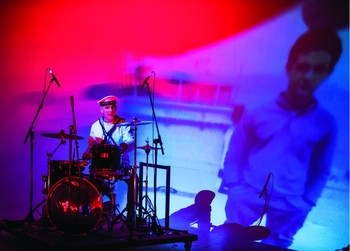
The six ex-soldiers used an array of different scenic means – wigs on stands, guitars and drums, children's toy models, photographs from historical archives and from the ex-servicemen's family archives – to expose the constructedness both of theatrical narrative and of historical narrative. The first example is provided by a scene that depicted the illegal sinking by the British Navy of the General Belgrano cruiser, which resulted in the deaths of 323 Argentinians (Fig. 1). The performers projected a framed photograph of the vessel onto the screen by means of an overhead digital projector. One performer, Rubén, who at the age of only nineteen had actually been on the ship when it was struck, narrated his memories of the terrible episode. Another dropped a cymbal that clashed to mark the impact of the missiles; yet another splashed water in a bucket to denote the flooding of the vessel, and someone yelled in Spanish, ‘Abandon ship’. During this scene, dry ice permeated the stage to conjure the fires that broke out. The three Argentinian performers then perched on the edge of a platform mounted on caster wheels, on which a drum kit stood, to represent how the marines had clung to a lifeboat for forty-one hours in freezing temperatures, coming close to dying as they waited to be rescued. Finally, strobe lighting, a raging drum solo and a screen projection of a photograph of the Belgrano shaken furiously by one of the performers symbolized the Argentinians’ fury at the fact that the ship had been attacked as it was sailing away.
Lola Arias, MINEFIELD (2016). © Tristram Kenton. Rubén Francisco Otero, drummer from the Get Back Trio, plays an aggressive solo at the point when the ARA General Belgrano, which he was on board during the conflict (pictured on the screen behind him) was struck by a British torpedo.

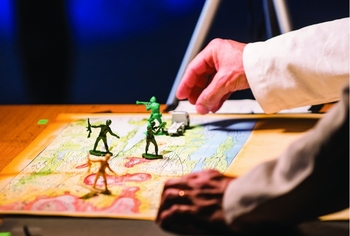
The second scene, where all six performers reconstructed an episode in which famished Argentinian soldiers whose supplies had run out went out in search of food, provides another explanation for the show's title. Five performers, standing in front of a set of shelves bearing various objects, re-created the scene. On the large white screen that dominated the back of the stage, the audience saw live-feed images of a performer, located at a table stage left, placing a small toy house on a strip of model railway grass next to a flat grey river. Other performers handled little plastic toy soldiers that depicted the troops crossing the river in the hope of finding food in the house on the other side, as another performer, stage right, created the sound effects by splashing his hand in a bucket of water. As the soldiers reached the other riverbank and traipsed through the gravel, the audience heard the crunch of footsteps in a cat litter tray. All the while, an Argentinian performer narrated the scene. On crossing the river, the soldiers found food as well as a small wooden boat, in which they transported the provisions. Once they had waded back across the river, pulling the boat, they decided to hide it, since it could come in handy in the future. As they were walking, carrying the upturned boat above their heads – an image that the performers re-created with their little toy model pieces (Fig. 2) – one stepped on a landmine. They were all killed. The performer narrating the story told of how he was witness to the scene of carnage because he was instructed by his superior to gather as many of the killed men's body parts as he could in a blanket, and drag them back to the camp. While performing this grim task, he realized that one of the dead men was his friend, since he recognized the football sock on one of the dismembered legs.
Lola Arias, MINEFIELD (2016). © Tristram Kenton. A performer moves toy soldiers around a map of the Malvinas/Falkland Islands, demonstrating the variety of means with which narrative was constructed in the play.

This narrative assemblage is significant for several reasons. In the set designed by Mariana Tirantte, the screen onto which images and video were projected was shaped like an open book standing on end. On its blank pages the veterans wrote their own versions of the war, thereby exposing self-consciously how all history is in part story. ‘I tell it like a story’, Lou said. History in MINEFIELD was presented as a ‘story’, since it was explicitly partial, subjective, affective and imaginative, rather than claiming to constitute a sequence of ‘facts’. MINEFIELD was at the same time ‘like a story’, without actually adopting the conventions of linear coherence and assured narration typical of a story or tale. Given that this was what one might classify as ‘verbatim’ theatre, testimony theatre or ‘theatre of the real’, the fact that Arias went to significant lengths not to impose words or events as fact or truth was all the more powerful.Footnote 41 At the start of the show, the audience saw on the large screen a photograph of each soldier when he had first joined up as a young man at the start of the war. Contrasted with these simple snapshots was the complex construction onstage of history, memory and story, out of objects, items of costume and a montage of photographic or filmed images. In one scene, one British and one Argentinian performer engaged in a kind of slam competition, each alternating contradictory facts about the war, respectively from online English- and Spanish-language encyclopedia entries. No single official narrative can account for war. ‘Have I got the right to speak on behalf of all those who fought?’ asked Lou.
In ‘Image and Violence’, Nancy contrasts representation, which can be violent in its intent to affirm a truth, and the artistic image: ‘In the image, the thing is not content simply to be; the image shows that the thing is and how it is. The image is what takes the thing out of its simple presence and brings it to pres-ence, to praes-entia, to being-out-in-front-of-itself, turned toward the outside’.Footnote 42 In MINEFIELD, video images alternated between live-feed close-ups of the performers’ weathered hands moving objects around the table, and historical footage from the war, where, of course, the means of production were excluded from the frame. After Nancy, one could describe how MINEFIELD replaced the assured presence of history with a ‘display’, a ‘manifestation’, an ‘exhibition’, a ‘setting-forth’ of presence.Footnote 43 While creating images of war, MINEFIELD undermined these images, thereby avoiding the violence inherent in the kinds of ideological absolute and historical certainty with which the conflict was presented to the public in Argentina and the UK, and that prevailed on both sides in populist discourses for decades after.
This exposure of the means by which stories and histories are constructed has been explored by a number of other contemporary theatre-makers. Katie Mitchell's productions with video artist Leo Warner, ranging from Waves (2008) to The Forbidden Zone (2016), and Belgian company Hotel Modern's La grande guerre (The Great War (2001)) and Kamp (2005) all deploy the specificities of theatre's medium – bodies, voices, objects and sounds that share the same space and time as the audience – to exhibit how these components can be melded into screen images that are simultaneously theatrically made onstage, and projected onto screens for the audience to watch. In Mitchell's Waves, for instance, on the screen the audience saw a video of a woman staring pensively into the middle distance through a rain-streaked window, while a voice narrated her thoughts. On the stage, we watched, simultaneously, one performer holding a pane of glass in front of another performer's face; a third performer squirting water onto the pane with a spray bottle; a fourth filming the woman's face through the wet glass, and a fifth reading from Virginia Woolf's novel The Waves. In these kinds of production, the techniques and devices that serve to create the kind of high-definition realism that habitually represents our world via the dominant televisual media that surround us are laid bare. To borrow Nancy's terms, Arias, like Mitchell or Hotel Modern, exposes the ‘violence’ of the ‘synthetic unity’ of such modes of representation practised by the dominant media. For Nancy, an assured and conclusive representation is violent, just as the authority of ideological systems is violent. Arias's DIY construction of narrative, like Mitchell's, knowingly rejects the violence of dominant political discourses, and the violently unquestioning ways in which they are represented.
Arias's playful patching of the ex-soldiers’ stories into a piece of theatre displayed all the mastery of the experienced and innovative director that she is. However, while the six men were all competent and engaging performers and musicians, they quite intentionally seemed to avoid the technical precision and athletic prowess that can typify performer training. Etymologically, virtuosity is associated with martiality. The term derives from the Latin virtuositas, meaning power, strength or efficacy.Footnote 44 The adjective virtus derives from the noun vir, meaning ‘man’ or ‘hero’, and is associated with physical courage and moral virtue, displayed especially in the context of military exercises. The virtuous person perfects normative gestures and movements to a high degree of excellence. While the term ‘virtuosity’ has now evolved to denote remarkable achievements, in the past it was associated with notions of physical force, masculinity, discipline, obedience and, inevitably, the martial. At the start of MINEFIELD, the three British soldiers in khaki T-shirts marched on in formation, sprinted on the spot, dropped to the floor, did a set of push-ups and sprang back up, before one of them reminded the others that he is fifty-seven now and has to take it easy. This was in stark contrast with the National Theatre of Scotland's production of Gregory Burke's Black Watch (2006), directed by John Tiffany, in which the disciplined bodies of the actors representing Black Watch troops, whose gestures were executed in unison with ‘military’ precision, produced a spectacle of power: power of the army over the regimented soldiers’ normalized bodies, power of the director's authority over the performers’ choreographed bodies, power of the army over the adversary, and power of the theatrical spectacle over the spectator, who is encouraged to be impressed by the show of regulated movement. The performers in MINEFIELD were no longer professional soldiers; nor were they professional actors. When three of them picked up guitars and the other sat at the drums, they resembled a bunch of mates enjoying a jam together – one critic described them as a ‘rag-tag five-piece’ and a ‘pub covers band from a mine-pitted no-man's land’.Footnote 45 The men's performances and their assembled hotchpotch of objects and images might have appeared ‘amateur’, but they were significant because they avoided the virtuosity which can be associated with the subservience of the performing body to the regulatory power of order, especially in the context of military authority and command. In MINEFIELD, the at times unassured bodies, gestures and voices of the performers, and the manner in which they cobbled together scenes from the past using toys, family photographs and scraps of clothing, thus avoided the confidence and knowability of ideologically ‘violent’ spectacles.
In Performing Remains, which treats the subject of war re-enactment, Rebecca Schneider writes, ‘The hauntingness of history, its literal in-bodied articulation, the boisterous and rattling ghosts of ancestors, and the queasy “something living” of the pastness of the past, return us to the transmission of affect in the jumping and sticky viscosity of time’.Footnote 46 By ‘jumping’, as though in a ‘time machine’, from past to present and back, fact to fiction and back, official history to personal experience and back, story to body and back, text to music and back, and stage to screen and back, MINEFIELD confronted violently defiant spectacles of war via its apparatus of appearances that simultaneously constructed and deconstructed stage narrative, and history. By laying bare spectacle at the very level of its own sign usage, MINEFIELD avoided the violence implicit in sleek spectacles of national pride or individual self-importance.
Conclusion: the part played by theatre
In an article written shortly after 9/11, which was received with no little controversy, the French philosopher Jean Baudrillard wrote, ‘The spectacle of terrorism forces the terrorism of spectacle upon us’.Footnote 47 When sensationalist images, or ‘spectacular strategies’, as Mondzain labels them – such as the spectacles of warmongering produced and propagated by state and media on both sides during the Falklands Conflict, or indeed in conflicts today – actively ‘discourage critique’ and attempt to impress their ideologies or their products on the public, they become ‘violent’ in Nancy's terms, or ‘barbaric’ in Mondzain's terms.Footnote 48 Baudrillard, Mondzain, Nancy and others in no way deny the abhorrent violence of actual acts of war and aggression. Rather, they argue that the spectacles with which wars are represented, and indeed fought, not only report on violence, but perform violence, through their at times narrowed and coercive means.
In response, I have tried to show how there is a possibility to realize the ‘violence without violence’ that Nancy advocates, in theatre. Images, icons and spectacles are not endowed with indisputable meaning, nor with the power to induce irresistible compulsion: they can be opened to multiple, sometimes incompatible, interpretations. Nancy states, ‘Violence does not play the game of forces. It does not play at all. Violence hates games, all games; it hates the intervals, the articulations, the tempo’.Footnote 49 Nancy discusses painting, photography and video. I feel, though, that it can be theatre, which is inherently ‘play’, that can foreground an innate groundlessness. Theatre can consciously be used to show the audience that its fictions are grounded in nothing more than the bodies, voices, objects, sounds and lights onstage. Since theatre is potentially composed of an assemblage of so many disparate elements, all of which were deployed by Arias and her performers in MINEFIELD – text, body, voice, costume, make-up, hair, objects, scenography, music, acoustics, lighting, video, sight, sound, smell and sensation – there is all the more potential to disperse these discrete components, to place centre stage the tears and ruptures necessary to attain a ‘violence without violence’ in art. It is all the more bold to emphasize the ‘groundlessness’ and to reject truth value in the case of documentary theatre like MINEFIELD, which creates spaces in which slogans and spectacles are blown apart, making way for more oppositional and prolonged moments of critique and debate.