Report
A 2-month-old infant, with multiple left heart obstructive lesions consisting of mitral valve stenosis, severely dysplastic aortic valve and severe coarctation of aorta status post-coarctation repair, was transferred to our institution for transplant evaluation in view of severe left ventricular dysfunction. The immediate post-operative period following CoA surgery was complicated by unexplained segmental left ventricular wall motion abnormalities and persistent severely depressed LV function with no evidence of left ventricular outflow tract or residual aortic obstruction. The patient was on maximum medical therapy for congestive heart failure with no noticeable improvement in left ventricular function.
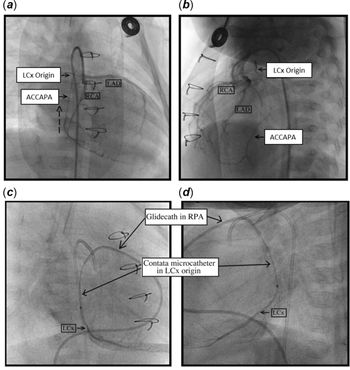
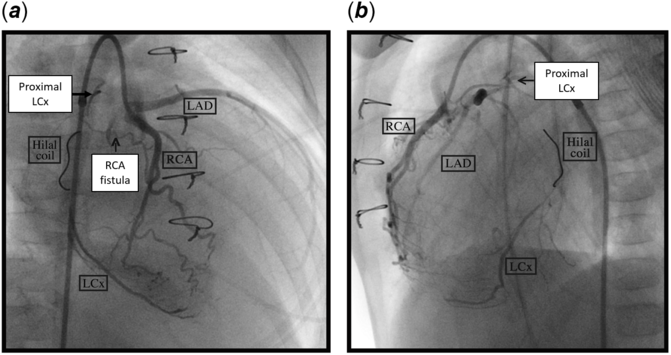
Pre-transplant cardiac catheterisation evaluation showed the anomalous circumflex coronary artery origin from pulmonary artery (ACCAPA). The origins of the right coronary and the left main coronary artery, continuing as left anterior descending, were normal. Retrograde filling of the left circumflex coronary, via collaterals from right coronary and left anterior descending arteries, with “coronary steal” to the right pulmonary artery was noted (Fig 1a and b, Supplementary videos S1, S2 and S5). Using a coaxial 4-French angled glide catheter and 2.8-French microcatheter system, the anomalous ostium of the left circumflex artery from the proximal right pulmonary artery was entered and a selective angiogram performed (Fig 1c and d). After discussions with the surgical team regarding the risks and benefits of reimplantation of the left circumflex to the aorta, a decision was made to occlude the anomalous origin of the left circumflex to stop the coronary steal to the pulmonary artery. This was accomplished with a single Hilal 18-2-2 embolisation coil™ (Cook Medical, Bloomington, IN, United States of America) advanced through the microcatheter. A 3-month follow-up angiography showed retrograde filling of the left circumflex system from right coronary and left anterior descending artery collaterals up to the previously placed Hilal coil (Fig 2, Supplementary videos S3 and S4). There was no ventricular function recovery despite maximal medical therapy for left ventricular dysfunction and the patient eventually underwent a heart transplant.
Anomalous circumflex coronary (LCX) artery origin from pulmonary artery (ACCAPA). (a and b) Aortic root angiography shows the normal origin of right coronary artery (RCA) and left coronary artery extending as left anterior descending artery (LAD) and retrograde filling of left circumflex coronary artery (LCX) with a coronary steal (direction pointed by a dotted line) to proximal right pulmonary artery (RPA). (c and d) Selective angiography of the ACCAPA with coaxial microcatheter advanced from proximal RPA. Note: Filling of the LCX artery and its branches.

Follow-up angiography 3-month post-coil embolisation of ACCAPA. Selective right coronary artery (RCA) angiogram showed retrograde filling of LCX via collaterals. Note: Hilal coil completely occluding coronary steal from ACCAPA. A trivial coronary fistula from the proximal RCA branch to the proximal LCX was noted.

We hypothesise that misdiagnosis of this very rare coronary artery anomaly, associated with Shone’s syndrome, led to inadequate myocardial protection during initial cardiac surgery, with cardioplegia bypassing the myocardium in the left circumflex distribution and causing myocardial ischaemia and dysfunction. Previous case reports have described other modalities of treatment for ACCAPA including reimplantation of the anomalous vessel to the aortic root. Reference Sarioglu, Kinoglu and Saltik1,Reference Korosoglou, Ringwald, Giannitsis and Katus2 Due to significant left ventricular dysfunction, we felt the best therapeutic option for our patient was to occlude the anomalous origin of the left circumflex artery to prevent ongoing coronary steal to help with any potential myocardial recovery and remodelling.
Supplementary Material
To view supplementary material for this article, please visit https://doi.org/10.1017/S1047951120003352.
Acknowledgements
None.
Financial Support
This research received no specific grant from any funding agency, commercial or not-for-profit sectors.
Conflicts of Interest
None.
Ethical Standards
This is a case report of a single patient. No IRB was needed per our institutional guidelines. The authors assert that all procedures contributing to this work comply with the ethical standards.