Studies from many languages with head-initial relative clauses (RCs) consistently report that subject RCs are produced in an adultlike manner more often and earlier than object RCs by children (e.g., Catalan: Gavarró, Cunill, Muntané, & Reguant, Reference Gavarró, Cunill, Muntané and Reguant2012; English: Zukowski, Reference Zukowski2009; French: Labelle, Reference Labelle1990, Reference Labelle1996; German: Adani, Shem, & Zukowski, Reference Adani, Shem, Zukowski, Stavrakaki, Konstantinopoulou and Lalioti2013; Hebrew: Arnon, Reference Arnon2010; Italian: Contemori & Belletti, Reference Contemori and Belletti2013; Guasti & Cardinaletti, Reference Guasti and Cardinaletti2003; Portuguese: Costa, Lobo, & Silva, Reference Costa, Lobo and Silva2011; Spanish: Pérez-Leroux, Reference Pérez-Leroux1995). However, in languages with head-final RCs such as Mandarin (exemplified in (1a) for subject RCs and in (1b) for object RCs), Cantonese, and Japanese, results are mixed; no asymmetry, a subject RC advantage, and an object RC advantage have all been reported (e.g., Chan, Matthews, & Yip, Reference Chan, Matthews, Yip and Kidd2011; Chen & Shirai, Reference Chen and Shirai2014; Hsu, Hermon, & Zukowski, Reference Zukowski2009; Ozeki & Shirai, Reference Ozeki, Shirai, Matsumoto, Oshima, Robinson and Sells2007; Su, Reference Su2004). These differences raise the questions of how language-specific properties influence language acquisition and development. Here we address this question by investigating the acquisition of RCs in Mandarin.
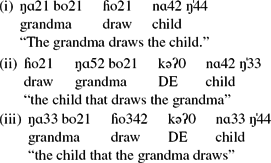
(1)

Mandarin is a subject–verb–object language with head-final RCs. As exemplified in (1), the RC linearly precedes the relative marker de and the relative head. As a result, the gap precedes the antecedent. This type of RCs is extremely rare, according to Dryer (Reference Dryer, Dryer and Haspelmath2013b)'s observations. Dryer analyzed 879 languages and found that head-initial and head-final RCs are roughly equally common among object–verb languages; however, almost all verb–object languages have head-initial RCs and only 5 verb–object languages have head-final RCs. In Dryer's data, these are Mandarin Chinese, Cantonese, Hakka, Bai, and Amis.Footnote 1 Therefore, Mandarin represents an interesting language for evaluating different theories of RC acquisition and testing how typological properties affect children's RC acquisition.
In this article, we will provide evidence that a subject RC advantage holds in the acquisition of Mandarin RCs; this will be explained in terms of a locality approach expressed in the relativized minimality framework. According to this proposal, object RCs are difficult because they feature the intervention of the subject between the relative head and its trace (Friedmann, Belletti, & Rizzi, Reference Friedmann, Belletti and Rizzi2009). The article is organized as follows. We begin with a review of previous production studies with Mandarin-speaking children. Then we present the predictions for the acquisition of Mandarin RCs in terms of the relativized minimality approach. Next, we present our two experiments, and finally, we discuss our results.
PREVIOUS PRODUCTION STUDIES ON MANDARIN RCS
As we said, results on the production of Mandarin RCs are mixed. Cheng (Reference Cheng1995) examined 27 children aged from 3 years, 6 months (3;6) to 6;3, using an elicitation task, and observed a subject preference (i.e., subject RCs vs. object RCs, 42% vs. 19%). In contrast, Su (Reference Su2004) tested 40 children aged from 5;0 to 6;5 and 31 adults, using the elicitation methodology devised by Hamburger and Crain (Reference Hamburger, Crain and Kuczaj1982) and Crain, McKee, and Emiliani (Reference Crain, McKee, Emiliani, Frazier and de Villiers1990), and did not find any preference (e.g., subject vs. object RCs, 84% vs. 88%, for children aged 5;0–5;6). These results should be considered with some caution because they were obtained with two trials for each sentence type. It has been recommended that in elicited production task at least four tokens of each sentence type should be used (Thornton, Reference Thornton, McDaniel, McKee and Cairns1996).
Hsu et al. (Reference Hsu, Hermon and Zukowski2009) tested 23 children aged from 4;0 to 6;5 and 10 adults, using an elicited production task with the help of picture presentations modeled after Hamburger and Crain (Reference Hamburger, Crain and Kuczaj1982) and developed by Zukowski (Reference Zukowski2009). They found that both children and adults produced more subject RCs than object RCs (children, 83.5% vs. 38.9%; adults, 95% vs. 79.5%). However, some of their materials were arguably problematic due to the properties of the verbs: in the subject RC elicitation task, some verbs could be used intransitively, and this could have inflated the subject advantage. For instance, (2a) was used to depict two girls in the experimental picture: one girl was singing and another girl was drawing. Then, a mouse appeared in front of one of the two girls and the experimenter asked, “Which girl is the mouse watching?” to elicit the subject RC in (2b). Here, changge and huahua could either be interpreted transitively to describe a generic activity, like “sing a song” or “draw a painting,” or intransitively as in “sing” and “draw.” The intransitive verb only requires one argument and assigns the agent theta role to its argument. In contrast, the transitive verb requires two arguments and assigns the agent and patient theta roles to its arguments. The theta-role assignment of intransitive verbs is possibly easier than that of transitive verbs. Therefore, the use of optionally intransitive verbs may enhance the production of subject RCs. By contrast, the elicitation of object RCs always involved transitive verbs, and was thus more demanding.
(2)
Chen and Shirai (Reference Chen and Shirai2014) reported an object RC advantage in early child speech, by analyzing the spontaneous production of four monolingual Mandarin-speaking children (aged 0;11–3;5). In total, they observed 34 subject RCs and 78 object RCs. Some of their examples of subject RCs are given in (3a) and of object RCs in (3b). That object RCs emerge early and are used more frequently during the period investigated in the Mandarin-learning children's speech is in contrast with the findings concerning the early spontaneous production of English-speaking children (a subject RC preference found in Diessel & Tomasello, Reference Diessel and Tomasello2000) and of Japanese-speaking children (no asymmetry reported in Ozeki & Shirai, Reference Ozeki, Shirai, Matsumoto, Oshima, Robinson and Sells2007). Although Chen and Shirai's (2014) study uncovered an early stage of Chinese children's RC production, it has some limitations. The object advantage established was merely on a numerical basis, and the complexity of the clauses was not examined. When we look at their examples, we observe lots of simplified structures, such as (3c), which is a headless RC with an intransitive verb.
(3)
To sum up, the aforementioned studies on the production of Chinese RCs are mixed and present some limitations in one way or another, thus making it hard to evaluate which preference holds in Mandarin and which is the source of difficulty in the production of RCs.
A relevant feature of children's RCs across languages is the use of a resumptive strategy, mostly involving resumptive pronouns and less frequently resumptive NPs (noun phrases; e.g., Catalan: Gavarró et al., Reference Gavarró, Cunill, Muntané and Reguant2012; English: Pérez-Leroux, Reference Pérez-Leroux1995; French: Labelle, Reference Labelle1990, Reference Labelle1996; Italian: Guasti & Cardinaletti, Reference Guasti and Cardinaletti2003). A resumptive pronoun occurs inside the RC and is related to the relative head, in that it encodes its grammatical function inside the RC, as in (4a) (example from Cheng, Reference Cheng1995); a resumptive NP is a double of the relative head and occupies the extraction site, as in (4b) (example from Hsu et al., Reference Hsu, Hermon and Zukowski2009).
(4)
Both resumptive pronouns and resumptive NPs are attested in Chinese children's production data. Cheng (Reference Cheng1995) found that children produced resumptive pronouns in subject RCs (3.2%, 4 out of 122) and in object RCs (7%, 4 out of 57); they only produced resumptive NPs in object RCs (15.8%, 9 out of 57). Su (Reference Su2004) did not differentiate resumptive pronouns and resumptive NPs and observed resumptive elements in subject RCs (3.2%, 2 out of 63) and in object RCs (8.8%, 6 out of 68). Hsu et al. (Reference Hsu, Hermon and Zukowski2009) only found RCs with resumptive NPs, with fewer instances in subject RCs (3.4%, 10 out of 296) than in object RCs (18.3%, 38 out of 208) in the child production; adults only used resumptive NPs in object RCs (1.9%, 3 out of 160). To summarize, Chinese children produce resumptive elements less often in the subject extraction site (4a) than in the object extraction site (4b). Adults also produced some resumptive NPs.
Resumptive pronouns have been discussed in the literature. Gu (Reference Gu2001) stated that resumptive pronouns are obligatory in oblique object RCs and are optional in other positions (see Ning, Reference Ning2008). Similarly, in several Romance languages, resumptive pronouns in RCs are optional/obligatory in substandard varieties (see Guasti & Cardinaletti, Reference Guasti and Cardinaletti2003, and references cited therein). Although resumptive NPs are produced by Chinese children and adults, there is thus far no systematic investigation of their status in Mandarin, and it is taken for granted that RCs with resumptive NPs are prohibited. In the light of this, it is important to clarify this issue in Mandarin.
Therefore, two issues are left open to inquiry: first, which preference is displayed by Mandarin-speaking children in the production of subject/object RCs in comparison to children speaking head-initial RCs; and second, what is the status of resumptive NPs for Mandarin-speaking children and adults, when compared to the optionality of resumptive pronouns in Mandarin.
THEORETICAL APPROACHES TO RC ACQUISITION
In the sentence-processing literature, the subject/object asymmetry is captured in terms of principles according to which a chain between a moved element and its trace tends to be established as soon as possible (e.g., the active filler hypothesis, Frazier & Flores D’Arcais, Reference Frazier and Flores d’Arcais1989; the minimal chain principle, De Vincenzi, Reference De Vincenzi1991). According to this view, a subject chain is favored because a subject trace can be hypothesized almost immediately having seen the relative head. By contrast, in the case of object extraction, it is assumed that the parser attempts to posit a subject trace, but cannot because an overt subject is present. Thus, the object chain is more difficult to build because the embedded subject blocks the parser's attempt to posit the trace; in a sense, it acts as an intervener. The notion of intervention in a dependency between a moved element and its trace figures prominently in the linguistic literature, and this has led Friedmann et al. (Reference Friedmann, Belletti and Rizzi2009) to attempt a unification between ideas stemming from the linguistic literature and those stemming from the processing literature. In particular, these authors have proposed that relativized minimality is implicated in the explanation of the subject/object asymmetry in child language (see also Adani, van der Lely, Forgiarini, & Guasti, Reference Adani, van der Lely, Forgiarini and Guasti2010; Belletti, Friedmann, Brunato, & Rizzi, Reference Belletti, Friedmann, Brunato and Rizzi2012; Belletti & Rizzi, Reference Belletti, Rizzi, Piattelli-Palmarini and Berwick2013; Contemori & Belletti, Reference Contemori and Belletti2013; Guasti, Stavrakaki, & Arosio, Reference Guasti, Stavrakaki and Arosio2012; for criticism, see Goodluck, Reference Goodluck2010).Footnote 2
Relativized minimality (RM; Rizzi, Reference Rizzi1990, Reference Rizzi and Belletti2004) is a locality constraint on dependencies within a sentence. In configuration (5), a local structural relation cannot hold between X and Y if Z is similar to X, that is, if there is a qualified intervener in the dependency between X and Y.
- (5)
a. X . . . Z . . . Y
b. Z intervenes between X and Y if and only if Z c-commands Y and Z does not c-command X (Rizzi, Reference Rizzi and Belletti2004, p. 225).
Although RM was formulated as a linguistic principle, its insights are very similar to principles formulated within the sentence-processing literature to account for the subject/object asymmetry as we sketched earlier. In this respect, Friedmann et al.'s (2009) proposal is that a dependency is harder or ungrammatical if there is a qualified intervener between the antecedent and its gap. More specifically, these authors argued that the difficulty in RC acquisition is modulated by the nature of the relative head and of the NP in the embedded clause. Under a raising analysis, the relative head is attracted by a complex attractor [+R, +NP], where R and NP express the relative feature and the lexical restriction feature, respectively. See Example (6), with the schematic featural representation given below each clause.
- (6)
a. the childi that ti draws the teacher
[+R, +NP][+NP]
b. the childi that the teacher draws ti
[+R, +NP][+NP]
In the subject RCs in (6a), the lexically restricted relative head does not cross over the lexically restricted element in the clause, that is, the embedded object, whereas, in object RCs (6b), the lexically restricted relative head has to cross over another lexically restricted element, that is, the embedded subject. In object RCs, the relative head bears [+R, +NP] features and the embedded subject bears a [+NP] feature, with the latter having a subset of the features of the former. To consider them distinct as required by RM, one has to compute the subset–superset relation, but by hypothesis, limited computational resources sometimes prevent younger children from making this computation. Accordingly, a RM violation arises, and children have greater trouble in understanding and producing object RCs than subject RCs. Note that children are not violating RM; they are just unable to compute the subset–superset relation.
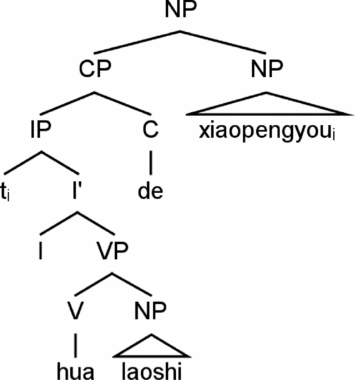
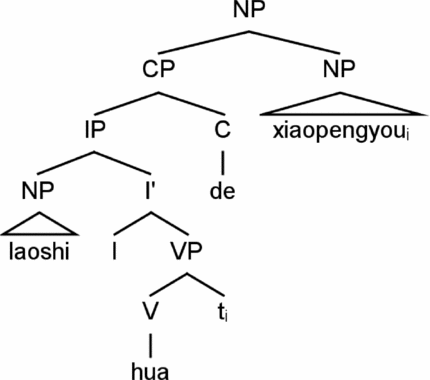
The RM approach makes precise predictions for the acquisition of Mandarin RCs, namely, it anticipates that object RCs should be also harder than subject RCs as in the head-initial RCs. Following Huang (Reference Huang1982) and Aoun and Li (Reference Aoun and Li2003), let us assume the hierarchical structure of Mandarin RCs in (7).Footnote 3 Intervention is determined on the basis of c-command, so that in a subject RC, the relative head (xiaopengyou “child”) c-commands its trace without the intervention by the embedded object (laoshi “teacher”) as shown in (7a). In contrast, as shown in (7b), in an object RC the embedded subject (laoshi “teacher”) intervenes between the relative head (xiaopengyou “child”) and its trace. To reiterate, under the raising analysis, the embedded subject has a [+NP] feature and thus it has a subset of the features of the relative head. According to the RM approach sketched above, children have problems in computing the subset relation, and thus, Mandarin object RCs are expected to be more difficult to acquire than subject RCs, as happens in other languages.
- (7)
a. Mandarin subject RCs
b. Mandarin object RCs
It could be argued that structural intervention does not matter and what counts and influences children's acquisition is linear intervention. Contrary to structural intervention, which is established in terms of c-command, linear intervention is based on precedence.
Linear and structural factors cannot be separated in head-initial RCs, for example, English RCs, but can be teased apart in Mandarin RCs. Consider the English RCs in (6) again. In subject RCs, the embedded object the teacher does not intervene between the relative head the child and its trace both linearly and hierarchically. In object RCs, the subject the teacher intervenes between them both linearly and hierarchically. Both linear and structural factors predict that, in languages such as English, subject RCs should be easier than object RCs, and this is what has been reported.
Now consider the Mandarin RCs in (1) and their hierarchical structure in (7) again. In the case of Mandarin subject RCs, as exemplified in (1a), the embedded object (laoshi “teacher”) linearly intervenes between the relative head (xiaopengyou “child”) and its trace; however, as shown in (7a), the object does not structurally intervene between the relative head and its trace. By contrast, in the case of Mandarin object RCs, as exemplified in (1b), the embedded subject (laoshi “teacher”) does not linearly intervenes between the relative head (xiaopengyou “child”) and its trace, but, as shown in (7b), it structurally intervenes between them. If only structural factors matter, we would expect object RCs to be problematic for children; but if only linear factors matter, we would expect the opposite.
Franck, Lassi, Frauenfelder, and Rizzi (Reference Franck, Lassi, Frauenfelder and Rizzi2006), based on the results of a series of production experiments on subject–verb agreement, pointed out that both hierarchical and linear intervention create interference, but they do so to different degrees. Structural intervention has stronger effects than linear intervention. If this is the case, we anticipate not only a subject advantage in Mandarin, as we said earlier, but also some mild difficulties with subject RCs in Mandarin, due to linear intervention.
In summary, the RM approach predicts that object RCs should be harder than subject RCs because of structural intervention. If linear intervention also matters, we should find some penalty in the production of subject RCs.
In this study we examine the production of RCs by children and adults with four goals in mind: (a) to investigate which acquisition pattern holds in the production of Mandarin RCs; (b) to examine how the acquisition pattern develops across ages; (c) to characterize children's difficulties, if any, by looking at the pattern of nontarget structures and errors; and (d) to show how structural and linear factors influence the production of Mandarin RCs. To these purposes, we ran an elicitation experiment with children and adults (Experiment 1) and a grammaticality judgment task with adults (Experiment 2). The latter experiment is the first grammaticality study focusing on Mandarin RCs with resumptive NPs and attempting to tease apart prescriptive grammar from the grammar of spoken Chinese in the domain of RCs.
EXPERIMENT 1
Participants
One hundred and twenty-five children and 20 adults participated in this experiment. We divided children into six groups: the 3-year-old group (N = 20, aged 3;0–3;11, M = 3;7, SD = 0.29, 10 males), the 4-year-old group (N = 24, aged 4;0–4;11, M = 4;7, SD = 0.31, 11 males), the 5-year-old group (N = 21, aged 5;0–5;11, M = 5;6, SD = 0.32, 12 males), the 6-year-old group (N = 20, aged 6;1–6;11, M = 6;6, SD = 0.29, 10 males), the 7-year-old group (N = 20, aged 7;0–7;11, M = 7;5, SD = 0.30, 10 males), and the 8-year-old group (N = 20, aged 8;0–8;11, M = 8;5, SD = 0.26, 10 males). All the children were native speakers of Mandarin Chinese who lived in Zhejiang, China. They were typically developing without language impairment or hearing deficits. All the adults (N = 20, aged 22;0–30;0, M = 26.8, SD = 2.26, 10 males) were native speakers of Mandarin Chinese who studied at the Universitat Autònoma de Barcelona.
Materials and design
RCs were elicited using a preference task modeled after Novogrodsky and Friedmann (Reference Novogrodsky and Friedmann2006). The experimenter presented two options and asked participants to respond with their preference. The method is exemplified in (8a) for eliciting subject RCs and in (8b) for eliciting object RCs.
- (8)
a. You liang-ge xiaopengyou. Yi-ge xiaopengyou qin mama. Yi-ge xiaopengyou qin baba. Ni xiang dang na-ge xiaopengyou?
“There are two children. One child kisses the mother. Another child kisses the father. Which child do you want to be?”
b. You liang-ge xiaopengyou. Baba qin xiaopengyou. Mama qin xiaopengyou. Ni xiang dang na-ge xiaopengyou?
“There are two children. The father kisses one child. The mother kisses another child. Which child do you want to be?”
There were 20 items, half aimed at eliciting subject RCs and half aimed at eliciting object RCs. To build up our stimuli, we employed 15 verbs. Five verbs were used in both conditions, that is, bao “hug,” hua “draw,” qin “kiss,” bang “help,” and la “hold hands.” Five verbs were only used in the subject RCs condition, that is, he “drink,” chi “eat,” mai “buy,” xi “wash,” and da “play,” and 5 verbs only in the object RCs condition, that is, zhui “chase,” han “call,” deng “wait,” bei “carry,” and jie “pick up.” All verbs were used transitively, with two noun phrases very familiar to children, including laoshi “teacher,” tongxue “classmate,” and family members, for example, yeye “grandpa on father's side,” nainai “grandma on father's side,” waigong “grandpa on mother's side,” waipo “grandma on mother's side,” baba “father,” and mama “mother.”
Procedure
Participants were tested individually in a quiet room in the school. The experimental items were randomized and the whole procedure was recorded with the software on an iPad.
Scoring
Responses were classified into three categories: target RC responses, nontarget RC responses, and other responses. The target responses included subject RCs like those exemplified in (9a) and object RCs like those exemplified in (9b).
(9)
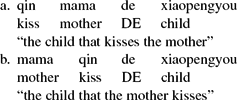
The nontarget responses included passive RCs in (10a), RCs with resumptive pronouns in (10b), and RCs with resumptive NPs in (10c). Note that, with the passive marker bei, (10a) is turned into a subject RC and is perfectly grammatical. RCs with resumptive NPs (10c) were not considered as errors here in contrast to other studies (e.g., Hsu et al., Reference Hsu, Hermon and Zukowski2009). We will dwell on resumptive NPs in Experiment 2.
(10)
Other responses were further divided into five types: (a) NP responses, (b) NP de NP responses, (c) declaratives, (d) omission de responses, and (e) reversal RCs. The first type represents a simplification, frequently occurring in the younger children. For instance, mama “mother” or mama xiaopengyou “mother child” was used to express the child that kisses the mother or the child that the mother kisses. The second type included utterances with omission of the verbs, resulting in the phrase NP de NP. For example, instead of producing an object RC mama qin de xiaopengyou “the child that the mother kisses,” they produced mama de xiaopengyou (literally, the child DE mother), corresponding to a possessive construction “the child of the mother,” because de in Chinese can also correspond to a possessive marker. In the phrase mama de xiaopengyou, the verb, qin “kiss,” is omitted. The third type was a declarative response as exemplified in (11). When a subject RC was elicited, children produced a declarative sentence with a null subject like (11a); when an object RC was elicited, they produced a declarative sentence with a null object like (11b); in both conditions, they also produced a subject–verb–object declarative sentence like (11c).
(11)
The fourth type of other responses is illustrated in (12a), and occurred when a subject RC was elicited. We can consider it as a subject RC with omission of the relative marker de, because the word order of the sentence (i.e., V-NP1-NP2 in (12a)) differs from the word order in a declarative sentence (i.e., NP1-V-NP2 in (11c)). In the object RC case, Mandarin speakers strongly prefer the inclusion of de, because the word order of the sentence ([NP1-V-(de)-NP2]) in (12b) is identical to the word order of a declarative sentence (Cheng & Sybesma, Reference Cheng and Sybesma2009). In our study, adults did not omit de at all, and we defined target sentences in a restrictive way, only including RCs with the relative marker de as in (9), but not the sentence in (12a).
(12)
The fifth type of other responses consisted in reversing the thematic role so that a subject RC rather than an object RC was produced. That is, instead of producing the object RC (9b), they produced the subject RC (9a). It was an obvious error and only occurred when an object RC was elicited.
Results
The experiment yielded a total of 2,500 responses from children and 400 responses from adults. In both cases, half resulted from the elicitation of subject RCs and half from the elicitation of object RCs. The next subsection lays out the analysis of target RC responses, and the following subsection briefly describes nontarget RC responses and then reports the analysis of RCs with resumptive NPs, followed by a comparison with the results in previous studies. The last subsection briefly reports other responses.
The analysis of target RC responses
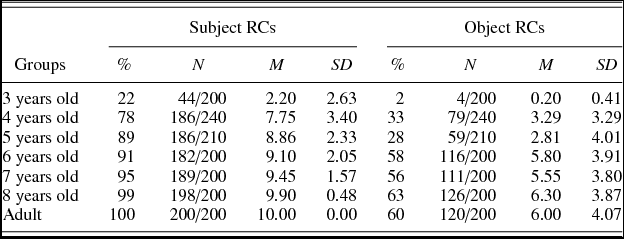
Of the 1,480 target responses from children, 985 were subject RCs and 495 were object RCs. Of the 320 target responses from adults, 200 were subject RCs and 120 were object RCs. Table 1 shows the percentages, the raw scores, the means, and the standard deviations of target responses in both conditions for all groups. Subject RCs were more frequently produced than object RCs by both children and adults, and the proportion of target responses increased with age, at least from 3 to 6 years of age.
Percentages, raw scores (N), means, and standard deviations of correct response in each age group

These observations are confirmed by the statistical analysis. We used R (R Development Core Team, 2013) and lme4 (Bates, Maechler, & Bolker, Reference Bates, Maechler and Bolker2012) to perform a series of analyses. The p values were obtained by likelihood ratio tests of a full model without the effects against a model with the effects. We fitted responses to a mixed-effects model with sentence type (i.e., subject RCs vs. object RCs) and age (i.e., 3-, 4-, 5-, 6-, 7- and 8-year-olds and adults) as fixed factors and subjects and items as random factors. The reference categories were object RCs for the sentence type factor and 3-year-olds for the age factor. The sentence type factor predicted the ability to produce RCs, that is, object RCs were significantly less likely to be produced than subject RCs, χ2 (1) = 50.87, p < .001; Wald Z = 14.62, p < .001.Footnote 4
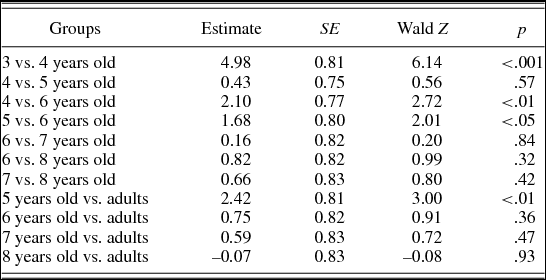
As expected, age yielded a significant effect, χ2 (6) = 97.55, p < .001. By changing the reference categories, we compared each age group with other age groups. Table 2 reports a summary of the results of the statistical analysis. We observed a robust increase in the production of target responses at age 4 and at age 6. The performance of 4-year-olds significantly differed from that of 3-year-olds, but not from that of 5-year-olds. The performance of 5-year-olds significantly differed from that of adults, while the performance of 6-year-olds did not show a significant difference from that of adults. A crucial point is that, given that the eldest child tested in previous studies was 6;5 (e.g., Hsu et al., Reference Hsu, Hermon and Zukowski2009; Su, Reference Su2004) and that 6-year-olds were not distinguished from 5-year-olds, our study is the first to report that the production of target responses does not differ between adults and 6-year-olds.
Summary of the age factor in the mixed-effects model for producing target RCs
Note: N = 2,900, SD of subjects = 2.41, SD of items = 2.21, log likelihood = –960.2.
The analysis of nontarget RC responses
Of the 196 nontarget RC responses from children, 62 were passive RCs, 41 RCs with resumptive pronouns, and 93 RCs with resumptive NPs. Of the 80 nontarget RC responses from adults, 35 were passive RCs and 45 RCs with resumptive NPs. Note that all nontarget RC responses from adults were obtained in the object RC elicitation task.
Passive RCs were only observed in the object RC elicitation: 4 passive RCs were produced by 5-year-old children and 58 were produced by 8-year-old children. This is consistent with the cross-linguistic finding that children tend to be comfortable with the use of passives at a relatively late age (e.g., Hirsch & Wexler, Reference Hirsch, Wexler, Deen, Nomura, Schulz and Schwartz2006). Adults produced 35 passive RCs. Given that the amount of passive sentences was not abundant, we only conducted a chi-square test by comparing the observed number of passive RCs with the expected number. The observed + expected data were summarized in one contingency table with one degree of freedom. Although there were descriptively more passives produced by 8-year-olds than by adults, the difference was not significant, χ2 (1) = 3.15, p > .05.
Similarly, RCs with resumptive pronouns were only observed in the object RC elicitation. The only resumptive pronoun that children produced was wo “me.” Fifteen such sentences were produced by 4-year-olds, 21 sentences by 5-year-olds, and 5 sentences by 8-year-olds. This is in line with what has been found across languages (see Contemori & Belletti, Reference Contemori and Belletti2013; Gavarró et al., Reference Gavarró, Cunill, Muntané and Reguant2012; Guasti & Cardinaletti, Reference Guasti and Cardinaletti2003; Labelle, Reference Labelle1990, Reference Labelle1996; Pérez-Leroux, Reference Pérez-Leroux1995). The children in our study did not produce subject RCs with resumptive pronouns, which has been reported in previous studies (e.g., Cheng, Reference Cheng1995), but note that the number of resumptives in subject RCs was low even in Cheng (Reference Cheng1995).
RCs with resumptive NPs were produced by children both in the subject RC (1.3%, 13 out of 998)Footnote 5 and in the object RC elicitation (11.8%, 80 out of 678), but only in the object RC elicitation by adults (22.5%, 45 out of 200). They were observed in every age group, but the majority were produced by younger children: 31 by 4-year-olds and 37 by 5-year-olds. Relatives with resumptive elements decreased from age 6 on (2 by 6-year-olds, 15 by 7-year-olds, and 7 by 8-year-olds).
To see which factors influence the production of RCs with resumptive NPs, the results were fit to a mixed-effects model with extraction site (i.e., subject vs. object) and group (i.e., children vs. adults) as fixed factors and subjects and items as random factors. The reference categories were object RCs with resumptive NPs for the extraction site factor and children for the group factor. We found a significant effect of extraction site: object RCs with resumptive NPs were significantly more common than subject RCs with resumptive NPs, χ2 (1) = 53.63, p < .001; Wald Z = –9.38, p < .001.Footnote 6 No significant effect of age was found, χ2 (1) = 1.51, p = .22.
Our data are in agreement with previous studies as far as children's production is concerned; for example, in Hsu et al. (Reference Hsu, Hermon and Zukowski2009), 4- to 6-year-old children produced 3.4% resumptive NPs in the subject condition (10 out of 296 utterances) and 18.3% in the object condition (38 out of 208). However, they differ with respect to the adults’ production. In our study, adults produced 22.5% object RCs with resumptive NPs (45 out of their 200 utterances in the object RC elicitation), while in Hsu et al.'s study, this production was 1.9% (3 out of 169 utterances). We argue that this discrepancy is partly due to the different tasks employedFootnote 7 and the smaller number of participants in Hsu et al.'s study (10 adults vs. 20 adults in ours).
We also examined the individual performance to see if every participant consistently produced resumptive NPs. We counted the number of participants who produced subject and object RCs with resumptive NPs at least once. In total, there were 8 (out of 125) children who produced resumptive NPs in subject RCs, 28 (out of 125) children who produced resumptive NPs in object RCs, and 9 (out of 20) adults who produced resumptive NPs in object RCs. In addition, we counted the number of participants who produced them at least five times (out of 10). Regarding subject RCs with resumptive NPs, 1 (out of 20) 7-year-olds produced them more than five times. Regarding object RCs with resumptive NPs, 3 (out of 24) 4-year-olds, 4 (out of 21) 5-year-olds, and 4 (out of 20) adults produced them at least five times. This observation indicates that some individuals allow resumptive NPs freely.
The analysis of other responses
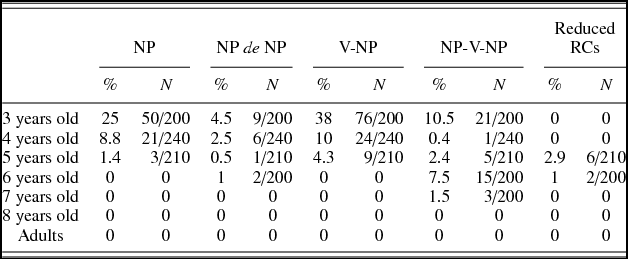
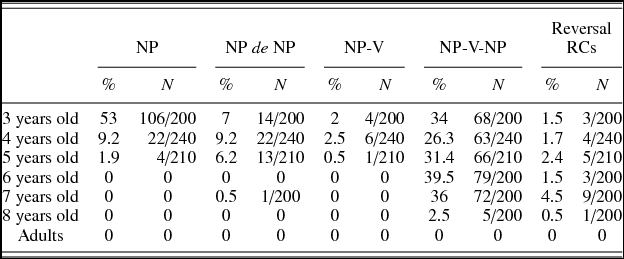
To investigate what children do when they fail to produce RCs, we examined the different types of responses (including errors) in our study. Table 3 and Table 4 provide the percentages and number of other responses in each age group. Adults did not produce any sentence in this category.
Percentages and total number of different errors in each age group in the subject RC elicitation
Note: V-NP, NP-V-NP, and Reduced RCs, a declarative sentence with a null subject, a declarative sentence, and subject RCs with omission of de, respectively.
Percentages and total number of different errors in each age group in the object RC elicitation
Note: NP-V, a declarative sentence with a null object.
First, younger children typically answered with an NP,Footnote 8 an NP de NP, and a declarative sentence with a null subject or a null object (V-NP and NP-V, respectively). As we can see in the two tables, the NP and NP de NP responses were more common in the object RC elicitation than in the subject RC elicitation. In contrast, the NP-V responses in the object RC elicitation were less frequent than the V-NP responses in the subject RC elicitation.
We fitted responses to a mixed-effects model with condition (i.e., subject vs. object RC elicitation) and age (i.e., 3-, 4- and 5-year-olds) as fixed factors and subjects and items as random factors. As for the NP responses, we found a significant main effect of condition, χ2 (1) = 19.09, p < .001; Wald Z = –4.59, p < .001,Footnote 9 and age. There was a significant decrease from age 3 to age 4, χ2 (2) = 38.15, p < .001; Wald Z = –4.16, p < .001,Footnote 10 but not from age 4 to age 5 (Wald Z = –0.63, p = .53). As for the NP de NP responses, a significant effect of condition was found, χ2 (1) = 13.29, p < .001; Wald Z = –3.97, p < .001,Footnote 11 but not of age, χ2 (2) = 0.86, p = .65. As for the V-NP and NP-V responses, a significant effect of condition, χ2 (1) = 35.21, p < .001; Wald Z = 7.12, p < .001,Footnote 12 and age were found. There was a significant decrease from age 3 to age 4, χ2 (2) = 30.57, p < .001; Wald Z = –3.90, p < .001,Footnote 13 but not from age 4 to age 5 (Wald Z = –1.07, p = .29).
Second, declarative sentences (NP-V-NP) were very common, especially when object RCs were elicited, and especially in children from 3 to 7 years of age. The statistical analysis supported this observation. We fitted responses to a mixed-effects model with condition (i.e., subject vs. object RC elicitation) and age (i.e., 3-, 4-, 5-, 6-, 7- and 8-year-olds) as fixed factors and subjects and items as random factors. Children were significantly more likely to use declarative sentences when they failed to produce object RCs than subject RCs, χ2 (1) = 55.91, p < .001; Wald Z = –13.58, p < .001.Footnote 14 As for the age factor, the only significant decrease was observed from age 7 to age 8, χ2 (5) = 29.68, p < .001; Wald Z = –3.09, p < .01.Footnote 15 No significant decrease was observed across other age groups.Footnote 16
Third, as shown in Table 3, subject RCs with omission de were very rare, with only eight sentences being observed in the subject RC elicitation and only being produced by children at 5 and 6 years of age.
Fourth, as shown in Table 4, reversal RCs were observed in every age group, but they were very rare in contrast to what are reported in research on other languages (e.g., Catalan: Gavarró et al., Reference Gavarró, Cunill, Muntané and Reguant2012; Italian: Guasti & Cardinaletti, Reference Guasti and Cardinaletti2003).
In sum, the results suggest that subject RCs are targetlike sooner than object RCs, and the response pattern of the 6- and 7-year-olds differed from that of the 8-year-olds (e.g., the declarative response was still common in the former age group, but not in the latter age group), although their production of target RCs did not differ.
Summary
Our findings can be summarized as follows. First, the subject/object asymmetry was observed in children and in adults, with an advantage for subject RCs, as predicted by the RM approach. Second, object RCs were transformed into subject RCs through passives by 8-year-old children and adults, in a similar way. Third, children used resumptive pronouns, while adults did not. Although this is in line with what has been found in other studies, we must note that the amount of resumptive pronouns in Chinese seems to be lower than in other languages. Fourth, both children and adults produced RCs with resumptive NPs, and no difference was observed between children and adults (in clear contrast with what has been found in other languages). Children showed the same pattern as in previous studies: they produced more resumptive NPs in the object extraction site than in the subject extraction site. In contrast, adults produced them only in the object extraction site, but their occurrence was much more frequent than in previous studies. The use of resumptive NPs may be the result of an error that adults inadvertently made or an option in the spoken language. Because RCs with resumptive NPs are forbidden in prescriptive grammar, we ran a grammaticality judgment task with adults to establish whether they are an option in their grammars.
EXPERIMENT 2
Our results in Experiment 1 showed that adults produced RCs with resumptive NPs. Although this possibility is banned in prescriptive grammar (Cheng, Reference Cheng1995; Hsu et al., Reference Hsu, Hermon and Zukowski2009), our data suggest that they may be licit in spoken Chinese. In Experiment 2, we tested this possibility using a grammaticality judgment task. In particular, we attempted to determine whether native speakers of Mandarin Chinese accept RCs with resumptive NPs.
Participants
Eighty undergraduate students (M = 20;9, SD = 0.95, aged 18;1–23;0, 16 males) volunteered to participate in the experiment. All were native speakers of Mandarin Chinese and studied in Hangzhou Normal University.
Materials and design
We prepared 12 sets of sentences including four variants for a total of 48 sentences. Each set included subject and object RCs with or without resumptive NPs, as exemplified in (13). To build up our stimuli, we employed 12 reversible verbs: bao “hug,” hua “draw,” qin “kiss,” bang “help,” zhui “chase,” bei “carry,” han “call,” jiao “teach,” kan “look at,” xuan “choose,” pai “photograph,” and qian “hold hands.” Of these, 7 verbs appeared also in Experiment 1.
(13)
The target sentences were split into four lists, with each list including one sentence from each of the 12 sets using a Latin square design. All sentences had a length of 11 characters. In order to make sentences with the same length, an adjective, for instance, piaoliang “pretty” in (13a), was added before the head noun, namely, sunnü “granddaughter.” In addition, each item was combined with 12 filler sentences.
Each sentence was judged on a 5-point scale (1 = completely acceptable, 2 = acceptable, 3 = I am not sure, 4 = unacceptable, and 5 = completely unacceptable). In order to avoid an influence of the order of scale, half of the participants were asked to judge sentences with a reverse order (viz., 1 = completely unacceptable rather than completely acceptable).
Procedure
Stimuli were presented in a randomized order. The participants were tested orally (also to avoid the impact of the standard writing conventions), and they recorded their responses on an answer sheet.
Scoring
As indicated above, half of the participants judged sentences with the scale, from 1 = completely acceptable to 5 = completely unacceptable, and the other half judged with the reverse order. There was no order effect, and thus we transformed all the responses to the scales with 1 = completely acceptable and 5 = completely unacceptable.
Results
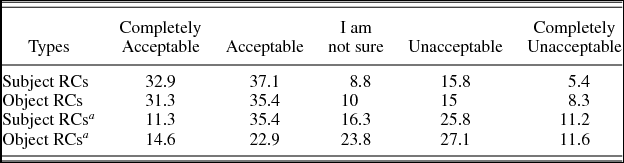
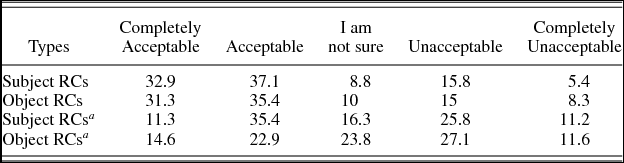
Table 5 reports the distribution of responses for each sentence type. As expected, the acceptance rate of RCs with gaps was higher than that of RCs with resumptive NPs. However, adults accepted RCs with resumptive NPs to some extent.
The distribution (%) of responses for each sentence type
aWith resumptive NPs.
We fitted responses to the model with resumption (i.e., RCs with gaps vs. RCs with resumptive NPs) and extraction site (i.e., subject vs. object) as fixed factors and subjects and items as random factors. The reference categories were RCs with gaps for the resumption factor and object for the extraction site factor. We found a significant effect of resumption, χ2 (1) = 72.21, p < .001,Footnote 17 which indicates that RCs with resumptive NPs were less likely to be accepted as compared to RCs with gaps. As for the extraction site, we did not find a significant difference, χ2 (1) = 1.64, p = .20. Therefore, when we considered the individual performance, we did not distinguish between subject RCs and object RCs.
We examined the individual performance for judging RCs with resumptive NPs. There were 9 (out of 80, i.e., 11.3 %) participants who accepted them all the time (including “completely acceptable” and “acceptable” responses), and 8 (out of 80, i.e., 10%) participants who rejected them all the time (including “completely unacceptable” and “unacceptable” responses). In addition, there were 51 (out of 80, i.e., 63.8%) participants who accepted this structure from one to five times.
Summary
To sumamrize, the gap strategy was preferred as shown by the statistical analysis. However, at the individual level analysis, there were a considerable number of participants who accepted RCs with resumptive NPs. The results are not different from what we have found in production: RCs with gaps were produced more than RCs with resumptive NPs, but there were a number of participants who employed the resumptive strategy.
GENERAL DISCUSSION
Using an elicitation task (Experiment 1), we found a clear subject advantage for RCs in children that persists as children grow older. The same asymmetry was found among adults. Unlike what happens in other languages, RCs with resumptive NPs were produced by children in each age group and by adults. Using a grammaticality judgment task (Experiment 2), we found that, for many native speakers of Mandarin Chinese, RCs with resumptive NPs are acceptable in spoken Chinese, inconsistent with the prescriptive grammar. In this section, we first discuss the subject/object asymmetry and then turn to our finding on Mandarin RCs with resumptive NPs.
As predicted by the RM approach, children produced more subject RCs than object RCs. In the former structure, there is no structural intervener between the relative head and its trace, while there is a structural intervener in object RCs between the relative head and its trace, that is, the embedded subject. In particular, as illustrated earlier in (7b), the relative head bears [+R, +NP] features and the embedded subject bears the [+NP] feature, that is, a subset of the features of the relative head. In the adult system, RM applies when the intervener is identical in features with the target (and trace). In order to establish that the relative head and the embedded subject are not identical, one needs to compute a subset relation in the case of RCs. However, this computation is argued to be too demanding for children, who sometimes fail and treat the intervener as sufficiently similar to the target and its trace. Being similar, RM applies, and the structure is not produced or is simplified. As children grow older, their computational resources increase and they become able to compute the subset relation (Belletti & Rizzi, Reference Belletti, Rizzi, Piattelli-Palmarini and Berwick2013). As a consequence, object RCs become more accessible to them.
In line with what has been found in studies in other languages, our children circumvent the intervention problem with different strategies depending on their age and on the syntactic resources they are endowed with; for example, the younger children mainly resort to the simplification strategy (the NP, NP de NP, NP-V, and V-NP responses), while the older children adopt passive RCs as adults. In addition, resumption was generally adopted by children across all age groups. Four- and 5-year-olds showed a similar preference for resumptive pronouns and resumptive NPs. From age 6, children's resumptive responses decreased; this change may be related to the exposure to formal instruction, which starts at 6 years (Guasti & Cardinaletti, Reference Guasti and Cardinaletti2003). Note that with respect to resumptive NPs, although the proportion of responses decreased, many older children still produced them. Given that adults produced them as well, this is not unexpected. As for the adoption of the resumptive strategy, we assume with McKee and McDaniel (Reference McKee and McDaniel2001) that it stems for the production system's inability to keep track of the antecedent-trace relation. This happens in Mandarin RCs because the trace linearly occurs before the antecedent, and more frequently in the object than in the subject condition, because the trace in the former is structurally deeper than that in the latter. Notice that a linear account would predict just the opposite, because the trace is linearly closer to the antecedent in object RCs than in subject RC. Therefore, we propose that structural effects play a greater role than linear effects, in line with Franck et al. (Reference Franck, Lassi, Frauenfelder and Rizzi2006).
Regarding adult production (Experiment 1) and their grammaticality judgments (Experiment 2), we found a coherent picture: adults produced RCs with resumptive NPs and, expectedly, they accepted them, with variability across participants. One may think that accepting the resumptive NP structure is based on comprehensibility. As stated in the literature, there are several factors affecting acceptability judgment such as processing factors and grammatical constraints (e.g., Hofmeister, Casasanto, & Sag, Reference Hofmeister, Casasanto and Sag2014). In the current study, our main aim was not to investigate how these factors affect our results, but to investigate whether Mandarin-speaking adults accept RCs with resumptive NPs. As our results showed, these structures are not ruled out as ungrammatical by a number of participants interviewed. Thus, it is not surprising that they emerged in the spoken language. This coherent fact indicates a certain tension between prescriptive grammar and their internalized grammar. All in all, we propose that RCs with resumptive NPs are more targetlike than previously thought, inconsistent with the prescriptive grammar, which claims that they are errors.
In line with studies on substandard varieties of spoken Italian language (Guasti & Cardinaletti, Reference Guasti and Cardinaletti2003), resumption has recently been found in wh-questions in Italian Sign Language (Branchini, Cardinaletti, Cecchetto, Donati, & Geraci, Reference Branchini, Cardinaletti, Cecchetto, Donati and Geraci2013). In their corpus data, they found 13% samples in which the wh-phrase moves to the right and the trace in situ is also pronounced (notice that Italian sign language is subject–object–verb).
RCs with resumptive NPs are referred to as double-headed RCs in the literature (Cinque, Reference Cinque2013; Dryer, Reference Dryer, Dryer and Haspelmath2013a). This structure is allowed in some languages such as Kombai and Yagaria. As exemplified in (14), RCs in Kombai “have both an external head noun and a noun corresponding to the head noun inside the relative clause” (Dryer, Reference Dryer, Dryer and Haspelmath2013a). Thus, the use of resumptive NPs by Mandarin speakers results in the adoption of a structure attested in other languages.
(14)

To conclude, the results in this study are twofold. First, we have observed a clear subject advantage in the production of Mandarin Chinese RCs in line with other cross-linguistic findings, as predicted by the RM approach. Second, in contrast to the literature claiming that RCs with resumptive NPs are only a strategy used by children, we found that, presumably due to specific characteristics of Mandarin Chinese, namely, the trace precedes the antecedent, resumptive NPs are an option in Mandarin RCs for adults as well. We confirmed this through a grammaticality judgment task, in which adults were observed to accept resumptive RCs to a certain extent.
ACKNOWLEDGMENTS
Many thanks are due to the participants in the study. We are also grateful to Meilian Zhang, Yanmei Zhang, Shuangling Hu, and Haibo Xu for their help in running experiments; to Meilian Zhang and Wenjun Zhang for their help in obtaining permission to work in Zhourang Kindergarten, Zijin Kindergarten, and Zhourang Center Primary School; and Adriana Belletti, Carlo Cecchetto, Guglielmo Cinque, Luigi Rizzi, and our reviewers for their valuable advice and comments. We also acknowledge the China Scholarship Council and Project FFI 2011-29440-C03-03 (to Centre de Lingüística Teòrica and Universitat Autònoma de Barcelona) for funding.