Introduction to the Controversy
On September 30, 2005, the Danish newspaper Jyllands-Posten printed 12 editorial cartoons, several of which contained caricatures of the Islamic Prophet Muhammad. This publication sparked a controversy that began in Denmark and spanned the globe. The cartoon publications stemmed from an article discussing the difficulty in finding illustrators for a book on the life of the Prophet Muhammad. According to the book's author, cartoonists refused contract out of fear of retaliation from the Muslim community, citing the example of the 2004 murder of Theo Van Gogh, a Dutchman, for making the documentary Submission, a film focused upon the position of women in Islam.1
For a report on the murder see: http://news.bbc.co.uk/1/hi/entertainment/film/3975211.stm.
For more information on the discussions and debate surrounding self-censorship it is worth noting that on September 17, 2005, an article ran in the Danish newspaper Politiken titled “Dyb angst for kritik af islam” (Profound fear of criticism of Islam) that precipitated wider discussions and events (http://politiken.dk/). Equally important was Flemming Rose's opinion piece “Why I Published Those Cartoons” in the Washington Post (Sunday, February 19, 2006, detailing the events leading up to the publication as well as his intentions (www.washingtonpost.com/wp-dyn/content/article/2006/02/17/AR2006021702499.html).
For an interview with Rose where he expresses his views in greater detail see www.msnbc.msn.com/id/11179140/site/newsweek. Also see his editorial in the Washington Post where he states that the cartoons were an attempt at integrating Danish Muslims into mainstream Danish society, where everyone's religions are treated in a satirical manner: www.washingtonpost.com/wp-dyn/content/article/2006/02/17/AR2006021702499.html.
A month after the publication of the 12 cartoons, Danish Imams and 11 ambassadors from Muslim countries petitioned the Danish government asking for its position on and against the cartoons.4
For a copy of the petition see www.filtrat.dk/grafik/Letterfromambassadors.pdf.
Several newspapers around the world, including a few in the United States, published the cartoons. See Shawn Healy's article in this symposium for more information on the main-stream and university newspapers who printed the cartoons. Among the European nations in which newspapers published the cartoons were: Austria, Belgium, Bulgaria, Finland, France, Germany, Greenland, Iceland, Italy, Netherlands, Norway, Spain, Sweden, and the United Kingdom.
It is difficult to determine the exact number of individuals killed. An independent web site, www.cartoonbodycount.com, claims to have kept track of the number of individuals killed, listing the total at 139. The numbers appear to have been collated through newspaper reports of lives lost. The deaths were, in most part, non-targeted protestors who were killed in police violence or in the frenzy of the mob. Some of the deaths were of innocent bystanders to the violence and uprising.
This paper stems from a study that I initiated in an undergraduate research methods course as a means to help students practice survey design skills and gain knowledge collecting survey data through experiential learning. As the cartoon controversy approached its zenith in the early part of 2006, I assisted my students in the design of a survey instrument with the purpose of investigating public sentiment in and around metropolitan Washington, D.C. in response to the violence and protests following the cartoon publications. The study aimed to seek greater understanding of the social significance, the reaction to protest, ideas of censorship, and the political significance of this event. In particular, the study set out to find answers to the following questions: 1) What were the sentiments and responses of Washingtonians regarding the printing of the cartoons? And 2) What was the impact of religious affiliation to these responses?
Scholarly Understanding of the Events
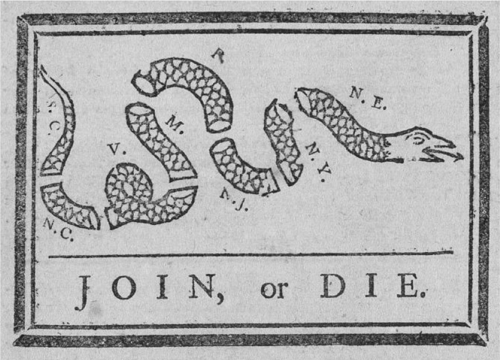
These particular cartoons, like others, are intriguing political discourse that reflects cultural and social beliefs. The media has a long history of transmitting political discourse in the United States. The first example of a U.S. political cartoon conveying a strong message was Benjamin Franklin's 1754 sketch of a severed snake with the caption “Join, or Die” (each of the eight segments represented colonies, with the head representing a united New England; Figure 1). Since most people were illiterate at the time, the image itself sent a powerful reminder that should the colonies fail to join forces to fight against the Indians and the French, they would meet defeat. From that point forward, the media took on a powerful role in delivering political discourse and for centuries has operated under a certain degree of freedom; however, rights do not come without limits or consequences.

Image courtesy of the Library of Congress.
Most media operate under highly complex codes of ethics (Hafez 2002). These codes of ethics are ultimately impacted by what could be considered “good” journalism, yet, determining what comprises “good” journalism is laden with multiple meaning and influenced by culture and religion. Furthermore, each culture establishes its own level of freedoms and artistic expression. Most recently, Reporters Without Borders has concluded that Denmark ranks first in the world in their Freedom of the Press Index, while Muslim countries fall near the bottom of the world rankings (Reporters Without Borders 2005). Nonetheless, finding meaning in such indexes or rankings is a complicated and complex undertaking, and ultimately says little about journalistic ethics.
In order to understand the issue at hand, it may be helpful to look at the roots and origins of the words “caricature” and “cartoon.” The word “caricature” has Italian origins stemming from the word caricare which means to load or exaggerate. Dictionaries define it as a deliberate exaggeration or pictorial representation meant to produce comic or grotesque effect. Similarly, “cartoon” is defined as a humorous or stereotypical representation often accompanied by caption. For that reason, a reasonable person could argue that the 12 depictions published could have been both caricatures and cartoons. Moreover, depending upon one's culture and religion, the interpretation of those depictions could reasonably have varied between humor and blasphemy. The political discourse conveyed in the depictions, while possibly meant to be humorous, was not fully received as such. Cultural anthropologist Clifford Gertz has long warned that humor rarely crosses cultures; therefore, if Gertz is correct, the world is growing ever more complicated as societies embrace greater cultural diversity.
Freedom of Expression and Multiculturalism
The current cartoon controversy has pitted freedom of expression against principles of multiculturalism. It begs the questions: When is satire oppressive? Too offensive? And under what conditions, if at all, should the media be expected to exercise responsible self-censorship? While many artists would be revolted by the idea of restraint and adjustment to others' value systems, a conflict such as this calls into question sensibilities, freedoms, respect, and understanding.
Political philosopher and historian Sir Isaiah Berlin popularized notions of liberty that stressed costs and benefits, controls and discipline. Berlin stressed that freedom without consideration of the values of others was dangerous and could result in violence, injustice, and cruelty. His philosophy on ethical thought and value pluralism weighed the importance of relationships with others and the evaluation of how we treat one another. He noted the dangers of utopian views and emphasized the need for measured political pragmatism. Ronald Dworkin, while critical of Berlin's work, promoted a similar broad notion of liberty in his theory of equality. Like Berlin, Dworkin's theory discussed options and values, and respect and sensitivity toward others. In this vein, globalization has yielded a pluralistic multicultural world interconnected by the Internet, satellites, cell phones, and emerging media. This increasingly borderless world demands increased sensitivity, respect, and tolerance toward others' beliefs and values systems, even when such tolerance includes experiencing images or words that may be insulting.
Defenders of freedom of expression have weighed-in on the current controversy from many diverse perspectives. Art Spiegelman, a cartoonist for the New Yorker asserted in the Nation that people have a right to insult others, even if it stirs discomfort because discourse need not always be polite.7
To read the editorial interview, go to: www.thenation.com/doc/20060306/interview.
Method and Findings
This study utilized both qualitative and quantitative approaches in a triangulated effort to understand the complex issue of U.S. public perception of the Danish cartoon controversy and its aftermath. Undergraduate students developed a 30-question paper-and-pencil survey and collected data over a one-week period (February 17–23, 2006) in various random locations in Washington, D.C. At this point in time, the furor over the initial publication and extensive reprinting of the cartoons had resulted in mass riots, bomb threats, deaths, boycotts, and the evacuation of embassies. The controversy was front-page news in newspapers nationwide as well as lead stories on network TV news. In total, 57 survey instruments were returned.
Thirty female and 27 male Washingtonians participated in the survey of which 60% reported having completed a college education. When religious affiliation was sampled, 60% reported they were Christian, 16% were Muslim, 19% claimed no religion, and 5% reported being non-Christian, -Buddhist, and -Hindu. When asked to report where participants initially viewed the cartoons, Christian participants and those reporting no religious affiliation first viewed the cartoons on the survey instrument, whereas Muslims, Hindus, and Buddhists first saw the cartoons on the Internet and in newspapers. Of the 57 participants, only three (two Muslims and one Christian) reported never viewing the images, and refrained from viewing them on the instrument.
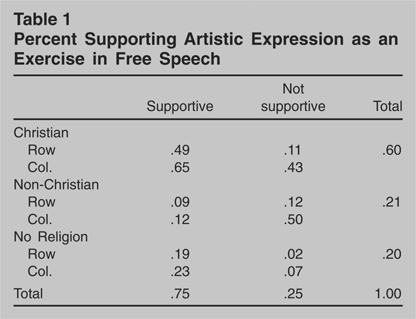
When respondents were analyzed by religious affiliation, 73% of Christians and 82% of non-religious peoples believed that religious cartoons were acceptable while 67% of non-Christians (Muslims, Hindus, and Buddhists) felt such publications were not acceptable. A majority of all respondents (84%) reported that democracy as a legal framework demands respect for others, yet 74% of all participants reported that the publication of the cartoons was an exercise in free speech (Table 1). Christian respondents were two times more likely than Muslims, Hindus, and Buddhists to view the publication of the cartoons as an exercise in free speech. Muslims, Hindus, and Buddhists on the other hand, were more likely to indicate that such cartoons could never be considered an exercise of free speech.
Percent Supporting Artistic Expression as an Exercise in Free Speech

Free speech and respect aside, more than half of the respondents felt that the cartoons were insensitive (53%), insulting (63%), and blasphemous (51%). Religion was not found to impact the respondents' view that the cartoons were insensitive or insulting; however, non-Christians (Muslims, Hindus, and Buddhists) were 20% more likely to report the cartoons as blasphemous. Eighty-four percent of all participants supported editorial censorship of such publications, with non-Christians reporting a stronger support of such censorship.
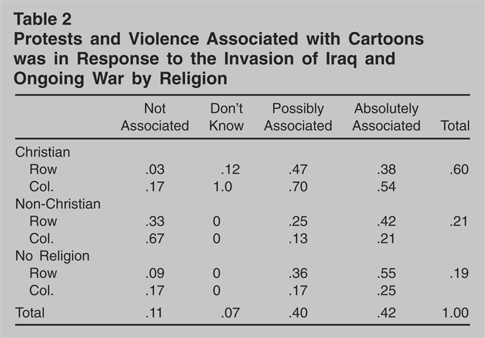
Over 80% of all those surveyed felt that the violent protests were, in part, a response to the war in Iraq, but when respondents were analyzed by religious affiliation, non-Christians were 91% more likely to report that the protests had no association to the ongoing Iraq War (Table 2). Only one Christian and one individual with no religious affiliation concurred that the protests were not associated with the war.
Protests and Violence Associated with Cartoons was in Response to the Invasion of Iraq and Ongoing War by Religion

Nearly all respondents reported that the cartoon publications and resulting controversy represented a culture clash (95%). Over 82% of the respondents felt that protesting was an acceptable form of response, but three-quarters felt that destruction of Western property was not acceptable. Eighty-eight percent responded that death associated with protests was not warranted. When controlling for religion, Christians were 67% more likely than non-Christians to support the destruction of Western property, and individuals with no religious affiliation were 85% more likely to support destruction of Western property. Non-religious individuals were 70 times more likely than Christians and non-Christians to report that death associated with protests was warranted. The majority of all respondents supported nonviolent protests (88%), yet over half were unaware of the nonviolent protests and nearly all (90%) reported seeing only reports focused upon violent protests.
Clash of Cultures or Provocation?
These findings both confirm and confront many of the assumptions arising out of the cartoon controversy, and demonstrate the problems and challenges facing multicultural pluralistic societies. The publication of these cartoons represented a visual discourse which simultaneously challenged beliefs and biases, perpetuated beliefs and biases, and evoked strong reaction. These images have caused offense to many Muslims, and in doing so, united Islamists worldwide in religious solidarity. Some of this solidarity spread in the form of violent riots, property damage, and death. Images of the uprising were broadcast worldwide, fanning the flames of bias and stereotypes and adding additional fuel to the belief that Islam and violence are interconnected. Effectively, in the imitation of art by life, the satirical cartoonists were proved correct.
The media chose to focus upon the most violent protests and resulting deaths while nearly ignoring nonviolent protests and boycotts. The spoils of a few marred the masses and served to reinforce stereotypes. In fact, a Washington Post-ABC News poll (March 2–5, 2006) conducted shortly after the unrest began found that a majority of Americans believed that Muslims are disproportionately prone to violence and extremism: A view that has grown significantly since 2002.9
To view the entire poll, go to: (www.washingtonpost.com/wp-srv/politics/includes/postpoll_iraqwar_030606.htm), see questions 28–32.
The responses in this survey, while small, mirrored those in other polls and surveys conducted around the same time in speaking about the social significance of these events. A majority of all respondents were likely to find the depictions as insensitive, insulting, and blasphemous, yet overwhelmingly they rejected censorship and sided with freedom of expression. In understanding this response, participants were more likely to report that the events could be the result of a clash of cultures, a finding also reported in surveys conducted in Spain10
See Instituto Opina—the survey was a telephone interview with 1,000 Spanish adults conducted on February 16, 2006, with a reported margin of error of 3.1%.
The Washingtonians included in this study reflect a diversity of opinion largely segregated by religion and culture. Furthermore, this divide was also reflected in the difference of opinion regarding the association of the protests to the War in Iraq. Christians were overwhelmingly more likely to make an association; Non-Christians were clear that there was little to no association. Further differences indicative of religious affiliation arose out of perceptions of insult, insensitivity, and blasphemy. Christians perceived the Muslim response as more about freedom of expression, possible retaliation to the War in Iraq, and feelings of Western oppression and cultural difference. The results of this study mirror the diversity of opinion found worldwide.
Whether the cultural editor of Jyllands-Posten meant to provoke the Muslim community or simply meant to stimulate nationwide debate on censorship, his understanding of the importance of Muhammad to Islam was grossly miscalculated. As some media sources celebrate freedom and democracy by unhindered publication of artistic expression, this controversy raises questions about how one reconciles artistic freedom, freedom of expression, and the interconnectivity of pluralistic societies. While freedom has limits, freedom also calls for the consideration of others' values and tolerance even when such tolerance involves images that offend. Subsequently, as the world becomes an interconnected multicultural community, editors will face greater challenges in balancing political correctness with the impacts of using metaphorical images and diction.