Majority of the children in the Third World do not have access to treatment for congenital or acquired heart diseases, as the priorities in health care are different from the developed countries.Reference Kumar and Tynan 1 – Reference Tchervenkov, Jacobs and Bernier 4 Catheter interventions or cardiac surgery procedures for congenital or acquired heart diseases are expensive, because of the installation and maintenance costs of the expensive equipment, the requirement of dedicated trained personnel, and the need to stock a large inventory of expensive hardware, both for surgery and for interventions.Reference Kumar and Tynan 1 , Reference Hewitson, Brink and Zilla 5 , Reference Rao 6 In the past, cooperation with developing countries mainly focused on transferring a limited number of these patients to sophisticated western centres to offer surgical or catheter treatments.Reference Leblanc 3 , Reference Tchervenkov, Jacobs and Bernier 4 , Reference Kalangos 7 However, treating children in their own environment is more cost effective and economical compared with transferring a smaller number to western centres.Reference Leblanc 3 , Reference Köhler, Schierbaum and Konertz 8 If a local unit is established with trained personnel, then a larger population can receive specialised paediatric cardiac treatments. Short-term medical missions, supported by their institutions or by charitable organisations, may be a reasonable strategy of providing specialised medical care to children in the developing countries.Reference Vastag 9 – Reference Novick and Di Sessa 12 The limitations of such a strategy include a lack of a sustainable programme with a small number of patients only being treated during the small number of visits by missions. However, to produce a sustainable programme, the optimal strategy should involve the training and education of the local teams, in addition to the development of the building and infrastructure.Reference Tchervenkov, Jacobs and Bernier 4 , Reference Köhler, Schierbaum and Konertz 8 Establishing specialised paediatric cardiac centres is also evolving as an achievable target.Reference Yacoub 2
The Cardiac Center in Addis Ababa, Ethiopia, is a charity centre established and equipped by the Children’s Heart Fund of Ethiopia, in collaboration with the University of Addis Ababa and the Chain of Hope (United Kingdom) and opened in January, 2009. The centre has two catheterisation laboratories equipped with old second-hand Siemens single-plane C-arm angiographic machines with one slave monitor and one RGB haemodynamic monitor. There is one power injector for contrast injections shared between the two catheterisation laboratories. The centre has also two operating theatres and a 12-bedded, well-equipped intensive care unit.
Before January, 2009, there was no paediatric cardiac catheterisation or cardiac surgery service anywhere in Ethiopia. Since the opening of the Cardiac Center, surgical and catheterisation teams from different countries have visited the centre with the aim of delivering surgical and catheter-based treatments to paediatric cardiac patients and to support the development of a sustainable programme. This study aims to focus on and report our experience with the implementation of interventional paediatric cardiology service in a resource-limited setting.
Materials and methods
Since 2009, teams supported by the Chain of Hope, United Kingdom, and Spanish medical volunteers from hospitals in Madrid, Spain, have travelled twice a year, undertaking four missions each year from the two countries. Furthermore, other teams from different countries have also undertaken visits to the centre during the same period. In addition to treating the patients, the visits were aimed at transferring knowledge and developing the skills of the local catheterisation laboratory team. On each mission, the visiting teams sourced the consumables from donations or industry and organised the team members themselves.
Experienced anaesthetists, haemodynamic technicians and nurses were part of the visiting teams, so that they could train their local counterparts. Outside of the mission periods, the local physicians held consultations with the visiting team consultants on patient management and follow-up by e-mail communications and occasionally by telephone calls. The visiting consultants also delivered textbooks, mainly in electronic format and sometimes hard copies and their protocols, to the local teams, to provide training materials.
The patients were recruited for treatment having been screened by the local cardiologists and detailed clinical summaries, containing data on the patient age, weight, height, diagnosis, and relevant echocardiographic parameters, were sent to the visiting teams in advance of the visits. The teams then sourced the necessary consumables in their respective countries, based on the patients’ details and the proposed treatment. The final screening of the patients was by further echocardiography performed jointly by the local and the visiting paediatric cardiologists, on site, before the patients were admitted for intervention.
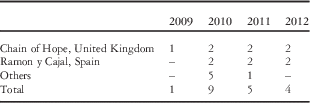
Between January, 2009 and December, 2012, a total of 19 visits were made to the Cardiac Center by paediatric cardiac interventional teams, with a stay ranging from 3 days to 2 weeks on each mission. The number of visits by each team is shown in Table 1. A total of 296 catheter procedures were performed on 287 patients. Of the total procedures, 129 (43.6%) procedures were performed by the Spanish team, and 90 (30.4%) by the Chain of Hope, UK team. The other teams performed 77 (26%) of the procedures.
Number of interventional missions per year from overseas.

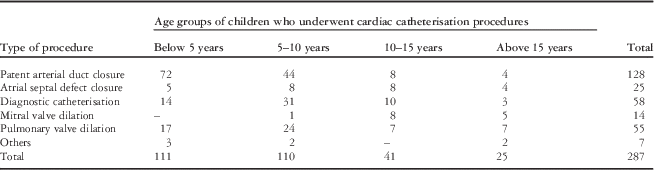
The mean age for all the patients treated was 7.41±5.68 years (range 3 months--30 years). Children under 5 years of age accounted for 111 (38.7%) of the procedures, and 187 (65.2%) of the patients were females. Closure of the patent arterial duct was performed on 128 patients, and balloon dilation of pulmonary valve stenosis on 55 patients. Other procedures performed during the period are shown in Table 2.
Age distribution of children versus types of cardiac catheterisation procedures performed.

Results
Procedural success and mortality
Procedural success was achieved in 264 (89.2%) of the procedures. There were three deaths that occurred within 72 hours of intervention. All the deaths occurred in patients with severe pulmonary valve stenosis and associated right-heart failure. The cause of death in these patients was pulmonary oedema resulting from reperfusion injury following the balloon dilation procedure.
Complications
Device embolisation occurred in three patients with patent arterial ducts and needed surgical removal in all. Device embolisation also occurred in two patients, in whom closure of secundum atrial septal defect was attempted. These devices were also retrieved surgically, at which time the atrial septal defect was closed. Other complications were encountered in patients with rheumatic mitral stenosis in whom percutaneous balloon valvoplasty was attempted. In this group, two patients required mitral valve replacement for severe mitral regurgitation following balloon dilation, and a third patient had hemiparesis due to an embolic stroke, which improved over several months after physiotherapy.
Training of local teams
During the visits, the visiting teams initially performed the procedures with assistance from the local team. As the local team gained experience, the visiting teams assisted the local team to perform the interventions. Towards the end, the local team was able to perform the interventions independently, with the visiting team being available for any support or advice, if needed. Eventually, one cardiologist, six nurses, and two haemodynamic technicians were trained sufficiently to be able to perform most common interventions without supervision of the visiting consultants after the initial 2 years. Subsequent supervision was aimed at more complex procedures. Haemodynamic technicians were able to assume responsibility to the extent that the overseas mission did not need to include the technicians in the list of visiting team members. The plan for the future is to reduce the number of missions and to transfer full responsibility to the local team.
Discussion
Ethiopia is the second most populous country in the Sub-Saharan Africa, having a population of about 91 million. 13 The under five mortality rate is 68 per 1000 live births. 13 Children <15 years of age account for about 43% of the total population. 13 The gross per capita income is about $1110.
Pneumonia, diarrhoea, and perinatal problems account for a large proportion of under five mortality. In addition to congenital heart disease, the country has one of the highest burdens of rheumatic heart disease in the paediatric and adolescent age groups.Reference Oli and Porteous 14 However, there are no population-based epidemiologic studies to estimate the prevalence of these conditions accurately.
Before January, 2009, there was no treatment available for most congenital or acquired heart diseases in Ethiopia. Like other developing countries,Reference Hewitson, Brink and Zilla 5 infectious diseases, nutritional disorders and HIV/AIDS have been the priority areas in health care for the Ethiopian government. Cardiology and cardiac surgery, with the expensive resource and expertise required, are difficult for the country to implement. Some developing countries, which started their own national pediatric cardiology programmes, have been challenged by the high costs in equipping and maintaining the level of surgical, intensive care, and other therapeutic facilities required for providing timely, life-saving, quality care for children with heart disease.Reference Casanova, Selman-Houssein and Palenzuela 15 The most common congenital heart defects, such as severe pulmonary valve stenosis with congestive heart failure and cyanosis, have presented late for treatment in Ethiopia, because of a lack of facilities until recently.Reference Tefera, Qureshi, Bermudez-Cañete and Rubio 16 These patients, if treated, have the potential for normal lifestyle. Furthermore, in the future, they have the potential to be less of a financial burden on their families and may even become the breadwinners for their families.
In many countries, including Ethiopia, inadequately trained paediatric and general surgeons performed many ligations of patent arterial ducts, although significant complications, such as inadvertent ligation of a branch pulmonary artery instead of the arterial duct, occurred afterwards in some of these patents. It is therefore extremely important that local teams be trained in common interventions. This was the aim of the visiting teams, when the programme started. It is recognised that reliance solely on visiting teams to perform a limited number of interventions on a small number of patients during the visits is not ideal and not sustainable. The local teams need to be trained to a level of competence where they are able to perform these common interventions safely by themselves. Paediatric cardiac catheterisation was performed in January, 2009 for the first time in Ethiopia by a UK-based charity mission team from the Chain of Hope. In the beginning, many challenges were faced as the overseas teams needed to take responsibility for all of the arrangements in the catheterisation laboratory. However, with interaction between the local and the visiting teams, the capabilities of the local team gradually improved with time, and much of the burden on the visiting teams was reduced during the subsequent visits. Since December, 2011, the local team has been independently performing interventions such as closure of the patent arterial duct, closure of atrial septal defects, and dilation of pulmonary valve stenosis in the presence or absence of the visiting mentors. The role of the visiting mentors now is to continue to train on interventions that are more complex.
In the last 2 decades, the Chain of Hope and other non-governmental organisations from developed countries have been engaged in expanding paediatric cardiology services in sub-Saharan Africa by sending missions that treat patients and train physicians and health-care workers in basic paediatric cardiac care, bringing physicians from developing countries to sophisticated western centres for training in surgical and catheter intervention procedures and establishing and equipping paediatric cardiac centres in the native countries.Reference Kalangos 7 , Reference Senga, Rusingiza and Mucumbitsi 11 , Reference Giamberti, Mele and Di Terlizzi 17 These members of staff are then exposed to the protocols and treatments in the western centres. They can then take this expertise back to their own country and disseminate it more widely. The aims of such a comprehensive approach are to disseminate the knowledge and training to the wider team in as short a period as possible. The long-term benefits include the provision of sustainable services locally and the provision of specialised care to the wider community.
Conclusion
Training an independent interventional paediatric cardiology team and implementing interventional paediatric cardiology service in a sub-Saharan setting is challenging but achievable. It may be difficult for a single centre from a developed country to send frequent missions to a developing country to make a meaningful contribution to the patient treatment and skill transfer. However, if centres from different countries could coordinate their efforts, there is potential in terms of creating a self-sufficient and sustainable paediatric cardiology service in the developing countries, where millions of children die every year because of lack of access to specialised medical care. In our case, coordination between the United Kingdom and Spanish teams has helped us achieve our goal. It is also equally important to develop strong relationships with local physicians, health-care staff, and institutional leaders to ensure a coordinated pre-procedure patient selection and preparations including post-intervention follow-up of the patients, to provide the best possible care.
Acknowledgement
The authors thank Dr Belay Abegaz and the Children’s Heart Fund of Ethiopia and the Cardiac Center, for creating the ground for cardiology practice and sponsoring the travel and stay of the humanitarian missions. We are indebted to the Chain of Hope (United Kingdom) for its unlimited support with the provision of equipment and for co-ordinating the team visits. They also extend their gratitude to all members of overseas missions and staff at the cardiac centre in Ethiopia. Last but not least, the authors would like to thank all those who have donated the consumables used in these humanitarian missions.
Financial Support
This research received no specific grant from any funding agency, commercial, or not-for-profit sectors.
Conflicts of Interest
None.
Ethical Standards
The departmental ethics and publication committee has approved the study.