INTRODUCTION
The white-beaked dolphin (Lagenorhynchus albirostris Gray, 1846) and the short-beaked common dolphin (Delphinus delphis Linnaeus, 1758) are, in the summer season (May to October), two of the most abundant delphinid species in the shelf waters around the United Kingdom (UK) and Republic of Ireland (ROI) (Hammond et al., Reference Hammond1995, Reference Hammond2002; Reid et al., Reference Reid, Evans and Northridge2003). The white-beaked dolphin is endemic to the colder waters of the North Atlantic and is primarily limited to shelf waters (<200 m water depth), particularly around Europe (Reeves et al., Reference Reeves, Smeenk, Kinze, Brownell, Lien, Ridgway and Harrison1999). The common dolphin is more widespread, occurring in warmer shelf and oceanic waters throughout the world (Evans, Reference Evans, Ridgway and Harrison1994). Since common dolphins generally move into shelf waters around the UK and ROI during the summer months, and have relatively similar habitat preferences and diet to white beaked dolphins (MacLeod et al., Reference MacLeod, Hauser and Peckham2005, Reference MacLeod, Weir, Pierpoint and Harland2007; (M.B.S.), unpublished data), the distribution of the two species could potentially overlap at this time of year (Reid et al., Reference Reid, Evans and Northridge2003). With such ecological similarities, white-beaked and common dolphins might be expected to partition their otherwise shared niche to reduce the potential for competition (Chase & Leibold, Reference Chase and Leibold2003). Niche partitioning has been identified within a number of cetacean assemblages and can occur along variables such as water depth (e.g. Griffin & Griffin, Reference Griffin and Griffin2003; MacLeod et al., Reference MacLeod, Bannon, Pierce, Schweder, Learmonth, Reid and Herman2004; Bearzi, Reference Bearzi2005) and water temperature (e.g. Selzer & Payne, Reference Selzer and Payne1988).
Previous research has suggested that white-beaked and common dolphins are partitioned by water temperature in shelf waters on the west coast of Scotland during summer months, with a switch in dominant species from common to white-beaked dolphins as water temperature drops below 12°C (MacLeod et al., Reference MacLeod, Weir, Pierpoint and Harland2007). The widespread existence of such temperature-based partitioning could have important implications for how these species may respond to current and future changes in water temperature resulting from global climate change (estimated to be around 0.5°C per decade around the UK and ROI—Fisheries Research Services, 2003). Indeed, it has already been suggested that white-beaked dolphins are declining and being replaced by common dolphins in north-western Scotland, where temperature-based niche partitioning has been previously identified, as a result of increases in local water temperature (MacLeod et al., Reference MacLeod, Hauser and Peckham2005, Reference MacLeod, Weir, Pierpoint and Harland2007).
However, the identified partitioning by water temperature is based on a relatively small number of sightings collected over two short surveys (<3 weeks) in two consecutive years (2004 and 2005) in a relatively restricted area on the west coast of Scotland (MacLeod et al., Reference MacLeod, Weir, Pierpoint and Harland2007). As a result, it is unclear whether this partitioning, and the resulting conservation implications, are a local-scale phenomenon limited to the west coast of Scotland, or whether it is likely to exist whenever these species have the potential to co-occur around the UK and ROI. This study used data collected during surveys throughout shelf waters around the UK and ROI during the summer season from 1983–1998 to investigate whether there is evidence that temperature-based niche partitioning is a spatially widespread phenomenon. The implications of the results of this study for conservation of these species around the UK and ROI are then considered.
MATERIALS AND METHODS
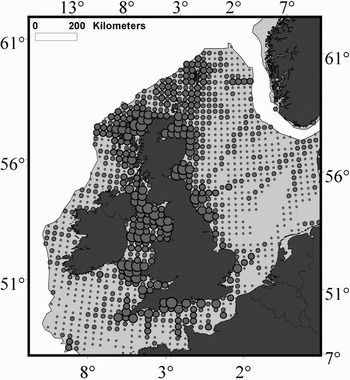
The data used in this study were collected by the Seabirds At Sea Team (SAST) of the Joint Nature Conservation Committee (JNCC) during surveys of waters around the UK and ROI (Figure 1). While these surveys were primarily designed to record seabirds, observers also collect data on any cetaceans observed. Full details of the data collection methods used during these surveys, with specific reference to the collection of cetacean data, can be found in Pollock et al. (Reference Pollock, Mavor, Weir, Reid, White, Tasker, Webb and Reid2000) and Reid et al. (Reference Reid, Evans and Northridge2003). While there are a number of inherent limitations to using these data to analyse habitat preferences of cetaceans (such as variations due to the use of different vessels and different numbers of observers for different surveys, variations in observer experience, variations in detectability between cetacean species, variations in sea state of observations and of spatial coverage within and between years), the SAST data set is a valuable source of spatio-temporal cetacean sightings data and any biases resulting from these limitations are likely to be consistent in relation to the relative detectability of the two species of interest to this study. As a result, while it may be difficult to use such data to demonstrate absolute habitat preferences of individual species, these data can be used to compare relative habitat preferences between the species throughout the areas surveyed. Specifically, any differences in the distribution of sightings of these two species in relation to niche variables, such as water temperature, are likely to represent real differences between the species for the areas and times surveyed rather than variations in the relative detection probabilities of the two species.
Total effort by Seabirds At Sea Team (SAST) surveys in shelf waters per 1/4 International Council for the Exploration of the Sea rectangle (15′ latitude × 30′ longitude) for summer months between 1983 and 1998. Smallest circles, 0–100 km2 surveyed; largest circles, >1000 km2 surveyed; grey shading, shelf waters of less than 200 m water depth. NOTE: SAST survey efforts in non-shelf waters are not shown on this figure.

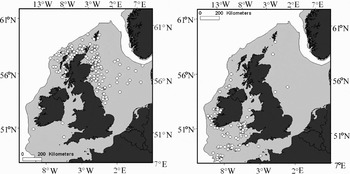
The date and location of all white-beaked and common dolphin sightings, recorded in shelf waters (<200 m depth) around the UK and ROI (including some waters of the wider North Sea—see Figures 1 & 2) during the summer season (May–October), were extracted from the SAST database (N = 569) and entered into a geographical information system (GIS) created in ArcView 3.3. Each sighting was assigned a sea surface temperature (SST) for its specific month, year and location from the Reynolds sea surface temperature data set downloaded from the National Center for Atmospheric Research (NCAR), USA website. These data are monthly average model results from remotely sensed data and survey temperature data, with a spatial resolution of 1o longitude by 1o latitude (Reynolds & Smith, Reference Reynolds and Smith1994). This provided a coarse-scale measure of the concurrent sea surface temperature at the location of each sighting. Total effort per 1/4 ICES (International Council for the Exploration of the Sea) statistical rectangle was also calculated.
The distribution of white-beaked (left) and common dolphins (right) sightings, from the Seabirds At Sea Team database, for shelf waters in summer months (May–October) 1983–1998. Grey shading: shelf waters of less than 200 m depth. NOTE: sightings recorded in non-shelf waters are not shown on this figure.

To assess whether there was evidence of niche partitioning based on SST, the sightings data were divided into 1°C temperature categories and the proportion of sightings of each species was calculated. The data were then grouped into three categories: (i) 1°C temperature classes where white-beaked dolphins dominate (i.e. make up more than 75% of all sightings); (ii) a transitional temperature range; and (iii) 1°C temperature classes where common dolphins dominate. A χ2 contingency table test was then used to assess whether there was a real difference in the comparative occurrence of each species within these three categories.
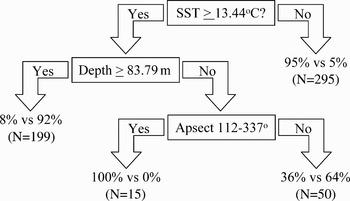
Finally, the importance of SST based niche partitioning on white-beaked and common dolphin distribution was investigated in comparison with other habitat variables. Data on water depth were extracted from the British Geological Society Digbath 250 m resolution data set. A triangular integrated network continuous surface was created from this contour data set to provide a measure of the depth, slope of seabed and aspect of seabed for the location of each sighting. A classification tree was then constructed using the Brodgar interface for R statistical software. Classification trees can be used to identify the most important variable for determining species occurrence as they separate data into groups based on similarities and differences in explanatory variables. The variable that separates data into one group with the highest proportion of occurrence and another with the lowest is the most important for defining species occurrence. The value of this variable used to create the two groups will define the key value for species occurrence (MacLeod et al., Reference MacLeod, Weir, Pierpoint and Harland2007 and references therein). For this study, SST, depth, slope of seabed and aspect of seabed were used as explanatory variables and species was used as the dependent variable. This method is identical to using presence–absence data, since each data point will represent the presence of one species but the absence of the other. Due to the Digbath coverage being limited to the UK designated waters and adjacent Irish waters (see http://www.bgs.ac.uk/products/digbath250/coverage.html) only the 558 sightings (329 white-beaked dolphin and 229 common dolphin sightings) recorded within this geographical region of the total 569 sightings used in the first part of this study were included in the classification tree analysis.
RESULTS
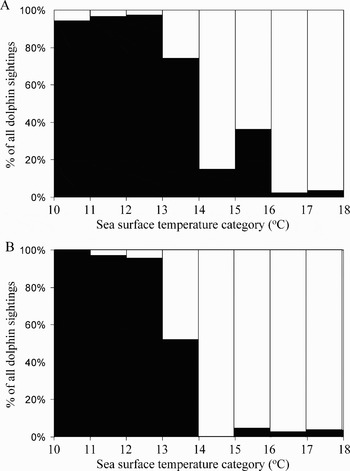
The SAST survey effort was widespread throughout shelf waters around the UK and ROI, including some areas of the wider North Sea, during summer months from 1983–1998, but with higher levels along the south coast of England, in the Irish Sea, off north-western Scotland and along the North Sea coasts of Scotland and England (Figure 1). The SAST database contained 336 white-beaked and 233 short-beaked common dolphin sightings from this area (Figure 2). White-beaked dolphins were recorded in water temperatures ranging from 8.1 to 17.2°C (mean: 12.5°C; standard deviation (SD): 1.2°C), while common dolphins were recorded in temperatures of 8.1 to 18.5°C (mean: 14.9°C; SD: 1.6°C). However, there were only sufficient numbers of sightings (>25) of one or both species, to compare proportions in 1°C temperature classes from 10 to 18°C (only three sightings were recorded in temperatures <10°C and one in a temperatures >18°C, presumably due, at least in part, to a lack of waters of these temperatures in shelf waters around the UK and ROI in summer). In all temperature classes <14°C, more than 70% of all sightings were white-beaked dolphins in each class, and in temperature classes <13°C sightings of white-beaked dolphins were over 90% (Figure 3). In contrast, in all temperature classes >14°C, over 60% of sightings were common dolphins and in temperature classes >16°C over 90% of sightings were common dolphins.
The proportion of sightings of each species in 1°C temperature classes for summer months from 1983–1998. Black, white-beaked dolphins; white, common dolphins. (A) All sightings; and (B) excluding records from the central and southern North Sea.

When the sightings data were grouped into three putative categories (<13°C, 13–14°C and >14°C), white-beaked dolphins were found to be dominant in waters <13°C (96% of sightings were white-beaked dolphins) while common dolphins were dominant in waters >14°C (86% common dolphins). In the transitional temperature range (13–14°C), 74% of sightings were white-beaked dolphins and 26% were common dolphins. There was a significant difference between the observed frequency of each species within the three categories and the expected values (χ2 = 338, df = 2, P < 0.001). There were significantly more white-beaked dolphin sightings than expected in the <13°C category (χ2 = 56.0, df = 1, P < 0.001) and significantly fewer in the > 14°C category (χ2 = 78.9, df = 1, P < 0.001). There was no significant difference in the frequency of white-beaked dolphin sightings in the putative transitional temperature range (χ2 = 3.48, df = 1, P = 0.064). In contrast, for common dolphins there were significantly fewer sightings than expected in the <13°C category (χ2 = 80.7, df = 1, P < 0.001) and in the putative transitional temperature range (χ2 = 4.96, df = 1, P = 0.026), and significantly more in the >14°C category (χ2 = 78.9, df = 1, P < 0.001). This is consistent with region-wide partitioning of shelf waters around the UK and ROI in summer months between white-beaked and common dolphins based on water temperature. However, there were significantly fewer common dolphin sightings than expected in the putative transitional zone, suggesting that temperature may affect the occurrence of common dolphins to a greater extent than white-beaked dolphins.
In the classification tree, for the restricted data set of sightings with associated topographic data, SST was found to be the most important of the four variables tested, with a SST of 13.44°C representing the key value for separating between occurrence of the two species (Figure 4). Below this temperature, 95% of the 295 sightings were white-beaked dolphins, while above 13.44°C, 81% of the 263 sightings were common dolphins.
Classification tree of occurrence of white-beaked and common dolphins in relation to water temperature, depth, seabed slope and seabed aspect. In all cases, the left-hand number at the terminal node represents the proportion of sightings of white-beaked dolphins and the right-hand number of common dolphins. The number of sightings falling into each classification category is given in parentheses. The most important variable is identified by the one which determines the first branch of the tree. The tree has been pruned to display only the first three branches for clarity.

DISCUSSION
Using data collected over a wide area (shelf waters around the UK and ROI including the wider North Sea) and long period of time (May to October 1983–1998), this study found evidence consistent with niche partitioning in summer months between white-beaked and common dolphins based on water temperature. Specifically, at water temperatures below 13°C, white-beaked dolphins are the dominant species, while at temperatures above 14°C common dolphins dominate the otherwise shared niche. The classification tree confirmed that, given the spatio-temporal coverage of the available data and the variables examined (SST, water depth, seabed slope and seabed aspect), water temperature is the most important difference in habitat preferences between these species. These results are consistent with the spatially and temporally limited study from the west coast of Scotland conducted by MacLeod et al. (Reference MacLeod, Weir, Pierpoint and Harland2007); however, the estimated threshold temperature identified by this study was around 1–2°C higher. The difference in estimated threshold temperature between the two studies may result from differences in the resolution of the temperature data sets (MacLeod et al., Reference MacLeod, Weir, Pierpoint and Harland2007 used 4 km resolution satellite data—not available for the time series of data used in this study—rather than the coarser-scale 1o by 1o resolution data used in this study) and the real threshold value for the switch in dominance between the species may lie somewhere between those found in the two studies.
It is possible that the differences in temperature of occurrence between the two dolphin species do not reflect actual habitat requirements, but are driven by differences in temperature preferences of preferred prey. Around the UK and ROI, both white-beaked and common dolphins consume a wide variety of fish species, including many that also occur in waters colder and warmer than the temperature which appears to partition the two species (~13–14°C). In particular, for animals stranded in summer months in Scotland, the main prey species found in their stomach were gadoids, whiting (Merlangius merlangus Linneaus, 1758) and mackerel (Scomber scombrus Linneaus, 1758) for common dolphins, and haddock (Melanogrammus aeglefinus Linneaus, 1758), whiting and other gadoids for white-beaked dolphins from Scotland—M.B.S., unpublished data). These fish species occur throughout shelf waters of north-western Europe (see Froese & Pauly, Reference Froese and Pauly2007; http://www.fishbase.org). Therefore, the temperature-based partitioning between white-beaked and common dolphins identified in this study is unlikely to be simply an artefact of preferences for different prey that are themselves temperature-limited.
The question arises as to what could drive niche partitioning based on temperature in these two dolphin species. It seems unlikely that any mechanism for niche partitioning based on temperature is due directly to adaptations to different water temperature ranges (i.e. the change in dominance occurs at the temperature where hypothermia causes death in common dolphins and/or hyperthermia causes death in white-beaked dolphins) as both species have, on occasions, been recorded at temperatures above and below the apparent threshold temperature. In particular, white-beaked dolphins seem to be able to occur at warmer temperatures when common dolphins are absent (see below). Rather, it seems more plausible that the observed niche partitioning is linked to how water temperature affects the outcome of competition for shared resources, such as prey. It is possible that common dolphins generally out-compete white-beaked dolphins when they co-occur, but their occurrence in waters of <13°C in summer months is, for some reason, limited. For example, waters colder than 13°C may be below the common dolphin lower critical temperature, meaning that although they can survive in it, it may not be energetically advantageous to remain in such waters for prolonged periods. This difference between the two species is likely to be related to their relative body sizes, with common dolphins having greater energetic costs in cooler waters because of their smaller body size. Although not directly comparable, Hersteinsson & MacDonald (Reference Hersteinsson and MacDonald1990) proposed a similar type of hypothesis for explaining the distribution of red foxes Vulpes vulpes (Linnaeus, 1758) and Arctic foxes Alopex lagopus (Linnaeus, 1758), with factors associated with body size limiting the northern extent of one species while the southern limit of the second results from the outcome of competition with the first.
The possibility that the presence of common dolphins limits the occurrence of white-beaked dolphins in warmer waters is supported by the occurrence of white-beaked dolphins in the southern and central North Sea. While these waters often warm to temperatures >14°C in summer months (when common dolphins could be expected to exclude white-beaked dolphins), the main route for dolphins to enter this relatively enclosed region seems to be around northern Scotland as there is little evidence of common dolphins entering the North Sea through the English Channel in any great numbers (e.g. a lack of sightings in the eastern Channel and southern North Sea; Figure 2). However, the waters around northern Scotland are often cooler than 13°C even in summer months. Therefore, this area of cooler waters may act as a barrier preventing common dolphins from regularly accessing otherwise suitable habitat in the southern and central North Sea. This lack of common dolphins seems to allow white-beaked dolphins to occur in warmer temperatures than in other areas around the UK and ROI, and almost all summer records of white-beaked dolphins in water temperatures greater than 14°C in this study occurred in this region (30 out of 33). When sightings from the central and southern North Sea are excluded, the niche partitioning based on temperature between the two species becomes even more apparent (Figure 3B). Therefore, when common dolphins are, for some reason, absent, white-beaked dolphins occur at higher temperatures than when they are present which is consistent with niche partitioning being driven by competitive exclusion. Finally, such a temperature-mediated influence on the extent and outcome of competition is also consistent with the apparently rapid replacement of white-beaked dolphins by common dolphins recorded on the west coast of Scotland in a relatively short space of time between the late 1990s and early 2000s (after the data used in this study were collected) as local waters warmed (MacLeod et al., Reference MacLeod, Hauser and Peckham2005). However, more research is required to investigate that this is, indeed, the correct mechanism driving the observed niche partitioning.
Similarly, this study only examined the two most abundant dolphin species in shelf waters around the UK and ROI in the summer season. These waters are also inhabited by a number of other marine top predators, such as the harbour porpoise Phocoena phocoena (Linnaeus, 1758), bottlenose dolphins Tursiops truncatus (Montagu, 1821) and Atlantic white-sided dolphins Lagenorhynchus acutus (Gray, 1828) which may also interact competitively with white-beaked and common dolphins to produce niche partitioning along other eco-geographical variables. For example, MacLeod et al. (Reference MacLeod, Weir, Pierpoint and Harland2007) found evidence of partitioning between white-beaked dolphins and Atlantic white-sided dolphins based on water depth, with the latter species preferring deeper waters. Therefore, further research is also required to investigate whether niche partitioning between other species based on other eco-geographical variables may further limit the occurrence of white-beaked and common dolphins within their preferred temperature ranges.
Whatever the mechanism, both wide-scale (this study) and fine-scale (MacLeod et al., Reference MacLeod, Weir, Pierpoint and Harland2007) studies of the relative occurrence of white-beaked and common dolphins are consistent with temperature-based niche partitioning. In the light of the potential effects of global climate change on local water temperatures (Clark et al., Reference Clark, Fox, Viner and Livermore2003; Fisheries Research Services, 2003), such niche partitioning has implications for the conservation of these species in shelf waters around the UK and ROI.
The most concern here is the white-beaked dolphin. If predicted increases in water temperature are realized, common dolphins could replace white-beaked dolphins throughout an ever increasing proportion of shelf waters around the UK and ROI, and the wider North Sea, in summer months. Of particular concern are the estimated ~8000 white-beaked dolphins inhabiting the North Sea (Hammond et al., Reference Hammond2002), which comprises a stronghold for this species in north-western Europe. At the moment, common dolphins are rare in this area (Hammond et al., Reference Hammond2002). However, as sea temperatures continue to warm, common dolphins may encroach more and more into the North Sea in summer months, particularly around northern Scotland, potentially resulting in the exclusion of white-beaked dolphins from this area.
There is little suitable neighbouring shelf habitat which consistently maintains an SST below 13°C and into which white-beaked dolphins could move into as an alternative, and white-beaked dolphins do not appear to use deeper waters around north-western Europe (Reid et al., Reference Reid, Evans and Northridge2003; MacLeod et al., Reference MacLeod, Weir, Pierpoint and Harland2007), possibly due to niche partitioning with Atlantic white-sided dolphins (MacLeod et al., Reference MacLeod, Weir, Pierpoint and Harland2007). In particular, north of 61oN, shelf waters are almost exclusively limited to a relatively narrow strip along the coast of Norway (see Figure 1). As a result, rather than being able to shift their range into alternative neighbouring habitats (particularly further north) as the waters they currently occupy warm, the number of white-beaked dolphins using the North Sea waters around the UK and ROI may decline as the area of suitable summer habitat available to them decreases. Given the current predicted increases of water temperature around north-western Europe of up to 0.5°C per decade (Fisheries Research Service, 2003) and the apparent threshold temperature for a shift in dominance between the two species, white-beaked dolphins could potentially become almost completely excluded from the shelf waters of the UK and ROI in summer months in the near future. However, further research is required to investigate the exact time frame over which this may occur.
Therefore, range contraction due to the effects of increasing water temperature on competitive interactions has the potential to be one of the most important conservation concerns for the white-beaked dolphin around the UK and ROI, and presumably other parts of its range where common dolphins are present. However, in order to fully assess this possibility, its potential extent, timing and the conservation implications of such range contraction in the near future, it is essential that an appropriate monitoring programme specifically designed to regularly assess whether changes in species occurrence and distribution have occurred is set in place in the near future.
In contrast to white-beaked dolphins, common dolphins could potentially benefit from global climate change and expand their range as waters warm. However, this may bring new conservation issues for this species around the UK and ROI. In particular, common dolphins are vulnerable to by-catch in commercial fisheries (e.g. Lopez et al., Reference Lopez, Pierce, Santos, Gracia and Guerra2003). If their range expands, common dolphins may start interacting with fisheries where by-catch has not previously been an issue and where there are currently no or few measures aimed at monitoring or reducing it. Therefore, it is also important to monitor change in distribution of species whose range may expand as a result of global climate change, such as common dolphins. In addition, if range expansion into new areas occurs, adjacent waters could simultaneously experience a decline in common dolphin numbers that may be incorrectly attributed to other anthropogenic impacts.
Finally, while this study only investigated temperature-based partitioning between common and white-beaked dolphins in waters around the UK and ROI, the relative species ranges suggest that similar partitioning could also occur between common dolphins and other members of the genus Lagenorhynchus in other parts of the world. For example, temperature-based partitioning may potentially exist between common dolphins and dusky dolphins L. obscurus (Gray, 1828) in the southern hemisphere and between common and Pacific white-sided dolphins L. obliquidens Gill, 1865 in the North Pacific, with similar implications for their conservation in relation to climate change. However, further research is required to test whether such partitioning is, indeed, a general feature of interactions between common dolphins and members of the genus Lagenorhynchus or whether it is only a feature of interactions between common and white-beaked dolphins.
ACKNOWLEDGEMENTS
The views expressed in this paper are the authors' own and do not necessarily reflect the position of their organizations. The authors would like to thank the Seabirds and Cetaceans section of JNCC for providing the data used in this analysis, and all of those who helped in the collection and collation of these data during SAST surveys. We are grateful to Graham Pierce for comments on earlier versions of this manuscript.