After riding down a shiny escalator at a hotel bearing his own name, Donald Trump stepped onto a platform, hugged his daughter Ivanka, and wasted no time in bragging about the size of the crowd who had come to hear him announce his presidential candidacy. After insulting his fellow candidates who “sweated like dogs” in the heat of a less air-conditioned forum, Trump began to paint a picture of a troubled nation that was once dominant and glorious, but which “[doesn’t] have victories anymore.” Describing the rising fortunes of other countries such as China, Japan, and Mexico, Trump said the United States was becoming a “third-world country” and that “the American Dream is dead.” He continued with punctuated pauses: “But, if I get elected president, I will bring it back bigger, and better, and stronger than ever before and we will make America great again.” The message was clear: America is losing its status in the world, others have what rightfully belongs to us, and I can turn this tragedy around.
Just six months later in January 2016, the United States unemployment rate was its lowest in seven years—(4.9%; percent; Bureau of Labor Statistics, U.S. Department of Labor 2016), and after six years of the Affordable Care Act more Americans were covered by health insurance than had been in years (Barnett and Vornovitsky Reference Barnett and Vornovitsky2016; Rovner Reference Rovner2016). Contrary to Trump’s portrait of doom and gloom, several measurements of national fiscal health indicated that while the country was not growing at the rate that many had hoped, it was trending gradually upward (U.S. Bureau of Economic Analysis Blog 2016). Still, his message of loss was seemingly resonating with large pockets of voters all over the country, from Iowa (where he came in second to Senator Ted Cruz) to New Hampshire, South Carolina, and Nevada, where he won. Watching predominately white crowds at Trump’s rallies become energized by his brash, racialized rhetoric of national descent and promised resurgence, liberal and conservative pundits tried to make sense of Trump’s popularity through various narratives—he was paying attention to working-class whites who feel forgotten; he was tapping into the fear of white Americans of all economic classes who feel threatened by a growing non-white population; he was emboldening whites who were suspicious of Muslims, felt overrun by immigrants from south of the border, and were viscerally distrustful of Barack Obama from the very beginning.
To date, a number of studies evince that white fear of demographic changes and racial resentment toward black Americans fueled Trump’s ascendancy to the White House (Nteta and Schaffner Reference Nteta and Schaffner.2016; Tesler Reference Tesler2016b; Mutz Reference Mutz2018), but few if any studies have set out to explain whether whites’ perceptions of their own racial status, and specifically notions of white disadvantage, predict support for Donald Trump during the 2016 elections (Cohen et al. Reference Cohen, Fowler, Medenica and Rogowski2017). Empirical research on white racial attitudes relating to the 2016 primary season in particular is especially limited. I test whether white attitudes about their own racial standing predict support for Donald Trump at a time when the electoral field was still wide open. Measures of perceived racial disadvantage are modeled alongside other factors that have been demonstrated or presumed to motivate support for Trump, such as racial resentment, and rates of unemployment and immigration; I also control for attitudinal measures about the Latinx community,Footnote 1 which have been largely overlooked in the extant literature. Using original survey questions fielded two weeks before the Iowa Caucus, I find that whites who ascribe a sense of detriment and hindrance to whiteness were most likely to support Donald Trump than any other candidate, and that these beliefs about disadvantaged whiteness were salient predictors of candidate preference even after accounting for racial resentment against blacks and residential context variables measuring the percent change of unemployment and the foreign-born population over the previous fifteen years. The analysis further demonstrates that Trump’s earliest white supporters are amongst the segment of the population most at odds with the concept of structural racism—or a social, political, economic, and cultural system that mainly benefits white people.
I begin by presenting my theoretical framework and empirical expectations. I then proceed through a description of the data and research, followed by my findings. I conclude with a discussion of the implications of these results for future research on white racial attitudes and the study of American politics.
White Racial Attitudes about the Outgroup, Ingroup, and Racialized Self
The study of white racial attitudes seeks to explain, among other phenomena, the cognitive and emotional antecedents of white Americans’ opinions about a variety of political and social matters. Given the historical fact that white people have comprised the dominant racial majority in the United States, and that for the past half-century, that dominance has been challenged and constricted both in the courts and “in the streets,” it is not surprising that scholarship on white racial attitudes is largely oriented around whether, to what extent, and how whites think and feel about racial out-groups (namely, black Americans).
As norms of racial equality and colorblindness become more firmly established in everyday civil and political practice (Mendelberg Reference Mendelberg2001; Bonilla-Silva Reference Bonilla-Silva2006), scholars use a number of empirical measures to track and better understand white attitudes about non-whites. Numerous articles and books convincingly demonstrate that while most white Americans no longer subscribe to tenets of old-fashioned racism, such as claims of biological inferiority of racial minorities, many whites will negatively stereotype the work ethic, sexual behavior, reproductive practices, criminality, and moral deviance of people of color, ushering forth revised forms of racism through the language of alleged cultural deficiency (Ibid.). Mainstays of white racial attitudes literature include out-group measures like “laissez-faire racism” (Bobo, Kluegel and Smith Reference Bobo, Kluegel, Smith, Tuch and Martin1997) that test the belief that obstacles to black upward mobility have been dissolved, and “symbolic racism”(Kinder and Sears Reference Kinder and Sears1981) that conceptualize white beliefs that black people violate principles of Protestant work ethic and are undeserving of help from the government as a veiled form of racial animus. Relatedly, the “racial resentment scale” is commonly used as a latent measure of the inimical belief that “blacks do not try hard enough to overcome the difficulties they face and that they take what they have not earned”(Kinder and Sears Reference Kinder and Sanders1996, 106). In recent years, racial resentment has been put to reinvigorated use in political science to explain white opinion and political behavior during the historical administration of the country’s first black and bi-racial president. Tesler’s use of racial resentment to formulate the “spillover of racialization” theory (Tesler Reference Tesler2012; Tesler Reference Tesler2016a) is particularly instructive for understanding how white feelings toward racial out-groups—particularly black Americans—inform a host of policy preferences and evaluations of political figures.
Attitudinal measures about racial outgroups offer numerous ways for social scientists to theorize, understand, and track the racial mores and political trends of white Americans as social movements and as political elites attempt to shape national and local policies that either realize greater racial equality and undercut long-standing notions of white racial supremacy and superiority, or conversely, restore a more hierarchical order. While outgroup-oriented research yields compelling findings, other bodies of white racial attitudes—namely, those that center whiteness per se as the focus of inquiry—demonstrate that theories and instruments about outgroups are not sufficient for our understanding of white public opinion.
Contributions from psychology and sociology lead the white racial attitudes field in experimental and survey-based research that centers both the white racial ingroup and whites’ own racialized selves as the objects of inquiry. From the White Racial Identity Development Model (Helms Reference Helms1984), to later scholarship on social-structural theories of group conflict and group position (Bobo Reference Bobo1983; Bobo Reference Bobo1999); in-group preference and out-group hostility (Bobo and Zubrinsky Reference Bobo and Zubrinksky1996); white guilt (Swim and Miller Reference Swim and Miller.1999); and ingroup privilege and outgroup disadvantage (Powell, Branscombe and Schmitt Reference Powell, Branscombe and Schmitt2005; Branscombe, Schmitt and Schiffhauer Reference Branscombe, Schmitt and Schiffhauer2007), these empirically-quantitative studies make the powerful case that the phenomenology of whiteness itself is elemental to white racial attitudes.
Insights from this corpus of work increasingly permeate the discipline of political science. In the past decade and a half, a turn toward treating white racial identity and racial group belonging as worthy of its own political analysis has produced important strides for research on the racial politics of white people, and is clearing space for scholars to more directly undertake study on the politics of whiteness (i.e., the politics of being white). Wong and Cho (Reference Wong and Cho2005), for example, utilized a measurement of group closeness (à la Tajfel Reference Tajfel1981) to bring the question of white racial identity to bear on white racial politics. At the time, they found that whites’ identification with their group led to more positive feelings toward the ingroup, however, racial identity appeared to have a limited effect on political attitudes. Their postulation that racially chauvinistic elites could potentially actuate a linkage between racial identification and political attitudes and interests directed other scholars to consider the relationship between the ingroup and outgroup, especially in contexts of competition or threat.
Kinder and Kam’s (Reference Kinder and Kam2010) conceptualization of ethnocentrism, which theorizes a relationship between outgroup animosity and ingroup favoritism, predicts support for social welfare programs that are believed to benefit white people (i.e., Social Security and Medicare), and drive opposition against programs that are believed to aid racial minorities. In a related vein, Jardina’s (2014, 37) theory of dominant group identity asserts that white racial identity—or “a conscious favoritism for one’s ingroup and recognition that one’s group has shared interests”—predicts white political attitudes and behavior under conditions of threat to traditional status. More recently, Weller and Junn (Reference Weller and Jane Junn2018) postulate that white racial identity may be a utility-based trait that rationally navigates white Americans toward a political candidate choice. Relatedly, a growing number of researchers are attempting to test the political utility of white racial identity in formulating racial attitudes by replicating Dawson’s (Reference Dawson1994) “black utility heuristic,” or linked fate model, for the white population; at present, the concept of white linked fate yields less consistent findings than that of its original predecessor (Miller et al. Reference Miller, Gurin, Gurin and Malanchuk1981; Sanchez and Vargas Reference Sanchez and Vargas2016; Fowler Reference Fowler2017).
Racial Status, White Privilege, and White Disadvantage
Theories of white racial identity, ethnocentrism, linked fate, and group consciousness assume a dominant status that whites feel must be either defended or recovered, but the measures themselves do not direct white research subjects to identify themselves within a racial hierarchy or assess whether their life chances are benefitted or harmed by being white. Inquiries about racial hierarchy are also theoretically distinct from questions that ask respondents about how much racial discrimination whites (or any other group) endure. That is, experience of racial discrimination toward the ingroup does not preclude the ingroup from maintaining a general or even context-specific dominant status; perceptions of racial discrimination toward an outgroup are similar in that they do not compare the status of people of color to whites.
The literature on stratification beliefs is helpful in thinking about how to measure whites’ attitudes about their own racial status and what that would mean for political preferences and behavior. This branch of political psychology research from the 1980s and 1990s, for example, demonstrates that attributing racial disparities to individualistic rationales such as hard work and talent predicts public policy preferences differently than do explanations of racial inequality in terms of racial discrimination against people of color. Moreover, this research repeatedly showed that whites are more likely to de-emphasize structural racism than are black Americans and other people of color (Kluegel and Smith Reference Kluegel and Smith.1986; Kinder and Sanders Reference Kinder and Sanders1996; Hunt Reference Hunt2004). More recently, in bridging the racial stratification literature with critical whiteness studies (McIntosh Reference McIntosh, Delgado and Stefancic1997; Johnson Reference Johnson2006; Bonilla-Silva Reference Bonilla-Silva2006; Feagin and O’Brien Reference Feagin and Eileen2003), a string of innovative studies by Hartmann, Gerteis, and Croll (Hartmann, Gerteis and Croll Reference Hartmann, Gerteis and Croll2009; Croll Reference Croll2011) find that asking Americans to rate the importance of structural and individualistic factors for explaining white racial advantage separately from black racial disadvantage yields a conceptual incongruence in the way people understand one side of racial inequality versus the other. This line of research also finds that while black Americans more heavily emphasize the importance of structural and interpersonal discrimination in explaining black disadvantage than do whites, about “two-thirds of white Americans (63 per cent) believe that prejudice and discrimination in favour of whites is important in explaining whites’ greater success” in acquiring better jobs, income and housing (Croll Reference Croll2011, 11).
While the aforementioned scholars use the concept of white advantage in survey research, a suite of experimental studies by Lowery and colleagues rigorously explore the cognitive inequivalence of thinking about racial privilege for the ingroup versus racial disadvantage for the outgroup. Advancing a model of inequity framing, they find that one’s identification with their racial group moderates policy preferences when primed with a vignette about unearned racial advantages for their group versus discrimination against an out-group (Lowery, Knowles and Unzueta Reference Lowery, Knowles and Unzueta2007; Knowles and Lowery Reference Knowles and Lowery2012). Research on white racial identifiers suggests that despite the dominant and racially normative ideology of colorblindness (Bonilla-Silva Reference Bonilla-Silva2006; Lopez Bunyasi and Wright Rigueur Reference Lopez Bunyasi and Wright Rigueur2015), which de-emphasizes the importance of race and racism in everyday life, there are actually more whites in the United States who may be classified as feeling a salient sense of racial identity than some may realize (between 37% percent according Croll Reference Croll2007 and about half by another estimate from Wong and Cho Reference Wong and Cho2005). Taken together, this foundational theoretical and empirical research shows that framing racial inequality as either advantage or disadvantage has profound implications for how Americans behave interpersonally, socially, and politically. Understandably, the inequity-framing model is being gradually incorporated into political psychology and ethnic and racial politics research (Lopez Bunyasi Reference Lopez Bunyasi and Wright Rigueur2015; Weller and Junn Reference Weller and Jane Junn2018).
Where the previously-described scholarship utilizes the methodology of either asking whites to explain white racial advantage or priming whites with vignettes about unearned advantage or privilege, in earlier research I (2015) extend the vein of white racial attitudes regarding white (dis)privilege by exploring the prevalence and political implications of attitudes about personal racial benefit and racial ingroup advantage. By using survey questions that allow respondents to choose between privilege-conscious, colorblind, and disadvantage-oriented descriptions about their racial standing, I find that support for racial policies such as affirmative action and anti-discrimination laws vary among those who think of their racial identities as either life-enhancing, life-hindering, or as largely inconsequential to their upwardly mobile pursuits.
The breakthrough of quantitative social science to directly measure white attitudes about or cognitive responses to the concept of white privilege enriches the extant scholarship on white racial ideologies, which argues that colorblindness is the primary and most publicly-sanctioned way that most Americans talk (or don’t talk) about race (Manning, Hartmann, and Gerteis Reference Manning, Hartmann and Gerteis2015). While most white Americans do not consciously think about their racialized selves with the same consistency as studies suggest that people of color do, it seems that roughly one-quarter report that their white ingroup has a better chance of getting ahead in today’s society, and that only 8% feel that their racial identity is beneficial in the workplace (Lopez Bunyasi Reference Lopez Bunyasi and Wright Rigueur2015, 215-16). This does not mean that whites in the main do not take up the language of victimization; they do, this is neither uncommon nor new (Bonilla-Silva Reference Bonilla-Silva2006; Bonilla-Silva, Lewis, and Embrick Reference Bonilla-Silva, Lewis and Embrick2004; Frankberg Reference Frankenberg1993; Anderson Reference Anderson2016). Research about white people and white racial attitudes in the Obama era, however, beckons renewed attention to what seems to be a growing sense of racial marginalization and white fragility (DiAngelo Reference DiAngelo2011) as some whites view Obama’s black body in the White House as a symbol of racial ascendancy among blacks while certain low-skill and manufacturing jobs once seen as mainstays of the white middle and working class evaporate from the economy (Tesler and Sears Reference Tesler and Sears2010; Tesler Reference Tesler2016a; Gest Reference Gest2016; DiAngelo Reference DiAngelo2011). Mounting evidence shows that the white population became particularly racialized during the Obama administration, in no small part because Obama’s black racial identity primed the racial resentment of racial conservatives (Tesler and Sears Reference Tesler and Sears2010; Kinder and Dale-Riddle Reference Kinder and Dale-Riddle.2012; Tesler Reference Tesler2016a). As the Obama administration came to a close, researchers also found that one’s support or opposition to Donald Trump’s candidacy moderated whites’ political and emotional response to racial cues attached to governmental assistance programs (Luttig, Federico and Lavine Reference Luttig, Federico and Howard2017). This “two-sided racialization” (Tesler Reference Tesler2016a) suggests that an ideological cleavage among the white population continued to rip and play an active role in the election of Trump in 2016.
Predicting Support for Trump
Counter to the pontifications of many in the media, a number of social scientists provide evidence that status threat and anti-outgroup affect—not economic anxiety—dominated the candidate preference of the white electorate (Mutz Reference Mutz2018). In lieu of measures that directly probe attitudes of racial status threat, Mutz uses the social dominance orientation (SDO) scale (Sidanius and Pratto Reference Sidanius and Pratto1999) to argue that a sense of threat to the domestic and international hierarchy is positively related to support for Trump. Relatedly, a study by Jones, Cox, and Lienesch (Reference Jones, Cox and Lienesch2017) suggests that fear about the displacement of American culture drove the white working-class toward Trump. Nteta and Schaffner (Reference Nteta and Schaffner.2016) find that whites who think that an impending majority-minority nation is a “bad thing” are “20 percentage points more likely to support Trump than those who [said it was a] ‘good thing’ or ‘neither’ [a good nor bad thing].” In an experimental setting, Major, Blodorn and Blascovich (Reference Major, Blodorn and Major Blascovich2018) observed that when whites who strongly identify with being white were reminded that people of color will outnumber their ingroup in the next two and a half decades, they reported more support of Trump.
Tesler and Sides (Reference Tesler and Sides2016) provide another analysis showing that white support for Trump is related to strength of white racial identification, perceived discrimination against whites, the belief that whites lose jobs to racial minorities, and the attitude that whites should work together to change laws that are unfair to their racial group.Footnote 2 Confirming these and other findings about the role of racial resentment in getting Trump elected (Tesler Reference Tesler2016b), Cohen et al., (2017; see also Fowler, Medenica, and Cohen Reference Fowler, Medenica and Cohen2017), used two items from the racial resentment scale alongside agreement that white people as a group are losing education and job opportunities to people of color, and conclude that a sense of “white vulnerability” was significantly strong amongst millennial Trump voters.
In a separate study, Schaffner, MacWilliams, and Nteta (Reference Schaffner, MacWilliams and Nteta2018) examine support for Trump and Clinton by directly asking respondents about their beliefs about white privilege. Replicating certain statements from the Color-Blind Racial Attitudes Scale (CoBRAS)(Neville et al. Reference Neville, Lilly, Duran, Lee and LaVonne2000) and the Psycho-Social Costs of Racism to Whites Scale (Spanierman and Heppner Reference Spanierman and Heppner2004)—“White people in the U.S. have certain advantages because of the color of their skin”; “Racial problems in the U.S. are rare, isolated situations”; and “I am angry that racism exists”—they find that low levels of acknowledgement of and empathy for racism was significantly related to support for Trump.
To more fully explicate the stream of research on white racial attitudes about white racial status and their relationship to candidate preference during the 2016 election season, I use unique explanatory variables that measure the perceived white racial status of the ingroup, as well as how race affects their own personal experiences within the specific context of the job market. These particular measures allow respondents to register their sense of racial vulnerability, but also provide alternative options to indicate either perceived racial advantage or a belief that a person or group’s life chances are not shaped by racial identity. The ingroup-focused question asks respondents to compare the status of their group to that of blacks; I, therefore put the power of this variable to a conservative test by controlling for racial resentment against blacks under the theoretical premise that beliefs about the standing of one’s ingroup and the bearing of whiteness upon one’s own life is cognitively distinct from and inequivalent to how they feel about an outgroup (Lowery, Knowles and Unzueta Reference Lowery, Knowles and Unzueta2007; Knowles and Lowery Reference Knowles and Lowery2012). I advance the following hypothesis:
Hypothesis 1: Whites who believe that their ingroup has worse life chances in the job market relative to blacks are more likely to support Trump’s candidacy
The other job-specific question that I use asks whites to assess the effect of their racial identity on their own life chances. Unlike the previous measure, this question does not explicitly ask respondents to compare their lived experiences to that of other individuals (within or apart from their racial ingroup); therefore, I will test the explanatory power of this measure in two models, one controlling for racial resentment against blacks, and the other controlling for attitudes about the status of another racial outgroup, Latinxs. I hypothesize:
Hypothesis 2: Whites who believe that being white has personally put them at a disadvantage in the job market are more likely to support Trump, controlling for attitudes about the black outgroup (H2A) and attitudes about the Latinx outgroup (H2B)
In an alternate model of perceived white dominance, I use a single Likert-item measure that probes agreement with the claim that whites benefit from a pervasive system of racism. As with hypotheses 2A and 2B, I will separately control for attitudes about both outgroups. The hypothesis follows:
Hypothesis 3: Agreement with the claim that racism is a pervasive system that mainly benefits whites is negatively related to white support for Trump, controlling for attitudes about blacks (H3A) and Latinxs (H3B)
On his tour of the country, candidate Trump regularly framed the state of the nation through zero-sum terminology. The final hypothesis explores whether support for Trump can be predicted by whites’ beliefs that being white is more of an asset or more of a burden in the calculus of white life chances. This hypothesis will be tested in four models, the first without controlling for similar variables that measure the state of being black and, separately, of being Latinx; the second and third will control for the outgroup-focused measures separately, and the fourth will control for both. Testing the relationship between this whiteness variable and others like it which ask similar questions about the state of being black and the state of being Latinx will bring new insights into how weighing the pros versus the cons of a racial identity predicts support for a candidate.
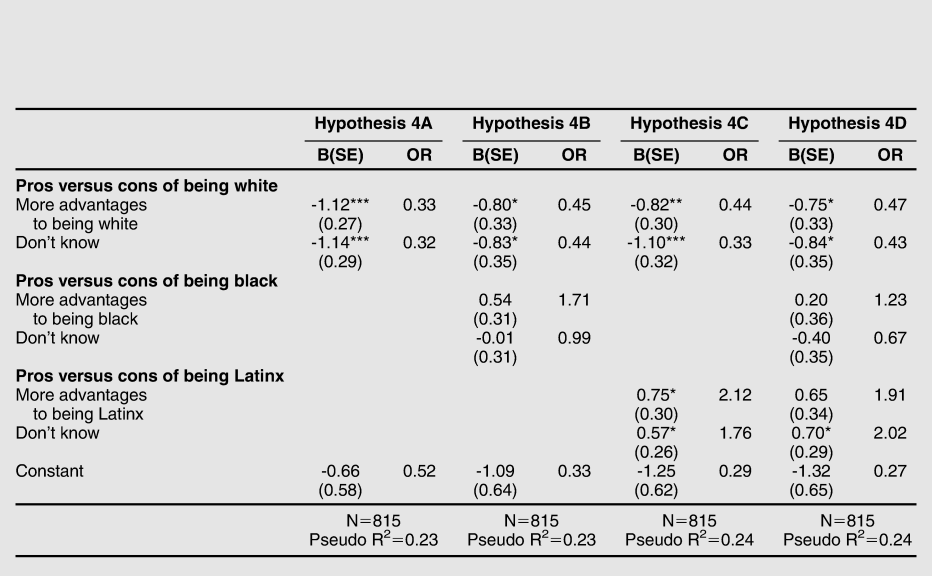
Hypothesis 4: Whites are more likely to support Trump if they believe that there are more disadvantages to being white than there are advantages (H4A); controlling for attitudes about blacks (H4B); controlling for attitudes about Latinxs (H4C); controlling for attitudes about blacks and Latinxs (H4D)
Taking seriously the inequity framing model, each hypothesis explores the relationship between white attitudes about whiteness—framed either through the language of the ingroup or through personal racial embodiment—and support for one of American history’s most racialized candidates, while also accounting for white attitudes about racial outgroups. Thus, the present study tests whether, if at all, attitudes about whites’ status and, specifically, their beliefs about white privilege and dominance are related to support for Donald Trump.
Data and Methodology
The virtue of an early poll in the 2016 election year helps measure the American people’s attraction towards a wide variety of candidates and messages before the contest drills down to two or three main voices. The National Study of Color-Blindness and Race-Consciousness (NSCBRC), a survey of racial and political attitudes of white and black Americans, was conducted online by Qualtrics, an academic and marketing research company, and financed with a summer research funding award from my academic institution. The survey was fielded between January 5 and January 18, 2016, a few weeks before the Iowa Caucus, the first contest in which citizens cast a vote for their preferred candidate. In creating its survey panel, Qualtrics used a non-probability sample designed to capture three quota requirements: an even gender split between self-identified females and males per racial group (non-Hispanic whites; non-Hispanic blacks); household income per racial group (white alone, not Hispanic; black alone) approximating U.S. Census Annual Social and Economic Supplement figures for 2014; and regional representation per racial group (non-Hispanic whites; non-Hispanic blacks) for all ten geographic division levels approximating U.S. Census Vintage estimates for 2014.Footnote 3 Sixty-eight percent of the individuals who initiated the survey, completed it. A total of 598 people were disqualified from participating in the survey. Of this total, 172 declined to give their consent to participate; 168 were disqualified when being screened for fit on the basis of race, gender, household income, and region; 256 were disqualified for failing to correctly answer one of the three attention-checking questions; and 2 were disqualified for speeding through the survey. On average, it took participants 21 minutes to complete the survey, and the median time for completion was 16 minutes. The data collection processes yielded 921 good complete cases for non-Hispanic whites, and 303 good complete cases for non-Hispanic blacks. The following analysis focuses exclusively on the non-Hispanic white cases.
Despite the now-regular use of online panels in academic research, it should be noted that methodology experts are still debating the extent to which the use of non-probability samples interviewed via the Internet may yield less accurate measurements than RDD telephone surveys and face-to-face probability sample surveys (Malhotra and Krosnick Reference Malhotra and Krosnick2007; Yeager et al. Reference Yeager, Krosnick, Chang, Javitz, Levendusky, Simpser and Wang2011; Fahimi et al. Reference Fahimi, Barlas, Thomas and Buttermore2015). Moreover, in a report on online panels by the American Association for Public Opinion Research, the authors explain that “where nonprobability online panels are concerned, there appears to be no research that focuses specifically on the reliability and validity of the purposive sampling aspects of online panels when comparing results with those from other methods”(Baker et al. Reference Baker, Blumberg, Brick, Couper, Courtright, Michael Dennis, Dillman, Frankel, Garland, Groves, Kennedy, Krosnick, Lavrakas, Lee, Link, Piekarski, Rao, Thomas and Zahs2010, 748). It is also not clear how proportional quota sampling using race-specific requirements (as is used in the present methodology) for the primary purpose of measuring racial attitudes, in particular, compares to more traditional data collection processes. Relying on my own judgment as a scholar of racial attitudes and public opinion, I identified household income, region, and gender as salient correlates to racialized social and political attitudes, and hence employed these categories in the present sampling technique in an effort to reduce error and bias.
Dependent Variable: Support for Trump
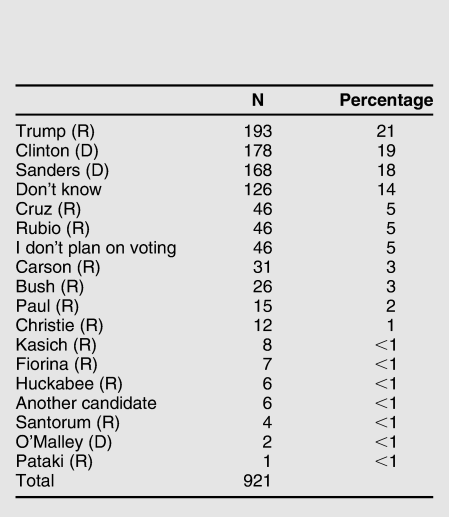
The dependent variable in each model of my study is support for Trump. The variable stems from the question, “The next presidential election will be held in 2016. Below is a list of declared candidates. Who are you most likely to vote for?” The response categories included 3 Democrats, 14 Republicans (including Trump), the option for a fill-in candidate, an “I don’t know” category, and an option for respondents to explain that they “don’t plan on voting in the 2016 election.” Trump’s popularity with white Americans was evident before the first vote of the election. He was the preferred candidate of 21% of those polled in the NSCBRC. Following closely behind were Hillary Clinton with 19% and Bernie Sanders with 18%. Nearly 14% of those polled did not know who their preferred candidate was. No other candidate was in the same competitive space as the three front-runners. The closest Republican candidates to Trump—Ted Cruz and Marco Rubio—held support from 5% of white respondents each, the same proportion of whites who planned to entirely opt out of voting (see table 1).
Presidential candidate preference amongst white respondents

For the purposes of this analysis, I code support for Trump as a binary variable (1= support, 0=any other response). By measuring support for Trump against that of all the other candidates, as well as uncertainty for one’s preference and one’s intention to not vote at all, I put my hypotheses through a series of conservative tests. The additional benefit of coding the dependent variable in this manner, as opposed to framing the contest as a head-to-head competition between the eventual party nominees, is to learn about the willingness for whites to back Trump against more established candidates and politicians. These models are a measure of support, not a vote.
Independent Variables
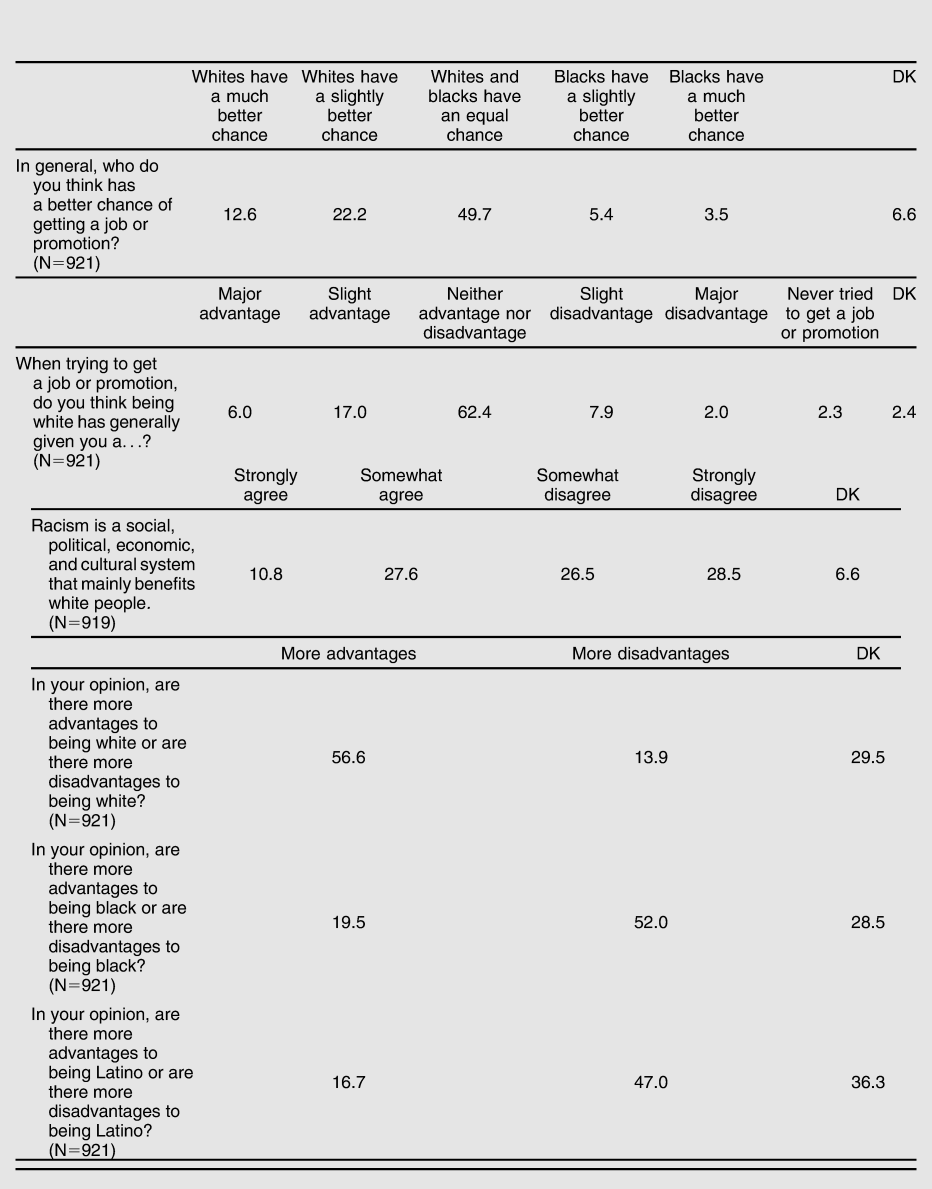
To explore how white attitudes about ingroup status, personal implications of being white, and systemic white racial dominance are related to support for Donald Trump’s candidacy, I asked respondents a number of original questions. The survey presented white respondents with questions about the life chances of their ingroup, as well as their own personal racialized experiences within the specific context of the job market. The first job market question asks, “In general, who do you think has a better chance of getting a job or promotion—whites, blacks, or do whites and blacks have about an equal chance of getting a job or promotion?” The original five response categories (“Whites have a much better chance,” “Whites have a slightly better chance,” “Whites and blacks have an equal chance,” “Blacks have a slightly better chance,” and “Blacks have a much better chance,”) are collapsed into three categories; “Whites have a better chance,” “Whites and blacks have an equal chance,” and “Blacks have a better chance.” A little over one-third (35%) of whites said that their racial group has a better chance of getting work than do blacks, 50% think that whites and blacks have an equal chance, and 9% think that blacks have a better chance of landing a job or promotion than do whites (refer to table 2). “Don’t know” responses are coded as missing.
Main independent variables

Figures indicate percentages
On another survey page, a corresponding question asked respondents to gauge whether and to what degree their racial identity as a white person has affected their own personal life. The job market question in this section reads, “When trying to get a job or promotion, do you think being white has generally given you a major advantage, a slight advantage, a slight disadvantage, a major disadvantage, or has it given you neither an advantage nor disadvantage?” Following the reconfiguration of the group-level categories, the original five response categories of this personal-level question are collapsed into three categories: “Being white is an advantage,” “Being white is neither an advantage nor disadvantage,” and “Being white is a disadvantage.” “Don’t know” responses are coded as missing, and those who said that they had “never tried to get a job or promotion”—2% of those surveyed—were also coded as missing. In comparison to attitudes about group-level life chances, fewer whites (23%) believe that they have personally been advantaged by being white. A large majority of 62% believe that generally speaking, being white has been neither advantageous or disadvantageous when it comes to their chances or employment and promotion. Ten percent of whites claim that being white has served as a liability to getting work (refer to table 2).
How whites think about their ingroup’s chances of getting work relative to blacks, and how they think about how their own whiteness shapes their job prospects is likely to be related to their support for Trump. In his candidacy announcement speech, Trump said that one of his primary goals was to become “the greatest jobs president that God ever created,” and he continued to frame job creation as one of the centerpieces of his campaign platform. In the models treating perceptions of whiteness in the job market (Hypothesis 1, and Hypotheses 2A and 2B), I use “Blacks have a better chance in job market” as the reference category for the ingroup status variable, and “Being white has given R a disadvantage in job market” as the reference category for the variable denoting the effect of being white, respectively.
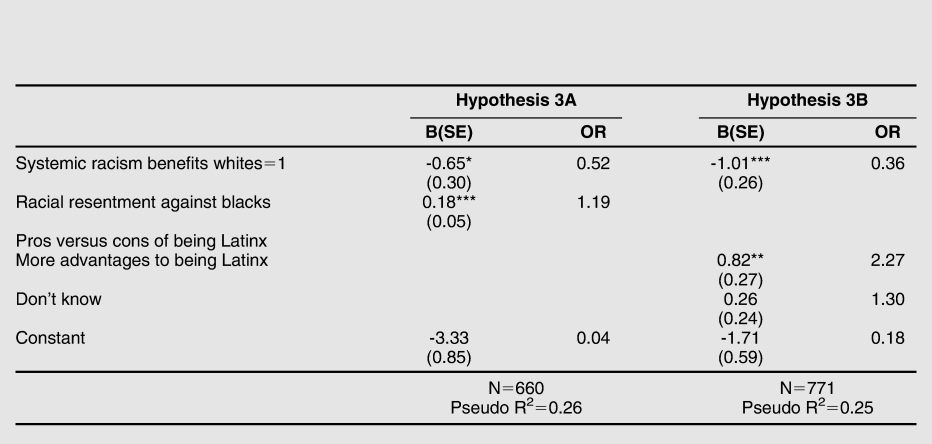
Hypotheses 3A and 3B tests the relationship of perceived white racial status with support for Trump by measuring whether or not respondents agree that white people are the main beneficiaries of systemic racism. By asking respondents whether they think that whites are the primary beneficiary of pervasive differential treatment and “conferred dominance,” (McIntosh Reference McIntosh, Delgado and Stefancic1997) we can get a sense of whether whites believe that a racial order of white racial dominance exists in the twenty-first century. Respondents were asked whether they strongly agree, somewhat agree, somewhat disagree, or strongly disagree with the following statement: “Racism is a social, political, economic, and cultural system that mainly benefits White people;” 38% agreed and 55% disagreed. This measure is coded as a binary variable (agree=1, disagree=0), and the “don’t know” category is coded as missing (refer to table 2).
The next three variables derive from questions that intend to measure how whites weigh the advantages against the disadvantages of being either white, black, or Latinx (Hypotheses 4A–4D). The framing of these questions allows for the possibility that a respondent may think that there are both benefits and detriments to any racial identity, but it nudges the respondent to weigh the good against the bad. Extant research indicates that whites tend to give colorblind responses to questions about racial inequality (Lopez Bunyasi Reference Lopez Bunyasi and Wright Rigueur2015), but what is previously under-examined is how whites asses the meaning of various racial identities when the race-neutral category is removed. In this study, three similarly-formatted questions are used to measure the perceived value of three racial identities: “In your opinion, are there more advantages to being (white/black/Latino) or are there more disadvantages to being (white/black/Latino)?” Although most whites de-emphasized the salience of being white in the context of employment, a clear majority (57%) report that there are more advantages to being white, and 14% say that there are more disadvantages. When assessing the pros versus the cons of being a racial minority, most whites believe that it is more disadvantageous to be black (52%) and Latinx (47%); refer to table 2. Only about one-fifth of whites think that it is more advantageous to be black (20%) or Latinx (17%). A large proportion of whites provided a “don’t know” response to these three questions (between 28% and 36%). The high “don’t know” response could result from being genuinely uncertain as to the benefits and detriments of being white, black, or Latinx, but it may also result from the fact that there is no ideologically-normative response category (Lopez Bunyasi and Wright Rigueur Reference Lopez Bunyasi2015) that registers as colorblind. Unlike the first two independent variables, the “don’t know” categories are included in the subsequent analysis in order to keep a large proportion of cases for the statistical tests, as well as to understand whether there is a significant difference between whites who selected this answer over a clearer assessment of advantage or disadvantage.Footnote 4
When testing Hypotheses 1, 2A, and 3A, I control for racial resentment towards blacks. Racial resentment is a well- studied measure used in the field of white racial attitudes, and for purposes of putting this study in conversation with the extant literature, I privilege its use when modeling the effect of white attitudes of whiteness to compare its explanatory power to that of attitudes toward the black outgroup. Racial resentment is used by numerous scholars to measure the belief that black people have failed to “pick themselves up by their bootstraps” and are responsible for their group’s lower economic status relative to whites. The scale is a composite of four questions measured on a four-point Likert scale; higher values correspond to higher levels of racial resentment. Models testing Hypotheses 2B, 3B, 4C, and 4D control for the previously-described variable weighing the pros versus the cons of being Latinx. At present, there is no equivalent racial resentment scale measuring white attitudes toward Latinxs, probably for good reason. With items like, “Generations of slavery and discrimination have created conditions that make it difficult for blacks to work their way out of the lower class,” this measure intends to capture a particular racial resentment directed toward blacks that is nested in a specific historical paradigm and informed by a particular (though transferable) set of stereotypes. In lieu of a more contextually-specific measure of anti-Latinx affect, I utilize the measure of perceived Latinx status. Finally, models testing Hypotheses 4B and 4D control for the variable weighing the pros versus the cons of being black; this variable is only used in Hypothesis 4 because the framing of the question is similar to that of the main variable in the models testing Hypothesis 4, which weighs the advantages versus disadvantages of being white. A correlation matrix of the main exploratory variables and controls are available in table A of the online appendix.
Partisanship and self-identified political ideology are the most traditionally salient factors that determine candidate support in national elections. Party identification is a three-category variable (Democrat, Independent, and Republican) with “Republican” treated as the reference category. Political ideology is a three-category variable (liberal, moderate, and conservative) with “conservative” treated as the reference category. “Don’t know” responses are coded as missing.
As a proxy for concern about the economy, I control for the percent change of unemployed people in the respondent’s zip code from 2000 to 2015. As a proxy for concerns about immigration, I also control for the percent change of foreign-born people in the respondent’s zip code from 2000 to 2015. These data are from the U.S. Census Bureau’s American Community Survey 2011–2015 (5-year estimates) and the 2000 U.S. Census. The change in unemployment is coded along a four-point scale (1=all negative values and 4=100% or more), and the change in foreign-born population is coded along a six-point scale (1=all negative values and 6= 100% or more).
Gender is included as a control because Hillary Clinton’s candidacy galvanized particular excitement among women of all racial groups as the most serious woman contender for the country’s highest office. Educational attainment, household income, region of the country, and respondent’s generation are also used as controls. Various studies debate whether and to what extent socioeconomic status shapes vote choice in presidential elections, but given the tenor of Trump’s campaign, many analysts believed that his greatest supporters were from a class of Americans whose lack of education and income rendered them invisible and forgotten. In the general election, Trump did particularly well in the Midwest and South; for this measure I will used the West as a reference category where he did least well. Finally, one’s generation is controlled for because generational divides surfaced with Millennials’ overwhelmingly supporting Sanders, to many people’s surprise. With Trump’s campaign slogan calling for a memory of another era, it is appropriate to think of one’s age as a member of a generation rather than a numerical age year. Perhaps this message resonated differently with different whites per generation. Generation is treated in three categories: the Baby Boomers (25%) and members of the Silent Generation (6%) are treated as one category, members of Generation X (25% of the sample) are a second category, and the Millennials (44%) are treated as the reference group.
All models are logistic regressions. The tables display unstandardized coefficients and odds ratios. Odds ratios greater than 1 signify greater likelihood to support Trump over any other candidate or voting option. Odds ratios less than 1 signify less likelihood to support Trump.
Findings
In a test of four central hypotheses, the following analysis indicates that Donald Trump’s earliest white supporters have a strong tendency to see the twenty-first century U.S. racial landscape as disadvantageous toward whites.
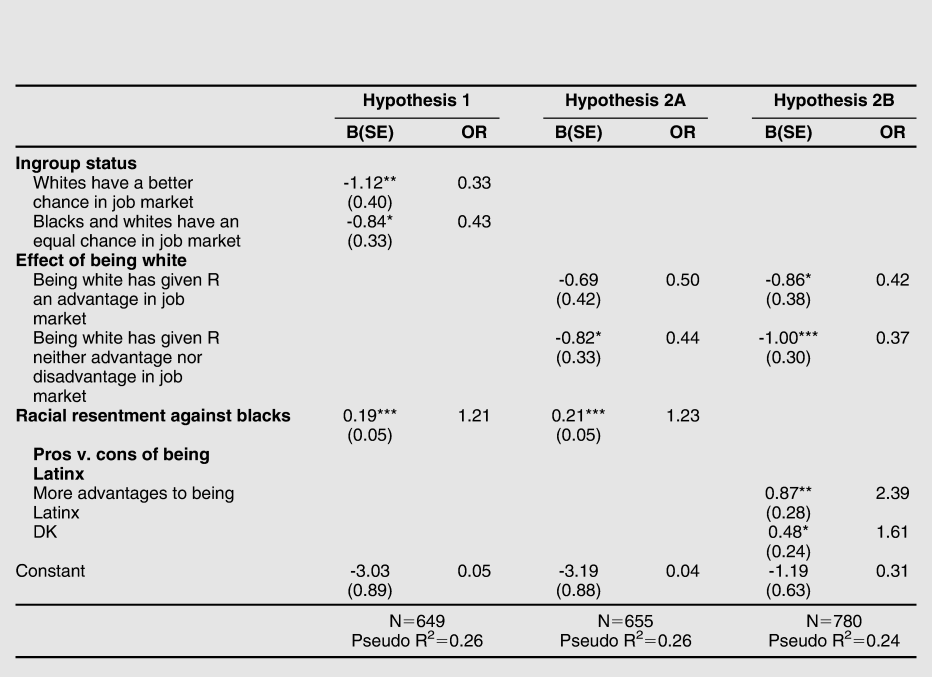
Testing Hypothesis 1, the analysis shows that whites who believe that their own racial group has the upper hand in getting jobs or promotions are less likely to support Donald Trump when compared to whites who believe that black people are more advantaged in the job market (OR= 0.33; p≤0.01). Those who think of the job market as a level playing field are also less likely to support Trump when compared to whites who think of the workplace as biased against their ingroup (OR=0.43; p≤0.05) (refer to table 3; the full table is shown in table B of the online appendix). It should be noted that there is no statistically significant difference in support for Trump between whites who think their ingroup is advantaged and those who say that both groups have an equal chance.
Logistic regressions predicting support for Trump given attitudes about ingroup status in the job market (H1) and effect of being white in the job market (H2A and H2B)

Notes: Unstandardized coefficients, odds ratios, and standard errors (in parentheses) reported. * p<.05 level; ** p<.01 level; *** p<.001.
Base category for ingroup status=Blacks have a better chance
Base category for effect of being white=Being white has given R disadvantage in job market
Base category for pros v. cons of being Latinx=More disadvantages to being Latinx
Controls (not shown here) include: gender, educational attainment, region, generational status, partisanship, political ideology, percent change of unemployed people in the respondent’s zip code from 2000 to 2015, and percent change of foreign-born people in the respondent’s zip code from 2000 to 2015.
The analysis of the model testing Hypothesis 1 echoes findings from other studies that suggest that racial resentment played an important role in determining candidate preference in 2016; increases in the level of racial resentment are positively related to support for then-candidate Trump (OR=1.21; p≤0.001). Whites who believe that black people are not doing enough to advance their own socio-economic standing are more likely to have supported Trump early in the primary season. The fact that this measure is salient in this model (and in subsequent models) may have to do with its concentration on the matter of (un)deservedness of black people. Indeed, the trope of undeservedness, especially as it relates to undocumented immigrants, was a key feature of Trump’s platform; this measure could be registering the effect of this general sentiment. Previous research also demonstrates that racial resentment was useful in predicting antipathy for Barack Obama (Tesler and Sears Reference Tesler and Sears2010; Tesler Reference Tesler2016a); given Trump’s continuous racialized slander of Obama and his prominent role in the birther movement, it is not surprising that Trump’s early white supporters trend toward the high end of this measure. However, this model (and others) suggest that particular negative attitudes about the black outgroup cannot fully explain the racial elements of candidate preference—how white people think about whiteness, the perceptions of white status, and structural bias in favor of whites is related to but should not be conflated with how they think about non-whites.Footnote 5
Not surprisingly, those who identify as Democrats (OR=0.07; p≤0.001) or as Independents (OR=0.25; p≤0.001) are less likely than Republicans to support Trump over any other candidate or voting option. Five other control variables are statistically significant in this model: political ideology, population shift of foreign-born people living in the respondent’s zip code, household income, region, and generation. Liberals and moderates are more likely to get behind Trump than are conservatives (OR=2.11 and OR=1.79; p≤0.05 for both); although confounding upon first blush, this finding makes sense given Trump’s unorthodox Republican candidacy and the fact that more prototypically conservative candidates were on the ballot. Whites who live in an area where the population of foreign-born people increased by either 60% to less than 100%, or in places where the increase was 100% or more between 2000 and 2015 are more likely to support Trump than those who live in a zip code where the foreign-born population has decreased (OR=2.56 and OR=2.28, respectively; p≤0.05 for both). Respondents living in households with higher incomes are less likely to support Trump than those living in homes with lower incomes (OR= 0.96; p≤0.05), and those that live in the South (OR=2.07; p≤0.05) and Northeast (OR=2.85; p≤0.01) have a greater likelihood to lend support to Trump than are whites in Western states. Finally, in comparison to white Millennials, Gen X whites are more likely to prefer Trump over other candidates (OR=2.29; p≤0.01).
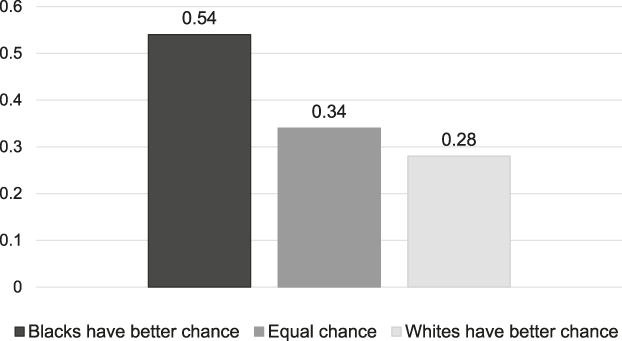
Illustrating predicted probabilities for Donald Trump’s candidacy concretizes the significance of white attitudes about ingroup status in the 2016 electoral season. Figure 1 highlights the spectrum of attitudes about white status in the job market; control variables are set to represent a voter profile that pundits in the media often drew attention to when discussing swing-states: white moderate Independents, with no college education living in the Midwest.Footnote 6 We see here that even after accounting for the powerful effect of racial resentment (which is set at its mean), support for Trump was 20 percentage points higher among whites who believe that blacks have better chances at getting jobs or promotions when compared to the majority of whites who think that both groups have an equal chance at being hired or promoted; support among disadvantage-perceiving whites is 26 percentage points higher than among those who think that racial bias in the job market is tipped in white people’s favor.
Predicted probabilities of support for Trump given attitudes about ingroup status in the job market

When the question of life chances shifts from the ingroup-level to one’s attitudes about their own experiences of being white (Hypothesis 2A and 2B), we find that those who feel that being white has been fairly inconsequential in their life’s course are less likely to back Trump than those who think that being white has brought them hardship in the workplace (Hypothesis 2A, controlling for racial resentment against blacks OR=0.44, p≤0.05; Hypothesis 2B, controlling for attitudes about Latinxs OR=0.37, p≤0.001). In the model controlling for attitudes about the Latinx outgroup, those who believe they are benefitted by being white are also less likely to support Trump than are those who feel that the chips have been stacked against them (OR=0.42, p≤0.05)(refer again to table 3).
As in the previous model, the outgroup-focused measure of racial resentment is statistically significant (Hypothesis 2A, OR=1.23; p≤0.001). In the model testing Hypothesis 2B, attitudes about being Latinx are statistically powerful; the odds of supporting Trump are 2.4 times greater for those who think there are more advantages to being Latinx than for those who think that racial identity carries more disadvantages (p≤0.01). Whites who say that they “don’t know” how to weigh the costs versus the benefits of being Latinx are also more likely to support Trump than are people who perceive greater costs (OR=1.61; p≤0.05). There is no significant difference between whites who think a Latinx identity is more advantageous and those who “don’t know.”
We see similar findings related to the controls when testing Hypothesis 2A as we do with the model testing Hypothesis 1. In the model testing Hypothesis 2B, control variables perform somewhat differently from those in the model testing Hypothesis 2A; none of the political ideology or region variables are significant, and neither is household income. Also, only those whites living in an area where the population of foreign-born people increased between 60% and less than 100% are more likely to support Trump than those who live in a zip code where the foreign-born population has decreased (OR=2.12; p≤0.05). Using the same composite profile as before, we see that the predicted probability for support is roughly 22 percentage points higher, on average, for those who think they have been placed at a disadvantage compared to those who believe being white is neither harmful nor helpful in their occupational pursuits; likelihood of support is 21 percentage points higher for those who frame their whiteness in terms of disadvantage than white respondents who think being white has been advantageous for them (see figures A and B in the online appendix for illustrated predicted probabilities).
When job-specific measures of ingroup status are included in the same model with attitudes about one’s own job-specific racialized experiences, the belief that white people have a better chance of getting work than do blacks (versus the belief that blacks have better chances in the workplace) remains significant (OR=0.35; p≤0.05), as does racial resentment (OR=1.20; p≤0.001) (refer to the left column in table C in the online appendix); however, the personal effect of being white fails to reach statistical significance. This suggests that attitudes about the ingroup are more powerful predictors for support for Trump than one’s assessment of their own personal experiences of being a white person looking for a job or advancement in the chain of command.
Table 4 illustrates support for Hypotheses 3A and 3B; whites who believe “racism is a social, political, economic, and cultural system that mainly benefits white people” are less likely to support Trump (Hypothesis 3A, OR=0.52, p≤0.05; Hypothesis 3B, OR=0.36, p≤0.001; the full table is shown in table D of the online appendix). The majority of respondents in this survey disagreed with this statement, which situates early Trump supporters within one branch of the colorblind ideological majority. Where Trump supporters depart from the crowd that deemphasizes the role of race in life outcomes is in their assessment of white status in the domain of employment, as well as in an overall weighing of the worth of whiteness, which I will discuss further in the following paragraphs. As with the other models, racial resentment was positively related to support for Trump’s candidacy (OR=1.19; p≤0.001). In the model illustrated in the right column of table 4, we see that attitudes about the pros versus the cons of being Latinx are also significant; the odds of a white person supporting Trump are 2.27 greater for those who think being Latinx is mostly beneficial (as opposed to being detrimental) ( p≤0.01).
Logistic regressions predicting support for Trump given agreement that systemic racism benefits whites (H3A and H3B)

Notes: Unstandardized coefficients, odds ratios, and standard errors (in parentheses) reported.
* p<.05 level; ** p<.01 level; *** p<.001.
Base category for pros v. cons of being Latinx=More disadvantages to being Latinx
Controls (not shown here) include: gender, educational attainment, region, generational status, partisanship, political ideology, percent change of unemployed people in the respondent’s zip code from 2000 to 2015, and percent change of foreign-born people in the respondent’s zip code from 2000 to 2015.
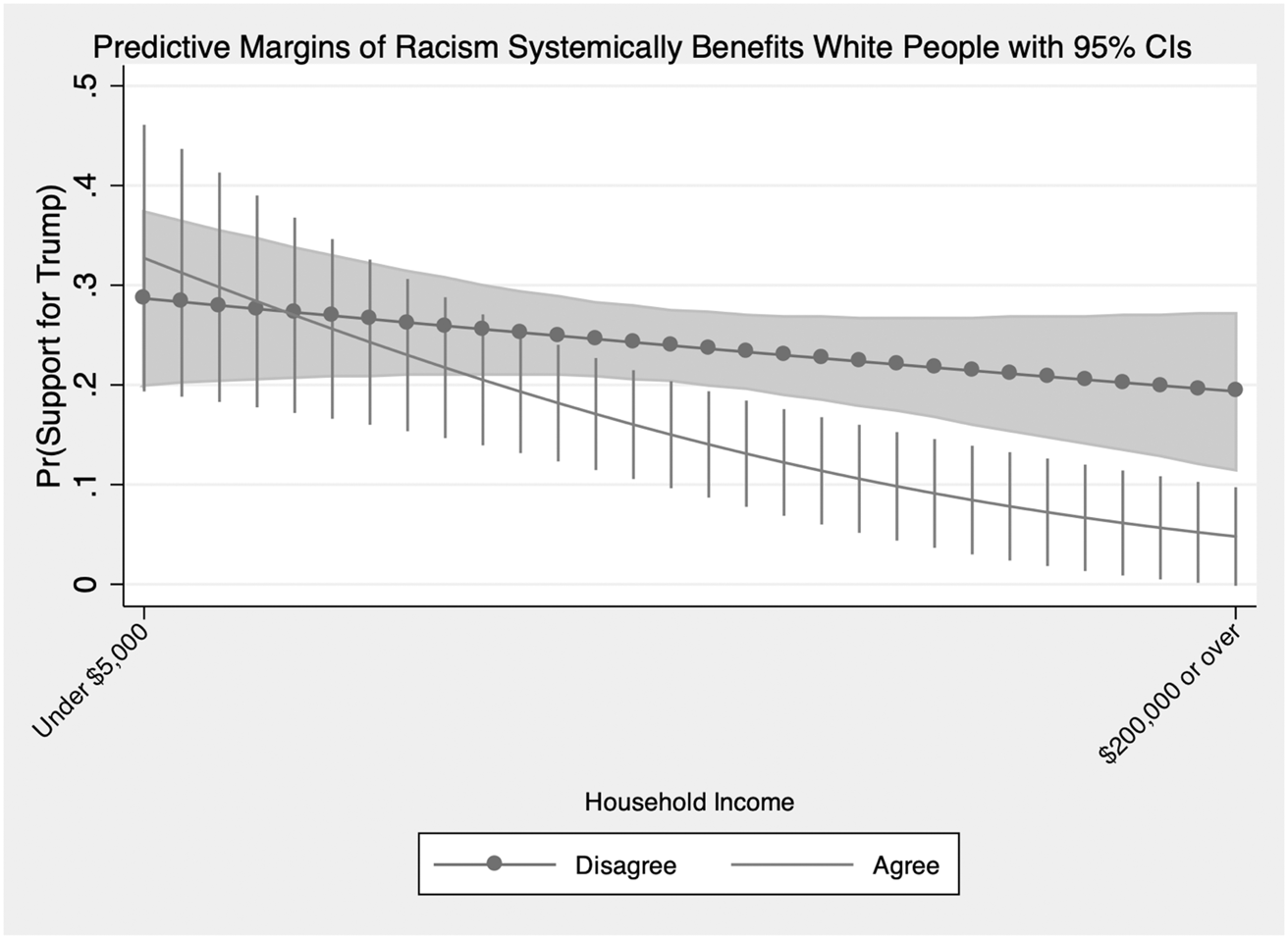
Before advancing to the final set of hypotheses, I tested the interactions between my primary explanatory variables and attitudes about outgroups, household income, and change in foreign-born population. None of the interactions using either the measurement of ingroup status on the job market from Hypothesis 1 nor the variable measuring the personal effect of being white from Hypothesis 2 were statistically significant. Among models testing Hypothesis 3, there was also only one interaction that was statistically significant: systemic racism benefits white people x household income (when controlled by either racial resentment against blacks or attitudes about Latinxs). For whites who agree with the concept of structural white supremacy, support for Trump decreases at a greater rate as income levels rise (B= -0.07, OR=0.93, p≤0.05 when controlling for racial resentment against blacks, B= -0.08, OR=0.92, p≤0.05 when controlling for attitudes about the Latinx outgroup; refer to figure 2 depicting the model that controls for racial resentment). Fully specified interaction models are located in table E of the online appendix.
Predicting support for Trump given agreement that systemic racism benefits whites x household income

The models testing Hypothesis 4 allow attitudes about the ingroup to be tested more comparatively to attitudes about both outgroups. The questions ask respondents to think about whether living as a white person has more perks than drawbacks, or vice versa. The same exact framing is then used to probe how they imagine life being black, and then being Latinx. Coincidentally, the same number of respondents (and the same actual respondents) answered all three questions. The logistic regression output in table 5 demonstrates that attitudes about whiteness were statistically significant in all four models (the full table is shown in table F of the online appendix); white people who think that the setbacks of being white outweigh the benefits were more squarely in Donald Trump’s corner. Interestingly, the variable measuring attitudes about blackness was not statistically significant in either of the two models that it was included in, but the model controlling only for attitudes about Latinidad (or ‘Latinx-ness’) was statistically significant.Footnote 7 There was no statistically significant relationship between people who thought whiteness was mostly advantageous and those who “don’t know.” There was also no statistically significant relationship between those who think of being Latinx as mostly a good thing and those who reported “don’t know.” These findings suggest that the undecided responses to these three questions are not capturing ideologically-similar people even though they are evidently distinct from those whites who are most supportive of Trump.
Logistic regressions predicting support for Trump given pros versus cons of being white, pros versus cons of being black, and pros versus cons of being Latinx (H4A, H4B, H4C, and H4D)

Notes: Unstandardized coefficients, odds ratios, and standard errors (in parentheses) reported. * p<.05 level; ** p<.01 level; *** p<.001.
Base category for pros versus cons of being white=More disadvantages to being white
Base category for pros versus cons of being black=More disadvantages to being black
Base category for pros versus cons of being Latinx=More disadvantages to being Latinx
Controls (not shown here) include: gender, educational attainment, region, generational status, partisanship, political ideology, percent change of unemployed people in the respondent’s zip code from 2000 to 2015, and percent change of foreign-born people in the respondent’s zip code from 2000 to 2015.
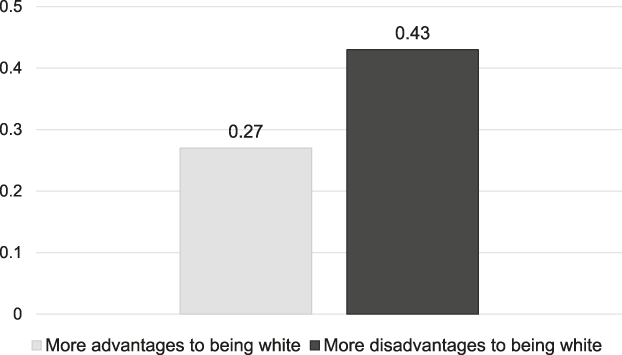
Using the same aforementioned profile of the imagined swing state voter so often discussed in the media, the likelihood of supporting Trump over all other candidates in the field for the 2016 election prior to the Iowa Caucus was 43% for whites who think that there are more drawbacks to being a white person than there are perks (refer to figure 3). Whites who hold opposite views, however, had only a 27% likelihood of supporting a candidate who built his presidential campaign around loss of control, security and status, and reclamation of all three.Footnote 8
Support for Trump given pros versus cons of being white

Discussion
My study contributes to the burgeoning exploration of white attitudes about whiteness and furthers the discipline’s understanding of Trump’s surprising ascendance to the presidency by exploring attitudinal questions about systemic white privilege and one’s general calculus of the worth of whiteness, in addition to specific attitudes about white ingroup status and the personal outcomes of being white in the context of employment. In each model, support for the over-arching theory is evident: how whites think about whiteness mattered for their likelihood to support Donald Trump.
It is rare that any presidential candidate be supported by his or her base for a single reason, and Donald Trump is no exception; indeed, a number of alternative hypotheses about the role of strongman leadership, exposure to “fake news” on social media platforms, and the urban-rural divide could shed additional light on Trump’s victories in the primaries and general election. This study, however, provides clear evidence that among white Americans, his early supporters were most likely to find difficulties being white in contemporary America. This should perhaps come as no surprise, especially in retrospect. Noteworthy in my analysis here is the finding that attitudes about being white are statistically significant predictors of support for candidate Trump, in a wide-open contest, before any official vote could demonstrate the kind of momentum he would take on. Bearing in mind that social desirability bias may lead white respondents to mask their perceptions of anti-white bias (Krumpal Reference Krumpal2013; Dodou and de Winter Reference Dodou and de Winter2014), it is likely that the findings presented here are conservative estimates of white (dis)privilege attitudes and Trump support. What’s more is that these measures of perceived white status were statistically significant in models that took account of racial resentment against blacks and beliefs about the racial status of Latinxs, while also controlling for the percent change of unemployed people and the percent change of foreign-born people in a respondent’s zip code.
To be clear, attitudinal measures about blacks and Latinxs were statistically significant in nearly every model, and in some cases, were more powerful; however, this depended upon which measures were being used. In the final set of models testing Hypothesis 4, attitudes about whiteness perform better than those measures accounting for attitudes about Latinxs and blacks. The field’s prominent measure of white hostility toward blacks—the racial resentment scale—does a lot of work in predicting attitudes, but consideration of attitudes on whiteness paints a more complex picture. My analysis suggests that there is insightful utility in using measures that tap white beliefs about their own group’s status relative to others. In comparison to the personal-level variable used here, measures framed around the ingroup proved to be more powerful. This finding supports the idea that even while the survey instrument of “white linked fate” may perform with varying success, there is a white group consciousness out there in the social-political milieu that is politically consequential, especially when it comes to matters of racial hierarchy. The question about whether the respondent believes that being white is helpful, hurtful, or of little consequence in the job market did provide certain insights, especially in its interaction with household income. The framing of the response categories to both the personal and the ingroup job-related questions allows for different angles of interpretation. One take on the analysis is that whites who think the racial chips are stacked against them were drawn to Donald Trump. On the flip side, I find that whites who believe that they are racially privileged and who believe that the United States has a white supremacist social structure were less likely to throw their support behind Donald Trump. Ultimately, this study further confirms the growing chorus in political science that white racial attitudes are not reducible to beliefs and emotions about racial outgroups, and that we should be more intentional about studying awareness of white privilege and claims of devalued whiteness.
Alongside other studies produced since the 2016 electoral season, this research provides further evidence that the unemployment rate and the evisceration of local economies did not play the most prominent role into candidate preference, although one’s household income had a consistent, but tempered main effect on support, as well as some interesting interactive effects with the main exploratory variables. Although not explored in any great detail here, it is noteworthy that whites who live in areas that have experienced large increases in the foreign-born population were more likely to back Trump early on. I can only speculate that this subset of the white population was compelled by Trump’s earliest descriptions of Mexican immigrants as drug-toting, crime-bringing rapists (with “some” being “good people”) and his determination to and “terminate President Obama’s illegal executive order on immigration [i.e., DACA or Deferred Action for Childhood Arrivals].”
My main effort is to test the power of white attitudes about the racial ingroup and the racialized self in explaining support for Trump. The use of pre-Iowa Caucus data provides certain insight about his base at a time when many onlookers from the left and right took his candidacy as a gimmick; it may also help us understand who will be mobilizing at the ballot box when he runs for re-election. The second main contribution of the research is its use of an original attitudinal measure about a non-white outgroup that isn’t black. My measure about the meaning of being Latinx is unorthodox but performed well, filling in some information about Trump’s prospective electorate. Questions that explicitly treat non-black people of color are in great need in the field of political science, and are especially useful in gauging the politics of white and non-white people who live in regions of the country where black people are not prevalent in the population. The Trump presidency makes this point all the more salient given his identification of a variety of non-white groups as problematic. For now and in the time to come, we are well-served to broaden our measures of how whites feel about being white, and how any group thinks or feels about racial ingroups or outgroups when their most immediate frame of reference is with the Latinx, Asian American, Middle Eastern, or indigenous American population.
The growing trend of accounting for different elements of whiteness itself should take hold and become more routinized in political science. As history has shown us, what being white means to white people has many implications for the state of American politics and the nation’s commitment to realizing its egalitarian potential. From the piecemeal racial codes of colonial America to the abolition movement, Reconstruction to the era of Redemption, imperial ventures to isolationism, segregationism to Freedom Rides, whites’ understanding of their racial status has informed how people take stock of their own lives and shapes what they imagine for the country more generally (Jacobson Reference Jacobson1998; Roediger Reference Roediger1991, Reference Roediger1998; Hughey Reference Hughey2012). Whether it feels like a “wage” (Du Bois 1935) or property (Harris Reference Harris1993; Lipsitz Reference Lipsitz1998), a source of relative deprivation (Gurr Reference Gurr1970), or mostly meaningless (Flagg Reference Flagg1993; McKinney Reference McKinney2005), one’s evaluation of the worth of whiteness and the connections whites make between whiteness and racial inequality can predict support for a variety of policies (Lopez Bunyasi Reference Lopez Bunyasi and Wright Rigueur2015; Lowery, Knowles and Unzueta Reference Lowery, Knowles and Unzueta2007). With the white majority in numerical decline and headed toward non-majority status, it is more pressing than ever for political scientists working on white racial attitudes to ask what white conceptions of whiteness means for contemporary and future American politics.
Supplementary Materials
Table A. Correlation matrix of main exploratory variables and controls
Table B. Logistic regressions predicting support for Trump given attitudes about ingroup status in the job market (H1) and effect of being white in the job market (H2A and H2B)
Table C. Logistic regressions predicting support for Trump given attitudes about ingroup status in the job market and effect of being white in the job market, modeled together
Table D. Logistic regressions predicting support for Trump given agreement that systemic racism benefits whites (H3A and H3B)
Table E. Logistic regressions predicting support for Trump given (Model 1) agreement that systemic racism benefits whites x household income (controlling for racial resentment); (Model 2) agreement that systemic racism benefits whites x household income (controlling for pros versus cons of being Latinx)
Table F. Logistic regressions predicting support for Trump given pros versus cons of being white, pros versus cons of being black, and pros versus cons of being Latinx (H4A, H4B, H4C, and H4D)
Table G. Logistic regressions predicting support for Trump given attitudes about ingroup status in the job market (H1)
Table H. Logistic regressions predicting support for Trump given attitudes about the effect of being white in the job market (H2A and H2B)
Table I. Logistic regressions predicting support for Trump given agreement that systemic racism benefits whites (H3A and H3B)
Table J. Logistic regressions predicting support for Trump given pros v. cons of being white (H4A) and pros versus cons of being black (H4B)
Table K. Logistic regressions predicting support for Trump given pros versus cons of being Latinx (H4C) and all pros versus cons attitudes (H4D)
Figure A. Predicted probabilities of support for Trump given attitudes about the effect of being white in the job market (H2A)
Figure B. Predicted probabilities of support for Trump given attitudes about the effect of being white in the job market (H2B)
To view supplementary material for this article, please visit https://doi.org/10.1017/S1537592719001427