Introduction
The Southern Ocean south of the Antarctic Polar Front is a region of high physical and biological variability (Hempel Reference Hempel, Gray and Christiansen1985, Hunt & Hosie Reference Hunt and Hosie2005). In this region krill, salps and herbivorous copepods are the main contributors to total zooplankton stock in relation to both abundance and biomass (Voronina Reference Voronina1998). Recently, much attention has been paid to their importance as key grazers for trophic pathways in the Antarctic pelagic food web, and also to their interactions for spatio-temporal distribution in response to global climate change (Loeb et al. Reference Loeb, Siegel, Holm-Hansen, Hewitt, Fraser, Trivelpiece and Trivelpiece1997, Le Fèvre et al. Reference Le Fèvre, Legendre and Rivkin1998, Pakhomov et al. Reference Pakhomov, Froneman and Perissinotto2002). In particular, in the Antarctic Peninsula region and in Lazarev Sea area, a number of studies have documented the overlapping distribution and competitive exclusion between krill and salps (Nishikawa et al. Reference Nishikawa, Naganobu, Ichii, Ishii, Terazaki and Kawaguchi1995, Siegel & Loeb Reference Siegel and Loeb1995, Kawaguchi & Takahashi Reference Kawaguchi and Takahashi1996, Dubischar & Bathmann Reference Dubischar and Bathmann1997, Loeb et al. Reference Loeb, Siegel, Holm-Hansen, Hewitt, Fraser, Trivelpiece and Trivelpiece1997, Ross et al. Reference Ross, Quetin and Haberman1998, Kawaguchi et al. Reference Kawaguchi, de la Mare, Ichii and Naganobu1998, Perissinotto & Pakhomov Reference Perissinotto and Pakhomov1998a, Reference Perissinotto and Pakhomov1998b, Pakhomov et al. Reference Pakhomov, Froneman and Perissinotto2002, Pakhomov Reference Pakhomov2004). These studies indicate that there is a spatial interaction link to the trophic interaction in relation to regional carbon flux and the food web.
Intensive studies on zooplankton community structure have been conducted in the Indian Ocean sector (Hosie Reference Hosie and El-Sayed1994, Hosie & Cochran Reference Hosie and Cochran1994, Hosie et al. Reference Hosie, Cochran, Pauly, Beaumont, Wright and Kitchener1997, Reference Hosie, Schultz, Kitchener, Cochran and Richards2000, Chiba et al. Reference Chiba, Hirawake, Horimoto, Sato, Nakajima, Ushio, Ishimaru and Yamaguchi2000, Reference Chiba, Ishimaru, Hosie and Fukuchi2001). Recently, Hosie et al. (Reference Hosie, Schultz, Kitchener, Cochran and Richards2000) revealed the existence of three distinct communities in the waters off eastern Antarctica between 80° and 150°E. The Main Ocean Community comprising herbivorous copepods, chaetognaths, and the euphausiid Thysanoessa macrura G.O. Sars dominated the area west of 120°E, but the area east of 120°E was dominated by Salpa thompsoni Foxton. The neritic community located in the waters of the continental shelf was dominated by the ice krill Euphausia crystallorophias Holt & Tattersall. However, despite increasing knowledge of zooplankton community structure and their distribution patterns in this area, the grazing impact of key grazers such as krill, salps and copepods in relation to overall community structure and their spatio-temporal variation, are still poorly documented in eastern Antarctic waters. Since the magnitude of the grazing on primary producers by the zooplankton community is the most important factor that determines the pathway of carbon flux in the system, it is essential to estimate the grazing impacts of major zooplankton groups to understand the Antarctic ecosystem.
As a part of the science project, “Studies on the Antarctic Ocean and Global Environment” (STAGE), zooplankton studies were carried out along the 140°E meridian, south of Australia. The aims of this study were to describe the abundance of Antarctic major grazers, krill, salps and large herbivorous copepods and to estimate their grazing impacts as a driving force in the biogeochemical cycle of the region in relation to their spatio-temporal distribution during early to late summer. We studied the four large Antarctic copepods, Calanoides acutus, Calanus propinquus, Rhincalanus gigas and Metridia gerlachei, which are important phytoplankton consumers, together with S. thompsoni, E. superba and E. crystallorophias (Everson Reference Everson and Laws1984, Conover & Huntley Reference Conover and Huntley1991, Voronina Reference Voronina1998). We also discuss the possible implication of carbon transfer through major zooplankton grazers with special reference to position of the Southern Boundary of the Antarctic Circumpolar Current (SB-ACC) in the study area.
Materials and methods
Field survey and sampling
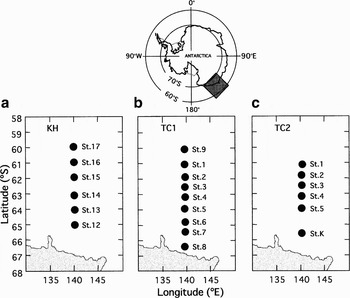
Field surveys were conducted along 140°E in the Southern Ocean north of Terre Adélie during three cruises; the KH cruise by RV Hakuho Maru, and TC1 and TC2 cruises by RV Tangaroa (NIWA, New Zealand) (Fig. 1). KH cruise took place in early summer during 8–14 January 2002 between 61°S and 65°S (KH: January 2002). TC1 cruise was conducted in midsummer during the period 13–27 February 2002, covered wide area from the waters between 60° and 66°S (TC1: February 2002). TC2 cruise was carried out in late summer during 26 February–6 March 2003 between 61° and 65.5°S (TC2: March 2003).
Locations of sampling stations during the three cruises, a. KH cruise (8–14 January 2002), b. TC1 cruise (13–27 February 2002), and c. TC2 cruise (26 February–6 March 2003).

Along each transect, six, nine and six net sampling stations were occupied for KH, TC1 and TC2 cruises, respectively. Macrozooplankton sampling, especially for krill and salps, was conducted at each station using a Rectangular Midwater Trawl (RMT 8: mesh size: 4.5 mm, effective mouth area: 8 m2, Baker et al. Reference Baker, Clark and Harris1973), equipped with a flow meter and a real time depth sensor. Tows were oblique from the surface to 200 m at 2–3 knots for TC1 and TC2 cruises. During the KH cruise, tows were made to a depth of about 1000 m. In addition, mesozooplankton sampling was carried out at the same stations using a NORPAC net with mouth diameter of 45 cm and mesh size of 0.33 mm, equipped with a flow meter. The net was hauled vertically from 150 m depth to the surface at a speed of about 1 ms-1. All zooplankton samples collected by these two nets were preserved in 5% (v/v) buffered formalin solution in seawater. The volume of water filtered for both nets was estimated by multiplying the effective mouth area of the net by the distance travelled measured by the flowmeter.
At each sampling site, water samples were collected for phytoplankton pigment analysis at 13 standard depths (0, 10, 20, 30, 40, 50, 60, 70, 80, 100, 125, 150, 200 m) in the upper 200 m of the water column. Chlorophyll a (chl a) was determined on board using a Turner Designs 10-AU fluorometer. The vertical profiles of water temperature and salinity were also measured with a conductivity-temperature-depth probe (CTD) at each station.
Laboratory sampling and data processing
In this paper we deal only with the three major zooplankton groups - krill, salps and large herbivorous copepods. In the laboratory all euphausiid and salp individuals were sorted and removed from the original sample collected by the RMT-8 net. Specimens of krill and salps were identified to the species level and counted. For sorting and counting of copepods, Calanoides acutus (Giesbrecht), Calanus propinquus Brady, Rhincalanus gigas Brady and Metridia gerlachei Giesbrecht, we used standardized vertical NORPAC net samples (mesh size of 0.33 mm) towed vertically from 150 m to the surface. We reasoned that the copepods were likely to have been undersampled by the RMT-8 net due to their small body size compared to the mesh size (4.5 mm) (Siegel Reference Siegel1986, Beaumont & Hosie Reference Beaumont and Hosie1997) and it would be difficult to compare the abundance of krill and salps with those of copepods from the samples obtained from the RMT-8 net.
The numerical abundance per m2 of the upper 200 m was estimated for Euphausia superba Dana, E. crystallorophias and Salpa thompsoni based on the number of the catch and the amount of water filtered. On the occasions when RMT-8 tows in January 2002 were deep (0–1000 m), we assume that all of the catches of E. superba, E. crystallorophias and S. thompsoni were collected in the upper 200 m layer, based on their normal distribution pattern (Pakhomov et al. Reference Pakhomov, Perissinotto and Froneman1998, Pauly et al. Reference Pauly, Nicol, Higginbottom, Hosie and Kitchener2000, Nishikawa & Tsuda Reference Nishikawa and Tsuda2001). Abundances for the three species were then standardized to numbers per m2 in upper 200 m, although there is some possibility that the abundance is overestimated in January 2002. Copepods abundance was estimated as a number of individuals per m2 in the upper 150 m based on the number of the catch and the volume of water filtered through the net, which was estimated from a flowmeter.
Demographic parameters were measured for the euphausiids, E. superba, E. crystallorophias, and the salp S. thompsoni. 150 individuals of krill and 100 individuals of salps were randomly picked from each of the sorted samples. All specimens were measured when the numbers of individuals were less than 100. Body length was measured to the nearest 1 mm from the tip of the rostrum to the tip of telson for E. superba and E. crystallorophias (SL1 of Mauchline Reference Mauchline1980). For the KH cruise, only wet weights were measured for the two euphausiids. For the S. thompsoni, the different forms (aggregate/solitary) were identified and oral-atrial lengths (Foxton Reference Foxton1966) were measured with an accuracy of 1 mm size classes for both forms.
Estimation of grazing impact for major zooplankton
Estimates of the grazing impact of S. thompsoni, E. superba and E. crystallorophias and the four large herbivorous copepods were determined using two different approaches. One method involved using clearance rates from published laboratory grazing experiments. The alternative method used estimates of the energetic requirements of each species.
The estimation of grazing impacts from known clearance rates was done as follows:
For S. thompsoni, E. superba and E. crystallorophias, daily ingestion rates (IR: mg chl a animal-1 d-1) for each size category of animal was estimated using the formula

where, F is the clearance rates (ml animal-1 h-1) for each size category of animal, and Ch the average chl a concentration (mg chl a m-3) in the top 200 m at each station. Here, F was estimated from the following relationships for S. thompsoni (Huntley et al. Reference Huntley, Sykes and Marin1989) and for E. superba and E. crystallorophias (Holm-Hansen & Huntley Reference Holm-Hansen and Huntley1984):


where W d is body dry weight (mg). W d was calculated from the length weight relationship obtained by Huntley et al. (Reference Huntley, Sykes and Marin1989) for S. thompsoni, by Ikeda et al. (Reference Ikeda, Dixon and Kirkwood1985) for E. superba and by Pakhomov et al. (Reference Pakhomov, Perissinotto and Froneman1998) for E. crystallorophias. However, IRs of the krill obtained from KH cruise were calculated from the clearance rates per mean dry weight.
For the copepods, the IR was estimated from following mean clearance rates obtained in each species by Schnack et al. (Reference Schnack, Smetacek, Bodungen, Stegmann, Gray and Christiansen1985): C. acutus, 275.7 ml individual-1 d-1; C. propinquus, 432.6 ml ind-1 d-1; R. gigas, 366.3 ml ind-1 d-1; M. gerlachei, 415.3 ml ind-1 d-1 and the average chl a concentration (mg chl a m-3) in the top 150 m at each station.
Carbon contents were calculated from the relationship dry weight = 0.001336L2.331, for S. thompsoni (Huntley et al. Reference Huntley, Sykes and Marin1989) and assuming a value of 45% body dry weight for krill (Ikeda & Bruce Reference Ikeda and Bruce1986) and 47% for copepods (Schnack et al. Reference Schnack, Smetacek, Bodungen, Stegmann, Gray and Christiansen1985). The IR and chl a were converted to carbon units using a carbon:chl a ratio of 50 (Atkinson Reference Atkinson1996). Grazing impacts (mg C m-2 day-1) were then calculated from the abundance and individual ingestion rates and also expressed as a percentage of the integrated phytoplankton biomass consumed per day.
Grazing impacts based on energetic requirements were estimated using the following assumptions: daily carbon demands was 25% of their body carbon for salps (Huntley et al. Reference Huntley, Sykes and Marin1989), 5% for krill (Clarke & Morris Reference Clarke and Morris1983) and 15% for copepods (Schnack et al. Reference Schnack, Smetacek, Bodungen, Stegmann, Gray and Christiansen1985), respectively.
Gut content analysis
The gut contents of salps and krill were analysed using intact specimens from Stns TC1-1, TC1-5, TC1-6, TC2-1 and TC2-5 for S. thompsoni, and TC1-8 for E. crystallorophias and TC2-K for E. superba. Three individuals were randomly picked from each sample. The guts were carefully isolated from the body under a dissecting microscope and then rinsed in filtered seawater in order to avoid contamination. They were moved to a glass slide with a cavity filled with filtered seawater and the contents were squeezed out using fine needles. The cavity slides were left for 24 hours to allow all the gut contents to settle, and were examined using an inverted microscope at 200 magnification. Food items in the guts were identified as far as genus level. For S. thompsoni, the diets were represented in terms of relative abundance of food items. However, for the two euphausiids, we could only determined the occurrence of food items because of difficulties in counting.
Results
Environments
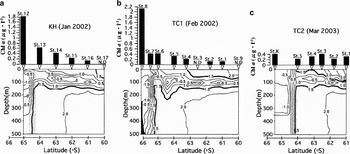
Oceanographic conditions are presented in detail elsewhere (Aoki et al. Reference Aoki, Rintoul, Hasumoto and Kinoshita2006). Here, we briefly mention characteristics of temperature and chl a during the surveys. Figure 2 describes the temperature contours and mean chl a concentrations in the upper 200 m along the survey transects in the three cruises.
Water temperature (°C) profile and mean chlorophyll a concentration (μg l-1) upper 200 m (a) during the three cruises: a. KH cruise (January 2002), b. TC1 cruise (February 2002), and c. TC2 cruise (March 2003). Arrows indicate the approximate locations of sampling stations. Hatched area denotes the approximate position of the Southern Boundary of Antarctic Circumpolar Current (SB-ACC) during the investigation period (Aoki et al. Reference Aoki, Rintoul, Hasumoto and Kinoshita2006). N.D = indicates no data.

Several oceanographic fronts were identified in the study area south of 60°S along the 140°E meridian during the research periods: the southern branch of the Polar Front (PF-S), the northern and southern branches of the Southern Antarctic Circumpolar Current Front (SACCF-N and SACCF-S), Southern Boundary of the ACC (SB-ACC), and the Antarctic Slope Front (ASF), respectively from the north (Aoki et al. Reference Aoki, Rintoul, Hasumoto and Kinoshita2006). The PF-S and SACCF-N were located between 60–61°S and 62–63°S, respectively. The SACCF-S, SB-ACC and ASF were closely spaced in the study area between 64–65°S (Aoki et al. Reference Aoki, Rintoul, Hasumoto and Kinoshita2006). The SACCF-S lies within the ACC, the SB-ACC marks the southern boundary of the ACC and the ASF is located within the westward flowing coastal current (CC) on the continental shelf. The SACCF-S and SB-ACC occasionally have merged on 140°E (Sokolov & Rintoul Reference Sokolov and Rintoul2002). The SB-ACC separates the comparatively warm, eastward flowing ACC to the north from the cold westward flowing the CC to the south (Hunt & Hosie Reference Hunt and Hosie2006). The SB-ACC across the present transect would be expected to function as one of the major biogeographic barriers to the macro scale distribution of the macro- and mesozooplankton (Tynan Reference Tynan1998, Nicol et al. Reference Nicol, Pauly, Bindoff, Wright, Thlele, Hosie, Strutton and Woehler2000b). For this reason, this study focused on the position of the SB-ACC. According to Aoki et al. (Reference Aoki, Rintoul, Hasumoto and Kinoshita2006), the SB-ACC defined by the southern limit of θmax. water warmer than 1.5°C, was located at 64–65.0°S on January 2002 section, and 64.8–65.1°S on February section and 64–64.5°S on March 2003 section, respectively (Fig. 2).
During January and February 2002, chl a concentrations generally increased towards the south (Fig. 2a & b), but their concentration at each location decreased within a month. Notably, there was a marked decrease in chl a concentration observed at the station around 65°S. Instead, a higher chl a concentration was observed at 66°S in February 2002. In March 2003, the pattern of chl a distribution was somewhat different, being relatively low (0.2–0.4 µg chl a L-1) without any particular latitudinal trends (Fig. 2c). This may be partly due to the late timing of the survey in 2003 (March) compared to 2002 (January–February) indicating the phytoplankton bloom associated with the summer ice retreat had already finished in 2003 in this area.
Abundance of krill, salps and copepods
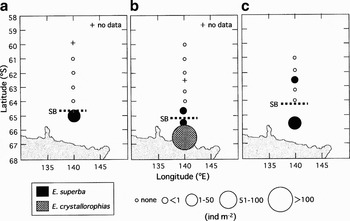
Euphausia superba and E. crystallorophias: In January 2002, E. superba and E. crystallorophias were found at only Stn KH-12 (11.7 ind m-2) south of the SB-ACC (Fig. 3a). In February 2002, E. superba occurred both north and south of the SB-ACC but in relatively low numbers of less than 0.1 ind m-2. Euphausia crystallorophias was observed only at Stn 8 with a high abundance of 170.4 ind m-2 (Fig. 3b). In March 2003, E. superba were also found both north and south of the SB-ACC with a higher abundance south of the SB-ACC (29.6 ind m-2 at Stn TC2-K) but was less abundant north of the SB-ACC (< 0.1 ind m-2 at Stn TC2-3) (Fig. 3c).
Distribution and abundance of Euphausia superba and Euphausia crystallorophias along 140°E transect during three cruises: a. KH cruise (January 2002), b. TC1 cruise (February 2002), and c. TC2 cruise (March 2003). SB = the Southern Boundary of the Antarctic Circumpolar Current.

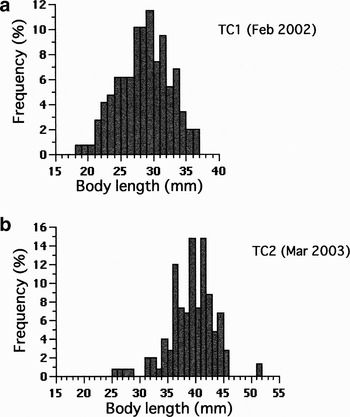
In February 2002, the overall density weighted length-frequency distribution (LFD) of E. crystallorophias showed a unimodal distribution pattern (size range of 18–37 mm) with a mode around 30 mm (Fig. 4a). Analysis of the maturity stages of E. crystallorophias showed that subadult (54%) and adult (38%) stages were abundant, while the juvenile stage was only 8% of the population. The spawning season for this species is thought to be in early December for the Weddell Sea (Fevolden Reference Fevolden1980). This is similar to the Indian Ocean sector (Harrington & Thomas Reference Harrington and Thomas1987, Hosie Reference Hosie1991). The timing of our survey should therefore be after the main spawning period. The existence of many gravid females (41% of females) in our samples shows that the ice krill was still spawning at the timing of sampling. We do not know whether this year was a late spawning year or the spawning period is different in this area. The presence of subadults of almost maximum size (25–30 mm) indicates that majority of the adults had already reproduced that season and started to regress their external characteristics as observed in E. superba (Thomas & Ikeda Reference Thomas and Ikeda1987).
Density weighted length frequency distribution (LFD) of a.Euphausia crystallorophias (TC1 February 2002), and b.Euphausia superba (TC2 March 2003).

In March 2003, E. superba ranged in size from 25–52 mm, with a mode around 40 mm (Fig. 4b). The adult stage was the dominant maturity stage, comprising 97% of the total population. Subadults were scarce (3%) and no juvenile stage was caught during this cruise. 56% of the adult females were in advanced stages of spawning with well developed ovaries.
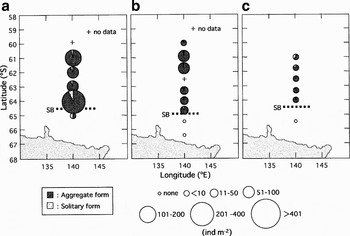
Salpa thompsoni: All salps observed were Salpa thompsoni. In January 2002, most of the salps occurred north of the SB-ACC, with the highest abundance of 219.6 ind m-2 at Stn KH-13, and a mean abundance of 129.9 ind m-2 in stations north of the SB-ACC (Fig. 5a). The abundance observed at station south of the SB-ACC was very low with 5.8 ind m-2. Interestingly, the percentage of the solitary form comprised 48% of the population compared to 5–10% for the rest of the stations north of the SB-ACC. In February 2002, the distribution was strictly limited to the region north of the SB-ACC. The maximum abundance of 71.6 ind m-2 was at Stn TC1-2. The mean abundance was 35.9 ind m-2 (Fig. 5b). The percentages of solitary forms were less than 10%. In March 2003, salps were again only caught at stations north of the SB-ACC (Fig. 5c). Maximum abundance was observed at Stn TC2-3 with 3.2 ind m-2, and in other stations with less than 2.0 ind m-2. These abundances are notably less than those observed in 2002. The percentage of solitary forms with only 1.4% at Stn TC2-5 just north of the SB-ACC increased towards the north and attained the maximum of 36.8% at StnTC2-1.
Distribution and abundance of Salpa thompsoni along 140°E transect during three cruises: a. KH cruise (January 2002), b. TC1 cruise (February 2002), and c. TC2 cruise (March 2003). SB = the Southern Boundary of the Antarctic Circumpolar Current.

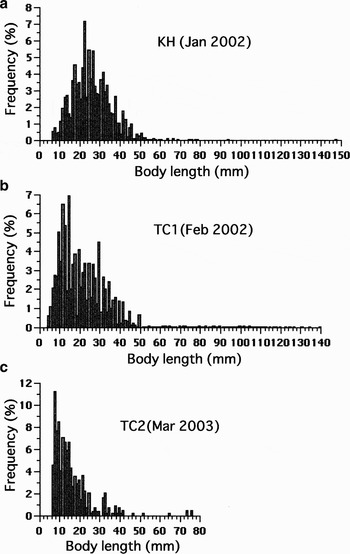
Density weighted LFDs for each cruise are presented in Fig. 6. The populations for three cruises mainly comprised individuals 4–50 mm size. However, the overall body size tended to decrease from January–March. The modal length was at 22 mm in January 2002 (Fig. 6a), 14 mm in February 2002 (Fig. 6b) and 8 mm in March 2003 (Fig. 6c), respectively.
Density weighted length frequency distribution of Salpa thompsoni during three cruises: a. KH cruise (January 2002), b. TC1 cruise (February 2002), and c. TC2 cruise (March 2003).

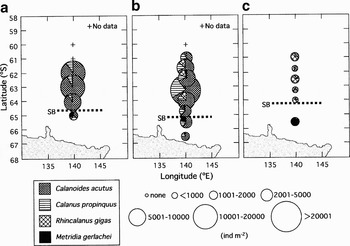
Copepods: In January 2002, the total abundance ranged from 1305–12 540 ind m-2 along the transect (Fig. 7a). Copepod densities were high at stations north of the SB-ACC. The maximum abundance was observed at latitude 63°S (Stn KH-14) with 12 540 ind m-2. Calanoides acutus contributed up to 90% of the total number of the four copepods, followed by Calanus propinquus, while R. gigas was poorly represented (mean: 1.1%) and M. gerlachei was absent north of the SB-ACC. Marked decreases in the copepod numbers were observed south of the SB-ACC (Stn KH-12: 1305 ind m-2). The contribution of C. acutus decreased in this region where it was replaced by M. gerlachei (comprising 32%).
Distribution and abundance of four large herbivorous copepods (Calanoides acutus, Calanus propinquus, Rhincalanus gigas and Metridia gerlachei) collected with Norpac net vertical holes along 140°E transect during three cruises: a. KH cruise (January 2002), b. TC1 cruise (February 2002), and c. TC2 cruise (March 2003). SB = the Southern Boundary of the Antarctic Circumpolar Current.

In February 2002 the total abundance ranged from 1050–21 615 ind m-2 along the transect. High abundances (more than 5000 ind m-2) were found between 61°30'S and 63°S, with maximum of 21 615 ind m-2 at Stn TC1-4 (Fig. 7b). Low numbers were observed at the northern most station around 61°S (Stn TC1-1: 2220 ind m-2) and at the southern most station on the shelf south of the SB-ACC (Stn TC1-8: 1050 ind m-2). Calanoides acutus dominated, comprising more than 60%. The mean percentage of C. propinquus was 15.4% at most stations, except at Stn TC1-1 where C. propinquus comprised 57.4% and dominated the sample. R. gigas and M. gerlachei were poorly represented in numbers in all sampling stations at this period.
In March 2003, the total abundance was relatively low and did not exceed 2000 ind m-2 throughout the transect (Fig. 7c). North of the SB-ACC, R. gigas often dominated numerically accounting for 34.3–73.6%, followed by Calanoides acutus (1.17–53.2%) and C. propinquus (0–34.3%). In contrast, M. gerlachei (90.2%) replaced these copepods as the dominant species south of the SB-ACC (Stn TC2-K).
Estimated grazing impacts by salps, krill and copepods
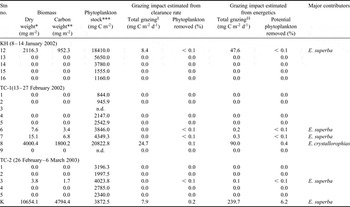
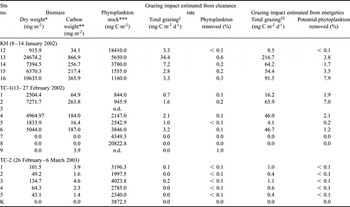
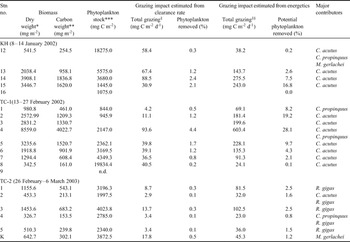
Tables I–III describe the biomass and grazing impacts, estimated by clearance rate and energetic requirements, for S. thompsoni, E. superba and E. crystallorophias, and the four herbivorous copepods.
Summary of abundance, biomass and grazing impacts based on the clearance rate and energetic requirements of krill (Euphausia superba and E. crystallorophias) along the 140°E transect during summer of 2002 and 2003.

* = Dry weight was calculated from length dry weight relationship obtained by Pakhomov et al. (Reference Pakhomov, Perissinotto and Froneman1998) for E. crystallorophias and by Ikeda et al. (Reference Ikeda, Dixon and Kirkwood1985) for E. superba.
** = Carbon weight was calculated assuming as 45% dry body weight (Ikeda & Bruce Reference Ikeda and Bruce1986).
*** = Total phytoplankton carbon was estimated using carbon chlorophyll ratio of 50 (Atkinson Reference Atkinson1996).
§ = Total grazing was calculated by the multiplying the number of krill and the grazing impact for each size category estimated from the clearance rate (Holm-Hansen & Huntley Reference Holm-Hansen and Huntley1984).
§§ = Total grazing as daily carbon demand was estimated by assuming their daily carbon demand as 5.0% of their body carbon (Clarke & Morris Reference Clarke and Morris1983).
n.d. indicates no data.
Summary of abundance, biomass and grazing impacts based on the clearance rate and energetic requirements of Salpa thompsoni along the 140°E transect during summer of 2002 and 2003.

* = Dry weight was calculated from length dry weight relationship obtained by Huntley et al. (Reference Huntley, Sykes and Marin1989).
** = Carbon content was calculated from length carbon content relationship obtained by Huntley et al. (Reference Huntley, Sykes and Marin1989).
*** = Total phytoplankton carbon was estimated using carbon chlorophyll ratio of 50 (Atkinson Reference Atkinson1996).
§ = Total grazing was calculated by the multiplying the number of salps and the ingestion rate for each size category estimated from the clearance rate ( Huntley et al. Reference Huntley, Sykes and Marin1989).
§§ = Total grazing as daily carbon demand was estimated by assuming their daily carbon demand as 25 % of their body carbon (Huntley et al. Reference Huntley, Sykes and Marin1989).
n.d. indicates no data.
Summary of abundance, biomass and grazing impacts based on the clearance rate and energetic requirements of four large herbivorous Copepoda, Calanoides acutus, Calanus propinquus, Rhincalanus gigas and Metridia gerlachei, along the 140°E transect during summer of 2002 and 2003.

* = Total dry weight was calculated from multiplying the abundance into mean dry weight per individual for each species obtained by Schnack et al. (Reference Schnack, Smetacek, Bodungen, Stegmann, Gray and Christiansen1985).
** = Carbon weight was calculated assuming as 47% of dry weight for each species (Schnack et al. 1985).
*** = Total phytoplankton carbon was estimated using carbon chlorophyll ratio of 50 (Atkinson Reference Atkinson1996).
§ = Total grazing was calculated by the multiplying the number of copepods and the ingestion rate based on the mean clearance rates in each species obtained by Schnack et al. (Reference Schnack, Smetacek, Bodungen, Stegmann, Gray and Christiansen1985).
§§ = Grazing impact as daily carbon demand was estimated by assuming their maximum daily carbon demand as 15% of their body carbon (Schnack et. al. 1985).
n.d. indicates no data.
When grazing impacts were estimated using known clearance rates, the overall range of the values were 0–34.4 mg C m-2 for salps, 0–24.7 mg C m-2 for both euphausiids, and 3.4–93.6 mg C m-2 for copepods. These rates accounted for only 0–4.4% of the total chl a stock consumed per day. On the other hand, if the grazing impacts were estimated using daily energetic requirements, the range of the values were 0–401.7 mg C m-2 for salps, 0–239.7 mg C m-2 for the euphausiids, and 23.0–603.4 mg C m-2 for copepods, respectively. These values were equivalent to 0–7.9% of the total chl a stock for salps, 0–6.2% for krill and 0.2–28.1% for copepods.
When grazing impact were separated by zooplankton groups, salps and krill showed marked difference in value north and south of the SB-ACC, (krill high in south, and salps high in north). Although copepods also showed generally higher grazing to the north of the SB-ACC, latitudinal variation was not as great as the other two groups.
In terms of temporal trends, total grazing impact of the three zooplankton groups was high in January 2002 (304.6–1183.3 mg C m-2) and February 2002 (346.4–1754.7 mg C m-2). March 2003 showed low impact at about one-third that of the previous year, ranging 98.1–563.5 mg C m-2. Grazing by salps was highest in January and it progressively decreased towards March. Since krill distributions were patchy and also the dominant species south of the SB-ACC was different in February (E. crystallorophias) from January and March (E. superba), it is difficult to generalize the temporal pattern for krill, but the mean grazing impact increased from January to March. The mean grazing impact by copepods stayed stable from January–March, but species composition seemed to be more diverse in March compared to the previous two months (Takahashi unpublished data).
Gut contents of salps and krill
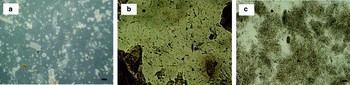
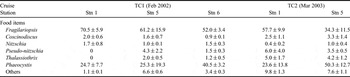
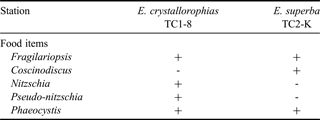
Gut contents of salps and krill collected from TC1 (February 2002) and TC2 (February–March 2003) were analysed. While phytoplankton observed from guts of S. thompsoni was almost intact (Fig. 8a), those in E. crystallorophias and E. superba were often destroyed and difficult to make quantitative assessments (Fig. 8b & c). Table IV summarizes main gut contents found in S. thompsoni. Major food items were Fragilariopsis (34.3–70.5%) and Phaeocystis (23.6–50.3%), with some variation in proportion depending on the sampling stations (Fragilariopsis: 34.3–70.5%, Phaeocystis: 23.6–50.3%). Other minor components were Coscinodiscus, Nitzschia, Pseudo-nitzschia, and Thalassiothrix. From the guts of E. crystallorophias, Fragilariopsis, Nitzschia, Pseudo-nitzschia and Phaeocystis were observed, while Coscinodiscus, Fragilariopsis, Phaeocystis, Nitzschia and Pseudo-nitzschia were found in the guts of E. superba (Table V). In general those phytoplankton found in the guts were reflecting the natural composition of the phytoplankton found from the environment (Gomi et al. Reference Gomi, Taniguchi and Fukuchi2007).
Gut contents of a.Salpa thompsoni (StnTC2-5 in March 2003), b.Euphausia crystallorophias and (StnTC1-8 in February 2002), and c.Euphausia superba (StnTC2-K in March 2003), respectively. (scale bar: 50 μm)

Food items and their relative abundance (mean % ± S.D) of Salpa thompsoni.

Gut contents of Euphausia crystallorophias and E. superba collected at Stns TC1-8 in February 2002 and TC2-K in March 2003.
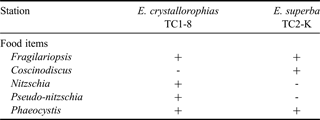
(+) and (-) indicate occurrence and absent of food item, respectively.
Discussion
Distribution pattern of krill, salps and copepods in relation to oceanography
Although different sampling nets and methodologies were used, and over two separate years, it seems to be quite feasible to compare the data from the three cruises for krill, salps, and major large copepods, which are all the important contributors to zooplankton biomass in the upper 200 m layer in summer. South of the SB-ACC, macrozooplankton assemblages were numerically dominated by Euphausia superba and/or E. crystallorophias. Generally E. superba is most abundant near the shelf edge between the oceanic and neritic zones and forms a distinct community (Hosie Reference Hosie and El-Sayed1994, Hosie & Cochran Reference Hosie and Cochran1994, Hosie et al. Reference Hosie, Cochran, Pauly, Beaumont, Wright and Kitchener1997). Euphausia crystallorophias usually replaces E. superba as the dominant euphausiid in shelf waters (Thomas & Green Reference Thomas and Green1998) and often becomes dominant in the neritic community in East Antarctica (Hosie & Cochran Reference Hosie and Cochran1994, Hosie et al. Reference Hosie, Schultz, Kitchener, Cochran and Richards2000). According to Hosie et al. (Reference Hosie, Schultz, Kitchener, Cochran and Richards2000), however, a distinct krill–dominated community is difficult to define geographically in the present study area, because of overall low krill abundance.
North of the SB-ACC, macrozooplankton assemblages were dominated by Salpa thompsoni, which has been described as a dominant indicator species of the northern oceanic community north of the SB-ACC (Hosie Reference Hosie and El-Sayed1994, Hosie & Cochran Reference Hosie and Cochran1994, Hosie et al. Reference Hosie, Cochran, Pauly, Beaumont, Wright and Kitchener1997). This was certainly the case in February 2002 when S. thompsoni almost exclusively dominated the northern waters (Stns TC-1 and 2) north of the SB-ACC. A major change of the distribution and abundance of the four large copepods was also found along the transect crossing the SB-ACC. Generally Calanoides acutus, Calanus propinquus, and Rhincalanus gigas have a wide circumpolar distribution from the Polar Front to the Antarctic coast, but they are usually more abundant north of the SB-ACC and decrease towards the continent (e.g. Smith & Schnack-Schiel Reference Smith, Schnack-Schiel and Smith1990, Schnack-Schiel & Hagen Reference Schnack-Schiel and Hagen1994, Atkinson Reference Atkinson1996, Voronina Reference Voronina1998, Hosie et al. Reference Hosie, Schultz, Kitchener, Cochran and Richards2000). This was particularly evident in our results of midsummer in January and February 2002, when the abundance was high north of the SB-ACC and low south of the SB-ACC. The remarkable difference in abundance between north and south of the SB-ACC was due to mainly to the disappearance of C. acutus and C. propinquus. Essentially, the same findings are also reported in the east Antarctic including our survey line of 140°E by Hosie et al. (Reference Hosie, Schultz, Kitchener, Cochran and Richards2000).
Grazing impacts of krill, salps and copepods
Euphausia superba and S. thompsoni attract much attention for their capability of consuming vast amount of food resources as single species. Each of the copepod species may not be as abundant and as dense in patches as these two species, but they are certainly one of the most important groups of zooplankton in the Southern Ocean (Voronina Reference Voronina1998). Collectively, their biomass is much higher, possibly representing at least 50% of the zooplankton carbon abundance in the Southern Ocean, and potentially consuming 3–8 times more of the primary production than is consumed by Antarctic krill (Conover & Huntley Reference Conover and Huntley1991, Pakhomov et al. Reference Pakhomov, Froneman and Perissinotto2002). Therefore, the magnitude of their grazing pressure is likely to exceed or at least equate with krill and salp grazing pressure in the Southern Ocean (Pakhomov et al. Reference Pakhomov, Froneman and Perissinotto2002).
In this study, we estimated grazing pressure by salps, krill and copepods in two ways. Laboratory clearance estimations are known often to be underestimations compared to their natural values, especially for the large animals such as krill and salps (Pakhomov et al. Reference Pakhomov, Froneman and Perissinotto2002). This may be due to experimental effects caused by being kept in a confined artificial space (Dubischar & Bathmann Reference Dubischar and Bathmann1997). Also their normal feeding may not be restricted purely to grazing on phytoplankton (Pakhomov et al. Reference Pakhomov, Froneman and Perissinotto2002). It is also known previously that the estimated grazing impacts using known clearance rates were lower than those based on energetic requirements, especially for krill and salps (Pakhomov et al. Reference Pakhomov, Froneman and Perissinotto2002). Copepods seemed to show reasonable agreement between the two types of estimation, possibly due to their smaller body size and active feeding (Le Fèvre et al. Reference Le Fèvre, Legendre and Rivkin1998). As we are interested in feeding potential in the wild, we use the estimates from energy requirements in the following discussion.
Our estimates of the grazing impact suggest that salps and copepods together would be able to remove a maximum of 30% of the total phytoplankton standing stock in midsummer in the area north of the SB-ACC. The contribution from Antarctic krill is negligible in this area. The high grazing impact is attributed to the relatively high zooplankton abundance and low phytoplankton abundance. The grazing pressure of salps, S. thompsoni, often accounted for more than 100% of the phytoplankton production in the ACC waters (Huntley et al. Reference Huntley, Sykes and Marin1989, Dubischar & Bathmann Reference Dubischar and Bathmann1997), and it is believed that salps prevent the build-up of a phytoplankton bloom in that region. The grazing of copepods also had a significant effect on phytoplankton biomass in midsummer. The combined mean densities of the two calanoid copepods C. acutus and C. propinquus, were 9900 ind m-2 in January 2002 and 7200 ind m-2 in February 2002, in this area. The copepodite CIII–CV stages were the dominant stages for both species. They quickly respond to a phytoplankton bloom and actively graze the phytoplankton at maximum rates in this season (Atkinson et al. Reference Atkinson, Shreeve, Pakhomov, Priddle, Blight and Ward1996). It is suggested that S. thompsoni, C. acutus and C. propinquus are key components of the major pathway of the carbon transport from surface to the deep ocean north of the SB-ACC, although their contributions could vary during the summer.
In late summer, however, the contribution of grazing impact by zooplankton became very limited or negligible. The reduction in their contributions may be caused by S. thompsoni becoming biologically inactive (Chiba et al. Reference Chiba, Ishimaru and Hosie1999) and migrating to greater depth, coupled with the diapause or overwintering of C. acutus and C. propinquus in autumn (Schnack-Schiel et al. Reference Schnack-Schiel, Hagen and Mizdalski1991, Atkinson Reference Atkinson1996). The paucity of these major zooplankters also suggests that the carbon transport from the surface waters to deep water is probably not as effective at this time of year.
Euphausia superba or E. crystallorophias are both dominant component of zooplankton assemblages south of the SB-ACC in the Indian Ocean sector of Southern Ocean (Chiba et al. Reference Chiba, Horimoto, Sato, Yamaguchi and Ishimaru1998, Hosie et al. Reference Hosie, Schultz, Kitchener, Cochran and Richards2000, Nicol et al. Reference Nicol, Kitchener, King, Hosie and de la Mare2000a). Surprisingly, however, overall daily grazing impact for them was quite limited and did not exceed 6% of the total phytoplankton standing stock based on carbon throughout the investigation periods. According to a hydroacoustic survey off East Antarctica by Pauly et al. (Reference Pauly, Nicol, Higginbottom, Hosie and Kitchener2000), while acknowledging acoustic estimated densities are not directly comparable to densities estimated from net samplings, mean krill density in the waters north of the SB-ACC between 115° and 150°E was estimated to be 4.28 g wet weight m-3. This value was estimated to be 408.3 mg C m-3, assuming krill dry weight to be 21.2% of wet weight (Ikeda et al. Reference Ikeda, Dixon and Kirkwood1985) and the carbon weight to be 45% of dry body weigh (Ikeda & Bruce Reference Ikeda and Bruce1986). Assuming the daily carbon requirement is 5.0% of their body carbon (Clarke & Morris Reference Clarke and Morris1983), the grazing impact was estimated to be 20.4 mg C m-3 d-1 and corresponded to only 0.74–1.28% (mean: 0.96%) of the chlorophyll a standing stock or 6.5% of the daily primary production south of the SB-ACC along the 140°E (Strutton et al. Reference Strutton, Griffiths, Water, Wright and Bindoff2000). These estimates are in the same range as those estimated in the present study but are substantially lower. It was considered that phytoplankton resources were adequate for Antarctic krill during our investigation periods. Admittedly, the ability of E. superba and E. crystallorophias to swarm suggests that those two species may locally dominate the zooplankton community and enhance the grazing activity, but their overall contribution as phytoplankton grazers may not be as high in this area.
High predation impact by carnivorous zooplankton may affect the zooplankton standing stock and secondary production, resulting in the low herbivorous zooplankton grazing impact (Pakhomov et al. Reference Pakhomov, Perissinotto and Froneman1999, Froneman et al. Reference Froneman, Pakhomov, Perissinotto and McQuaid2000). Pakhomov et al. (Reference Pakhomov, Perissinotto and Froneman1999) estimated that predators consume at least 10% of the zooplankton standing stock per day throughout the Southern Ocean. Huntley et al. (Reference Huntley, Lopez and Karl1991) suggested that more than 30% of the secondary production is consumed by fish, squids, birds and mammals during the summer in the entire of Southern Ocean. In the present study, carnivores, such as hyperiid amphipods (mainly Themisto gaudichaudi Guérin) and chaetognaths (mainly Eukrhonia hamata (Möbius)), comprised 46–85% of the total macrozooplankton abundance south of the SB-ACC, except for Stn TC1-8 where the E. crystallorophias dominated the macrozooplankton assemblages and the carnivores comprised only 3% of the abundance (Tanimura et al. unpublished data). Hyperiids and chaetognaths are both the most important consumers of mesozooplankton (Pakhomov et al. Reference Pakhomov, Perissinotto and Froneman1999). In addition to carnivorous zooplankton, the notothenioid fish Pleuragramma antarcticum Boulenger, which is also the most important fish predator of E. superba and E. crystallorophias, and probably of copepods, occurs abundantly around the margin of the continental shelf in our investigation area (Hoddell et al. Reference Hoddell, Crossley, William and Hosie2000). One of main reasons for the low krill density in this area could be due to potentially large predation pressure, not only by those predators, but also birds, seals and whales, leading to their low abundance in this area (Chiba et al. Reference Chiba, Ishimaru and Hosie1999). Low krill density around this area should also be examined in relation to dynamics of oceanography and surrounding current system (Nicol et al. Reference Nicol, Pauly, Bindoff, Wright, Thlele, Hosie, Strutton and Woehler2000b).
Ecological interactions among krill, salps and copepods along 140°E
Krill and salps overlap in distribution in the Antarctic Peninsula area and it has been suggested by many authors that they compete for food resources or habitat (Nishikawa et al. Reference Nishikawa, Naganobu, Ichii, Ishii, Terazaki and Kawaguchi1995, Siegel & Loeb Reference Siegel and Loeb1995, Loeb et al. Reference Loeb, Siegel, Holm-Hansen, Hewitt, Fraser, Trivelpiece and Trivelpiece1997, Kawaguchi et al. Reference Kawaguchi, de la Mare, Ichii and Naganobu1998, Pakhomov et al. Reference Pakhomov, Froneman and Perissinotto2002, Atkinson et al. Reference Atkinson, Siegel, Pakhomov and Rothery2004). Unlike the Antarctic Peninsula area, very little spatial overlap in the distribution of these two species has been observed in the present study area along the 140°E. There does not seem to be any direct interaction between these two species in our survey area. This has also been reported in the Prydz Bay region further west (Hosie Reference Hosie and El-Sayed1994).
During our survey, the position of the SB-ACC varied between 64° and 65°S, which seems to be closer to the continent compared to the other part of the Antarctic. We observed that the position of the SB-ACC could change seasonally as well as annually in the present study. Nicol et al. (Reference Nicol, Pauly, Bindoff, Wright, Thlele, Hosie, Strutton and Woehler2000b) proposed a conceptual model that links oceanography, sea ice, and relative abundance of krill and salps in the area of our survey (140°E). In their model, ocean circulation drives sea ice extent, the positions of oceanic boundaries, and hence biological boundaries. When the SB-ACC is located further offshore, cooler coastal waters would be more extensive, krill populations would be more extensive and salps would be found further offshore. However, when the SB-ACC is located further south, the cool coastal current would be narrower, krill would be scarce, or more coastally constrained, and salps more abundant closer to shore. The biological boundary moves as the physical boundary moves seasonally, suggesting potential competitive interactions between krill and salps at the common border of their distributional ranges even if we may not see any direct competition in our survey area.
When we look into the early life stage of E. superba, the larvae are known to be distributed further offshore than the adults, and are likely to be drifting into the ACC (e.g. Hosie Reference Hosie1991, Siegel & Loeb Reference Siegel and Loeb1995). Nicol et al. (Reference Nicol, Pauly, Bindoff, Wright, Thlele, Hosie, Strutton and Woehler2000b) observed the distribution of krill larvae were mainly north of the SB-ACC, and it overlapped with the area of high salp density in much of eastern Antarctica, including our study area. Overlaps in salps and krill larvae distribution were also consistently observed in the Prydz Bay region (Hosie Reference Hosie1991). One of the most important features of krill larvae is that they are extremely vulnerable to starvation; a week of starvation at the calyptopis I stage would be fatal (Ross & Quetin 1989, Meyer & Oettl Reference Meyer and Oettl2005). This means even only a short-term spatial overlap between krill larvae and salps could be enough to detrimentally effect krill larvae. Salps are opportunist species making maximum use of optimum conditions whenever they can, forming extremely dense swarms and consuming all the phytoplankton in the water column within a day (Huntley et al. Reference Huntley, Sykes and Marin1989, Dubischar & Bathmann Reference Dubischar and Bathmann1997, Perissinotto & Pakhomov Reference Perissinotto and Pakhomov1998a). Krill larvae are also dependent on phytoplankton and depletion of the phytoplankton standing stock by salps would affect the krill larvae food supply. Huntley et al. (Reference Huntley, Sykes and Marin1989) also suggests salps prey on krill larvae. Krill larvae and salps are both considered as passive drifters (Nicol Reference Nicol2006, Huntley et al. 1989), therefore once they reside in a same water mass, it maybe hard for them to be separated in space, except for the daytime when most of the salp populations migrate down to < 300 m depths (Nishikawa & Tsuda Reference Nishikawa and Tsuda2001). Therefore it is easy to imagine that if krill larvae spatially overlap with high salp abundances then both phytoplankton and krill larvae themselves will be consumed out as they drift together. Decrease in survival of larvae will result in low recruitment in the following year. For these reasons, we believe that absence of direct competition between adult krill and salps do not necessarily mean absence of interactions between these two species.
There is little information on the interactions between salps and copepods, C. acutus, C. propinquus, Rhincalanus gigas and Metridia gerlachei, as there is between salps and krill. Makarov & Solyankin (Reference Makarov, Solyankin and Solyankin1990) and Dubischar & Bathmann (Reference Dubischar and Bathmann1997) suggested that a huge abundance of salps has a negative effect on the seasonal development of dominant copepods species due to substantial food removal by salps during summer in the ACC. Indeed, S. thompsoni and the four large herbivorous copepods are both microphageous feeders with similar feeding modes (Le Fèvre et al. Reference Le Fèvre, Legendre and Rivkin1998). Therefore, the possibility of copepod exclusion through competitive removal of food by salps cannot be ignored. The distribution patterns of salps are often discussed in relation to chlorophyll densities and temperature conditions (e.g. Pakhomov et al. Reference Pakhomov, Grachev and Trotsenko1994, Reference Pakhomov, Froneman and Perissinotto2002, Perissinotto & Pakhomov Reference Perissinotto and Pakhomov1998a, Kawaguchi et al. Reference Kawaguchi, Siegel, Litovinov, Loeb and Watkins2004). Salps do not benefit from patchy conditions of high food concentration. They cannot continue to feed successfully without a low concentration of phytoplankton due to their inability to filter particles efficiently above a threshold particle size and concentration. Hence, it is considered that high chlorophyll areas are not suitable for salp reproduction (Harbison et al. Reference Harbison, McAlister and Gilmer1986). Low temperature also slows their physiological processes and therefore reproduction will be suppressed when environmental temperature is below a threshold. The chlorophyll threshold is generally thought to be 1 µg chl a L-1, and salps suffer above this concentration. In January 2002, salps were almost absent when chl a density was 1.6 µg L-1. In February 2002, salps were absent at stations with chl a density of 2.0, but also 0.4 µg L-1 where salps should be capable of grazing the phytoplankton. This suggests that chlorophyll is not the only limiting factor in this case. Instead, the distribution showed a clear difference between north and south of the SB-ACC, where there is a sharp temperature gradient. In March 2003, chl a concentration again did not seem to be the factor limiting salp distribution since chl a densities were below the threshold at all stations. Salps only occurred to the north of the SB-ACC. Recent studies have shown that S. thompsoni often occur abundantly in cold water masses in the high Antarctic (Maruyama et al. Reference Maruyama, Toyoda and Suzuki1982, Boysen-Ennen & Piatokowski Reference Boysen-Ennen and Piatkowski1988, Boysen-Ennen et al. Reference Boysen-Ennen, Hagen, Hubold and Piatkowski1991, Pakhomov et al. Reference Pakhomov, Grachev and Trotsenko1994, Chiba et al. Reference Chiba, Ishimaru and Hosie1999), but they are generally restricted to the warmer water masses (e.g. Foxton Reference Foxton1966, Voronina Reference Voronina1998, Pakhomov et al. Reference Pakhomov, Froneman and Perissinotto2002). It is obvious that our study area was located at the southern limit of the salp habitat, and this seems to be primarily dictated by the position of the SB-ACC. This result agrees with many of the previous studies showing temperature is the limiting factor, especially the position of the SB-ACC, for the distribution of S. thompsoni (e.g. Foxton Reference Foxton1966, Casaretto & Nemoto Reference Casaretto and Nemoto1986, Chiba et al. Reference Chiba, Ishimaru and Hosie1999, Kawaguchi et al. Reference Kawaguchi, Siegel, Litovinov, Loeb and Watkins2004).
The four large herbivorous copepod species are adapted to conditions of extensive high food concentration similar to krill (Le Fèvre et al. Reference Le Fèvre, Legendre and Rivkin1998). These copepods are known to perform more or less seasonal ontogenetic migration. Generally, they stay in deeper water in advanced copepodite stages during winter, and become mature and ascend to the surface layer in spring (e.g. Schnack-Schiel & Hagen Reference Schnack-Schiel and Hagen1994, Atkinson Reference Atkinson1996). Despite their life cycles varying depending on location and year, the important event in their life cycles is that the reproduction and intense larval development occur in the surface layer associated with the phytoplankton bloom along the retreating ice edge during spring to early summer. The phytoplankton bloom in spring is known to move southwards by following the spring retreat of the ice (Lancelot et al. Reference Lancelot, Mathot, Veth and Barr1993). Early in the season, the phytoplankton bloom occurs north of the SB-ACC as the winter ice edge is located north of the SB-ACC in the study area, and then proceeds southward, eventually crossing the SB-ACC and ceasing. Although, early in the season, the southern limit of salp distribution north of the SB-ACC would be governed by phytoplankton density, it is probable that the population of younger copepodite stages and salps are spatially separated in the different environments, inhabiting the marginal ice zone associated with the ice edge bloom for young copepods (Burghart et al. Reference Burghart, Hopkins, Vargo and Torres1999), and the open oligotrophic water away from the ice edge for salps. It is therefore considered that the competitive interaction between salps and copepods is negligible during the reproductive season of copepods.
The intense grazing of ice edge bloom by herbivorous copepods would remove the high concentration of phytoplankton and induce the cessation of the blooming condition. According to Le Fèvre et al. (Reference Le Fèvre, Legendre and Rivkin1998), the average minimum concentration of food needed to sustain respiration is possibly 30 times higher for C. propinquus than for S. thompsoni. We hypothesize that herbivorous copepods change the intense bloom condition to moderate or poor phytoplankton condition more suitable for salps and actively promote the salps population to advance south as the pioneer exploiter of the post ice edge bloom conditions. Additional positive relationship between salps and copepods is reported by Perissinotto & Pakhomov (Reference Perissinotto and Pakhomov1997). They found large R. gigas individuals in the branchial cavity of S. thompsoni in Lazarev Sea south of 66°S. They suggested that S. thompsoni could potentially benefit from R. gigas cleaning its filtering apparatus when clogging due to high particle concentrations occurs and they concluded that the association is a type of symbiotic relationship. If symbiosis between salps and herbivorous copepods often occurs in the Antarctic summer, most salps might survive during a phytoplankton bloom and make it easy to penetrate the high Antarctic.
Chiba et al. (Reference Chiba, Ishimaru and Hosie1999) reported that a large S. thompsoni population was observed in the same area as our survey during the summer of 1996, and the population had quickly diminished by autumn. They revealed that the autumn decline in salp population was responsible for the reduction in reproductive success, coupled with the critical low temperature. Casaretto & Nemoto (Reference Casaretto and Nemoto1986) also reported the poor reproduction of salps in high latitudes at low temperatures. In the present study, earlier in the season in January 2002, there were some salps observed south of the SB-ACC, but the solitary to aggregate ratio was almost 1. This indicates low reproduction in this area since the major driver of the salp bloom is asexual budding of up to 800 buds originating from a solitary salp (Daponte et al. Reference Daponte, Capitanio and Esnal2001). In addition, both the abundance and the size distribution decreased from early to late summer, despite our survey extending over two years (Figs 7 & 8). Possibly, the salp population in the high Antarctic encountered the thermo-physiological limits of the species (Casaretto & Nemoto Reference Casaretto and Nemoto1986) and their reproduction and recruitment seemed to be unsuccessful. Chiba et al. (Reference Chiba, Ishimaru and Hosie1999) also suggested that the southernmost population could not complete its life cycle because a decreasing water temperature inhibited sexual reproduction. Further analysis is necessary, in particular, to re-evaluate the status of S. thompsoni as a warm water species as pointed out by Hosie et al (Reference Hosie, Schultz, Kitchener, Cochran and Richards2000).
The present study has provided evidence for the possible carbon transfer through major zooplankton grazers along the 140°E transect in relation to oceanographic boundaries. Further studies on macro- and mesozooplankton communities, especially the interactions among krill, salps and copepods, are needed to understand the characteristics and function of the pelagic ecosystem off eastern Antarctica.
Acknowledgements
We are grateful the captains and crews of the RV Hakuho Maru, Ocean Research Institute, University of Tokyo and RV Tangaroa chartered by 43rd and 44th Japanese Antarctic Research Expedition (JARE) for their cooperation during the cruises. Thanks are also extended to onboard scientists for their support at sea. This study was partially supported by Grant-in-Aid (nos. 17510007 and 13760139) from the Japanese Society for the Promotion of Science (JSPS).