1. Introduction
You walk in, separate yourself from the world directly outside, sit on the bench, and slip into the red-and-violet, or blue-and-yellow, moods of the five glass panels in front of you. A continual hum greets you, and after a moment you begin to sort out the strands of the complex tapestry that the hum turns out to be. There are sustained chords, an intermittent rattle of deep bells overhead, and an irregular boom of extremely low frequencies that you have to focus on to remain aware of. It's a complex net of heterogeneous sounds, and though the ambiance is relaxing, taking everything in is a challenge for the ears. (Kyle Gann on his experience of The Place Where You Go to Listen: Gann Reference Gann2009)
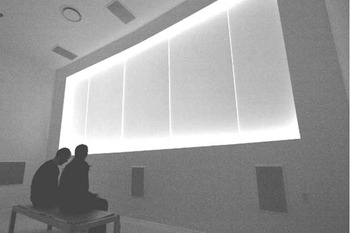
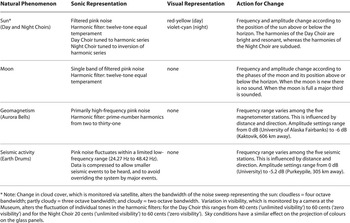
John Luther Adams's The Place Where You Go to Listen is a permanent audiovisual installation at the Museum of the North in Fairbanks, Alaska. Installed in 2006, the work is located at the top of a staircase in an alcove off the Museum's second-floor gallery. A plaque positioned at the entrance to The Place provides the listener with basic information regarding the design of the work, emphasising the installation's connection to nature and the importance of the listener's engagement with the sound-and-light environment (see the appendix to this article). Upon entering The Place, the museumgoer is exposed to the projection of electronic sounds from fourteen ceiling and wall speakers, and the illumination of fibre optic lights on five glass panels, which are approximately 6 metres wide by 3 metres tall (figure 1). Using the digital signal-processing software Max/MSP, real-time data streams of natural phenomena are translated into sound and colour signals.Footnote 1 The geophysical events measured are the placement of the sun and moon in relation to the earth, geomagnetism, seismic activity, and weather patterns (figure 2). By transforming sounds and sights of Alaska, The Place raises questions of musical discourse, including meaning, the role of technology, perception, and the use of geophysical data as material for music.
View inside The Place. © James H. Barker 2006. Used by permission.

Correlation between geophysical data and the audiovisual experience in The Place. Adams Reference Adams2009: 113–39.

By rendering non-sounding phenomena as aural material (also known as sonification), Adams invites listeners to engage the underlying structural components of geophysical events in an alternative way.Footnote 2 Where visualisation tools often frame data as a still image, translating data into sound is inherently narrative. Through aural perception, humans are capable of noting patterns and transformations, even among simultaneous streams of data that may go unnoticed visually (Hermann and Ritter Reference Hermann and Ritter1999: 194). The means by which data is manifest as sound is largely subjective. For example, the sonic portion of Paul Adderley and Michael Young's Ground-breaking: Extreme Landscapes in Grains and Pixels (2007), an installation that explores the geographical and cultural layers of the African Sahel, consists of environmental recordings and sound signals derived from soil samples, both of which have been manipulated using subtractive and granular synthesis (Adderley and Young Reference Adderley and Young2009). Adams also applies subtractive synthesis; however, using a range of data sources, the composer delineates sonifications in The Place by voicing each data stream with an individual ‘shade’ of filtered pink noise (produced with a random number generator).Footnote 3
For Adams, noise is a vehicle through which aspects of the natural world can be rendered into music, ultimately having the power to influence human awareness of the environment.Footnote 4 According to the composer,
If music grounded in tone is a means of sending messages to the world, then music grounded in noise is a means of receiving messages from the world. Noise takes us out of ourselves. It invites communion, leading us to embrace the patterns that connect us to everything around us. (Adams Reference Adams2009: 4; emphasis in original)
In past works, Adams has identified with Alaska through the integration of the language and poetry of indigenous cultures, transcriptions of Northern birdsongs, and field recordings of the Arctic. The Place is perhaps Adams's closest realisation of what the composer has termed ‘sonic geography’; that is, when place is understood as music, and music as place. Thus, Adams is not interested in representing an environment; rather, he seeks to transform it. By exploring the structural features of natural phenomena definitive of Interior Alaska and their relationship through time, the composer constructs a vantage point whereby listeners can re-imagine their understanding of a geographic region and place within it.
2. Geophysical Data And Its Connection To The Place
Science examines the way things are. Art imagines how things might be. Both begin with perception and aspire to achieve understanding. Both science and art search for truth. Whether we regard truth as objective and demonstrable or subjective and provisional, both science and art can lead us toward a broader and deeper understanding of reality. (Adams Reference Adams2009: 10)
Geophysical data is understood in terms of spectral decomposition, whereby signals received from a geophysical event are separated into constituent pure tones (also known as frequencies) on a power spectrum. Although techniques for measuring natural phenomena vary, scientists often choose to analyse data in terms of wave functions, due to the solubility of a wave as a differential equation (Steyn Reference Steyn2009). Sound is also generated by pressure fluctuations. In acoustical terms, a pure tone is created by regular wave oscillations. By contrast, noise is produced by irregular wave oscillations. Acousticians classify noise into types of colour (such as white, pink and red) based on characteristic properties of energy distribution.
The process by which Adams translates scientific data into music consists of four steps:
-
• 1: streams of real-time data are sent to Max/MSP.
-
• 2: data is translated into pink noise with the structural dimensions of the data factored into the acoustic parameters.
-
• 3: pink noise is sent through various band-pass filters.
-
• 4: processed sound is projected through speakers into The Place.
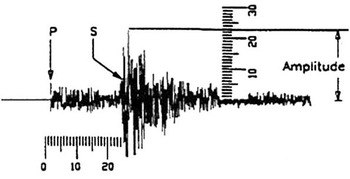
The geomagnetic and seismic data used in The Place are derived from scientific instruments placed in the Alaskan Interior.Footnote 5 Data mapped from geomagneticism and earthquakes onto Max/MSP consist of three components. For geomagnetic activity, fluctuations in the earth's magnetosphere are measured in three directions: north–south, east–west, and vertical planes. For seismic activity, energy distribution is measured in north–south, east–west, and vertical directions (figure 3).
Richter magnitude scale. Primary waves account for energy sent from the site of a quake to a receiving station. Primary waves observe energy vertically. Secondary waves account for energy perpendicular to the wave path. Secondary waves observe energy horizontally. From Earthquakes, 5e by Bruce A. Bolt. ©Reference Bolt2004 by W. H. Freeman and Company. Used with permission.

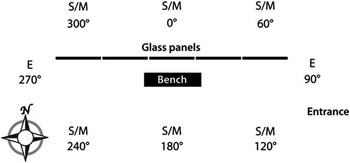
Frequency range and amplitude are used to signify the distance of measuring stations from the university; stations further from the university have a lower relative amplitude and more limited frequency range. While the sonifications of geomagnetic and sesmic activity deliver information about distance, the representation of the sun and moon in relation to the horizon and the lunar cycle is primarily associated with time. The movement of sounds associated with both the sun and moon across speakers and change among respective frequencies inform the listener of a place in a given celestial cycle (figure 4).
Location of wall speakers and sound types in The Place. Adams Reference Adams2009: 137.

Sounds associated with the sun and the moon are emitted from six wall speakers. As the position of the sun and moon changes in relation to the horizon, the representative sound of each moves accordingly through the six speakers. The Day Choir is heard through the speakers that correspond to the current position of the sun, while the Night Choir is presented through speakers 180° opposite those of the Day Choir. Seismic activity is emitted from two subwoofers at the base of the walls perpendicular to the glass panels. Geomagnetism is heard through six speakers in the ceiling; the vertical position of the speakers corresponds to the geographic location of magnetometer stations. According to programming assistant Jim Altieri, ‘rather than making you feel there are these pinpoints of sound moving around you, you feel like it's a field that is emanating from a specific direction’ (Nonpop 2006). This spatial quality not only heightens the listener's awareness of the translated geophysical events, but also, given the listener is engaged in the space for an extended period of time, dissolves any sense of stillness or stagnation he or she may experience.
Similar to the translation of scientific data to sound signals, the visual component of The Place is also generated through a four-step process:
-
• 1: streams of data from SunAngles, a program that tracks the position of the sun in relation to the horizon, are sent to Max/MSP.
-
• 2: data are translated into light signals with the structural dimensions of the data factored into the visual field.
-
• 3: light signals are sent through either one or two filters.Footnote 6
-
• 4: various shades of light shine onto glass panels according to the position of the sun above or below the horizon and current weather conditions.
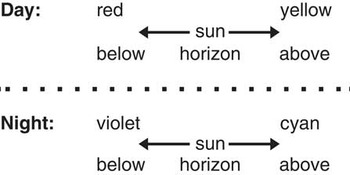
The approach Adams took in choosing colours was similar to that of synthesised sounds: the visual display is intended to create a realistic environment, in this case to imitate night and day. The field of colour associated with day is projected along the top of the glass panels, while that attributed to night is shone along the bottom. The colours illuminating the glass panels vary according to the change in position of the sun in relation to the horizon (figure 5).
Correspondence between the position of the sun and the colours projected in The Place. Adams Reference Adams2009: 117.

The visual component of the installation is at its darkest at midnight on the winter solstice with ‘zero visibility’ and brightest at noon on the summer solstice with ‘unlimited visibility’. Combined with the sonic manifestation of data streams, The Place creates a distinct musical narrative each year.
Adams experimented with various temperaments for the harmonic filters while designing the installation. In his book on The Place, the composer offers a rationale for his approach to ‘voicing’ streams of data:
This process of mapping, listening and re-mapping continued until I felt a particular sound had ‘the ring of truth’, resonating in a convincing way with the geophysical force from which it was derived. As the voice of each sounding element emerged, it had to be integrated into the larger ecosystem of The Place, in a process I came to think of as ‘tuning the world’. (Adams Reference Adams2009: 113)Footnote 7
Adams's ambition to find ‘the ring of truth’ of a specific sound resonates with ideas associated with soundscape composition. By exploring the inner nature of a sound taken from the environment, through such methods as the manipulation of recorded material (Hildegard Westerkamp, Talking Rain, 1998) and the use of ecological models for the design of a composition, whether it be the behaviour of individual sound events (Barry Truax, Riverrun, 1986) or the structural basis of a work (Natasha Barrett, ‘In the Rain’, movement one from Three Fictions (Northern Mix), 2000), soundscape composers strive to reveal a deeper understanding of the initial sound and its environmental context.Footnote 8 For example, Westerkamp's modification of rain recordings in Talking Rain (looping, use of band-pass filters, etc.) not only highlights the acoustic parameters of water, but also invites the listener to explore its relationship to other sounds (e.g. frogs, and cars on wet pavement). Adams's isolation of the fundamental tone or ‘inner resonance’ of a particular broadband noise may be compared to the exploration of sonic footage in soundscape composition (Adams Reference Adams2009: 46). Adams also constructs an acoustic space where the listener can consider the parameters of sound events (in this case sonified geophysical data) and their interaction through time. Truax's use of granular synthesis in Riverrun may be heard as an imaginary journey through different types of water environments, ranging from individual drops to a slow-moving river to the rush of rapids. Comparable to The Place, the sonic experience of Riverrun is made entirely from synthetic sound. Although the sounds present in both works ‘behave’ like natural phenomena, meaning in Riverrun is created through metaphor, whereas meaning in The Place is constructed through allusion. The organisation of sound grains in Riverrun is determined by the composer, while the presentation of sound signals in The Place is governed directly by environmental sources. Barrett uses the ecological model of raindrops striking a two-dimensional surface as the structural foundation for the first movement of Three Fictions. Barrett modifies the sonic identity of rain while maintaining the spatial map created by the distribution of drops. Like Barrett, Adams's presentation of sound in The Place models the spatial dimensions of geophysical forces.
In addition to these compositional techniques, Adams's installation corresponds to the broader aesthetic concerns of soundscape composition. The Place satisfies Barry Truax's four principles of soundscape composition:
-
1. Adams maintains recognisability of the source material (i.e. geophysical data) by designating sound and light signals that evoke traits associated with specific natural phenomena;
-
2. many visitors to the Museum of the North are familiar with the geophysical events voiced in the installation and their association with Alaska;Footnote 9
-
3. Adams's awareness of Alaskan geography and indigenous cultures is integral to the design of The Place, demonstrated both by the conception of the installation as a form of ‘sonic geography’ and the Iñupiat myth surrounding The Place Where You Go to Listen;Footnote 10 and
-
4. by ‘listening’ to geophysical features of Alaska (i.e. experiencing in an alternative way data used to explain natural phenomena) the museumgoer is given the opportunity to contemplate his or her place within immediate surroundings and beyond (Truax Reference Truax2008: 105–6).
Through the use of real-time data streams to evoke the ‘behaviour’ of natural phenomena, The Place affirms a central facet of soundscape composition: the reconstitution of a holistic relationship between listener and environment. While Adams's process of ‘mapping, listening and re-mapping’ may be interpreted as a type of inner journey that explores the relationships among sound, self and place, the progression of events in The Place and the ways in which these events interact spatially and temporally suggest a complex network of possible meanings.
3. Experiencing The Place
Temporal frames characterise numerous geophysical events, such as night and day, month, year, and season. The periodicity of The Place is defined by natural phenomena that are predictable (the lunar cycle and the position of the sun and moon in relationship to the horizon). In this case, periodicity means the repetition of sound or light signals at fixed intervals. Although events that are unpredictable (geomagnetism, seismic activity, and to some extent weather) do not alter the periodicity of predictable events, they do have the capacity to influence the listener's perception of a predictable event's place in a given cycle. For example, during a July afternoon with geomagnetic activity above the university, a moon that is three-quarters full and located 5° above the horizon, no cloud cover and ‘unlimited visibility’, the sonic experience in The Place consists of shimmering Aurora Bells, a resonant, four-octave Day Choir, and a low band of pink noise associated with the moon. The loudness and higher timbres of the Aurora Bells and Day Choir challenge the ear's recognition of the subtle drone associated with the moon. By locating the speaker from which the moon is sonified, the listener is able to deduce its position in relation to the horizon and phase in the lunar cycle. The degree to which periodicity is experienced in The Place is left in part to the laws of nature (respective geophysical events determine the rate at which content is repeated), and in part to the audience. The listener determines when and for what duration to experience The Place.Footnote 11
The periodicity of some events portrayed in The Place is extraordinarily slow. For instance, the sonic representation of the lunar cycle takes place over approximately twenty-eight days. The cliché ‘being at the right place at the right time’ holds true here: a listener who attends The Place at pre-determined times (e.g. during a full moon and then during a new moon) will observe a periodicity that would go unnoticed if attending the installation two days in a row. Furthermore, sonic and visual events in the installation happen both synchronically and diachronically. For example, it is possible for data generated by an earthquake to stream into The Place simultaneously as that of geomagnetic activity. The museumgoer could follow changes in the sonification of a diachronic event such as the lunar cycle. Exploring the interactions of data streams reconstitutes the listener's notion of otherwise disparate geophysical forces.
3.1. Hypothetical listening experience: winter solstice at midnightFootnote 12
Entering The Place at midnight on the winter solstice, the museumgoer observes calm lighting from the five glass panels. The panels are illuminated: a tint of midnight blue at the base, violet along the top, and colours fading together midway on the left and right sides. At first the listener hears a harmonically rich, yet subdued, wash of sound. The installation may at first seem static; however, through extended interaction, the listener notices flux, both in the location from which sounds project and in the properties of audio signals. The Night Choir emanates from speakers on the front wall, while the Day Choir is heard from the rear. With the sun approximately 49° below the horizon, the base frequency of the choirs is at its lowest (24.27 Hz). The Night Choir is at its highest amplitude (0 dB), matching the intensity of higher-register sounds; the Day Choir is notably quieter (−12 dB). Due to ‘zero visibility’ the harmonies of the choirs are limited to a two-octave range along with noticeable fluctuation in timbre, giving the choirs a blurred quality. Additionally, the presence of a full moon (an event that takes place on the winter solstice approximately every two decades) creates a bright band of pink noise in the front left speaker (486.5 Hz); the moon is sonified a major third above that which was heard fourteen days earlier during a new moon. With the moon located 53° above the horizon, the band of sound is softer (1 dB) than when the moon was at the horizon several days earlier (6 dB). A few minutes pass and faint metallic shimmering is heard from rear speakers on the ceiling. The speaker location and dimness of sound (−6 dB) suggests distant geomagnetic activity registered by the magnometer station in Kaktovic, 606 km away. As if accompanying the Aurora Bells, a small earthquake is sounded through the left subwoofer. The lack of frequency modulation in the Earth Drums informs the listener that the earthquake is weak (the translation of data measuring primary waves). The listener finds the amplitude of the Earth Drums similar to the Aurora Bells, concluding that the earthquake is distant, plausibly registered in Purkeypile, 350 km away. The listener shifts away from individual sound events to focus briefly on the larger sonic texture. The prominent drone of the Night Choir, which seems supported by the lower vibrations of the Earth Drums, provides a foundation over which the Aurora Bells instill a dynamic, yet harmonious sonority. The Earth Drums soon fade, followed by the Aurora Bells. Having spent one hour in the installation, the listener takes a final assessment of the overall acoustic environment: the sliver of pink noise associated with the moon has moved towards the centre speaker and is slightly lower in register and pitch – the moon must be waning. The harmonies of the Night Choir sound less pronounced with lower timbres and those of the Day Choir slightly charged, resonating with a few higher frequencies. The sound source of the choirs has gradually changed: the Night Choir has shifted faintly to the speaker behind the listener's right shoulder, the Day Choir towards the speaker from which the moon was first heard on the front left.
3.2. Hypothetical listening experience: summer solstice at noon
Immersed in The Place at noon on the summer solstice, the glass panels feature a bright yellow hue along the bottom and cyan along the top. The listener first perceives a bright, resonant wash of sound. With ‘maximum visibility’ outside, sounds are exponentially more articulate than those experienced during the winter solstice with ‘zero visibility’. During the summer solstice the sun is approximately 49° above the horizon, compared to its location approximately 49° below the horizon during the winter solstice. As a result, the change of base frequency is noticeable: 24.27 Hz (winter solstice, midnight) versus 426.54 Hz (summer solstice, noon), an ascent of approximately two octaves. Due to the height of the sun and clear weather conditions, the Day Choir shimmers across four octaves. The speakers sounding the Day and Night Choir are reversed from those through which they were projected during the winter solstice (the Day Choir is heard from the front wall speakers, the Night Choir from the rear). The sound attributed to the moon is barely audible in the front right speaker. Due to its low register (48.9 Hz) and amplitude (−1 dB), and proximity to the right subwoofer, the ear could plausibly mistake this sonification for an earthquake. Upon recognition of the sound source and observation of acoustic parameters, the listener concludes that the moon is one-quarter full. Approximately twenty minutes into the listening experience, cloud cover briefly compacts the frequency range of the Day Choir. At this point, Aurora Bells seemingly emerge from the brilliance of the Day Choir. The bell sonorities project strongly from the front centre speaker, revealing geomagnetic activity above the university. Having listened to the projection of individual sound types and their interactions, the listener assesses the properties of these ‘voices’ and their position in acoustic space: the speakers from which the choirs are heard have rotated slightly, yet the Day Choir still dominates the front wall. The sound of the moon is barely audible, either due to its cycle towards a new moon or phasing into the larger wash created by the Day Choir and the Aurora Bells.
Through immersion in The Place at two important moments in the cosmic calendar, the listener is given the opportunity to observe not only the behaviour of individual data sources, but also the larger structures they create through their simultaneous projection into the installation. The Place portrays a series of cycles, governed by predictable events, upon which unpredictable events penetrate the surface. In certain instances, the introduction of a new sound or the change in a sound from a previous utterance alters the listener's perception of another sound source. Important astronomical events within cosmic cycles (e.g. a new or full moon, the bi-annual equinox, or the summer or winter solstice) function as markers in the narrative, having the capacity to illuminate the listener's perception of unpredictable events and to re-imagine his or her relationship to the natural forces omnipresent in interior Alaska.
4. Information Theory And The Place
Information theory can help us sort through some of the complexities and interpretative issues of The Place, and lead us to a clearer understanding of Adams's conceptual design and the ways in which the audiovisual installation speaks to the relationship between humans and the natural world. Umberto Eco writes, ‘to analyse a work of art in terms of the amount of information it conveys is … a way of clarifying some of the characteristics and resources of its ability to communicate’ (Eco Reference Eco1989: 62). Communication, however, does not guarantee the conveyance of meaning. Information reflects not what is said but what could be said, whereas meaning characterises a particular message (Eco Reference Eco1989: 57).
As mentioned earlier, events in The Place may be distinguished as those that are predictable (the lunar cycle and the position of the sun and moon) and those that are unpredictable (geomagnetism, earthquakes, and possibly weather). Information theory informs us that although disorder offsets predictability, it is also capable of increasing the quantity of information communicated. Through this perspective, geomagnetism and seismic activity deliver greater information into the installation than the lunar cycle and the placement of the sun and moon.
Although two of the six data sources are unpredictable, the probability of experiencing these events is high due to the number of times they occur in Alaska – earthquakes take place approximately 12,000 times in the state per year and geomagnetism, on average, 133 days per year. Therefore, the capacity of information carried among unpredictable events is not as disparate as that of predictable events. Yet, unpredictable events are strikingly varied with regard to intensity, thus creating disorder. The saturation of unpredictable events into the larger sonic environment of The Place changes the perception of events that are predictable. The listener cannot step into the same audiovisual stream twice; furthermore, meaning is interpreted differently from person to person. Therefore, the installation is continuously being recontextualised. Thus, interpretations are perhaps influenced more by extra-musical ideas that a listener associates with The Place, such as a psychological state or a collective viewpoint of nature, than the self-governing properties of the installation (Eco Reference Eco1989: 71).
5. Listening Perspectives
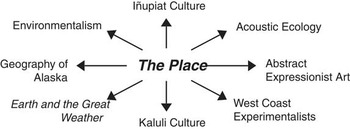
Exploring the intertextuality of the fifth movement of Mahler's Third Symphony, Raymond Monelle claims, ‘the musical text … is a boundary between inside and outside [the work], rendered problematic by the flow across the boundary and the interdependence of inside and outside’ (Monelle Reference Monelle2000: 155). Using Monelle's model, figure 6 outlines a possible intertextual network of extra-musical ideas associated with the composer that may influence a listener's experience of the installation:
Possible network of ideas that may be associated with The Place. Monelle Reference Monelle2000: 155.

This network of broad ideas highlights several biographical aspects of the composer that may be associated with the work. These include Adams's involvement with environmental organisations, his affiliation with West Coast composers (including mentors James Tenney and Lou Harrison), the composer's awareness of the Kaluli practice of composing songs by waterfalls and streams, and his interest in the work of Jackson Pollock among other abstract expressionists. Adams's Earth and the Great Weather, an experimental music theatre work composed in 1993, exemplifies how the musical features of an earlier piece and its reference to specific cultural and physical geographies of Alaska invite a particular interpretation of The Place Where You Go to Listen. Earth consists of a series of recitations of indigenous names for Arctic places, animals, plants, seasons and weather spoken in English, Latin, Iñupiaq and Gwich'in, spoken respectively by the Iñupiat and northern Athabascan peoples. The first movement of Earth is under the same name as Adams's The Place Where You Go to Listen. Through the use of field recordings, static instrumental textures, and the narration of place names in Iñupiaq, Adams evokes the expanse of the Arctic landscape and the intimate connection its native peoples have to the land.
The network of extra-musical ideas associated with The Place and the unconventional design of the installation invite multiple interpretations. A listener familiar with Earth may associate The Place with the Iñupiat myth or as a message to raise environmental awareness. Some may overlook the geophysical connection altogether, focusing purely on the sensorial experience (i.e. the play of sound and light textures), while others retreat to the space for meditation.Footnote 13 Audience members bring their own experiences, values, and memories of nature into the installation. Yet we cannot overlook that the massive amount of information received in the form of audio and visual signals threatens the reception of a multi-level message; that is, the listener is faced with the challenge of distinguishing the simultaneous streams of translated data. According to Umberto Eco,
the most difficult message to communicate is the one that, relying on a wider range of sensibility on the part of the receiver, will avail itself of a larger channel, more likely to allow the passage of numerous elements without filtering them – that is, a channel capable of conveying a great deal of information but with the risk of limited intelligibility. (Eco Reference Eco1989: 64; emphasis in original)
With the aid of the plaque at the entrance to the installation, the listener is invited to sort out the different signifiers of geophysical events. Recognising the correlation between speakers and geophysical forces, in particular distinguishing between speakers that project predictable and unpredictable sound sources, the ear is able to shift between synchronic and diachronic perspectives.
6. Conclusion
Adams's installation not only creates a sense of place through its sonic properties, but also puts forth a gesture of environmental advocacy. By translating geophysical data into music, the composer invites listeners to broaden their understanding of the geophysical activities around them, paying closer attention to the inaudible ‘voices’ of nature. The Place may be viewed in light of a growing cultural awareness of the relationship between humans and the environment. This is perhaps influenced most strongly by concerns over climate change. Adams contends,
music can contribute to the awakening of our ecological understanding. By deepening our awareness of our connections to the earth, music can provide a sounding model for the renewal of human consciousness and culture. (Adams Reference Adams2009: 1)
Through the process of sonification, Adams offers listeners a means to experience anew the features of the natural world and their place within it. The location of The Place in a museum setting and its geographical isolation play a central role in the meaning the Fairbanks community and visitors to the Museum attribute to the installation. By reanimating the geophysical properties of Alaska in an isolated, interior space, Adams presents his audience with an interactive musical work that showcases the dynamic quality of the geography of a specific location.
Consideration of the difference between geophysical events that are predictable and those that are unpredictable informs us that the information produced in The Place is a complex network of signals. The audiovisual experience reflects causes and effects, whereby geophysical events generate numerical mappings that are input into a computer program and projected as sound and light signals into the installation. Causality is also reflected in the interaction of natural phenomena: the placement of the sun affects the lunar cycle and weather patterns impact the intensity of sunlight. Upon recognising relationships among signified forces in The Place, the museumgoer can shift between listening to the work as a homologous texture and focusing on the properties of individual data streams.
Adams's decisions regarding the types of sounds, the naming of sounds, the locations from which sounds are heard, and the lighting design of The Place were influenced by pre-established cultural codes associated with the natural world (i.e. according to the way humans collectively perceive the environment and the concepts used to process and explain this cognition). The installation may be interpreted as part of a network of extra-musical ideas that generate various meanings based on both the listener's assessment of The Place and his or her previous experience, especially familiarity with music and nature. The Place functions as a portal through which the listener can reflect on his or her position in the immediate context as well as the surrounding universe. Ultimately, the ‘voices’ of nature are not found in the sounds emitted from the installation but in the listener's interpretation of the sounds. Through our engagement with The Place, we not only strengthen our connection to Alaska, but also confirm and redefine our personal relationship with and ecological role in a place oft-defined by its geophysical grandeur.
Plaque located at the entrance to The Place. Reprinted in Adams Reference Adams2009: 140:
The Place Where You Go to Listen
We are immersed in music.
The earth beneath us, the air around us, and the sky above us are filled with vibrations. Most of these vibrations are beyond the reach of our ears.
In this room you will hear some of this music.
You will hear no familiar musical instruments or sounds of nature. Yet every sound you hear is connected directly to the natural world, here and now.
The atmosphere of sound and light changes with the movements of the sun, the rhythms of day and night. Daylight sings like a choir of bright voices. Its colors are yellow, orange and red. The voices of night are darker. Its colors are violet, blue and cyan.
The moon rises and falls, appears and disappears, like a solo voice.
When the aurora borealis is active (even if hidden by daylight or clouds) bell-like sounds float across the ceiling.
When the earth quakes (even imperceptibly) the walls and floor shudder and rumble like deep drums.
This music has no beginning, middle or end. Even in moments of apparent stillness, it is always changing. But it changes at the tempo of nature. To experience its full range requires listening in day and night, winter and summer.
This is an ecosystem of sound and light that resonates with the larger world around it. When no one is here, the forces of nature continue to reverberate within this space.
But the awareness of the listener brings it to life.
The Place Where You Go to Listen is not complete until you are present and listening.