Many classic theories of developmental psychopathology are interpersonal in nature (Rudolph, Lansford, & Rodkin, in press). This is true in the domain of peer relationships, where early disturbances with peers may forecast proximal as well as long-term risk factors throughout adolescence and into adulthood (Crick, Casas, & Ku, Reference Crick, Casas and Ku1999; Parker, Rubin, Erath, Wojslawowicz, & Buskirk, Reference Parker, Rubin, Erath, Wojslawowicz, Buskirk, Cicchetti and Cohen2006). Of the myriad of stressors that may challenge children in their day-to-day dealings with others, from rejection and exclusion, to association with delinquent friends, to the establishment of entrenched animosities, the stressor of peer bullying and victimization appears particularly pernicious. Reports of the negative consequences of peer victimization, and perhaps of bullying perpetration as well (Wolke, Copeland, Angold, & Costello, Reference Wolke, Copeland, Angold and Costello2013), have sparked outrage in American society and around the globe.
Our concern in this manuscript is that the interpersonal nature of peer bullying has not been matched by methodologies that allow interpersonal aspects of bullying and victimization to be properly assessed. Bullying and victimization are rarely measured relationally, but when they are, significant dyadic (or actor–partner) variance is consistently reported (Card & Hodges, Reference Card and Hodges2007a; Card, Rodkin, & Garandeau, Reference Card, Rodkin and Garandeau2010; Hanish, Sallquist, DiDonato, Fabes, & Martin, Reference Hanish, Sallquist, DiDonato, Fabes and Martin2012; Rodkin & Berger, Reference Rodkin and Berger2008; Sainio, Veenstra, Huitsing, & Salmivalli, Reference Sainio, Veenstra, Huitsing and Salmivalli2010; Veenstra et al., Reference Veenstra, Lindenberg, Zijlstra, De Winter, Verhulst and Ormel2007). More often, peer nominations or self-reports of bullying and victimization are tabulated with reference to some period of time (e.g., Olweus, Reference Olweus, Jimerson, Swearer and Espelage2010). Owing to this measurement strategy, the fast-growing literature on bullying faces critical questions. What is new in bullying research that has not already been concluded in the voluminous literature on child and adolescent aggression? What new principles or methods are needed to account for what makes bullying unique and distinct from aggression? Without conceptual and empirical differentiation, there is little reason other than semantics and faddism to tailor antibullying interventions anew when more general aggression-reduction programs are on the shelf (see Cook, Williams, Guerra, Kim, & Sadek, Reference Cook, Williams, Guerra, Kim and Sadek2010).
The present research introduces an approach for assessing bullying and victimization that is inherently relational; we directly ask elementary-aged children who bullies whom in their classroom. In so doing, we attempt to accomplish three goals. First, we assess whether bullying involves a power differential between bully and victim, using peer popularity as an index of power. According to Olweus (Reference Olweus1993), power asymmetry between bully and victim is the hallmark of bullying as distinguished from aggression more generally, yet this is rarely assessed and has been downplayed as an essential component of bullying definitions (Ross & Horner, Reference Ross and Horner2009; Vaillancourt et al., Reference Vaillancourt, McDougall, Hymel, Krygsman, Miller and Stiver2008). Second, we determine whether bully/victim dyads are also participants in a relationship, whether a friendship (mutual liking) or an antipathy (mutual disliking). This is important because, in addition to noting power differentials, Olweus (Reference Olweus1993) contended that bullying and victimization are not one-time interactions, but relationships with temporal duration. Third, we examine the gender composition of bully/victim dyads, specifically the extent to which bullying and victimization cross gender lines and whether gender moderates patterns of bully/victim power differentials and relational contexts. This provides a contrast to more traditional approaches that ask whether boys and girls display similar levels and forms of bullying and victimization. Throughout, bullying is examined while controlling for baseline levels of aggression, allowing the constructs of bullying and aggression to be distinguished at between-person and within-dyad levels.
Bullying and Aggression: What's the Difference?
Consider the classic definition of bullying, proposed by Olweus (Reference Olweus1993), that bullying involves an intentional display of aggression, that has some temporal duration (i.e., repeated over time), and involves a power differential between bully and victim. What distinguishes this definition of bullying from aggression more generally? Of these three components, intentionality is clearly similar in aggression and bullying. However, power asymmetry and temporal duration are unique to bullying and presuppose a relational frame.
Power asymmetry
Aggressive behaviors that are directed toward one or more individuals of relatively equal power might be conceptualized as a game of the dozens, a fight, or even as mean-spirited and harmful, but they are less likely to provoke moral offense than are attacks against a weaker individual. Situations that involve a weaker individual attacking a more powerful individual can even evoke heroic images of the underdog (i.e., David and Goliath). Nevertheless, none of these aggressive interactions would be considered bullying. The ugly heart of bullying, and its most distinctive element, is an asymmetric power relationship, characterized by unequal, coercive power, in which a more powerful aggressor attacks a less powerful victim. It is power asymmetry, and the accompanying specter of abuse, that most elicits outrage.
Although “power” could be seen simply as a synonym of “aggression,” the intention by Olweus (Reference Olweus1993) and others (e.g., Leff, Power, & Goldstein, Reference Leff, Power, Goldstein, Espelage and Swearer2004) was to encompass both “physical and psychological power” within the power rubric, with psychological power including notions of socioeconomic or social status. Yet the expansiveness of this definition of power, and the complexity entailed with operationalizing an “asymmetric power relationship,” has led to attempts to do away with or revise definitions of bullying. For example, children pay little heed to the components of bullying outlined by Olweus (Reference Olweus1993) when asked to complete the sentence: “A bully is … ,” emphasizing instead global negative behaviors, such as teasing or mean behaviors (Vaillancourt et al., Reference Vaillancourt, McDougall, Hymel, Krygsman, Miller and Stiver2008). According to Vaillancourt et al. (Reference Vaillancourt, McDougall, Hymel, Krygsman, Miller and Stiver2008), less than 2% of 8- to 18-year-old participants spontaneously mentioned that bullying is intentional, 6% spontaneously mentioned that bullying is repetitive, and only 26% (but up to one-third of adolescent respondents) noted that bullying entails a power imbalance. Some bullying prevention efforts, particularly those from a positive behavioral support perspective, address the problem of bullying from a purely behavioral level by avoiding the use of the term “bully,” redefining the bullying construct so as to focus on concrete behaviors underlying bullying (e.g., hitting, threatening, or name-calling), without bothering with amorphous and subjective requirements of assessing power differentials, and without considering the interpersonal dynamic existing between children who bully and the peers they harass (Ross & Horner, Reference Ross and Horner2009). Therefore, in this case, what is the difference between bullying and aggression more generally?
The critical empirical implication of power asymmetry involves distinguishing associations between aggression and status at each of two levels: between person (i.e., bullies) and within bully/victim dyads. Regarding between-person comparisons, because bullying entails aggressive behavior, children who score higher on bullying will also score higher on aggression. For example, when children are compared on aggressive behavior along “bully,” “victim,” and “bully–victim” (i.e., a child who both bullies and is victimized) categories, one finds that bullies are more aggressive than victims (with multiproblematic bully–victims tending to be most aggressive of all; Cook et al., Reference Cook, Williams, Guerra, Kim and Sadek2010). Yet when considering within-dyad patterns of bullying and victimization, the Olweus (Reference Olweus1993) definition suggests that the most conspicuous cases of bullying and victimization are characterized, not by great discrepancies in aggression, but by great discrepancies in psychological power, or social status. Bullying entails aggression (hence bullies are aggressive), but bullying is about the exploitation of power differences. Thus, in the current study we expected bullies as a group to be more aggressive than victims as a group, but we also expected that the bully/victim dyads most likely to be recognized by peers would be primarily characterized by discrepancies in popularity rather than discrepancies in aggressive behavior.
Temporal duration
The temporal duration element draws attention to the fact that bullying is not a onetime interaction but a relationship with temporal expanse (Hinde & Stevenson-Hinde, Reference Hinde and Stevenson-Hinde1987). To the extent that there are multiple interactions between a child who bullies and another child who is harassed by the bully, a relationship has emerged, even if it is one that is unwanted by the victim. Thus, the term “relationship” should not imply that the tie between bully and victim is, or ever was, positive, but that “bullying” is intrinsically dynamic, in a relationship that unfolds over time and that potentially entangles others, such as bystanders.
Little is known about the relationship between a bully and the child whom he or she targets. Instead, the focus has been on identifying children who fall into bully, victim, and bully–victim categories, and then determining prevalence rates and behavioral characteristics of bullies, victims, and bully–victims (e.g., Cook et al., Reference Cook, Williams, Guerra, Kim and Sadek2010). This procedure puts bullies, victims, and bully–victims into separate boxes and overemphasizes their separateness. In practical terms, this could mean that there is no known relationship between a bully and a victim; in other words, that bullying involves a random targeting.
Reality is more complicated. Bullies and victims often have a previously existing relationship that presages bullying before it happens, which, if known, might alert knowledgeable adults about possible trouble spots (Card & Hodges, Reference Card and Hodges2007a). One predictor of bullying is animosity. Potential bullies, particularly socially integrated bullies (see Farmer et al., Reference Farmer, Irvin, Leung, Hall, Hutchins and McDonough2010), actualize angry thoughts into aggressive behavior toward low-status peers whom they already dislike, and who dislike them (Hodges, Peets, & Salmivalli, Reference Hodges, Peets, Salmivalli and Harris2009). Conversely, one might even find that bullies and the children they harass tend to be friends (Crick & Nelson, Reference Crick and Nelson2002). This has been suggested as a possibility when girls bully other girls (Zimmer-Gembeck, Pronk, Goodwin, Mastro, & Crick, Reference Zimmer-Gembeck, Pronk, Goodwin, Mastro and Crick2013). It might also reflect the possibility that bullying, particularly cross-gender bullying (e.g., boys bullying girls or vice versa), is an expression of immature romantic interest, or “push-and-poke courtship” (Maccoby, Reference Maccoby1998; Pellegrini, Reference Pellegrini2001). In the present study, we sought to determine whether bullies and the children they harass tend to nominate one another as mutual friends, mutual enemies, or whether there tends not to be a recognized relationship between bully and victim.
Gender and the Bully/Victim Dyad
A relational perspective on bullying is essential when dealing with issues of gender (Pepler et al., Reference Pepler, Craig, Connolly, Yulie, McMaster and Jiang2006). Gender issues in bullying include but go beyond such contrastive questions as whether boys or girls are more likely to be bullies, or whether female bullying is best captured through attention to socially or relationally aggressive forms (Crick & Zahn-Waxler, Reference Crick and Zahn-Waxler2003). Bullying is a gendered phenomenon in many ways, whether it be in children's targeting of, and attempts to gain status among, same- and other-sex peers (Faris & Felmee, Reference Faris and Felmee2011; Hanish et al., Reference Hanish, Sallquist, DiDonato, Fabes and Martin2012; Rodkin & Berger, Reference Rodkin and Berger2008), cross-gender bullying as an immature attempt for romantic involvement (Pellegrini, Reference Pellegrini2001), developmental linkages to intimate relationships characterized by coercion and control (Espelage, Low, Anderson, & De La Rue, Reference Espelage, Low, Anderson and De La Rue2013; Pepler et al., Reference Pepler, Craig, Connolly, Yulie, McMaster and Jiang2006; Rodkin & Fischer, Reference Rodkin and Fischer2003), or the targeting of youth based on real or perceived sexual orientation (Pauletti, Cooper, & Perry, in press; Robinson & Espelage, Reference Robinson and Espelage2012). Gender often underlies decisions about whom, why, and how to harass.
Approaches that treat gender as a characteristic of only the bully or only the victim can lead to the incorrect assumption that bullying only occurs within gender (i.e., boys bully other boys and girls bully other girls). However, once bullies and victims are considered in a dynamic relationship, it becomes clearly evident that bullying occurs among both same- and other-gender peers. Once children's interactional preference for same-gender partners is controlled, rates of same- and other-gender aggression are relatively similar (Hanish et al., Reference Hanish, Sallquist, DiDonato, Fabes and Martin2012). Even before adolescence, empirical reports suggest that there are a number of cases, possibly half, where aggressive boys are harassing girls (Rodkin & Berger, Reference Rodkin and Berger2008; Veenstra et al., Reference Veenstra, Lindenberg, Zijlstra, De Winter, Verhulst and Ormel2007). Olweus (Reference Olweus1993, p. 18, italic in original) first reported this finding, writing that “boys carried out a large part of the bullying to which girls were subjected.” That is, 60% of fifth- through seventh-grade girls who were reportedly harassed said that they were bullied by boys.
In the present research, we had two sets of questions regarding the gender composition of bully/victim dyads. First, we were interested in the prevalence rates of different gender compositions (i.e., male–male, female–female, male–female, and female–male) across the sample. While we anticipated that more boys would be named as bullies owing to the covariation of being male and aggressive behavior, once aggression was controlled we did not expect large differences in the gender composition of bully/victim dyads. Second, we were interested in whether gender composition moderated findings concerning within-dyad popularity and aggression differences and relationship status. Based on a preliminary study using a prior version of the Who Bullies Whom measure, Rodkin and Berger (Reference Rodkin and Berger2008) reported that typical popularity differences in favor of bullies over victims were reversed in male–female dyads, such that less popular boys tended to harass more popular girls. We expected this result to replicate in the present analysis. In addition, we were attentive to possible interactions between gender composition and relationship status, possibly indicating that either female–female or cross-gender bully/victim dyads might be more likely to view one another as friends compared to male–male dyads.
Methodological Approach
This study is a cross-sectional analysis of two cohorts of first-, third-, and fifth-grade children enrolled within 71 classrooms and 10 schools. Hierarchical linear modeling was used to analyze predictors of the reputational strength of bully/victim ties, with bully/victim ties nested within individual bullies, which were in turn nested within classrooms. Aggression and popularity difference scores between bully and victim, the gender composition of bully/victim dyads, and the relationship (i.e., friendship or animosity) existing between bullies and victims were the primary Level 1 variables. In addition, numerous covariates throughout the three levels of analysis (e.g., victim nominations at Level 1, bully aggression at Level 2, and grade and cohort at Level 3) were introduced. Study hypotheses were that the reputational strength of the bully/victim relationship would be (a) more highly associated with popularity than with aggression differences between bully and victim, (b) more highly associated with mutual animosities (positively) than with mutual friendships (negatively), and (c) would occur in relatively equal proportions across same- and cross-gender bully/victim dyads. In addition, we expected that gender composition would moderate findings regarding aggression and popularity differences and relationship status. We did not have predictions regarding effects of grade and cohort.
Method
Participants
This study is part of a larger multicohort, short-term longitudinal study of teaching practices, classroom peer ecologies, and youth outcomes in first-, third-, and fifth-grade classrooms. Different schools and classrooms were recruited each year (over a 5-year period), and participating schools agreed to remain engaged in the study for 1 academic year. The current analysis was based on data that were collected during 2 years of data collection (Years 3 and 4 of the larger project) in urban areas in Illinois and Indiana. The first year of data collection for the current study (referred to from now on as Cohort 1) consisted of 855 students enrolled in 15 first-, 12 third-, and 11 fifth-grade classrooms from five schools. The second year of data collection (i.e., Cohort 2) consisted of 723 students enrolled in 10 first-, 13 third-, and 10 fifth-grade classrooms from five schools. Parental consent and student assent were sought for all students in participating classrooms at the beginning of each year. Of the 1,578 students enrolled in the 71 classrooms, 1,289 students (81.7%) participated in our study (51.7% boys, 55% from Cohort 1). Of the 289 students who did not participate in the study, 69% did not receive parental permission and the remainder were absent during assessments. The mean age for first, third, and fifth graders was 6.50 (SD = 0.48), 8.66 (SD = 0.56), and 10.72 (SD = 0.66) years, respectively. There were approximately equal number of participants in each grade (n Grade1 = 516, n Grade3 = 553, n Grade5 = 509). The ethnic composition across the entire sample was 28.7% European American, 45.7% African American, 15.2% Hispanic, 7.6% Asian, and 2.7% classified as other.
Procedure
Students who received parental permission to participate in the study and gave their oral (first graders) or written (third and fifth graders) assent were invited to complete a survey. Surveys were administered during a regular class period that took approximately 45 min. First-grade participants completed the survey through an individual interview with a research assistant. Third- and fifth-grade participants completed the survey as a group; a research assistant read aloud instructions and questions while the students followed along and recorded their answers. To maximize privacy, students placed standing folders around their desks to cover their responses. At least two trained assistants were present in the classroom to assure privacy and to assist participants. Participants were reassured that their answers were confidential and that participation was voluntary.
Measures: Bully, victim, and bully/victim relationship
Who bullies whom?
Bully/victim dyads were assessed using the Who Bullies Whom measure, in which participants nominated male and female bullies as well as their male and female victims within their classroom (Ahn, Rodkin, & Gest, Reference Ahn, Rodkin and Gest2013). The first page of the measure contained the following instructions: “Some kids like to bully other kids around (they push them, or hit them, or say mean things to them, or call them names, or tell lies about them, or get other kids not to play with them). If there are boys or girls in your class who like to bully other kids around, circle their names in the first column, then circle the names of the kids they bully the most in the second column. Draw a line between the two.” A sample was provided following the instructions (see Appendix A).
The following four pages consisted of the same set of questions asking participants to nominate bully/victim dyads of various gender compositions: male–male (MM), male–female (MF), female–female (FF), and female–male (FM). For instance, to assess MM bully/victim dyads, participants were first asked to circle “yes” or “no” to the following question: “Are there some boys in your class who really like to bully other boys around?” Participants who circled “no” were asked to turn to the next question. Participants who circled “yes” were asked to review the list of boys in the subsequent bully and victim columns (all boys in the class were listed under each column) and identify which boys bullied which male peers. There was no limit to the number of bullies and victims that participants could identify. Participants were also permitted to self-identify as a bully or victim. Separate questions assessed MF, FF, and FM bully/victim dyads.
Bully, victim, and bully/victim relationship
From the Who Bullies Whom measure, we obtained three indices. The first two indices, bully count and victim count, were used to control for children's general reputational tendencies as bullies and victims. They represent the frequency with which a particular child was identified as a bully or a victim, respectively, and they were calculated by counting nominations as bully or victim within the class.
The third index, bully/victim relationship, was used as the primary outcome measure. It represents the reputational strength of the relationship between the bully and the victim and, as such, the frequency with which a particular bully and victim pair were identified by classmates. Bullies and victims who were named as a dyad more often were considered to have a stronger bully/victim relationship than those who were named less often. This measure was calculated by creating individually distinct ego networks using a technique that is derived from discrete homotopy theory for simplicial complexes (Barcelo et al., Reference Barcelo, Hanish, White, Severs, Gosney and Raman2012; Barcelo & Laubenbacher, Reference Barcelo and Laubenbacher2005; Hanish, Martin, Fabes, & Barcelo, Reference Hanish, Martin, Fabes and Barcelo2008; Hanish et al., Reference Hanish, Barcelo, Martin, Fabes, Holmwall, Palermo, Rodkin and Hanish2007). To begin, we created an incidence matrix of nominations for each child identified as a bully, indicating all peers with whom that child was reputed to victimize (coded as 0/1 if a peer was not/was nominated as a victim). The rows of the matrix were indexed by nominations and the columns by peers. We calculated measures of the strength of each bully/victim dyad by summing the nominations across rows for each bully/victim pair. This score is denoted as bully/victim relationship. Larger values represent a stronger bully/victim tie.
Gender composition
The gender composition of the bully/victim dyad was obtained from the Who Bullies Whom measure: MM, MF, FF, and FM. Gender composition was dummy coded with MM as the reference group (MM = 0).
Measures: Aggression, popularity, friendships, and animosities
Participants also completed sociometric measures related to aggression, popularity, friendships, and animosities. The purpose for assessing these constructs was to quantify aspects of the dyadic relationship between the bully and the victim, such as the degree to which bullies differed from their victims on aggression and popularity as well as the extent to which bullies and victims were friends or enemies. Aggression, popularity, friendships, and animosities were measured by presenting participants with a list of all students in their classroom and asking them to circle the names of those students who best fit each description. Participants were permitted to nominate as many classmates as they wanted, including themselves, or to skip the question if no one fit the description.
Aggression differences (B-V aggression)
Aggression was assessed with four sociometric items that represented a range of aggressive behaviors (sample items were “These kids start fights” and “These kids say mean things about other kids”; α = 0.94). Proportion scores for each item were computed by counting the total number of nominations that each child received (excluding self-nominations) and dividing by the number of participants in the classroom. An average proportion score from these four items was computed to measure aggression for each student. The resulting aggression scores were then standardized within classroom and ranged from –1.67 to 4.23. Aggression difference scores for each possible bully/victim dyad were calculated by subtracting the victim's standardized aggression score from the bully's standardized aggression score (range = –4.79 to 4.79). Positive aggression differences indicate that the bully was more aggressive than the victim.
Popularity differences (B-V popularity)
Popularity was assessed with the item “These are the most popular kids in my class.” Proportion scores were calculated and standardized within classroom as described above. The standardized popularity scores ranged from –2.70 to 3.26. Popularity differences for each possible bully/victim dyad were calculated by subtracting the victim's standardized popularity score from the bully's standardized popularity score (range = –4.70 to 4.70). Positive popularity differences indicate that the bully was more popular than the victim.
Reciprocal friendships
Friendships were assessed by asking participants to nominate classmates whom they perceived as friends. A reciprocal friendship was counted when children nominated each other as friends. In all other cases (when only one individual nominated the other as a friend or neither individual nominated the other), the dyad was counted as nonfriends. Reciprocal friendship was dummy coded as reciprocal friend = 1 and nonfriend = 0.
Reciprocal animosities
Animosities were assessed with the item “These are the kids whom I would like least to play with.” Reciprocal animosities were defined and dummy coded in the same way as were friendships.
Grade level
Grade level was dummy coded with fifth grade as the reference group (fifth grade = 0).
Cohort
To account for potential cohort differences, cohort was included in the analysis and dummy coded as Cohort 1 = 1 and Cohort 2 = 0.
Statistical model
Because a single bully could victimize multiple peers, there was a nesting of i bully/victim relationship indicators (where i = number of victims) within each of j bullies. In addition, children were nested within k classrooms. Therefore, multilevel analysis techniques were used, with bully treated as Level 2 in our models (preliminary analyses in which bully/victim dyads were nested within victims yielded results complementary to what is reported here). Classroom served as Level 3 in our multilevel models. The dependent variable of the multilevel analysis (bully/victim relationship) was the count of the classmates' nominations; hence, a Poisson distribution was used to approximate the nature of the dependent variable. Analyses were conducted using SAS PROC GLIMMIX, with log transformation for a better model fit. Between–within degree of freedom was utilized because we have an unbalanced sample (i.e., different class sizes).
Statistical analysis
Model 1
Data analysis proceeded through four multilevel models. Model 1 was a baseline variance components analysis (unconditional model), with no predictors. It was tested to indicate how much could be gained by adding other variables into this model in later analyses. The equations for Model 1 took the following form: Level 1: Dyad
 $${\rm log}\lpar {\rm BullyVictimRelationship}_{ijk}\rpar = {\rm \beta }_{0jk} + R_{ijk}$$
Level 2: Bully
 $${\rm \beta }_{0jk}= r_{00k}+ U_{0jk}$$
Level 3: Classroom
 $$r_{00k}= \delta_{000} + E_{00k}$$
Model 2
A taxonomy of models was then fitted to test study hypotheses. Model 2 included fixed effects of (a) dyad level information: B-V aggression and popularity, gender composition, reciprocal friendships, reciprocal animosities, and victim count; (b) bully-level information: bully count, bully aggression, and bully popularity scores; and (c) classroom-level information: grade and cohort. No interaction effects were added. Although victim popularity and aggression were not included in the model, bully aggression and popularity scores coupled with B-V aggression and popularity scores provide the information carried in victim aggression and popularity (i.e., victim score = bully score – difference score). Bully and victim count controls were included to take into account class size effects and to focus analyses on unique predictors of the relational tie between bully and victim. B-V aggression and popularity, bully count, victim count, bully aggression scores, and bully popularity scores were treated as continuous variables; gender composition, reciprocal friendships, reciprocal animosities, grade, and cohort were treated as categorical variables. The equations for Model 2 took the following form: Level 1: Dyad
 $$\eqalign{{\rm log}\lpar &{\rm BullyVictimRelationship}_{ijk}\rpar \cr \quad &= {\rm \beta }_{0jk}+ \beta _{1jk}B - {\rm VAggression}\cr & \quad + \beta _{2jk}B - {\rm VPopularity} \cr & \quad + \beta _{3jk}{\rm GenderComposition}+ \beta _{4jk}{\rm Friendships} \cr & \quad + \beta _{5jk}{\rm Animosities}+ \beta _{6jk}{\rm VictimCount}+R_{ijk}}$$
Level 2: Bully
 $$\eqalign{{\rm \beta }_{0jk} = r_{00k}+ r_{01k} &{\rm BullyCount}+ r_{02k} {\rm BullyAggression} \cr & \quad \quad \hskip -66pt+ r_{03k} {\rm BullyPopularity}+ U_{0jk} \cr & {\rm \beta }_{1jk} = r_{10k} \cr & {\rm \beta }_{2jk}= r_{20k} \cr & {\rm \beta }_{3jk} = r_{30k} \cr & {\rm \beta }_{4jk}= r_{40k} \cr & {\rm \beta }_{5jk}= r_{50k} \cr & {\rm \beta }_{6jk}= r_{60k}}$$
Level 3: Classroom
 $$\eqalign{& r_{00k}= {\rm \delta }_{000}+ {\rm \delta }_{001}{\rm Grade}+ {\rm \delta }_{002}{\rm Cohort}+ E_{00k} \cr &{\hskip 5.72pc} r_{01k}= {\rm \delta }_{010} \cr &{\hskip 5.72pc} r_{02k}= {\rm \delta }_{020} \cr &{\hskip 5.72pc} r_{03k}= {\rm \delta }_{030}}$$
Model 3
Model 3 added the interaction effects to Model 2 at the dyad level: B-V Aggression × Gender Composition, B-V Popularity × Gender Composition, Reciprocal Friendships × Gender Composition, and Reciprocal Animosities × Gender Composition interaction effects. The equations for Model 3 took the following form: Level 1: Dyad
 $${\hskip -1pc}\eqalign{{\rm log}&\lpar {\rm BullyVictimRelationship}_{ijk}\rpar \cr & \; = {{\rm \beta }_{0jk}} + {{\rm \beta }_{1jk}}B - {\rm VAggression} \cr & \,\;\;\;\; + \; {{\rm \beta }_{2jk}}B - {\rm VPopularity} \cr &\,\;\;\;\; + {{\rm \beta }_{3jk}} {\rm GenderComposition} + \; {{\rm \beta }_{4jk}}{\rm Friendships} \cr & \,\;\;\;\; + \; {\beta _{5jk}}{\rm Animosities} + {{\rm \beta }_{6jk}} {\rm VictimCount} + \; {{\rm \beta }_{7jk}}B \cr &\,\;\;\;\; - {\rm VAggression}\times {\rm GenderComposition} + \; {{\rm \beta }_{8jk}}B \cr & \,\;\;\;\;- {\rm VPopularity}\times {\rm GenderComposition} \cr & \,\;\;\;\;+ \; {{\rm \beta }_{9jk}} {\rm Friendship} \times {\rm GenderComposition} \cr & \,\;\;\;\;+ \; {{\rm \beta }_{10jk}}{\rm Animosities}\times {\rm Gender Composition} + {R_{ijk}}}$$
Level 2: Bully
 $$\eqalign{& {\rm \beta }_{0jk} = r_{00k}+ r_{01k} {\rm BullyCount}+ r_{02k} {\rm BullyAggression} \cr & \quad \quad \hskip 6pt+ r_{03k} {\rm BullyPopularity} + U_{0jk} \cr &{\hskip 7pc} {\rm \beta }_{1jk}= r_{10k} \cr &{\hskip 7pc} {\rm \beta }_{2jk}= r_{20k} \cr &{\hskip 7pc} {\rm \beta }_{3jk}= r_{30k} \cr &{\hskip 7pc} {\rm \beta }_{4jk}= r_{40k} \cr &{\hskip 7pc} {\rm \beta }_{5jk}= r_{50k} \cr &{\hskip 7pc} {\rm \beta }_{6jk}= r_{60k} \cr &{\hskip 7pc} {\rm \beta }_{7jk}= r_{70k} \cr &{\hskip 7pc} {\rm \beta }_{8jk}= r_{80k} \cr &{\hskip 7pc} {\rm \beta }_{9jk}= r_{90k} \cr &{\hskip 6.7pc} {\rm \beta }_{10jk}= r_{100k}}$$
Level 3: Classroom
 $$\eqalign{& r_{00k}= {\rm \delta }_{000}+{\rm \delta }_{001}{\rm Grade}+ {\rm \delta }_{002}{\rm Cohort}+ E_{00k} \cr &{\hskip 5.7pc} r_{01k}= {\rm \delta }_{010} \cr &{\hskip 5.7pc}r_{02k}= {\rm \delta }_{020} \cr &{\hskip 5.7pc}r_{03k}={\rm \delta }_{030}}$$
Model 4
Finally, Model 4 extended Model 3 by including random slopes for relevant Level 1 and 2 variables. We allowed these variables to vary randomly at the bully (Level 2) and classroom (Level 3) levels, because B-V aggression, B-V popularity, bully count, victim count, bully aggression, and bully popularity do not necessarily show the same pattern across the large number of bully and classroom levels. The equations for Model 4 took the following form: Level 1: Dyad
 $${\hskip -1pc}\eqalign{{\rm log}&\lpar {\rm BullyVictimRelationship}_{ijk}\rpar \cr & = \; {{\rm \beta }_{0jk}} + \; {\beta _{1jk}}B - {\rm VAggression} \cr &\,\;\;\;\; + \; {{\rm \beta }_{2jk}}B - {\rm VPopularity} \cr &\,\;\;\;\;+ \; {{\rm \beta }_{3jk}} {\rm GenderComposition} \cr &\,\;\;\;\;+ \; {\rm \beta }_{4jk}{\rm Friendships} + \; {\rm \beta }_{5jk}{\rm Animosities} \cr &\,\;\;\;\;+ \; {\rm \beta }_{6jk}{\rm VictimCount} + \; {\rm \beta }_{7jk}B \cr &\,\;\;\;\;- {\rm VAggression} \times {\rm GenderComposition} + \; {\rm \beta }_{8jk}B \cr &\,\;\;\;\;- {\rm VPopularity} \times {\rm GenderComposition} \cr &\,\;\;\;\;+ \; {\rm \beta }_{9jk} {\rm Friendships} \times {\rm GenderComposition} \cr &\,\;\;\;\;+ \; {\rm \beta }_{10jk}{\rm Animosities} \times {\rm GenderComposition} + R_{ijk}}$$
Level 2: Bully
 $$\eqalign{& {\rm \beta }_{0jk}= r_{00k}+ r_{01k}{\rm BullyCount}+ r_{02k}{\rm BullyAggression} \cr & \quad \quad + r_{03k}{\rm BullyPopularity}+ U_{0jk} \cr &{\hskip 5.8pc}{\rm \beta }_{1jk}= r_{10k}+ U_{1jk} \cr &{\hskip 5.8pc} {\rm \beta }_{2jk}= r_{20k}+ U_{2jk} \cr &{\hskip 5.8pc} {\rm \beta }_{3jk}=r_{30k} \cr &{\hskip 5.8pc} {\rm \beta }_{4jk}= r_{40k} \cr &{\hskip 5.8pc} {\rm \beta }_{5jk}= r_{50k} \cr &{\hskip 5.8pc} {\rm \beta }_{6jk}= r_{60k} \cr &{\hskip 5.8pc} {\rm \beta }_{7jk}= r_{70k} \cr &{\hskip 5.8pc} {\rm \beta }_{8jk}= r_{80k} \cr &{\hskip 5.8pc} {\rm \beta }_{9jk}= r_{90k} \cr &{\hskip 5.51pc} {\rm \beta }_{10jk}= r_{100k}}$$
Level 3: Classroom
 $$\eqalign{& r_{00k}= {\rm \delta }_{000}+{\rm \delta }_{001}{\rm Grade}+{\rm \delta }_{002}{\rm Cohort}+ E_{00k} \cr &{\hskip 4.5pc} r_{10k}= {\rm \delta }_{100}+ E_{10k} \cr &{\hskip 4.5pc} r_{20k}= {\rm \delta }_{200}+ E_{20k} \cr &{\hskip 4.5pc} r_{01k}= {\rm \delta }_{010}+ E_{01k} \cr &{\hskip 4.5pc} r_{60k}={\rm \delta }_{600}+ E_{60k} \cr &{\hskip 4.5pc}r_{02k}= {\rm \delta }_{020}+ E_{02k} \cr &{\hskip 4.5pc}r_{03k}= {\rm \delta}_{030}+ E_{03k}}$$
Results
Nominations of bullies and victims
Of 1,289 participants, 282 (22%) reported there were no bully/victim dyads in their classroom. Mean difference tests showed that participants who reported bully/victim dyads were perceived by peers as significantly more popular, t (1,287) = 2.00, p < .05, aggressive, t (564.35) = 6.48, p < .001, and disliked, t (1,287) = 2.89, p < .01, than were participants who did not report any bully/victim dyads. There were no significant differences between participants who reported and those who did not in terms of the number of friends they had, t (1,287) = –0.41, p = .68, grade, t (427.34) = 1.77, p = .08, or gender, t (452.41) = 1.62, p = .11.
Descriptive statistics for bully and victim indices
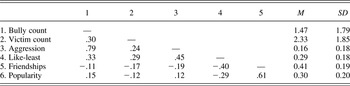
Table 1 shows that bully and victim indices were correlated with other variables in the way that one would expect for conventional peer nomination assessments of bullies and victims (de Bryun, Cillessen, & Wissink, Reference de Bryun, Cillessen and Wissink2010; Marsh et al., Reference Marsh, Nagengast, Morin, Parada, Craven and Hamilton2011). There was a positive correlation between being named as a bully and as a victim, r (1,576) = .30, p < .01. Children with high bully scores tended to be perceived by peers as aggressive, r (1,576) = .79, p < .01, and disliked, r (1,576) = .33, p < .01, but also as somewhat popular, r (1,576) = .15, p < .01. Children with high victim scores tended to be perceived by peers as aggressive, r (1,576) = .24, p < .01, and were both disliked and unpopular, r (1,576) = .29 and –.12, p < .01.
Correlations, means, and standard deviations of bully count, victim count, and sociometric measures

Note: Bully count and victim count were derived from the Who Bullies Whom measure. Bully indicated the number of times a child was circled under the bullies column, whereas victim indicated the number of times a child was circled under the victims column. Aggression, like-least, friendships, and popularity were based on proportion scores from peer nominations. All correlations are statistically significant at p < .01.
Bully/victim dyads
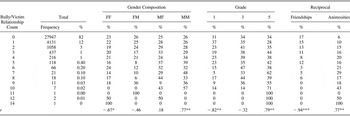
Table 2 shows that of 34,034 possible bully/victim dyads, 82% received a score of zero, which indicates that they were never named as a bully/victim dyad. Thus, the remaining 18% of dyadic pairs were named as a member of a bully/victim dyad at least once, with the number of times they were named reflecting the reputational strength of the bully/victim relationship. Specifically, 12% of pairs were named by only one peer, another 3% were named by two peers, and 3% were named by three or more peers as having a bully/victim relationship. As the reputational strength of the bully/victim relationship increased, bully/victims dyads were more likely to be composed of all-male dyads, r (9) = .77, p < .01, in fifth grade as compared to younger grades, r (9) = .79, p < .01, and were not friends, r (9) = –.94, p < .001, but were instead in reciprocated animosities, r (9) = .77, p < .01. Note that these findings are descriptive and do not take into account large differences in aggression levels between boys and girls, or older children's capacity to give more elaborate responses than do younger children. To control for these factors, primary analyses were conducted using multilevel modeling.
Descriptive statistics for bully/victim relationship index
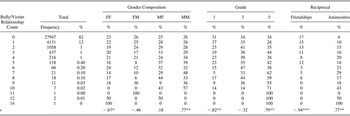
Note: Each row in the table is treated as a unique case, which leads to N = 14. However, because of the low cell count, as the bully/victim relationship score exceeded 10, cases in which the bully/victim relationship equaled 11, 12, and 14 were considered as outliers and were dropped for computation of correlations. Hence, the Pearson correlations reported in the table were based on bully/victim relationship scores of 0 – 10 (N = 11) with degrees of freedom equaling N − 2 = 9.
*p ≤ .05. **p < .01. ***p < .001.
Multilevel model
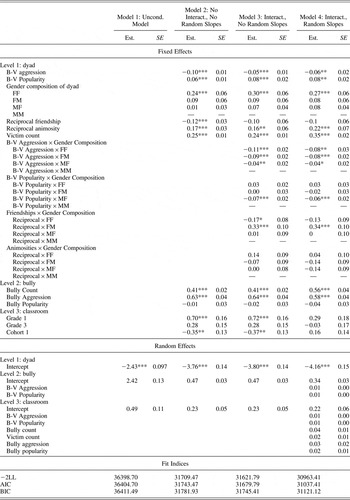
As can be seen from the bottom panel of Table 3, negative 2 log likelihood, the Akaike information criterion, and the Bayesian information criterion declined largely and sequentially from Model 1 to Model 4, which indicated that Model 4 had the best model fit statistics among the four models. For each of these indicators, the smaller the value, the better fitting the model. Therefore, the results from Model 4 are discussed, and conclusions drawn are from Model 4.
Estimated fixed and random effects and standard error for models predicting bully/victim (B-V) relationships

Note: We performed log transformation for the dependent variable in the model building process; thus, the estimates can be interpreted by taking its exponential value. For example, in Model 4, the estimate for the FF bully/victim dyad was 0.27. Given that MM bully/victim dyads were the reference level in the analysis, we concluded that FF bully/victim dyads were exp(0.27) = 1.31 times more prevalent than MM bully/victim dyads when other variables were held constant. −2LL, −2 log likelihood; AIC, Akaike information criterion; BIC, Bayesian information criterion.
*p < .05. **p < .01. ***p < .001.
Level 1: Dyad
B-V aggression and popularity
Table 3 shows that, at the dyadic level, the main effect of B-V aggression was negative and significant (β = –0.06), t (33,940) = –2.52, p < .01, and the main effect of B-V popularity was positive and significant (β = 0.08), t (33,940) = 3.05, p < .01. In bully/victim dyads that were more relative to less frequently nominated, bullies tend to become less aggressive yet more popular than the victims whom they harass.
Gender composition
The main effect of gender composition was not significant except for FF dyads (β = 0.27), t (210) = 4.36, p < .001, suggesting that, once variables such as bully aggression levels were controlled, FF bully/victim dyads are more prevalent as the strength of the bully/victim relationship increases than are MM bully/victim dyads.
Reciprocal friendships and animosities
The main effect of reciprocal friendship was not significant (although negative trends are apparent in Models 2 and 3), suggesting that friendship status between bully and victim did not predict bully/victim dyads. The main effect of reciprocal animosities was positive and significant (β = 0.22), t (70) = 3.36, p < .001, indicating that among dyads that were most often nominated, bullies and victims were likely to dislike one another.
Victim count
The main effect of victim count was positive and significant (β = 0.35), t (33,940) = 15.63, p < .001. Children who were often nominated as a victim were also more likely to be involved in highly noticeable bully/victim dyads.
B-V Aggression × Gender Composition
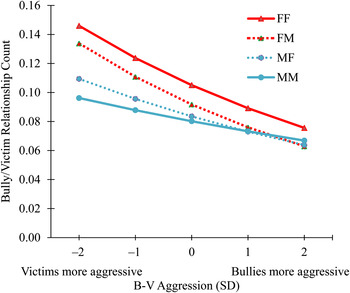
To test whether aggression differences within a bully/victim dyad depended upon the gender composition of the dyad, interaction effects between aggression differences and each gender composition were included. All of these interaction effects were negative and significant: B-V Aggression × FF (β = –0.08), t (33,940) = –2.79, p < .01; B-V Aggression × FM (β = –0.08), t (33,940) = –3.23, p < .001; B-V Aggression × MF (β = –0.04), t (33,940) = –2.12, p < .05, suggesting that the aggression differences found in FF, FM, and MF bully/victim dyads were significantly different from those found in MM dyads. Specifically, Figure 1 shows that, among dyads that were most often nominated, aggression differences in favor of the victim were most apparent in dyads that involved girl bullies (e.g., FF and FM), were somewhat apparent in cross-gender MF dyads, and were least apparent in MM bully/victim dyads.
(Color online) Bully-Victim (B-V) Aggression × Gender Composition predicting the bully/victim relationship for fifth-grade bully/victim dyads whose B-V popularity, bully counts, and victim counts were at the sample mean and who were in neither reciprocal friendships nor reciprocal animosities.

B-V Popularity × Gender Composition
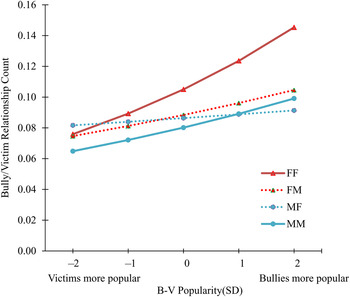
To test whether popularity differences within a bully/victim dyad depended upon the gender composition of the dyad, interaction effects between popularity differences and each gender composition were included. Only the interaction between B-V popularity and MF was significant (β = –0.06), t (33,940) = –3.20, p < .001, suggesting that the pattern of popularity differences in MF dyads was significantly different form that in MM dyads. Figure 2 shows that, among dyads that were most often nominated, bullies tended to be more popular than victims, but such popularity differences were least apparent among MF dyads.
(Color online) Bully-Victim (B-V) Popularity × Gender Composition predicting the bully/victim relationship count for fifth-grade bully/victim dyads whose B-V aggression, bully counts, and victim counts were at the sample mean and who were in neither reciprocal friendships nor reciprocal animosities.

Reciprocal Friendships × Gender Composition
The interaction between reciprocal friendships and FM was significant (β = 0.34), t (208) = 3.38, p < .001, suggesting that when girls bullied boys, dyad members were likely to nominate one another as friends.
Reciprocal Animosities × Gender Composition
None of the Reciprocal Animosities × Gender Composition interactions were significant, suggesting that bully/victim dyads were likely to be in reciprocated animosities regardless of the gender composition of the dyad.
Level 2: Bully
At the bully level, the main effect of bully count and bully aggression were positive and significant (β = 0.56), t (33,940) = 14.62, p < .001 and (β = 0.58), t (33,940) = 13.16, p < .001, respectively. These effects indicate that children who were nominated as a bully perpetrator or as aggressive were more likely to be involved in bully/victim dyads. Conversely, the main effect of bully popularity was not significant, indicating that the social status of the bully did not predict involvement in highly noticeable bully/victim dyads. Thus, at a between-person level, bullies can be characterized as aggressive children with highly variable levels of social status.
Level 3: Classroom
At the classroom level, the effects of grade and cohort were not significant, suggesting that neither grade nor cohort predicted involvement in bully/victim dyads.
Discussion
Development is stimulated by synergistic interactions across multiple levels of adaptation (Cicchetti & Cohen, Reference Cicchetti and Cohen2006; Rudolph et al., in press). To date, research on peer bullying has been hindered by methodological limitations that restrict the testing of hypotheses about the nature of interacting personal, interpersonal, and contextual characteristics that may clarify the very nature of bullying (for instance, how bullying differs from aggression, and how it operates within dyadic and group contexts). Perhaps it is for these conceptual and analytic restrictions that, despite well-publicized deleterious effects of peer victimization on child adjustment, bullying has still not typically been seen as “a paradigmatic example of either risk taking or of psychopathology” (Dodge & Albert, Reference Dodge and Albert2012, p. 625). The present research, centered around a relational measurement strategy, was designed to shed light on the unique properties of bullying within a dyadic, gendered context, and to lay some groundwork for a more representative developmental psychopathology perspective on peer bullying and victimization.
Study results speak most directly to the importance of distinguishing individual and dyadic phenomena in the analysis of peer bullying. At the individual level, children involved in bullying tended to be aggressive with highly variable levels of social status. This combination of relative homogeneity with respect to aggression and heterogeneity with respect to status corresponds with well-known taxonomies, such as Olweus's (Reference Olweus1993) bully and bully–victims or Farmer et al.'s (Reference Farmer, Irvin, Leung, Hall, Hutchins and McDonough2010) socially integrated and socially marginalized bullies. However, when analysis shifts to the dyadic bully/victim relationship, the obtained pattern of aggression and status differences at the individual level essentially reverses, in ways that are entirely compatible with theoretical definitions of bullying (Olweus, Reference Olweus1993). Specifically, bully/victim dyads most frequently nominated by peers were characterized in this study by large asymmetries in social status, where bullies were increasingly more popular than their victims, but also by decreasing asymmetries in aggression. Thus, in highly noticeable cases, bully/victim dyads were characterized less by individual differences in aggression and more by disparities in social power, which is the hallmark of the bullying, abusive relationship. Further, classroom peers clearly recognized bully/victim dyads that participated in a preexisting relationship, one of mutual animosity and, to a lesser extent, an absence of friendship.
Many study differences with respect to aggression, popularity, and relationship status were moderated by the gender composition of the bully/victim dyad. Male–male and male–female dyads were most prevalent according to descriptive indicators, but once baseline levels of aggression were controlled, female–female dyads appeared most prevalent. Furthermore, the within-dyad dynamics of bully/victim ties were sensitive to gender composition: aggression differences in favor of the victim were least apparent in male–male dyads, popularity differences in favor of the bully were least apparent in male–female dyads, and there was a tendency for children in female–male dyads to nominate one another as friends. Other results, such as the presence of animosity within the bully/victim dyad, were not moderated by gender composition. Results appeared to generalize across grade and cohort for the 71 first-, third-, and fifth-grade classrooms in this study.
Power asymmetry
The power of the bully has long been thought to come from the bully's aggressive prowess, although Olweus (Reference Olweus1993) was clear that bullies often possess psychological power over their victims. As a group, bullies show elevated aggression. This might lead to the assumption that bullies are necessarily more aggressive than their victims, and victims have often been thought to be nonaggressive or submissive (Schwartz, Dodge, & Coie, Reference Schwartz, Dodge and Coie1993). However, the present findings contradict such a relational assumption for the sample as a whole. Instead, as the strength of the bully/victim relationship increased, asymmetries in aggression increasingly tilted toward the victim, such that victims were more aggressive than their bullies. In other words, victims who become embroiled in well-defined bully/victim peer relationships tend to also be, or to become, highly aggressive, particularly when girls were involved as bullies or victims.
To address this issue, we must differentiate a bully/victim relationship from victimization that occurs outside of an established and recognized peer relationship. Perhaps, nonaggressive and submissive children are vulnerable to peers' aggression but not to developing an established bully/victim relationship. For many children, victimization is more temporary than enduring; this is particularly true for nonaggressive victims (relative to those who are aggressive; Hanish & Guerra, Reference Hanish and Guerra2004; Kochenderfer-Ladd & Wardrop, Reference Kochenderfer-Ladd and Wardrop2001). Thus, vulnerability to becoming a specific victim of a specific bully might be greater for those children for whom a coercive cycle is being established. For instance, aggressive children might provoke others into proactively attacking them. They might also respond to others' attacks with counteraggression (Hanish et al., Reference Hanish, Sallquist, DiDonato, Fabes and Martin2012; Olson, Reference Olson1992).
Although bullies were not necessarily of high social status in the classroom network as a whole, they were generally more socially powerful than their specific victims. Given that victims were also aggressive, it seems unlikely that bullies' relative social power comes from their aggressive behavior per se. As Rodkin, Farmer, Pearl, & Van Acker (Reference Rodkin, Farmer, Pearl and Van Acker2000) have shown, some aggressors enjoy greater social status than do others. Thus, aggression is not a defining feature of youth's social position. However, bullies' higher social power relative to their victims might be related to their efficacy in using aggressive behaviors (Salmivalli & Helteenvuori, Reference Salmivalli and Helteenvuori2007). That is, some displays of aggression are more acceptable in the peer group. For instance, aggression that is proactive and controlled is more socially accepted than aggression that is dysregulated and reactive (Card & Little, Reference Card and Little2006). Further, relational forms of aggression may be associated with greater social prominence than are physical forms of aggression (Andrews, Hanish, Martin, & Santos, Reference Andrews, Hanish, Martin and Santos2014; Rose, Glick, & Smith, Reference Rose, Glick, Smith, Cillessen, Schwartz and Mayeux2011).
Bully/victim relational status
The overall tenor of the bully/victim relationship was decidedly negative: bullies and victims were not likely to be friends; rather, they tended to dislike one another. Several studies have led to similar conclusions (Card & Hodges, Reference Card and Hodges2007b; Murray-Close & Crick, Reference Murray-Close and Crick2006). For instance, Hafen, Laursen, Nurmi, and Salmela-Aro (Reference Hafen, Laursen, Nurmi and Salmela-Aro2013) reported that adolescent bullies and victims tend to dislike one another as a group. Moreover, Casper and Card's (Reference Casper and Card2010) meta-analysis of 26 studies of antipathetic relationships revealed that antipathies tend to involve victimization. However, in none of the prior studies was the specific relationship between a bully and his or her victim(s) tested. This finding could be extended by examining other kinds of relational ties between bullies and victims, such as whether they tend to be, if not friends, affiliates within the same peer group (Crick & Nelson, Reference Crick and Nelson2002).
The association between bully/victim ties and animosity, and its lack of moderation by gender, suggest little support for the idea that cross-sex bullying in preadolescence is merely a manifestation of immature “push-and-poke courtship” (Maccoby, Reference Maccoby1998; Pellegrini, Reference Pellegrini2001). This is particularly the case for when boys bully girls, with relatively unpopular boys targeting relatively popular girls in a strong context of mutual dislike. In contrast, we did find some indication that mutual friendships were apparent in cases where girls bully boys, albeit without concomitant reduction in animosity among female–male dyads. Thus, female–male dyads might be more ambiguous or variable in relationship quality than other bully/victim dyads. It is also possible that victimization that occurs outside of an established and known bully/victim relationship may happen among friends. However, presumably, such victimization either would be short-lived or, if lasting, would portend the dissolution of the friendship, with an antipathetic, aggressive relationship emerging in its place (Casper & Card, Reference Casper and Card2010).
Bully/victim dyads as gendered relationships
Essential to the present study is the fact that findings varied by gender. This speaks to the legacy left by Nicki Crick, who forever influenced the field by bringing a gendered perspective to the study of aggression and bullying (Crick et al., Reference Crick, Casas and Ku1999). The work that we presented here builds on prior research that has treated gender as an individual-level variable by considering gender from a relational perspective. That is, bully/victim relationships occur both within gender (i.e., male–male and female–female) and across gender (i.e., male–female and female–male). This finding parallels literature indicating that bully/victim relationships can occur in any gendered combination (Hanish et al., Reference Hanish, Sallquist, DiDonato, Fabes and Martin2012; Rodkin & Berger, Reference Rodkin and Berger2008; Veenstra et al., Reference Veenstra, Lindenberg, Zijlstra, De Winter, Verhulst and Ormel2007).
Studying the gendered nature of bullying is critical because the features that characterize bullying dynamics depend upon the gender of both bully and victim (Hanish et al., Reference Hanish, Sallquist, DiDonato, Fabes and Martin2012). For instance, male–male bully/victim relationships were unique (even compared to male–female and female–male dyads) in that the aggression asymmetry favoring victims was least evident. Nevertheless, male–male bully/victim relationships were still characterized by asymmetries in social status and mutual animosity. In contrast, social status asymmetries were less evident in male–female dyads, suggesting that male bullies were not more popular than their female victims (see also Rodkin & Berger, Reference Rodkin and Berger2008). Taken together, these two findings suggest that, for male bullies, the nature of the bully/victim relationship depends upon whether the victim is a male or a female. This finding would not be evident by simply studying male bullies without consideration of whom they are victimizing.
Study limitations and future directions
This was a preliminary study with a novel methodology and analytic strategy, so there are numerous limitations and future directions. First and foremost, this is a cross-sectional analysis that leaves open critical questions regarding development. An important next step is to examine trajectories of bully/victim scores over one academic year, relating those trajectories to adjustment markers. For example, are children who are named as harassed by the same bully over the course of a school year at greater risk for depression and externalizing problems than children who are harassed by different bullies? Are children who are predisposed to be harassed within distinct gender combinations (e.g., boy bullying girl vs. girl bullying girl) subject to unique stressors with differential adjustment outcomes? Longitudinal analysis would permit the possibility of examining relational trajectories where children who once were friends become enemies owing to the onset of bullying and harassment (see Crick & Nelson, Reference Crick and Nelson2002). Regarding age-related changes, although we did not find significant differences between first-, third-, and fifth-grade classrooms, our analysis of age differences was underdeveloped in the present study. In preliminary descriptive analyses, one notable trend was that first graders tended not to name girls as bullies to the same extent as third graders and fifth graders, but the significance of this result did not survive multilevel modeling. More generally, the prevalence of bully/victim dyads across gender compositions throughout this prepubescent sample suggests that the problem of cross-gender bullying may have deep developmental roots (Hanish et al., Reference Hanish, Sallquist, DiDonato, Fabes and Martin2012).
Second, another limitation lies in not considering nominator-level differences in the Who Bullies Whom measure, particularly children's self-nominations as a bully or a victim. There may be important differences between children who alone are aware of, or report, peer harassment versus those for whom peer harassment is public knowledge. For example, Berger and Rodkin (Reference Berger and Rodkin2009) reported that self-nominated female victims had lower social status and were involved in more antipathies than were their peer-nominated counterparts, but among boys, self- and peer-reported victims had the lowest social status. Closer analysis of bully/victim nomination patterns also has the potential to clear up some long-standing confusions in the bullying literature. Are children in the “bully–victim” taxonomy harassing and being harassed by the same peers within a repetitive cycle of violence? Are these children's patterns of aggressive response and receipt instead determined along the lines of social network hierarchies, with bully–victims being bullied by higher status peers and then harassing (in classic frustration–aggression mode) lower status peers?
Third, the present focus on gender and aggression from a relational perspective is entirely in keeping with the legacy of Prof. Nicki Crick. However, Dr. Crick promoted advances in the study of ethnicity as well as gender (e.g., Kawabata & Crick, Reference Kawabata and Crick2011), and bullying, with its focus on power and abuse, is well suited for the analysis of interethnic and interracial aggression (Garandeau, Wilson, & Rodkin, Reference Garandeau, Wilson, Rodkin, Jimerson, Swearer and Espelage2010; Stroheimer, Kärnä, & Salmivalli, Reference Stroheimer, Kärnä and Salmivalli2011). In diverse samples such as the one featured here, further analyses could be undertaken directed at questions such as whether bullying and victimization is primarily directed within or across ethnic groups, or disproportionately toward minority students, and whether such patterns are moderated by contextual factors such as classroom ethnic composition and teacher involvement.
Implications for developmental psychopathology
We began by posing the question of how bullying differs from childhood and adolescent aggression more generally. The answer to this question lies in the relationship, in the interpersonal dynamics, operating between bully and victim. Consistent with Olweus' (Reference Olweus1993) now decades-old supposition, we found that the stronger the tie between bully and victim, the more likely they were to be embroiled in an established and lasting relationship that is marked by aggression, mutual animosity, and an imbalance in power. Nevertheless, the bullying relationship is not one size fits all. Rather, who (male or female) is bullying whom (male or female) matters. As shown here, relationally oriented research, in which the bully and the victim are simultaneously considered, provides a unique lens with which to study bullying, one that yields a different picture than does separate studies of bullies and victims. Such research provides a critical piece to the puzzle, enabling the differentiation of bullying from aggression more generally and speaking to the social processes that underlie bullying in peer groups.
It is no wonder that involvement in bullying is linked with the development of psychopathology, especially for the victim (Wolke et al., Reference Wolke, Copeland, Angold and Costello2013). The victims who are most deeply embroiled in bully/victim relationships resemble the type of victim often characterized as “bully–victims,” who tend to experience maladjustment across many indices of psychopathology (Cook et al., Reference Cook, Williams, Guerra, Kim and Sadek2010). This study, by highlighting the interpersonal dynamics of bullying, takes a new step in explaining why these children are at such elevated risk for negative outcomes. As such, the lessons to be learned from the study of bully/victim relationships may prove similar to the lessons learned from studying other harmful interpersonal interactions such as child abuse and domestic violence (Rodkin & Fischer, Reference Rodkin and Fischer2003). The common underlying feature is enmeshment in relationships that are marred by animosity, violence, and abuses of power. The victim is trapped: escape is difficult, coping options are limited, and capacity for ending the ongoing cruelty is low. Thus, other things being equal, the experience of a victim who is embroiled in a bully/victim relationship is likely more serious than the experience of someone who is targeted for victimization outside of the boundaries of such a relationship, although this is an issue for further empirical analysis.
Thoughts on the legacy of Professor Nicki Crick
In its larger and proper import, this paper is a tribute to the legacy of Prof. Nicki Crick. Without Professor Crick's creativity and insight into the bone-deep human phenomena of relationships, aggression, and gender, none of the concepts set forth here could be adequately explicated. There was absolutely nobody else who even came close to Nicki in bringing home to people the nature of conflict among girls. There was a time in the late 1990s when it seemed Nicki had a paper out every other month, each one a classic cited to this day.
Very few of us can come to grips with the tragic grief accompanying a vivid and true soul denied its proper time with us in this world, but almost all of us understand relationships, and we treasure them fiercely. Herein lies the everlasting legacy of Prof. Nicki Crick in her everyday life and work. Nicki was able to see, and to communicate with the rest of us, the aggression that can become part of children's relationships, pain that adults otherwise overlook. Nicki's selfsame talent and sensitivity to the nuances of conflict in relationships was also manifested positively, beautifully, in how Nicki shared her life with all of us living creatures, stirring our hearts, improving our minds, increasing our joy. The joy ebbs now with Nicki's death, but our hearts and minds have never been stronger. Nicki, thank you, forever more.
Appendix A
Bullies and kids they pick on
Some kids like to bully other kids around (they push them, or hit them, or say mean things to them, or call them names, or tell lies about them, or get other kids not to play with them).
If there are boys or girls in your class who like to bully other kids around, circle their names in the first column, then circle the names of the kids they bully the most in the second column. Draw a line between the two.