Introduction: conflict narratives in Narok and Laikipia
Research into socio-ecological relations in Kenya's Rift Valley has often been approached via narratives of ethnic conflict, which have also gained weight among civil society groups and the media (Oucho Reference Oucho2002; Rutten Reference Rutten, Rutten and Mazrui2001; Kanyinga Reference Kanyinga2009; Kantai Reference Kantai2007). As such, interactions between the ethnic groups in this article's areas of focus, Narok and Laikipia, often appear to be defined primarily by engagement in antagonistic relations and violent conflict (KHRC 1993; Hornsby Reference Hornsby2012; Klopp Reference Klopp2001b).
The most common explanation for conflict relates to the politicization of ethnicity and resources when intergroup violence coincides with general elections (Akiwumi Reference Akiwumi1999; Klopp Reference Klopp2000; Reference Klopp2001a; Branch Reference Branch2011; Lonsdale Reference Lonsdale2008; Lynch Reference Lynch2006; Throup and Hornsby Reference Throup and Hornsby1998; Anderson and Lochery Reference Anderson and Lochery2008). Political campaigns driven by a majimbo Footnote 1 agenda have often portrayed non-indigenous ethnic groups as ‘outsiders’ appropriating resources that belong to others, thereby justifying their expulsion from respective areas.
To exemplify how powerful such narratives are, one can look at recent Kenyan history. During the political violence of the 1993 elections, twenty-five Kikuyu were killed and 10,000 forcibly evicted from Enoosupukia (Klopp Reference Klopp2001b; KHRC 1993; Hornsby Reference Hornsby2012). In Laikipia, violent conflict pitting Samburu and Pokot communities against the Kikuyu claimed fifty-seven lives in 1998, while 5,000 people fled their homes (Rutten Reference Rutten, Rutten and Mazrui2001). The Akiwumi report (Reference Akiwumi1999) noted that the clashes in Laikipia, like those in Narok, were pre-planned with the intention of evicting non-Kalenjin and non-Maasai groups opposing the ruling party, the Kenya African National Union (KANU). The 2007–08 post-election violence represented the worst situation in the historical records for the Rift Valley. More than 1,000 were killed, and over 300,000 people fled their homes (Anderson and Lochery Reference Anderson and Lochery2008).
Following Kenya's devolved system of governance in 2010, majimboism has gained impetus. Party politics and intertwined ethnic loyalties are taking new shapes in governance structures, where dominant ethnic groups encourage invasion or the protection of boundaries against other groups (see, for example, Greiner Reference Greiner2013; Lynch Reference Lynch2006). Indeed, the expulsion of minority groups may intensify as political elites strive to safeguard ethnically homogeneous voting blocs. This conflict narrative has attracted the attention of the government, NGOs and international actors and has focused them on an agenda for peace in Kenya's fragile environments; and, in 2008, the Truth, Justice and Reconciliation Commission (TJRC) was established against the backdrop of a rise in ethnic conflict and political violence.Footnote 2
However, despite the over-representation of literature illustrating unremitting interethnic antagonism and tension, this article presents considerable evidence of cooperation that modifies such narratives. Specifically, patterns of intercommunity cooperation are as defining for the social landscape as conflict. Moreover, economic factors can provide a strong motivation for interethnic cooperation. We therefore wish to illustrate that social science research that focuses negatively on ethnicity may often overlook local and informal processes of ethnic integration and grass-roots peacebuilding processes. We do not contest the existence of conflicts in Narok, Laikipia or other parts of Kenya; nor do we devalue studies of change among homogeneous ethnic groups. Rather, we argue that studies of socio-ethnic frontiers Footnote 3 require more varied approaches, and that periodic incidences of violence do not necessarily inhibit social-economic exchange and interdependence (following Gregor and Sponsel Reference Gregor and Sponsel1994). Therefore, the question we ask in this article is the following: what drives the formation of ties and networks in ethnically hybrid spaces despite the recurrence of conflict?
Drawing on ethnographic data collected between 2013 and 2016 in Narok and Laikipia, we examine the contexts of intergroup collaboration through the institutions and actors involved and the types of environmental and economic factors that shaped collaborative actions. These factors not only explain intergroup cooperation in violent landscapes, but also shed light on how such ties persist despite outbreaks of violence.
Interethnic relations do not represent a new phenomenon; rather, they are reminiscent of historical processes of the nineteenth and twentieth centuries, reproduced in day-to-day activities as adaptive responses to changing environments. To demonstrate the persistence of ties in the midst of conflict, this article uses two case studies. The first relates to the cooperative use of land resources by Maasai and Kikuyu in the borderlands of Narok and Nakuru counties, and the second involves collaborative cattle raids by young Samburu and Kikuyu in Laikipia. While the interethnic relations in Laikipia are typically short term and socially thin, ties in the Narok/Nakuru borderlands are long term and socially thick. Both case study areas can be characterized as socio-ethnic frontiers as both have seen the immigration of people from surrounding ethnically homogeneous areas. In the Narok/Nakuru borderlands, the sharing of property rights through leasehold arrangements and intermarriage produces increasingly hybrid identities, together with the possibility of providing the conditions for peace building. In contrast, the raiding syndicates in Laikipia increase general insecurity in the area; however, this results in intercommunity efforts to circumvent the raiding organizations.
This article makes use of several related concepts. First, we set out a brief conceptual framework. A historical overview of our study areas follows, and then we move on to the two contemporary case studies. Our aim is to link the historical context to current social-ecological relations, thereby demonstrating the historical continuity of cooperative relations in Narok and Laikipia.
Hybrid identity, frontiers and cross-cutting ties in the mitigation of violence
Hybrid identity is understood as the unstable, multiple and fragmented nature of the contemporary ‘self’ (following Brubaker and Cooper Reference Brubaker and Cooper2000: 8). Woodward (Reference Woodward2000: 17) suggests that identity links the personal and the social – that is, individuals taking up identities and the social situations in which people find themselves, including social roles, everyday interactions with others and the language they use. We may therefore assert that hybrid identities are a function of structure and agency that play out in a given geographical area.
For the study areas, the history and contemporary case studies reveal this social-cultural construction of hybrid identities. Both Narok and Laikipia are spaces of encounter, conflict and blending of several ethnic categories (see Smith and Leavy Reference Smith and Leavy2008: 3–4). Ensuing negotiations involve three models of identity construction identified by Baumann and Gingrich (Reference Baumann and Gingrich2004): orientalism, through which ‘self’ and ‘other’ are reciprocally essentialized; segmentation, through which processes of group fusion and fission emerge in relation to strategy and context; and encompassment, through which ‘otherness’ is co-opted as a form of sameness.
The social-cultural construction of hybrid identities may play out more strongly within what Kopytoff (Reference Kopytoff and Kopytoff1987) terms the ‘internal African frontier’. Kopytoff's definition of the frontier is applicable to the cases of Laikipia and Narok, where farmers create satellite settlements on the margins of the occupied land while being dependent on exchange between the parties involved. With reference to ethnic convergence, we understand both areas as socio-ethnic frontiers: that is, social landscapes characterized by ethnic overlap, where each group negotiates access to the same social, political and environmental resources. Such a frontier influences contact and interaction, creating a mixture of cultures and a hybridity of identities (Newman Reference Newman2006: 150).
Kin or friendship ties enhance this mix by facilitating exchange and the cooperative use of available resources. These mutually supportive relations can be explored using Gluckman's notions of rituals of rebellion and cross-cutting ties (Gluckman Reference Gluckman2004 [1963]; Kang Reference Kang1976). These notions describe the ways in which division and difference can contribute to the persistence of intergroup relations because associated conflicting loyalties guide negotiations over resource use, access and exchanges. In Narok, rights to land are increasingly negotiated through non-violent means, although disputes form part of the social order. In Laikipia, joint cattle-rustling operations involving Kikuyu and Samburu youths increase general insecurity while offering potential economic gains through novel types of ties.
Competition and collaboration: the history of land settlements in Narok and Laikipia
Although land occupation has a long history in Kenya, the 1960s marked a shift in the decolonization struggles over land, paving the way for the occupation of the colonial Crown Lands (see Berman and Lonsdale Reference Berman and Lonsdale1992; Branch Reference Branch2009; Hornsby Reference Hornsby2012; Kanyinga Reference Kanyinga1998; Leo Reference Leo1989). Studies focusing on the post-1960 settlement (Wasserman Reference Wasserman1976; Kyle Reference Kyle1999; Nottidge and Goldsack Reference Nottidge and Goldsack1966; Leo Reference Leo1989) have paid little attention to the question of the ways in which different ethnic groups formed relationships around the lands they occupied. Instead, they have focused on questions of land reform and its consequences (Leo Reference Leo1981; Kanyinga Reference Kanyinga1998; Anderson and Lochery Reference Anderson and Lochery2008).
Maa speakers and Kikuyu in Enoosupukia, Narok
Enoosupukia is located in the former Maasai reserve, in the southern part of Lake Naivasha Basin. Enoosupukia borders Maiella Estate, a former settler farm run by an Italian until 1964. He sold it to a land-buying company made up of 581 Kikuyu, who later subdivided it among its members (Kioko Reference Kioko2016). Before the arrival of Maasai from Laikipia and Kikuyu from central KenyaFootnote 4 in the early 1900s, Dorobo hunter-gatherers inhabited what was then Enoosupukia Forest. Other Maasai groups, including the Keekonyokie, Purko and Loita, accessed the forest for dry-season grazing (Thomson Reference Thomson1887).
From the early twentieth century, Dorobo families welcomed northern Maasai and Kikuyu and provided them with access to land (Kioko and Bollig Reference Kioko and Bollig2015). Blackburn (Reference Blackburn and Kent1996) adds that access rights to land were also transferred between local groups as compensation or penalties imposed in dispute resolutions by councils of elders. For the Dorobo, sharing resources was a means to accumulate symbolic capital. Together with other Maasai, the Dorobo hoped to get the farmers to cultivate for them, thereby supplementing their diet. For the Kikuyu, this was an opportunity to expand their agricultural frontiers in the Rift Valley (Kioko and Bollig Reference Kioko and Bollig2015).
The majority of Kikuyu arriving in Enoosupukia towards the 1960s became client farmers in Maa-speaking homesteads. Some encouraged their sons to seek adoption among wealthy Maasai families in order to become the heirs to their property, while others married off their daughters into Maasai homesteads in exchange for land (Kioko and Bollig Reference Kioko and Bollig2015). This expansionist trend gained impetus following the purchase of Maiella Estate by the land-buying company, as it heralded the migration of Kikuyu into the area (Kioko Reference Kioko2016). The expansionism of Kikuyu extended beyond individual actions into group-based cooperatives characterized by clan and friendship affiliations (Kanogo Reference Kanogo1987). In most cases, Maa speakers protected their Kikuyu in-laws and friends, even when they built new villages on Maasai land (Waller Reference Waller, Spear and Waller1993). Kikuyu formed a client base for Maasai livestock and helped establish schools and churches towards the 1980s.
Maiella Estate became a strategic position for Kikuyu's peaceful expansion, through the instrumental githaka (kinship- and clan-based) system of land control. Indeed, towards the 1990s, the Kikuyu population surpassed that of Dorobo and Maasai combined (Matter Reference Matter2010). The subdivision and privatization of Maiella Estate created a vibrant land market in which land sales were non-discriminatory with regard to ethnicity. The trend towards heterogeneity persisted, albeit with occasional disputes because of changing land-use patterns, when former grazing grounds were converted into cultivated fields. Maa speakers described their relationships with Kikuyu as congenial and cordial (Sorrenson Reference Sorrenson1968; Galaty Reference Galaty, Spear and Waller1993).
Settlement and multi-ethnic developments in Laikipia
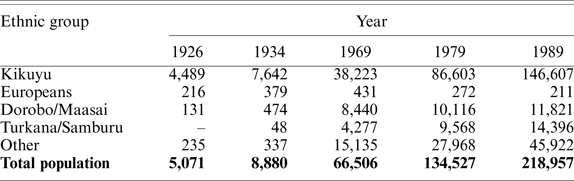
During colonization, Laikipia was part of the area declared as Crown Land by the British, even though it was not heavily settled before the 1920s. Despite it being a central part of the White Highlands, the Kikuyu population has dominated Laikipia since then (Table 1). Whereas Kikuyu squatters from the Kiambu and Muranga areas usually went to Naivasha and Nakuru districts, many from Nyeri moved onto settler farms in the Laikipia region as labourers; this was occurring at least from the early 1900s (Kanogo Reference Kanogo1987). Laikipia bordered the colonially demarcated Northern Frontier District to the north (present-day Samburu County). Whereas the settler farms towards the south of Laikipia were relatively peaceful, the cattle ranches in the north experienced frequent attacks from Samburu moran Footnote 5 who sought to rebel against their exclusion from their former grazing areas (Fratkin Reference Fratkin2015).
Changes in ethnic population composition in Laikipia District.

Sources: Laikipia District annual reports for 1926 and 1934;Footnote 6 Republic of Kenya (1970; 1981; 1994).
From the independence years onwards, the Kikuyu population in Laikipia increased immensely compared with the Samburu, Turkana and Kalenjin inhabitants. The Kikuyu settlers were often either lower-class people, last in line to acquire land in Central Province, or members of the new Kenyan elite (Branch Reference Branch2009). The new elite was successful in acquiring consecutive areas of land and often used it to garner political support by subdividing the land for smallholders through land-buying companies. Alternatively, the land was contained in a ranch or large-scale farm and continued under single ownership (Kanyinga Reference Kanyinga2009; Kohler Reference Kohler1987). Between 1969 and 1989, the Kikuyu population in Laikipia rose by 74 per cent to comprise 146,607 of the district's total population of 218,957 (Table 1). The influx continued following the government-initiated settlement schemes, and as people joined together to buy land through cooperatives founded by the elites (Rutten Reference Rutten, Rutten and Mazrui2001). With a political interest in containing insecurity, demands for land were satisfied by the government settlement programmes in Laikipia, including the Million Acre scheme, the Shirika schemes, the Haraka scheme and the Nyandarua scheme, all of which benefited mainly the Kikuyu communities (Kohler Reference Kohler1987).
Much of the land was bought in the late 1960s on smaller fertile estates in the south, whereas the larger estates were acquired in the 1970s when settlement shifted to the drier regions in the north-western areas of Laikipia District (Kohler Reference Kohler1987; Rutten Reference Rutten, Rutten and Mazrui2001). As was often the case with the land-buying companies, there was rampant fraud as directors stole peasant contributions, as well as prolonged processes for the distribution of title deeds, which meant that ethnic competition between different communities increased (Hornsby Reference Hornsby2012; Kanyinga Reference Kanyinga2009; Gravesen Reference Gravesen2018). However, just as often, shareholders would come together as one group in opposition to the directors of the land-buying companies, thereby generating closer neighbour relations despite various ethnic affiliations. Even though Kikuyu continue to dominate political positions in local government, the lower-class Kikuyu rarely profit from having wealthier kin. Rather, small-scale Kikuyu farmers have stronger ties to their livelihood kin with whom they share daily challenges, be they Turkana, Kalenjin or Samburu shareholders (Sottas and Wiesmann Reference Sottas and Wiesmann1993).
In the Narok area, informants told us that almost all colonial settlers had sold their land and had left by the end of the 1970s. In contrast, twenty years after independence, large-scale farming and ranching still covered over half of Laikipia (Kohler Reference Kohler1987). Nowadays, commercial ranches comprise 39 per cent of landholdings in Laikipia, many of which are managed or owned by foreigners and white Kenyans. In comparison, the subdivided areas used by smallholders and pastoralists cover 34 per cent (Graham and Musyoki Reference Graham and Musyoki2012). The influx of Kikuyu and other non-pastoral groups, combined with Samburu immigration since the 1990s, has turned Laikipia into a county of socio-ethnic diversity and land-use fragmentation. Whereas ethnic categorization continues to be relevant for social navigation, alternative denominators now link and divide the population.
For instance, smallholders of different ethnic affiliations have similar livelihoods and tend to gather as groups when confronted by a common enemy – for example, their pastoral or ranching neighbours or the land-buying company directors (Gravesen Reference Gravesen2018). Furthermore, the heterogeneous groups of smallholders share the challenges of small-scale farming in Laikipia's highly unpredictable ecological conditions, where unreliable sources of water have historically caused problems for users of the land, even before colonial times (ibid.). This context has made collaboration useful in certain situations, shifting denominators for interrelations from opposition to necessity. So, while tension has been present, Laikipia's mixed social and ethnic composition has simultaneously encouraged cooperative relations in trade and local organizations such as water boards, school committees, religious congregations, and so on (ibid.). As such, the heterogeneous Africanized smallholder lands in Laikipia illustrate a form of positive interethnic collaboration in everyday interactions.
Although the process of decolonization has shaped northern and southern Kenya in different ways – especially with regard to differing memories of loss of and rights to the land – this brief history provides evidence of cooperative relationships in multi-ethnic settings. This underlines our argument that peaceful relationships have dominated certain environments and have functioned as adaptive strategies to changing social-ecological conditions, despite periodic violence. Indeed, Muriuki (Reference Muriuki1974) posits that Kikuyu and Maasai coexist because of the sharing of resources, ideas, wives, norms, values and institutions.
Below, we shift our focus to contemporary interactions in Narok and Laikipia to demonstrate the historical continuity of cooperative relations, despite occurrences of conflict.
Case study 1: Intermarriage and land deals among Maasai and Kikuyu in Narok
Between 1908 and 1912, British officials moved Maasai into the southern reserve together with their livestock (Hughes Reference Hughes2006). The objective was to establish a Maasai-only reserve to control native activities (Waller Reference Waller, Spear and Waller1993). However, the project did not prevent social-economic relations, including livestock trade, intermarriage and cultivation (Campbell Reference Campbell, Spear and Waller1993); rather, Maasai protected Kikuyu from removal by the colonial authorities (Galaty Reference Galaty, Spear and Waller1993: 174–94). While in the reserve, Kikuyu made themselves available for labour and intermarriage as a strategy to secure rights to land. They adopted Maasai culture and language; some took Maasai names; and others knocked out a few lower teeth or pierced their earlobes to assimilate with the Maasai. Waller refers to this strategy of appropriation of resources as Kikuyu's colonization of agricultural frontiers in Maasailand (Reference Waller, Spear and Waller1993: 226–48). Furthermore, as a strategy to immigrate through cooperative territorial control, Kikuyu recreated the githaka Footnote 7 system and brought their kin onto the claimed land; some purchased land from Maa speakers, while others engaged in leasehold arrangements.
Intermarriage and assimilation
While demonstrating the importance of marriage and kinship in understanding social cohesion, Radcliffe-Brown and Forde argue that ‘a system of kinship and marriage can be looked at as an arrangement which enables persons to live together and co-operate with one another in an orderly social life’ (Reference Radcliffe-Brown and Forde1950: 3). And, as observed by Muriuki (Reference Muriuki1974) and Sorrenson (Reference Sorrenson1968), Maasai–Kikuyu intermarriage has a long history.
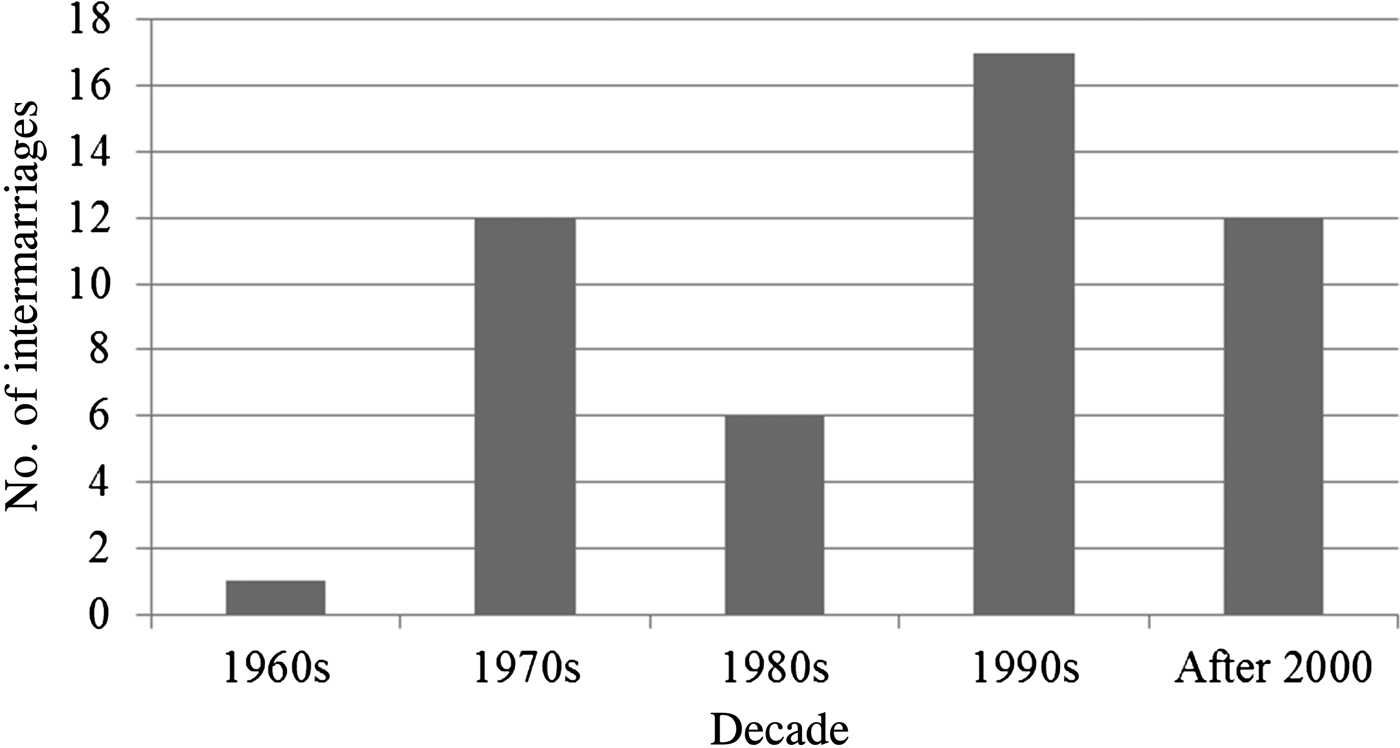
In Narok, marital alliances play a vital role in minimizing conflict.Footnote 8 Intermarriages in this predominantly Maasai pastoralist region have increased since the 1960s (see Figure 1): in a sample of 140 marriages, forty-eight intermarriages (34 per cent) between Maasai and Kikuyu were recorded, of which thirteen were recorded prior to the 1980s. Since the late 1980s intermarriages have increased, with Maasai men habitually marrying Kikuyu wives, mostly guided by the cultural dictates of exogamy (Kioko and Bollig Reference Kioko and Bollig2015).
Distribution of intermarriages over the last fifty years.

The children of intermarriages embody the conflicting loyalties of their parents. Known as manusu (singular: nusu nusu), they have become an important part of the population. Nusu nusu is derived from the Swahili word nusu (‘half’) and often refers today to offspring of Maasai/Kikuyu/Dorobo intermarriages, although people rarely used it when referring to themselves. The name also refers to Kikuyu who acquired Maasai identity through adoption, as labourers, friends and in-laws. It was already being used in the 1950s, when the district commissioner of the Maasai reserve, Galton-Fenzi, noted in a 1957 report that the nusu nusu population ‘would always be a problem for administrators’ due to their alliances with both dominant ethnic communities and their unclear relation to land.Footnote 9
Indeed, the concept acquired a generally pejorative meaning during the Emergency in the 1950s, when all Kikuyu settlers came under suspicion of supporting Mau Mau. ‘Nusus’ were thought to be particularly dangerous because they might encourage support for Mau Mau among their Maasai kin. Many Kikuyu households in Maasailand were removed or restricted under the pretext of preserving ‘traditional (Maasai) ethnicity’. To protect ties between Maasai and Kikuyu, oaths were taken. The sharing of blood, sometimes obtained from persons involved in the oath, meant that Kikuyu and Maasai became blood brothers, as a Maasai elder in Nkampani village, Narok, explained. This meant that none of the participants would reveal the whereabouts of the others to British officials.
Generally, manusu are strategically allied to the Maasai, manifesting their declaration of dependence for the purpose of land tenure security. However, they maintain a positive regard for their Kikuyu identity and can mobilize such identities when needed. Rogers, a nusu nusu, explained: ‘Every nusu nusu has a Maasai umbrella name with which they are associated. That name makes them Maasai and protects their ownership rights to land in Maasailand even if they married Kikuyu wives. Manusu are also Kikuyu; they speak Gikuyu because their mothers mostly come from Kikuyuland.’Footnote 10 Apart from the nusu nusu, intermarriage unites in-laws and forms Kikuyu–Maasai networks. In-law bonds facilitate peaceful relations between the families tied in kinship, but may also influence their friends and neighbours. Kikuyu as wife-givers and Maasai as landlords demonstrate reciprocal relationships in which each party is indebted to the other. Thus, land disputes become a family matter rather than a cause of disagreement between ethnic groups.
Furthermore, intermarriage produces socially thick relations, where personal security is strengthened and material flows are introduced, as explained by a Kikuyu woman:
The Maasai have a lot of respect for their in-laws. Since the time my three daughters got married to Maasai husbands, I feel respected. I occasionally receive presents sent by my in-laws, especially in the form of foodstuffs … The 1993 clashes can be thought of as ordinary conflicts in any family setting. However, if violence did occur while I was in the homestead of any of my in-laws or my Maasai friends, I would be offered protection.Footnote 11
Such exchanges are comparable to those among the Trobriand Islanders (Mauss Reference Mauss and Gunnison1967 [1925]). They become foundations for social constraint or reciprocal exchange, which is important in enhancing social solidarity. Rather than encouraging emotional attachments to a particular ethnic identity, intermarriage allows for hybrid identities, necessitating cultural diffusion when norms and institutions are shared. Thus, intermarriages open up windows of opportunity in social-economic exchange, neutralizing notions of ‘us versus them’ that could otherwise lead to conflict. Interestingly, the 1993 violence did not erode the marriage-related cross-cutting ties. Rather than causing separation, the violence served to strengthen marriage alliances – intermarriages even increased following the violence (Kioko Reference Kioko2016).
Despite the benefits, marital conflicts and land disputes are particularly notable within a polygynous arrangement involving Kikuyu and Maasai co-wives. It was noted during fieldwork that co-wives strive to control family resources (land and livestock) in competition with one another. Marital disputes are reduced when the first wife vetsFootnote 12 a potential co-wife before she is brought into the family.
Land rentals: from contested to shared landscapes
Enoosupukia has attracted land-seeking client farmers since at least the early twentieth century, when mobility and demands for settlement shaped the acquisition of land. For instance, a Kikuyu seeking land from a Maasai can bring his family and friends to settle immediately after having established a relation of dependence with his landowning patron. Similar groups follow, creating Kikuyu highlands within the Maasai lands. This is similar to Igor Kopytoff's idea of an internal African frontier (Kopytoff Reference Kopytoff and Kopytoff1987).
Land rentals can be seen as a recreation of the githaka system of territorial control, where Kikuyu clients take advantage of access rights rather than ownership rights, although with the hope of eventually acquiring ownership. In the cases observed, Kikuyu clients introduce their land-seeking kin to their Maasai landowners, thereby preventing others from obtaining leases.
By leasing land to Kikuyu clients, Maasai gain income. Therefore, land rentals become a means for livelihood diversification. Kikuyu clients in turn invest in commercial cultivation for the growing markets in urban areas. Cultivation is ideal here because of abundant rainfall and suitable soil for agriculture. Consequently, livestock pastures have decreased and herders now engage in ‘mobile’ livestock raising. Many use income from leasehold land to rent pastures in Kajiado, Gilgil and other less cultivated areas. Others use kin and clan affiliations to obtain grazing, extending as far as Tanzania, while yet others graze on the roadsides. Through land rentals, the Maasai's intention is to populate landholdings with crops, farmers and dakis.Footnote 13 In this way, their land is not left idle, when it could attract possible land-grabbers. Furthermore, this system is meant to deter the government from expanding the gazetted Enoosupukia Forest – something that occurred in 2004 and 2005 when government officials evicted residents of Mpeuti village in Enoosupukia. This prompted Maasai landowners to lease land to prevent future evictions.Footnote 14
Tenants attempt to please their landlords so that they will extend their lease periods by, for example, gift giving (Kioko and Bollig Reference Kioko and Bollig2015). Kikuyu tenants learn Maa while landowners learn Gikuyu, which improves their relations and eases tensions in communication. Furthermore, it indicates acceptance of the land tenure and client position; to employ Ferguson's terminology, the voluntary engagement in client relations functions as a declaration of dependence for the tenants, which is understood as a ‘mechanism for achieving social personhood’ (Ferguson Reference Ferguson2013: 226).
In-laws and friends of Maasai landowners are often exempt from paying for plots. This demonstrates the conflicting loyalties involved in land rentals, while making it possible for landowners to bring kin onto their land as a way to establish a permanent presence.
The size and number of plots and the lease periods vary depending on prior working relations. For instance, the Maasai landowner Ole Sere categorizes his tenants into groups. He allocates supervisory duties to his trusted tenants, who ensure that new clients pay for their leases in a timely fashion and adhere to operational rules. What emerges is a classical principal–agent relationship echoing Ensminger's example in which cattle owners cement relations by adopting ‘deserving herders’ (Ensminger Reference Ensminger and Cook2001). In the Narok context, trusted tenants monitor the activities of new tenants, relieving landlords of their monitoring duties. For instance, tenants may not grow crops that take a long time to mature, as this could be interpreted as an assertion of ownership rights to the land. Such arrangements protect the property rights of landowners (the principal) and could earn tenants (the agents) an extension of their lease periods.
Land rentals are also important for peace building, since the cross-cutting networks nurture social cohesion.Footnote 15 However, established and maintained relationships also help facilitate the peaceful resolution of disputes. Cooperative use of land has become the basis for intercommunity exchange, reciprocal obligations and trust. Indeed, land-seeking clients increasingly prefer user rights to ownership rights, due to the other effects of their ‘declarations of dependence’. Ownership rights, they argue, can be politicized, leading to violent conflict. Thus, land is increasingly a shared rather than a contested resource.
Case study 2: Interethnic raiding syndicates in Laikipia
In contrast to Narok, interethnic relations in Laikipia are fragmented. They cannot be simplified as win–win deals and interdependence between landowning Maasai and Kikuyu clients. Although respected intermarriages occur, they remain rare, and interethnic relations are generally socially thinner. As such, interethnic raiding syndicates are dissimilar from the socially thick features of intermarriages and patron–client relations. The raiding syndicates function temporarily and as shady activities kept from family members; in fact, family members can easily become victims of raids themselves (Gravesen Reference Gravesen2018). Since few individuals are involved and few benefit, the syndicates can be viewed as socially thin interrelations.
Research on cattle rustlingFootnote 16 in Kenya has gained weight in the past few decades. The proliferation of automatic weapons and politicized claims to land have transformed cultural motivations for raiding, making it a form of violent regulation (Greiner Reference Greiner2013). Today, there are multiple types of raids, the best known of which are organized by individuals from one pastoral group against another (Bollig and Österle Reference Bollig, Österle and Rao2008). Cattle rustling organized as a communal activity has different motivations from interethnic raids. In the former, livestock are transported alive because they are needed for restocking or to pay bride prices. Livestock function as a means to pool resources and therefore the animals’ value is higher if they are alive. Communal raids thereby constitute symbolic capital for the raiding moran (Bollig Reference Bollig1990; Reference Bollig1993; Greiner Reference Greiner2013).
While cultural aspects of raiding among pastoral communities are well documented, research on interethnic collaboration in raiding activities is more scattered (Schilling et al. Reference Schilling, Opiyo and Scheffran2012; Greiner Reference Greiner2013). Odhiambo describes collaborations between Ilchamus and Pokot, where coordinated raids for economic gain are carried out in the Lake Baringo area (Odhiambo Reference Odhiambo2015). Anderson has shown examples from 1981 in which groups of Tugen raided in Laikipia and moved west to exchange their livestock for a similar group of animals. Through multiple exchanges, they arrived at markets in Uganda (Anderson Reference Anderson1986). There are also records of collaborations from the 1930s where pastoralist groups stole livestock from white ranchers. The animals were then sold to slaughterhouses in Nyahururu to supply restaurants with meat for their customers, many of whom were the same white ranchers who were subject to raids (ibid.). As such, certain types of raiding activities already had commercial drivers in the 1930s.
In present-day Laikipia, groups of different ethnic identities organize some of the raiding activities. Young Kikuyu men form alliances with young men from pastoralist communities (Samburu, Turkana or Nandi) to forge raiding syndicates rooted in prospects of economic gain. With a high demand for meat, these gains are great if the raids are successful (Mwangi Reference Mwangi2012). Raiding can thus be categorized as a strategy to adapt to harsh economic environments rather than as a cultural manifestation of community status. Moreover, land is increasingly scarce and the inheritance of land cannot be guaranteed. This challenges young men to become independent when they move away from their father's house (Gravesen Reference Gravesen2018). For Kikuyu, the poor quality of soil in Laikipia compared with Central Province makes farming hard work that secures little return. Many subsistence farmers risk impoverishment due to the highly variable rainy seasons (Berger Reference Berger1989). Furthermore, tenure insecurity limits their freedom in land management and reduces protection from the authorities in cases of illegal grazing, livestock raids or crop damage by wildlife (Roden et al. Reference Roden, Bergmann, Ulrich and Nüsser2016; Droz and Sottas Reference Droz and Sottas1997). Ultimately, there are few options for young men without financial support to earn money quickly, and so raiding syndicates become tempting ventures.
The organization of interethnic raids
Unlike in Anderson's example, where live animals are transported, stolen animals are quickly slaughtered in nearby slaughterhouses before the meat is distributed to buyers. The reason for this shift is the increased risk of tracking due to improved technological systems. However, slaughterhouses often commission the raids, as was intimated by a reformed syndicate member in Salama. When demand for meat is high between October and January, the slaughterhouses contact the syndicates to order animals. During this time, the stealing is not as selective and bulls, cows and sick animals are all targeted. Interestingly, when some slaughterhouses record a high number of cows, a theft will have been reported during the same period (Mabel Reference Mabel2015). Although it is not unusual to have more females than males, this ought not to be the case in slaughterhouses, where male animals are preferred due to their ideal slaughter weight. In addition, it is uncommon for farmers to sell more of their female animals than the males because this decreases reproduction rates.
The owners of the slaughterhouses pay lorry drivers to transport animals. In some instances, the police have been bribed to facilitate the raids; in such cases they deliberately act slowly, do not investigate, or complicate the animal tracking process. At times, there are even links to chiefs and veterinary officers, who issue livestock transport licences to lorry owners despite having information that they are moving stolen livestock, as noted by a reformed syndicate member. As a general rule, the slaughterhouses receive the largest share of the profits. Money is distributed along a value chain, where the value is determined by the buyer – i.e. the slaughterhouses, which buy from the syndicate at a low price. The syndicate must accept the low price because of the associated risk. At the slaughterhouses, the meat is ‘laundered’ and then sold at market price (Gakuu Reference Gakuu2000).
The raiding itself draws on the comparative advantage of each syndicate member. Kikuyu are often the masterminds in charge of communication and planning, whereas the raid is carried out either by Samburu or by Turkana or Nandi members – but not by Kikuyu. As a Samburu elder in Surogoi, a Samburu-dominated area, noted:
The Kikuyu cannot come to this place. They stay in towns. The Samburu will then come here because they will not be suspicious [to fellow Samburu]. He will then spy around and know when to strike … The Kikuyu awaits the animals for loading and transportation. That's what they do. You know the Kikuyu cannot raid – they just plan the raids.Footnote 17
However, when the syndicate targets a Kikuyu, the raiders need insider information from a Kikuyu member in order to act swiftly and avoid jeopardizing the entire venture, and so the Kikuyu member may sometimes join the raiders. In Kikuyu-dominated Salama, a man explained how he woke up one night following a scuffle outside his house. He opened the door and realized that crooks were trying to steal his livestock and that his own son was among them. Similar examples were noted elsewhere in western Laikipia. Often, the consequences of exposure for syndicate members are more severe than they are in the aforementioned communally organized raids. For instance, some people in Rumuruti lynched a small group of Samburu and Kikuyu raiders following the unveiling of their syndicate. The reason for this severity can be found in the nature of the syndicate organizations. Their success depends on insider information from, say, a Kikuyu member. So that the Samburu members can perform the raid swiftly, the Kikuyu member provides details of a target to which he could only have access as a relative or by having a close connection to his own community. Therefore, syndicate members risk the consequences not only of raiding, but also of betrayal, the result of which is exclusion or death.
Motivations to join raiding syndicates
During the colonial period, Kikuyu individuals engaged in raiding activities because of their exclusion from resources. Raiding from settlers was a way of expressing their grievances over lost land. For Samburu, a traditional livestock economy was giving way to a growing market-based economy governed by money. Nowadays, motivations are different. With a high risk of over-grazing and general tenure insecurity, pastoralists as well as farmers must diversify their income streams and move towards a wider use of resources.
James, a reformed syndicate member, became interested in joining a syndicate after drinking in a den where one of his friends bragged about money. It was rare for uneducated and unemployed youth to be able to buy rounds of chang'aa (a local brew), and, wanting to know where the money came from, he approached his friend. James was immediately ready to offer allegiance and be part of the syndicate. On a market day, he met with his friend and four other members in Rumuruti. They explained the seriousness of the business and warned him not to reveal anything to anyone. He then became an informer. Although there was no ritual oath, they regularly threatened James to confirm the pact. Due to the risk of exposure, they could not appear as a group in public. Instead, he was given a mobile phone and a SIM card that was only to be used by the syndicate members. Threats, risk and necessity thus formed the bond between them. Kikuyu members needed to trust the Turkana member to deliver the stolen animals to the trucks or slaughterhouses. Likewise, Turkana members needed to trust that they would receive payments and new orders.
Studies on game theory show that people are less likely to cheat each other if they know one another or expect to meet again (Rapoport and Chammah Reference Rapoport and Chammah1965). Because the life situation of each syndicate member is at stake, a relationship of trust is necessary. While members might enter the venture motivated by the push factor of changing conditions and the pull factor of potential economic gain, neither would be of value without trust between the syndicate members. According to Granovetter, strong ties involve factors of time and similarity (Reference Granovetter1973; Reference Granovetter1983), and therefore syndicate members’ relations must develop over time. Drinking dens, livestock markets, schools and even churches in Laikipia all offer the possibility for such relations to develop. Rumuruti town was often mentioned as a meeting point for syndicate members because public facilities here are already ethnically diverse. Members of raiding syndicates also become acquainted and gain common frames of reference simply by growing up in the same area or attending the same schools and churches – the similarity that Granovetter also notes. With continually overlapping reference points, the members grow more similar despite their different ethnic affiliations. Therefore, collaborations seem more likely here than in less mixed areas, such as the more homogeneous Samburu County, where such syndicates would be unthinkable.
Discussion: the persistence of intergroup cooperation
Actors
Both case studies mainly involve younger generations. Historically, powerful patriarchal Kikuyu societies have stressed the importance of accumulating wealth to form a family, while simultaneously dividing resources in a hierarchical manner, with the firstborn sons having stronger inheritance claims (Droz and Sottas Reference Droz and Sottas1997; Beech Reference Beech1917; Sorrenson Reference Sorrenson1968). However, patriarchy no longer guarantees inheritance rights. Following increasing population numbers and the commodification of land, older generations sold much of their land holdings, leaving little inheritable land for the younger generations, despite the fact that they are still expected to establish a family to gain acceptance (Berman and Lonsdale Reference Berman and Lonsdale1992). Therefore, younger children can be tempted to venture into arranged marriages, client positions or criminal ventures to appropriate wealth.
To understand young people's positions within these patriarchal systems, the terminologies of rituals of rebellion and cross-cutting ties and alliances are relevant (Kang Reference Kang1976; Gluckman Reference Gluckman2004 [1963]). Here, conflicts are the very elements that sustain social structures, thereby becoming determinants for the continuation of the patriarchal system. Following Gluckman, societies have certain tendencies related to fluidity, whereby groups break apart, only to reassemble later. Thus, even though relations change, the social system continues (Gluckman Reference Gluckman2004 [1963]). For the Kikuyu, even though individual actions constitute acts of rebellion against the patriarchal system, the motivations for actions of accumulation ultimately ensure the system's preservation and confirm the young men's position of being dominated. Both interethnic client relations and raiding syndicates become alternative accumulation options for those excluded from inheritance. Judith Butler relevantly ponders the meaning of being dependent on those who suppress you. In this situation, that which provides a sense of purpose and a position in society simultaneously suppresses the individual. Therefore, abusive systems cannot be rejected by the oppressed. Yet, this position is ‘a place of no place’ that the individual will want to rebel against, because of the inherent limitations it places on that individual's life (Butler Reference Butler2015).
Institutions
Günther Schlee argues that the scale of historical movements and the fragmentation of ethnic clans illustrate how collaboration with neighbours became more important than sustaining kin connections following a move (Schlee Reference Schlee, Fukui, Kurimoto and Shigeta1997). When communities move, mixed social and ethnic landscapes are created. Such characteristics apply to both cases. For instance, the ties between young men in Laikipia show how collaboration between previously rival groups can be approached as a natural development in a mixed setting. Other types of collaboration, such as the Kalenjin alliance, have been politically motivated through efforts to acquire access to resources and influence (Lynch Reference Lynch2011).
Whether a relationship is considered an alliance or a cross-cutting tie depends on its place within a social system. Alliances denote a broad agreement marked by sanctions, oaths and social institutions (Spencer Reference Spencer1973), while cross-cutting ties exist as personalized networks where agreements are made on interpersonal levels (Kioko and Bollig Reference Kioko and Bollig2015): for example, peace caravans fall into the alliance category, while collaborative raids are cross-cutting ties. Intermarriages and client relations indicate a more embodied and permanent change in people's life situations; however, these ties are formed interpersonally and fall between the categories of alliances and cross-cutting ties.
Although there are similarities between the ‘game’ for meat and the ‘game’ for land, the case studies here also differ in the extent of ethnic partnership. In Narok, Maasai–Kikuyu relations extend into intermarriages and gain normative acceptance. The need to practise proprietorship of the soil causes some Kikuyu to acquire Maasai identity, at times even claiming nusu nusu status without a blood connection. Hybrid identities of shared norms, values and institutions are formed, reproducing the thickness of the relationships (Kioko Reference Kioko2016). Conflicts may function to affirm such ties rather than erode them. In contrast, intermarriages in Laikipia are rare. Even with collaboration across ethnic boundaries and ‘good neighbour’ relations, intermarriages have not become accepted and parents strongly advocate for their children to stay within accepted networks when considering potential partners (Gravesen Reference Gravesen2018).Footnote 18 As one Samburu elder in Thome put it: ‘We don't want their blood … We are like a royal family.’ Instead, strong opinions are voiced about other groups, preventing ties from becoming socially thick. Therefore, while ties create long-term socially thick relations of dependence in Narok, the interdependent relations in Laikipia remain thin, with short-term structures.
Environment
None of the collaborations mentioned are new phenomena; rather, they are reminiscent of historical patterns that have repeatedly taken place (Spear and Waller Reference Spear and Waller1993; Sorrenson Reference Sorrenson1968; Muriuki Reference Muriuki1974; Tignor Reference Tignor1976; Berntsen Reference Berntsen1976). Evidence reveals adaptive strategies of cooperation between Maasai and Kikuyu neighbours as responses to unpredictable environmental conditions and social-political pressure, despite rivalries over land use in the nineteenth and twentieth centuries (Spear and Waller Reference Spear and Waller1993).
Similar adaptations to changing environmental contexts continue to be prevalent today. While conflicts over the control of land and the politicization of ethnicity fuelled intergroup violence in Narok in the early 1990s, land disputes are the basis of the social order today (Kioko and Bollig Reference Kioko and Bollig2015). Nevertheless, the associated risks do not prevent people from forming ties. Similarly, collaborative raiding syndicates have persisted in and around Laikipia since the 1930s, despite violence in the region (Anderson Reference Anderson1986). Although interethnic raiding syndicates risk discovery by state agencies and by the communities affected, such collaborative actions have not decreased. Rather, both cases depict an opportunistic willingness to take risks through collaboration, revealing adaptive responses to social, political, economic and environmental changes. In Laikipia, poor prospects for keeping livestock and for agriculture tempt raiders into syndicates, while the landless in Narok have found opportunities for accessing productive land.
In addition, violence in Narok seems to erupt, disappear, and then return in waves, whereas in Laikipia the tension is more constant (Kioko Reference Kioko2016; Gravesen Reference Gravesen2018). The permanence of tension may explain the low regard for intermarriages in Laikipia compared with Narok. Arguably, the formation of ties in multi-ethnic settings is a form of path dependency when navigating a changing environment, because the instigation of collaboration remains unaffected despite – or even because of – the prevalence of ethicized politics and tension. On the individual level, if one is ready to denounce ethnic loyalty there are options to access resources. The fact that groups maintain interrelations despite conflict points to an imbalance between the individual and the group, where interpersonal relations persist as strategies for survival even though ethnic loyalty may be compromised.
Economics
Interethnic collaboration is motivated by the potential for economic gain, on the individual rather than the group level. This potential profit overrides investment costs – gift giving and lease payments in Narok, and undervalued buying prices and bribes in Laikipia. Furthermore, as a pull factor in collaborations, the potential gain is more powerful than restrictions from wider ethnic conflicts.
While land rentals and collaborative raids represent strategies for income diversification, social relationships and (non-)material exchanges shape economic enterprises. Good relations must be maintained to ensure access to land in Narok and to avoid exposure in Laikipia. Client relations and intermarriages are reminiscent of Ferguson's descriptions of dependence on hierarchical relations, although this does not apply to the raiding syndicate (Ferguson Reference Ferguson2013). In the syndicates, there is no permanent dependence because the collaboration can be dissolved if trust is broken or if the potential for economic gain decreases.
Lesorogol discusses the subdivision, privatization, commodification and resulting cultivation of pastoral lands in northern Kenya (Reference Lesorogol2003; Reference Lesorogol2008) – another example where the demand for economic security is an overriding factor. In recent decades, land and livestock have become important commodities, and pastoralists are increasingly motivated by income from land sales and leaseholds. Dietz et al. have also shown how pastoral communities pool resources to keep up with market flows (Reference Dietz, Nunow, Roba, Zaal, Mohamed Salih, Dietz and Mohamed Ahmed2001).
The raiding syndicates are instrumental in illustrating how such ventures can continue despite their criminality. With higher state-level security standards since the collaborations of the 1930s, the ventures have become riskier yet more efficient. A collaborative entity organized according to the members’ respective strengths is arguably more efficient than a group in which one ethnic group performs all the activities. However, collaborating with other ethnic groups also increases the risk of exposure. The willingness to raid family members also entails a significant increase in risk. However, the demand for meat has kept incentives high, and such incentives may continue as long as those who might expose the syndicates can be bribed. For Kikuyu in Narok, the potential to become a supplier of food products to the growing urban centres is a significant incentive for entering into client relations. As such, the desire for economic success is a strong motivation.
Conclusion
Collaborative raids, interethnic marriages and structures of land access all exemplify adaptation in ethnically mixed environments. The Laikipia case is an example of socially thin relations while the Narok case reflects socially thick constructions. Due to growing fragmentation of the socio-ethnic distribution of the population, there are few cultural anchors in the landscapes of both case study areas that hold historical or ritualized importance for particular ethnic communities. When residents have no long-term presence, we argue that cultural values can more easily be overshadowed by opportunities to gain financially.
In this article, we have extended our analysis of collaborations beyond the nature of ties to explore the motivations behind the creation of these ties. What we have found is that motivations for interethnic collaborations follow norms of wealth appropriation established by patriarchal systems. These systems benefit firstborns and leave younger children to fend for themselves, while still expecting all children to create economically stable families. Young generations must therefore innovate in wealth creation to earn the respect of their kin. The creation of ties in the ‘games’ of meat and land is thus motivated by the potential for economic gain. Younger generations in the case study areas have in common a willingness to take risks and push the limits of the justification for their ventures either by raiding their own families or by submitting to client relations and assimilating into another ethnic group.
However, whereas the benefits from raiding syndicates are short term and the ties created are temporary, the benefits from client relations are long term and permanent. These long-term benefits lie in the resources accessed, which become shared rather than contested. In Laikipia, this is not possible, since land is not owned primarily by one ethnic group. Instead, raiding syndicate members hope to acquire quick money to improve their situations temporarily.
Migration in Kenya is increasing, and migrants seek out land in all areas that are suitable for farming and other livelihood activities. As Smith and Levy point out, globalization tends to produce hybridization in the form of ambiguous identities, complex roles and pluralistic personalities (Smith and Leavy Reference Smith and Leavy2008). Therefore, these migration trends take place irrespective of the population's ethnic distribution. With globalization growing in both the present and the future, hybrid populations will likely increase. The way in which we have conducted this inquiry reflects how we see the need to approach interethnic relations in mixed areas in the future, and how we should resist the temptation to let ethnicity blindfold us in these endeavours.
Acknowledgements
We would like to thank David Anderson and Michael Bollig for suggestions and input to this article. We also thank the European Commission for generous funding for our PhDs at the Department for Social and Cultural Anthropology at the University of Cologne as part of the Marie Curie ITN project ‘Resilience in East African Landscapes’ (REAL). We also appreciate the DFG (German Research Foundation) for subsequent funding under the collaborative research centre, ‘Future Rural Africa: Future Making and Social-Ecological Transformation’.