Introduction
Tropical forests have constantly been disturbed by distinct ecosystem processes and global changes, which include land-use change, climate change, and urbanization (Grimm et al. Reference Grimm, Chapin, Bierwagen, Gonzalez, Groffman, Luo, Melton, Nadelhoffer, Pairis and Raymond2013; Rivas-Arancibia et al. Reference Rivas-Arancibia, Carrillo-Ruiz, Bonilla-Arce, Figueroa-Castro and Andrés-Hernández2014). They have a direct impact on the landscape and its biodiversity, which can significantly alter the biogeochemical cycles of ecosystems. In some lowlands, the forests that had been conserved by cultural traditions, human sentiments, reverence, and fear are the only forests left untouched by growing urbanization and other developmental activities (Bossart & Antwi Reference Bossart and Antwi2016; Bhagwat & Rutte Reference Bhagwat and Rutte2006). For example, when the forests of the Western Ghats biodiversity hotspot in India were encroached for silviculture, agriculture (tea, coffee, and rubber), and settlements during the colonial period, parts of them were left untouched, often intentionally upon the animistic and religious sentiments of local ethnic people – the sacred groves (SGs) (Gadgil Reference Gadgil2014). They have been worshipped and conserved by the local communities both as a spiritual hub and as a botanical sanctuary (Ormsby & Bhagwat Reference Ormsby and Bhagwat2010; Prashanth Ballullaya et al. Reference Prashanth Ballullaya, Reshmi, Rajesh, Manoj, Lowman and Sinu2019). Kirk (Reference Kirk1978) notes that ‘As settlement and deforestation increased, the SGs became in some lowland areas the only surviving relics of the original forest’.
In South and parts of Northeast India, SGs conserve fragments of primary and secondary forests and freshwater swamps as island habitats (Bhagwat & Rutte Reference Bhagwat and Rutte2006; Rath & Ormsby Reference Rath and Ormsby2020). Gadgil and Vartak (Reference Gadgil and Vartak1976) have recognized the potential of SGs for conserving biodiversity through their botanical investigations first. Since this seminal work, several studies have unearthed new species, communities, gene pools, populations, and microhabitats of rare, threatened, and vulnerable plant populations inside SGs of India (Boraiah et al. Reference Boraiah, Vasudeva, Bhagwat and Kushalappa2003; Chandrashekara & Sankar Reference Chandrashekara and Sankar1998; Bhagwat et al. Reference Bhagwat, Kushalappa, Williams and Brown2005, Reference Bhagwat, Nogué and Willis2014; Bhagwat & Rutte Reference Bhagwat and Rutte2006; Brown et al. Reference Brown, Bhagwat and Watkinson2006; Jana et al. Reference Jana, Wotsa, Dasgupta and Todaria2018; Jamir & Pandey Reference Jamir and Pandey2003; Khan et al. Reference Khan, Khumbongmayum and Tripathi2008; Rajendraprasad Reference Rajendraprasad1995; Ray & Ramachandra Reference Ray and Ramachandra2010). These studies have illustrated that the SGs, particularly those located on urbanized lowlands, have fortuitously served as sanctuaries for tropical biodiversity (Chandrashekara & Sankar Reference Chandrashekara and Sankar1998; Induchoodan Reference Induchoodan1996; Rajendraprasad Reference Rajendraprasad1995) and have a high number of native endemic plant species (Chandrashekhara & Sankar Reference Chandrashekara and Sankar1998; Jamir & Pandey Reference Jamir and Pandey2003). A recent review, however, has pointed out a critical gap on our knowledge on the faunal diversity, particularly the invertebrates of SGs (Ray et al. Reference Ray, Chandran and Ramachandra2014), which we are attempting to fill with our entomological expeditions (Rajesh et al. Reference Rajesh, Prashanth Ballullaya, Surendran and Sinu2017; Manoj et al. Reference Manoj, Rajesh, Prashanth Ballullaya, Meharabi, Shibil, Rajmohana and Sinu2017; Rajesh et al. Reference Rajesh, Prashanth Ballullaya, Unni, Parvathy and Sinu2020). Although an inventory of plant diversity might be useful for identifying sites that have conservation potential, periodical assessment of taxa that are sensitive to subtle changes in the environment and have high populations and functional roles (Leal et al. Reference Leal, Filgueiras, Gomes, Iannuzzi and Andersen2012; Mehrabi et al. Reference Mehrabi, Slade, Solis and Mann2014; Manoj et al. Reference Manoj, Rajesh, Prashanth Ballullaya, Meharabi, Shibil, Rajmohana and Sinu2017) can inform the present quality of habitats.
Recent studies indicate that the SGs of India have deteriorated their quality (Osuri et al. Reference Osuri, Madhusudan, Kumar, Chengappa, Kushalappa and Sankaran2014; Prashanth Ballullaya et al. Reference Prashanth Ballullaya, Reshmi, Rajesh, Manoj, Lowman and Sinu2019). In lowlands of the Western Ghats, the land-use change, urbanization, and growing disbelief on cultural aspects of SGs among youth have been cited as the reasons (Prashanth Ballullaya et al. Reference Prashanth Ballullaya, Reshmi, Rajesh, Manoj, Lowman and Sinu2019). The state of Kerala once had over 15,000 SGs distributed on the lowland of the Western Ghats mountain chains along the west coast. This has reduced to just 1,200 SGs (Suchitra Reference Suchitra2015). Due to the rapid urbanization in the lowlands, the SGs today have been distributed as islands of natural forests on a mosaic of crowded towns, business establishments, temples, road networks, and used lands. Although SGs may have a forest cover, it is not necessary that they are functionally prudent. The surrounding landscape can also have an impact on the biodiversity of island habitats like SGs (Rocha-Ortega & Castaño-Meneses Reference Rocha-Ortega and Castaño-Meneses2015; Melliger et al. Reference Melliger, Braschler, Rusterholz and Baur2018). Periodical monitoring of functionally important indicator taxa of fragments, such as litter-dwelling ants, can suggest the quality of SGs for conserving biodiversity.
The litter-dwelling ants have often been considered as suitable indicators of land-use change, fragmentation, and urbanization (Buczkowski & Richmond Reference Buczkowski and Richmond2012; Cuautle et al. Reference Cuautle, Vergara and Badano2016; Júnior et al. Reference Júnior, Rocha, Jesus, Oliveira and Araújo2020; Leal et al. Reference Leal, Filgueiras, Gomes, Iannuzzi and Andersen2012; Melliger et al. Reference Melliger, Braschler, Rusterholz and Baur2018; Narendra et al. Reference Narendra, Gibb and Ali2011; Rajesh et al. Reference Rajesh, Prashanth Ballullaya, Surendran and Sinu2017). They are taxonomically and functionally diverse and abundant enough to show numerical responses to subtle changes in environment and microenvironment (Andresen Reference Andersen1995). They have a range of functional guilds from Tropical Climate Specialists to invasive species and from subterranean Cryptic Species to large-bodied solitary Specialist Predators to indicate the degradation in the quality of a habitat (Andersen Reference Andersen1995; Rajesh et al. Reference Rajesh, Prashanth Ballullaya, Unni, Parvathy and Sinu2020). Because of their functional diversity, the litter-active ants contribute crucially to major ecological functions of forest fragments, such as decomposition of organic matter, nutrient cycling, predation, secondary dispersal of seeds, and so on (Philpott & Armbrecht Reference Philpott and Armbrecht2006). However, degradation of habitats can shift ant composition so much, so that the specialists can be replaced by generalists and ecological functions can be simplified or even threatened. One ramification of urbanization is the invasion of invasive and tramp species into natural and semi-natural habitats (Berman et al. Reference Berman, Andersen and Ibanez2013; Oliveira Hagen et al. Reference Oliveira Hagen, Hagen, Ibáñez-Álamo, Petchey and Evans2017; Williams & Lucky Reference Williams and Lucky2020). They, over time, may result into local and regional biotic homogenization through species extirpation or displacement, which can affect key ecological functions of forest fragments (Berman et al. Reference Berman, Andersen and Ibanez2013; Buczkowski & Richmond Reference Buczkowski and Richmond2012; Del Toro et al. Reference Del Toro, Ribbons and Ellison2015; Graham et al. Reference Graham, Freidenfelds, Mccormick and Langkilde2012; Holway et al. Reference Holway, Lach, Suarez, Tsutsui and Case2002; Hoffmann et al. Reference Hoffmann, Luque, Bellard, Holmes and Donlan2016; Meer Reference Meer2019; Williams & Lucky Reference Williams and Lucky2020). While the invasive ants might not disturb the normal life of native ants in undisturbed habitats, they can be a potential threat in degraded and disturbed habitats (Allen et al. Reference Allen, Birge, Slater and Wiggers2017; Berman et al. Reference Berman, Andersen and Ibanez2013; Naumann & Higgins Reference Naumann and Higgins2015).
Our overall aim was to understand whether the SGs can still function as a biodiversity hub as perceived by previous studies or have modified into a used land seen on their neighbourhood. In the present study area, the SGs have semi-evergreen forests constituted by multistoried vegetation including liana at upper story, and the immediate neighbouring used land to the SGs was constituted by home gardens (HGs). They have palms of coconut (Cocos nucifera) and arecanut (Areca catechu) at upper story and horticultural crops such as mango (Mangifera indica), jackfruit (Artocarpus spp), cashew (Anacardium occidentale) and banana (Musa spp), or rubber (Hevea brasiliensis) at the lower story. The SGs have a complex vegetation structure, closed canopy cover and thick litter bed (Rajesh et al. Reference Rajesh, Prashanth Ballullaya, Unni, Parvathy and Sinu2020). The HGs have sparse vegetation, open canopy, and bare ground.
In this paper, we assessed variation in patterns of diversity of ant communities in SG and neighbouring HG to examine whether the SG has a distinct community of ants from that were seen in HG. Because the landscape type can have an effect on the biodiversity of island habitats (Rocha-Ortega & Castaño-Meneses Reference Rocha-Ortega and Castaño-Meneses2015), we sampled ants on the paired SG–HG sites in rural and urban environment to examine whether the landscape type can predict the variation in the patterns of diversity of ant communities in SG and HG. Recent studies (Rajesh et al. Reference Rajesh, Prashanth Ballullaya, Surendran and Sinu2017, Reference Rajesh, Prashanth Ballullaya, Unni, Parvathy and Sinu2020) have warned that the SGs of Kerala are under pressure from Anoplolepis gracilipes,a globally notorious ant species known to exert interference and exploitation competition, and predation pressure to native ants, other elements of biodiversity, and key biotic functions in Asia-Pacific region (Drescher et al. Reference Drescher, Feldhaar and Blüthgen2011; Lach Reference Lach2005; Dorrestein et al. Reference Dorrestein, Todd, Westcott, Martin and Welbergen2019; Sinu et al. Reference Sinu, Sibisha, Nikhila Reshmi, Reshmi, Jasna, Aswathi and Megha2017). We examined the effect of A. gracilipes on the composition of native ant community and abundance of various functional groups of native ants with the hypothesis that their abundance interact with the landscape type and habitat type and together affect community composition and abundance of native ants. The β-diversity is presently segregated into local contribution to β-diversity (LCBD) and species contribution to β-diversity (SCBD) (Heino & Grönroos Reference Heino and Grönroos2017; Legendre & De Cáceres Reference Legendre and De Cáceres2013). We used the data collected in the present study to examine the ant species and the sites that have contributed significantly to the β-diversity of ant community in the study area.
Material and methods
Study site
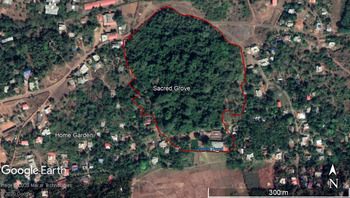
The study was conducted in the Kasaragod district of Kerala in peninsular India. The district is located at 12.51° N, 74.99° E with an average elevation of 19 m above the sea level. Kasaragod has an average annual temperature of 27.1 °C and an average precipitation of 3,825 mm annually. Subject to the availability and the permission obtained, we selected 11 sites – 5 on urban landscape (municipality limits and crowded towns) and 6 on rural landscape – for the present study. The SGs having at least 2 ha of their area under forest cover were selected for the present study (Figure 1), only five such sites could be selected on urban landscape. In each site, we sampled ants from one SG and an adjacent HG (Figure 1). Thus, a total of 11 SGs and 11 HGs were sampled. Apart from the difference in vegetation composition, the SGs of the present study had thick litter bed size (linear model: estimate±s.e.=3 ± 0.56; t = 5.31, p < 0.0005) and a closed canopy (40.67 ± 3.91; t = 10.41, p = 0.00005) over the HGs. The study was conducted in January 2019.
One pair of the sacred grove–home garden used for the present study. The sacred grove (Dharmashastha kaavu) is located in Cheemeni (12.240705° N, 75.236018° E)

Ant sampling
Ants were sampled using pitfall traps (Brown Jr. Reference Brown, Agosti, Majer, Alonso and Schultz2000). We relied pitfall trap for sampling litter-active ants because they have been proven efficient to provide a bias-free sample of both the subterranean groups of ants (Cryptic Species) and the large-bodied litter-active ants (Rajesh et al. Reference Rajesh, Prashanth Ballullaya, Unni, Parvathy and Sinu2020). We placed 2 line transects, one each radiating at least 100 m from the edge into the SG and HG and installed 10 pitfall traps on each transect. The first trap on each transect was at 10 m from the edge, and the inter-trap distance, based on the habitat size, was about 10–20 m (Qodri et al. Reference Qodri, Raffiudin and Noerdjito2016). Our previous studies suggest that the present sampling can get a good representation of litter insects including ants (Manoj et al. Reference Manoj, Rajesh, Prashanth Ballullaya, Meharabi, Shibil, Rajmohana and Sinu2017; Rajesh et al. Reference Rajesh, Prashanth Ballullaya, Surendran and Sinu2017, Reference Rajesh, Prashanth Ballullaya, Unni, Parvathy and Sinu2020). Pitfall traps consisted of 500-ml plastic containers (10 cm diameter), placed flush with the level of the ground and filled one-quarter with 75% isopropanol. We set the traps for five successive days for sampling ants. Our sampling design resulted into a total of 220 pitfall traps – 110 each from SG and HG. Upon retrieval of pitfall traps, ants were sorted out from remaining insects and identified down to the genus/species level using Bolton (Reference Bolton1994), Bingham (Reference Bingham1903) and secondary literature. The invasive species and ant functional groups were identified using Bharti et al. (Reference Bharti, Sharma, Bharti and Pfeiffer2013, Reference Bharti, Guénard, Bharti and Economo2016) and Narendra et al. (Reference Narendra, Gibb and Ali2011). Based on the functional role and competition, seven functional groups of ants have been identified and used their abundance in the present analyses. They include Opportunists, Generalist Myrmicinae, Tropical Climate Specialists, Subordinate Camponotini, Specialist Predators, Cryptic Species, and Hot Climate Specialists. The invasive species belong to each of these functional groups have been pulled out and considered them separately as another functional group, invasive ants, in data analysis. The present data have no representative species of Dominant Dolichoderinae – a group known to have a submissive effect on Subordinate Camponotini ( Narendra et al. Reference Narendra, Gibb and Ali2011). In the absence of Dolichoderines, Subordinate Camponotini responded independently to habitat complexity (Ormsby & Bhagwat Reference Ormsby and Bhagwat2010). Generalist Myrmicines are cosmopolitan and speciose functional group in our sample and known to have a submissive effect on Opportunists. All the specimens were deposited in the insect museum of the Central University of Kerala.
Statistical analyses
In this study, the site was considered as an independent unit or replicate; therefore, the catches of 10 pitfall traps of each habitat in each site were averaged to generate a site × species matrix for SG and HG. The sampling efficiency was assessed by comparing the observed species richness with the estimated species richness (Jack-knife 1) using the Program EstimatesS 9.0 (Colwell Reference Colwell2005). The site average abundance and richness of overall ants and abundance of various ant functional groups, Shannon diversity (H), and proportional trap incidence of ant species were used as the response variables in the statistical analyses. The proportional trap incidence of an ant species was calculated by dividing the number of traps with the ant species by the number of traps used in that site. We used a two-way ANOVA model for studying the effect of habitat, landscape, and an interaction of habitat by landscape on the response variables. Before using the data for modelling, we ensured that the data met the statistical requirements for performing parametric tests. We used analysis of covariance (ANCOVA) to study the interactive effect of landscape, habitat, and the abundance of A. gracilipes on abundance of native ants and other ant functional guilds. In the model, landscape and habitat were fitted as the categorical fixed variable, and the site average abundance of A. gracilipes as the covariate. In order to find the best regression model explaining the relationship between A. gracilipes abundance and abundance of other functional groups of ants and β diversity, we compared the linear regression with the second-order polynomial regression obtained using the lm function and with the non-linear regression models obtained using the gam and loess functions available in R using one-way ANOVA test. However, the linear models were found fitting best among all the models.
Although the habitats in two landscapes can have comparable richness, abundance, and diversity of ants, it is not necessary that they have the same species or similar communities in their assemblages. To examine for the changes in community composition of ants between habitat and landscape, we calculated permutational multivariate analysis of variance (PERMANOVA) on a similarity matrix of species based on Jaccard coefficient using the ‘adonis’ function of R-package ‘vegan’ (Oksanen et al. Reference Oksanen, Blanchet, Friendly, Kindt, Legendre, McGlinn, Minchin, O'Hara, Simpson, Solymos, Stevens, Szoecs and Wagner2018). The results were graphically illustrated on a non-metric multi-dimensional scaling (NMDS) available in the package ‘vegan’. We generated heat map using the normalized scores (z-score) of the trap-average abundance of ant species in sites using the R-package, ‘gplots’ (Warnes et al. Reference Warnes, Bolker, Bonebakker, Gentleman and Huber2016). The resulting similarity of the sites was checked using the hierarchical clustering method and Euclidean distance as a measure of dissimilarity. In order to study the impact of A. gracilipes on the compositional similarity of sites on ant communities, we constructed two heat maps, one each with and without the abundance data of A. gracilipes. The two resulting similarity matrices were correlated by using Mantel test available in the R-package, ‘vegan’. If a correlation exists between the two matrices, it can be inferred that A. gracilipes has little effect on the site distances by the ant community. To understand the ant distribution pattern and contribution to site diversity, components of β-diversity –SCBD and LCBD – were calculated using the ‘beta.div’ function available in the R package, ‘adespatial’ (Dray et al. Reference Dray, Bauman, Blanchet, Borcard, Clappe, Guenard, Jombart, Larocque, Legendre, Madi and Wagner2018). Because ants are social and nest proximity might influence the catch size (Ellison et al. Reference Ellison, Record, Arguello and Gotelli2007), we estimated β-diversity for both the abundance-based and the incidence (presence/absence)-based data.
Results
We recorded 11,356 ants belonging to 69 species from 11 paired sites. SGs registered 5,364 ants belonging to 52 species and HGs registered 5,992 ants belonging to 44 species. We collected 76.3 % of the expected species for HG (S obs = 44, Jack-knife 1 = 57.6) and 75.1 % of the expected species for SG (S obs = 52, Jack-knife 1 = 75.1). There were 25 and 16 unique species in SG and HG, respectively (χ 2 = 1.98, DF = 1, p = 0.15), which contributed 130 (mean ± SD = 5.2 ± 8.7 individuals/species; range=1–45) and 312 individuals of ants (19.5 ± 49.8 individuals/species; range=1–200), to the respective fauna (χ 2 = 74.94, DF = 1, p < 0.0005). Although the rural SG had more number of unique species (14) over urban SG (4), rural HG (8), and urban HG (6), the difference was insignificant (χ 2 = 7, DF = 3, p = 0.07). While the unique species of SG were forest specialists and Tropical Climate Specialists, the unique species of HG were plantation specialists, generalists, and opportunists.
The sample contained 6,124 ants belonging to 7 invasive species and 5,232 ants belonging to 62 native species; 83% of the invasive ants was belonging to A. gracilipes, which was way higher than the number of other invasive species (χ 2 = 2,595, DF = 1, p < 0.00005). Based on natural history and the behaviour of species, the 11,356 ants were grouped into one of the following functional groups: Opportunists (6,563), Generalist Myrmicinae (3,929), Tropical Climate Specialists (311), Subordinate Camponotini (262), Specialist Predators (159), Cryptic Species (130), and Hot Climate Specialists (2). The seven invasive species in the sample were belonging to Opportunists (Table S1).
Based on trap incidence data, ant communities were constituted by three common ant species – Pheidole multidens (trap incidence=77%), A. gracilipes (trap incidence=69%), and Pheidole sp 18 (trap incidence=54%), Together, they made up to 70% of the overall captured individuals. The trap incidence was highly correlated with the species abundance in the sample (R 2 = 0.90, p < 0.00005), suggesting that abundance can be a useful measure for comparing habitats and landscapes. Forty-six species were rare, because they were sampled on less than 5% of the pitfall traps and together contributed to about 3% of the overall captured ants. However, some rare species of SGs were the abundant species of HGs (Figure S1).
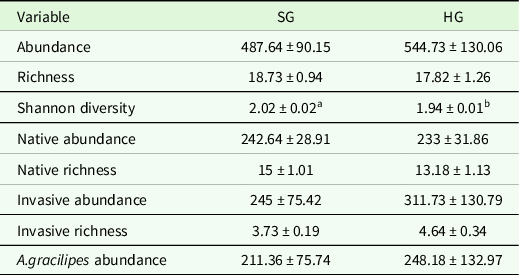
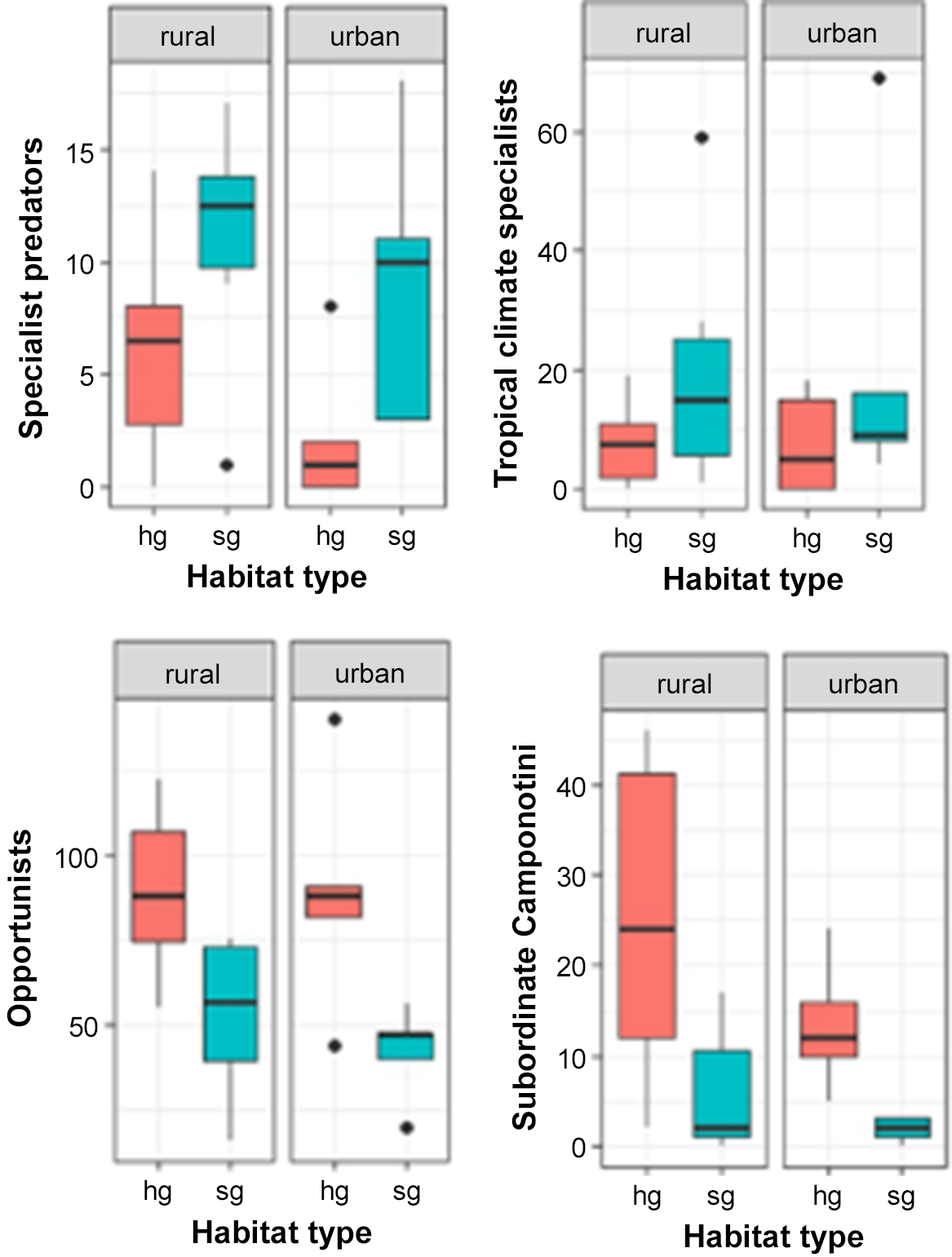
The abundance and richness of overall ants and abundance of various ant functional groups, but Opportunists (F 1,18 = 14.94, p = 0.001), Specialist Predators (F 1,18 = 6.74, p = 0.02) and Subordinate Camponotini (F 1,18 = 11.44, p = 0.003) were similar on SG and HG sites (Table 1, Table S2, and Figure 2). The Opportunists and Subordinate Camponotini were abundant on HG over SG. The Specialist Predators were abundant on SG over HG. Tropical Climate Specialists were higher on SG over HG, but the difference was only marginal (F 1,18 = 2.898, p = 0.10). Shannon diversity of ants was significantly higher on SG than on HG (F 1,18 = 15.2, p = 0.001). The average proportional trap incidence of ant species on SG (0.09 ± 0.01; mean ± SD) and HG (0.08 ± 0.02) was similar (p = 0.52). The LCBD on abundance (p = 0.31) and incidence data (p = 0.51) was similar on SG and HG. The proportion of unique species despite was similar on SG and HG (p = 0.31), the interaction of habitat by landscape type had a weak effect on the proportion of unique species (F 1,18 = 3.72, p = 0.06); the rural SGs consisted of more unique species than the other three site types (urban SG, rural HG and urban HG). Only the abundance of native ants was weakly predicted by the three-way interaction of A. gracilipes abundance, habitat, and landscape (F 1,14 = 3.28, p = 0.09).
Diversity measures of ants in habitats and landscape types. Mean ± SE per site are given. The significant differences between paired values are indicated by different alphabetical characters in superscript.

Abundance of four functional groups of ants in sacred groves (SGs) and home gardens (HGs) in rural and urban landscapes. While Specialist Predators and Tropical Climate Specialists were higher in SGs over HGs, the Opportunists and Subordinate Camponotini were sampled more in HGs than SGs.

Anoplolepis gracilipes’s abundance on sites did not affect the richness or abundance of native ants and ant functional groups (Figure S2). However, A. gracilipes often gave contrastingly different effects on native ants’ richness and abundance, and abundance of various ant functional groups in SG and HG sites. For instance, the population of Generalist Myrmicinae increased with the population of A. gracilipes on SG (R 2 = 0.26, F 1,9 = 4.65, p = 0.059), but had hardly any effect on HG (p = 0.6). The population of Cryptic Species decreased, despite weakly, with the population of A. gracilipes on SG (R 2 = 0.17, F 1,9 = 3.07, p = 0.11), but was not affected in HG (p = 0.7; Figure S3). Similarly, the abundance of overall native ants seemed to have increased with the abundance of A. gracilipes in SG (R 2 = 0.06, F 1,9 = 1.7, p = 0.2), but unaffected in HG (Figure S3).
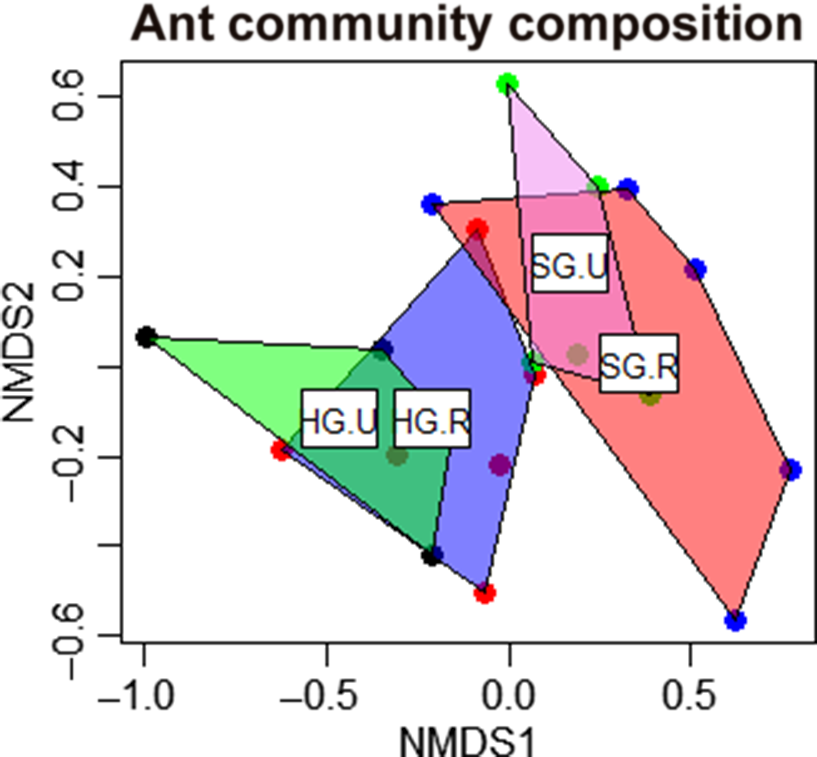
The NMDS plot showed that the two habitats have dissimilar ant communities (PERMANOVA: R 2 = 0.11, F 1,21 = 2.27, p = 0.031), which, however, were not further grouped by the landscape type (R 2 = 0.03, F 1,21 = 0.45, p = 0.87) (Figure 3). The interaction of habitat by landscape did not significantly influence community composition of ants (R 2 = 0.04, F 1,21 = 0.87, p = 0.54) (Figure 3).
Non-matric multidimensional scaling shows that habitats (SG and HG sites), irrespective of their landscape, are closer on ant community composition.

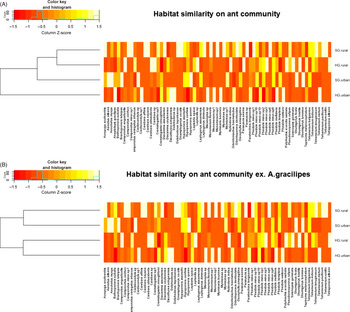
The abundance-based β-diversity estimation suggested that A. gracilipes contribute the most to the β-diversity (β = 0.16). The incidence-based data, however, did not pick any species up as a crucial one to contribute to SCBD, although three species had over 50% trap incidence across sites and habitats. Although the heat maps generated two different patterns of site similarity when A. gracilipes was and was not the part of the analyses (Figure 4A & B), the resultant distance matrices of the sites were correlated (Mantel r = 0.63, p = 0.04), suggesting that A. gracilipes had only a weak effect on the site distances on ant community.
Heat maps and dendrograms show site similarity of sacred groves and home gardens of rural and urban landscape when A. gracilipes was included (A) and not included (B) in the analyses. Trap average ant abundance of species in sites was used in the analysis. The colour palette is based on the z-score of ant abundance; the lighter the colour, the species is abundant; the darker the colour, the species is less abundant.

Except a weak positive correlation observed between species richness and abundance-based LCBD (R 2 = 0.10, F 1,20 = 1.45, p = 0.16), no species or site traits influenced β-diversity of ants. The LCBD on both the abundance (p = 0.9) and incidence-based ant community data (p = 0.6) was unrelated to the abundance of A. gracilipes on sites. In the overall data, two rural sites – Periyanganam (β = 0.15; p = 0.05) and Kammadam 1 (β = 0.13; p = 0.09) – and one urban site – Cheemeni (β = 0.14; p = 0.07) – contributed the most to β-diversity of ant community. On incidence data, two rural sites, Kammadam 1 (β = 0.14, p = 0.009) and Idayilakkad (β = 013, p = 0.02), contributed the most to LCBD.
Discussion
Traditional island habitats, such as SGs, orchards, and woodlands, have immense importance for conserving biodiversity in anthropogenic habitats and urban areas (Bhagwat & Rutte Reference Bhagwat and Rutte2006; Croci et al. Reference Croci, Butet, Georges, Aguejdad and Clergeau2008; Horák et al. Reference Horák, Rom, Rada, Šafářová, Koudelková, Zasadil, Halda and Holuša2018; Melliger et al. Reference Melliger, Braschler, Rusterholz and Baur2018). In India, SGs have been repeatedly illustrated as important biodiversity hubs both in urban landscape of lowland and in forest landscape of highland of the Western Ghats biodiversity hotspot (Ray et al. Reference Ray, Chandran and Ramachandra2014; Rajesh et al. Reference Rajesh, Prashanth Ballullaya, Unni, Parvathy and Sinu2020 and references therein). Meanwhile, studies have indicated that the SGs have been either vanished or degraded in parts of South India (Osuri et al. Reference Osuri, Madhusudan, Kumar, Chengappa, Kushalappa and Sankaran2014; Prashanth Ballullaya et al. Reference Prashanth Ballullaya, Reshmi, Rajesh, Manoj, Lowman and Sinu2019). In the present study, considering litter-active ant community and their various functional groups as ecosystem indicators, we examined whether the SGs were functionally prudent as generally perceived or have deteriorated on their quality, and whether the urbanization drives the pattern of biodiversity of SGs.
Our results showed that the response to the habitat type considerably varied among some functional groups of ants, if not by the richness and abundance of overall ants. The generalists’ abundances have increased in HGs and specialists’s abundances have increased in SGs, which suggest the conservation potential of SGs. The Shannon diversity of the overall ants also was higher for SG than for the HG. However, the response to urbanization and to an interaction of habitat by urbanization was weak for most of the ant functional guilds and overall ants. Although A. gracilipes was abundant and frequently collected in traps of SGs and HGs of both rural and urban environment, it did not drive the abundance pattern of most of the ant functional groups in the overall data, but the response of certain ant functional groups to A. gracilipes abundance in sites was contrastingly different for the two habitats. The study found that the ant community of SGs was different from HGs, but not grouped further on the degree of urbanization. However, the number of unique species was collected more on rural SGs over the other three site types.
Our results suggest that the richness of species may not be a better indicator of biodiversity change among habitats in urban environment; the shift in species composition and relative abundance of dominant species, which matters, can be masked by the richness and abundance. Both HG and SG have the same number of species and individuals, which, however, was not affected by the urbanization. Adopting a multi-functional group approach, we further found that the urbanization has a little effect on ant functional groups. The no response of ant richness, abundance, and diversity in both the habitats to urbanization is in agreement with Melliger et al. (Reference Melliger, Braschler, Rusterholz and Baur2018). We began surveying ants on SGs from 2013 onwards (Rajesh et al. Reference Rajesh, Prashanth Ballullaya, Surendran and Sinu2017, Reference Rajesh, Prashanth Ballullaya, Unni, Parvathy and Sinu2020). These surveys have reported a strong temporal effect on ant community change, indicated the signs of invasion of A. gracilipes into SGs sometimes during 2013 (Rajesh et al. Reference Rajesh, Prashanth Ballullaya, Surendran and Sinu2017) and witnessed its dramatic spread from urban SGs into rural SGs over a period of 6 years (Rajesh et al. Reference Rajesh, Prashanth Ballullaya, Unni, Parvathy and Sinu2020). However, we had not parallelly surveyed ants on HGs during this period to make use of that data in the present investigation. As the population of A. gracilipes increased in SGs over time, a dramatic turnover of ant community was also noticed in SGs during this period (Rajesh et al. Reference Rajesh, Prashanth Ballullaya, Unni, Parvathy and Sinu2020). The sample of ants of SGs that we used for comparing with the fauna of paired HG sites in the present investigation was belonging to 2019 – the time when the SGs experienced the highest population of A. gracilipes ever. This must have homogenized the ant community of both the rural and urban SGs and HGs for further grouping the habitats on urbanization.
Our findings that the species with high incidence across sites and high abundance in the data can contribute significantly to the abundance-based β-diversity are in agreement with Heino and Grönroos (Reference Heino and Grönroos2017). Anoplolepis gracilipes contributed the most to the SCBD. Although the species was abundant and invasive, its weak effect on the abundance of other functional groups of ants or differential effects on degraded habitat (HG in the present study) and relatively undisturbed habitat (SG in the present study) is in agreement with other studies in the study region and other parts of Asia-Pacific region (Buczkowski & Bennett Reference Buczkowski and Bennett2008; Gómez & Oliveras Reference Gómez and Oliveras2003; Narendra et al. Reference Narendra, Gibb and Ali2011; Rodriguez-Cabal et al. Reference Rodriguez-Cabal, Stuble, Guénard, Dunn and Sanders2012).
LCBD can suggest sites that are ecologically and biologically unique and need conservation priority and management interventions (Legendre & De Cáceres Reference Legendre and De Cáceres2013). Among the 11 paired sites sampled for the present study, the rural sites have contributed mostly to the β-diversity of ant community, particularly when the incidence data were used for estimation. However, the estimations have picked different sites when abundance and incidence data were the input data, which is likely and is in agreement with Heino and Grönroos (Reference Heino and Grönroos2017). When the abundance of ants was the input data, two rural sites and an urban site (Cheemeni, the one represented in Figure 1) have contributed most to β-diversity. When the incidence data were the input data, two rural sites have contributed most to the β-diversity. The β-diversity was unrelated to both the proportion of A. gracilipes and the abundance of overall ants in sites. The two sites topped first on the abundance and incidence-based LCBD – Periyanganam and Kammadam 1, respectively – had only 18% and 12% of their respective fauna contributed by A. gracilipes. However, the second most crucial site on abundance (Cheemeni) and incidence data (Idayilakkad) had 80% and 47% of their respective fauna contributed by A. gracilipes. Our results agree with Kim et al. (Reference Kim, Bartel, Wills, Landis and Gratton2018), Heino and Grönroos (Reference Heino and Grönroos2017), Tonkin (Reference Tonkin2016), Silva and Hernández (Reference Da Silva and Hernández2014), and Legendre and De Cáceres (Reference Legendre and De Cáceres2013), who found that the β-diversity of insects has been either negatively related or unrelated to the alpha diversity.
Invasive species can destabilize an ecosystem by disturbing the populations of native species and affecting biotic interactions in communities (Berman et al. Reference Berman, Andersen and Ibanez2013; Courchamp et al. Reference Courchamp, Fournier, Bellard, Bertelsmeier, Bonnaud, Jeschke and Russell2017; Didham et al. Reference Didham, Tylianakis, Gemmell, Rand and Ewers2007). In the present study, A. gracilipes did not give a major pressure on the abundance and richness of overall native ants or on the population of any ant functional guilds. Our results, therefore, agree that the invasive ants not necessarily can be a major threat for the native ants or the ecological functions they render (Ness & Bronstein Reference Ness and Bronstein2004). For instance, the increasing population of Solenopsis invicta, an invasive to Florida, USA, did not affect the richness or abundance of natives (King & Tschinkel Reference King and Tschinkel2006). We, however, found contrastingly different responses of the abundance of native ants, Specialist Predators and Generalist Myrmicincae on the abundance of A. gracilipes in HG and SG. This is in agreement with Berman et al. (Reference Berman, Andersen and Ibanez2013), who reported contrastingly different responses of native ants to A. gracilipes in disturbed and undisturbed parts of tropical Australia.
The SG sites have 25 unique species of ants; the lion’s share of it were forest specialists including the Tropical Climate Specialists (Gnamptogenys coxalis, Aenictus aitkenii, and Dolichoderus taprobanae) and the Specialist Predators (Anochetus myops, Brachyponera luteipes, Leptogenys assamensis, L. diminuta, and Odontoponera denticulata). The HG sites also have 16 unique species that are dominated by the open habitat and tropical plantation specialists, opportunists and tropical invasive ants. Pitfalls of several urban HG sites have sampled the tropical invasive ant species, Solenopsis geminata (Lester & Gruber Reference Lester and Gruber2016). Simultaneously, several pitfall traps installed in the rural HG of Kammadam (the closest to the Western Ghats) sampled several individuals of a recently discovered Cryptic Species from the Western Ghats – Discothyrea sringerensis (Zacharias & Dharma Rajan Reference Zacharias and Dharma Rajan2004). This is the only species reported from this genus in India. Both SG and HG also had their own share of unique Strumigenys spp, another Cryptic Genus known for restricted movement and living in small colonies in the humid soil. The lion’s share of unique Tropical Climate Specialists and Cryptic Species have been sampled from the rural sites. With the exception of Acropyga acutiventris, another Cryptic Species, all other unique species sampled from SGs are represented by less than 10 individuals, suggesting their rarity in the sites. This complementarity in the number of unique species in SG and HG sites might be another reason for the SG sites to stand out from the HG sites.
In the present work, we have not compared the ant fauna of SGs with a protected forest in the region for assessing the quality of SGs for the following reasons. First, such a protected forest was not available in the near vicinity of SG–HG pairs to make the comparison feasible by minimizing the plausible effect of site. Second, the SGs themselves are protected and small fragments of natural forests, therefore the control habitat for our study. We believe that comparing its fauna with the adjoining used land is more appropriate for a fair assessment of the quality of SGs and to craft management guidelines, if required.
Concluding remarks
Endemism, species richness, and threats are the keys for identifying global biodiversity hotspots (Myers et al. Reference Myers, Mittermeier, Mittermeier, Da Fonseca and Kent2000). The same criteria may be opted for identifying and prioritizing local sites for the conservation of potential unprotected forests. The SGs are the fine-scale local ‘biodiversity hotspots’ with a high representation of endemic flora and fauna (Bhagwat & Rutte Reference Bhagwat and Rutte2006), but have been threatened by urbanization and religious modernization (Prashanth Ballullaya et al. Reference Prashanth Ballullaya, Reshmi, Rajesh, Manoj, Lowman and Sinu2019). Although the plant diversity of SGs of Kerala (Chandrashekara & Sankar Reference Chandrashekara and Sankar1998; Induchoodan Reference Induchoodan1996; Rajendraprasad Reference Rajendraprasad1995) and other parts of India are well known (see a review by Ray et al. Reference Ray, Chandran and Ramachandra2014), insects, which help the ecosystems functioning well and indicate the ecosystem health of remnant forests, have been less explored in SGs (Ray et al. Reference Ray, Chandran and Ramachandra2014). Recently, Hariraveendra et al. (Reference Hariraveendra, Rajesh, Unni and Sinu2020) showed that the prey–predator function in SG and HG paired sites was similar for arthropod predators. However, the present study suggests that the SGs of Southwestern India could be functionally different from the surrounding used lands and should be conserved. Although A. gracilipes gave no major threat on the population of native ants and the ant functional guilds, its similar population size in rural and urban SGs and among habitats is of some concern. Its effect on other invertebrates and ecological functions of SGs require further investigation.
SGs might have lost their cultural or religious importance in the present world of religious modernization (Prashanth Ballullaya et al. Reference Prashanth Ballullaya, Reshmi, Rajesh, Manoj, Lowman and Sinu2019), but still function as a natural monument and sanctuary, and preserve lore and culture of ancient people and conserve biodiversity that can give necessary clues for biogeography and the land-use history of the Western Ghats. The state of Kerala recently initiated a flagship programme to create green islets in cities and towns in order to mitigate the pollution level in cities, towns, and villages, and to create habitat for urban wildlife. We urge the concerned state governments to consider the SGs in their jurisdiction as important natural monuments and conserve them as natural sanctuaries in a participatory manner.
Acknowledgements
We thank the two anonymous reviewers for giving valid and constructive comments on the previous versions of the manuscript, which improved the manuscript substantially. TPR and KM would like to thank the E-Grantz Doctoral fellowship from the State of Kerala. UPB would like to thank a Ph.D. fellowship from Kerala State Council for Science, Technology, and Environment. PAS would like to thank the Science Engineering Research Board for supporting this research.
Supplementary material
To view supplementary material for this article, please visit https://doi.org/10.1017/S0266467421000134