1 Introduction
Expressing oneself fluently and appropriately in oral interaction is a very important goal of language instruction (Payne and Ross, Reference Payne and Ross2005); however, teaching speaking has undoubtedly lagged behind other linguistic skills. According to Bardovi-Harlig and Salsbury, “it is time to make the study of speaking a major source of data. Communicating with someone – especially speaking to someone – is such a basic function of language that it is remarkable that it is not better represented in the interlanguage pragmatics literature” (2004: 199).
Perhaps one reason why conversation has not had an adequate pedagogic treatment is the tacit assumption that conversation could not be taught: “you learn to speak by speaking”. With hindsight, we can see that the teaching of conversational competence has mainly concentrated on output processing and on promoting fluency through well-known communicative activities. And although in the last two decades we have learnt that authentic input is an essential requirement in achieving conversational competence, the importance of authentic exposure to oral interaction has very often been missing. Indeed, listening and speaking is a two-way system through which communication is achieved (Oprandy Reference Oprandy1994). As Belasco (Reference Belasco1967: 112) affirms:
The key to achieving proficiency in speaking is achieving proficiency in listening comprehension. The day when the average foreign language student overhears a conversation between two or more native speakers and has no difficulty in understanding what is being said is the day when [s/he] will be well on the way to developing linguistic competence. To say it right, one must learn to listen.
In fact, input processing is essential in listening comprehension and ultimately in communicative competence (Tschirner, Reference Tschirner2001), and therefore it should play a major role in foreign language (FL) classes. However, comprehension and expression have hitherto not been treated in internal relation to one another but as independent constructs, which may explain why the field of oral communication has moved so slowly. This paper aims to highlight the interrelationship between listening and speaking as a prime site for innovation and development of conversation. In order to provide live data, we intend to make use of multimodal texts to expose learners to authentic learning environments so that they can interpret the pragmatic and semiotic variables of the social context.
2 The importance of context in oral comprehension
Oral understanding has been defined as “the process of receiving, attending to and assigning meaning to aural stimuli” (Wolvin and Coakley, Reference Wolvin and Coakley1985: 74), and one of the most obvious implications of this definition is that understanding is not just the perception of sounds, words, clauses or sentences but other things as well, such as broad contextual clues and internal schemata – background knowledge (Oxford, Reference Oxford1993). Hence it is widely accepted now that the more we know about understanding oral interactions from a cognitive, socio-cultural and semiotic perspective, the more teaching and learning will benefit insofar as comprehension can only occur when the conversant puts what s/he hears in context, i.e. the knowledge of who the participants are (sex, age, personality, relationship), the setting (where the linguistic situation takes place), the topic (the thing you are talking about) and even the purpose (what language is used for) (Byrne, Reference Byrne1986). The idea of “context”, which has caused a real revolution, first in mainstream linguistics and then in ELT, is widely recognized as one of the most influential concepts in the last century. In relation to oral understanding, accumulated work on the process of listening (Brown and Yule Reference Brown and Yule1983) suggests that comprehension can only occur when the listener places what s/he hears in context. As Halliday and Hasan ([Reference Halliday and Hasan1985] 1998: 52) stated: “text and context are so intimately related that neither concept can be enunciated without the other”.
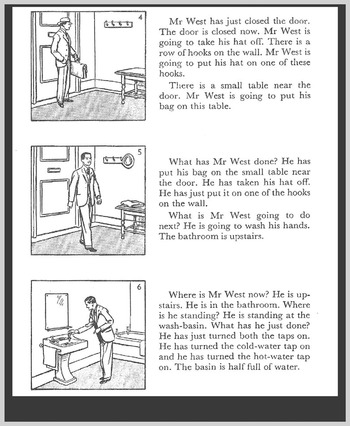
In Second Language Acquisition (SLA), we find that the process of conceptualization is very similar to that of First Language Acquisition (FLA). In the past forty years, applied linguists and teachers of English have emphasized the importance of understanding language in context. But in ELT, the emphasis was placed first on the concept of situation. This idea has been present all through the history of language teaching, beginning with St. Augustine and Comenius who realized the importance of the situation for teaching languages (Brown, Reference Brown1998). In the 1940s the situational method of Hornby was widely used (Brown, Reference Brown1998) and his idea was to associate the situation with the language forms (Hornby, 1954 see Figure 1). The student was presented with language through set situations such as ‘Mr. West at Breakfast’, ‘At the office’, etc. This approach assumed that there was a relation between context and the language. So students would recognize the context and then provide the language.
Hornby’s situational method: The Adventures of Mr. West (Hornby, 1954: 38)

In the sixties and seventies, deriving from the audiolingual tradition, the emphasis was placed on bottom-up processing, and hence little attention was paid to context. In the eighties, according to Garrod (Reference Garrod1986), borrowing from the fields of cognitive psychology and artificial intelligence, it was then acknowledged that top-down processes which involve context and schemata were crucial for understanding (Brown, Reference Brown1986). It was then argued that understanding requires some mental representation in order to translate phonetic and linguistic input into more abstract semantic knowledge which will eventually be stored in our memory; what is really retained after understanding is not the literal meaning but some mental representation mainly provided by contextual information (Garrod, Reference Garrod1986). Hence it has become quite clear that in giving students comprehension activities out of context we set them a difficult task (Brown, Reference Brown1986).
Thus, the relation between context and the teaching of the listening skill has run pari passu with the general ELT situation. Basically, there have been two trends for teaching oral comprehension: 1) context-free comprehension, that is, utterances in a contextual vacuum; and 2) embedded-context comprehension, i.e. listening within context (Garrod, Reference Garrod1986). In recent approaches, and particularly in the communicative approach, the current belief is that it is impossible to place sentences without context, to divorce form from function. It is for this reason that communicative competence is defined as the ability to use the language in the context of the situation. It is now generally accepted that language is not as a purely linguistic system but a way of using linguistic elements in a concrete setting.
After having analysed the situation of context in ELT, we can conclude that even though it has been proven by linguists that context plays a central role in the processes of understanding, and thus in the processes of meaning-making, there have not been serious attempts to provide students with natural contexts that illustrate the real target community and embody the attributes of oral interaction. This is even more inexcusable in the listening class when new technological advances can easily provide context to the listening experience. There is considerable potential for researchers, textbook designers and teachers to take advantage of the new millennium DVD technology for embedding context in understanding and interpreting oral interactions as a fundamental prerequisite for improving students’ productive conversational skills. This task will be our concern in what follows in this paper.
3 Approaches to teaching conversation: a multimodal approach
Since the advent of Communicative Language Teaching (CLT) in the late sixties, the conversation class has focused on promoting fluency through interactional activities with the idea of providing learners with opportunities to use the language fluently and creatively (Richards, Reference Richards1985). This was called the “indirect” approach and was part of the underlying philosophy of CLT: conversational competence was not taught explicitly and directly but, on the contrary, it was acquired implicitly by the act of involving students in interaction through a vast number of productive tasks such as roleplays, simulations, story-telling, information-gap, jigsaws, information transfer activities and so on (Bygate, 1987; Klippel, Reference Klippel1983; Pérez Basanta and Rodríguez Martín, Reference Pérez Basanta and Rodríguez Martín2006). However, the assumption that focus should be placed on meaning over form, and on fluency over accuracy and appropriacy (Hadley, Reference Hadley2002) has been questioned in the last two decades (Long, Reference Long1991; Batstone, Reference Batstone1994; Skehan, Reference Skehan1996, quoted in Hadley, Reference Hadley2002). Johnson (Reference Johnson1992: 180, quoted in Metcalf, 2003) contends that meaning-based activities per se may accelerate language progress but in the long term lead to “fluent-but fossilised students”. In the same vein, it is argued that you do not “learn to speak by speaking”, even if the communicative goal is achieved by strategic competence (Metcalf, Reference Metcalf2003). On the other hand, Johnson (Reference Johnson1992: 180, quoted in Metcalf, 2003) reveals that if there is no concern for feedback in terms of linguistic correctness, you bring about “inaccurate chatterers” who become “hapless victims of their own success” since if you produce incorrect language without any negative feedback you tend to fossilise (Metcalf, Reference Metcalf2003).
Another shortcoming has been a lack of teaching materials which embody the attributes of oral interaction, or ‘real English in real situations’. According to Carter and McCarthy (Reference Carter and McCarthy1995), there is available evidence pinpointing a lack of fit between conversational data and textbooks. It is still common practice in ELT that, instead of promoting samples containing real conversational features, textbook conversations use artificial scripted dialogues based on someone’s intuitions about what people are likely to say or in most cases drawn from written language. To our knowledge, this is mainly due to the unnoticed fact that “texts are becoming increasingly multimodal: employing visual and verbal (and aural) semiotic modes simultaneously” (Goodman, Reference Goodman1996: 72).
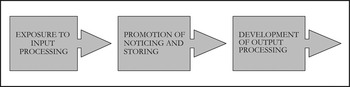
Therefore, we intend to consider how a multimodal approach can be used for raising students’ awareness of the importance of contextual factors in creating meaning. Our contention is that if we train students in authentic input, direct their attention to noticing and storing forms and meanings in context (Long, Reference Long1991) and finally encourage them to generate oral interactions through output processing (Swain, Reference Swain1985), they will become better listeners and eventually enhance their conversational proficiency. In graphic terms, this is the model we propose (see Figure 2).
Model for enhancing conversational competence

This paper will only deal with input enhancement as an essential aspect of developing conversational competence. As Van Patten (Reference Van Patten1994) argues, tasks which promote the premature production of language may be less effective than those aiming at the processing of input.
To illustrate this new pedagogic approach, we will report in detail on decisions taken from a three-fold perspective: (a) selection of texts taken from films and the benefits of using DVDs; (b) development of a multimodal analysis of film clips for the design of activities; and (c) promotion of a conversation awareness methodology through a bank of DVD clips to achieve an understanding of how native speakers actually go about the process of constructing oral interactions.
4 Selection of texts taken from films and the benefits of using DVDs
As previously mentioned, texts are no longer monomodal (Lemke, Reference Lemke1992); thus meaning is not created exclusively through one semiotic system, traditionally the linguistic code, but different semiotic resources together with contextual features interact in order to contribute to the whole business of meaning-making. Multimodal texts “combine and integrate the meaning-making resources of more than one semiotic modality – for example, language, gesture, movement, visual images, sound, and so on – in order to produce a text-specific meaning” (Thibault, Reference Thibault2000: 311). As a result, teachers cannot teach conversation, which is by nature multimodal, with monomodal materials. To provide such materials we created a database of DVD texts from various sourcesFootnote 1. These extracts have mainly been taken from films and have been transferred into computer-readable files to make them operational for visual display. Due to space restrictions, we cannot explain here in detail all the technical requisites for constructing these DVD extracts, which basically involve a computer, some movies, and a software package for segmenting the clips and converting them into computer-readable files.
One point of concern which should be noted is the use of language in films. One can argue that films might be considered informal, unstructured language of everyday use (Walker, Reference Walker1999). But a film embodies the most common features of conversation in that it “was made by native speakers for native speakers to hear, and so consists of authentic language” (Baddock, Reference Baddock1996: 20). The following arguments also support this standpoint. First, from a purely pragmatic point of view, “everything that happens between characters on-screen has to be depicted in such a way that is recognizable as a valid form of social interaction in a certain situational and cultural context” (Baumgarten, Reference Baumgarten2003: n.p.). Second, studies of audience behaviour have revealed that the elements of films which viewers most identify with are the words, phrases and the manner of speaking on-screen (Kozloff Reference Kozloff2001, quoted in Baumgarten Reference Baumgarten2003). Third, film discourse mimics face-to-face communication and thus provides contextual features of everyday conversation (Pérez Basanta and Rodríguez Martín, Reference Pérez Basanta and Rodríguez Martín2006). Finally, Buck (Reference Buck2001: 85) endorses the view that authenticity can either be “taken from the target-language use situation or [have] the characteristics of target-language use texts”.
In this particular research the use of films will be implemented through DVDs. The advantages of using digital video as a tool for language teaching and learning are widely accepted in ELT. With the emergence of DVDs it is assumed that media can and does enhance language teaching by bringing the outside world into the classroom, and making the task of learning a more meaningful and exciting one (Pérez Basanta, Reference Pérez Basanta1997). Let us consider some further benefits of using DVDs:
(a) Digital video can be controllable by the learner in a way hitherto only possible with written language (Tschirner, Reference Tschirner2001). Learners can select features of a particular film, “read” communicative situations and reflect on relevant features, move back and forth, make pauses, slow down, etc. In this way they can unveil more layers of pragma-linguistic and semiotic meaning (ibid, 2001).
(b) Authenticity: films can be replicas of real-life people and real-life situations, and utilize real-life language. In this respect, we give students access to the way native speakers talk in real everyday situations: “the dream of every language teacher” (Kramsch and Andersen, Reference Kramsch and Andersen1999: n.p.).
(c) Digital video films provide learners with all semiotic modalities which may be used in oral exchanges, such as gestures and body language, facial expressions, music, etc., and make students aware of the way language interacts with other sign systems (Kress and van Leeuwen, Reference Kress and van Leeuwen1996). In addition, digital video clearly portrays the context of situation and the context of culture.
(d) Sociolinguistic and pragmatic level of language: digital video shows the sociolinguistic and pragmatic level of language (Pérez Basanta, Reference Pérez Basanta1997). From a sociolinguistic perspective video shows the sociocultural elements of language and the subtleties of register. Native speakers will vary the register of what they say, depending on what they are saying, or to whom they are talking or their moods or their speech intentions.
(e) Promoting real vocabulary acquisition: presenting and learning words in context is a vital factor for learnability. Knowing a word means knowing its grammar, pronunciation, meaning and function. In this sense, learners can grasp the pronunciation, the grammar, or the different levels of meaning (contextual, metaphorical, colloquial, connotational, denotational, pragmatic and even epistemological meaning).
(f) Motivation, interest and confidence: the use of DVDs is an attractive and compelling way of teaching that has great potential for motivating students. Interest grows when language is experienced in a lively way. The combination of different semiotic systems can present language more comprehensively and realistically than any other medium. According to Lonergan (Reference Lonergan1984), a video sequence is a ‘slice of real life’. Linked to this is the key word ‘confidence’. Alongside motivation, the development of confidence is a crucial prerequisite for language learning.
(g) Active involvement and participation: video watching can be a wonderful springboard for promoting active involvement. Video is a good means of fostering oral production (Pérez Basanta, Reference Pérez Basanta1997).
The different points described above have frequently been discussed in second language teaching forums. However, the novelty of our approach is not the benefits of using DVDs on their own, but the use of digital video as text. In terms of the interface between video and multimodality, films build a perfect relationship between visual/verbal and contextual elements of communication (Goodman, Reference Goodman1996). We no longer focus on the linguistic code exclusively, but in relation to the different semiotic modes of conversation and its context. But the problem with context and ELT “is that […] it cannot be learned, it can only be experienced” (Kramsch and Andersen, Reference Kramsch and Andersen1999: n.p.). Thus in order to make context learnable, it needs to be transformed into analyzable text and quite obviously the best way is to make use of digital video (ibid). By using digital technology we can obtain chunks of films, which can be visualized, analysed, interpreted, and so on and so forth as many times as wanted, in order to portray the real context of conversations.
5 Multimodal analyses
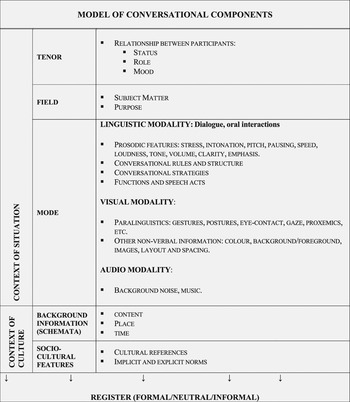
If we accept that clips of DVDs are texts, and if we want to give them to learners so that they can experience context, a systematic framework for the analysis of context in multimodal materials is required. Multimodal texts, in particular digital video, cannot be analysed using the traditional descriptive systems. A multimodal analysis “[is itself a form of analysis: it is a textual record of the attempts we make to systematize and unpack the codeployment of the semiotic resources and their unfolding in time as the text develops” (Baldry and Thibault, Reference Baldry and Thibault2006: xvi). Hence, building upon the theoretical insights discussed above, we have designed a working framework (see Figure 3) to compile a bank of film clips together with their corresponding multimodal analyses (see Appendix 1 for an example). By means of this bank of materials, teachers can create activities that may assist students to unveil the multimodal layers of meaning and interpretation in oral interactions.
Model of conversational components

In Figure 3, we distinguish three main parameters for describing context in film clips: context of situation, context of culture, and register. These are examined in more detail below with examples from Appendix 1, an extract taken from the film Sabrina (1995).
5.1 Context of situation
It is widely-acknowledged that you cannot understand language outside of a social context and without taking into account its effect on the audience. This firmly entrenched view that context is paramount in interpreting social interactions, brings us back again to the interpretation of the “tenor”, the “field” and the “mode”.
The “tenor” is concerned with the participants involved, their status, their relationship, etc. The DVD clip we have analysed in this study illustrates a situation where there are two participants: Linus, a tycoon who invites Sabrina, the once-plain chauffeur’s daughter who now appears as an attractive and spontaneous woman, to one of his exclusive and luxurious properties in Martha’s Vineyard. In terms of the “field”, i.e. subject matter and purpose of the conversation, this clip presents a scene where Linus subtly tries to woo Sabrina exclusively for business purposes. Concerning the “mode”, it involves the way the language is being employed and which modality is used. In this regard, we can think of three basic modalities: linguistic, visual and audio. We will examine them in detail in the following paragraphs.
5.1.1 The linguistic modality comprises at least four different issues
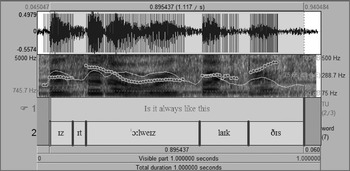
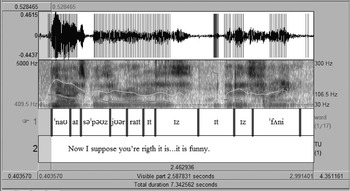
(a) Prosodic features – stress, emphasis, pitch (and pitch range), intonation, pausing, tempo, loudness, clarity – provide crucial information about speaker’s attitude (polite, annoyed, apologetic, impatient, aggressive, dogmatic, overbearing). For example, in the aforementioned clip of Sabrina, we come up with phonological features – with the help of a technological device called PRAATFootnote 2 – which prove highly informative in terms of the interface between phonology and pragmatics: Sabrina’s voice quality is high pitched and loud, with changing tones (rising, falling and rising-falling) (see Figure 4), and an accelerated tempo with hardly any pauses. In sum, these features reveal a lively attitude and self-confidence. On the contrary, Linus presents a low pitched voice accompanied by a narrow pitch range and a level tone (see Figure 5), with mostly slow tempo and an abundance of pauses and hesitation phenomena. This seems to imply detachment, and a tentative and shy attitude, even suggesting a certain degree of sadness.
Fig. 4Sabrina’s fall-rise intonation
 Fig. 5
Linus’ level intonation
(b) Conversational rules and structures imply the way conversation is organised (Dörnyei and Thurrell, Reference Dörnyei and Thurrell1994). Contrary to what was traditionally accepted, conversation is not random and unstructured (Bygate, Reference Bygate2001) but a very fixed construct. Hence, it is particularly important for students to notice these ritualistic aspects manifested in this DVD clip in a number of ways such as interruptions (L: No, wait, not me), adjacency pairs (S: What is exactly the right word? – L: I don’t know, uhm…lonely, maybe) and closings (L: Come on, let’s get the outside). Other aspects to consider in different extracts could be openings, turn-taking, backchannels, topic-shifts, etc.
(c) Conversational strategies “are invaluable means of dealing with communication ‘trouble spots’ such as not knowing a particular word, or misunderstanding the other speaker” (Dörnyei and Thurrell, Reference Dörnyei and Thurrell1994: 44). Undoubtedly the mastery of these strategies is essential for achieving fluency. These techniques involve paraphrasing, appealing for help, asking for repetition, downtoners, etc. As previously mentioned, in this clip their speech provides an excellent illustration of many of these conversational features, such as hedges (L: No, I suppose you’re right), repetitions and hesitation devices (L: I guess I…I (…) I guess) or fillers (L: Er…Gee, I don’t know. I guess I…).
(d) Speech acts have been defined as “functional units in communication” (Cohen, Reference Cohen1996: 384). In terms of teaching/learning, we should also note the fact that equipping learners with speech act knowledge is paramount, since it is not easy to acquire pragmatic competence without direct instruction (Cohen Reference Cohen1996). Some examples of speech acts in the extract are: asking for information (S: Are you depressed?), agreeing (L: I suppose you’re right), suggesting (S: You could always hire somebody), apologising (L: Oh, I’m sorry. I made you uncomfortable), etc. (See Appendix 1).


5.1.2 The visual or semiotic modality
can tell a lot about what others feel and try to communicate. This nonverbal level embodies: gestures, postures, facial expressions, eye-contact, gaze, etc. – and other elements such as colour, background/foreground, images, layout and spacing. Understanding these semiotic data might contribute to a deeper understanding of language and its culture. Although we are often unconscious of these signals, it would be highly commendable to train learners to recognize and interpret signals which transmit crucial feelings such as: openness, confidence, cooperation, readiness, indifference, boredom, evaluation, interest, doubt, suspicion, secretiveness, anxiety, frustration, anger, defensiveness, self-control, inner conflict, superior and subordinate, flirtation, courtship, etc. In this extract, for example, proxemics and eye-contact are particularly noteworthy, as the distance that both participants keep during the whole conversation is compensated by the deep eye-contact established at some points.
5.1.3 The audio modality
has to do with the environmental clues – background noise or music. In our clip, one of the most noticeable sounds is that of the seagulls coming from the sea, a noise which emphasises the contextual situation and reinforces the idea of a peaceful and secluded setting.
5.2 Context of culture
Cultural knowledge is essential for communicative competence, since language is not only the linguistic encoding or decoding but it is grounded in a set of background assumptions – shared schemata (Wilson, Reference Wilson1994) – together with implicit and explicit norms of cultural behaviour. A broad base of opinion in Applied Linguistics supports the notion that language and culture are intertwined and, therefore, you cannot understand language without its culture or “its way of life”: how individuals live, think, feel, and how they act (Stern, Reference Stern1992). In our model, we have distinguished between background information, i.e. schemata (pre-history of the linguistic event in terms of content, place and time) and socio-cultural features, i.e. those elements which embody cultural references and the implicit and explicit norms of cultural behaviour. Thus, in order to make the most of the extract taken from Sabrina, learners need to be introduced to the cultural aspects which are present in the story. It would therefore be useful for them to know that the film portrays the story of Sabrina, Larrabee’s chauffeur’s daughter, who after two years in Paris, comes back home now as an attractive young lady who is unknowingly putting Linus Larrabee’s terribly profitable business at risk. Linus tries to woo her, with the intention of keeping his business running. The story, which is set in the wealthy Larrabee estate during the 1990s, is a fair reflection of the gap between social classes.
5.3 Register
Register is defined as a subset of language used for a particular purpose or in a particular social setting. It should be contemplated as an all-subsuming category in that it includes aspects of context of the situation – field, tenor, and mode – and variables of context of culture. In this way, it is the predictor of the formality of language and it is often described on a formality scale:

In our particular clip and taking into account all that has been previously mentioned, we can easily predict that the register employed is predominantly formal and detached, as a consequence of social and personal distance.
To summarise, mainly drawing on systemics, this multimodal analysis makes it possible to examine the behaviour of the conversational features established in the above taxonomy, and thus to exploit texts which contain representative occurrences of natural conversation from which the learner can make generalizations about the way language behaves (Rundell, Reference Rundell1995). As aforementioned, an illustration of this is provided in the prototype multimodal card included in Appendix 1, containing the most significant parameters for the analysis of each DVD segment.
6 The promotion of a conversation awareness methodology
As we have seen, the teaching of listening has not hitherto been developed to improve students’ conversational competence, and neither have learners been instructed to carefully observe the different meaning-making devices used by native speakers in the process of interaction.
Contrary to traditional trends in the teaching of conversation, Nolasco and Arthur (Reference Nolasco and Arthur1987) argue that the first priority in developing conversation is the fact that students need to be conscious of how native speakers achieve conversational competence in the target language. A methodology that promotes awareness-raising activities is thus “useful for exposing students to the pragmatic aspects of language, and provide them with analytic tools to further their pragmatic development as the need arises” (Eslami-Rasekh, Reference Eslami-Rasekh2005: 207). This methodology will not be targeted at direct instruction but at promoting awareness of natural communication. The rationale behind it is that by exposing students to authentic language in use we challenge them to observe and induce patterns and generalisations by themselves (Van Lier, Reference Van Lier2002).
This research study will reach completion with the design and implementation of activities. However, this aspect is beyond the scope of this paper. Interactive activities to be delivered through an online course will be drawn from the DVD bank described above and will be further exploited, taking on board the particular features of each clip. The multimodal analysis will be the basis for developing these tasks that will be consequently designed in a more informed and systematic way. In practical terms, the procedure will be as follows: learners are to first visualise a digitized video clip online, reflect on the language and complete tasks that will hopefully encourage them to identify all those pragma-semiotic features considered in the multimodal framework.
7 Conclusion
The starting point for this paper is the contention that input processing plays an important role in the enhancement of general communicative competence and, in particular, in speaking competence, and also that context is an essential pillar upon which oral input processing is built. In our opinion, there is also an urgent need to reconsider the design of oral materials which have been used in traditional classes so as to find space for the introduction of multimodal texts, such as DVDs, in order to plunge learners into the world of native speakers. Thus, we are designing a database of video segments or multimodal texts taken from film input so that teachers and learners can better understand spontaneous speech behaviour. In this respect, we firstly explore the context of situation: the “tenor” (who is involved, relationships, status, etc.), the “field” (subject matter, purpose) and the “mode” (how the language is being employed and which modality is used) alongside the linguistic, visual and audio modalities, which in turn are subdivided into other components (prosody, conversational structures and strategies, speech acts, paralinguistics, non-verbal information, etc.). Secondly, we examine the context of culture bringing to the fore cultural references and the implicit and explicit norms of social behaviour and register. This analysis should be accompanied by an awareness-raising methodology, so that learners can reflect on how native speakers achieve communication by being fully aware of the different layers which make up conversational competence.
Finally, this research is still at an early stage of development, and more work should be done to validate this new multimodal approach which aims at promoting a better understanding of how native speakers go about the process of constructing oral interactions.
Acknowledgement
We wish to thank Dr Ángel Rosado García for his invaluable help in the phonological analysis.
Appendix 1