INTRODUCTION
Legal institutions have given scholars a range of empirical sites and phenomena to dissect patterns of stratification and mobility. One prominent strain of this scholarship has been the problematic dominant narrative of professional identity (Mertz Reference Mertz2007; Sommerlad Reference Sommerlad2007; Pearce, Wald, and Ballakrishnen Reference Pearce, Wald and Ballakrishnen2015), and a focus on minority actors and their identity negotiations within professionalization sites (Costello Reference Costello2005; Moore Reference Moore2008; Pan Reference Pan2017). In this Article, we use data on the experiences of a group that traditionally has not been recognized as a minority group—international students in American law schools enrolled in the Juris Doctor (JD) program—to reveal the ways in which the emphasis and negotiation of minority identities reproduce hierarchy.
Law schools long have been seen as seminal to the process of professional socialization (Kennedy Reference Kennedy1982; Costello Reference Costello2005; Mertz Reference Mertz2007) and, in the case of international students, the context of JD programs offers a particularly illuminating site to study minority identity formation. Unlike postgraduate law programs that have developed to cater to international students, like the Master of Laws (LLM) and the Doctor of Juridical Science (SJD),Footnote 1 the JD program historically has been considered a “domestic” and mainstream law degree. It is within this insular context that we ask the following interrelated questions: How is the identity of an international student created and sustained? And how do we understand the significance of this new identity group from the perspective of its members? We expect the answers to these and subsidiary questions to complicate our views about law school stratification and clarify our understanding of inequality in elite educational settings more generally.
Drawing from interview data with fifty-eight international JD students across seventeen graduating US law schools, as well as supplemental data from law school faculty and administrators, we suggest that there are several distinct ways in which being international in an American law school matters to the experience of these students. As one would expect, we find that interactions with peers as well as perceived “fit” within sites in which they are embedded (classrooms, student groups, study groups, etc.) shape these experiences. More importantly, we find that students with outward similarities navigate this international status differently. In our study, being international attached itself to a student’s identity in both assimilatory and isolating ways: a difference that was seen as “cool” in one student could be seen as “unrelatable” in another. Furthermore, while this identity-making involved interactions with peers and superiors, assumptions made about students by those with whom they interacted oftentimes had nothing to do with students’ formal citizenship. As a result, there were both students who technically were US citizens but were perceived as “international,” as well as those who were technically international (i.e., were attending the school on a student or research visa) but perceived as “not different.”
We use these variations of assimilation and exclusion as layers to capture the complex reality of being international in a setting that traditionally has been exclusionary to this category of student. The population of international students has been understudied, despite being a growing minority demographic. We begin with a discussion of what it means to be international in the JD program. Next, we describe how the JD program also often offered an inherent promise of an alternate identity: for many international students, enrollment in this program, at least at the outset, offered a chance at differentiating themselves from a predetermined international identity that attached firmly to those who chose the more “typical” international route of a postgraduate US law degree. But this assimilatory logic, while fairly universal, did not lend itself equally to all international students. While some students were able to inhabit their international identities without much repercussion (and in the odd case, even with advantage), others could not escape its implications. Finally, to unpack the experience of this marginal identity of being international in a mainstream law program, we borrow from Erving Goffman’s (Reference Goffman1963) concept of stigma and suggest that the interaction of students’ self-perception with their reception by others shaped the ways in which their environments were experienced. While Goffman’s theory initially was put forward to understand the lived realities of traditional social outliers with abject difference, it since has been used as an important lens to understand the social encounters of a range of minorities in high status institutional settings. Central to this work—and to the extensions that have followed it—has been the management of identity by the individual within a given social setting. In this Article, we use this theoretical framework as one entry point to understand identity creation and preservation by this growing and understudied US law school minority demographic.
MINORITY EXPERIENCES IN US JD PROGRAMS
Empirical accounts of the legal profession have been especially important for understanding institutional constructions of inequality around axes of gender and sexuality (e.g. Menkel-Meadow Reference Menkel-Meadow1988; Homer and Schwartz Reference Homer and Schwartz1989; Guinier, Balin, and Fine Reference Guinier, Balin and Fine1997; Yoshino Reference Yoshino2007), race and ethnicity (Wilkins Reference Wilkins1998; Carbado and Gulati Reference Carbado and Gulati1999; Pearce Reference Pearce2004), and class (Pipkin Reference Pipkin1982; Granfield Reference Granfield1991; Manderson and Turner Reference Manderson and Turner2006; Grover and Womack Reference Grover and Womack2017). Legal education, in particular, historically has been an important context to track and reproduce race and class privilege (Auerbach Reference Auerbach1976; Bourdieu and Passeron Reference Bourdieu and Passeron1977; Moran Reference Moran1985; Abel Reference Abel1989; Wilkins Reference Wilkins1993; Costello Reference Costello2005; Jewel Reference Jewel2009). In her seminal book about the “language” of law school, Elizabeth Mertz (Reference Mertz2007) argues that much of this reproduction is under the employed guise of meritocracy: a set of institutionalized thought and speech processes that have led students and professors alike in US law schools to truly trust their “superior analytical ability” (Reference Mertz2007, 98). In a similar vein, Moore and Bell (Reference Moore and Bell2011) argue that elite US law schools, often by employing structures of merit, facilitate the reproduction of existing hierarchies without explicit animosity to a diversity discourse. In turn, these institutionalized frameworks systematically disenfranchise outsiders and newcomers within these spaces, culminating in what is now dubbed the “least diverse profession” (Rhode Reference Rhode2017). To better understand the hegemonic processes that produce inequality within the legal profession, scholarship has started to focus on the ways in which professional socialization and minority experiences produce unequal career outcomes (e.g. Fontaine Reference Fontaine1995; Wilkins and Gulati Reference Wilkins and Gulati1996; Moore Reference Moore2008).
Class background and immigration status, for example, were identified by Pipkin (Reference Pipkin1982) in his early study on part-time law students as key determinants in whether a student attended law school full time. Granfield’s research (Reference Granfield1991) is more forthright with its claim about the marginalization of students on the basis of social class: non-elite students are intimidated, deal with more stress, and generally feel alienated within elite law schools. To lessen the tension and avoid being judged by their social status, many students manage and adjust their identities (e.g. by “passing” through attire and speech). Granfield suggests that legal education demands from these students not just educational skills, but also new kinds of social, cultural, and psychological capital. Similarly, scholarship on gender in the law school setting repeatedly confirms that women, despite their general parity in grades (Jacobs Reference Jacobs1972), have lower self-confidence, participate in classrooms much less than their male counterparts, and generally are excluded from formal and informal spaces within the law school (Fisher Reference Fischer1996; Guinier, Balin, and Fine Reference Guinier, Balin and Fine1997; Mertz Reference Mertz2007). To make sense of this systemic isolation, Wendy Moore (Reference Moore2008) draws on a critical race framework (Crenshaw Reference Crenshaw1988; Feagin Reference Feagin2006) and argues that law schools are inherently white spaces that have indoctrinated rationalized ideas of dominant narrative and privilege. Moore suggests that in responding to this “white racial frame” (Feagin Reference Feagin2006), students of color live in different worlds, even as they share what could appear to be the same law school environment. In more recent work, Pan (Reference Pan2017), who studies both elite and non-elite law schools, demonstrates that this persistent racial frame also impacts the socialization of Asian/Asian-American and Latina/o law students. In Pan’s study, the culture shock and racialized experiences of beginning law school propel minority students to form pan-ethnic affiliations. This finding confirms other work on professional socialization more generally, which explains that nonmainstream students suffer from not having what Carrie Yang Costello terms “identity consonance,” meaning that they arrive at professional school without the “contours of their identities already shaped in a manner appropriately streamlined, so that the grains of socialization slip smoothly around them” (Costello Reference Costello2005, 117).
Yet, while this literature on minority socialization and assimilation within law schools has richly documented race, gender, and class variations, less is known about the experiences of international students outside of specific postgraduate programs (e.g. Silver Reference Silver2001, Reference Silver2013; Ballakrishnen Reference Ballakrishnen2012; Garth Reference Garth2015; Hupper Reference Hupper2015; Lazarus-Black Reference Lazarus-Black and Nafziger2017). Immigrant assimilation long has been central to understanding boundary making within elite professional spaces (Smigel Reference Smigel1964; Auerbach Reference Auerbach1976; Abel Reference Abel1989; Menkel-Meadow Reference Menkel-Meadow1993; Sutton Reference Sutton2001; Wald Reference Wald2007). Yet, aside from a few exceptions (e.g. Nelson 1994; Stevens Reference Stevens2001; Dawe and Dinovitzer Reference Dawe, Dinovitzer, Headworth, Nelson, Dinovitzer and Wilkins2016), immigrant and, especially, temporary immigrant careers—as is the case of many students in our sample—have not received much attention. Further, despite the rich literature on the importance of law school socialization for diversity (e.g. Costello Reference Costello2005; Mertz Reference Mertz2007), little is known about how professional socialization helps buffer career assimilation for these student minorities. Early work suggests that immigrant entry was an important trigger for the erection of barriers within the profession (Auerbach Reference Auerbach1976; Abel Reference Abel1989), and there was systemic resistance to immigrant assimilation into elite law schools (Smigel Reference Smigel1964; Stevens Reference Stevens2001; Garth Reference Garth2013). And more recent research continues to suggest that foreign-born lawyers and recent immigrants are likely to be disadvantaged in career outcomes (Nelson 1994; Silver Reference Silver2001; Michelson Reference Michelson2015; Dinovitzer and Dawe Reference Dawe, Dinovitzer, Headworth, Nelson, Dinovitzer and Wilkins2016; Dias and Kirchoff Reference Dias and Kirchoff2018). However, we know less about the everyday, identity-creating experiences of this cohort of students: How do immigrant and nonimmigrant international students inhabit and experience law school? And, in turn, how do their experiences transform their—and our—understanding of the spaces themselves? It is this ground-up perspective that this research, following others in its tradition (e.g. Mertz Reference Mertz2007), attempts to illuminate.
Our data reveal that, for many students, the status of being “international” is neither singular nor one-dimensional. Instead, it has multiple implications and pragmatic consequences for students across levels of analysis, which depend on their self-perceived identity at the individual level; on their interactions with peers and professors within and outside classrooms at the interactional level; and, at the institutional level, on the kinds of educational environments within which they are embedded. Dissecting these factors and their interaction is important because it enables us to think of international identity as a “system” (Ridgeway and Correll Reference Ridgeway and Correll2004) that operates across different levels of analysis, reinforcing and priming the status in different ways given different circumstantial permutations. Our findings show that students experience their international identities differently and that the same identity that could offer welcome subversion to some, could be irrelevant, or even stigmatizing to others.
To understand these layered patterns of assimilation and belonging, we employ the theoretical framework extended by Erving Goffman (Reference Goffman1963) and used since by other scholars in theorizing about marginal identities (e.g. Granfield Reference Granfield1991; Yoshino Reference Yoshino2007; Bliss Reference Bliss2016). In his work on stigmatized identities, Goffman explains that individuals who possess traits that might differentiate them from mainstream “normals” (Reference Goffman1963, 5) are likely to employ a range of mechanisms to moderate their visibility (Reference Goffman1963, 48–51). A stigmatized person might act one way with “normals” and another in their interactions with similarly stigmatized individuals. But the stigma itself may attach only as a function of certain internal and external characteristics. Inherent to this theorizing is the underlying assumption that the stigmatized identity is a fluid one that is heightened or minimized depending on a combination of individual, interactional, and institutional factors. Thinking of the stigmatized identity beyond Goffman’s extreme examples of social outliers helps us access a broader sentiment that underlies this scholarship. Further, the porous fluidity of this identity in our data has important implications because it highlights the ways in which stigma can attach differently even among those who seemingly share the same identity category. To the extent that identity is flexible (Ong Reference Ong1999), then, so is its variable potential for associated stigma.
BEING INTERNATIONAL IN THE JD PROGRAM
Over the last two decades, US law schools have been a site of growing internationalization, with transformative changes in curriculum, research, and regulation (Trubek et al. Reference Trubek, Dezalay, Buchanan and John1993; Sexton Reference Sexton1996; Attanasio Reference Attanasio1996; Dezalay and Garth Reference Dezalay and Garth2002; Silver Reference Silver2006; Cummings Reference Cummings2008; Saegusa Reference Saegusa2009). The relationship of these changes to student demographics has most acutely been felt in the margins of the law school, through attendance and engagement of international students within international-friendly (and, often, internationally focused) postgraduate programs like the LLM and SJD (e.g. Silver Reference Silver2006, Reference Silver2010; Hupper Reference Hupper2007; Spanbauer Reference Spanbauer2007; Ballakrishnen Reference Ballakrishnen2012; Garth Reference Garth2015; Hupper Reference Hupper2015; Lazarus-Black and Globokar Reference Lazarus-Black and Globokar2015; Lazarus-Black Reference Lazarus-Black and Nafziger2017; Silver and Ballakrishnen Reference Silver and Ballakrishnen2018). In this section, we situate the growing internationalization in legal education within broader demographic contexts of the academy.
In higher education generally, as well as in the context of US legal education, the definition of who is international is derived from students’ immigration status as nonresident aliens. This is the basis for law schools’ formal reporting about student enrollment to the American Bar Association’s Section of Legal Education and Admissions to the Bar (which, through its Council, functions as the accrediting organization), as well as in marketing material describing students’ geographic diversity, among other things. But the nonresident alien category offers only a partial picture of the international student population, as described more fully below.
In many respects, trends in legal education reflect those in higher education, and it is helpful to consider enrollment patterns in higher education to contextualize changes in law. Within all levels of US higher education, international students comprised approximately 5.3 percent of enrolled students in the fall of 2016 (IIE 2017), but they were a more substantial portion of the population at the graduate level, where they accounted for slightly more than 13 percent of enrolled students (IIE 2017; National Center for Education Statistics 2017). Students pursuing professional degrees accounted for a small slice of all international graduate students studying in the United States: only approximately 3 percent of all graduate-level international students were enrolled in graduate professional degrees in the 2016–2017 academic year (IIE 2016/2017).
At many law schools, the proportion of international students exceeds these national figures. For at least two decades, a significant proportion of US law schools have offered postgraduate master’s-level degree programs (typically leading to an LLM degree) specifically for international law graduates—meaning students who earned their first degree in law from a school situated outside of the US. The popularity of the LLM for international law graduates is reflected in the growth in the proportion of law schools offering them: in the mid-2000s, approximately 40 percent of all American Bar Association (ABA)-approved law schools offered at least one LLM program open to international law graduates (Silver Reference Silver2006); today, this has increased to more than 75 percent of all ABA-approved law schools.Footnote 2 While not all LLM (much less other non-JD) programs are designed to attract international law graduates, even among those not specifically aimed at international graduates—such as LLM programs in tax—outreach in admissions to international law graduates is common (Georgetown Law 2018; Northwestern Law 2018b; University of Florida 2018). Law schools are not required to report the proportion of students in LLM and other non-JD programs who are international,Footnote 3 but evidence indicates that international law graduates may comprise as many as three-quarters of all applicants to US law school LLM programs.Footnote 4 And as JD enrollment has declined over the last several years, the proportion of all enrolled students who pursue an LLM or other post-JD degree has increased; between 2013 and 2016, the proportion of post-JD students to all enrolled students in US law schools rose from approximately 6.7 percent to approximately 8 percent (ABA Law School Data 2017).Footnote 5
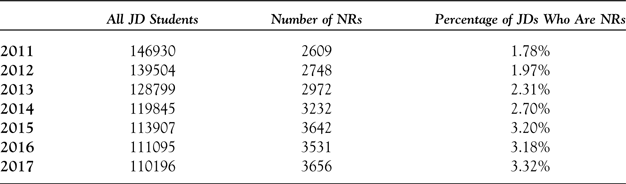
Although a much smaller proportion of the JD population is international, international JD students represent an important and growing demographic of new entrants. First, as Table 1 shows, there has been a marked growth of nonresident alien students, who require a visa to study in the US, within JD programs over the last half decade; this especially is the case in law schools highly ranked by US News & World Report, which is a significant force in framing the reputation of US law schools (Espeland and Sauder Reference Espeland and Sauder2016). The number of nonresident alien students reported by all ABA-approved law schools, in the aggregate, increased by slightly more than 40 percent between 2011 and 2017; as a percentage of the total JD population, the proportion of nonresident aliens increased during this same period by more than 86 percent (from 1.7 percent to 3.32 percent), reflecting the overall decline in law school enrollment. At a group of law schools consistently included in the top-twenty ranked positions by US News,Footnote 6 the number of nonresident aliens almost doubled during this period, and grew from comprising just over 4 percent to nearly 8 percent of the total JD population (ABA 2011–2017).
Nonresident Aliens (“NR”), Total Number at All ABA-Approved Law Schools and as Percentage of All Enrolled Students (All for JD Degree Students Only)

Source: ABA Standard 509 Requirement Disclosures (2011–2017).
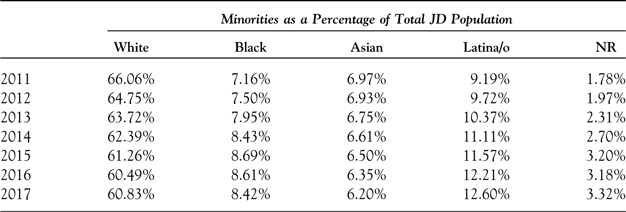
But it is not only that there are more international students. Because of the changing demographics in the law student population and the context of declining enrollment in the aggregate, international students are a more significant part of the overall diversity of the law student population, especially within highly ranked law schools. These broadscale trends are highlighted in Table 2, which reports on enrollment across races as compared to nonresident aliens. Generally, it shows that the greatest proportionate increase in any segment of the student population during the period of 2011 to 2017 was in the international student population. During this period, overall enrollment in the JD program fell from 146,930 to 110,183. Of course, even now, nonresident aliens remain a small segment of the JD population, but their relative role in the changing configuration of enrollment is significant. This point is illustrated by considering that the proportional representation of nonresident aliens during this time period increased much more than did the proportional representation of other minority groups: the proportion of nonresident aliens in the aggregate JD population grew by 86.52 percent (from 1.78 percent to 3.32 percent), compared to Latino students at 37.11 percent and Black students at 17.60 percent.
Percentage of JD Population who are White, Black, Asian, Latina/o and Nonresident Alien (“NR”), at All ABA-approved Law Schools

Source: ABA Standard 509 Requirement Disclosures (2011–2017).
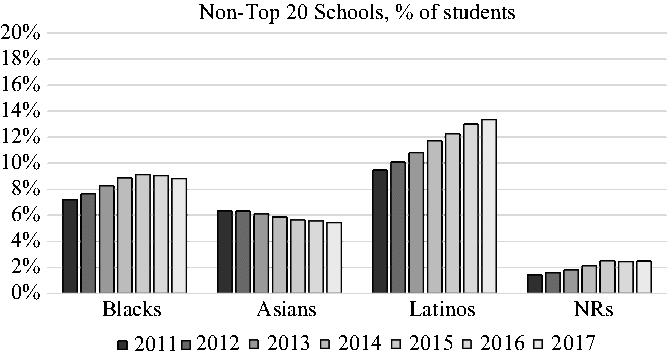
These patterns are further defined by the discrepancies in student enrollment for groups of law schools organized according to their US News rank (Figures 1 and 2). Despite a slight overall increase in the proportion of Black students at the aggregate group of law schools (Table 2) and reflected in the Non-Top Twenty schools (7.20 percent in 2011 to 8.84 percent in 2017), there was a decrease in Black law student enrollment at the Top Twenty ranked law schools (6.88 percent in 2011 to 6.30 percent in 2017). In contrast, despite an overall decrease in enrollment across schools, Asian student enrollment remains pronounced in Top Twenty schools and they are the single largest minority student group in these schools. Latina/o and nonresident alien students have growing populations across schools, but here too the relative patterns of enrollment offer further texture: while the increase in Latina/o student enrollment is much more pronounced outside the Top Twenty ranked law schools (9.48 percent in 2011 to 13.36 percent in 2017), it is in the Top Twenty schools that the growth of the nonresident alien student population is most significant (4.13 percent in 2011 to 7.64 percent in 2017). Together, these data suggest that although nonresident aliens are an increasing law student demographic, their relative presence is, at least for the time being, likely to be most significantly felt within highly ranked law schools.
Trends in Enrollment for Black, Asian, Latina/o, and Nonresident Alien (“NR”) JD Students at Top 20 Ranked Law Schools

Trends in Enrollment for Black, Asian, Latina/o, and Nonresident Alien (“NR”) JD Students at Law Schools Outside of the Top 20 Ranked Schools

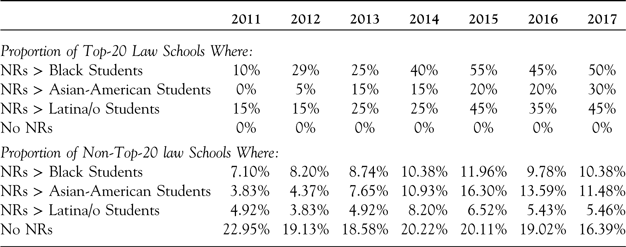
Delving into the school-level context clarifies the role of nonresident alien students as an important minority category. Nonresident aliens comprised a larger proportion of the student body than Black students at half of the Top Twenty law schools in 2017, up from just 10 percent of the schools in 2011. And the proportion of Top Twenty schools where the population of nonresident aliens is larger than the size of other minority populations also increased during this period, going from 0 to 30 percent of schools where there were more nonresident alien students than Asian students, and from 15 to 45 percent of schools where there were more nonresident aliens than Latina/os, as reported in Table 3 (ABA 2011–2017). Every Top Twenty law school has enrolled nonresident aliens in their JD program since 2011 (which is the earliest year for which data is reported). While the significance of nonresident aliens compared to Blacks, Asians, and Latina/os is modest at Non-Top Twenty law schools, the proportion of schools in this group that did not enroll any nonresident aliens fell by 28.58 percent, to only slightly more than 16 percent of the schools.
Law School Level Analysis of Nonresident Aliens (“NR”) in Comparison to Blacks, Asians, and Latina/os, Top 20 and Non-Top 20 Schools

Source: ABA Standard 509 Requirement Disclosures (2011–2017); US News & World Report (2011–2017); Caron (Reference Caron2013).
As international students become a more substantial and recurring segment of the mainstream law school population, understanding the forces that shape their experiences at this nascent stage may offer crucial insight into the early assimilatory stigmas of other minority groups within these settings, insight which might have become less obvious—or normalized—as groups crystallize into their specific subpopulation identities.
DATA AND METHODOLOGY
Nonresident alien status is one mechanism for identifying who is international. But the category of “international student” is a symbolic rather than an objective category (Dezalay and Garth Reference Dezalay and Garth1995, 31) that eludes a simple definition. Our work explores variations in this seemingly cohesive category, including how students are sorted and select themselves into micro-categories. This approach avoids inadvertently reproducing the views of a particular participant in legal education, whether the administration, faculty, or students. As a consequence, it was not possible to pursue this research by obtaining a list of “international” students from law schools. In order to address definitional challengesFootnote 7 and to generate as diverse a sample in terms of law school attended, home country, gender, and experience, we pursued several methods of identifying interviewees. In addition to outreach efforts through law schools,Footnote 8 we used a snowball sample method by asking each interviewee to identify other international JDs who might consider participating in the research. Snowball sampling resulted in slightly more than 30 percent of our interviewees, with the remaining coming from direct or indirect outreach by law schools.
Interviewees were enrolled in and graduated from seventeen US law schools.Footnote 9 Thirty-eight percent (twenty-two) of the interviewees were enrolled in a single law school; twenty-eight interviewees graduated from eight other law schools at which we interviewed between two and seven interviewees per school; the remaining eight interviewees graduated from eight different law schools. As we show in other work (Silver and Ballakrishnen Reference Silver and Ballakrishnen2018), interviewees pursued different paths in and to law school: some earned degrees outside the United States before beginning their JD, some had LLMs before they enrolled in the JD program, and others transferred between law schools within the parameter of a three-year JD.Footnote 10 These variations also were further complicated by the different home countries and citizenship statuses of interviewees.Footnote 11
Law schools do not publicly report the home countries of their JD students, which presents a challenge with regard to assessing the representativeness of the home countries of the interviewee sample. Two sources of information provide some insight. First, the Law School Admission Council (LSAC) reports on the number of matriculating students by country of citizenship. However, if an applicant reported two countries of citizenship, LSAC reported both. As a result, LSAC’s data would report nonresident aliens as well as US citizens with dual citizenship. Nevertheless, the data provide some insight into international students’ home countries, and for the 2015 academic year, when most of the interviews were conducted, LSAC reported that Canada, China, and Korea accounted for the largest non-US citizenship groups of matriculating students: Canadians comprised approximately 26 percent of non-US citizen matriculating students, Chinese citizens were 15 percent, and Koreans nearly 11 percent (LSAC 2015a).
A second source for gaining insight into the home countries of international JD students comes from data on visa approvals for students entering the United States to study law in a doctoral program, which is defined according to the Classification of Instructional Programs to include the JD degree (National Center for Education Statistics 2018). Data from such visa approvals, obtained through a Freedom of Information Act request by the Brookings Institution’s Senior Policy Analyst and Associate Fellow, Neil Ruiz, was made available to us in the aggregate for the years 2008–2012. These data avoid the complication of LSAC’s over-inclusiveness because of individuals holding US and non-US citizenship, since those individuals would not require a visa to study in the United States. At the same time, because trends in sending countries are not static, and the date of these data is slightly earlier than the period when our interviewees were law students, we cannot be certain that they reflect the same trends characteristic of the period when we conducted interviews. Nonetheless, the visa data are consistent with the LSAC report with regard to home country: Canada accounted for approximately one-quarter of all international JD students needing a visa, China accounted for approximately 19 percent, and South Korea for nearly 16 percent. Our sample generally reflects this demographic.Footnote 12 Canada, China, and South Korea account for slightly more than 70 percent of our interviewees (compared with approximately 52 percent of matriculants reported by LSAC and 60 percent of recipients of student visas).
All but eleven interviews took place in 2015; seven were conducted in 2016 and four in 2017. Interviews were conducted either in person or through a video call platform (Skype or FaceTime) by one of the authors, with the exception of three interviews conducted by a trained research assistant, himself an international JD. Interviews were open-ended and semi-structured and both authors were involved in developing interview questions, especially as subsequent interviews began to probe into emergent themes from the preliminary data. Interviews lasted approximately one hour and all but two were recorded. All recordings were transcribed and interviewers took detailed written notes of unrecorded interviews.Footnote 13 Authors discussed emerging themes from the data as the interviews progressed and developed an exhaustive coding scheme (174 items) that incorporated both personal and demographic data (e.g. home country, education, characteristics of US law school, etc.) as well as a range of thematic categories that motivated the interview questions around experiences (e.g. in the law school classroom, within pan-ethnic community spaces), interactions (e.g. between different contingents of JD students and international students) and temporal life events (e.g. marriage, partnership decisions, career interests, etc.). The emergent data were further analyzed with more focused coding on similarities and differences, interpreted based on existing research on minority experiences in higher education research (e.g. peer group affiliations, classroom sociability) as well as our schematic understandings of the data (e.g. stigma for international status, unperturbed international status) especially around students’ emerging cosmopolitan life experiences (e.g. previous socialization in the United States through camps, exchanges, transnational parents). Interviewees are referred to by a pseudonym derived from lists of common given and surnames in the interviewee’s home country.Footnote 14 American names were assigned to interviewees who used American names.
FINDINGS
For international students, the JD offers the most likely path into the US legal labor market. The JD is the “traditional” route pursued by domestic students and it is the only path to bar eligibility universally recognized in the United States (NCBE and ABA 2017). In contrast, the two degrees that law schools designate for international students—the one-year LLM and the research-focused SJD—do not have the same sort of credibility in US labor markets (Silver Reference Silver2010; Ballakrishnen Reference Ballakrishnen2012; Hupper Reference Hupper2015) or in legal markets outside of the United States that are influenced by US law firm hiring preferences (Silver Reference Silver2010, 48); nor do they qualify for bar eligibility in all states (NCBE and ABA 2017). A range of functional distinctions were important to students as they made the decision to pursue a JD: the advantages of having more time in the program (three years versus nine months), the credibility on the job market, and the overall feeling that their legal training was more solid. Prisha Patel, a second-year student who pursued her JD as part of a combined degree she earned from a law school in her home country, described this difference between the two degrees as one of credibility (I1530, 6): “But US law schools really train you to think like a lawyer and I don’t know if LLM would have given me that. Especially at the outset, I was sure I wanted to practice in US.” Similarly, Yu Wei, a first-year JD from China (commenting here on the relative burden of being international, I1517, 12) felt that there were core functional advantages to going through the JD experience, despite the steep costs associated with it: “If I want to stay in United States, of course I will choose JD. Even though it’s, like, three years program, you need to put efforts and time in it, but it’s worth it.”
But alongside this technical difference for what the JD could do in the job market, our respondents’ choice also was motivated by another factor: avoiding the bias of being a typical international student. For many interviewees, their self-perception of being international was tied to their perception of what it meant to be an international student in an international program (i.e., the LLM or the SJD) within the law school—an identity that they reserved for others not like them. As Yana Nabiyeva, a woman from Eastern Europe who had earned her undergraduate degree in the United States, offered, “I feel that my personal experience, there is this divide between JD and LLM students” (I1532, 9). Many interviewees perceived their degree to be a path that allowed for more identity masking and negotiation.
This distancing from the LLM identity is important to note because it reveals the perceived stigma attached to this category of student within US legal education. Some interviewees suggested that LLMs were not as serious about their legal education. As Robert Silva, a second-year JD student who initially earned an LLM from another US law school, explained, the difference between LLM and JD students was simply a degree of seriousness:
[The LLM is] a whole different culture experience that you want to explore, so for spring break they travel around the country and do things like that. As a JD, I don’t really want to do that anymore…. So, it’s different, and sometimes I do feel that there is some tension that makes it more difficult for both groups to build lasting relationships. (I1542, 13)
Some interviewees noted identity assumptions about LLM students. Take, for example, Victoria Zeng, who did not otherwise feel like she would stand out as international (she is a Canadian student of Chinese descent and felt, for the most part, that she fit in) but nonetheless understood why students—especially those whose first language was not English—would want to signal that they were not LLM candidates. She explained, “I do feel like people whose, let’s just say if English isn’t their first language and they sound like they may be an LLM or they’re international, I feel like there is a bias, kind of, that people don’t necessarily want to work with them” (I1539, 12).
The diversity of backgrounds and statuses of students who volunteered to talk about their experiences as “international JD students” reveals the importance of students’ self-perception of their international identity. Beyond being able to distance themselves from their peers in the LLM, identity was negotiated through three main lenses for international JDs: their technical citizenship and immigration status, students’ views of their own identity within the JD program as a function of their experiences, and the ways in which their perceived identities were primed in interactions with peers, professors, and others. Each student who required a visa had to contend with the technicality of being international; students routinely described visa and labor restrictions as something they worried about. But while all students with nonresident alien status shared these technical consequences of being international, their self-perception of being international did not mean or signal the same thing to everyone.
The JD track offered a path for an international student both to feel better prepared for life outside law school as well as to signal a more legitimate status to audiences considered relevant by the student. Interviewees generally spoke about entering a JD program as a thought-out decision, aimed at gaining access to and preparing for a market that was both insular and yet influential outside of the United States. Less clear, however, was how much of this decision actually bore fruit. As we describe in the following sections, students navigated different paths once in law school, sometimes independent of their immigration status.
All Internationals Are Not Equal: Technical Citizenship and Navigated Status
The nonresident alien immigration status used by law schools to report on who is international is both over- and under-inclusive of those students who identify as being international. A student who was born in the United States would not be reported as a nonresident alien but nonetheless might consider herself international. An example is Daisha Robinson, who was born in the United States but lived in the Caribbean from shortly after her birth until age eighteen, when she returned to the United States for college. Although she held US citizenship because of her birth in the United States, she considered herself an international student:
So, I personally identify as an international person. If someone asks me where I’m from, [I would tell them] that I am [describes identity as rooted in her home country], that [name of country] is where all my family is. This [the US] is not my home in that sense, and therefore in that sense I consider myself an international student. (I1535, 22)
Other respondents relayed feeling torn between identities of their home country and the United States because dual citizenship allowed them to view themselves as belonging and not belonging in equal parts. A Canadian interviewee, Sophia Bertrand (I1513, 9), explained that “people [who] have two citizenships, including a US one for example” are included as international students in law school reports as a way for “the admissions office to bolster their number so that it sounds so great and welcoming, but actually the reality is slightly different.” She went on to describe her understanding of a “pure international” as someone who “wouldn’t have a US citizenship.”
Other interviewees had permanent residency status rather than citizenship. Prisha Patel (I1530), for example, was born and raised outside of the United States and immediately before beginning the JD program gained permanent resident status based on one of her parents being a naturalized citizen. Another student, Lin Lai (I1515), explained that she was about to “lose” her international status based on her husband qualifying for a “Green Card.” Several interviewees described themselves as having a “dual identity,” including Seohyun Lee (I1533), a second-year student who was born in South Korea and lived there until age ten, when she moved with her family to the United States and later became a permanent resident. Daniel Tao, a third-year student from China, echoed this sentiment (I1528, 5): “most of the time, I just consider myself both [‘Chinese or to be more Chinese American or Asian-American’], as one package, if that makes any sense.” On the other hand, David Zamora (I1557), who is categorized by his law school as a nonresident alien, declined to participate in the study, explaining: “I’m not exactly your target audience. I have lived in the United States since I was seven, so I feel more American than international. The only respects in which I’ve had a different experience have been with visa issues/concerns.”
But while David does not self-identify as international, despite his school’s classification, other interviewees who held US citizenship (and thus, technically were not nonresident aliens), nevertheless identified a different, related dissonance. Kyungsoo Lee, for example, was born in Texas and moved to Korea at age one when his parents returned to their home country. He spent approximately half of his life in Korea and the other half in the United States. Like Daisha, he was not technically international, but he felt like others treated him as if he were:
I don’t think [the law school] count[s] me as an international student in their statistics. But they do think of me as an international student when I interact because I think I represent myself as such. I think it’s because although I lived here for long enough to speak the language and understand the culture, I still have some things that I do not completely understand. For example, the fever over Super Bowl, I don’t watch it. And like, you know, I really like soccer. And I played it in high school and I watched English primarily, but because I don’t watch anything else there are some basketball or baseball or the Super Bowl, different sports-oriented cultural America that I cannot …. When the kids start talking about that, I just, I feel very isolated. (I1531, 5)
Kyungsoo’s experience illustrates how assimilation for many international students was not simply a function of their technical status, or even often-touted characteristics like “poor language” or not “understanding the culture.” Instead, these variations illustrate that being international is a complicated and layered social category. It is to these variations in perception and reception that we turn next.
The Trouble with Being International: Peer Interactions and Other Experiences
Although our sample was comprised of students who defined themselves as “international,” in choosing the JD program they attempted to assimilate into the core US law student identity group. Despite this intention, their degree program choice did not always enable breaking out of the mold of being an international student, and they did not uniformly succeed in avoiding being seen or read as international by their environments and in interactions.
Not surprisingly, for students for whom English was not a first language, the technical difficulty of being international extended to the classroom. In line with other research on pedagogy and minority identity (Menkel-Meadow Reference Menkel-Meadow1988; Granfield Reference Granfield1991; Guinier, Balin, and Fine Reference Guinier, Balin and Fine1997; Mertz Reference Mertz2007), the classroom was a hostile space for many students in our sample. For example, Yan (Violet) Min’s classroom experience summed up what many students whose first language was not English felt about the hardship of keeping track of their foreign surroundings:
I think in law school there are basically two things that struggle me…. One is the language problem …. And I have to pay more attention to… the class. And sometimes I … have to sit in the front row…. And I can listen clearly. And … I’m trying to be more involved in class ‘cause I noticed that some other American people, they answer the question frequently and carefully, but most of Chinese people won’t answer the questions, even though they know the answer, they don’t want to hands up and answer that…. And the second … thing is about the … way you think…. Just like what I talk about, about the legal system, and the different teaching method that you should get used to that. (I1511, 41–42)
While language proficiency isolated Violet and others like her from their environments, language in the classroom was only one form of distancing that international students felt they encountered. The JD, as many of these students recounted, was a chance at more time in an environment that could socialize them more completely into an American law school experience. But for students whose language hurdles hindered them in the classroom, and for students who were not assimilated at entry, the extra time in the JD program, compared to the LLM, did not always result in a more heterogeneous social circle. Even for those who could have assimilated based on their years spent in the United States, a general sense of displacement from the dominant narrative of the law school made them more likely to seek homogenous peers. As John Oh, a Korean student who spent substantial periods of time prior to law school in the United States, including high school and college, shared:
And this is very personal, but when I meet a lot of Americans, I can tell that they’re one of those people who have never had an Asian friend in their life or had a good amount of diversity in their experience. So sometimes it’s really hard to be close to those American friends. And … you know, there’s some people, and dare I say some professors, I’ve heard a lot of complaints about my friends too, who are just uncomfortable with different cultures, bad English. (I1526, 10–11)
This suggestion by John that his JD experience did not necessarily result in a wider, more heterogenous network of friends is in line with Pan’s (Reference Pan2017) research that suggests a pan-ethnic clustering and “incidental racialization” of Asian and Latina/o students. Relatedly, many students told us about acquaintances who found their international backgrounds interesting and some spoke about friends who shared ethnic or language similarities, but few shared stories about close friends who were “American.” “American,” of course, was a euphemism for how international students described US—and often, white—students who did not share their racial, ethnic, and cultural heritage. Instead, as Liwei Jiang recalls, the circles of international students were often homogenous:
It wasn’t until the second semester of my 2L at [name of law school] when I start making friends with Chinese JD students who started as 1Ls. Strictly speaking, I don’t have any close friends among American JD students at [name of law school]. Most of my close friends are from China or Korea. (I1549, 5)
Dissonance between the students’ anticipation of social opportunities and their lived experiences was common. For students who felt assimilated in terms of language and culture, the JD offered a much less jarring law student experience. But for students who saw themselves as outside of this in-group of English-speaking mostly domestic students, relationship networks remained more homogeneous. However, pan-ethnic social groups also did not offer a safe haven to all international students. As John Oh, who, despite having a fairly homogenous friend group, commented: “In terms of things to do, I would have to say at least for me it makes me not mix into some student groups. So, for example, APALSA [the law school’s Asian students’ association], with all due respect, I think those are great guys, but to me they’re a little too American so I just don’t click with them in a way.” John’s comment about his peers at APALSA being too “American” complicates our understandings of these students’ experiences, both distinguishing and building on the research on the work these spaces do for domestic ethnic minorities.
In addition to these moderators of the law school experience, there were more subtle measures of difference-making and othering. Interviewees commonly described a bias against international students, especially in interactions with peers, which they perceive in indirect—but no less powerful—ways from their environment. An example of this was relayed by Hillary Han, a third-year student who earned her undergraduate degree at a Big Ten university and was in her third year of law school at another Big Ten school. She reported having felt excluded in her civil procedure class, a first-year required course at her law school. Her description of feeling both that she did not know what was going on and that she did not feel comfortable enough in her surroundings to ask for clarification sets up exactly the kind of hostile environment that many international students endure:
So, for the Civil Pro class—I had never taken any law class before, because we don’t have a law degree in the US. And I never had any legal background…. And then I find out that I had a problem understanding what the professor is talking about in Civil Pro. And I felt so awkward to ask questions, because I feel everybody else around me knows what is going on, except myself. And I still remember one day one of my classmates asked me a question. I have no idea what she’s talking about. And she gave me a really dirty look…. it just feels so hard. (G1659, 7)
Despite her relative proficiency with the English language, this illustration of “how hard it feels” for Hillary when her classmate gave her a “really dirty look” is not unlike Violet’s description of the hostile classroom where she and her peers were afraid to answer questions. A robust literature confirms that speaking up is hard for minorities, especially in high status environments where they feel judged by a “fair” and “meritocratic” standard (Costello Reference Costello2005; Mertz Reference Mertz2007), and these experiences reveal how classmates and instructors alike worked in different ways to exclude students who did not feel that they were natural fits in the classroom.
Another common example of exclusionary behavior that primed the minority status of international students involved the classic case of being ignored and/or specifically targeted by a faculty member. Students often were quick to reassure us that this behavior was mostly unintentional and rooted in the faculty member’s inability to navigate the palpable differences in the classroom. Nevertheless, the exclusion was a common theme in these students’ experiences. Seohyun Lee explains:
So, I had one professor who cold-called everybody by their first names, but I don’t blame him at all, I think it’s natural, but he referred to me and this other Korean JD MBA by our last names because it was easier. I wasn’t offended by it, but it just feels more distant. That’s one. And I’m not sure if this … if professors also think about this consciously, but I never get cold called in the beginning of the semester. And I like to think that it’s because my name is not …. When you’re looking at the seating chart it’s not the first thing that pops up. It’s not the easiest I think for professors to say, that’s my guess. (I1533, 21)
Seohyun’s example of exclusion (not being called on) and express inclusion (being referred to by her last name) highlight two important characteristics of increasingly diverse classrooms: First, there is high potential for students to feel alienated in classrooms when they are not part of the dominant group (in this case, not being seen as domestic students), even when professors do not intend to treat them differently. Second, even when they are treated differently, students may underreport or, as in Seohyun’s case, explain away actions that further alienate themselves and similar peers. As researchers studying these newly diversifying environments, we are mindful of students’ relative standing as they navigate these terrains, as well as their tendency to justify the structural inequalities around them (Moore Reference Moore2008). After all, even targeted alienation, in the eyes of a student who structurally has less power, can be perceived as “just another quirk” or something that is convenient for the professor. Further, this alienation may seem unimportant to the student because, in addition to having less power in such a situation, she also has an incentive to downplay these divisive classroom dynamics. After having worked so hard at trying to fit in, who would want to make a scene about being made to stand out?
Alongside faculty interactions that—independent of intention—resulted in students feeling that they were different (on positive interpretations) or did not belong (with less generous interpretations), law school colleagues, both within and outside of the classroom, were pivotal to shaping students’ experiences. James Wilson, a second-year student from Canada, explained:
I think particularly toward international students from East Asian, East and Southeast Asia, there’s a presumption among many American students that their English ability will be limited or that their cultural understanding will be limited. That may not always be true, and that … presumption can actually hinder what could otherwise be fruitful discussions…. Never anything quite so overt as rolling eyes, but cutting conversations short early because of a slight language barrier or conversations among Westerns where people just sort of express an attitude of like, what’s the point of talking to that person or like referring to someone as like some random Asian chick or whatever…. I mean I’ve had those interactions where I’m at an event and it might be a loud, crowded event and someone tries to have a conversation with me and I just literally can’t understand what they’re saying. And I’m like, I don’t want to be dismissive, but I just cannot understand between the noise and the accent and the vocabulary. (I1540, 9–10)
Crucial to this explanation is the difference between what actually marks a student’s identity (their language and cultural references) and what is seen as marking their identity. The difference between the perception (in this case) of Asian students presupposed any chance of an interaction with them, thereby reinforcing the distance that already was at play in these interactions. As James highlighted, there are cases where the language gap is real, but that is not always the case. It is worthy of note that James was a white male student from Canada, who saw himself as a different sort of international compared to students from non-English-speaking, non-Western countries. His suggestion that this assumption of poor language skills might interfere with “what could otherwise be fruitful discussions” reveals another level of intra-group distancing pursued by a cross-section of international students within their own cohort. It also offers insight into how a majority of international students might be received by their environments.Footnote 15
A central element of the management of these identities is that they were not always predicated on actual international or domestic status. Even students who were not technically international, like Kyungsoo Lee, described earlier, found that over and above language, the cultural American-ness of the classroom served as a barrier. And even for those who had socialized cultural entry into the United States, like Daisha Robinson (who went to college in the United States), entry into peer groups often was stymied by their otherness and by the perception of their being international, whether or not that was technically the case. Daisha explained that while her current friends are Americans, this had not always the case:
The friends that I am closest to now are all American actually…. Going in [to law school], I probably would have never thought [that Americans] would have been my closest friends …. so when I first arrived, this accent that I have, no, I didn’t have then. So I sounded like I was directly from the [Caribbean], so every time I spoke they could never really understand what I was saying. They would make fun of me all the time and tell me I’m their [Caribbean] and all that. (I1535, 6)
Overall, being international was not determined by a student’s passport or the visa on it, but rather was a combination of how identity was imagined by the self and then perceived and managed in interactions with others.
The Relatively Unperturbed Internationals
Not every interviewee experienced law school with a sense that they did not belong or had been mistaken to assume that assimilation was possible. Alongside the students we describe above, who felt their difference palpably, other students experienced the international tag differently; many did not perceive themselves as different, even if on occasion others received them as international. Timothy Cho, for example, had spent equal amounts of time in Korea and the United States prior to law school. He was technically international but he did not consider this status central to his identity. After earning his undergraduate degree (not in law) in Korea, Timothy’s decision to apply to a US JD program had much less to do with being in the “less-international” track and more to do with what he wanted to do with his life:
So, my decision to come to law school was really not about being an international student or just … it was pretty much like 100 percent about my career goals. I need … I wanted the legal education that I could get here. I didn’t even consider myself … I didn’t even think that it would be hard adjusting to the US. So, it was really not a consideration. Like being an international student didn’t really matter to me at all. (I1521, 27)
Similarly, Victoria Zeng, introduced earlier, felt that the status of being international did not matter much to her. When asked if she felt like she was treated differently as an international student, her response was direct: “Not at all. I feel like it’s because people generally don’t even realize that I’m international” (I1539, 8). Instead, for students like Victoria and Timothy, the technical restrictions around their international status were at odds with their everyday experience in law school. They had to worry about visas, paperwork, and finding different sources of funding. But many of these technical challenges were administrative and some of them—like standing in longer immigration lines in the airport—were more of a hassle than a real problem. As Victoria explains:
… [I]t is kind of an annoyance … that coming back into America all the time if I were just coming in as a tourist, a Canadian tourist, I could use the kiosk, the global entry kiosk and it would be very painless, very easy…. But because I’m on a student visa I don’t get to use that and I always have to go through the super long line and wait super long for them to scan my papers. So that’s just an annoyance that I have to deal with, but I wouldn’t say it’s a challenge. (I1539, 12)
Victoria’s description stands in contrast to “technically American” students (i.e. students who had US citizenship and did not have to go through these paperwork “challenges”), who nevertheless felt that they were different from the standard “American” JD student. Instead, Victoria and Timothy are examples of students who describe being international as having very little effect beyond general ambivalence. For these students, who, aside from technical or administrative hurdles, felt completely assimilated, having an international background was incidental to their interactions.
Further, to the extent they were interested in more global careers, global fluency could even potentially help such students. Victoria, for example, explained that given her interest in international law, her background “helped her get the job she wanted” (I1539, 12). Other research has revealed that accent and intonation can work to the advantage of British LLM graduates practicing in the United States (Silver Reference Silver2012, 2404). While interviewees did not report their accent as providing them extra credibility, for students like Daisha, being international offered an exotic rather than marginal identity. She saw her experience in law school as one in which students could learn from her about different cultures, and she felt that among her “mostly American friend group” she might be “their first international friend” (I1535, 6).
But Daisha’s experience of being able to inhabit a certain global status was exceptional. Moreover, even fewer international students were able to effectively pass as “local” students. For example, James Wilson (who, as we saw earlier, had strong opinions about the limitations of certain kinds of international students), knew that his identity in a Midwestern law school—as a white male Canadian—still was “different.” James explained that when he started at law school, he was teased about his Canadian accent (11540, 12–13), a tick that he had to “forcibly shift” to make himself more mainstream. Yet, this was an option available to very few international students. Most could not come close to passing sufficiently to become part of—or be mistaken for—the local “American” in-group, even with language proficiency and despite technical “localness.”
DISCUSSION: VARIATIONS ON BEING INTERNATIONAL
These accounts go beyond casting light on demographic shifts to suggest that even within what often is seen as a singular category, international students traverse the US law school in a variety of ways. In unraveling the interconnected processes in which these students negotiate their identities, we find that international status operates as a flexible social category that goes beyond the technical and logistical classifications of immigration and visa regulations. For many—if not most—students, being international was attached to a certain kind of stigma, but their experience suggests that there is not just one way of being international. Instead, unlike strict normative rules and procedures that bind the dichotomy of US or international status, international students’ identities emerge in their experiences and mindsets. Specifically, we find that being international matters differently based on the interaction of students’ self-perception and the reception by others, as primed in interactions.
To the extent these categories are flexible, then, so are the degrees of stigma that attach to them. Different combinations of their self-perception and reception allow students more or less leeway in seeming like the mainstream or “normal” American student. And a range of factors affected the ways in which these international students navigated their JD experiences, including their immigration status or citizenship, their familiarity and comfort in the United States, their home country and ethnicity, and their confidence and ability to work in English (Silver and Ballakrishnen Reference Silver and Ballakrishnen2018). Further, while most students were disadvantaged by their international identity, for select students, being international offered a slight advantage—either by enabling a student to signal cosmopolitan status or by being useful in their broader global careers.
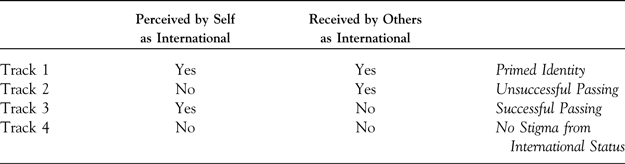
To make sense of these variations, we offer a set of classifications to explain the relationship between student identities and their associated stigma (Table 4). As we suggest in this typology, each variation of this identity creation—of being primed as international, passing for local, or it being insignificant altogether—corresponds to students describing their identities as a burden, advantage, or neutral factor, respectively.
Identity Negotiation Based on Perception and Reception of International Status

For instance, the typical interviewee perceived herself and was received by others as international (Track 1), and generally experienced being international as a central identity that was primed across most of her interactions. She likely was spoken to and interacted with as an “other,” she most likely viewed herself as different from international students in postgraduate LLM programs but at the same time, also as different from “mainstream American” JD students. In contrast, variations in perception and reception characterizing the experiences of other students allowed them to pass with varying degrees of success (Tracks 2, 3). It was easier, for example, for a Canadian student who needed to just slightly alter his accent (Track 3) than it was for a Korean student to pass as a “normal” student, despite being an American citizen (Track 2). And for the few exceptional students who neither perceived themselves nor were seen by others as international (Track 4), the stigma of being international had no relevance because it was not a category through which their experiences were mediated.
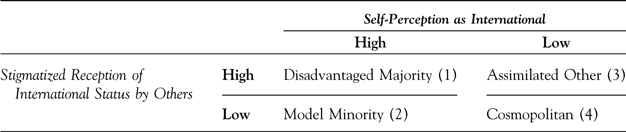
At the same time, while these tracks are useful analytically to make sense of the two main factors contributing to variations in student experiences, these factors themselves (i.e. perception and reception) were more fluid and relational. In order to unpack this complicated layering, which does not neatly align within tracks, we offer four broad ways to theorize about international student identity and experiences (Table 5). Particularly, drawing on the variations in perception and reception outlined in Table 4, we suggest that international students fall within one of four general contingents based on the ways they navigate their JD program and the broader law school environment: disadvantaged majority, assimilated other, model minority, and cosmopolitan. In turn, as we discuss below, each of these contingents corresponds to a four-by-four matrix that reflects various levels of self-perception (as international) and stigmatized reception of such status.
Variations on Being International

For a majority of our interviewees, self-perception and reception aligned to form a mainstream international identity. These are the “disadvantaged majority” who conform to a standard perception of how we think of the international “outsider”—those who are international, who are seen as international, and who identify themselves as international. For these students, the identity of being an international student generally is experienced as a burden, and it is one they work hard at overcoming. These students are seen as active exceptions in the American JD classroom and their actual experience in the law school remains on the periphery. They are acutely aware of their difference compared to the traditional “American” student. Students in this Disadvantaged Majority quadrant share a number of common experiences and perceptions, including the sense that they often work harder to be recognized in the classroom, that their international status is primed routinely in interactions with faculty and peers, and that their friends most often are members of their own identity group (either other international JDs or students in the law school with language and/or home country similarities).
In contrast, students in the second quadrant did not experience an international identity as something that worked against them. Similar to the Disadvantaged Majority, these students strongly self-identified as international, but their identity was received as either an asset or an irrelevance. For these “model minorities,” their distinct sort of internationalness buttressed, rather than undermined, their lived experience. There were not many students in our sample for whom this Model Minority status was plausible, and in large part this depended on the negotiation of other kinds of intersectional advantage. For example, Daisha described the interest in her international background (including growing up in the Caribbean and working outside of the United States prior to law school) shown by lawyers with whom she interviewed during her job search. She felt these were beneficial in building relationships with members of the law firm she clerked for as a summer student (and in which she eventually accepted a permanent position) (I1535, 26). Similarly, interviewees who were enrolled in a joint JD-MBA program reported a more favorable reception to their international identities by their business school peers (I1525, 15). These students were committed to their international identities, but the reception of it in interactions was not as stigmatized as it was for students in the Disadvantaged Majority.
As we show in other work (Silver and Ballakrishnen Reference Silver and Ballakrishnen2018), many interviewees narrativized their enrollment in a JD program as a ticket to assimilation. The third quadrant is comprised of students who had internalized this rhetoric. These “assimilated others” had a low self-perception of themselves as international, they were students who knew that they sometimes were seen as international others (including often when it was not actually the case), but who, alongside this othering, considered themselves as generally having been assimilated. An example is Seohyun, who had lived in the United States since about age ten—that is, for more than half of her life by the time we met her—and was about to become a naturalized citizen. Her experiences in law school reflected her being read as an international person, and she excused the alienating conduct by constraining it to being about her name. Seohyun offered that her name was not perceived as a clue to her being international in the law firm she worked at over the summer (and was planning to join after graduation), as if to say she was looking beyond the parochialism of the law school environment in forming her identity. In other cases, these Assimilated Others were technically international but for a range of reasons (e.g. having spent formative years in the United States) they did not perceive themselves to be international in any way that affected them in a negative fashion even as their internationalness was something they had to contest and explain in select interactions.Footnote 16 Similarly, Kyungsoo Lee, who spent many of his formative years in the United States, felt mostly assimilated (and was not even technically international!) but still felt like he did not culturally fit in sometimes. For both Seohyun and Kyungsoo, the disparity between their own and received identities was a cause of slight frustration because, unlike a student like Daisha who strongly identified with being international (and felt the advantage of being a Model Minority), they felt their environments stigmatize them in ways that were inconsistent with their self-perception.
Finally, a fourth quadrant of students, the “cosmopolitans,” navigated the law school environment as being “international” in name only: they were not likely to identify strongly with an international identity and they were not often received as international in interactions, either. The experiences of the Cosmopolitans were of even more assimilation than the Assimilated Others; they were read as native students and their international identity did not affect or impact them in stigmatizing ways. Our Canadian respondents, such as Victoria Zeng, provide a good example, as do students like Timothy Cho. These were students who did not get read as international, who did not perceive themselves to be “really” international, and for whom the technical liability of having a non-American passport did not result in meaningful consequences. In the rare case of a stigma relating to being international attaching to these students, it was different from the ways in which stigmas attached to those in the other quadrants. For students like James Wilson, for example, who felt he had to change his accent just a little bit to fit in, passing was possible, not to mention easier than it was for others of our interviewees. Nevertheless, the experience of having to make an effort to adjust was a reminder of difference, at least in name.
These variations reveal important aspects of the layered socialization processes that reproduce hierarchies within law school. Our hope is that this preliminary framework helps map the different ways of “being international” in these and perhaps other contexts. At the same time, recognizing variations within the international student category does not explain all the possible processes that they encompass (Gordon Reference Gordon1964). For one, as we mention above, variations in students’ perception and reception are neither standard nor predictable. Further, even within the broad categories of combinations of self-identity and reception by others that we outline, differences (and overlaps) exist, and the high/low (or, in another sense, strong/weak) characterizations we suggest in Table 5 offer only a starting point to think about and organize these individual variations. Second, and crucially, most categories have intersectional implications (Crenshaw Reference Crenshaw1988; Feagin Reference Feagin2006). Interactions can be stigmatizing even when not obvious (Costello Reference Costello2005; Moore Reference Moore2008), and different kinds of pan-ethnic organizing might respond more to hegemonic student categories than to a commitment to specific ethnic identity (Pan Reference Pan2017). Notably, we cannot discount the influence of race in these interactions of self-identity and reception by others. Third, without further observational data, the theoretical matrix we offer about perception and reception is not comprehensive as we do not have full knowledge about all the ways in which stigma could attach to students’ interactional experiences. At the same time, while our data cannot reveal nuances in the reception of international status beyond the descriptions offered by interviewees of their environments, they do provide insight into the ways in which these environments clash or are consistent with self-perception. Fourth, international students do not fall neatly within existing categories of diversity and identity within the US law school context and might require different analytical tools to deconstruct. These data suggest that there are certain assumptions based on nationality (e.g. James’ comment about the language presumptions attributed to certain students from Asia), but these assumptions do not necessarily tack onto affinity between what might be considered racially homogenous groups. As John Oh offered about the APALSA, “I think those are great guys, but to me they’re a little too American so I just don’t click with them in a way.”
A more substantive limitation about the nature of these findings relates to our attempt at theorizing this population as a new kind of minority. We recognize that international students are different in important ways from other minority groups. The international students in our sample do not necessarily start from the position of a disadvantaged minority. To the contrary, many in our sample were socially advantaged in their home countries, and it was this home country privilege that gave them access to a US legal education. Furthermore, many had global career options not accessed by (and, often, unavailable to) domestic law students. As a result, despite the inequalities in socialization, it is likely that the returns they reap from this education differentiate them from students whose pre-law school experiences and social positioning necessarily attach to their extended careers. Even so, as our data reveal, while certain advantages of social class were important and even necessary for entry, other factors like socialization, language proficiency, and assumed racial identities affected the ways in which stigma attached to these students once they were admitted. In short, social class was important, but could not necessarily solve for other characteristics valorized in the US law school context (and perhaps, also, in the broader legal profession). Instead, over and above technical variations, what explained the variance in experience for international students was a more nuanced global, cosmopolitan advantage—a particular strand of global cultural capital—that only certain students were able to leverage even while they remain in the United States.
Despite these limitations, these data offer fresh insight into understanding the creation and experience of law school cultures for a rising demographic of the US law student body. In doing so, they inform our understanding about how minority identities and hierarchies are created and reproduced. We hope this research will serve as a jumping-off point to explore the growing population of international students more generally, and that future research uses this as a case to theorize about global stratification and stigma. Recognizing marginalization as a function of transnational mobility allows us to explore nuances about social stratification that could extend existing theoretical understandings of flexible global identity to include ideas of flexible privilege and stigma. It is this malleable category of diversity creation and stigma attachment that, at its core, this research begins to unpack.
CONCLUSION
International students comprise an important and understudied group within US law schools. We have argued in this Article that formal or official definitions of the “international student” do not do justice to the rich variation of a category that is complex, porous, and plural. Students’ experiences were moderated by the ways in which they perceived their own status and the ways in which their status was received within these environments. Together, these factors create a matrix for understanding how students categorize themselves and, in turn, are categorized. Other scholars have paid attention to identity formation within law school as a prism to understand inequality within the profession more generally. In revealing this new minority category, our research adds to that literature and highlights a cohort of students who are becoming increasingly relevant to law schools, and, even more generally, to international (and internationalizing) legal organizations and legal practice.
Yet, as parallel minority narratives foreshadow, an increase in numbers does not necessarily mean a decrease in alienation or isolation. These discrepancies are of significance given the strong relationship between professional socialization and future career trajectories and inequalities (e.g. Seron et al. Reference Seron, Susan, Cech and Rubineau2016). As law schools begin to accommodate this new diversity, they should consider the kinds of hegemonic spaces they are creating that consistently exclude and include different kinds of students (Kennedy Reference Kennedy1982; Mertz Reference Mertz2007). This may implicate rethinking their pedagogy and the kinds of scholarship—and scholars—they value (Olivas Reference Olivas1994; Lopez Reference Lopez2005; Deo Reference Deo2019). Scholars across disciplines have been pushing to more critically examine the importance of a “hidden curriculum” in higher education (Margolis Reference Margolis2001) that alienates different minorities and disadvantaged others. Incorporating lessons from such dialogues with relevant populations (e.g. Calarco Reference Calarco2018) should be a priority as law schools reconsider their social organization to better account for (and meet) the needs of diverse students. As feminist scholars have argued about the importance of going beyond mere inclusion for women (Hamlar Reference Hamlar1983; Homer and Schwartz Reference Homer and Schwartz1989), one cannot “add and just stir” (Littleton Reference Littleton1987; Guinier, Balin, and Fine Reference Guinier, Balin and Fine1997) upon reaching a certain critical mass. If law schools are committed to holistic consideration of their diverse student bodies, accommodation of international students has to go beyond admittance to nurture more sustainable, thoughtful acceptance.