Introduction
Around the world, the predicted sharp rise in dementia cases in the coming decades has caught media and political attention, and has inspired dramatic descriptions such as the “dementia tsunami” or “dementia avalanche.” A letter by 11 experts to the UK's Health Secretary described the future economic consequences of dementia as “catastrophic,” and warned that the National Health Service might not survive the next 20 years (BBC News, 17 June 2008). While such fears have increasingly become a part of the public discourse on dementia, it remains to be seen how the public reacts to this perceived crisis. Although no government would want to see public stigma against dementia obstructing collective efforts to tackle the crisis, it seems likely that stigma will remain a perennial issue in the battle against this pandemic. It is therefore important to bring the issue of stigma to the forefront of dementia research.
Public stigma refers collectively to the unwarranted stereotype, prejudice, and discriminatory practices against a social group that are widely shared by members of a society. People who are stigmatized are seen as different in a negative sense because they possess certain attributes that are considered undesirable, disgraceful, or even objectionable (Rüsch et al., Reference Rüsch, Angermeyer and Corrigan2005). Globally, stigma against mental illness is widely held and is more common than that against chronic physical illnesses (Crisp et al., Reference Crisp, Gelder, Rix, Meltzer and Rowlands2000; Lee et al., Reference Lee, Lee, Chiu and Kleinman2005). Compared to other forms of mental illness such as schizophrenia, dementia is seldom the subject of scholarly research in the area of stigma, despite the fact that dementia stigma is recognized to be widespread in international communities (UK Department of Health, 2009; Umegaki et al., Reference Umegaki, Suzuki and Iguchi2009; Blay and Peluso, Reference Blay and Peluso2010; Chiu et al., Reference Chiu, Yu and Lam2010; Connelly, Reference Connelly2010). Stigma is an important issue because it promotes social exclusion rather than a caring community, and deters help-seeking by patients and caregivers (Link and Phelan, Reference Link, Phelan, Aneshensel and Phelan1999; Corrigan, Reference Corrigan2004; Rüsch et al., Reference Rüsch, Angermeyer and Corrigan2005; UK Department of Health, 2009). In a recent review of the barriers to diagnosis and management of patients with dementia, stigma was identified as one of the major themes affecting help-seeking (Koch and Iliffe, Reference Koch and Iliffe2010). Worse, stigma is associated with distress and depression in patients and caregivers (Mak et al., Reference Mak, Cheung, Law, Woo, Li and Chung2007a; Perlick et al., Reference Perlick2007), affecting the latter's capacity to perform care, and, as research suggests (Steffens et al., Reference Steffens2006), potentially hastening decline in the former. Stigma is exhibited not just by the general public but also by healthcare professionals (Werner and Giveon, Reference Werner and Giveon2008; UK Department of Health, 2009) and is one of the major reasons for the under-recognition of dementia in primary care patients by physicians (Vernooij-Dassen et al., Reference Vernooij-Dassen2005; Brodaty and Cumming, Reference Brodaty and Cumming2010). A recent study in Brazil showed that 15% of adults aged 18–65 years held stigmatizing attitudes toward people with dementia symptoms, and that those with lower education had more negative attitudes (Blay and Peluso, Reference Blay and Peluso2010). In Hong Kong and elsewhere, it is common for persons with dementia not to seek medical attention until the symptoms have persisted for long periods of time and the illness is at an advanced stage (Chow et al., Reference Chow2002; Sheng et al., Reference Sheng, Law and Yeung2009; UK Department of Health, 2009). Stigmatizing attitudes could be a major hindrance to help-seeking.
There are three main approaches in countering or eliminating stigma – protest, education, and contact – each with different theoretical assumptions (Rüsch et al., Reference Rüsch, Angermeyer and Corrigan2005). Attempts to reduce dementia stigma have relied primarily on public education, rather than on the other two approaches. The education approach assumes that stigma is based on misunderstanding and that people will revise their views when accurate information is provided. Because stereotypes are well learned and deeply ingrained in established world views, they are resistant to change. As a result, the effectiveness of educational programs on reducing the stigma of mental illness has been mixed (Corrigan and Penn, Reference Corrigan and Penn1999; Rüsch et al., Reference Rüsch, Angermeyer and Corrigan2005), while no formal evaluation has been made of dementia education programs.
This study focuses on three issues surrounding dementia stigma and educational programs. First, does exposing people to the symptoms of dementia exacerbate their stigmatizing attitudes? Researchers have found that individuals who read about acute schizophrenic symptoms in a fictitious person reported more adverse affective reactions toward the person than those who read another vignette that provided only the diagnostic label but without description of the symptoms. Additionally, those who had no prior contact with a schizophrenic person believed the person to be more dangerous (Penn et al., Reference Penn, Guynan, Daily, Spaulding, Garbin and Sullivan1994). Thus, it is possible that education programs describing the symptoms and progression of dementia can backfire, especially in those without prior experience with persons with dementia. Alternatively, if education programs work, they are likely to be more effective for those who have had experience with dementia (Corrigan and Penn, Reference Corrigan and Penn1999).
Second, labeling theory suggests that the label of dementia would arouse preconceptions about this debilitating condition and lead to stigma (Link and Phelan, Reference Link, Phelan, Aneshensel and Phelan1999). Whitehouse and George (Reference Whitehouse and George2008) asserted that the label “Alzheimer's” triggers terror. They contended that “Alzheimer's” should be construed as accelerated aging so as to demedicalize and normalize this condition. Doing so is expected to lower social stigma and allow older people to refocus on enhancing quality of life, rather than on treating the disease. Nevertheless, the only study that has examined the effect of labeling in Alzheimer's disease (AD) showed that participants who read a story with a diagnostic label showed more sympathy than those who read the same story without the label (Wadley and Haley, Reference Wadley and Haley2001). The authors argued that people tended to attribute AD to external, biological causes that are beyond the ill person's control, suggesting that certain disease labels may actually reduce stigma. However, in the Wadley and Haley (Reference Wadley and Haley2001) study, the target person was hypothetically the participant's own parent, and it was not clear whether sympathy was aroused only because of the closeness of the relationship.
Third, educational success tends to be associated with length and intensity of exposure to educational programs (Hawkins et al., Reference Hawkins, Blanchard, Baldwin and Fawcett2008). Research on countering mental illness stigma generally shows that brief educational programs have no effect (Wahl and Lefkowitz, Reference Wahl and Lefkowitz1989; Hayes and Vaughan, Reference Hayes and Vaughan2002). However, brief and intermittent exposure is more typical of dementia education conducted via mass media than lengthy and repeated exposure. Does brief information about dementia have any effect on stigma?
Study objectives
To address the above questions, we conducted a study in which adults were randomized into one of three conditions, in which they responded to questions on stigma directly or after reading vignettes about persons with dementia. Half of those who were given vignettes read descriptions of the person's symptoms, whereas the other half read the same vignettes together with the diagnostic information (i.e. dementia). In doing so, we investigated whether brief educational scenarios could reduce stigma, and whether the inclusion of the diagnostic label of dementia reduced stigma over and above the situation in which the label was not provided. In addition, we were interested in whether the effect of this experimental manipulation, if any, varies by whether the person knows with someone with dementia. Because of the exploratory nature of this study, we did not specify the direction of the effects.
Methods
Sample
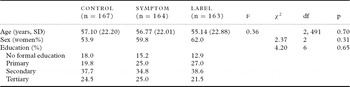
Adults (N = 504) were recruited on a convenience basis from colleges, vocational retraining centers, community centers, and social and health centers for older persons all over Hong Kong. We targeted a sample size of around 500 as we calculated that 476 participants would be required to detect a small effect size (η2p = 0.02) for a 3 (experimental condition) × 2 (whether knowing someone with dementia) interaction effect, while controlling for three covariates (see statistical analysis below), at α = 0.05 and power = 0.80 (calculation using G-Power 3). Ethics approval was obtained from the Survey and Behavioral Research Ethics Committee of the Chinese University of Hong Kong, and from the Department of Health, Hong Kong SAR Government. Ten participants with missing data on key measures were excluded, leaving 494 individuals aged 18–92 for analysis. Further details of sample characteristics, broken down by experimental groups, are provided in Table 1. Compared to the general adult population in Hong Kong, the sample was older and had more participants without formal education due to the over-representation of older adults (Census and Statistics Department, 2007). Nevertheless, the three groups did not differ by age, sex or educational attainment (Table 1).
Demographic characteristics by experimental groups

Measures
Stigma was measured by 11 items constructed with reference to other stigma scales (Taylor and Dear, Reference Taylor and Dear1981; Fife and Wright, Reference Fife and Wright2000; Struening et al., Reference Struening2001; Mak et al., Reference Mak, Poon, Pun and Cheung2007b). Because the existing scales are intended to measure the personal experiences of marginalized groups and tend to be generic (i.e. without reference to any particular population), we adapted items from the existing measures while changing the wording to refer specifically to dementia, and added a few others as a result of a pilot survey in Hong Kong. An initial pool of 15 items was developed and 11 of them were selected for the present study on the basis of their inter-item correlations. The items (see Appendix) cover the cognitive (i.e. negative stereotypes and prejudice, including attitudes against measures to help persons with dementia), emotional (i.e. negative emotional reactions, such as feeling embarrassed or devalued when associated with someone with dementia), and behavioral aspects (i.e. avoidance and discriminatory practices) of stigma. They were rated on a 5-point scale of 1 “strongly agree” to 5 “strongly disagree,” and the scores were averaged across the items, with a higher score indicating greater stigma. The α coefficient was 0.75.
In addition, respondents provided demographic data (age, sex, education) and responded to two additional questions that tapped their experience with dementia and belief in its prognosis. One question asked if they had a relative/friend who had dementia or who was suspected to have dementia. The other asked if they believed dementia to be treatable. For both questions, the response options were “yes,” “no,” and “not sure.” For the former question, the options “no” and “not sure” were combined.
Procedure
Participants were randomized into one of three conditions. In the control condition (n = 167), participants responded to the stigma questionnaire and the other measures directly. In the symptom condition (n = 164), participants first read two vignettes that described the symptoms of dementia in two fictitious older individuals (one male, one female – see the Appendix), before answering questions on stigma and the other variables. In the label condition (n = 163), participants read the same vignettes which ended with a statement that the person was recently diagnosed with dementia by a physician. Both cases, developed by a focus group of professionals including geriatric psychiatrists, occupational therapists, social workers, and psychiatric nurses, depicted a person in transition from being asymptomatic to having progressive memory loss, with delusion and mild disorientation. They focused on early-stage dementia because it is during this phase that the effect of labeling would likely be most pronounced. Randomization was performed by a computer which assigned participants sequentially into the experimental conditions; questionnaires that referred to specific experimental conditions were then sequentially arranged and numbered. Furthermore, within the symptom and the label conditions, the order of the vignettes’ presentation was counter-balanced; i.e. half of the participants were randomized to read the man's story first, and half to read the woman's story first. Research assistants then distributed the questionnaires one by one in the pre-arranged sequential order that corresponded to the randomized assignment.
Owing to the relatively low level of literacy of the older cohort in Hong Kong, the older adults were interviewed individually, whereas the younger and midlife adults filled out the questionnaire by themselves. This data collection strategy has been successfully used in previous studies that covered the entire adult age span in Hong Kong (Cheng, Reference Cheng2004; Cheng et al., Reference Cheng, Fung and Chan2007; Cheng and Yim, Reference Cheng and Yim2008). It was justified because whether questionnaires were self-administered or administered by the interviewer yielded no significant difference in responses by both older and younger adults (Cheng and Yim, Reference Cheng and Yim2008).
Statistical analysis
The main analysis was an analysis of variance (ANOVA) with scores of the stigma questionnaire as the dependent variable, and experimental condition (three levels), whether knowing someone with dementia (two levels), belief in dementia prognosis (three levels), age (18–34, 35–64, 65–79, 80+; four levels), and education (four levels) as between-subjects factors. All interactions were suppressed except for the experimental condition × “knowing someone” interaction term. Significant main effects were probed by post-hoc pairwise comparisons with Bonferroni correction.
Results
Descriptive data
The proportions of control group participants endorsing (“agree” or “strongly agree”) different stigmatizing attitudes toward persons with dementia (after reversing negatively worded items) were as follows: they should be institutionalized (41.9%); they are dangerous (26.3%); dementia occurs only in people with low education (3.0%); would feel looked down upon if family member has dementia (19.8%); research only undertaken for profit by drug companies (18.6%); research resources should be devoted elsewhere (25.7%); no need to have more liberal attitudes from society (4.2%); avoid personal contact (5.4%); avoid telling people if family or friend has dementia (7.2%); embarrassment when going out with someone with dementia (10.8%); and public expenses for dementia care are a waste (4.2%) (see Appendix for item details). Thus, there were substantial variations in people's attitudes toward different aspects of dementia. Because responses by participants in the other two groups had been subject to experimental manipulation and hence did not reveal baseline data, they are not shown.
Does stigma change with exposure?
Levene's test of homogeneity (F[154,339] = 1.15, p = 0.15) was nonsignificant, and the stigma measure did not show marked deviation from normality (skewness = 0.21, SE = 0.110; kurtosis = −0.14, SE = 0.219). Thus, the assumptions for ANOVA were met.
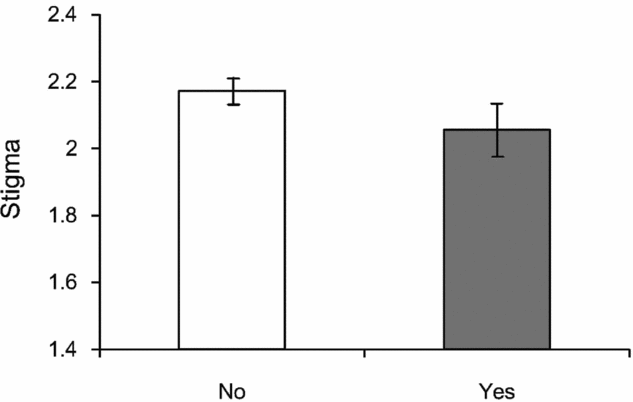
Results of ANOVA revealed significant main effects for all the independent variables. As shown in Figure 1, the experimental manipulation had a small effect on stigma (F[2,480] = 6.09, p = 0.002, ηp2 = 0.03). Post-hoc comparisons with Bonferroni correction showed that the control (A) group (mean [SE]: 2.23 [0.044]) reported significantly higher stigma than both the symptom (B) (2.01 [0.047]) and the label (C) group (2.10 [0.055]), but the latter two did not differ from each other. Knowing a relative or friend with dementia (2.17 [0.025] was also associated with lower stigma than not knowing one (2.06 [0.052]; F[1,480] = 4.59, p = 0.03, ηp2 = 0.01). The interaction of experimental condition × “knowing someone” was not significant (F[2,480] = 1.58, p = 0.21), suggesting that the effect of the experimental manipulation was the same whether one had pre-existing experience with dementia or not (see Figure 2).
Stigma scores due to experimental conditions, controlling for age, education, belief in prognosis, and whether the participant knew someone with dementia. Error bars denote 95% confidence intervals.

Stigma scores in relation to whether the participant knew someone with dementia, controlling for experimental manipulation, age, education, and belief in prognosis. Error bars denote 95% confidence intervals.

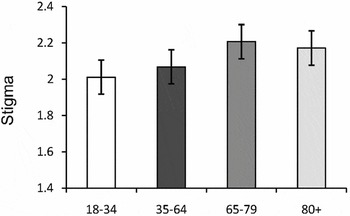
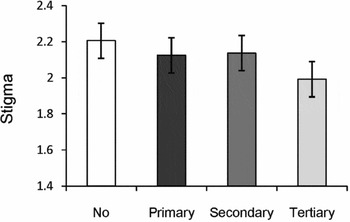
Additionally, despite the fact that age and educational attainment are strongly inversely related in Hong Kong adults (Census and Statistics Department, 2007), both age (F[3,480] = 3.61, p = 0.01, ηp2 = 0.02) and education (F[3,480] = 3.03, p = 0.03, ηp2 = 0.02) had independent effects on stigma. Post-hoc comparisons with Bonferroni correction showed that those aged 18–34 and 35–64 (2.01 [0.050] and 2.07 [0.055] respectively) had lower stigma than those aged 65–79 and 80+ (2.21 [0.038] and 2.17 [0.070] respectively), whereas the former two age groups did not differ from each other, and nor did the latter two groups (Figure 3). Moreover, those with tertiary education (1.99 [0.060]) reported lower stigma than those with secondary (2.14 [0.042]), primary (2.12 [0.051]), or no education (2.21 [0.060]), and those with secondary education also had lower stigma than those with no education (Figure 4). (To further explore whether the effect of experimental manipulation varied by age and educational level, we added two product terms, experimental condition × age and experimental condition x education, in the model. None of these interaction terms were significant.)
Stigma scores in relation to age categories, controlling for experimental manipulation, education, belief in prognosis, and whether the participant knew someone with dementia. Error bars denote 95% confidence intervals.

Stigma scores in relation to educational attainment, controlling for experimental manipulation, age, belief in prognosis, and whether the participant knew someone with dementia. Error bars denote 95% confidence intervals.

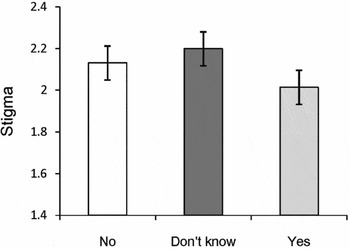
Finally, belief in the prognosis of dementia also had a main effect on stigma (F[2,480] = 6.36, p = 0.002, ηp2 = 0.03). Post-hoc comparisons with Bonferroni correction revealed that those who had a more optimistic view, or saw dementia as being treatable (2.01 [0.042]), reported significantly lower stigma than those who believed dementia not to be treatable (2.13 [0.038]) or those who were not sure (2.20 [0.046]).
Stigma scores in relation to belief in dementia prognosis (yes = treatable), controlling for experimental manipulation, age, education, and whether the participant knew someone with dementia. Error bars denote 95% confidence intervals.

Discussion
This is the first study to investigate how attitudes toward dementia might change with controlled exposure to information about the disorder. Employing an experimental design, we found that being exposed to hypothetical cases with progressive symptomatic decline in older adulthood resulted in less stigma toward dementia, whether or not the cases were explicitly labeled with the dementia diagnosis. Thus, it appears that open discussion about dementia arouses more sympathy in an aging society where dementia is becoming increasingly common. Umegaki et al. (Reference Umegaki, Suzuki and Iguchi2009) also made a similar observation about a drop in stigma against dementia from 2004 to 2008 in Nagoya, Japan, when there was a massive public health campaign to impart knowledge on dementia as well as other governmental measures to tackle long-term care needs during that period.
It is difficult to compare the prevalence of stigmatizing attitudes in Hong Kong and those elsewhere, due to the lack of data internationally and, where data exist, the lack of a standard measure for dementia stigma. For example, in a recent study of the Brazilian population, stigma was determined by positive responses to three questions (endorsement percentages in parentheses): (i) whether a fictitious person with dementia symptoms would commit violence (41.6%), (ii) whether others would have negative ideas about this person (43.4%), and (iii) whether others would avoid the person (35.5%). Fifteen percent of the sample endorsed all three items, but the last two items were really about the perception of public reactions, not the personal opinions and attitudes which were the focus of this study. Typically, when making such generalized judgments, one relies on stereotypic views if available. If stereotypic views are not available, especially when the questions concern matters not readily observable, then answers to the questions become ad hoc responses and might not be reliable. Therefore, we must read the Brazilian data with caution.
Another study conducted in people aged 40 years or over in Nagoya, Japan showed strikingly prejudiced attitudes toward dementia (Umegaki et al., Reference Umegaki, Suzuki and Iguchi2009). In 2008, those saying “yes” or “tend to yes” ranged from “(a) shameful disease” (39.1% in those aged 40–64; 53.2% in those aged 65+) to, for example, “(an) unfamiliar and scary disease” (74.9% in those aged 40–64; 81.4% in those aged 65+). Again, it is difficult to compare these data with those of the present study because the response options (i.e. tend to yes) and the items (e.g. one would expect most people to say that they are unfamiliar with dementia) were different. At the same time, the award of one of the 2009 Nobel Prizes to a Chinese physicist who had invented fiber optics and was diagnosed with AD, which was coincidentally announced right before the conduct of the experiment, might have influenced the present findings and even how the public considers this disorder in the long term.
Clearly, however, whether in Japan, Brazil or Hong Kong, a substantial proportion of adults believe that people with dementia tend to be dangerous. This may reflect a lack of understanding about this disorder. On the whole, responses from the control group suggest a deep-seated pessimism about this disorder, so that spending more resources on services and research was considered unwise. Moreover, a significant proportion of the respondents (41.9%) in the control group opined that persons with dementia should be institutionalized, suggesting a rather common preconception that such persons are not suitable for community care. A further negative reaction to community care was the finding that 20% of our participants would feel they would be looked down upon by others if a family member had dementia. This suggests a widespread perception that dementia is a family disgrace, which echoes Western findings that one is stigmatized because one's family member has dementia (i.e. stigma by association; Werner et al., Reference Werner, Goldstein and Buchbinder2010). The prevalence and adverse impact of stigma are further shown by the finding that 7% would choose not to disclose their relationship to someone with dementia, and 11% would feel embarrassed if they went out with this person. As community care remains a crucial component of dementia care in the foreseeable future, such attitudes will need to change if help-seeking by family carers is to be encouraged. On the whole, the results suggest widespread negative views held by the public that are detrimental to aging in the community and to further scientific research that is vital in improving our understanding, management, and prevention of the disorder. Thus attempts to correct public misconception about dementia and to change stigmatizing attitudes are crucial aspects of any public health strategies against dementia.
Our findings concur with those of Blay and Peluso (Reference Blay and Peluso2010) with regard to the influence of education on stigma toward dementia. People with lower education levels tend to have more negative attitudes toward people with this disorder. Thus, persons with more education are more receptive, and are likely to be more empathic towards the behavioral and cognitive problems exhibited by people with dementia. There was also a trend of younger adults, compared to older ones, to display less stigmatizing attitudes towards dementia. Interestingly, the effect of age could not be solely explained by a lower educational attainment in the older age groups. As age is associated with increasing risk for dementia, it appears that one is more likely to reject people with this disorder as one's susceptibility increases. While this could be an attempt to distance oneself psychologically from the disorder when the threat of developing it is elevated, more research is needed to understand this interesting phenomenon.
Knowing somebody with dementia was associated with lower stigma toward persons with this disorder. This was consistent with the contact hypothesis (i.e. lack of contact with minority groups leads to prejudice; Corrigan, Reference Corrigan2004). However, no interaction effect was observed between this factor and the experimental manipulation. Thus, the effect of different degrees of exposure to information about dementia was the same, whether one had some link to someone with dementia or not. We did not measure how close these links were and could not tell if the effect might depend on closeness to the patient. Persons who are close to the patient (and who would thereby have relatively more knowledge and experience with the disorder) might not benefit from educational messages as much as those who are not close. Without differentiation of the degree of closeness, the potential interaction effect might have been diluted. Future research may shed more light on this issue and help practitioners and policy-makers to determine the primary targets of educational programs.
Stigmatizing attitudes towards mental and related disorders have long been a major agenda in mental health policies. For instance, the UK National Dementia Strategy emphasizes the need to tackle stigma as a key way to ensure better knowledge and early diagnosis (UK Department of Health, 2009; Banerjee, Reference Banerjee2010). The findings presented here suggest that such attitudes are associated with ignorance about dementia, and that public education can have a destigmatizing effect. However, such observations have to be interpreted with caution as the study suffered from several limitations. First, we did not examine long-term and cumulative effects of intervention. Second, prominent neuropsychiatric disturbances were not included in the brief experimental scenarios. These symptoms are even less understood by the general public and are often perceived to be more disturbing than the memory decline in dementia. Thus, whether the findings will hold when a more complete picture of the dementia symptomatology is presented is a crucial question. In order to plan educational programs effectively, there is a need to evaluate carefully the long-term effects of different training materials.
Second, this was not a representative sample of the population. Although the most important concern in an experiment is its internal validity (i.e. causal inference), an experiment that is performed on a representative sample drawn randomly from the general population would provide stronger conclusions and better estimates of the effect of public educational interventions on dementia stigma. Third, the sample came entirely from a Chinese society and the degree to which the findings are generalizable to other cultures is not clear. As reducing stigma has been recognized as a key strategy to dementia care across countries (e.g. UK Department of Health, 2009; Brodaty and Cumming, Reference Brodaty and Cumming2010; Connelly, Reference Connelly2010), it is important to investigate if the current findings are replicated in other cultural contexts.
Despite these limitations, the data provide valuable preliminary insights into the general public's cognitive, emotional, and behavioral responses to dementia in a Chinese society. The data are important because China and its neighboring developing countries will experience the fastest growth in their dementia populations in the next few decades, and will account for about 30% of the world's dementia population by 2020 (Ferri et al., Reference Ferri2005). Experimental data provided encouraging information that even brief exposure to information may change attitudes toward people with dementia. For the implementation of dementia care policy, destigmatization should be a key strategy with public education playing an indispensible role.
Conflict of interest
None.
Description of authors’ roles
S.-T. Cheng, L. C. W. Lam, and L. C. K. Chan designed the study. S.-T. Cheng performed the data analysis; S.-T. Cheng, L. C. W. Lam, and A. C. B. Law wrote the paper. The remaining team members implemented the study and collected the data.
Acknowledgment
We thank two anonymous reviewers for their helpful comments on an earlier version of the paper, and Peter Rabins for his editorial assistance.
This study was supported in part by an unrestricted educational fund donated to the Chinese Dementia Research Association by Eisai Pharmaceutical.
Appendix
Dementia stigma items
Items are rated on a 5-point scale of 1 = strongly agree, 2 = agree, 3 = neutral, 4 = disagree, and 5 = strongly disagree. Those marked by (-) at the end are to be reversed before scoring.
1 Persons with dementia should be institutionalized. (-)
2 Persons with dementia are not as dangerous as people think.
3 Only those with a low educational level would develop dementia. (-)
4 People who live at home with relatives with dementia would be looked down upon by others. (-)
5 Research on dementia is nothing but a good way for pharmaceutical companies to make profits. (-)
6 Resources for medical research should be devoted to the acute conditions of those with productive activities. (-)
7 Society should treat persons with dementia with more tolerance.
8 I would avoid contact with people with dementia. (-)
9 I would avoid disclosing the truth if my relatives or friends had dementia. (-)
10 I would feel embarrassed going out with a relative or friend who has dementia. (-)
11 Increasing spending for dementia care services is a waste of money. (-)
Vignette 1
Mr. Chan is an 80-year-old retired teacher living with his family in a private flat. Having served as a teacher for his whole career, Mr. Chan had strong views and was rather chatty. However, his memory has deteriorated in recent years and when he talks he tends to repeat himself. Last week he forgot how to write his address. [Vignette 1 stops here for Symptom condition – Group B.] Mr. Chan has recently been assessed by geriatric psychiatrists, and was diagnosed as suffering from dementia.
Vignette 1
The relatives of Mrs. Wong report that she has been shy and dependent all her life. Her daughter-in-law has noticed that she has poor memory and has tended to get lost over the past three months. Mrs. Wong is also very suspicious and irritable, losing her temper over minor things. She is unhappy most of the time as she thinks her possessions have been stolen. The family are at a loss as to how to handle this situation. (Vignette 2 stops here for Symptom condition – Group B.) Last week Mrs. Wong was assessed by geriatric psychiatrists and diagnosed as suffering from dementia.