Introduction
The International Psychogeriatric Association (IPA) Task Force on Mental Health Services in Long-Term Care (LTC) Facilities aims to support and strengthen mental health services in the LTC sector. As one component of this work, task force members from different countries and disciplines have come together to develop guidelines for the delivery of good mental health care in these facilities. The purpose of this paper is to identify and examine broad principles that may underpin the drive towards meeting the mental health needs of residents of LTC facilities and their families, as well as to enhance the overall delivery of residential care services. In essence, our question is: “Are there recurrent high-level messages that suggest common underlying principles, despite local, regional, national and international differences in the organizational systems, cultures, community attitudes, social circumstances, resources and funding that determine how services should be delivered on the ground?”
A series of documents produced by the World Health Organization under the auspices of the Cross-Cluster Initiative on Long-Term Care (Brodsky et al., Reference Brodsky, Habib and Siegel2002; Reference Brodsky, Habib and Hirschfeld2003; Wikler and Hirschfeld, Reference Wikler and Hirschfeld2002) illustrates that residential care arrangements in different regions and countries include a variable mix of social, physical, clinical and mental health services. There are universal challenges in defining and providing the mix of services that are deemed to be appropriate and necessary. Different countries and regions have different foundations for providing residential care services, including knowledge, financing (publicly supported or privately funded aged care), and the availability of different services. Furthermore, there is significant international disparity in the availability and use of residential care, reflecting differences in cultures, expectations, resources, policies and policy implementation. Equally important is understanding of the various roles informal care providers fill in meeting the needs of older, disabled and chronically ill adults. Although there are considerable differences both between and within countries in their residential care arrangements for older adults with LTC needs, the IPA Task Force aims to identify core principles to guide residential care both in theory and practice.
Methods
Well-known official international documents by the most representative organizations with a mandate to further the well-being of older adults were selected for preliminary analysis. These were: Principles for Older Adults (United Nations, 1991), Madrid International Plan of Action on Ageing (United Nations, 2002), Active Aging Policy Framework (World Health Organization, 2002), and Organization of Care in Psychiatry of the Elderly: A Technical Consensus Statement (World Health Organization, 1997), the last representing a collaboration between the World Health Organization and the World Psychiatric Association. These documents were searched for quotations relevant to the LTC context. The content analysis of the documents was carried out with a view to identifying common principles of good care.
Guidelines produced by national organizations on the care of older adults with mental and behavioral disorders were then selected through a two-part process. Members of the Task Force, representing several different nations, identified key guidelines. A supplemental literature search was conducted to confirm that the major English language documents had been identified. We were unable to extend our review to guidelines produced in languages other than English. We obtained six guidelines, developed in Australia (NSW Department of Health, 2006), Canada (Conn et al., Reference Conn2006), the U.K. (National Collaborating Centre for Mental Health, 2007) and the U.S.A. (American Geriatrics Society and American Association for Geriatric Psychiatry, 2003; American Medical Directors Association, 2003; Alzheimer's Association, 2006). These documents were searched for quotations as above. Principles that were represented in the majority of the international and national documents were deemed to represent an emerging consensus. We were reluctant to identify these principles as fully consensual, given the lack of global representation in the analysis.
Each of the emerging principles is discussed in relation to the international research and practice literature. We discuss the challenges associated with actualizing these principles, taking into consideration key issues for families, facilities, systems, and societies. Recommendations for practice, policy and advocacy to establish an internationally endorsed principles-based framework for the evolution and development of good mental health care within LTC facilities are provided.
Results
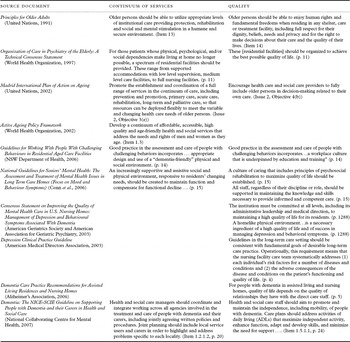
Despite differences in culture, resources and government policy among nations, a review of international consensus documents on human dignity, elder well-being and human rights as well as specific mental health practice guidelines reveals broad support for core principles regarding both the quality of care and the need for a continuum of care. Table 1 presents a sampling of statements from the consensus documents and guidelines to illustrate these themes.
Statements on residential care in consensus documents and practice guidelines

Although the attention to principles in these documents is limited, this review revealed an emerging consensus that: (1) residential care should be situated within a continuum of services which are accessible on the basis of need; (2) there should be an explicit focus on quality of care in residential facilities; and (3) quality of life for the residents of these facilities should be a primary objective.
Principle 1: A full continuum of care should be provided such that services to older adults in the community are coordinated with short-stay and respite services and with a range of long-term residential care services
The development of a full continuum of care remains a vision rather than a reality for most regions and countries as yet. However, it has been said that the unavailability of resources for the provision of care does not invalidate the aim to provide care according to endorsed principles (World Health Organization, 1997). It is critical that the anticipated expansion in the LTC sector to meet the needs of the worldwide growing older adult population proceeds in concert with the development of a more comprehensive and seamlessly integrated continuum of health care services for elders.
In the U.S.A., rates of LTC institutionalization vary across states from a low near 2% to a high near 6.5%, with an average of roughly 4.2% for older adults (Houser et al., Reference Houser, Fox-Grage and Gibson2006; Mor et al., Reference Mor2007). Very little of this difference reflects differences in population need. In fact, U.S. states with higher institutional rates tend to have facilities with lower-acuity residents (Mor et al., Reference Mor2007). The variation suggests that perhaps as many as two-thirds of the LTC facility residents in some states could be cared for in the community. International comparisons reveal a similar disparity in institutionalization rates. Although most countries have seen a recent increase in access to newly emerging alternatives to nursing home care, reliance on institutionalization varies by more than 60%, with less than 5% of older adults in residential care in several countries and more than 8% in others (OECD, 2005; 2007; Fujisawa and Colombo, Reference Fujisawa and Colombo2009).
The aging population has need of a range of health care services, tailored to their current and evolving physical, mental, familial, social and financial circumstances. In addition to full service LTC facilities, there is a need for community-based assisted living services of varying composition and intensity (Alzheimer's Australia, 2009). Tailoring services to individual need while avoiding fixed packages of care that bundle both needed and unneeded services is likely to be not only more efficient in the long run, but more appealing to those receiving such services. The Silver Chain group in Perth, Australia, has been evaluating such a model (Lewin et al., Reference Lewin2008).
Principle 2: Residential care facilities and the public and private agencies that support and regulate them should actively promote quality of care
Efforts to address quality in residential care settings have been widely adopted across many countries. Quality of care includes several aspects such as: (a) organizational structures and leadership; (b) environmental aspects; (c) care approaches; and (d) relationships with care providers. High quality care depends on a commitment to all of these elements. The quality of the relationships among residents, families and care providers is in turn dependent on the individual provider's competence (knowledge and education, abilities, qualities, motives and attitudes) and the support they receive. As reported in one consensus statement, high quality mental health care in nursing homes is possible only where overall care is of high quality (American Geriatrics Society and American Association for Geriatric Psychiatry, 2003).
A scan of recent literature demonstrates that several systemic issues dominate the pursuit of quality care in LTC facilities across many countries. Interdisciplinary care planning and the written care plan are mandated processes that are imbedded in the regulatory fabric and routines of the American nursing home (Dellefield, Reference Dellefield2006). The development and dissemination of the Resident Assessment Instrument (RAI) suite of assessment tools has been instrumental in promoting a common approach to assessment internationally (see interRAI website at: www.interrai.org). Evidence-based practice guidelines have become ubiquitous in health care in Canada, despite continuing concerns about the challenges of implementation (Ploeg et al., Reference Ploeg2007). Personnel issues are a focus in several countries, including Finland (Raikkonen et al., Reference Raikkonen, Perala and Kahanpaa2007), Sweden (Josefsson et al., Reference Josefsson, Sonde, Winblad and Robins Wahlin2007) and Taiwan (Hsieh and Su, Reference Hsieh and Su2007). In Australia, low pay and an aging workforce are of particular concern (Richardson and Martin, Reference Richardson and Martin2004). Wages and payment systems for services and other systemic issues are noted to impede quality of care in Germany (Hirsch, Reference Hirsch2008). American practice guidelines echo this concern (American Geriatrics Society and American Association for Geriatric Psychiatry, 2003). In addition, knowledge and training are important issues. For example, unregulated care providers provide the majority of care for older people with dementia in LTC facilities in Canada (Janes et al., Reference Janes, Sidani, Cott and Rappolt2008).
At the clinical level, much of the work on improving residential care has focused on aspects of basic physical care, such as decreasing pressure sores, countering weight loss, removing physical and chemical restraints, and such like. There has been less focus on ways to improve day-to-day living arrangements, increase access to social interaction and implement acceptable models for providing physical care. Interventions such as the Eden Model were designed to promote the integration of the care facility with the community (Ransom, Reference Ransom2000; Thomas, Reference Thomas2004). Care models such as the Green House Project in the U.S.A. (Kane et al., Reference Kane, Lum, Cutler, Degenholtz and Yu2007) and social programs in Sweden (Ministry of Health and Social Affairs, 2001) have had success in including social care as a basis for ensuring dignity for residents.
It is generally held that the quality of care provided in LTC facilities is highly dependent upon the knowledge, skills and quality of intervention provided by those working as direct caregivers. Standards of care, therefore, must not only be explicit in content, but actionable, meaning those engaged in the day-to-day activities of direct care-giving not only have the necessary education and training, but also have access to open communication with and support from management. Otherwise, the caregivers, who all too often work in vulnerable positions with few employment opportunities, may hesitate to challenge the “status quo” when quality of care is compromised. Given that the pursuit of quality in care crosses cultural and national boundaries, there is an urgent need for collaborations such as this IPA Task Force to create opportunities to share knowledge, experiences, successes and caveats internationally in the interests of accelerating the development of an evidence base on which to build local initiatives.
Principle 3: All countries should strive to provide the highest level of quality of life among its older citizens, including those in residential care
Quality of life is ultimately a subjective evaluation, and LTC residents, like everyone else, will hold their own views about the quality of life they experience and the factors that matter to them as individuals. However, it behooves care providers to hold the goal of helping residents to experience their highest possible quality of life as a validating principle for the services they provide.
The quest to define, quantify and interpret quality of life in LTC residents with dementia appears to be global. A scan for relevant publications uncovered recent work conducted in Japan (Matsui et al., Reference Matsui2006), Korea (Shin, Reference Shin2006), Sweden (Falk et al., Reference Falk, Persson and Wijk2007), Taiwan (Fuh and Wang, Reference Fuh and Wang2006) and U.S.A. (Weiner et al., Reference Weiner2000). American researchers have concluded that individuals have the capacity to form new supportive relationships following a move to assisted living (Street et al., Reference Street, Burge, Quadagno and Barrett2007) and that organizational factors have a dominant influence on the autonomy of facility residents (Sikorska-Simmons and Wright, Reference Sikorska-Simmons and Wright2007). In Scandinavia and elsewhere there has been a strong movement in the last decade towards more homelike milieus that emphasize the importance of having one's own private room (Gibson, Reference Gibson2006). These efforts help to reframe the negative connotations linked to the traditional understanding of LTC facilities.
The person-centered care movement originated in the context of caring for older people with dementia in the U.K. and is now influential in Australia, parts of Western Europe and North America as well (Dewing, Reference Dewing2004). Several of the guidelines included in Table 1 specifically refer to person-centered care. Examples of this are: “Residents should receive care that is individualized, person-centred, and, to the extent desired and possible, self-directed” (Conn et al., Reference Conn2006, p.15); “Good practice in the assessment and care of people with challenging behaviours incorporates: . . . a philosophy that supports person centred care” (NSW Department of Health, 2006, p.14); “. . . fundamentals for effective dementia care, which are based on person-centred care – care tailored to the abilities and changing needs of each resident” (Alzheimer's Association, 2006, p.3); “Apply the principles of person-centred care when working with people with dementia and their carers” (National Collaborating Centre for Mental Health, 2007, p.18).
The underlying conceptual framework for person-centered practice embodies attention to the individual's values, the caregiver's values and the context of the care environment (McCormack and McCance, Reference McCormack and McCance2006). For people with severe dementia, the person-centered care philosophy has appeal because it promotes recognition of the ongoing personality and humanity of the individual, despite functional and cognitive losses secondary to disease processes (Edvardsson et al., Reference Edvardsson, Winblad and Sandman2008). Research has shown that a person-centered view can be more important than education and experience when it comes to care providers’ abilities to recognize cognitive decline among residents with dementia (Macdonald and Woods, Reference Macdonald and Woods2005). A person-centered approach has also been associated with high job satisfaction among care providers (Zimmerman et al., Reference Zimmerman2005) while a negative view of the residents has been associated with low job satisfaction (Brodaty et al., Reference Brodaty, Draper and Low2003).
Discussion
Improving the quality of care provided in LTC facilities and the quality of life of residents often will involve changes in the operation of facilities. We have argued that there is an emerging international consensus on the importance of at least three key principles as the bedrock on which to ground progress. In this section we discuss issues that influence the implementation of these three key principles. This section is divided into four parts, representing different stakeholders and levels of decision-making and influence.
At the family level
The assumption of filial care is nearly universal. However, at the same time, in most countries, evolving social structures have ushered in rapid changes in family life and are changing family norms and beliefs about what it means to fulfill filial duties. Moreover, given population aging, the next generation available to provide care may themselves be older and in need of care. This suggests that the current widespread reliance on informal care may not be sustainable over the longer term. This is further complicated by the changing role of marriage in society, increased mobility of family members within their society, and fewer children in families.
In developed countries, demographic factors are changing the use of LTC facilities. The shrinking age gap between spouses is increasing men's reliance on facility-based care (Lakdawalla and Schoeni, Reference Lakdawalla and Schoeni2003). At the same time, the age at entry to LTC facilities is increasing, meaning that the potential pool of familial caregivers is also getting older. In addition, there is increased worker mobility, which leads to family members being widely scattered. Smaller families and higher divorce rates lead to disruption of family allegiances and an increase in single-person households (United Nations, 2003). All of these factors may lead in the future to lower levels of support and care being provided to older adults by family members in many countries.
Population-based longitudinal research in Finland confirms that gender, living arrangements, and socioeconomic status are major determinants of residential care utilization (Martikainen et al., Reference Martikainen2009). In Sweden, population-based studies show that determinants for receiving care in special accommodation rather than at home are cognitive impairment (Agüero-Torres et al., Reference Agüero-Torres, von Strauss, Viitanen, Winblad and Fratiglioni2001; St. John et al., Reference St. John, Montgomery, Kristjansson and McDowell2002), older age, being female, living alone and having more health problems (Karlsson et al., Reference Karlsson, Edberg, Westergren and Hallberg2008).
The importance of positioning LTC facilities within a continuum of care is underscored by these changes in the structure and composition of the family. Within many families, there is the will and the ability to provide some support, but not complete care, for their aging members. Likewise, there is a widespread preference for “aging at home” among older persons, but what this actually means in practical terms is poorly described. In its most simplistic form, this preference is interpreted as “aging anywhere but in a LTC facility”, which perpetuates the stigma of LTC residency to the detriment of those individuals who need this level of support in order to survive. Issues of stigma and discrimination are compounded for those individuals who are aging with a mental disorder (Graham et al., Reference Graham2003). Responsive health care networks that allow for changing personal and familial circumstances and both compensate for care gaps and enable capacities to provide care will be most effective in making the use of limited health care resources, including both community residential and institutional LTC options.
Among the challenges of preparing for an aging population in a world with a changing extended family structure, rapidly changing global economies and social structures, lengthening life expectancies and decreasing fertility rates, is the need to prepare people more realistically for the possibility that they may need LTC services, including residential care, at some point in their lives. Within LTC facilities, a priority focus on quality of care would go a long way toward engaging family members as partners in care so that their capacities are appropriately utilized within the facility to complement the efforts of formal care providers. Endorsement of the principle to help residents to experience the best possible quality of life would place value on transcending the challenges of institutionalization to respect and preserve healthy relationships among family members, however defined and whether near or far.
The situation in developing countries appears to be following the same path. There is an emerging recognition of the need for residential care options, reflecting familial and social changes secondary to increasing urbanization. Globalization disrupts traditional family relationships and systems of support as all members of families must adapt to systemic changes in their society (Brodsky et al., Reference Brodsky, Habib and Hirschfeld2003). It is unrealistic to argue against the need for an expanded range of care options (including LTC services), on the grounds that care of older adults traditionally has been provided by families, when such traditions are undergoing rapid change.
At the direct service level for those who access residential care
Although general agreement exists on the centrality of quality in the discussion of residential care principles, much of the extant literature documents ongoing struggles to achieve basic levels of good care in many countries. What does it mean to ensure dignity, when most residents of skilled nursing facilities can go many hours with little meaningful social interaction or psychological stimulation, day after day? Treating residents as individuals is a huge challenge when processes, such as daily bathing and holding meals at fixed times, are prioritized.
Aspects of care – like dignity, respect for the individual and autonomy – are both elements of ethical practice and reflect high standards of care (Franklin et al., Reference Franklin, Ternestedt and Nordenfelt2006). The involvement of relatives in care is desirable from the perspective of person-centered care, but it can also be used to reduce the cost of direct care at the expense of family members. It is critical that family members are respected as partners in care and receive the support and training they require to collaborate with health care providers to the extent that this is feasible and appropriate in the individual circumstance. Differences of opinion as to what course of action is best for a resident should be addressed through collaboration rather than confrontation. This, however, requires an understanding of each other's experience (Sandberg et al., Reference Sandberg, Lundh and Nolan2001; Reference Sandberg, Nolan and Lundh2002). Quality of care implies the ability to compromise and to balance the needs of all parties involved, including the recipient of care, family members and care providers. Thus, while it is generally agreed that the provision of high quality care requires well-trained staff, and the complexity of health conditions among LTC residents suggests that better education of care providers should result in higher quality care, there is evidence in many fields that training alone is not sufficient. Other changes are also required, for example, in staff support, supervision and reward, as well as the organizational culture in which staff operate.
Many older adults not only live but also die in LTC facilities. Although there are notable exceptions, especially the work that has been conducted in the Netherlands (Franke, Reference Franke2003), palliative care is not well established in LTC facilities. The role of medical technology in sustaining life (or in some cases, hastening death) needs to incorporate the views of the dying person, as well as their family. Current bioethics positions that assume full decision-making capacity are a mismatch with the realities of living and dying with dementia, and this creates additional challenges in residential care delivery. Care at the end of life for people with dementia is often unsatisfactory for all concerned. People with dementia are often subject to painful and unnecessary examinations (Mitchell et al., Reference Mitchell, Morris, Park and Fries2004; Sachs et al., Reference Sachs, Shega and Cox-Hayley2004; Hughes, Reference Hughes2006) and receive fewer analgesics than other diagnostic groups (McCarthy et al., Reference McCarthy, Addington-Hall and Altman1997; Morrison and Siu, Reference Morrison and Siu2000; Aminoff and Adunsky Reference Aminoff and Adunsky2005). During the last phase of life, there is also a lack of psychosocial support to the family. Relatives of persons who have dementia are engaged in less dialogue regarding care choices than are relatives of those with cancer (Sachs et al., Reference Sachs, Shega and Cox-Hayley2004). It has been suggested that a palliative care approach should form the basis of all care for older persons (Hallberg, Reference Hallberg2006), but further research is urgently needed to inform this important and developing area of clinical practice (Sampson et al., Reference Sampson, Ritchie, Lai, Raven and Blanchard2005).
At the resource and policy level
Health care can be regarded both as a right and as a personal responsibility. The economic challenges of providing health care contribute to disparities within and across countries. Complex needs that must be addressed in a high quality care system include interactions among increased physical frailty, multiple chronic illnesses, cognitive decline and emotional distress. Consideration of these factors highlights common service gaps in current LTC systems. Despite recent efforts in North American and European countries to improve residential care services and quality, the pressures of scarce resources in the public system have led to an increase in the number of privately-operated, expensive residential care arrangements. Although data are scarce outside the U.S.A., some have begun to question whether the rise in privatization of residential care is threatening the goals of achieving quality of care (Rachlis, Reference Rachlis2000). For example, it has been suggested that a two-tier system exists in the U.S.A., reflecting differences in care associated with Medicaid versus other funding sources of care (Mor et al., Reference Mor2007). Policy initiatives that emphasize “aging at home” and home care services as alternatives to LTC can function most effectively as components of an integrated health care system that supports LTC facilities for those in most need, including older adults who are homeless and those without sufficient family supports relative to their needs.
An independent accreditation body can serve as a visible and influential means of supporting expectations for quality of care in LTC facilities. Accreditation standards should reflect an expectation that knowledgeable and skilled services will be provided by caring staff and supported by responsive administrative structures. This of course assumes that a government has adopted and implemented such a set of standards for care facilities. The role of the inspection of facilities by an independent agency is also important. Resource limitations create pressures among some administrators to cut corners. The existence of a national set of standards that specify the expected quality of care is a first step toward optimizing quality of life among residents of LTC facilities (see for example, the Australian accreditation standards at www.accreditation.org.au). A system of inspections that holds operators of care facilities to those standards is one of the best mechanisms for ensuring that the quality of care will not be compromised, along with integrated quality assurance programs (Aria, Reference Aria1993).
At the global level
The literature reviewed herein reflects assumptions and principles applicable primarily in countries with developed economies. Countries with developing economies may have different challenges in meeting the emerging LTC needs of older adults as the capacity for familial care declines. Very soon roughly two-thirds of the world's older adults will reside in countries with developing economies. Social concerns in these counties are directed almost entirely at the young, reflecting in part the high but mostly preventable mortality rate among children under five years of age, coupled with an often complete lack of retirement programs, services for older adults, or accessible health care for the population in general.
The utilitarian view of governments in at least some less developed countries is such that those who cannot engage in productive work are regarded as less desirable members of society. Scarcity demands difficult decisions, and in a society where most are underserved, those who promise the least return may be denied basic services. It is no accident that the homeless in many less developed countries include not only very young children, but vulnerable older adults as well (Barrientos et al., Reference Barrientos, Gorman and Heslop2003). At the same time, an emergence of and demand for private LTC in response to the growing gaps between those benefiting from economic reforms in some countries (e.g. China, India) and those lagging behind, suggest that the developing system of LTC will, for at least the near future, be inaccessible to the majority of older adults in need. Moreover, the development of private markets for LTC without public policy and social reforms ensures that some of the least desirable qualities of the LTC system in developed countries will be unwittingly imported to those with little recourse and no other options for care (Prabhu, Reference Prabhu1996; Wu et al., Reference Wu, Carter, Goins and Cheng2005; Reference Wu, Mao and Xu2008; Chu and Chi, Reference Chu and Chi2008).
Although rarely discussed in the extant literature on LTC policy, social justice and the distribution of scarce resources in an aging world forms an essential framework for the discussion on principles of good practice in LTC facilities. The issue of facility-based LTC for older adults cannot be segregated from the broader discussion regarding the ongoing day-to-day struggles in which the bulk of the world's population is engaged for clean water, nutrition and basic healthcare. Therefore, the continued narrow focus of the LTC literature on the needs of a few of the world's older population while ignoring the needs of most of the world's elders can no longer substitute for thoughtful LTC policy discourse (Polivka, Reference Polivka2001; Polivka and Borrayo, Reference Polivka and Borrayo2002).
Conclusions
In keeping with the spirit of this IPA Task Force and its mission to support and strengthen mental health services in the LTC sector, we conclude that the literature reveals a small number of principles that are endorsed internationally as underlying good care, including mental health care, in LTC facilities. The literature is far from global in its reach, however, and there is a need to understand whether these principles are in fact the “bedrock” on which to build LTC practices universally, or whether important cultural, ethnic and national nuances simply are not currently represented.
We close with recommendations for further study, policy development, and advocacy to establish an internationally-endorsed principles-based framework for the evolution and development of LTC facilities:
Recommendations
1. LTC or residential care should be situated and valued within a continuum of services which are accessible on the basis of need.
2. There should be an explicit focus on quality of care in LTC homes.
3. Quality of life for the residents of these facilities should be a primary objective.
a. Quality of care includes several aspects such as: (i) organizational structures and leadership; (ii) environmental aspects; (iii) care approaches; and (iv) relationships with care providers.
b. The quality of care should be assessed in all dimensions – physical, psychological, social and spiritual care.
c. Dignity, respect for the individual and autonomy are all elements of ethical practice and a high standard of care.
4. Policy-makers should consider the changing family structure as the current widespread reliance on informal care may not be sustainable over the longer term.
5. Each country should have a set of standards about the quality of care offered to residents in LTC facilities and systems to monitor those standards.
6. There is a need to encourage research in developing countries as global recommendations cannot be drawn based primarily on the research from developed countries.
Global and international health and social care associations should:
7. Publicize models of good practice in facility based LTC policy and service for the benefit of the international community, acknowledging their local, regional, and national context.
8. Underpin the evolving international dialogue on facility-based LTC policy and infrastructure with an explicit commitment to articulated principles.
9. Endorse principles that acknowledge the interconnectedness of generations, societies, cultures and nations.
Conflict of interest
None.
Description of authors’ roles
M. Gibson led the literature review and wrote the paper. M.W. Carter contributed to the overall direction and assisted in writing the paper. E. Helmes assisted in conceptualization and in writing the paper. A-K. Edberg assisted in writing the paper. All authors contributed to the literature review in their areas of expertise.
Acknowledgments
The authors thank Claudia Lai, Discussant, for her review of this work at the IPA Expert Conference in Montreal, September 2009.