Introduction
Marriage requires physical, emotional and personal maturity of each partner. It marks the transition from childhood to adulthood (Kamal et al., Reference Kamal, Hassan, Alam and Ying2015). The Universal Declaration of Human Rights states that individuals must enter into marriage freely and fully conscious and must be at a mature age (United Nations General Assembly, 1948). Every human being below the age of 18 years is defined as a ‘child’ (United Nations General Assembly, 1989). Because of this, any formal or informal union in which at least one partner is under this age is termed as ‘child marriage’ (Svanemyr et al., Reference Svanemyr, Chandra-Mouli, Christiansen and Mbizvo2012; UNICEF, 2020). Child marriage, although seen in both genders, primarily affects females. In those girls, it violates the child’s rights and moreover leads to increased negative physical (Nour, Reference Nour2006; Parson et al., Reference Parson, Edmeades, Kes, Petroni, Sexton and Wodon2015) and psychological (Le Strat et al., Reference Le Strat, Dubertret and Le Foll2011; Chandra-Mouli et al., Reference Chandra-Mouli, Camacho and Michaud2013) health outcomes.
Child marriage, despite its globally decreasing prevalence rates, continues to be an important social and public health problem (United Nations General Assembly, 1989). Each year 15 million girls marry before the age of 18 years worldwide (Petroni et al., Reference Petroni, Steinhaus, Fenn, Stoebenau and Gregowski2017). Why they marry so young has been the topic of many studies. Low educational level with poverty accentuating low economic and cultural and social norms and religious beliefs are the most frequently reported factors relevant to these marriages (Kamal et al., Reference Kamal, Hassan, Alam and Ying2015; Marphatia et al., Reference Marphatia, Ambale and Reid2017; UNICEF, 2020). With the influence of these factors, the frequency of child marriage varies across and within countries (Svanemyr et al., Reference Svanemyr, Chandra-Mouli, Raj, Travers and Sundaram2015). It is more common in underdeveloped and developing countries with the highest rates in sub-Saharan Africa and South Asia (in 4–3 out of 10 girls) (UNICEF, 2020). Moreover, compared with urban areas, it is more common in rural areas (Kamal et al., Reference Kamal, Hassan, Alam and Ying2015; Turkish Statistical Institute, 2018).
Legal systems, with establishing age limits for first-time marriage, constitute important barriers to child marriages. However, only very few countries accept the 18-year age limit as the basis for an acceptable legal age for first marriages without any compromise (Marphatia et al., Reference Marphatia, Ambale and Reid2017). Instead, in many countries, laws allow child marriages in the presence of parental or judicial consent (Le Strat et al., Reference Le Strat, Dubertret and Le Foll2011). According to the Turkish Civil Code (2001), being 17 years old is enough for an individual to marry. The same Civil Code also allows marriages among 16-year-old children with judicial consent. In order to make an appropriate decision, judges send these children to hospitals for assessment of their physical and mental readiness for marriage.
Legal child marriage in 16-year-old children is a specific type of child marriage. These children, who are most commonly girls, instead of waiting for a period of 12 months maximum, prefer to apply to law courts to get judicial consent, despite this being a laborious process. Based on the latest data from the Turkish Statistical Institute (2018), in Turkey 81,588 girls aged 16–19 years got married in 2018. However, as it covers only the registered legal marriages conducted by marriage officers, this data does not reflect the actual frequency of the child marriages in the country. In Turkey, people may prefer to marry in a religious ceremony. These religious marriages are conducted by a religious man without any specified age limit for first-time marriage. Also, they are neither legally valid nor registered in the official records of the country. Although many factors are reported to be associated with child marriages, literature on the associated factors is limited. A recent study has shown that besides low socioeconomic and socio-cultural levels, pregnancy and religious marriages are common in girls who request judicial consent for marriage (Eyupoglu & Eyupoglu, Reference Eyupoglu and Eyupoglu2019). However, not every child of low socio-cultural and economic level marries, suggesting that other associated individual and environmental factors. This study aimed to examine the socio-demographic, clinical and family characteristics of 16-year-old girls who applied through the courts to get judicial consent for legal child marriage in Turkey. It was hypothesized that these children were being forced to marry under the influence of certain individual and familial factors, including educational, economic, psycho-social and psychiatric problems.
Methods
This study was conducted in a child psychiatry outpatient clinic in a major state hospital in the Istanbul province of Turkey. Girls who were admitted to hospital between January 2015 and December 2018 for the assessment of whether they were physically and mentally ready to marry were included in the study, and their hospital records were scanned. In this time period, 126 children had been admitted to hospital for evaluation. Four were excluded as they were boys, and eight because they had incomplete data on their files, leaving a study sample of 114 participants. All were female, citizens of Turkey, aged 16–17 years and had been referred from the law courts where they had applied to get judicial consent.
Data related to socio-demographic characteristics and clinical information were obtained retrospectively from the hospital files of the participants. Because these participants were forensic cases, their files included clinical information and also a detailed socio-demographic data form specially created by the investigators for these specific cases. The socio-demographic data form consisted of questions about the socio-demographic features of the individual participating girls themselves, their candidate husbands and their families, and associated traits of the marriages that had been planned at the time of evaluation. The monthly family income of the participants was evaluated based on the national minimum wage (NMW) of the country determined for each year for all working groups by the Ministry of Labour and Social Security of the country (Legislation Information System of Presidency of the Republic of Turkey, 2020). Participants were evaluated for the presence of a history of child marriage in their social environment, and specifically in their parents. For this purpose, during the interview the question ‘As far as you know, is there anyone in your social environment (parents, 2nd and 3rd degree relatives, neighbours or friends) who got married before the age of 18 years?’ was asked to participants and their parents. Clinical information used in the study included: the girl being pregnant/having a child, the results of psychometric evaluations, which were done with the Wechsler Intelligence Scale Revised (WISC-R), and Axis I psychiatric diagnosis (made by a child and adolescent psychiatrist based on DSM-5). An Axis I diagnosis is any mental problem other than a personality disorder or intellectual disability.
Data obtained from the study was analysed using NCSS 11 Statistical Software (2016) (NCSS, LLC. Kaysville, Utah, USA: ncss.com/software/ncss). Descriptive statistics were used to define continuous variables (mean, standard deviation, minimum, median, maximum). Frequency and percentage values were used for categorical variables. The comparisons of two independent variables without normal distribution were performed by the Mann–Whitney U test. The comparisons of two independent variables with normal distribution were done by Student’s t-test. The chi-squared test, and where appropriate Fisher’s Exact test and Spearman’s correlation test, were used to examine the relationship between categorical variables. The statistical significance level was determined as p<0.05.
Results
A total of 114 participants with a mean age of 196.39±3.19 months (range: 192–203 months) were included in the study. None of the participants was attending school at the time of evaluation. Monthly family income was at (n=22; 19.3%) or below (n=48; 42.1%) the national minimum wage in the majority of cases. The majority of the mothers had completed 5th grade of school and only a minority had completed high school. This was also true for fathers. School drop-out was present in 45.6% (n=52) of participants.
The socio-demographic characteristics of the participating girls, their parents and their candidate spouses are shown in Table 1. Evaluation of other familial and environmental risk factors showed that parental divorce/separation was present in 21.1% (n=24), maternal child marriage in 54.4% (n=62), child marriage in the social environment in 80.7% (n=92), domestic violence in 22.8% (n=26) and migration of the family after the birth of the participant in 35.1% of cases (n=40).
Socio-demographic characteristics of the participant girls, their parents and their candidate husbands, N=114

NMW=national minimum wage.
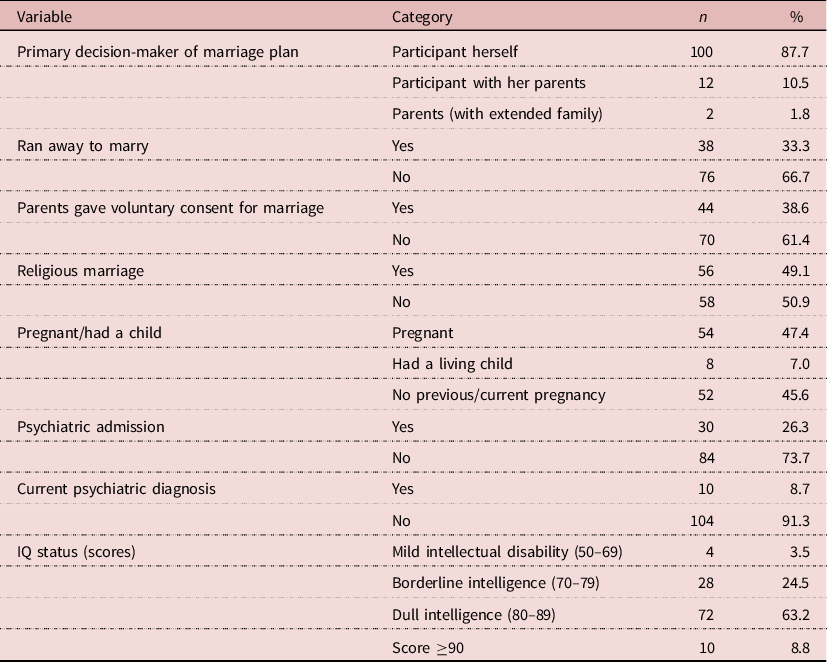
Evaluation of the features of the planned marriages showed that 49.1% (n=56) of girls had had a religious marriage at the time of evaluation. The majority of girls (87.7%; n=100) reported that the marriage was their own decision, and none reported having a forced marriage. Around a third of participants (33.3%, n=38) ran away from home to marry. The majority of parents (61.4%; n=70) reported that they did not actually want the marriage but felt obliged to allow it. The girl being pregnant was the major reported reason for this feeling of obligation (in 57.1% of fathers; n=40) (Table 2).
Features of the marriage that was being planned at the time of evaluation and clinical features of participant girls

The participants were asked about their reasons for wanting to get married. These were: wanting to live with their loved one (82%; n=92) and being pregnant/having a child (9%; n=11) (9% [n=11] of cases did not answer this question). Among the participants who ran away to get married (n=38), the reported reasons for this decision were: being pregnant (63.2%; n=24) and wanting to live with their loved one (26.3%; n=10) (10.5% [n=4] did not answer this question).
Examination of the clinical features of the participants revealed that 47.4% (n=54) of the girls were pregnant and 7% (n=8) had a child at the time of evaluation. A previous admission to child and adolescent psychiatry was present in 26.3% (n=30) of cases. An Axis 1 diagnosis was present in 8.8% of cases on the psychiatric evaluation based on DSM-5. The psychiatric diagnoses included; depression (n=5), behaviour disorder (n=4), anxiety disorder (n=4) and substance use disorder (n=1). The mean intelligence score (WISC-R total score) of the participants was 82.05±7.4 (55–94). Only 8.8% (n=10) had scores at or over 90 (meaning above the dull normal intelligence scores) (Table 3).
Comparison of participants by whether they ran away to marry

aFisher’s Exact test; bSpearman’s correlation; c χ 2 test; dStudent’s t-test.
NMW=national minimum wage.
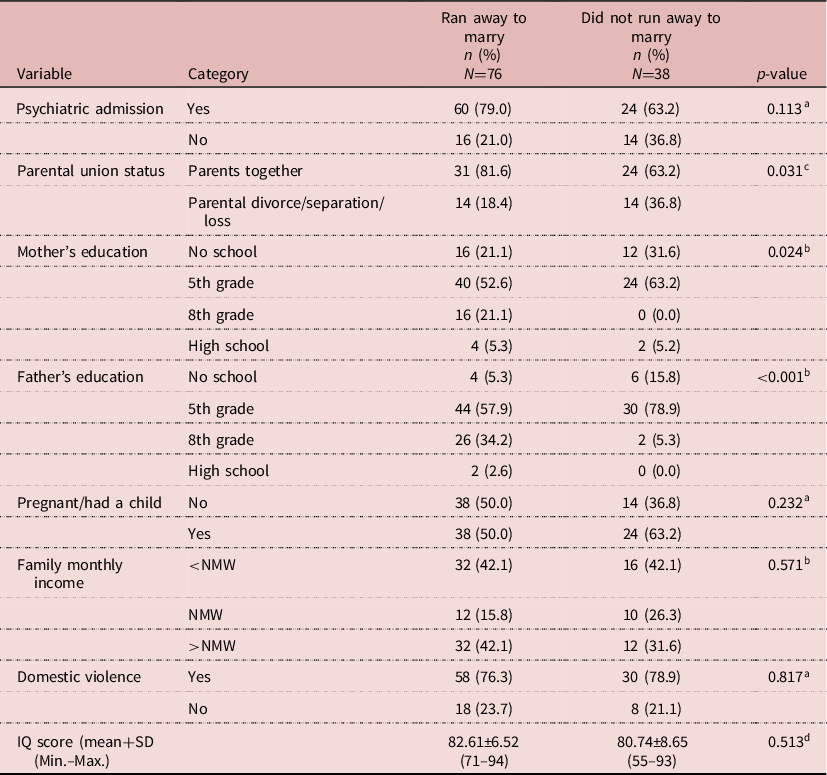
Comparison analysis showed that being pregnant/having a child was not related to having a previous psychiatric admission, IQ score, parental union status or parental educational status. Running away to marry was associated with lower parental educational levels (p<0.05) but unrelated to psychiatric admission or being pregnant/having a child (Table 3).
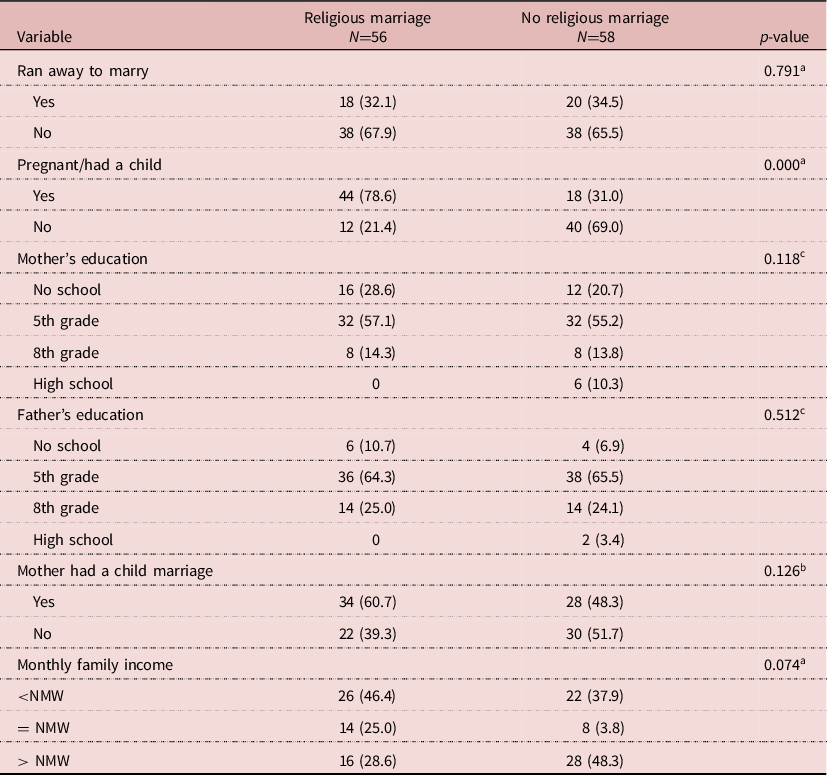
Comparison of girls according to whether they had a religious marriage showed that the rate of being pregnant/having a child was significantly higher in girls who had a religious marriage than in those who had not (71% vs 29%) (p<0.001) (Table 4). Among the participants who had a religious marriage (n=56), 46.4% (n=26) reported that they got pregnant after the marriage and 32.1% (n=18) reported that they were pregnant before the marriage.
Comparison of the participants according to whether they had a religious marriage

aχ 2 test; bFisher’s Exact test; cSpearman’s correlation.
NMW=national minimum wage.
Discussion
This study examined the socio-demographic, clinical and family characteristics of 16-year-old girls in Turkey who were referred from the courts to where they had applied to get judicial marriage consent. The results showed that these girls tended to be from low-income families and have lower than average educational levels of both themselves and their parents compared with people living in Istanbul province (Turkish Statistical Institute, 2020). Also, school drop-out was common among their candidate husbands. Child marriage, both among their parents and in their social environment, was common, and many of the participant girls who had a religious marriage were pregnant at their referral. The study results regarding the features of the participants’ planned marriages and clinics showed striking findings. First, none of the girls reported being forced into marriage. Secondly, many had run away from home to marry, with pregnancy being the major reason for this. More than half of the participating girls were pregnant or had a child at the time of evaluation, and the majority of them had IQ scores of below 90. Comparison analysis showed that running away to marry was significantly associated with lower educational levels of parents and that pregnancy was more common in girls who had had a religious marriage than those who had not.
Besides low socioeconomic and socio-cultural levels, social and religious norms and beliefs are important factors in the occurrence of early marriages. Approval of early marriage among girls by her social environment is reported to be one of the most important obstacles to preventing child marriages (Kaptanoglu & Ergocmen, Reference Kaptanoglu and Ergocmen2012). There is a vicious cycle whereby the children of adolescent mothers start life at a disadvantaged level of poverty and related disadvantage, especially in education and employment, leaving them at increased risk of child marriage (Maswikwa et al., Reference Maswikwa, Richter, Kaufman and Nandi2015). The results of this study show that educational and financial problems and the presence of child marriage in the social environment are important factors in legal child marriage in Turkey.
This study found a high rate of religious marriage among the participating girls. Many were already married with a religious bond before their referral. A high rate of religious marriage has been reported in a similar sample in a recent study in Turkey (Eyupoglu & Eyupoglu, Reference Eyupoglu and Eyupoglu2019). Besides socio-cultural norms and beliefs, marriage age is also influenced by religious beliefs (Aktepe & Atay, Reference Aktepe and Atay2017). A study from sub-Saharan Africa has shown a lower prevalence of child marriage and adolescent pregnancy in countries that have laws with no dispensation about first marriage at age 18 years or above, even after adjustment for socio-cultural, economic and religious status and rural–urban location (McFarlane et al., Reference McFarlane, Nava, Gilroy and Maddoux2016). Unfortunately, today in many countries children are still married off by their parents under customary and religious laws without any age limit (Marphatia et al., Reference Marphatia, Ambale and Reid2017). The results of this current study indicate that legal arrangements related to formal and religious marriages are not sufficient to prevent child marriages in Turkey.
Child marriages are reported to be associated with hidden or overt enforcement (Gangoli et al., Reference Gangoli, McCarry and Razak2009; Maswikwa et al., Reference Maswikwa, Richter, Kaufman and Nandi2015; Montazeri et al., Reference Montazeri, Gharacheh, Mohammadi, Rad and Ardabili2016). The Turkey Demographic and Health Survey (2013) demonstrated that there were high number of forced marriages among the women who married as children in Turkey. Similarly, a previous study on 48 girls who married before 15 years of age revealed that marriage without girls’ consent occurred in only 22.9% of cases (Soylu & Ayaz, Reference Soylu and Ayaz2013). Contrary to the literature on child marriage in younger groups, none of the girls reported being forced to marry. Moreover, the majority of parents reported that they did not actually want their daughters to marry. This finding may indicate that in Istanbul, which is a city of high socio-cultural developmental level, child marriages are not accepted among parents.
Among the participating girls, one-third ran away to marry, and more than half were pregnant or had a child at the time of evaluation. The majority had IQ scores well below the average mental capacity level. Pregnancy was the main reported reason for running away to marry (63.2%). Also, in the majority of girls (82%), the reported reason for willingness to get married was wanting to live with their loved one. In some underdeveloped countries child marriage has been practised for generations in order to protect girls from premarital sex and its unwanted consequences, such as pregnancy (McFarlane et al., Reference McFarlane, Nava, Gilroy and Maddoux2016). In the adolescent period, interest in the opposite sex and sexual drives increase but impulse control is weak. The prefrontal cortex, which regulates high cognitive functions such as behavioural control, planning and decision-making, matures later than other brain areas associated with other sensory and motor tasks, and this leads to increased risky behaviours in adolescence (Arain et al., Reference Arain, Haque, Johal, Mathur, Nel and Rais2013). This study’s findings on girls running away to marry and pregnancy status draw attention to the weak impulse control experienced during adolescence. The mental capacity of the study participants was not very acute, and this may have caused them more difficulty in achieving this control. Because marriage requires psycho-social and cognitive maturity, a weakness in impulse control leads to extra difficulties in the lives of individuals if they marry during their teenage years. The finding of this study related to intelligence score was not consistent with that of a recent study by Eyupoglu and Eyupoglu (Reference Eyupoglu and Eyupoglu2019) conducted in the Mardin province of Turkey. This reported that all girls who requested judicial consent for marriage had psychometric scores within the normal mental capacity range. This difference may be attributable to the socio-cultural and socio-economic differences in the samples of the two studies. For example, in rural regions, with their low economic and educational opportunities, cultural norms and beliefs are more important than educational and economic factors for marriage age (Matlabi et al., Reference Matlabi, Rasouli, Behtash, Dastjerd and Khazemi2013). However parental education is known to be an important factor in child marriage (Maswikwa et al., Reference Maswikwa, Richter, Kaufman and Nandi2015). Although child marriages are declining in frequency, the rate is still high in girls with illiterate fathers (Kaptanoglu & Ergocmen, Reference Kaptanoglu and Ergocmen2012). This current study demonstrated that in these girls, running away to marry was associated with lower parental education level, just like child marriages at younger ages. This finding underlined the important impact of parental education on the marriages of their offspring.
Early pregnancy is dangerous for psychological and physical well-being and has been found to be associated with many factors, including individual (educational status, low self-esteem, alcohol and substance abuse, inability to resist sexual drive/impulse), socio-cultural, environmental and economical (poverty, religious beliefs, lack of parental counselling and guidance, poor sexual education given by parents, and in school) and health service related (lack of comprehensive sexual education, poor adolescent reproductive lessons) determinants (Yakubu & Salusi, Reference Yakubu and Salisu2018). Moreover early pregnancy is one of the negative consequences of child marriage (Taner et al., Reference Taner, Cetin, Isik and Iseri2015; Marphatia et al., Reference Marphatia, Ambale and Reid2017). The current study demonstrated that having a pregnancy as a child, although not related to the child’s clinical and familial characteristics, was significantly higher in those who had religious marriages. Among those with a religious marriage (n=56), the majority (78.6%) were pregnant/had a child, and nearly half (46.4%) got pregnant after the religious marriage. These findings points to the fact that early pregnancy is still an important result of early marriage even in this century of high access to knowledge. It has been asserted that the most important step in preventing these pregnancies is to prevent early marriages (Seckin et al., Reference Seckin, Yucel, Karsli, Ozdemir, Togrul and Celik2016).
However, the findings of this study showed that pregnancy was present before the marriage in nearly a third of cases with religious marriage and it was also common in cases without religious marriages – in other words, in cases which had not married with religious requirements. Besides, in the parents who did not want their daughter’s marriage, pregnancy was the most commonly reported reason for allowing the marriage of the girl. These findings suggest that pregnancy is not only a resultant factor but also a precipitating factor for child marriages, and underlines the fact that these girls had premarital and early sexual relations and were lacking in psycho-sexual education and sexual protection.
Inadequate sexual health and sexual protection education and misconceptions about contraceptives are important factors related to early pregnancies (Yakubu & Salisu, Reference Yakubu and Salisu2018). In sub-Saharan Africa, sexual relations and unplanned pregnancies often precede child marriages (Petroni et al., Reference Petroni, Steinhaus, Fenn, Stoebenau and Gregowski2017). This may be associated with the religious and cultural prohibition of premarital sexual activity and termination of pregnancy, which push girls and their families into child marriage. Many societies consider premarital sexuality to be an important taboo, influenced of cultural and religious beliefs. In societies where premarital relationships are not accepted, marriage can be early in order to start a sexual life. A study from Iran found that some married adolescents reported that they married to meet their sexual needs (Montazeri et al., Reference Montazeri, Gharacheh, Mohammadi, Rad and Ardabili2016). Moreover, leaving school, which is required for socialization and sexual education, may prevent these children from learning about sexual health and protection, which in turn may lead to early sexual intercourse and early and unwanted pregnancy.
A striking finding of this study was related to the psychiatric evaluations of the participants. Although child marriages have been reported to be associated with higher risk of psychiatric problems (Chandra-Mouli et al., Reference Chandra-Mouli, Camacho and Michaud2013), the results of this study did not show higher rates of current Axis 1 diagnosis in those girls who requested legal child marriage. Although almost a quarter (26.3%) reported a previous psychiatric admission, only small percentage (8.8%) had an Axis 1 psychiatric diagnosis, and this rate was lower than the Turkish norm. A recent multicentre nationwide epidemiological study of psychopathology in Turkish children reported the overall prevalence to be 17.1% (Ercan et al., Reference Ercan, Polanczyk, Ardic, Yuce, Karacetin and Tufan2019). It could be that the reason for this low psychiatric rate was the tendency of the study participants to hide symptoms that they thought might hinder their chances of being allowed to marry.
The most important limitations of this study were related to the sample, which was small in size and only included participants from one centre in a metropolis area. This was therefore not representative of the whole country. Another limitation was related to its retrospective design, which was based on file scanning.
In conclusion, to assess the factors associated with legal child marriages in Turkey, 16 year-old girls who applied to courts to get judicial consent for legal marriage were investigated in the current study. The results showed that these marriages tended to be in families of low economic and educational level, similar to previous studies on child marriages. However, forced marriages were not reported in any of the girls, contrary to the literature related to child marriage. Many of the girls had a history of running away from home to be married, and this was related to the lower educational status of parents. Moreover, many had already been married with a religious bond. In particular, these marriages were closely associated with early premarital sexual intercourse. The study findings suggest that the prevention of legal child marriages of 16-year-old girls in Turkey requires regular school attendance in an established educational system and comprehensive sexual health education both at home and at school. Further studies with a larger sample size are needed to confirm the factors associated with early pregnancy, premarital sexuality and the educational problems underlying child marriages in Turkey.
Acknowledgments
The authors thank all the girls and their parents for their participations in the study.
Funding
This research received no specific grant from any funding agency, commercial entity or not-for-profit organization.
Conflicts of Interest
The authors have no conflicts of interest to declare.
Ethical Approval
This retrospective study was approved by the local Ethic Committee of Bakirkoy Dr. Sadi Konuk Training and Research Hospital with protocol number 2018/435 and decision number 2018.21.08. All procedures contributing to this work comply with the ethical standards of the relevant national and institutional committees on human experimentation and with the Helsinki Declaration of 1975.