1 INTRODUCTION
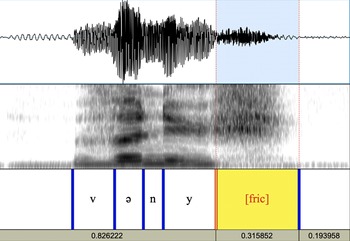
Phrase-final fricative epithesis (PFFE), a phenomenon also known in the literature as phrase-final vowel devoicing (PFVD), refers to a well-attested phenomenon in Hexagonal French (HF) in which breath group-final vowels lose their voicing and give way to a short burst of high-frequency aperiodic energy, akin to a fricative, e.g. mais oui_chh [mεwiç], merci beaucoup_hhh [mεʁsibokux] (Figure 1). The occurrence of this phonetic behaviour is not absolute – not all HF speakers use the variable, and it is not realized it in every possible situation among those who do (Candea etal., Reference Candea, Wottawa, Adda-Decker and Lamel2020) – nor is it unique to spoken French (see Myers (Reference Myers2005) for a discussion of “final vowel devoicing” in Kinyarwanda), but its emergence can be explained through the convergence of several articulatory and prosodic behaviours characteristic of the language: a high degree of articulatory tension during vowel articulation, decreasing articulatory energy throughout the breath group and lengthening in intonation phrase-final position (Straka, Reference Straka1979). The first linguistic description of this phenomenon defined it as the emergence of “sharp, phrase-final whistles” (Fónagy, Reference Fónagy1989); subsequent research witnessed a split in nomenclature, with researchers publishing in North American venues often opting for a name focusing on voicing loss – “vowel devoicing/dévoisement vocalique” (Fagyal & Moisset, Reference Fagyal and Moisset1999; Smith, Reference Smith2002; Reference Smith2003; Reference Smith2006; Martin, Reference Martin2004), and those publishing in European venues opting for one focusing on the emergence of the downstream fricative – “fricative epithesis/épithèse (consonantique) fricative” (Fagyal, Reference Fagyal2010; Candea, Reference Candea2012; Candea, Adda-Decker & Lamel, Reference Candea, Adda-Decker and Lamel2013; Candea etal., Reference Candea, Wottawa, Adda-Decker and Lamel2020). Because the present study will focus on characterizing the occurrence of graphical representations of the emergent downstream fricative as portrayed in social media writings, the term “fricative epithesis” has been intentionally selected.
PFFE on the spectrogram: venu ‘came’. The PFFE corresponds to the final, highlighted segment—characterized by the lack of a voicing band (spectrogram) and the presence of aperiodic energy (waveform) – immediately following the articulation of the vowel [y] – characterized by the presence of full formant structure (spectrogram) and periodic energy (waveform).

Much attention has been paid in the last 25 years to understanding the mechanisms behind the production and social distribution of the PFFE variable in varieties of European and Canadian French. Early work focused itself on determining the variable’s structural predictors (Fagyal & Moisset, Reference Fagyal and Moisset1999; Smith, Reference Smith2003; Reference Smith2006; Martin, Reference Martin2004). Investigations into the variable’s social predictors were early (Fagyal & Moisset, Reference Fagyal and Moisset1999; Smith, Reference Smith2006) and are on-going (Candea, Reference Candea2012; Candea, Adda-Decker & Lamel, Reference Candea, Adda-Decker and Lamel2013; Dalola, Reference Dalola2014), with its high saliency also inspiring a series of studies examining its usage among advanced L2 French speakers (Dalola, Reference Dalola2014; Dalola & Bullock, Reference Dalola and Bullock2017). Investigations into the perception of PFFE have been much less frequent but instructive, revealing the variable’s reception among L1 French users as similar to that of other markers of covert prestige (Paternostro, Reference Paternostro2008), and signaling stark perceptual differences between L1 and L2 French users (Dalola, Reference Dalola2014; Reference Dalola2016).
What unites the previous work on PFFE is that it has all involved an acoustic or perceptual analysis of recorded spoken data. The goal of the present study is to extend this line of sociophonetic research into the realm of written digital media, in this case, Twitter. This platform not only affords ample displays of formal and affected speech but has also been shown to feature a less stringent, more creative and phonetically approximative writing style which gives linguists keen insight for monitoring socially distributed sound changes in real time (Eisenstein, Reference Eisenstein2015; Tatman, Reference Tatman2015; Reference Tatman2016; Lamontagne & McCulloch, Reference Lamontagne and McCullochthis issue; Law, Reference Lawthis issue). In this chapter, we will use the structural and social findings of earlier work on PFFE to test the previously reported perceptual findings in a novel, digital corpus collected from Twitter, and document for the first time the emergence and nascent stabilization of the PFFE sociophonetic variable in writing. This chapter situates itself in the larger volume through its shared use of creative phonetic spelling as a means of tracking the social and pragmatic predictors of a sociophonetic variable in real time.
2 STATE OF RESEARCH
2.1. Structural Predictors
Much of the previous scholarship on PFFE has focused on diagnosing its structural, prosodic, phonological and lexical conditioning among native speakers of HF. The phenomenon has been observed following all vowels in French (Smith, Reference Smith2006) but has been documented most robustly after the series of high vowels, /i,y,u/ (Fónagy, Reference Fónagy1989; Fagyal & Moisset, Reference Fagyal and Moisset1999; Smith, Reference Smith2003; Reference Smith2006; Martin, Reference Martin2004). Among different speech types (read/planned and conversational/impromptu), PFFE has been found to occur at significantly higher rates in read speech (Fagyal & Moisset, Reference Fagyal and Moisset1999; Dalola, Reference Dalola2014); among different sentence types (declarative statements, echo questions, partial questions, inverted questions), it has been found at significantly higher rates at the end of declarative statements, and more generally, at the end of the intonation phrase, where, in French, the intonation falls (Fagyal & Moisset, Reference Fagyal and Moisset1999; Smith, Reference Smith2003). The phonetic and phonological properties of preceding consonantal segments have also been examined, to reveal PFFE at significantly higher rates when preceded by stop consonants (as compared to other manner types), however, this research found no conditioning effects for the preceding consonant’s voicing or place of articulation (Dalola, Reference Dalola2015b). Lexical frequency has also been found to play a role, with more frequent words more likely to exhibit PFFE than less frequent ones (Dalola, Reference Dalola2015b). Although no account has documented PFFE as having fully lexicalized in any single form, the word oui ‘yes’ has been suggested to be well on its way, as it oftentimes sports an epithesized fricative in speech, even outside of the usual phrase-final domain of the phenomenon (Smith, Reference Smith2006).
2.2. Social Predictors
Commonly associated with HF, spoken in and throughout France, PFFE has been more narrowly associated with Parisians (Fagyal & Moisset, Reference Fagyal and Moisset1999; Fagyal, Reference Fagyal2010; Smith, Reference Smith2006), and more broadly associated with speakers from other metropolitan centres in France, such as Lyon and Strasbourg (Dalola, Reference Dalola2014). Dalola (Reference Dalola2014) also reported the variable in the speech of adult French expatriates who had been living in the United States for an extended period, anywhere from 2 months to 31 years, but that had regular (albeit virtual) contact with francophone populations back home. Outside of France, the behaviour has been documented in the speech of French, Belgian and Canadian news anchors (Paternostro, Reference Paternostro2008), a description that might suggest extranational conformity to a perceived prestige variety, more so than index France itself. Similarly, several studies in television and radio media have described it as a common linguistic tic prevalent in the speech of young or inexperienced news anchors (Paternostro, Reference Paternostro2008; Candea, Reference Candea2012; Candea, Adda-Decker & Lamel, Reference Candea, Adda-Decker and Lamel2013). In its original description (Fónagy, Reference Fónagy1989), PFFE was exemplified in the speech of female speakers, causing many early studies to examine the variable’s occurrence uniquely or primarily among women (Smith, Reference Smith2006; Fagyal & Moisset, Reference Fagyal and Moisset1999, respectively), although later work has documented its occurrence at statistically similar rates in the speech of both men and women (Dalola, Reference Dalola2014; Candea, Adda-Decker & Lamel, Reference Candea, Adda-Decker and Lamel2013; Candea, Reference Candea2012). Examinations of age on PFFE usage have been somewhat inconclusive: one study operationalized age via a categorical variable with three levels and found PFFE to be most prevalent in the peripheral age groups (16-35 years and 61-85 years) (Fagyal & Moisset, Reference Fagyal and Moisset1999), while another used a continuous operationalization of age and found speakers to be marginally more likely to produce PFFE the older they were (Dalola, Reference Dalola2014).
2.3. L2 Speakers
Recent work has also identified PFFE in the L2 French of advanced speakers in the United States (Dalola, Reference Dalola2014; Dalola & Bullock, Reference Dalola and Bullock2017). An initial study employing wordlist and reading tasks reported rates of PFFE use to be significantly higher in L2 users than L1s (Dalola, Reference Dalola2014), but a follow-up study targeting a wider range of task types and pragmatic shifts clarified this finding by reporting similar rates of use across speaker groups but different conditioning factors. Dalola & Bullock (Reference Dalola and Bullock2017) reported that L1 users produced PFFE more often in roleplay scenarios, while L2 users employed it more often when reading wordlists. They also examined the duration of the epithesized fricative and found that L1 speakers were most sensitive to pragmatic shifts when realizing this dimension of the variable, while L2 speakers proved instead most sensitive to task shifts. This resulted in L1 users producing longer fricatives in slower and formal speech, and L2 users producing longer fricatives only in the word list task (Dalola & Bullock, Reference Dalola and Bullock2017). Despite the abundance of associations between PFFE and various social categories within L1 HF communities, this same study found no effects for gender or age on its distribution or duration among advanced L2 speakers (Dalola & Bullock, Reference Dalola and Bullock2017).
2.4. Perceptual Value
To date, only two perception studies surrounding PFFE in francophone communities are described in the literature. The first (Paternostro, Reference Paternostro2008) follows the Lambert etal. (Reference Lambert, Frankle and Tucker1966) methodology of matched-guise design, by surveying the language attitudes of PFFE-ful speakers and speech among francophone listeners via sets of bipolar scales targeting qualities of personality, competence and demeanor, e.g., vulgaire ‘vulgar’ ∼ recherché ‘refined’, entrecoupé ‘halting’ ∼ fluide ‘fluent’, monotone ‘dull’ ∼ mélodieux ‘melodious’. A group of 25 L1 francophone listeners in a Belgian context (originating from francophone areas of Belgium, Luxembourg, Switzerland and France) were asked in separate tasks to rate both speakers and speech samples on a 7-point scale for each of a set of bipolar scales. Results reported speakers using PFFE to be perceived as more vulgar, more crude, less cultured, less learned, and more reminiscent of the middle class than speakers who did not use PFFE, while speech containing PFFE was perceived as warmer, friendlier, more charming/quaint (=pittoresque), more melodious, more jovial, more pleasant and more fluent than speech without it. In a later series of matched-guise tasks examining both L1 and L2 percepts of the variable and the effect of PFFE length in conditioning them, Dalola (Reference Dalola2014; Reference Dalola2016; Reference Dalolain progress) asked a similar set of questions and observed via exploratory factor analysis that the perceptual value of PFFE was different across speaker groups: L1 French speakers rated it highly for traits of ADMIRABILITY (an umbrella term chosen by the author for the factor containing the adjectives: well-educated, professional, polite, confident, trustworthy, respectable, believable, speaks clearly, intelligent, patient, persuasive, I would like to speak like X) and INTENSE AFFECT (an umbrella term chosen by the author for the factor containing the adjectives: aggressive, bourgeois, superficial, bossy, native speaker, speaks with emotion), while L2 speakers rated it highly for far fewer traits (8 versus 18), and only those marking ADMIRABILTY (an umbrella term chosen by the author for the factor containing the adjectives: confident, persuasive, respectable, trustworthy) and FORMALITY (an umbrella term chosen by the author for the factor containing the adjectives: polite, well-educated, speaks clearly, speaks formally). She also reported a length effect that suggested that both speaker groups were able to hear the difference between no PFFE versus some PFFE in speech, but not the difference between a mean-length PFFE versus a long PFFE (= mean + 3 standard deviations). Listeners in both groups rated samples +2.14 points higher for the adjectives in each of the factors versus the ungrouped adjectives. A significant interaction revealed that L2 listeners also made a rating distinction between mean-length PFFE and long PFFE, scoring the long variants on average +0.5 points higher, but only in the case of the ADMIRABILITY factor.
2.5. Motivation
The primary goal of this research is to conduct the first ever analysis of PFFE in a corpus comprised of written social media data, in order to investigate how a sociophonetic variable might be graphically rendered in a text- and visual-centric medium that proliferates with creative orthographic representations and what those representations might indicate about the variable’s saliency and evolution in spoken language and emergence and stabilization in the written form. Any text-based social media platform would afford such an investigation of form and distribution – that Twitter is also a space where many of the relevant emotional traits seemingly attached to the variable are notoriously performed by users of all kinds daily is a serendipitous coincidence.
First, we will examine the affect type of the tweets in which PFFE occurs, to see if it aligns with the previous perceptual research that found it to index features of FORMALITY and INTENSE AFFECTFootnote 2 (RQ #1)(Dalola, Reference Dalola2014; Reference Dalola2016; Reference Dalolain progress). Next, we will investigate if men and women recognize these two affect categories with respect to PFFE-manifestation at similar rates (RQ #2). Finally, we will explore the role of structural and lexical properties in conditioning the presence of PFFE in tweets, by examining the lexical frequency and structural position of the hostwords (RQ#3). We will close with a discussion of what PFFE’s distribution on Twitter might suggest about the variable’s future in written and spoken HF.
3. METHODS
3.1. Orthographic Representations of PFFE
Because PFFE results in audible high-frequency aperiodic energy, the relevant acoustic percept is most commonly a high-frequency fricative. Although the spectral quality of PFFE fricatives has been reported to vary allophonically, relative to the backness of its hostvowel (Fónagy, Reference Fónagy1989; Dalola, Reference Dalola2015a; Dalola & Bridwell, Reference Dalola and Bridwell2019, Reference Dalola and Bridwell2020, Reference Dalola and Bridwellin press; Candea etal., Reference Candea, Wottawa, Adda-Decker and Lamel2020), acoustically, relative to the fricative-vowel ratio of its hostvowel (Dalola & Bridwell, Reference Dalola and Bridwell2019, Reference Dalola and Bridwell2020, Reference Dalola and Bridwellin press) and socially, relative to the L1 or L2 speakergroup of the speaker producing it (Dalola & Bridwell, Reference Dalola and Bridwell2020, Reference Dalola and Bridwellin press), the phenomenon is conceptually mapped somewhat uniformly to French phoneme [ʃ], the voiceless alveopalatal fricative. As a result, -ch and -che are its most common orthographical representations when written. A pilot study examining the variable in social media discourse (Dalola, Reference Dalola2017) revealed other variants, including -sh and -h, which produces a fricative with much lower, more diffuse energy, as well as those containing several repetitions of these same letters. Given that the PFFE variable is subphonemic and realized in final position, the current analysis will target occurrences of the above allographs that occur as suffixes on pre-existing French words.
3.2. Corpus and Extraction
The corpus of tweets for this analysis was extracted from Twitter using the TwitteR package (Gentry etal., Reference Gentry and Gentry2016) during a period of 20 months (from July 2019 to March 2021). Because this package does not allow for the extraction of tweets for more than three days prior to the sample date, the remainder of the tweets were collected manually using Twitter’s Advanced Search function. This allowed for the consideration of every potential instance of PFFE on Twitter in the public domain – thus, the tweets in this corpus date back to November 2009. Due to the variable’s well-established association with Hexagonal French, tweets were pulled from a 300-mile radius of 46.45° N latitude and 2.24° E longitude, coordinates which indicate the geographic centre of France, in an attempt to target varieties of French tweeted from within the Hexagon. It should be noted, however, that the use of GPS coordinates to constrain the location of tweeters is not without issue – Graham, Hale and Gaffney (Reference Graham, Hale and Gaffney2014) report that the use of geolocations on Twitter is often unreliable, due to users’ false indication of residence information in their profiles. To that end, the researcher has taken a tweeter’s combined usage of French and their indicated geolocation on Twitter as being adequate criteria for inclusion in the present corpus.
The subphonemic and phrase-final position of the variable suggests that it will be written as a bound suffix attached to other words. For that reason, a snowball sampling method was used to locate it: the search began with PFFE’s most common hostword oui (c.f. Smith (Reference Smith2006) who found PFFE occurring on this word even in non-final locations), which was combined with each attested allograph as a suffix to yield the search strings ouich, ouiche, ouish, ouih, each of which was mined for with the GPS criteria separately. From the collection of tweets containing one of the “yes” forms, a list of all other lexical items bearing a PFFE suffix in the tweet was compiled, and each of those lexical items was subsequently queried independently, combined with each of the four possible suffixes. This process was repeated until all words that had appeared in a tweet bearing a PFFE suffix had been queried independently with each possible suffix. This resultant list of PFFE-bearing words was then manually inspected, to remove established words that happened to end in a PFFE character string, e.g. quiche, ouiche liste, as well as Twitter handles that appear in the text when one tweeter replies to or quotes another. The resultant corpus contained 2060 tokens of PFFE on 299 lemmas comprising 1843 tweets sent by 1686 tweeters. Each token was then coded for tweeter gender (man, woman – as determined by pronouns in their profile and their adjectival agreement in French), pragmatic category of the tweet (formality, intense affect, other), location of the hostword with PFFE in the phrase (constituent-final, not constituent-final) and lexical frequency of the hostword (continuous: Leipzig Corpora Collection, 2020).
3.3. Methods for Coding
3.3.1. Affect Category
Tweets were categorized as exhibiting traits of formality, intense affect or other, based on the sum of their lexical and iconic, i.e. emojis, images and gifs, content in the full context of the multiple-tweet discussion in which they appeared. Individual lexical items generally did not singlehandedly earn their tweet a classification into a given affect category, with a few notable exceptions: a label of formality was given to the tweets containing non-ironic uses of merci ‘thank you’, je t’/vous en prie ‘please/you’re welcome’ and s’il te/vous plaît ‘please’. This was also sometimes represented via the use of the folded hands emoji, a common equivalent in messages of thanks. Intense affect was occasionally assessed based on the presence of charged lexical items, e.g. expletives and insults, but was more frequently detectable through the presence of emotion-indicating emojis, e.g. laughing-crying face, or capital letters, e.g. J’AI DIT NON ‘I SAID NO!’, a common crosslinguistic writing strategy to represent shouting. Tweets that didn’t contain any overt lexical or iconic markers of formality or intense affect were given a label of “other” and later classified into meaningful pragmatic subgroups based on their lexical and iconic content and discursive strategies, e.g. alignment, disalignment. Tweets were categorized along these lines manually and by a single researcher, introducing the possibility of error and bias, both potential limitations of this method.
3.3.2. Gender
A tweeter’s gender was determined by a manual inspection of their Twitter profile page for the overt mention of pronouns and adjectival agreement and/or an observation of the ways in which they and others used adjectival agreement to talk about themselves/each other in publicly visible tweets. No nonbinary tweeters using the pronouns iel, œl, or ille, alternating masculine and feminine adjectival agreements, e.g. using heureux ‘happy m.sg.’ one time and heureuse ‘happy f.sg.’ the next, both in reference to themselves, concatenated forms, e.g. amoureux.se, content.e, or novel nonbinary forms, e.g. fatiguet, amoureu, were observed in this dataset.
3.3.3. Lexical Frequency
Continuous measures of lexical frequency were taken from the French Mixed Corpus based on material from 2012 (Leipzig Corpora Collection, 2020), which contains approximately 1.5 billion tokens and 75 million sentences. The frequency metric selected for this analysis was Frequency Class, a gross score that normalizes measures of frequency across different corpora by grouping words of similar frequencies into the same class and assigning them a number from 0-20. On this scale, the most frequent items are in the frequency class awarded the score of 0: those in frequency class 1 are found in the corpus roughly half as often as frequency class 0 and those in frequency class 2 are found roughly half as often as frequency class 1, etc. In large corpora such as this one, extremely rare words may have a frequency class of 20 or higher. The lexical items from the present study ranged in frequency class from 0 de ‘of/from’ to 24 betonnerie ‘concrete work’ and xptdr ‘an internet acronym meaning ‘exploded from laughter’’; the scores were treated as continuous variables in the statistical analysis.
3.3.4. Structural Position
Structural position in this analysis was determined to be constituent-final or not constituent-final based on the placement of accentual phrases (groupes rythmiques). Tweets were broken up into sentences following overt punctuation in the tweet (final punctuation was assumed insituations where none was indicated but there was an observable grammatical break and/or topic shift, e.g. tu vois_c’est pas grave ‘you see, it’s no big deal’. Sentences were then broken down into accentual phrases following the structural tendencies of written French (Dansereau, Reference Dansereau2006). Given that the creation of accentual phrases in French is largely subjective (following constituency guidelines) and that the meaningful determination in this analysis was whether or not the item bearing the PFFE was in constituent-final position, smaller accentual phrases were assumed over larger ones when it was otherwise impossible to tell, in an effort to not overstate any finding that might emerge surrounding PFFE’s occurrence non-finally.
3.4. Statistical Analysis
The data were submitted to descriptive and inferential statistical tests in R (version: 3.6.1: R Core Team, 2019). The research question of affect type (RQ#1) used descriptive statistics to tabulate the number of tweets in each affect category (formality, intense affect, other). The question of gender (RQ#2) made use of a factorial logistic regression using the lme4 package (Bates etal., Reference Bates, Mächler, Bolker and Walker2015), in which binary measures of pragmatic category (formality, intense affect) were examined as a function of tweeter gender and hostword location in the phrase. The question investigating lexical frequency and structural position (RQ#3) used a factorial linear regression using the lme4 package (Bates etal., Reference Bates, Mächler, Bolker and Walker2015), in which continuous measures of lexical frequency were examined as a function of tweeter gender and hostword location in the phrase.
4. RESULTS
4.1. Affect
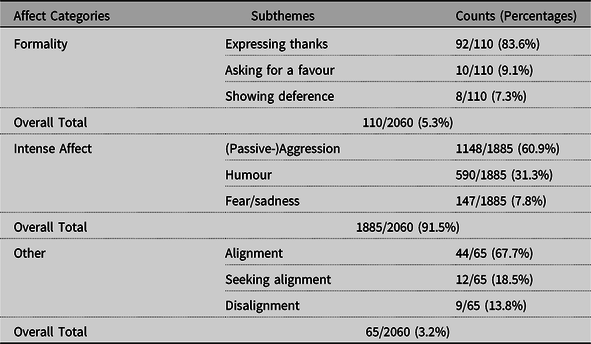
About 96.8% of the tweets (1995/2060) in the corpus were classified into the affect categories of Formality and Intense Affect. Following the examination of each category’s contents, tweets in the Formality categoryFootnote 3 were organically grouped into the subthemes of expressing thanks, asking for a favour and showing deference; tweets in the Intense Affect category were organically grouped into subthemes of (passive)-aggression, humour and fear/sadness; tweets in the Other category were organically grouped into subthemes of alignment, seeking alignment and disalignment. The distribution of tweet in each category and subtheme is visualized in Table 1.
Tweet counts per affect category

Example tweets from each affect category are shown in (1) and (2), respectively. Instances of PFFE are tagged in the English glosses with ‘PFFE’. Usernames have been removed to protect the anonymity of tweeters who are not public figures.


(1a) exhibits the use of PFFE in the expression of gratitude by the tweeter to a known, specific individual for an item they have received, here, a Lego set of the Eiffel Tower. The tweets in (1b-c) present extensions of this, in that they not only portray expressions of gratitude, but are preceded by requests for information and/or participation and are addressed to a general, unspecified public. (1d-e) present polite affirmative replies to earlier tweets requesting favours, none of which contained PFFE prior in the interaction; (1e) specifically shows deference to an interlocutor in a position of power. Except for the use of multiple exclamation points to indicate an excessive willingness to comply with a request, as portrayed in (1e),Footnote 4 no other creative uses of iconicity are reported in the collection of tweets comprising the Formality category.
(2a) exhibits the use of PFFE in the expression of humour: it applies the variable not only to recognizable lexical items, but also to an innovative acronymic form (XPTDR) that has a comically more intense reading than the two individual acronyms it is a combination of (XPLDR = explosé.e de rire + PTDR = pété.e de rire). (2b-d) present instances of PFFE to mark passive-aggression (2b) and overt aggression (2c-d): In (2b), the tweeter appears to “thank” the French railway company for its service with a PFFE-suffixed merci ‘thanks’, but actually signals a thinly veiled complaint about said railway company’s lack of punctuality. (2c-d) are more explicit expressions of aggression: (2c) witnesses the tweeter stating their opinion and then telling the known, specified recipient of the message via the use of an imperative to shut up, while (2d) issues a threat in the form of an enthusiastic statement of a violent future plan. (2e) presents an instance of PFFE to mark sadness. In this case, the tweeter reinforces this sentiment via the use of a frowning emoticon. It should be noted that the Intense Affect category witnessed a regular exploitation (797/1885 or 42.3%) of iconicity in the tweets via the use of capital letters to signal (both good and bad) screaming, a practice that is common across many digital platforms (McCulloch, Reference McCulloch2020).
The remaining 3.2% of all tweets that did not exhibit traits of Formality or Intense Affect were organically grouped into the subgroups of Alignment, Seeking Alignment and Disalignment, behaviours by which tweeters sought to express agreement with an interlocutor, earn agreement from an interlocutor or express disagreement with an interlocutor. Examples from each category are shown in (3).

(3a-b) exhibit the use of PFFE to express agreement with an interlocutor’s previous message. In each instance, there is also the admission of a realization by the tweeter that what the interlocutor has previously said is correct: In (3a), this is signaled via the presence of Ahhhhhh ‘Ohhhhh’, in (3b) via both Ah ‘Oh’ and en effet ‘indeed’. (3c) presents an identical structure to that observed in (3a-b), but the use of Euh ‘uhhh’, a marker of hesitation, serves to present an air of doubt on the behalf of the tweeter, thereby suggesting that they wish to disalign themselves with what the interlocutor has said, rather than align. (3d) presents a situation of one interlocutor trying to convince another to espouse their belief system, using the PFFE-marked lexical item to establish solidarity between them.
4.2. Affect Category
To observe the role of gender and structural position in predicting the occurrence of PFFE in the previously described affect categories, a series of three factorial logistic regressions were run: one investigating gender and structural position differences in the recognition of both affect categories, one investigating gender and structural position differences within the Formality category and one investigating gender and structural position differences within the Intense Affect category.
4.2.1. Combined affect categories
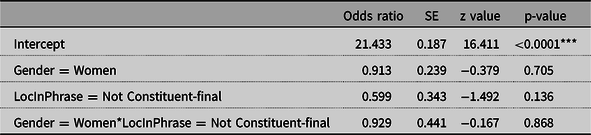
Binary measures of Affect category (formality, intense affect) were submitted to factorial logistic regression with Gender (men, women) and Location in Phrase (constituent-final, not constituent-final) as independent variables. The model output is visualized in Table 2.
Factorial Logistic Regression: Affect Category as Predicted by Gender and Structural Position

No significant main effects or interactions were observed between the variables, suggesting that men and women use PFFE to collectively mark formality or intense affect in tweets in similar ways in all phrasal positions. This means that one gender group does not show evidence of marking one of the affect categories or one of the phrasal locations more readily with PFFE than the other, suggesting the absence of a gender effect in the overall rendering of PFFE in French-language tweets. The lack of a main effect for location in phrase also suggests that PFFE, at least in written tweets, may no longer be constrained to phrase-final position.
4.2.2. Formality category
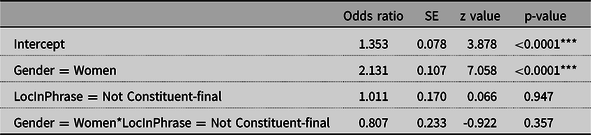
Binary measures of Formality Category Fit (no, yes) were submitted to factorial logistic regression with Gender (men, women) and Location in Phrase (constituent-final, not constituent-final) as independent variables. The model output is visualized in Table 3.
Factorial Logistic Regression: PFFE in Formality Category as Predicted by Gender and Location in Phrase

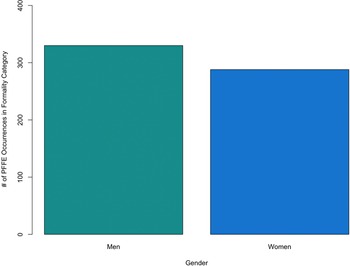
A significant main effect for Gender was found, such that women were 52% less likely than men to use PFFE to mark instances of formality (p<0.0001), as illustrated in Figure 2. This finding suggests that men are more likely to use PFFE to mark situations of formality in French-language tweets than women. The lack of an interaction or main effect involving phrasal location suggests that PFFE is used to mark formality at a similar rate in both phrase-final and non-phrase-final positions in tweets.
PFFE Occurrences in Formality Category by Gender.

4.2.3. Intense Affect category
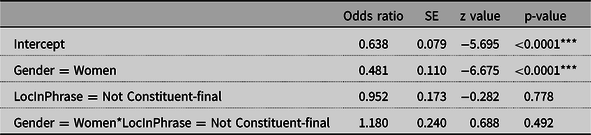
Binary measures of Intense Affect Category Fit (no, yes) were submitted to factorial logistic regression with Gender (men, women) and Location in phrase (constituent-final, not constituent-final) as independent variables. The model output is visualized in Table 4.
Factorial Logistic Regression: PFFE in Intense Affect Category as predicted by Gender and Location in Phrase

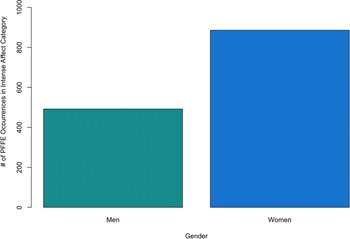
A significant main effect for Gender revealed that women were 2.1 times more likely to use PFFE to mark an instance of intense affect than men (p<0.0001), as illustrated in Figure 3. This means that men are only half as likely as women to use PFFE to mark situations of intense affect in French-language tweets. The lack of an interaction or main effect involving structural position suggests that PFFE is used to mark intense affect at a similar rate in both phrase-final and non-phrase-final positions in tweets.
PFFE Occurrences in Intense Affect Category by Gender.

Taken together with the findings from above, the overall pattern suggests that both men and women use PFFE to observe situations of formality and intense affect, and they do so in both phrase-final and non-phrase-final positions in their tweets. However, men are more likely to use PFFE to be formal (express thanks, ask for a favour and show deference), while women are more likely to use it to express intense affect, in particular (passive)-aggression, humour and fear/sadness.
4.3. Lexical frequency & structural position
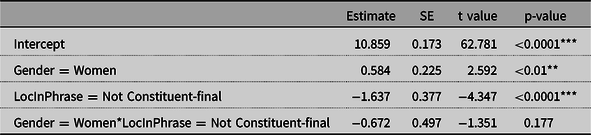
Continuous measures of lexical frequency were submitted to factorial linear regression with Gender (man, woman) and Location in phrase (constituent-final, not constituent-final) as independent variables. The model output is visualized in Table 5.
Factorial Linear Regression: Lexical Frequency in Words with PFFE as Predicted by Gender and Location in Phrase

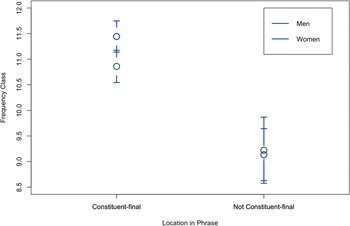
A significant main effect for gender revealed that women apply PFFE to lower frequency words, corresponding to frequency measures that are on average 0.584 points higher (higher measures = lower frequency words) than men (p<0.01), as visualized in Figure 4. This suggests that women use PFFE across a wider range of word frequencies than men. If PFFE has begun to lexicalize in certain high-frequency words, then this finding would suggest that women’s use of the variable does not seem to be centered predominantly around such forms.
Frequency Class by Gender and Location in Phrase.

A significant main effect for location in phrase revealed that words with PFFE in non-constituent-final position possessed a higher lexical frequency, corresponding to frequency measures that are on average 1.637 points lower, than those bearing PFFE in constituent-final position (p<0.0001), as visualized in Figure 4. This suggests not only that PFFE in French-language tweets is not restricted to phrase-final position, but that the structural constraints predicting its occurrence in speech may be loosening via a path that first witnesses its extension to high-frequency items in novel structural positions.
5. DISCUSSION
The Formality and Intense Affect categories associated with PFFE, as laid out in Dalola (Reference Dalola2014; Reference Dalola2016; Reference Dalolain progress), were well represented in this Twitter corpus, accounting for a combined 96.8% of the overall data. The Formality category (representing 5.3% of PFFE occurrences in the data) was defined in this study by three different speech acts – expressing thanks, asking for a favor and showing deference – each of which formed organically during the binary determination of each tweet’s fit to the Formality, Intense Affect and Other categories. While these specific displays of formality were able to be observed in the environment of Twitter, it should be noted that several of the descriptors from Dalola (Reference Dalola2014; Reference Dalola2016; Reference Dalolain progress)’s Formality category could not be evaluated in this corpus, due to their subjective nature. This full set of descriptors included: well-educated, speaks clearly, polite, confident, persuasive, I respect X, and I trust X; only polite and confident could be assessed in the short text and strings of emoji afforded by Twitter. Another limitation comes with assessing situations of formality more generally on social media platforms like Twitter, where participants often know one another well and/or are wont to bypass many of the conventions of written language for ease of notation even when they don’t. It is likely for this reason that the Formality category was 1/18th the size of the Intense Affect category in this corpus.
The Intense Affect category (representing 91.5% of PFFE occurrences in the data) was defined in this study through the organically formed groups of (passive)-aggression, humour and fear/sadness. While expressions of Intense Affect are arguably the predominant message type on Twitter, not all the descriptors from Dalola (Reference Dalola2014; Reference Dalola2016; Reference Dalolain progress)’s Intense Affect category were able to be evaluated, for the same issue of subjectivity. This full set of descriptors included: aggressive, bourgeois, superficial, bossy, and speaks with emotion; only aggressive, bossy and speaks with emotion could be assessed via the short text and strings of emojis. Future research should seek to explicitly mine speaker subjectivities vis à vis the remaining descriptors in these two affect categories, perhaps via other methods and/or media types, in order to determine their correlation to PFFE usage in digital spaces.
5.1. PFFE not just phrase-final on Twitter
The finding that PFFE is not restricted to phrase-final position on Twitter opens the door to many possible explanations. The examples in (4a-d) illustrate instances of the phenomenon across a variety of structural locations. Accentual phrases were assessed liberally, i.e. creating the smallest accentual group possible in order to not overinflate the presence of non-final tokens, and are marked in the tweets below with the horizonal bar |. Non-final instances of PFFE appear underlined.

With few non-final instances of PFFE, (4a-b) more or less resemble what has been documented in PFFE production or corpus studies involving spoken language (Fagyal & Moisset, Reference Fagyal and Moisset1999; Smith, Reference Smith2006; Dalola, Reference Dalola2014; Candea etal., Reference Candea, Wottawa, Adda-Decker and Lamel2020): PFFE can occur outside of constituent-final position, but almost always does so on high frequency items like oui ‘yes’ or merci ‘thanks’, though the vast majority of cases do not. (4c) makes a nod toward these spoken practices with its subtle lengthening of the very final instance of PFFE in the tweet, which it encodes as rirecheeeee, in comparison to the others, which are realized as -sh or -ch(e), even in non-phrase-final constituent-final position. This manifestation of French final lengthening is especially comical, given that the final schwa vowel of rire is not pronounced in most Hexagonal varieties of French to begin with. (4d) with its almost regular application of -sh to every word in the tweet illustrates a sort of iconicity imbued in the suffix, a visual rhyme or eye dialect that intensifies the sociophonetic variable’s contextual meaning but, due to unpronounceability, isn’t meant to approximate a spoken utterance. This iconic value of PFFE is supported not only by its usage in (4d), but also in several of the other unpronounceable examples from earlier sections of this analysis, e.g. (2a), (2c), (4b).
The findings involving lexical frequency afford us a more comprehensive theory, namely that this observed loosening of structural constraints may be driven by the use of certain high-frequency words in which PFFE may be starting to lexicalize, in a wider variety of structural positions. The present study did not test for such lexical effects, but its corpus certainly reflects them, with 327 tokens of oui ‘yes’ and 75 tokens of merci ‘thanks’ (the two most frequent lexical items in the set).
5.2. Gender-based Preferences for PFFE
The finding that men and women use PFFE in their tweets to observe situations of formality and intense affect in both phrase-final and non-phrase-final positions certainly mirrors the findings from the production (Dalola, Reference Dalola2014) and corpus-based investigations of the variable (Candea, Adda-Decker & Lamel, Reference Candea, Adda-Decker and Lamel2013; Candea, Reference Candea2012). The tendency for men to use PFFE more often to mark formality in the contexts observed here (expressing thanks, asking for a favour and showing deference) versus the tendency of women to use it more often to express intense affect introduces the first documented gender-based difference in PFFE usage in the history of the variable’s scholarship, even though much early work associated it with women by describing it as a feature of female speech, independently of men’s. While this finding is significant in the present analysis, its level of meaningfulness among twenty-first-century HF users remains to be fully articulated. It may be that women are overall more likely to engage in online displays of intense affect than men, reflecting a disproportion in the genders vis à vis affect types that is media-based and independent of PFFE usage. Additionally, the small size and restricted operationalization of the Formality category limited the observations that could be made concerning formality in this venue. Future work should take a nuanced approach in examining the relationship between gender performance and language in a variety of digital spaces to better understand their relationship to PFFE expression.
5.3. Additional predictors
The subthemes that formed organically within the Other category are described here for the first time in the PFFE literature and are not examined for their predictability in terms of gender and structural position. Most tokens within this group are simple instances of tweeters saying oui ‘yes’ with PFFE, in sincere (=alignment) or insincere contexts (=disliagnment). Since it has been documented in the literature that PFFE may have already been exhibiting signs of lexicalizing in oui ‘yes’ some 15 years ago (Smith, Reference Smith2006), it’s unclear if later tweeters’ usage of this form is intended as an iconic Twitter-type use of the PFFE variable or the mere usage of an increasingly popular lexical variant of oui ‘yes’ unassociated with the digital style altogether. Future research will assess the current state-of-affairs of lexicalized instances of PFFE and innovate nuanced ways to differentiate them in large, corpus-based analyses.
5.4. Twitter: a lens for social saliency and written innovation
While several studies in this volume (Law, Reference Lawthis issue; Lamontagne & McCulloch, Reference Lamontagne and McCullochthis issue) have demonstrated the utility of Twitter data for gaining insight on current and imminent changes in spoken varieties, the findings here on PFFE as they pertain to spoken language are present albeit more indirect: that twenty-first-century French users have devised variable written representations of PFFE to allow for its iconic use in tweets marking affect and softening requests indicates that the original sociophonetic variable must have already increased in saliency in the spoken language enough to warrant this type of orthographic innovation. What is demonstrated here then – that PFFE can be written using a variety of graphemes and sprinkled throughout a tweet with no regard to the constraints of prosodic finality that bind its usage in spoken language – is that a sociophonetic variable has essentially been borrowed from spoken language and adapted structurally to meet the context-specific demands of a visual-based digital context. It appears from this analysis that the general perceptual values attached to PFFE in spoken language – formality and intense affect – are also reflected here, but it should be noted that the operationalization of formality in a social media platform like Twitter was limited and difficult to objectively determine. Future research should focus on mining the inherently more formal corners of social media to assess the presence of PFFE in authentic exchanges.
The variable representation of PFFE on Twitter also introduces an additional layer of allographical variation that may signal something meaningful about the tweeter or the interaction. The most commonly attested allograph in this dataset was “-CXHX(E)” (where X equals any number of iterations of the preceding character: 885/2060 or 43%), but other representations were also well represented, namely “-HX” (759/2060 or 37%) and “-SXHX” (414/2060 or 20%). Future work will tease apart these allographic variants and examine their preference among French users of different ages, genders and linguistic backgrounds, in order to determine if stabilization of the written form is imminent.
5.5. On the road to stereotype
A qualitative analysis of the tweets comprising the Other category offers unique insight into the current status of the PFFE variable among a subset of the French-speaking community (=French tweeters). It appears that PFFE has at least attained the stage of a phonetic marker (Labov, Reference Labov1972; Reference Labov1994; Trudgill, Reference Trudgill1986) in France. This determination is made from the observation that not only is the variable perceptually salient to a substantial number of twenty-first-century French users, but that many have already begun associating it with particular personae, as demonstrated in (5) below:

In these cases, we observe tweeters describing a collection of different personae – a baker, a teacher, a ticket taker on the national railway and someone’s cousin – using PFFE in a specific context – selling sandwiches near a school, interacting with students in a class, validating tickets on a train, sending text messages to a family member. Considering the categories described in Dalola (Reference Dalola2014; Reference Dalola2016; Reference Dalolain progress), we might easily identify (5a-c) as instances of formality, in which the person using the PFFE is doing so to be polite to customers, students or passengers. Although we do not observe the same hierarchical difference between the participants described in (5d), we might conjecture that the one sending texts is showing politeness to the one receiving them, perhaps due to age or something else about their relationship that goes beyond the simple fact that they are cousins. What we can take away from (5d) is that, as in (5a), the person using the PFFE is described as a woman. An additional bit of metacommentary – that the cousin only attaches PFFE to her words when sending text messages – offers further evidence that the variable’s proliferation in digital writing is intended as genre-specific and likely purely iconic.
There is also evidence in this dataset that PFFE is well on its way to stereotype status (Labov Reference Labov1972; Reference Labov1994; Trudgill Reference Trudgill1986) among French users in France. This determination is made from the observation that the PFFE variable is salient to both in-group and out-group members – that is, those who use it and those who do not – and subject to negative comments from the larger community, as visualized in (6):

The negative attitudes toward the PFFE variable revealed in these tweets range from telling users they “sound stupid” or “nauseating” to implying they are rednecks who are unworthy of being in loving relationships. In two cases, the variable is equated to other lexical sociolinguistic variables that have also achieved stereotype status – et bonjour ‘and hello’, which is identified here as a marker of southern French varieties, and du coup ‘thus’, identified here as a contemporary language tic. In the case of (6b), the tweeter specifically calls out a personality on an episode of a reality tv show where property owners try to convince couples to select their hotel as a wedding venue – it’s clear given the pattern of PFFE-usage described in this study that certain property owners might be in the position to overuse formal PFFE, as a way of signaling subservience to the contestants. Taken together, the tweets in this dataset lend substantial evidence for PFFE’s burgeoning status as stereotype of twenty-first-century Hexagonal French. Candea etal. (Reference Candea, Wottawa, Adda-Decker and Lamel2020) report a similar conclusion from a quantitative perspective, namely that the epithesized fricative characteristic of PFFE grew significantly longer between the years of 2003 and 2007 in mediatized speech in France (television and radio), contributing to the variable’s increased saliency among HF speakers and stabilization as a stylistic marker.
6. CONCLUSIONS
This study examined the effects of affect type, gender, structural position and lexical frequency on the appearance of PFFE in Hexagonal French tweets. Findings supported previous work suggesting that the variable may be used to mark displays of formality and intense affect, and both men and women were found to recognize these two categories at similar rates when using PFFE on Twitter. The novel findings of this study were that PFFE has become salient enough in spoken French for twenty-first-century users to represent it graphically in their tweets, however, the variable’s usage in digital spaces is structurally more permissive than in spoken language. This suggests that PFFE has taken on an iconic value in digital media writings, and that its structural constraints in spoken language may slowly be loosening due to the lexicalization of the variable in certain high-frequency words. Future research should identify and monitor both behaviours across a multitude of media types, digital and otherwise, to determine the enregisterment of this once only-sociophonetic variable.
Competing interests
The author declares none.
Funding
There are no funding sources to report.