Introduction
Acute epistaxis is one of the most common ENT emergencies and is associated with significant morbidity. Indeed, the Epistaxis 2016: national audit of management demonstrated a 30-day mortality rate of 3.4 per cent.1 In more recent years, well-established standards of care have outlined initial assessment and management protocols for the treatment of patients presenting with epistaxis.2 Traditionally, these have involved a stepwise approach to management, with interventions including cautery, topical haemostatic agents, the use of non-dissolvable intranasal packs and surgery.Reference Pope and Hobbs3 Depending on the medical co-morbidities and management received, admission to hospital as an in-patient is not uncommon. Interestingly, many patients re-present to hospital following initial treatment and discharge, 30-day re-presentation rates of 13–14 per cent have been reported in the literature.1,Reference Cohen, Shoffel-Havakuk, Warman, Tzelnick, Haimovich and Kohlberg4
The coronavirus disease 2019 (Covid-19) pandemic has had a fundamental impact on the delivery of healthcare services in the UK. Many services have been limited to delivering urgent or emergency care only, and specialty consensus documents have encouraged doctors to minimise hospital admissions unless absolutely necessary.5,6 This has affected the treatment of patients with epistaxis in a number of ways. Firstly, examination of the oronasopharyngeal airway is associated with a high risk of aerosol generation,Reference Thamboo, Lea, Sommer, Sowerby, Abdalkhani and Diamond7 and this may put the clinician and other hospital staff at risk. Secondly, patients with non-dissolvable intranasal packs are traditionally admitted because of the risk of rebleeding, aspiration and patient discomfort, as recommended by National Institute for Health and Care Excellence and the BMJ, prompting a shift away from non-absorbable packs.Reference Iqbal, Jones, Dawe, Mamais, Smith and Williams8 Additionally, epistaxis is commonly associated with an elderly population, or patients with complicating co-morbidities, many of whom may have been advised to ‘shield’ during the pandemic.Reference Pallin, Chng, McKay, Emond, Pelletier and Camargo9,10
At the start of the first wave of the pandemic, ENT-UK released guidelines on managing epistaxis. The key aim was to ‘reduce the number of admissions with epistaxis whilst ensuring the safety of patients and staff’.11 The guidelines involved the use of tranexamic acid topically, and absorbable nasal dressings such as Nasopore® and haemostatic agents such as FloSeal®, as first-line agents, before considering cautery and non-absorbable nasal packing. They also advised discharging patients with a nasal pack in situ, if clinically suitable, and reattendance for review the following day. In order to minimise the risk of Covid-19 transmission, it was advised that all epistaxis patients be managed as if Covid-19 positive. Our own department adopted a ‘standard operating procedure’ based on these new guidelines (Table 1). Elderly frail patients, particularly those living alone, were still admitted, and patients were only discharged if safe to do so.
Standard operating procedure for managing epistaxis patients

AgNO3 = silver nitrate
The Covid-19 pandemic has led to a change in the way we manage patients with epistaxis. This tertiary centre based study compared the safety and efficacy of newer management pathways with the more traditional in-patient management approach. Importantly, it explored whether it is feasible to adopt this management long-term by investigating patient-reported satisfaction outcomes measures.
Materials and methods
A retrospective study of all patients with acute epistaxis referred to the ENT department at Charing Cross Hospital, Imperial College Healthcare Trust, was performed over a five-month period. The Covid-19 epistaxis standard operating procedure was implemented with effect from 16 March 2020. Eligible cases were identified between 16 March 2020 and 31 May 2020, with a control group selected from the preceding 10-week period prior to the Covid-19 pandemic protocol.
Epistaxis patients who were managed solely by the emergency department without referral to ENT were excluded from the study. Data were collected on demographics, treatments and outcome measures, with follow up over a 30-day period.
Patient satisfaction was assessed using a standardised five-question telephone survey to evaluate the efficacy and feasibility of sending patients home with non-dissolvable nasal packs in situ. Ten patients treated with non-dissolvable packs as out-patients were randomly selected for this.
IBM® SPSS statistical software (version 21) was used to perform statistical analysis using chi-square tests to compare the control ‘pre-Covid-19’ group with the ‘Covid-19’ group. A p-value of less than 0.05 was deemed clinically significant.
Results
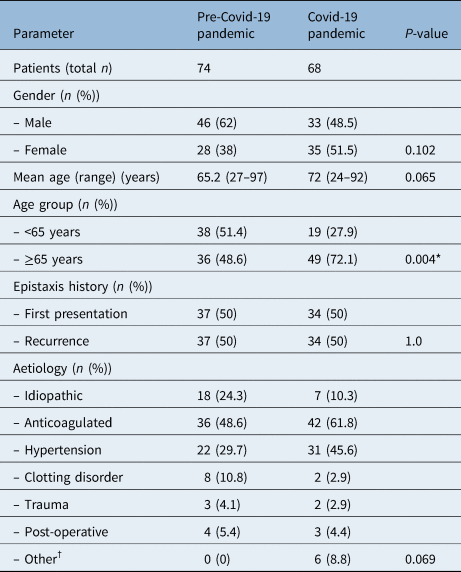
A total of 142 patients were seen by the ENT team across the study period; 74 patients were seen in the first 10 weeks and 68 patients were seen post implementation of the new standard operating procedure. Table 2 displays the clinicodemographic data of all the patients seen. There were significantly more patients aged over 65 years presenting during the pandemic (p = 0.004). The remainder of the demographic data remained similar between the two groups.
Clinicodemographic data

*Indicates statistical significance. †Other aetiologies include drug-related, liver disease, vasculitis and hereditary haemorrhagic telangiectasia. Covid-19 = coronavirus disease 2019
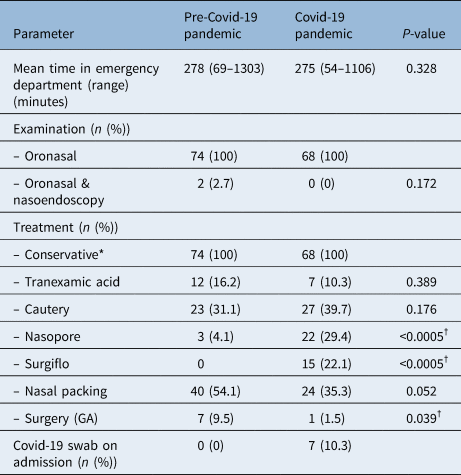
Table 3 displays the initial examination and management options of the patients seen. Flexible nasoendoscopy was not performed routinely during the pandemic as it is a potentially aerosol generating procedure. Use of conservative management measures including cautery were similar across the two groups. There was significantly increased use of local haemostatic agents (Nasopore and Surgiflo®) in the Covid-19 group (p < 0.0005). There was decreased use of non-dissolvable packing in the Covid-19 group, but this finding was not statistically significant.
Treatment data

* Conservative treatment includes pressure, ice, and topical lidocaine and phenylephrine. †Indicates statistical significance. Covid-19 = coronavirus disease 2019; GA = general anaesthesia
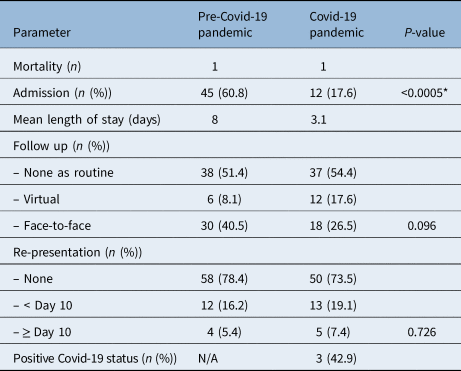
Table 4 displays the outcomes for the two groups. Of note, there were significantly fewer admissions in the Covid-19 group, but similar rates of mortality and re-presentation, and mean length of hospital stay.
Outcome measures

* Indicates statistical significance. Covid-19 = coronavirus disease 2019; N/A = not applicable
Mortality
The 30-day mortality rate was 1.4 per cent in our study, compared to 3.4 per cent in the literature.1 Both patients died due to causes other than epistaxis; the patient in the Covid-19 pandemic group passed away from Covid-19.
Re-presentation
There was no statistical difference in the number of patients re-presenting within 30 days between the control and the pandemic groups. Of the 18 patients to re-present in the Covid-19 group, there were no significant discernible demographic or treatment-related factors. Six out of 22 patients (27.2 per cent) managed with Nasopore re-presented within 30 days, and 4 out of 15 patients (26.7 per cent) managed with Surgiflo re-presented. The 10-day re-presentation rates were 18.1 per cent (4 out of 22) and 13.3 per cent (2 out of 15) respectively. Of note, none of the patients managed with a non-absorbable pack at home re-presented in this study.
Nasal packs
In the control group, 40 patients were packed with non-absorbable nasal packs and all were admitted to hospital overnight. In the Covid-19 group, 15 out of 24 patients (62.5 per cent) who were packed with non-absorbable nasal packs were discharged home. A telephone survey was conducted with 10 of these patients who had gone home with non-dissolvable nasal packs in situ. The following patient-reported factors were assessed: pain, comfort, bleeding, breathing and impact on function. Table 5 reveals the results of this survey. Patients found the nasal packs to be both efficacious and feasible as a management option.
Survey results for patients discharged home with non-dissolvable nasal packs

Scale: 1 = no impact or effect; 2 = minimal impact or effect; 3 = mild impact or effect; 4 = moderate impact or effect; and 5 = severe impact or effect
Cost analysis
An estimated cost analysis of the patient cohort in this study is outlined in Table 6. Costing estimates were obtained from internal end-of-financial-year reports and auditing. The proposed saving over the three-month period as a result of the new management of epistaxis was estimated as £61 984.18.
Key cost-analysis estimate comparison between the two groups

* The difference in total costs between groups equates to a saving of £61 984.18 for the coronavirus disease 2019 (Covid-19) pandemic group. A&E = accident and emergency department
Discussion
The Covid-19 pandemic has led to a significant impact on healthcare services in the UK, and has consequently prompted many specialties to adapt and evaluate their pre-existing standards of care. Given the rapid nature of the pandemic, change has had to be rapid. Many of these changes have been deemed to be sustainable and have been seen as signs of promising innovation, particularly with regard to telemedicine.Reference James, Papoutsi, Wherton, Greenhalgh and Shaw12 Within ENT, the implementation of new guidelines on the emergency management of epistaxis has brought about fundamental changes. There has been a national emphasis on reducing admissions, whilst ensuring safety to clinicians and patients. Our study aimed to determine whether these changes are safe, efficacious and sustainable for long-term practice, particularly to safeguard services in the face of future pandemics.
The number of patients referred to our ENT department with epistaxis during the pandemic was comparable to that in the 10 weeks preceding the pandemic. Despite studies reporting a reduction in the presentation of other emergency presentations, our data demonstrate that the number of epistaxis presentations to the ENT department did not change in our institution.Reference Hartnett, Kite-Powell, DeVies, Coletta, Boehmer and Adjemian13 Additionally, there was a significant increase in the proportion of patients presenting with epistaxis aged over 65 years. This was particularly surprising, as a proportion of these individuals are likely to have been within the recommended shielding group. Trauma cases have understandably decreased during the pandemic,14 yet trauma as an aetiology for epistaxis does not seem to have been affected similarly. This stresses the importance of seeking medical advice for epistaxis if conservative measures fail at home.
We have demonstrated a significant reduction in admissions related to epistaxis. There are three main reasons for this. Firstly, we report a significantly increased use of absorbable intranasal dressing and haemostatic agents. Secondly, there was a reduction in the use of non-absorbable nasal packing. Thirdly, we were able to manage patients with non-absorbable nasal packs as out-patients, despite previously practised best evidence-based guidelines. By reducing the number of epistaxis-related admissions, we were able to reduce the risk of exposure to Covid-19 amongst a potentially vulnerable cohort of patients. Additionally, we were able to play our part in helping the hospital to cope with the anticipated surge capacity, as well as saving bed occupancy costs.
Nasopore was the most commonly used bioabsorbable dressing in our study. Current recommendations from the British Rhinological Society regarding dissolvable nasal packs are limited by a lack of high-quality evidence, related to the diversity of products and the lack of clarity over indications.2 Consequently, recommendations for the use of Nasopore are largely based upon consensus opinion, of which there is a lot of variability at a local level. Despite this, we suspect that a significant increase in its use during the pandemic has contributed to decreased admissions and reduced use of non-absorbable packs. Indeed, a recent meta-analysis revealed that Nasopore may be superior to Merocel® (a non-absorbable pack) in terms of pain, bleeding and pressure,Reference Wang, Cai and Wang15 further advocating its use early in the epistaxis management pathway.
Haemostatic agents such as gelatine–thrombin matrices (FloSeal and Surgiflo) have been increasingly used during this pandemic prior to insertion of non-dissolvable packs. A large meta-analysis revealed it to be preferable to non-dissolvable nasal packs such as RapidRhino® in terms of achieving short-term haemostatic control.Reference Milinis, Swords, Hardman, Slovick, Hutson and Kuhn16 One randomised, controlled trial additionally found that patients may be less likely to re-present with FloSeal compared to nasal packs.Reference Mathiasen and Cruz17 Particularly on a local level, many centres have been reluctant to use haemostatic agents as first-line treatment because of their initial higher cost, but subsequent cost analyses have revealed it to be a more cost-effective option compared to nasal packing for anterior epistaxis.Reference Le, Thavorn, Lasso and Kilty18,Reference Murray, Mendez, Hopkins, El-Hakim, Jeffery and Côté19
The future management of patients after non-dissolvable pack insertion may be controversial. Certainly, existing guidelines recommend admitting patients who have had non-dissolvable packs inserted.Reference Iqbal, Jones, Dawe, Mamais, Smith and Williams8 This is because of the risk of rebleeding, aspiration and patient discomfort. The British Rhinological Society also does not explicitly advocate discharging patients with packs in situ.2 However, some high-level evidence has suggested that it is safe to discharge nasally packed patients.Reference Iqbal, Jones, Dawe, Mamais, Smith and Williams8,Reference Van Wyk, Massey, Worley and Brady20 Our study adds to this evidence, and goes further to suggest that objective outcome measures of re-presentation and mortality rates, and mean length of stay, are unchanged, irrespective of in-patient or out-patient management in those with non-dissolvable packs.
A national audit carried out during the initial peak of the pandemic has provided comparison data for our re-presentation rates.Reference Hardman21 Nationally, 18.2 per cent of all patients with non-dissolvable products discharged from the emergency department re-presented within 10 days, whilst 21.8 per cent of those with Nasopore, and 24.7 per cent of those with FloSeal or Surgiflo, re-presented within 10 days. Our study had significantly lower re-presentation rates: 0 per cent of our patients discharged with non-dissolvable products re-presented within 10 days. Of those, 18.1 per cent with Nasopore, and 13.3 per cent with Surgiflo or FloSeal, re-presented within 10 days.
• The coronavirus disease 2019 pandemic has resulted in changes in the emergency management of epistaxis
• New management favours absorbable dressings and local haemostatic agents prior to nasal packing, resulting in fewer hospital admissions
• Early analysis estimates this new management to be more cost effective
• Re-presentation and mortality rates, and length of stay are similar to those treated with pre-existing guidelines
• Patients with non-absorbable nasal packs can be safely managed at home, and patient surveys have revealed this to be efficacious and feasible
• This management is as safe and effective as previously well-established epistaxis management regimens
There is currently no validated and widely used patient-reported outcome measure for non-dissolvable intranasal packs. In light of this, we devised a survey based on important outcome measures reported in the literature, namely pain, comfort, bleeding, breathing and impact on function.Reference Mathiasen and Cruz17,Reference Murray, Mendez, Hopkins, El-Hakim, Jeffery and Côté19,Reference Badran, Malik, Belloso and Timms22,Reference Kastl, Reichert, Scheithauer, Sommer, Kisser and Braun23 Our findings revealed that the majority of patients were happy being managed as an out-patient, and it is something that is feasible long-term. Long-term adoption of such practice to manage this cohort of patients on an out-patient basis would justify the validation of patient-reported outcome measures for non-dissolvable intranasal packs.
Limitations
This study is effective in providing a direct comparison with pre-existing epistaxis management. However, it is limited by a lack of data on bleeding severity and bleeding location. Additionally, it did not include the patients managed solely by the emergency department. Accident and emergency department (A&E) clinicians play an important role in epistaxis management, particularly with regard to stabilising patients, managing epistaxis conservatively, and often packing patients prior to being seen by ENT. The implementation of guidelines on the use of dissolvable packing and haemostatic agents needs to be filtered down to A&E to be truly effective in reducing admissions.
Conclusion
The Covid-19 pandemic has accelerated the shift towards the use of local haemostatic agents and out-patient management of epistaxis, which is as safe and effective as previously well-established epistaxis management. This is especially important in light of prolongation of the current Covid-19 pandemic, and for any future potential strain on in-patient hospital resources.
Competing interests
None declared