Over the past two decades, open-economy politics (OEP) has emerged as the dominant paradigm in the field of international political economy. Scholars working in this tradition reason “from the most micro- to the most macro-level.”Footnote 1 They use economic theory to derive the policy preferences of individuals and groups within a country, and then investigate how political institutions and international bargaining translate preferences into actual policies. Initially developed to explain trade policy, OEP has been extended to many other issues, including international monetary policy, capital controls, foreign investment, foreign aid, and immigration.Footnote 2 Today OEP is recognized as the principal approach to international political economy in the United States, and it has transformed scholarship in other parts of the world as well.Footnote 3
OEP rests on the assumption that the policy preferences of individuals and groups reflect economic self-interest. To determine which policy would serve this goal, analysts consult economic theory. They use economic models to infer how policies would affect an actor's income, given the actor's endowments and role in the global economy. Deducing interests from economic theory is not only “the keystone” of OEP but also the “fundamental innovation” that distinguishes OEP from other approaches to international political economy.Footnote 4
As OEP rose to prominence, scholars began assessing the foundational premise that individuals have economically selfish policy preferences. The vast majority of micro-level studies focused on trade. Using public opinion polls, scholars tested whether opinions about trade follow predictably from a respondent's economic endowments and exposure to international competition. Early studies suggested that trade preferences did indeed reflect economic self-interest.Footnote 5 More recent work, however, has questioned this connection by arguing that attitudes toward trade depend primarily on symbolic and social considerations, rather than material self-interest.Footnote 6
This new wave of research challenges the foundations of OEP itself. The postulate that “interests are determined largely by a unit's production profile or position in the international division of labor” is, according to David Lake, “the hard core” of the OEP paradigm. “This assumption cannot be altered significantly without altering or, indeed, vitiating the paradigm itself.”Footnote 7 However, before concluding that OEP should be modified or jettisoned, it is important to understand the puzzling disconnection between material interests and policy preferences. Why doesn't self-interest play a bigger role in policy preferences, and could the relationship be stronger in some contexts than in others?
We maintain that the connection between economic interests and policy preferences depends on causal beliefs—specifically, perceptions about how government policies would affect the material well-being of individuals and groups.Footnote 8 Most voters do not understand the economic consequences of protectionism. We use experiments to study how voters would respond if they had more information about the winners and losers from trade policy.
Distributional cues could generate two opposing effects. By revealing how policies would affect the respondent personally, distributional cues could give people the information they need to identify self-serving policies. At the same time, distributional cues could clarify how policies would affect others, enabling people to choose policies that would advance the welfare of others. Hence, information about winners and losers could facilitate both egoism and altruism. In our study both reactions were evident, but selfish responses outweighed altruistic ones. Thus, if people knew more about the distributional effects of trade, the correlation between personal interests and policy preferences would tighten.
Our experiments not only showed how causal beliefs affect policy preferences, but also uncovered significant heterogeneity across individuals. Respondents with college degrees used distributional cues to advance their own ends. Respondents without college degrees, in contrast, used cues for both altruistic and egoistic purposes. Future research should examine why some groups are more sensitive to economic information than others, and why information provokes primarily selfish responses among some people while triggering altruistic reactions among others.
Our findings have important implications for the study of international relations. Above all, the selfishness of policy preferences should no longer be treated as a self-evident axiom, but should instead be seen—and studied—as a variable that fluctuates across individuals and over time in response to causal beliefs. By investigating how beliefs vary and moderate the connection between economic self-interest and policy preferences, researchers can move toward more realistic, behaviorally informed theories of international political economy.
Self Interest and the Potential Role of Economic Ignorance
Most research about trade preferences has tested the explanatory power of the Stolper–Samuelson theorem. This theorem holds that, in each country, free trade helps owners of the relatively abundant factor of production while hurting owners of the relatively scarce factor. Scholars have used this theorem to predict the policy preferences of ordinary citizens. In advanced economies where educated labor is relatively abundant, highly educated workers should favor free trade whereas less educated workers should oppose it. In developing countries where educated labor is relatively scarce, the opposite pattern should emerge: highly educated workers should oppose free trade, but less educated workers should favor it.
In the early 2000s scholars used public opinion polls to test these predictions.Footnote 9 They found a strong positive correlation between education and support for free trade in advanced countries, and a weaker correlation in developing countries. Based on this research, Anna Mayda and Dani Rodrik concluded that “pro-trade preferences are significantly and robustly correlated with an individual's level of human capital, in the manner predicted by the factor endowments model” of Stolper and Samuelson.Footnote 10 These studies appeared to provide empirical microfoundations for many OEP models in which trade policies emerged from aggregating the preferences of economically selfish actors.Footnote 11
Once regarded as conventional wisdom, these early studies have recently come under fire. A growing body of research now argues that the connection between material self-interest and trade policy preferences is far weaker than previously thought. Some authors find that material self-interest has little explanatory power after controlling for other predictors of public opinion.Footnote 12 Others acknowledge that variables like education are robustly correlated with attitudes toward trade but maintain that the correlations do not reflect material self-interest. Jens Hainmueller and Michael Hiscox, for example, show that the relationship between education and trade attitudes is just as strong among people outside the labor force as among people in the labor force. They conclude that “the effects of education on individual trade preferences are not primarily a product of distributional concerns linked to job skills.”Footnote 13
In other work we provide additional insight by analyzing opinions about protectionism for specific industries, as well as sentiment toward free trade in general.Footnote 14 Even with this fine-grained data, scholars find surprisingly little evidence that the preferences of citizens fit the predictions of standard economic models, including not only Stolper–Samuelson, but also Ricardo–Viner and “new-new” models of trade with heterogeneous firms.Footnote 15 The introductory essay in this special issue concurs: having surveyed the burgeoning literature about public attitudes toward trade, Emilie Hafner-Burton and coauthors see “little evidence that voters actually define their interests in these rational, materialist ways.”Footnote 16
These studies, if correct, raise a profound puzzle: why does material self-interest have so little predictive power? One possibility is that individual preferences are determined by nonmaterial considerations. Shahrzad Sabet, for example, finds that attitudes toward foreign cultures trump economic self-interest as predictors of opinions about trade.Footnote 17 Other studies concur that cultural and ideological predispositions such as nationalism, ethnocentrism, racism, ideology, and social trust play important roles in shaping opinions about trade.Footnote 18
A second possibility is that people weigh material considerations but focus on society as a whole, while putting little if any weight on their own individual circumstances. Edward Mansfield and Diana Mutz argue that “trade attitudes are guided less by material self-interest than by perceptions of how the US economy as a whole is affected by trade.”Footnote 19 Xiaobo Lü, Kenneth Scheve, and Matthew Slaughter add that people exhibit “inequity aversion,” and therefore prefer trade policies that minimize inequality or combat poverty.Footnote 20
We pursue a third, complementary explanation for the weak correlation between self-interest and trade opinion. Perhaps ordinary citizens do not understand how trade affects their material welfare, and therefore find it hard to choose the policy that would maximize their economic interests. In an early discussion of this theme, David Rankin asserted that ordinary citizens do not pay close attention to trade policies and lack the knowledge to weigh the personal costs and benefits of trade. They instead rely on information shortcuts, including symbolic predispositions such as national identity. Rankin did not measure public understanding about the consequences of trade, however, nor did he test whether attitudes would change if citizens were more thoroughly informed.Footnote 21
More recently, scholars have studied how citizens respond to arguments for and against free trade.Footnote 22 These researchers have exposed citizens to various pro and con arguments and estimated how the arguments moved public opinion. Researchers have also used visual stimuli that encourage people to identify with either producer or consumer interests.Footnote 23 Although innovative, these experiments do not explicitly identify winners and losers. Hence, the studies do not reveal how citizens would respond to information about the effects of trade on specific groups.
To our knowledge only one previous study experimentally manipulated the identity of domestic winners and losers from trade. The study, by Richard Herrmann, Philip Tetlock, and Matthew Diascro, described a trading relationship with a foreign country. Some respondents were told that in the United States, “the benefits from this trade go largely to the wealthy.” Others learned that “the benefits from this trade help the poor at least as much as the wealthy.” After supplying additional details, the investigators asked whether the United States should restrict trade with the country. Support for the trading relationship was substantially higher when benefits accrued to the poor in the United States.Footnote 24
Building on this work, we hypothesize that economic knowledge has a powerful effect on whether citizens express self-serving preferences. As a baseline, consider how public opinion might look if citizens lacked information about the distributional effects of trade. In that case, citizens would not know enough to judge which policies are best for themselves, leading to a low correlation between material interests and trade policy preferences. As we will show, many if not most Americans fit this description: ignorant about the distributional effects of trade, they express policy preferences that do not fit standard OEP models.
How would public opinion change if citizens learned about the distributional consequences of trade? We hypothesize that exposure to this type of information could generate two opposing effects. On the one hand, such information could increase the correlation between a person's material interests and policy preferences. Prior research has argued that policy preferences are most likely to reflect economic self-interest when the costs and benefits to individuals are clear and certain.Footnote 25 Armed with clear cues about how trade would affect them personally, citizens could more accurately identify and advocate policies that advance their own pocketbooks.
On the other hand, teaching people about winners and losers could facilitate altruism—the tendency that “one's utility increases with well-being of others.”Footnote 26 A growing body of research has documented altruistic tendencies in human behavior, including political behavior.Footnote 27 On the topic of trade policy, Lü, Scheve, and Slaughter identified altruism as a potential reason that low-skilled sectors typically receive more protection than high-skilled ones.Footnote 28 Displaying altruism on the topic of trade may require at least some knowledge about how trade policies would affect the welfare of others. If most citizens have only a limited understanding of the distributional effects of trade, raising awareness could help people act on their altruistic tendencies.
The net effect of these two changes—one selfish, the other altruistic—is ambiguous. If people use knowledge primarily for selfish purposes, distributional cues will cause citizens to sort into pro-trade and anti-trade camps that reflect material self-interest. If, on the other hand, people use information primarily to serve others, distributional cues will weaken the correlation between self-interest and policy preferences. Instead of advocating policies that help themselves, people will increasingly choose policies that help (or avoid hurting) others. We test for both selfish and altruistic responses to information, and assess whether distributional information makes public opinion more self-serving, on average.
We acknowledge that our predictions may not hold in practice. There are at least two reasons that economic cues might not trigger the patterns we hypothesized. On the one hand, economically ignorant citizens may not need information to behave rationally. They could instead acquire self-serving or other-regarding policy preferences indirectly, by following the advice of more knowledgeable actors. Recommendations from trusted political parties, interest groups, the media, colleagues, and friends could allow “badly informed voters to emulate the behavior of relatively well informed voters.”Footnote 29
On the other hand, even economically informed citizens may not base their policy preferences on the material consequences for themselves or other groups. Nonmaterial concerns including nationalism, ethnocentrism, racism, and ideology could overshadow if not override economic costs and benefits.Footnote 30 In short, our predictions could fail either because citizens do not need economic information or because they tend not to use it. In the remainder of this article we investigate how much citizens actually know about trade, and how they would respond if they were better informed.
Knowledge About the Effects of Trade Policies
Most members of the American public have not thought deeply about the economic effects of trade policy. A 2004 survey by the Pew Research Center revealed that 26 percent of Americans had never heard the claim that “free trade results in better products and better prices for American consumers.” An additional 14 percent had heard the argument but not thought much about it, and another 20 percent knew the argument but disagreed. Thus, surprisingly few respondents were familiar with and sympathetic to the classical case for free trade.Footnote 31 The same study found that Americans were hazy about the effects of trade on jobs, economic growth, and “the gap between rich and poor in the United States and in the world as a whole.”
Low levels of economic knowledge are not unique to the United States. Juan Díez Medrano and Michael Braun asked Spanish citizens, “would you say that you know a lot, some, little, or nothing about the consequences of raising or lifting barriers to the import of foreign products?” Approximately 34 percent confessed that they knew nothing about the issue, and an additional 48 percent said they had little knowledge about it. Moreover, more than 60 percent had never heard family, friends, or coworkers comment about foreign imports.Footnote 32 Clearly, knowledge about trade is low not only in the United States but also in other countries.
To explore why opinions about trade might not reflect economic self-interest, we measured how much citizens know about the distributional effects of trade. Our survey tested familiarity with the key predictions of Stolper–Samuelson, the workhorse model in OEP studies of trade. The Stolper–Samuelson theorem posits that an increase in the relative price of a product will increase the real returns to the factor used most intensively to make the product while decreasing the real earnings of other factors of production. Suppose, for example, that the US government limited imports of clothing, furniture, fruits, vegetables, and other items made by foreign workers without college degrees. The relative price of those products would rise, helping low-educated Americans at the expense of highly educated ones. Limiting imports made by foreigners with college degrees would have the opposite effect: helping Americans with college degrees while hurting Americans without college degrees. Table 1 summarizes these predictions.
Predictions about the distributional effects of trade barriers

When developing our survey, we focused on education for three reasons. First, we wanted to maximize comparability with previous research. Nearly all previous studies about trade preferences have treated education as the key factor of production. Moreover, the few authors who tried alternative measures achieved poor results. As Bruce Blonigen notes, “with the exception of education, the relationships between labor market attributes and trade policy preferences are not robust in US survey data.”Footnote 33 Second, the focus on education helped make our survey accessible to respondents. Ordinary citizens understand the idea of formal education and can easily imagine products made by people with and without college degrees. Third, the education of respondents is easier to measure than alternative concepts, such as skill.Footnote 34
Our survey tested whether Americans anticipate the economic effects in Table 1. We noted, “Some people think the US government should limit imports from foreign businesses that employ a low percentage of workers with college degrees.” We then asked how such a policy would affect Americans with and without college degrees. In a similar way, we asked what would happen if the US government limited imports from foreign businesses that employed a high percentage of workers with college degrees.
We administered the questionnaire to a sample of 1,495 US adults: 500 in December 2013 and an additional 995 in April 2015. The two waves yielded similar responses, which we pooled to increase the precision of our estimates. All participants were recruited via Amazon Mechanical Turk, an online service that is widely used for academic research. Validation studies show that, for many topics, surveys fielded through MTurk yield approximately the same findings as surveys on nationally representative samples.Footnote 35 Of special relevance for research about trade, Connor Huff and Dustin Tingley found that “the percentage of MTurk respondents employed in specific industries is strikingly similar” to data from the Cooperative Congressional Election Study, a nationally representative survey supported by the National Science Foundation.Footnote 36
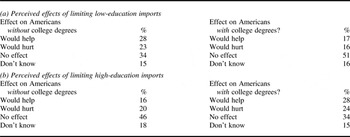
The beliefs of participants in our study did not fit the Stolper–Samuelson model. Table 2 section (a) summarizes respondents' guesses about the consequences of limiting low-education imports, that is, products made by foreign businesses that employ only a small share of workers with college degrees. Only 28 percent of respondents thought, as Stolper–Samuelson predicts, that such a policy would help Americans without college degrees, and only 16 percent felt the policy would hurt Americans with college degrees. The remaining respondents did not know, claimed the policy would have no effect, or predicted the opposite of Stolper–Samuelson.
Beliefs about the distributional effects of trade barriers

Note: Percentage of respondents, out of 1,495 in total, who made each prediction.
Table 2 section (b) summarizes guesses about the effects of limiting high-education imports, that is, products by foreign businesses with high proportions of college-educated workers. Here, too, the beliefs of respondents diverged sharply from Stolper–Samuelson. Only 20 percent said that such a protectionist policy would hurt Americans without college degrees, and only 28 percent thought it would help Americans with college degrees. In summary, our data revealed an enormous gap between the beliefs of ordinary Americans and the predictions of Stolper–Samuelson.
Of course, some types of citizens may be more knowledgeable than others about the consequences of trade. Hainmueller and Hiscox have argued that people with college degrees may enjoy an informational advantage, thanks to greater exposure to economic ideas such as the theory of comparative advantage.Footnote 37
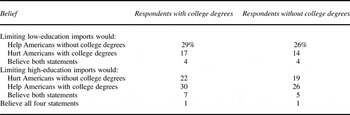
Surprisingly, though, we found no evidence that college graduates are more knowledgeable about the distributional effects of trade. Table 3 splits our sample into respondents with and without college degrees. College graduates were slightly more likely to offer predictions that accorded with Stolper–Samuelson, but the differences were substantively small—between zero and four percentage points—and could have arisen by chance alone.Footnote 38 Moreover, the percentage of respondents who held all four beliefs was only 1 percent, regardless of whether the respondents had graduated from college.
Beliefs about distributional effects, by education of respondent

Note: Percentage of respondents who made each prediction. The sample contained 748 people with college degrees and 747 people without college degrees.
In summary, ordinary Americans know little about the economic consequences of trade. Most are not familiar with the classical case for free trade, and even fewer anticipate the distributional arguments (such as Stolper–Samuelson) that have animated the academic literature. These findings could help explain the puzzling mismatch between the material interests of citizens and their trade policy preferences. Without understanding the distributional effects of trade, citizens may not be competent to identify and choose policies that would fill their own pocketbooks. At the same time, our findings suggest the potential efficacy of cues. Given low levels of knowledge in society as a whole, opinions could shift significantly if we informed citizens about the winners and losers from trade.
Experimental Design
How might citizens respond if they were more knowledgeable about trade? To find out, we designed a survey experiment in which some participants received cues about the distributional consequences of protectionism, whereas other participants did not. All participants read an introductory script: “US businesses and consumers buy many products that are made in foreign countries. The products from foreign countries are called imports. There is much debate about whether the US government should use laws to limit imports by US businesses and consumers.” Each respondent was then assigned to one of four groups.
The first group received cues about both winners and losers. Our cues taught respondents about Stolper–Samuelson, which was appropriate given the theorem's centrality in the existing literature. Respondents were told, “Some people think the US government should limit imports from foreign businesses that employ a low percentage of workers with college degrees. This policy would help Americans without college degrees by protecting their jobs from foreign competition and increasing the income they earn from their jobs. This policy would hurt Americans with college degrees by raising the prices they would have to pay for products, without protecting their jobs or increasing their income.” After presenting the information, we asked whether the government should limit imports from foreign businesses that employ a low percentage of workers with college degrees.
The first group also learned who would win and lose if the government restricted imports made by well-educated workers. “Some people think the US government should limit imports from foreign businesses that employ a high percentage of workers with college degrees,” we noted. “This policy would help Americans with college degrees by protecting their jobs from foreign competition and increasing the income they earn from their jobs. This policy would hurt Americans without college degrees by raising the prices they would have to pay for products, without protecting their jobs or increasing their income.” After supplying these cues we asked whether the government should limit imports from foreign businesses that employ a high percentage of workers with college degrees.
The second group received cues about winners only. We explained that limits on low-education imports would help Americans without college degrees by protecting their jobs and raising their income, but did not mention that the same policy would hurt Americans with college degrees by raising the prices they would have to pay for products. Similarly, we noted that blocking high-education imports would help Americans with college degrees, but did not add that the policy would hurt Americans without college degrees. After presenting these partial cues, we asked whether the government should limit each type of import.
The third group received cues about losers only. They read that restrictions on low-education imports would hurt Americans with college degrees, without reading that the same policy might benefit Americans without college degrees. Likewise, they read that restrictions on high-education imports would hurt Americans without college credentials, without reading that the same restrictions would help Americans who had graduated college.
The fourth group did not receive any cues about winners and losers. We simply asked whether the government should limit imports from foreign businesses that employ a low percentage of workers with college degrees, and whether the government should limit imports from foreign businesses that employ a high percentage of workers with college degrees. This no cues group provided an important baseline by revealing how citizens would respond given their preexisting knowledge.
We recruited a sample of 5,027 US adults via Amazon Mechanical Turk. As noted earlier, numerous studies have validated MTurk for research on a wide range of topics, including public opinion about trade. Nevertheless, we confirmed that our central conclusions held even after reweighting the MTurk sample to approximate the demographic profile of the national population.Footnote 39 The interviews were spread over a four-year period from August 2011 to April 2015.Footnote 40
Effects of Distributional Cues on People with College Degrees
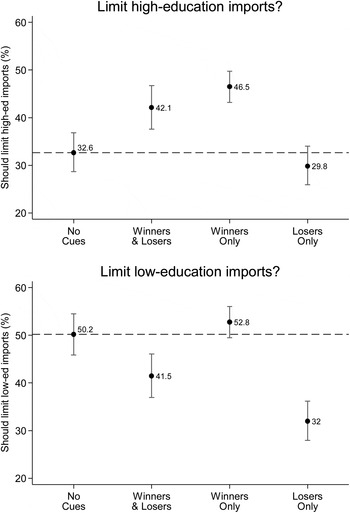
We begin by analyzing the responses of college graduates, who made up 48.5 percent of the sample. The top half of Figure 1 shows, by experimental condition, the percentage of college graduates who thought the US government should limit imports from foreign companies that employ a high proportion of workers with college degrees. The bottom portion of Figure 1 summarizes how the same people felt about limiting imports from companies that employ low proportions of college-educated workers. The dots in Figure 1 are point estimates and the vertical bars are 95 percent confidence intervals.
Preferences of respondents with college degrees

If college graduates were following their own economic interests as defined by Stolper–Samuelson, they would block high-education imports but allow low-education imports to enter freely. In the absence of cues, this prediction failed. Less than one-third (32.6%) wanted to limit high-education imports, whereas half (50.2%) preferred to limit low-education imports. This pattern is the reverse of what one would expect if respondents were maximizing their personal pocketbook according to Stolper–Samuelson.
When we provided information about both winners and losers, the policy preferences of college-educated graduates became markedly more selfish (relative to the control group that did not receive any distributional cues). The desire to block high-education imports rose by 9.5 percentage points, from 32.6 percent to 42.1 percent, and their willingness to inhibit low-education imports fell by 8.7 percentage points, from 50.2 percent to 41.5 percent. Both effects were not only substantively large but also statistically significant.
This pattern was not preordained. As emphasized earlier, cues about winners and losers could have produced two opposing reactions. On the one hand, cues could have made policy preferences more self-serving by helping citizens understand how trade policies would affect themselves. On the other hand, informing people about winners and losers could have facilitated altruism by helping people see how the policies would affect others. Among the college graduates in our sample, the egoistic effect clearly dominated the altruistic one.
For additional insight, we separately estimated egoistic versus altruistic reactions by analyzing reactions to the one-sided treatments (winners only and losers only). Did college graduates respond egoistically when they learned how a policy would affect themselves without also learning how it would affect others? Did they respond altruistically upon learning how a policy would affect others without learning how it would affect themselves?
We found that college graduates used cues almost entirely for selfish purposes. The top portion of Figure 1 shows that, without cues, only 32.6 percent of college graduates wanted to limit high-education imports. When we explained that restrictions would serve their own interests without mentioning the potential harm to others (the winners-only condition), support climbed to 46.5 percent, a 13.9 percentage point swing in opinion. When, on the other hand, we explained that restrictions would hurt less-educated Americans without mentioning the benefits for respondents themselves (the losers-only condition), support fell by only 2.8 percentage points, from 32.6 percent to 29.8 percent. This difference was substantively small and could have arisen by chance alone.
The bottom half of Figure 1 shows a similar pattern. Without cues, 50.2 percent of college graduates said the US government should limit low-education imports. When we disclosed that the proposal would hurt college-educated respondents without mentioning the benefits for other Americans (the losers-only condition), support fell by more than 18 percentage points. In contrast, the desire to block low-education imports rose by only 2.6 percentage points when we explained how the policy would help less-educated Americans, without adding that the policy would cause respondents themselves to suffer.
Thus, in both halves of Figure 1, the reaction to distributional cues was highly asymmetric. People with college degrees responded strongly to news about how policies would affect themselves, but barely budged after being told how policies would affect others. This helps explain why the dual-cue condition, which included information about both winners and losers, made preferences much more self-serving, on balance.
Our analysis of college graduates suggests that the mismatch between material interests and policy preferences is partly a result of economic ignorance. When we explained the distributional effects of trade, policy preferences moved in a self-serving direction. Thus, if college graduates were better informed about the distributional effects of trade, the correlation between their economic interests and protectionist attitudes would tighten.
Giving cues about winners and losers would not drive all college graduates to egoistic extremes, however. Even after learning about winners and losers, only 42.1 percent of respondents with bachelor's degrees endorsed policies that would serve their own interests by protecting their jobs and increasing their wages. Moreover, 41.5 percent remained willing to limit low-education imports, even though such policies would hurt them personally by making products more expensive. On balance, providing information about winners and losers increased the correlation between self-interest and policy preferences but many college graduates still failed to choose policies that would advance their material welfare. Thus, economic ignorance can explain part, but not all, of the disjunction between personal interests and policy preferences.
Effects of Distributional Cues on People without College Degrees
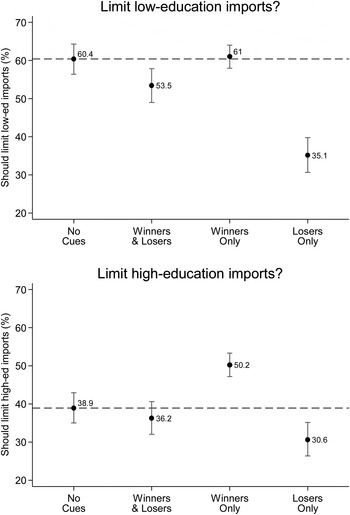
How did people without college degrees (51.5% of the sample) react to distributional cues? If these less-educated Americans were maximizing their economic returns as predicted by Stolper–Samuelson, they would limit imports made by unskilled foreign labor, while allowing the output of educated foreign labor to enter the domestic market freely. Figure 2 provides some support for this prediction. Unaided by cues, 60.4 percent wanted limits on low-education imports, whereas only 38.9 percent wanted limits on high-education imports. Thus, even without cues, people without college degrees promoted their own interests by disproportionately blocking imports from foreign firms that used their own factor of production.
Preferences of respondents without college degrees

In this context, providing cues about distribution triggered an altruistic reaction. When we explained who would win and lose from limiting low-education imports, support for those types of barriers fell by 6.9 points, from 60.4 percent to 53.5 percent (top half of Figure 2). This occurred because cues provoked an asymmetric reaction: respondents become significantly less protectionist after hearing how trade barriers would hurt educated Americans (the losers-only condition), but did not become more protectionist after learning how trade barriers would advance their own interests (the winners-only condition).
The bottom half of Figure 2 shows how people without college degrees responded to cues about high-education imports. The winners-and-losers treatment moved opinion by only 2.7 percentage points, a small change that could have occurred by chance alone. The net effect was practically nil because the winners-and-losers treatment pulled people in both altruistic and egoistic directions, to roughly equal degrees. When we said that limiting high-education imports would help Americans with college degrees, without mentioning that the same policy would penalize less educated respondents (the winners-only cue), support rose from 38.9 to 50.2 percent, an altruistic shift of around 11 percentage points. When, on the other hand, we revealed how the barriers would hurt citizens without college degrees without citing the benefits for more educated citizens (the losers-only cue), support fell from 38.9 to 30.6 percent, an 8.3 point shift in the egoistic direction. Presenting both cues caused these opposing effects to cancel out.
In summary, distributional cues facilitated both egoism and altruism, but the overall effect varied with the audience. People with college degrees used the cues to select policies that served their own economic interests. People without college degrees, on the other hand, used the information for both altruistic and egoistic purposes. Among this less educated group, some cues triggered both altruism and egoism; others sparked altruism alone.
Why did these two groups respond differently? A complete answer lies beyond the scope of this paper. Nevertheless, we briefly consider three possibilities. The first possibility involves prior beliefs. If the two groups entered the experiment with different background knowledge about the distributional effects of protectionism, our cues could have caused one group to learn more than the other. Table 3 undermines this hypothesis, however. We found no significant differences in the baseline beliefs of the two groups of respondents.
A second possibility concerns variation in attentiveness. Perhaps people with college degrees were better trained to pick up on experimental cues. Our data contradict this conjecture as well. Both groups responded strongly to cues. Indeed, the largest effect in our study occurred among people without college degrees (the losers-only condition in the top portion of Figure 2). Pooling across all experimental conditions, we see that the average absolute value of the treatment effects among college graduates was 9.3 percentage points, not substantially larger than the average of 9.2 points among people without college degrees.
A third possibility concerns differences in values. Perhaps respondents with college degrees were fundamentally more egoistic—cared more about themselves—than the other half of our sample. If true, this could explain why people with college degrees used cues to zero in on policies that would serve themselves, whereas people without college degrees used cues to advance both altruistic and egoistic goals. Scholars have found that egoism increases with education, income, and other markers of social class.Footnote 41 Future research should investigate this topic more thoroughly.
Do Distributional Cues Make Preferences More Consistent with Stolper–Samuelson?
Our cues elicited both self-serving and altruistic responses. On net, did cues cause the preferences of ordinary citizens to become more consistent with Stolper–Samuelson? Under Stolper–Samuelson, there should be a negative relationship between a person's education and their desire to limit low-education imports. At the same time, there should be a positive relationship between a person's education and their desire to limit high-education imports.
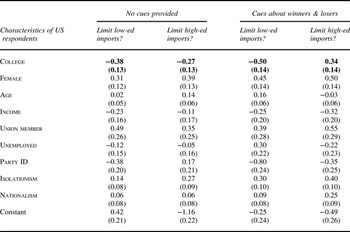
To test these predictions, we ran a series of logistic regressions in which the dependent variable was 1 if the respondent wanted to limit imports from the specified type of business and 0 otherwise. The main explanatory variable was college education, coded 1 if the respondent had completed a bachelor's degree and coded 0 otherwise. Our regressions included control variables that might be correlated with education: gender (female or not), age, household income, union membership, unemployment, party identification (ranging from 0 for strong Democrats to 1 for strong Republicans), isolationism, and nationalism.Footnote 42
Table 4 presents logistic regressions for the control condition in which we gave no cues, and for the treatment condition in which we informed people about winners and losers. The key explanatory variable, college, appears in bold. When respondents received no cues, people with college degrees were less willing to limit low-education imports, but they were also less willing to limit high-education imports. In other words, educated Americans preferred free entry for all types of products, contrary to Stolper–Samuelson.
Multivariate analysis of support for trade barriers, with and without distributional cues

Notes: The table presents parameter estimates and standard errors from logistic regressions. The sample sizes were 1,145 when no cues were provided and 970 when cues were provided about both winners and losers.
When we offered cues about winners and losers responses became more consistent with material self-interest. Cues strengthened the negative correlation between education and limits on low-education imports. At the same time, cues reversed the observed correlation between education and limits on high-educated imports; the coefficient on college in the last column of Table 4 became positive and significant.
To quantify the importance of this reversal, we computed the average effect of a college degree on the probability that the respondent wanted to limit high-education imports, holding all other variables at their observed values. This was equivalent to estimating the following counterfactual: how much more (or less) protectionist would members of our sample have been if all members had graduated from college, compared to a hypothetical in which none had graduated from college? Without cues, the effect of college on the desire to limit high-education imports was –.06; with cues, the effect switched signs and became .08. Thus, cues increased the effect of a college degree by 14 percentage points, rendering attitudes more consistent with Stolper–Samuelson.
Conclusion
Our findings advance several themes that are central to the behavioral revolution in international relations. As other contributors to this special issue show, the preferences and beliefs of key actors often deviate from rationality on matters of international security.Footnote 43 Our data show substantial departures from rationality in international political economy, as well. When it comes to trade, most people do not exhibit the sophisticated beliefs and egoistic preferences we would expect if each were maximizing their own material interests according to economic theory.
At the same time, our study illustrates the payoffs from studying the interplay between preferences and beliefs.Footnote 44 We used experiments to estimate how preferences would shift if citizens were better informed about the distributional consequences of trade policies. In our experiments, information about winners and losers prompted two types of reactions. On the one hand, the information clarified how trade policies would affect respondents, thereby helping them identify and advocate self-serving policies. On the other hand, the information made people more aware of how trade policies would affect others, enabling them to act on altruistic values.
On balance, selfish responses outweighed the altruistic ones. Thus, if people knew more about the distributional effects of trade, the correlation between personal interests and policy preferences would tighten. We conclude that economic ignorance is partly responsible for the apparent discrepancy between material self-interests and trade policy preferences. By measuring causal beliefs and manipulating them experimentally, we contributed to solving one of the major puzzles in international political economy.
Given our findings, as well as other studies about the mismatch between economic interests and policy preferences, we recommend changes to the OEP paradigm. OEP rests on the assumption that individuals have economically selfish policy preferences that can be derived from economic theory. We suggest, however, that the selfishness of policy preferences should not be treated as a static axiom, but should instead be seen—and studied—as a variable that depends on causal beliefs about who would win and lose from government policies. By documenting the diversity of causal beliefs and studying their effects on preferences, we can advance our understanding not only of trade, but also of sovereign debt, foreign aid, monetary policy, and other topics in international political economy.Footnote 45
By investigating how beliefs affect preferences, OEP researchers can also build a bridge to scholars in other theoretical traditions. Constructivists, for example, have long emphasized the power of ideas and ideological contestation.Footnote 46 The traditional divide between rationalism and constructivism has, in our view, prevented rationalists from paying sufficient attention to the role of prevailing ideas. Much can be gained by entering into dialogue with constructivists, and by incorporating the study of causal beliefs into our accounts of economic preferences.
In addition to revealing how beliefs affect preferences, our experiments uncovered significant heterogeneity across individuals and groups. People varied not only in their baseline knowledge and preferences but also in their responses to cues. Americans with college degrees used cues to advance their own ends, whereas people without college degrees used cues altruistically as well as egoistically. This discovery reinforces another major theme in this issue and the behavioral revolution more generally: actors in international relations use information in strikingly different ways, which can cause preferences, beliefs, and strategies to diverge.Footnote 47
Future research should proceed along several lines. First, scholars should investigate how economic knowledge varies across countries and over time. We showed that Americans know little about the effects of trade policy, and we cited similar evidence of economic ignorance in Spain. Knowledge may be higher in other countries, particularly in places where trade has a bigger effect on the national economy or is a major topic of political debate. Costa Rica, for example, held a national referendum on the Central America Free Trade Agreement (CAFTA) in 2007. In the run-up to the referendum, political parties informed citizens about the distributional consequences of the agreement.Footnote 48
Second, future research could deepen our understanding of the two-way relationship between public and elite opinion. On the one hand, scholars know that public opinion constrains what leaders can do, not only in trade but also in other areas of domestic and foreign policy.Footnote 49 On the other hand, politicians and the media can shape public opinion through the strategic use of rhetoric. Indeed, our experiments suggest that elites could move public opinion by (selectively) clarifying the distributional effects of trade policy. Studying how elites not only follow but also lead public opinion, and how public preferences get aggregated into government policy, are important frontiers for future research.Footnote 50
As research about these topics proceeds, it is important to acknowledge the challenges of modeling and inference. The sheer complexity of the global economy makes it difficult for economic actors—and the scholars who study them—to predict how policies would affect material interests. The experiments in this paper focused on Stolper–Samulson because of its central role in research about the political economy of trade. There are, however, other theories about the distributional effects of trade. The existence of contending theories could, in itself, contribute to an apparent mismatch between self-interest and policy preferences. In light of this complexity, it is important to measure the beliefs people actually hold, and study how variation in those beliefs affects both preferences and policy outcomes. Over time, this research agenda should produce a more realistic, behaviorally informed foundation for theories of international relations.
Supplementary Material
Supplementary material for this article is available at https://doi.org/10.1017/S0020818316000394