1.0 INTRODUCTION
Inducing sliding regimes in nonlinear systems gives a rise to a much richer variety of possibilities for establishing desirable motions than linear systems(Reference Sera-Ramirez1). The application of sliding mode control (SMC) for nonlinear multivariable systems is a totally open area of research and contributions. SMC has successfully been applied in complex automation and control of highly nonlinear systems including aircraft, rotorcraft, spacecraft, flexible structures and electromechanical systems(Reference Edward and Spurgeon2-Reference Wu, Shi and Su6). The main strengths of SMC are (1) relative simplicity of design, (2) insensitivity to modelling uncertainties which are common problems in nonlinear control, (3) robustness to disturbances, and (4) a vast number of control applications including regulation, observation, filtering and model following. Within SMC frameworks, first, sliding hypersurfaces are selected such that the system's trajectories exhibit desirable behaviours when confined to these hypersurfaces. Then, appropriate control laws are designed to drive trajectories towards these manifolds in spite of uncertainties and disturbances(Reference Utkin7,Reference Utkin, Guldner and Shi8) .
SMC has been recently applied to the design of controllers and switching laws for large-scale, switched and stochastic jump systems, which form an important class of hybrid systems(Reference Shi, Xia, Liu and Rees9-Reference Shi, Su and Li17). For example, in Ref. Reference Lian, Zhao and Dimirovski10, the authors studied the problem of robust H∞ SMC for a class of uncertain switched delay systems. Hysteresis switching laws were designed for both delay-known and delay-unknown systems and the resulting closed-loop systems were robustly stabilised using H∞ disturbance attenuation level γ. In Ref. Reference Wu, Su and Shi11, the problem of sliding mode control for Markovian jump singular systems with time delay was investigated. Using an integral-type switching sliding surface, the authors designed a synchronisation sliding mode law to ensure the admissibility of stochastic sliding mode dynamics. Model reduction, which plays an important role in approximation of higher-order systems, was deeply investigated for Takagi-Sugeno fuzzy switched systems (TSFSS) in Ref. Reference Su, Wu, Shi and Chen15. The authors used the convex linearisation approach to solve the problem of model reduction for TSFSS with stochastic disturbances. Recently, a fuzzy-parameter-dependent technique to achieve a dissipativity-based filtering for TSFSS using time technique and piecewise Lyapunov function approach was proposed in Ref. Reference Shi, Su and Li17. In this investigation, a mean-square exponential stability was reached with dissipativity error performance.
However, performance characteristics of sliding mode controllers depend essentially on the choice of the sliding surfaces that is mostly related to some stabilisation problems. The main difficulties in applying conventional SMC algorithms to nonlinear systems are the design of the sliding hypersurfaces and the selection of the performance criteria in terms of coordinate transformations to reduce systems to their regular forms. In addition, conventional SMC algorithms suffer from some restrictions and difficulties such as the need for first-order dynamics, high-frequency control switching and sensitivity of trajectories to perturbation during the reaching phase. In addition, it is more difficult to directly extend the conventional SMC design to nonlinear multivariable cross-coupling systems(Reference Utkin and Chang18-Reference Young, Utkin and Ozguner20).
On the other hand, high-order sliding mode (HOSM) algorithms have been successfully applied as alternative to first-order SMCs. Among recent HOSM approaches, one can cite the twisting, super-twisting, nested, homogeneous and outer-loop sliding modes. Although most HOSM controllers show a number of practically important features (including finite-time convergence and robustness in presence of perturbations, noises and discrete measurements), there are some difficulties associated to the implementation of HOSM control algorithms, such as convergence of trajectories to an arbitrary small neighbourhood of the origin and no constructive tuning procedure of gains, which makes the convergence rate not arbitrarily selected(Reference Defoort, Floquet, Kokosy and Perruquetti21-Reference Aguilar-López, Martínez-Guerra, Puebla and Hernández-Suárez23). In the aeronautical and aerospace fields, HOSMs have been successfully applied to design automatic flight control systems and autopilots(Reference Kada24-Reference Shtessel, Shkolnikov and Levant30).
The main questions that motivated us to carry out the present study are: (1) how to design robust finite-time controllers for cascade systems with local interaction between different subsystems; (2) how to achieve free chattering sliding mode control in presence of high nonlinearities; (3) how to design sliding mode surfaces for cross-coupling nonlinear systems; and (4) how to cancel the effect of simultaneous additive white Gaussian noises corrupting control channels. In this paper, we present a new high-order variable structure control framework to design robust controllers for nonlinear multivariable cross-coupling systems. The control strategy combines a modified conventional equivalent control with a high-order discontinuous control in one hybrid-sliding mode control (hybrid-SMC) scheme to benefit from the advantages of both control strategies such as fast rate of convergence, finite time stability, compensation for nonlinearities and uncertainties and chattering attenuation. A new equivalent control algorithm is designed based on the use of the local properties of nonlinear systems in terms of relative degree concept to overcome the difficulties associated to conventional control algorithms. This concept is introduced through a series of linear dynamic constraints imposed on the sliding variable
 ${\bm \sigma (x})$
and its successive time derivatives up to r − 1 where r is the relative degree of
 ${\bm \sigma (x})$
with respect to the system's control input. The hybrid-SMC scheme uses weighting coefficients to weight and combine both sliding mode control signals (i.e., equivalent and high-order discontinuous control signals). The proposed hybrid-SMC scheme is validated for a laboratory-scale helicopter model: the twin rotor multi-input-multi-output system (TRMS). TRMS is a good example for cross-coupling and switching control applications. In comparison to other control schemes that have been recently dedicated to the control of uncertain nonlinear systems(Reference López-Martínez, Ortega, Vivas and Rubio31-Reference Han and Liu34), hybrid-SMC does not involve the linearisation of the system's dynamics or use the simplified dynamics such as integrator chains. In addition, hybrid-SMC does not neglect the cross-coupling effects and is chattering free SMC law. In addition, the proposed hybrid-SMC can effectively cope with cross-coupling effects and it is chattering-free controller.
The outline of this paper is as follows. In Section 2, a nonlinear model for TRMS that is adequate to the application of cross-coupling control is presented. A hybrid-SMC approach to multivariable nonlinear systems is formulated in Section 3. Hybrid-SMC-based control of TRMS is derived and simulated in Section 4 and Section 5, respectively. Concluding remarks are reported in Section 6.
2.0 TRMS DYNAMIC MODEL
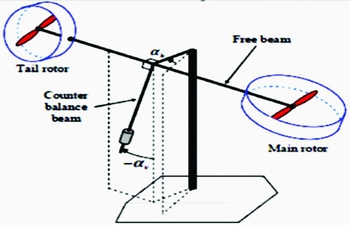
TRMS is a laboratory setup multi-input–multi-output MIMO system developed by Feedback Instruments Ltd. for identification, analysis and real-time control experiments(35). The TRMS simulates the main and tail rotor subsystems of a rotorcraft system with their interactions resulting in highly nonlinear cross-coupled dynamics. It is widely used as scaled model of highly nonlinear vehicles with strong cross-coupling effects.
2.1 Coupled nonlinear dynamic model
The phenomenological modelling of the TRMS shown in Fig. 1 is based on the use of the first principal approach, which leads to the following highly nonlinear cross-coupled MIMO dynamic model:(Reference Rahideh, Shaheed and Huijberts36)
Twin rotor MIMO system.

 $$\begin{equation}
\left\{ {\begin{array}{@{}*{1}{c}@{}} {{{\dot{\alpha }}_h}}\\ {{{{\rm{\dot{\Omega }}}}_h}}\\ {{{\dot{\omega }}_h}}\\ {{{\dot{\alpha }}_v}}\\ {{{{\rm{\dot{\Omega }}}}_v}}\\ {{{\dot{\omega }}_v}} \end{array}} \right\} = \left\{ {\begin{array}{@{}*{1}{c}@{}} {{{\rm{\Omega }}_h}}\\ {\frac{{{L_t}{f_2}\left( {{\omega _h}} \right) - {K_{{\Omega _h}}}{\Omega _h} - {f_3}\left( {{\alpha _h}} \right)}}{{{J_h}}}}\\ { - \left( {\frac{{{{\left( {{K_{ah}}{\varphi _h}} \right)}^2}}}{{{J_{tr}}{R_{ah}}}} + \frac{{{B_{tr}}}}{{{J_{tr}}}}} \right){\omega _h} - \frac{{{f_1}\left( {{\omega _h}} \right)}}{{{J_{tr}}}} + \frac{{{K_{ah}}{\varphi _h}}}{{{J_{tr}}{R_{ah}}}}{h_h}\left( {{u_h}} \right)}\\ {{{\rm{\Omega }}_v}}\\ {\left( {\begin{array}{*{20}{c}} {\frac{{{L_m}{f_5}\left( {{\omega _v}} \right) - {K_{{{\rm{\Omega }}_{\rm{v}}}}}{{\rm{\Omega }}_v} + g\left[ {\left( {A - B} \right)\cos \left( {{\alpha _v}} \right) - Csin\left( {{\alpha _v}} \right)} \right]}}{{{J_v}}}} \end{array}} \right)}\\ { - \left( {\frac{{{{\left( {{K_{av}}{\varphi _v}} \right)}^2}}}{{{J_{mr}}{R_{av}}}} + \frac{{{B_{mr}}}}{{{J_{mr}}}}} \right){\omega _v} - \frac{{{f_4}\left( {{\omega _v}} \right)}}{{{J_{mr}}}} + \frac{{{K_{av}}{\varphi _v}}}{{{J_{mr}}{R_{av}}}}{h_v}\left( {{u_v}} \right)} \end{array}} \right\}
\end{equation}$$
where α h ,α v ,Ω h ,Ω v ,ω h ,ω v ,uh ,uv , refer to the horizontal and vertical angular positions of the beam, yaw and pitch rates, rotational speeds of the main and tail rotors, and input voltage signals of main and tail rotors, respectively. The moments of inertia Jh and Jv , and operation functions fi are given by
 $$\begin{equation}
\left\{ {\begin{array}{@{}*{1}{c}@{}} {\begin{array}{*{20}{c}} {{J_h} = Dco{s^2}\left( {{\alpha _v}} \right) + Esi{n^2}\left( {{\alpha _v}} \right) + F} \end{array};\ \ \ \ {J_v} = \ \mathop \sum \limits_{i = 1}^8 {J_i}}\\ {\ {f_1}\left( {{\omega _h}} \right) = \ {K_1}\omega _h^2\ ;\ \ {f_2}\left( {{\omega _h}} \right) = \ {K_2}\omega _h^2\ \cos \left( {{\alpha _v}} \right)}\\ {{{\begin{array}{@{}*{1}{c}@{}} \ \\ f \end{array}}_3}\left( {{\alpha _h}} \right) = \ {K_3}{\alpha _h};\ {f_4}\left( {{\omega _v}} \right) = \ {K_4}\omega _v^2;\ \ {f_5}\left( {{\omega _v}} \right) = \ {K_5}\omega _v^2}\\ {{L_t} = {l_t}\cos \left( {{\alpha _v}} \right);\ \ \ \ \ \ \ \ {L_m} = {l_m} + {K_g}{{\rm{\Omega }}_h}} \end{array}} \right.
\end{equation}$$
The angular velocities of the beam, in horizontal and vertical planes, are given by
 $$\begin{equation}
\ {S_h} = {{\rm{\Omega }}_h} - \frac{{{K_m}{\omega _v}{\rm{cos}}\left( {{\alpha _v}} \right)}}{{{J_h}}};\ \quad {S_v} = \ {{\rm{\Omega }}_v} - \frac{{{K_t}}}{{{J_v}}}{\omega _h}
\end{equation}$$
 $\begin{array}{*{20}{c}} {{K_{ah}}{\varphi _h},\ \ {J_{tr}},\ \ {R_{ah}},\ \ {B_{tr}},\ \ {l_t},\ \ {K_{{{\rm{\Omega }}_{\rm{h}}}}},\ \ {K_m},\ \ {K_{av}}{\varphi _v},\ \ {J_{mr}},{l_m},\ {K_g},{R_{av}},\ {B_{mr}}\ {K_{{{\rm{\Omega }}_{\rm{v}}}}},\ {K_t},A\ ,\ B,}\end{array}\\ C,\ D,\ E,\ F\ \textrm{and}\, H$
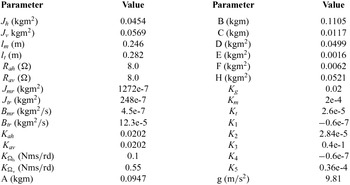
are positive constant values (see Table 1).
Physical parameters of TRMS

2.2 Nonlinear subsystems dynamics
In this work, the model in Equation (1) is divided into two nonlinear coupled subsystems according to the TRMS inputs and outputs. The state space representation of the two subsystems is written as
 $$\begin{equation}
\left\{ \begin{array}{@{}ll@{}}
{\dot{\bm x}}_k = {\bm f}_k\left( {\bm x}_k \right) + {\bm g}_k\left( {u_k} \right)\\
{y_k} = {\bm C}_k^T{\bm x}_k\\
\end{array} \right.\quad k = 1,2
\end{equation}$$
with
 $$\begin{equation*}
\begin{array}{@{}l@{}} {{\bm x}^T} = {\bm \ }{\bm x}_1^T{\bm \ \ \ }{\bm x}_2^T\\ {{\bm x}_1} = {\bm \ \ }{\left[ {{x_{11}}{\bm \ \ \ }{x_{12}}\ \ \ {x_{13}}} \right]^T} = {\bm \ \ \ }{\left[ {{\alpha _1}\ \ \ {{\bm \Omega }_1}\ \ \ {\omega _1}} \right]^T}\\ {{\bm x}_2} = {\bm \ \ \ }{\left[ {{x_{21}}{\bm \ \ \ }{x_{22}}\ \ \ {x_{23}}} \right]^T} = {\bm \ \ }{\left[ {{\alpha _2}\ \ \ {{\bm \Omega }_2}\ \ \ {\omega _2}} \right]^T}\\ {{\bm g}_1} = {\left[ {0\ \ 0\ \ {h_1}\left( {{u_1}} \right)} \right]^T};\ \ \ {{\bm g}_2} = {\left[ {0\ \ 0\ \ {h_2}\left( {{u_2}} \right)} \right]^T}\\ {{\bm C}_1} = {{\bm C}_2} = {\bm \ }{\left[ {1\ \ 0\ \ 0} \right]^T}{\bm \ } \end{array},
\end{equation*}$$
where
 ${{\bm x}_k} \in {\mathbb{R}^3}$
,
 ${u_k} \in \mathbb{R}$
, and
 ${y_k} \in \mathbb{R}$
denote the state vector, control input signal and output signal of a subsystem k, respectively. The functions
 ${{\bm f}_k} \in {\mathbb{R}^3}$
and
 ${{\bm g}_k} \in {\mathbb{R}^3}$
are uncertain nonlinear functions and
 ${{\bm d}_k}$
are disturbance vectors. In the following, indices 1 and 2 refer to the horizontal h and vertical v planes, respectively.
Yaw motion:
 $$\begin{equation}
\left\{ {\begin{array}{@{}*{1}{c}@{}} {{{\bm f}_1}\left( {{{\bm x}_1}} \right) = \left\{ {\begin{array}{@{}*{1}{c}@{}} {{f_{11}}}\\ {{f_{12}}}\\ {{f_{13}}} \end{array}} \right\} = \left[ {\begin{array}{@{}*{1}{c}@{}} {\begin{array}{@{}*{1}{c}@{}} {{x_{12}}}\\ {\frac{{{L_t}{K_2}x_{13}^2 - {K_{{{\rm{\Omega }}_1}}}{x_{12}} - {K_3}{x_{11}}}}{{{J_1}}}}\\ { - \left( {\frac{{{{\left( {{K_{a1}}} \right)}^2}}}{{{J_{tr}}{R_{a1}}}} + \frac{{{B_{tr}}}}{{{J_{tr}}}}} \right){x_{13}} - \frac{{{K_1}}}{{{J_{tr}}}}x_{13}^2} \end{array}}\\ {} \end{array}} \right]}\\ {{{\bm g}_1}\left( {{u_1}} \right) = {{\left[ {{g_{11}}\ \ \ {g_{12}}\ \ \ {g_{13}}} \right]}^{\bm T}} = {\bm \ }{{\left[ {0\quad 0\quad \left( {\frac{{{K_{a1}}}}{{{J_{tr}}{R_{a1}}}}{h_1}\left( {{u_1}} \right)} \right)} \right]}^T}} \end{array}} \right.
\end{equation}$$
Pitch motion:
 $$\begin{equation}
\left\{ {\begin{array}{@{}*{1}{c}@{}} {{{\bm f}_2}\left( {{{\bm x}_2}} \right) = \left\{ {\begin{array}{@{}*{1}{c}@{}} {{f_{21}}}\\ {{f_{22}}}\\ {{f_{23}}} \end{array}} \right\} = \left[ {\begin{array}{@{}*{1}{c}@{}} {\begin{array}{@{}*{1}{c}@{}} {{x_{22}}}\\ {\left( {\begin{array}{@{}*{1}{c}@{}} {\frac{{{L_m}{K_5}x_{23}^2 - {K_{{{\rm{\Omega }}_2}}}{x_{22}}}}{{{J_2}}} + }\\ {\frac{{g\left[ {\left( {A - B} \right)\cos \left( {{x_{21}}} \right) - Csin\left( {{x_{21}}} \right)} \right]}}{{{J_2}}}} \end{array}} \right)}\\ { - \left( {\frac{{{{\left( {{K_{a2}}} \right)}^2}}}{{{J_{mr}}{R_{a2}}}} + \frac{{{B_{mr}}}}{{{J_{mr}}}}} \right){x_{23}} - \frac{{{K_4}}}{{{J_{mr}}}}x_{23}^2} \end{array}}\\ {} \end{array}} \right]}\\ {{{\bm g}_2}\left( {{u_2}} \right) = {{\left[ {{g_{21}}\ \ \ {g_{22}}\ \ \ {g_{23}}} \right]}^{\bm T}} = {\bm \ }{{\left[ {0\ \ \ \ \ 0\ \ \ \ \ \left( {\frac{{{K_{a2}}}}{{{J_{mr}}{R_{a2}}}}{h_2}\left( {{u_2}} \right)} \right)} \right]}^T}} \end{array}} \right.
\end{equation}$$
As the angular positions and velocities remain always bounded due to the mechanical structure limitations,
 ${{\bm f}_k}( {{{\bm x}_k}} )$
and hk
(uk
) are sufficiently smooth and bounded functions on an open set for any
 ${{\bm x}_k} \in {\mathbb{X}_k}$
and
 ${u_k} \in {\mathbb{U}_k}$
 $$\begin{equation}
\begin{array}{@{}*{1}{c}@{}} {{{\bm f}_k}{{\left( {{{\bm x}_k}} \right)}_2} < {f_{k0}}}\\ {{h_k}{{\left( {{u_k}} \right)}_2} < {h_{k0}}} \end{array},
\end{equation}$$
where
 ${\mathbb{X}_k} \subset \mathbb{X}$
and
 ${\mathbb{U}_k} \subset \mathbb{U}$
are the operating and admissible control spaces of a subsystem k, respectively;
 $\mathbb{X}$
and
 $\mathbb{U}$
are the operating and admissible control spaces for the whole system;
 ${\| . \|_2}{\bm \ }$
is the Euclidian norm; and
 ${f_{k0}} \in {\mathbb{R}^ + }\ \ $
and
 ${h_{k0}} \in {\mathbb{R}^ + }$
are some positive constants.
Motivating by the uniqueness of sliding mode equations in affine systems(Reference Utkin, Guldner and Shi8), we assume that the functions hk (uk ) in the submodels in Equations (5) and (6) are linear in terms of the control inputs uk . The subsystems in Equation (4) are considered as affine subsystems with scalar linear control functions h 1(u 1) = u 1 and h 2(u 2) = u 2.
3.0 HYBRID SLIDING MODE CONTROL DESIGN
Consider the following class of multivariable cross-coupling systems where the dynamics are described by a set of m submodels:
 $$\begin{equation}
\left\{ \begin{array}{@{}*{1}{c}@{}} {{{{\dot{\bm x}}}_k} = {{\bm f}_k}\left( {{{\bm x}_k}} \right) + {{\bm g}_k}{u_k} + {{\bm d}_k}\quad \quad }\\ {{{\bm \sigma }_k} = {{\bm \sigma }_k}\left( {{{\bm x}_k}} \right)\ \ \ \ \ \ \ \ \ \ \ \ \ \ \ \ \ \ \ \ \ \ \ \ \ \ \ \ } \end{array}\quad \left( {k = 1,..,m} \right)\right.,
\end{equation}$$
with
 ${{\bm x}_k} = {[ {{x_{k1}}\ \ {x_{k2}} \ldots \ {x_{k{m_k}}}} ]^{\bm T}} \in {\mathbb{R}^{{m_k}}}$
and uk
are the state vector and the control input of the subsystem k.
 ${\sigma _k} \in \mathbb{R}$
is an output constraint.
Assumption 1. The vectors
 ${{\bm g}_{\rm{k}}}\ $
can be reduced for any
 ${{\bm x}_{\rm{k}}}$
to their non-zero scalar components
 $$\begin{equation}
\left\{ {\begin{array}{@{}*{1}{c}@{}} {{g_{k1}} = {\bm \ }{g_{k2}} = \ldots = {g_{k{m_{k - 1}}}} = 0\quad \quad \ \ \ \ \ \ \ \ }\\ {\ {g_{k{m_k}}} = {\bm \ }{g_k} \in \mathbb{R} \ne 0\ \ \ \ \ \ \ \ \ \ \ \ \ \ \ \ \ \ \ \ \ \ \ \ \ \ \ \ } \end{array}} \right.
\end{equation}$$
It results that each vector
 ${{\bm g}_k}{\bm \ }$
is equivalent to
 $$\begin{equation}
{{\bm g}_k} = {\bm \ }{\left[ {\begin{array}{*{20}{c}} 0&{{g_k}} \end{array}} \right]^{\bm T}} \in {\mathbb{R}^{{m_k}}}
\end{equation}$$
Assumption 2. The components of the disturbance vectors
 ${{\bm d}_{\rm{k}}}\ $
are assumed to be
 $$\begin{equation}
\left\{ {\begin{array}{@{}*{1}{c}@{}} {{d_{k1}} = {\bm \ }{d_{k2}} = \ldots = {d_{k{m_{k - 1}}}} = 0\ \ \ \ \ }\\ {\ {d_{k{m_k}}} = {d_k}{\bm \ \ }{\rm{with}}{\bm \ }\left| {{d_k}} \right| < {d_0} \in {\mathbb{R}^ + }\ } \end{array}} \right.
\end{equation}$$
Assumption 3. For each subsystem k there exists a well-defined constant relative degree
 ${{\bm r}_{\rm{k}}}$
. The constancy of
 ${{\bm r}_{\rm{k}}}$
means that the control input uk
appears explicitly in the rth
-time derivative of the constraint output σ
k
(xk
)(Reference Isidori37).
Assumption 4. The controllers uk
are designed such that the subsystem's trajectories intersect the hypersurfaces σ
k
and their rk
− 1 time derivatives in finite time (i.e.
 ${\sigma _k} = {\dot{\sigma }_k} = , \ldots , = \sigma _k^{( {{r_k} - 1} )} = 0$
) and remain on for further time.
To achieve this goal, the controllers uk are supposed to be composite or hybrid controllers:
 $$\begin{equation}
{u_k} = {u_{keq}}\left( {\bm x} \right) + {u_{{r_k}}}\left( {{\sigma _k},{{\dot{\sigma }}_k}, \ldots ,\sigma _k^{{r_k} - 1}} \right),
\end{equation}$$
where ukeq are the equivalent controllers (continuous components) and u rk are the robust controllers (discontinuous components). The controllers u rk are generally used to compensate for the effects of parameter uncertainties, unmodeled dynamics and external disturbances.
Assumption 5. The control inputs u
rk
are discontinuous at the origins of the coordinate systems
 ${\Sigma _k} = ( {{\sigma _k},{{\dot{\sigma }}_k}, \ldots \sigma _k^{( {{r_k} - 1} )}} )$
, which means that u
rk
are discontinuous along the trajectories
 ${\sigma _k} = {\dot{\sigma }_k} = \ldots = \sigma _k^{( {{r_k} - 1} )} = 0$
 $$\begin{equation}
{u_k} = \left\{ {\begin{array}{@{}*{1}{c}@{}} {\left\{ {{u_{keq}}\left( {{{\bm x}_k}} \right) + {u_{{r_k}}}\left( {{\Sigma _k}} \right)} \right\}\quad {\rm{if}}\ {\Sigma _k} \notin {\Gamma _k}\ \ }\\ {\left[ { - u_k^{{\rm{max}}},u_k^{{\rm{max}}}\ } \right]\ \quad {\rm{if}}\ {\Sigma _k} \notin {\Gamma _k}\ \ \ \ \ \ \ \ \ \ \ \ } \end{array}} \right.{\bm \ ,}
\end{equation}$$
where u max k are some positive constants and Γ k are closed sets in Σ k .
Assuming that Assumptions 1–5 hold for each subsystem k, in the following subsections the controllers (12) are designed within a hybrid-SMC framework. First, sliding hypersurfaces
 ${{\bm \sigma }_k}( {{{\bm x}_k}} )$
are selected such that the subsystems trajectories exhibit desirable behaviours when confined to these surfaces. Then, a set of controllers
 ${u_k}( {{{\bm x}_k}} )$
is designed to enforce the subsystems trajectories to intersect the hypersurfaces
 ${\sigma _k} = {\dot{\sigma }_k} = \ldots = \sigma _k^{( {{r_k} - 1} )} = 0$
and remain on for further time.
3.1 Continuous control design
With the help of the conditions in Equations (10) and (11), each subsystem k in the model in Equation (8) is transformed into the cascade of two-reduced order blocks, referred to as the regular form
 $$\begin{equation}
\left\{ \begin{array}{@{}*{1}{c}@{}} {{{{\dot{\bar{\bm x}}}}_k} = {{{\bar{\bm f}}}_k}\left( {{{\bm x}_k}} \right)\ \ \ \ \ \ \ \ \ \ \ \ \ \ \ \ \ \ \ \ \ \ \ \ \ \ \ \ \ \ \ \ }\\ {{\bm \ }{{\dot{x}}_{k{m_k}}} = {f_{k{m_k}}}\left( {{{\bm x}_k}} \right) + {g_k}\left( {{{\bm x}_k}} \right){u_k} + {d_k}} \end{array} \right.,
\end{equation}$$
with
 $$\begin{equation*}
{{\bar{\bm f}}_k} = {\left[ {\ {f_{k1}}\ \ {f_{k2}}\ \ldots \ {f_{k{m_k} - 1}}} \right]^T}
\end{equation*}$$
 $$\begin{equation*}
{{\bar{\bm x}}_k} = {\left[ {{x_{k1}}\ \ {x_{k2}}\ \ldots \ \ {x_{k{m_k} - 1}}} \right]^T}
\end{equation*}$$
In order to make the origin of
 ${{\dot{\bar{\bm x}}}_k} = {{\bar{\bm f}}_k}( {{{\bm x}_k}} )$
asymptotically stable, the conventional sliding mode control design is performed in two steps:(Reference Luk'yanov and Utkin38)
-
1. The states x kmk are handled as smooth stabilising state feedback controls of the upper blocks and designed as functions of the states xki (i = 1, . . ., mk − 1) in correspondence with some performance criterion
(15)where the scalar valued functions $$\begin{equation}\left\{ {\begin{array}{@{}*{1}{c}@{}} {{x_{k{m_k}}} = {{\bm \Phi }_k}\left( {{{{\bar{\bm x}}}_k}} \right)}\\ {{{\bm \Phi }_k}\left( 0 \right) = 0\ \ \ \ \ \ } \end{array}} \right.,\end{equation}$$
${{\bm \Phi }_k}( {{{{\bar{\bm x}}}_k}} )$
are to be defined such that the origins
${{\bar{\bm x}}_k} = 0\ $
of the upper blocks become stable with desired domains of attraction.
-
2. Sliding controllers are designed such that sliding regimes occur on the hypersurfaces
${{\bm \sigma }_k}( {{{\bm x}_k}} )$
and the states x
k, mk
of lower blocks reach
${{\bm \Phi }_k}( {{{{\bar{\bm x}}}_k}} )$
in finite time
(16)
$$\begin{equation}{\sigma _k}\left( {{{{\bar{\bm x}}}_k},{x_{k{m_k}}}} \right) = {x_{k{m_k}}} + {\Phi _k}\left( {{{{\bar{\bm x}}}_k}} \right) = 0\end{equation}$$


When the sliding motions
 ${{\bm \sigma }_k}( {{{\bm x}_k}} ) = 0$
are established, conditions in Equation (15) hold and the further motion in each subsystem k is governed by the differential equation
 $$\begin{equation}
{{\dot{\bar{\bm x}}}_k} = {{\bar{\bm f}}_k}\left( {{{{\bar{\bm x}}}_k},{x_{k{m_k}}}} \right) = {{\bar{\bm f}}_k}\left( {{{{\bar{\bm x}}}_k},{{\bm \Phi }_k}\left( {{{{\bar{\bm x}}}_k}} \right)} \right)
\end{equation}$$
The continuous components ukeq of the control inputs uk are computed under the reachability condition
 $$\begin{equation}
{\dot{\sigma }_k}\left( {{{{\bar{\bm x}}}_k},{x_{k{m_k}}}} \right) = {\dot{x}_{k{m_k}}} + {{\dot{\bm \Phi }}_k}\left( {{{{\bar{\bm x}}}_k}} \right) = 0,
\end{equation}$$
which yields
 $$\begin{equation}
{f_{k{m_k}}} + {g_k}{u_k} + {d_k} + {\left[ {\frac{{\partial {{\bm \Phi }_k}\left( {{{{\bar{\bm x}}}_k}} \right)}}{{\partial {{{\bar{\bm x}}}_k}}}} \right]^T}{{\bar{\bm f}}_k} = 0
\end{equation}$$
The continous controllers
 ${u_{keq}}( {{{\bm x}_k}} ){\bm \ }$
are now given by
 $$\begin{equation}
\begin{array}{*{20}{c}} {{u_{keq}}\left( {{{{\bar{\bm x}}}_k}} \right) = - \hat{g}_k^{ - 1}\left( {{{{\bar{\bm x}}}_k},{{\bm \Phi }_k}} \right)\left( {{{\widehat {\bar{f}}}_{k{m_k}}}\left( {{{{\bar{\bm x}}}_k},{{\bm \Phi }_k}} \right) + \begin{array}{*{20}{c}} {{{\left[ {\frac{{\partial {{\bm \Phi }_k}\left( {{{{\bar{\bm x}}}_k}} \right)}}{{\partial {{{\bar{\bm x}}}_k}}}} \right]}^T}{{\widehat {{\bar{\bm f}}}}_k}} \end{array} + {d_k}} \right)} \end{array},
\end{equation}$$
with
 $\hat{g}_k^{ - 1}( {{{{\bar{\bm x}}}_k},{{\bm \Phi }_k}} ) \ne 0$
.
The main issue in the construction of the conventional controllers in Equation (20) is the selection of the sliding hypersurfaces σ k and the transformations in Equation (15). In the following a new explicit multi-step procedure is proposed to overcome such challenges and to enhance the controllers’ convergence.
Theorem 1. Let the outputs of the subsystems in Equation (8) be measurable or observable signals and σ
k
be continuous functions of
 ${{\bm x}_k}$
and derivable up to the orders
 ${{\bm r}_k}$
, the following multistep procedure establishes stable high-order sliding modes under constraint dynamics.
Step 1: Consider the following diffeomorphic state coordinate transformations:
 $$\begin{equation}
\begin{array}{@{}*{1}{c}@{}} {{{\bm \xi }_k}\left( {{{\bm x}_k}} \right) = {{\left[ {{\sigma _k}\ \ \ {x_{k2}}\ \ \ldots .\ \ {x_{k{m_k} - 1}}\ \ \ \ {{\dot{x}}_{k{m_k} - 1}}\ } \right]}^T}\ \ \ \ }\\ {{\bm \ \ \ \ \ \ \ \ \ } = {{\left[ {{\xi _{k1}}\ \ \ {\xi _{k2}}\ \ \ldots .\ \ {\xi _{k{m_k} - 1}}\ \ \ \ {\xi _{k{m_k}}}\ } \right]}^T}\ \ \ \ } \end{array},
\end{equation}$$
where σ k = yk − ykd (t) with yd k (t) = x k1 d are the desired trajectories (superscripted by d). The dynamics in Equation (14) are expressed in the coordinate systems in Equation (21) as follows
 $$\begin{equation}
\left\{ {\begin{array}{@{}*{1}{c}@{}} {{{{\dot{\bar{\bm \xi }}}}_k} = {{{\bar{\bm f}}}_k}\left( {{{\bm \xi }_k}} \right)\ \ \ \ \ \ \ \ \ \ \ \ \ \ \ \ \ \ \ \ \ \ \ \ \ \ \ \ \ \ \ \ \ }\\ {{{\dot{\xi }}_{k{m_k}}} = {p_k}\left( {{{\bm \xi }_k}} \right) + {q_k}\left( {{{\bm \xi }_k}} \right){u_k} + {d_k}} \end{array}} \right.,
\end{equation}$$
where
 ${{\bar{\bm \xi }}_k} = {[ {\ {\xi _{k,1}}\ \ {\xi _{k,2}}\ \ldots \ {\xi _{k,{m_k} - 1}}} ]^T}$
. The functions
 ${{\bar{\bm f}}_k}( {{{\bm \xi }_k}} )$
are bounded continuous functions in the bases Π
k
= (ξ
k1ξ
k2. . . .ξ
kmk
).
Step 2: By imposing uniformly asymptotically stable linear constraint dynamics to the tracking errors σ k , the stabilisation of the subsystems (14) with the desired input-output closed-loop dynamics uk → yd k1 is obtained:
 $$\begin{equation}
\sigma _k^{\left( {{r_k}} \right)} + {\lambda _{k{r_k} - 1}}\sigma _k^{\left( {{r_k} - 1} \right)} + \ldots + {\lambda _{k1}}{\dot{\sigma }_k} + {\lambda _{k0}}{\sigma _k} = 0,
\end{equation}$$
where the parameters λ krk − 1, . ., λ k, 0 are such that the polynomials z rk + λ krk − 1 z rk − 1 + . . . + λ k1 z + λ k0 = 0 are Hurwitz.
Step 3: The functions
 ${p_k}( {{{\bm \xi }_k}} )$
and
 ${q_k}( {{{\bm \xi }_k}} )$
are computed using the following identities:
 $$\begin{equation}
{\dot{\xi }_{k{m_k}}} = {\ddot{\xi }_{k{m_k} - 1}} = {\ddot{x}_{k{m_k} - 1}} = {p_k}\left( {{{\bm \xi }_k}} \right) + {q_k}\left( {{{\bm \xi }_k}} \right){u_k} + {d_k}
\end{equation}$$
Step 4: Using Equation (23), the controllers
 ${u_{keq}}( {{{\bm \xi }_k}} )$
are obtained as follows:
 $$\begin{equation}
\begin{array}{*{20}{c}} {{u_{keq}}\left( {{{\bm \xi }_k}} \right) = - {\varrho _{0k}}\hat{q}_k^{ - 1}\left( {{{\bm \xi }_k}} \right)\left[ {{p_k}\left( {{{\bm \xi }_k}} \right) + \begin{array}{*{20}{c}} {\mathop \sum \limits_{i = {m_k}}^1 \left( {{\lambda _{ki - 1}}{\xi _{ki}}} \right)} \end{array} + {d_k}} \right]} \end{array}
\end{equation}$$
Step 5: Homogeneous controllers defined in Subsection 3.2 are added to the controllers (25) to produce hybrid-SMC schemes.
The asymptotic convergence of the new state vectors
 ${{\bar{\bm \xi }}_k}$
to zero ensures the asymptotic convergence of the vector
 ${{\bar{\bm x}}_k}$
to
 ${\bar{\bm x}}_k^d = {[ {x_{k1}^d\ \ \ \ \ 0\ \ \ldots \ \ 0} ]^T}$
. The parameters ϱ0k
are some weighting coefficients. The proof of Theorem 1 is given in Section 3.3.
3.2 Robust finite time control design
Being functions of
 ${\sigma _k},{\dot{\sigma }_k}, \ldots ,\sigma _k^{( {{r_k} - 1} )}$
, the controllers ukr
are designed to robustly compensate for uncertainties, unmodeled dynamics, disturbances and small measurement noises.
Assumption 7. Successive time derivatives up to
 ${{\bm r}_k} - 1$
of each sliding variable σ
k
are continuous functions of
 ${{\bm x}_k}$
and the set
 ${\sigma _k} = {\dot{\sigma }_k} = \ldots = \sigma _k^{( {{r_k} - 1} )} = 0$
is non-empty integral set in Filippov's sense(Reference Levant39).
From assumption 7, it results that
 ${\bm \sigma }_k^{({r_k})}( {{{\bm x}_k}} )$
are bounded affine functions with respect to the control inputs uk
 $$\begin{equation}
{\bm \sigma }_k^{\left( {{r_k}} \right)}\left( {{{\bm x}_k}} \right) = {a_k}\left( {{{\bm x}_k}} \right) + {b_k}\left( {{{\bm x}_k}} \right){u_k},
\end{equation}$$
with
 $$\begin{equation*}
{a_k}\left( {{{\bm x}_k}} \right) = L_{{{\bm f}_k}}^{{r_k}}\left( {{{\bm \sigma }_k}} \right),\quad {b_k}\left( {{{\bm x}_k}} \right) = {L_{{{\bm g}_k}}}L_{{{\bm f}_k}}^{{r_k} - 1}\left( {{{\bm \sigma }_k}} \right),
\end{equation*}$$
 $$\begin{equation*}
\left| {{a_k}} \right| \le C,\quad {K_m} < \left| {{b_k}} \right| < {K_M},
\end{equation*}$$
where C,
 ${K_m},{K_M} \in {\mathbb{R}^ + }$
, and
 $L_{{{\bm f}_k}}^{{r_k}}( . )$
and
 $L_{{{\bm f}_k}}^{{r_k}}( . )$
are the Lie derivatives.
Lemma 1
(Reference Isidori37). Due to the boundedness of the functions
 $\sigma _k^{{r_k}}( {{{\bm x}_k}} )$
, it is possible to construct r-sliding homogeneous feedback controllers of the form
 $$\begin{equation}
{u_{{r_k}}} = {U_k}\left( {{\sigma _k},{{\dot{\sigma }}_k}, \ldots ,\sigma _k^{{r_k} - 1}} \right) = - {\varrho _{rk}}{H _{{r_k}}}\left( {{\sigma _k},{{\dot{\sigma }}_k}, \ldots ,\sigma _k^{\left( {{r_k} - 1} \right)}} \right),
\end{equation}$$
such that all the trajectories (26) converge in finite time to the origins of the
 ${{\bm r}_k}$
-sliding phase spaces
 ${{\bm \Sigma }_k}$
defined in Assumption 5. The functions
 ${{\bm H }_{{r_k}}}( . )$
are given by recursive procedures and
 ${\varrho _{rk}} \in \mathbb{R}$
are the controllers’ gains with
 ${\rm{sign}}( {{\varrho _{rk}}} ) = {\rm{sign}}( {{{\bm b}_k}( {{{\bm x}_k}} )} )$
.
The most known discontinuous r-sliding mode controllers are the homogeneous or quasi-continuous controllers defined as r-sliding stabilising controllers. Homogeneous
 ${{\bm r}_k}$
-sliding controllers are defined by the following recursive procedure:
 $$\begin{equation}
\begin{array}{@{}*{1}{c}@{}} {\begin{array}{@{}*{1}{c}@{}} {{u_{{r_k}}} = - {\varrho _{rk}}{{\bm H }_{{r_k}}}\left( {{{\bm \sigma }_k},{{{\dot{\bm \sigma }}}_k}, \ldots ,{\bm \sigma }_k^{\left( {{r_k} - 1} \right)}} \right)\ }\\ {\ \ \ \ \ \ = - {\varrho _{rk}}{{\bm f}_{k,i}}/{N_{k,i}}i = 0, \ldots ,{r_k} - 1\ } \end{array}\ \ } \end{array},
\end{equation}$$
with
 $$\begin{equation*}
\left\{ {\begin{array}{@{}*{1}{l}@{}} {{\phi _{k,0}} = {\sigma _k},{\bm \ }\ {N_{k,0}} = \left| {{\sigma _k}} \right|,{\bm \ \ \ }{{\bm H }_0} = {\phi _{k,0}}/\ {N_{k,0}} = sign\left( {{\sigma _k}} \right)}\\ {{\phi _{k,i}} = \sigma _k^{\left( i \right)} + {\beta _{ki}}N_{k,i - 1}^{\left( {{r_k} - 1} \right)/\left( {{r_k} - i + 1} \right)}\ {{\bm H }_{i - 1}}\quad \quad \quad \quad \quad \quad \quad }\\ {{N_{k,i}} = \left| {\sigma _k^{\left( i \right)}} \right| + {\beta _{ki}}N_{k,i - 1}^{\left( {{r_k} - 1} \right)/\left( {{r_k} - i + 1} \right)\quad \quad \quad \quad \quad \quad \quad \quad \quad \quad \quad \quad \quad \quad }}\\ {{{\bm H }_i} = {\phi _{k,i}}/\ {N_{k,i}}\quad \quad \quad \quad \quad \quad \quad \quad \quad \quad \quad \quad \quad \quad } \end{array}} \right.
\end{equation*}$$
The design parameters
 ${\beta _{k,i}} \in {\mathbb{R}^ + }$
are tuned to provide for the needed convergence rates. For the proof of the lemma 1 and for more details on the homogeneous high-order sliding modes, one can refer to Refs. Reference Levant39 and Reference Levant and Pavlov40.
3.3 Stability analysis
Suppose that the hybrid-SMC feedbacks (12), when applied to the subsystems (8) simultaneously, stabilise the states
 ${\bar{x}_{ki}}$
to their desired values. To prove the stability of the origins
 ${{\bar{\bm x}}_k} = 0$
, a set of operators Δ
k
is defined as follows
 $$\begin{equation}
\begin{array}{*{20}{c}} {\begin{array}{*{20}{c}} {\begin{array}{*{20}{c}} {{\Delta _k} = {p_k}\left( {{{\bm \xi }_k}} \right) + \begin{array}{*{20}{c}} {\mathop \sum \limits_{i = {m_k}}^1 \left( {{\lambda _{ki - 1}}{\xi _{ki}}} \right)} \end{array} + {d_k} - {\varrho _{0k}}{q_k}\left( {{{\bm \xi }_k}} \right)q_k^{ - 1}\left( {{{\bm \xi }_k}} \right)\left[ {{p_k}\left( {{{\bm \xi }_k}} \right) + \begin{array}{*{20}{c}} {\mathop \sum \limits_{i = {m_k}}^1 \left( {{\lambda _{ki - 1}}{\xi _{ki}}} \right)} \end{array}} \right]} \end{array}} \end{array}\ } \end{array}
\end{equation}$$
and variables sk are chosen such that
 $$\begin{equation}
{\dot{s}_k} = {\Delta _k} + {q_k}\left( {{{\bm \xi }_k}} \right){u_{{r_k}}}\left( {{\sigma _k},{{\dot{\sigma }}_k}, \ldots ,\sigma _k^{\left( {{r_k} - 1} \right)}} \right),
\end{equation}$$
with
 $$\begin{equation*}
\left| {\frac{{{\Delta _k}\left( {{{{\bar{\bm \xi }}}_k},{\xi _{k{m_k}}}} \right)}}{{{{\bm q}_k}}}} \right| \le {\mu _k}\left( {{{{\bar{\bm \xi }}}_k},{\xi _{k{m_k}}}} \right) + {\tau _{k0}}\left| {{u_{{r_k}}}} \right|
\end{equation*}$$
 $$\begin{equation*}
{\mu _k}\left( {{{{\bar{\bm \xi }}}_k},{\xi _{k{m_k}}}} \right) \ge 0,\;\ 0 \le {\tau _{k0}} < 1
\end{equation*}$$
The reachability conditions are now given as
 $$\begin{equation}
\begin{array}{*{20}{c}} {{s_k}{{\dot{s}}_k} = {s_k}{\Delta _k} + {s_k}{q_k}{u_{{r_k}}}{\bm \ } \le \ {q_k}\left[ {\left| {{s_k}} \right|\left( {{\mu _k} + {\tau _{k0}}\left| {{u_{kr}}} \right|} \right) + {s_k}{u_{{r_k}}}} \right]{\bm \ }} \end{array}
\end{equation}$$
The gains ϱ rk of the controllers (28) are selected such that
 $$\begin{equation}
{\varrho _{rk}} \ge \frac{{{\mu _k}}}{{1 - {\tau _{k0}}}} + {\varrho _{0k}}\ ,\ \ \ \ {\varrho _{0k}} > 0
\end{equation}$$
One can find that
 $$\begin{equation}
{\dot{s}_k}{s_k} \le - {\eta _k}\left| {{s_k}} \right|,
\end{equation}$$
with
 $$\begin{equation*}
{\eta _k} = {q_k}{\varrho _{0k}}\left( {1 - {\tau _{k0}}} \right)
\end{equation*}$$
The reachability conditions in Equation (33) guarantee that the time-derivatives of Lyapunov function candidates
 ${V_k} = \frac{1}{2}s_k^T{s_k}$
are negative definite for strictly positive design parameters η
k
> 0.
4.0 HYBRID-SMC APPLIED TO TRMS CONTROL
In the models in Equations (5) and (6), the dynamics of the rotational speeds ω1 and ω2 are directly controlled by the system voltage inputs u 1 and u 2, while the dynamics of the angular positions α1 and α2 and the yaw and pitch rates Ω1 and Ω2 are controlled by the rotors' speeds. The control objective is to robustly drive the outputs α1 and α2 to their desired values α d 1 and α d 2 in finite time in spite of uncertainties and disturbances. Following the multi-step procedure developed in Section 3, a hybrid-SMC scheme for the TRMS is constructed as follows.
Step 1: Sliding hypersurfaces and coordinate transformations
Since the rotational speeds of tail and main rotors in the models in Equations (5) and (6) are directly controlled by the voltages uk , the following coordinate transformations are considered:
 $$\begin{equation}
{{\bm \xi }_k}\left( {{{\bm x}_k}} \right) = \left[ {\begin{array}{@{}*{1}{l}@{}} {{\xi _{k1}} = {x_{k1}} - x_{k1}^d = {\sigma _k}({{\bm x}_k})}\\ {{\xi _{k2}} = {x_{k2}}\ \ \ \ \ \ \ \ \ \ \ \ \ \ \ \ \ \ \ \ \ \ \ \ \ \ \ \ \ \ }\\ {{\xi _{k3}} = \ {{\dot{x}}_{k2}}\ \ \ \ \ \ \ \ \ \ \ \ \ } \end{array}} \right]
\end{equation}$$
with
 $$\begin{equation}
\left\{ {\begin{array}{@{}*{1}{l}@{}} {{{\dot{\xi }}_{k1}} = {\xi _{k2}} - \dot{x}_{k1}^d\ \ \ \ \ \ \ \ \ \ \ \ \ \ \ \ \ \ \ \ \ \ \ \ \ \ \ \ \ }\\ {{{\dot{\xi }}_{k2}} = {\xi _{k3}}\ \ \ \ \ \ \ \ \ \ \ \ \ \ \ \ \ \ \ \ \ \ \ \ \ \ \ \ \ \ \ \ \ \ \ \ \ \ \ \ \ \ }\\ {{{\dot{\xi }}_{k3}} = {p_k}\left( {{{\bm \xi }_k}} \right) + {q_k}\left( {{{\bm \xi }_k}} \right){u_k}\ \ \ \ \ \ \ \ \ \ \ \ \ } \end{array}} \right.
\end{equation}$$
The convergence of the new states ξ
k1 to their zero level ensures the convergence of
 ${\bar{x}_{k1}}$
to xd
k1 = α
k
d
. Using the models in Equations (5) and (6), the yaw and pitch motion models corresponding to the transformations in Equations (34) and (35) are given, respectively, by
 $$\begin{equation}
\left\{ {\begin{array}{@{}*{1}{l}@{}} {{\xi _{11}} = {x_{11}} - x_{11}^d = {\sigma _1}({{\bm x}_1})}\\ {{\xi _{12}} = {x_{12}}\ \ \ \ \ \ \ \ \ \ \ \ \ \ \ \ \ \ \ \ \ \ \ \ \ \ \ \ \ \ }\\ {{\xi _{13}} = {{\dot{x}}_{12}}\ \ \ \ \ \ \ \ \ \ \ \ \ \ \ \ \ \ \ \ \ \ \ \ \ \ \ \ \ \ } \end{array}} \right.,\quad \left\{ {\begin{array}{@{}*{1}{l}@{}} {{{\dot{\xi }}_{11}} = {\xi _{12}} - x_{11}^d\ \ \ \ \ \ \ \ \ \ \ \ \ \ \ \ \ \ \ \ \ \ \ }\\ {{{\dot{\xi }}_{12}} = {\xi _{13}}\ \ \ \ \ \ \ \ \ \ \ \ \ \ \ \ \ \ \ \ \ \ \ \ \ \ \ \ \ \ \ }\\ {{{\dot{\xi }}_{13}} = {p_1}\left( {{{\bm \xi }_1}} \right) + {q_1}\left( {{{\bm \xi }_1}} \right){u_1}\ \ } \end{array}} \right.,
\end{equation}$$
and
 $$\begin{equation}
\left\{ {\begin{array}{@{}*{1}{l}@{}} {{\xi _{21}} = {x_{21}} - x_{21}^d = {\sigma _2}({{\bm x}_2})}\\ {{\xi _{22}} = {x_{22}}\ \ \ \ \ \ \ \ \ \ \ \ \ \ \ \ \ \ \ \ \ \ \ \ \ \ \ \ \ \ }\\ {{\xi _{23}} = {{\dot{x}}_{22}}\ \ \ \ \ \ \ \ \ \ \ \ \ \ \ \ \ \ \ \ \ \ \ \ \ \ \ \ \ \ } \end{array}} \right.,\quad \left\{ {\begin{array}{@{}*{1}{l}@{}} {{{\dot{\xi }}_{21}} = {\xi _{22}} - x_{21}^d\ \ \ \ \ \ \ \ \ \ \ \ \ \ \ \ \ \ \ }\\ {{{\dot{\xi }}_{22}} = {\xi _{23}}\ \ \ \ \ \ \ \ \ \ \ \ \ \ \ \ \ \ \ \ \ \ \ \ \ \ \ \ \ }\\ {{{\dot{\xi }}_{23}} = {p_2}\left( {{{\bm \xi }_2}} \right) + {q_2}\left( {{{\bm \xi }_2}} \right){u_2}\ } \end{array}} \right.
\end{equation}$$
Step 2: Constraint dynamics
From the models in Equations (5) and (6), it is clear that the relative degrees of the input-output dynamics u 1 → α1 and u 2 → α2 are r 1 = 3 and r 2 = 3, respectively. It results from the identity in Equation (23) that the constraint dynamics imposed on the sliding variables σ1 and σ2 take the following form
 $$\begin{equation}
\sigma _k^{\left( 3 \right)} + {\lambda _{k2}}\sigma _k^{\left( 2 \right)} + {\lambda _{k1}}\sigma _k^{\left( 1 \right)} + {\lambda _{k0}}{\sigma _k} = 0
\end{equation}$$
Step 3: Computing the functions
 ${{\bm p}_k}( {{{\bm \xi }_k}} )$
and
 ${{\bm q}_k}( {{{\bm \xi }_k}} )$
For the yaw mode, it follows from the third identity in Equations (34) that
 $$\begin{equation}
\begin{array}{@{}rcl@{}}
{{\dot{\xi }}_{13}} &=& {{\ddot{x}}_{12}}\ = \frac{1}{{{J_1}}}\left( {2{L_t}{K_2}{x_{13}}{{\dot{x}}_{13}} - {K_{{{\rm{\Omega }}_1}}}{{\dot{x}}_{12}} - {K_3}{{\dot{x}}_{11}}} \right)\ \\[10pt]
&=& \displaystyle\frac{{2{L_t}{K_2}{x_{13}}}}{{{J_1}}}\left[ { - \left( {\displaystyle\frac{{{{\left( {{K_{a1}}{\varphi _1}} \right)}^2}}}{{{J_{tr}}{R_{a1}}}} + \displaystyle\frac{{{B_{tr}}}}{{{J_{tr}}}}} \right){x_{13}} - \displaystyle\frac{{{K_1}}}{{{J_{tr}}}}x_{13}^2 + {g_{13}}{u_1}} \right]\ - \displaystyle\frac{1}{{{J_1}}}\left[ {{K_{{{\rm{\Omega }}_1}}}{\xi _{13}} + {K_3}{\xi _{12}}} \right] \end{array}
\end{equation}$$
with
 $$\begin{equation*}
\begin{array}{@{}rcl@{}} {\xi _{13}} &= &{{\dot{x}}_{12}} = \displaystyle\frac{{{L_t}{K_2}x_{13}^2 - {K_{{{\rm{\Omega }}_1}}}{x_{12}} - {K_3}{x_{11}}}}{{{J_1}}}\\ [10pt]
& = &\displaystyle\frac{{{L_t}{K_2}x_{13}^2 - {K_{{{\rm{\Omega }}_1}}}{\xi _{12}} - {K_3}\left( {{\xi _{11}} - {x_{k1d}}} \right)}}{{{J_1}}} \end{array}
\end{equation*}$$
From these two new identities, one can find that
 $$\begin{equation}
\left\{ {\begin{array}{@{}*{1}{l}@{}} {{{\dot{\xi }}_{13}} = {p_1}\left( {{{\bm \xi }_1}} \right) + {q_1}\left( {{{\bm \xi }_1}} \right){u_1}\quad \quad \quad \quad \quad \quad \quad \quad \quad \quad }\\ {{p_1}\left( {{{\bm \xi }_1}} \right) = - {a_{11}}\chi _1^2\left( {{{\bm \xi }_1}} \right) - {a_{12}}\chi _1^3\left( {{{\bm \xi }_1}} \right) - {a_{13}}{\xi _{12}} - {a_{14}}{\xi _{13}}}\\ {{q_1}\left( {{{\bm \xi }_1}} \right) = {b_1}{\chi _1}\left( {{{\bm \xi }_1}} \right)\quad \quad \quad \quad \quad \quad \quad \quad \quad \quad \quad \quad } \end{array}} \right.
\end{equation}$$
with
 $$\begin{equation*}
{\chi _1}\left( {{{\bm \xi }_1}} \right) = \ {\left( {\frac{{{J_1}{\xi _{13}} + {{\bm K}_{{{\rm{\Omega }}_1}}}{\xi _{12}} + {{\bm K}_3}\left( {{\xi _{11}} + {x_{k1d}}} \right)}}{{{L_t}{{\bm K}_2}}}} \right)^{1/2}}
\end{equation*}$$
 $$\begin{eqnarray*}
{a_{11}} &=& \frac{{2{L_t}{K_2}}}{{{J_1}}}\left( {\frac{{{{\left( {{K_{a1}}{\varphi _1}} \right)}^2}}}{{{J_{tr}}{R_{a1}}}} + \frac{{{B_{tr}}}}{{{J_{tr}}}}} \right),\quad {a_{12}} = \ \frac{{2{L_t}{K_1}{K_2}}}{{{J_1}{J_{tr}}}}, \quad {a_{13}} = \ \frac{{{K_3}}}{{{J_1}}},\quad {a_{14}} = \frac{{{K_{{{\rm{\Omega }}_1}}}}}{{{J_1}}},\\
{b_1} &=& \frac{{2{L_t}{K_2}}}{{{J_1}}}{g_{13}}
\end{eqnarray*}$$
For the pitch mode,
 $$\begin{eqnarray}
{{\dot{\xi }}_{23}} &=& {{\ddot{x}}_{22}} = \frac{1}{{{J_2}}}\left( {2{L_m}{K_5}{x_{23}}{{\dot{x}}_{23}} - {K_{{{\rm{\Omega }}_2}}}{{\dot{x}}_{22}}g\left[ {\left( {A - B} \right)\cos \left( {{x_{21}}} \right) - Csin\left( {{x_{21}}} \right)} \right]} \right)\nonumber\\
&& -\, \frac{1}{{{J_2}}}
{K_{{{\rm{\Omega }}_2}}}{x_{22}}g{{\dot{x}}_{21}}\left[ {\left( {B - A} \right)\sin \left( {{x_{21}}} \right) - Ccos\left( {{x_{21}}} \right)} \right]\nonumber\\
& =& \frac{{2{L_m}{K_5}{x_{23}}}}{{{J_2}}}\left[ { - \left( {\frac{{{{\left( {{K_{a2}}{\varphi _2}} \right)}^2}}}{{{J_{mr}}{R_{a2}}}} + \frac{{{B_{mr}}}}{{{J_{mr}}}}} \right){x_{23}} - \frac{{{K_4}}}{{{J_{mr}}}}x_{23}^2 + {g_{23}}{u_2}} \right]\nonumber\\
&& -\, \frac{{{K_{{{\rm{\Omega }}_2}}}g}}{{{J_2}}}{\xi _{23}}\left[ {\left( {A - B} \right)\cos \left( {{\xi _{21}} + {x_{21d}}} \right) - Csin\left( {{\xi _{21}} + {x_{21d}}} \right)} \right] \nonumber\\
&&-\, \frac{{{K_{{{\rm{\Omega }}_2}}}g}}{{{J_2}}}\xi _{22}^2\left[ {\left( {B - A} \right)\sin \left( {{\xi _{21}} + {x_{21d}}} \right) - Ccos\left( {{\xi _{21}} + {x_{21d}}} \right)} \right]
\end{eqnarray}$$
with
 $$\begin{equation*}
\begin{array}{@{}rcl@{}}
{\xi _{23}} &=& {{\dot{x}}_{22}}\ \ = \displaystyle\frac{{{L_m}{K_5}x_{23}^2 - {K_{{{\rm{\Omega }}_2}}}{x_{22}}g\left[ {\left( {A - B} \right)\cos \left( {{x_{21}}} \right) - Csin\left( {{x_{21}}} \right)} \right]}}{{{J_2}}}\\[10pt]
&=& \displaystyle\frac{{{L_m}{K_5}x_{23}^2}}{{{J_2}}} - \displaystyle\displaystyle\frac{{{K_{{{\rm{\Omega }}_2}}}g}}{{{J_2}}}{\xi _{22}}\left[ {\left( {A - B} \right)\cos \left( {{\xi _{21}} + {x_{21d}}} \right) - Csin\left( {{\xi _{21}} + {x_{21d}}} \right)} \right] \end{array}
\end{equation*}$$
These new identities yield
 $$\begin{equation}
\left\{ {\begin{array}{@{}*{1}{l}@{}} {{{\dot{\xi }}_{23}} = {p_2}\left( {{{\bm \xi }_2}} \right) + {q_2}\left( {{{\bm \xi }_2}} \right){u_2}}\\ {{p_2}\left( {{{\bm \xi }_2}} \right) = - {a_{21}}\chi _2^2\left( {{{\bm \xi }_2}} \right) - {a_{22}}\chi _2^3\left( {{{\bm \xi }_2}} \right)}\\ { - {a_{23}}\left( {{{\bm \xi }_{23}} + \xi _{22}^2} \right)\cos \left( {{{\bm \xi }_{21}} + {x_{21d}}} \right)}\\ { - {a_{24}}\left( {{{\bm \xi }_{23}} + \xi _{22}^2} \right)\sin \left( {{{\bm \xi }_{21}} + {x_{21d}}} \right)}\\ {{q_2}\left( {{{\bm \xi }_2}} \right) = \ \ {b_2}{\chi _2}\left( {{{\bm \xi }_2}} \right)} \end{array}} \right.,
\end{equation}$$
with
 $$\begin{equation*}
\begin{array}{@{}*{1}{l}@{}} {{\chi _2}\left( {{{\bm \xi }_2}} \right) = \begin{array}{@{}*{1}{l}@{}} {{{\left( {\begin{array}{@{}*{1}{l}@{}} {\begin{array}{@{}*{1}{l}@{}} {\displaystyle\frac{{{J_2}{\xi _{23}}}}{{{L_m}{K_5}}} - \displaystyle\frac{{{K_{{{\rm{\Omega }}_2}}}g}}{{{L_m}{K_5}}}\left( {A - B} \right){\xi _{22}}\cos \left( {{\xi _{21}} + {x_{21d}}} \right)}\\ [10pt]
{ + \displaystyle\frac{{{K_{{{\rm{\Omega }}_2}}}g}}{{{L_m}{K_5}}}C{\xi _{22}}sin\left( {{\xi _{21}} + {x_{21d}}} \right)\ \ \ \ \ \ \ \ \ \ \ \ \ \ \ \ \ \ \ \ \ \ } \end{array}} \end{array}} \right)}^{1/2}}} \end{array}\ } \end{array}
\end{equation*}$$
 $$\begin{eqnarray*}
{a_{21}} &=& \frac{{2{L_m}{K_5}}}{{{J_2}}}\left( {\frac{{{{\left( {{K_{a2}}{\varphi _2}} \right)}^2}}}{{{J_{mr}}{R_{a2}}}} + \frac{{{B_{mr}}}}{{{J_{mr}}}}} \right) ,\quad {a_{22}} = \frac{{2{L_m}{K_5}}}{{{J_2}}}\frac{{{K_4}}}{{{J_{mr}}}},\quad {a_{23}} = \frac{{{K_{{{\rm{\Omega }}_2}}}g}}{{{J_2}}}\left( {A - B - C} \right) ,\\
{a_{24}} &=& \frac{{{K_{{{\rm{\Omega }}_2}}}g}}{{{J_2}}}\left( {B - A - C} \right)\quad {b_2} = \frac{{2{L_m}{K_5}}}{{{J_2}}} {g_{23}}
\end{eqnarray*}$$
Step 4: Continuous controllers
The equivalent controllers
 ${u_{keq}}( {{{\bm \xi }_k}} )$
for both yaw and pitch motion modes are given from the identity in Equation (25) as follows
 $$\begin{equation}
\begin{array}{@{}*{1}{l}@{}} {\left\{ {\begin{array}{@{}*{1}{l}@{}} {{u_{1eq}}\left( {{{\bm \xi }_1}} \right) = - q_1^{ - 1}\left( {{{\bm \xi }_k}} \right)\left[ {{p_1}\left( {{{\bm \xi }_1}} \right) + \begin{array}{*{20}{l}} {\mathop \sum \limits_{i = 3}^1 \left( {{\lambda _{1i - 1}}{\xi _{1i}}} \right)} \end{array} + {d_1}} \right]}\\ {{u_{2eq}}\left( {{{\bm \xi }_2}} \right) = - q_2^{ - 1}\left( {{{\bm \xi }_2}} \right)\left[ {{p_2}\left( {{{\bm \xi }_2}} \right) + \begin{array}{*{20}{l}} {\mathop \sum \limits_{i = 3}^1 \left( {{\lambda _{2i - 1}}{\xi _{2i}}} \right)} \end{array} + {d_2}} \right]} \end{array}} \right.} \end{array}
\end{equation}$$
Step 5: Quasi-continuous controllers
Using the law (28), the quasi-continuous control components u rk of the overall signals (12) are given as follows:
 $$\begin{equation}
\begin{array}{*{20}{l}} {{u_{{3_k}}} = - {\varrho _{3k}}{{\bm H }_{{3_k}}}\left( {{{\bm \sigma }_k},{{{\dot{\bm \sigma }}}_k},{\bm \sigma }_k^{\left( 2 \right)}} \right)} \end{array},
\end{equation}$$
with
 $$\begin{equation}
{{\bm H }_{{3_k}}} = \frac{{\left[ {\sigma _k^{\left( 2 \right)} + {\beta _{k1}}{{\left( {\left| {{{\dot{\sigma }}_k}} \right| + {{\left| {{\sigma _k}} \right|}^{\frac{2}{3}}}} \right)}^{ - \frac{1}{2}}}\left( {{{\dot{\sigma }}_k} + {\beta _{k2}}{{\left| {{\sigma _k}} \right|}^{\frac{2}{3}}}sign\left( {{\sigma _k}} \right)} \right)} \right]}}{{\left[ {\left| {\sigma _k^{\left( 2 \right)}} \right| + {\beta _{k3}}{{\left( {\left| {{{\dot{\sigma }}_k}} \right| + {{\left| {{\sigma _k}} \right|}^{\frac{2}{3}}}} \right)}^{\frac{1}{2}}}} \right]}},
\end{equation}$$
In this study, the control functions in Equation (45) were used with three design parameters β ki . The controllers in Equation (44) are implemented using the following boundary conditions:
 $$\begin{equation}
{u_{{3_k}}} = - {\varrho _{3k}}{\rm{min}}\left[ { - 1,\;{\rm{max}}\left( {{{\bm H }_{{3_k}}}/{\varepsilon _k}} \right)} \right]
\end{equation}$$
5.0 SIMULATION RESULTS
In order to highlight the advantages of the proposed hybrid-SMC scheme, a series of tracking scenarios through numerical simulations was conducted and a comparative study with control algorithms presented in Refs. Reference Utkin, Guldner and Shi8 and Reference Levant39 was carried out.
5.1 Performance analysis
Scenario 1: In this scenario, the controllers in Equation (12) were applied to drive the TRMS outputs y
1 and y
2 to certain desired values yd
1 = α1
d
and yd
2 = α2
d
, respectively. In this scenario, the substates
 ${{\bar{\bm x}}_1} = {[ {{\alpha _1}\ \ \ {{\bm \Omega }_1}} ]^T}$
and
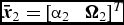 ${{\bar{\bm x}}_2} = {[ {{\alpha _2}\ \ \ {{\bm \Omega }_2}} ]^T}$
were driven to
 ${\bar{\bm x}}_1^d = {[ {\alpha _1^d\ \ \ \dot{\alpha }_1^d} ]^T} = {[ {{{75}^{\circ} }\ \ \ 0} ]^T}$
and
 ${\bar{\bm x}}_2^d = {[ {\alpha _2^d\ \ \ \dot{\alpha }_2^d} ]^T} = {[ {{{25}^{\circ} }\ \ \ 0} ]^T}$
, respectively.
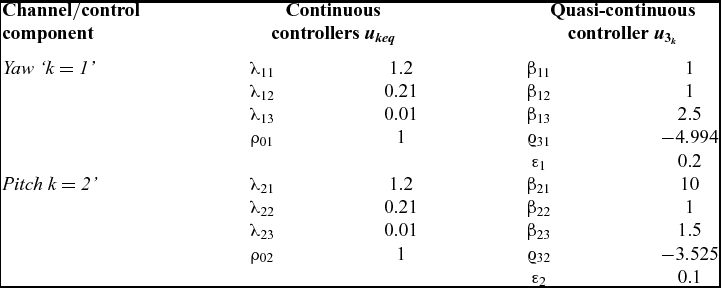
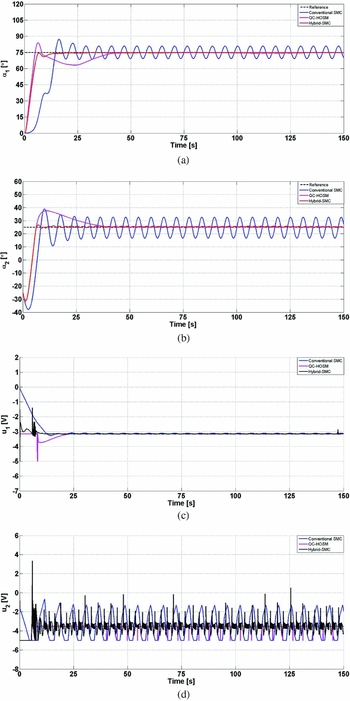
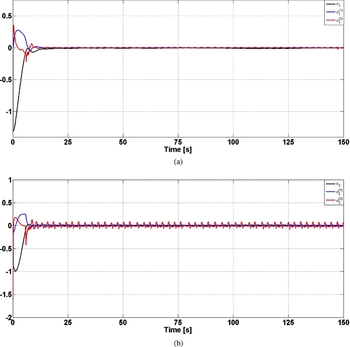
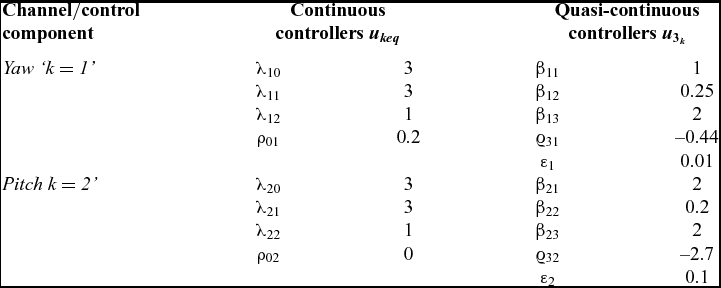
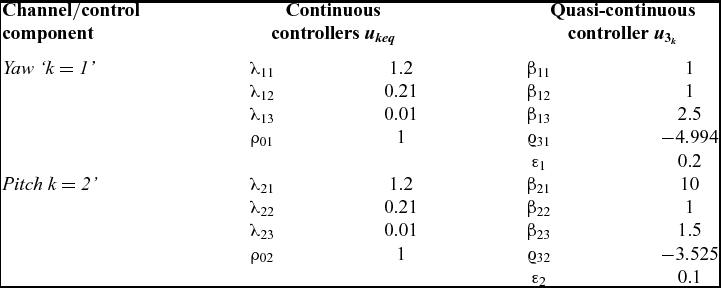
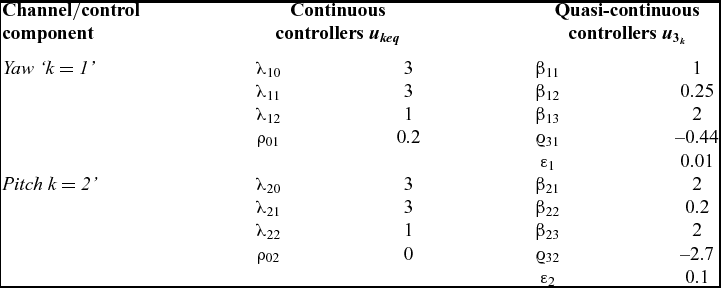
The hybrid-SMC tracking performances were compared to those of conventional SMC given by Equations 16–20 and the controllers in Equation 28 that have only quasi-continuous parts. The design parameters of the components in Equations 43 and 44 of the controllers in Equation 13 are given in Table 2. Figure 2 shows the time-history plots of the horizontal and vertical angular positions of the beam and their corresponding voltage inputs. Figure 3 depicts the behaviour of the sliding variables σ k and their time derivatives up to rk − 1.
Controllers design parameters for scenario 1
Time-history of tracking signals: (a) α1 = α h , (b) α2 = α v and their corresponding control efforts, (c) u 1 = uh , (d) u 2 = uv , respectively.

Time-history of sliding variables and their time derivatives: (a)σ1 = α1 − α d 1, (b) σ2 = α2 − α d 2.

5.2 Robustness issues
To meet requirements of practical applications, it is highly desirable to evaluate the robustness of the proposed hybrid-SMC scheme against persistent disturbances such as wind disturbances.
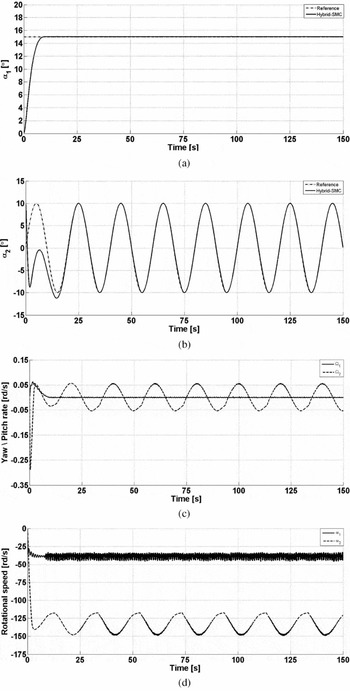
Scenario 2: In this simulation, the yaw motion subsystem was subjected to a persistent disturbance of the form
 $$\begin{equation}
{d_1}\left( t \right) = 5{\rm{sin}}\left( {2t} \right)
\end{equation}$$
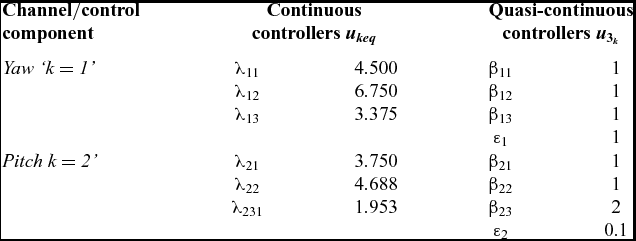
The control task was to maintain a desired yaw angle α d 1 = 15° in spite of the disturbance in Equation (47) while the pitch motion subsystem performed a sinusoidal tracking. Table 3 shows the controllers design parameters and Fig. 4 illustrates the results of scenario 2.
Controllers design parameters for scenario 2
Time-history of tracking with persistent disturbance: (a) α1 = α h , (b) α2 = α v (c) Ω1 = Ω h and Ω21 = Ω v , (d) ω1 = ω h and ω21 = ω v .

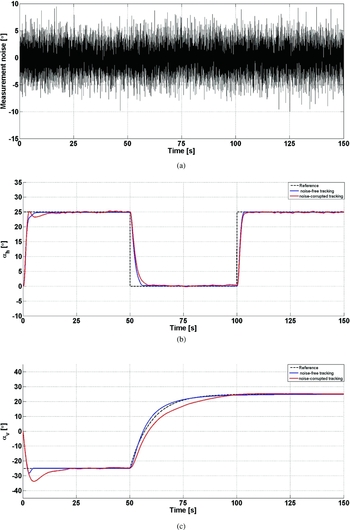
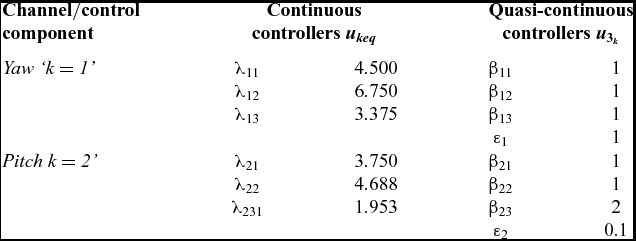
Scenario 3: In the previous scenarios, sample runs were considered without measurement noises. In this scenario, both TRMS subsystems were enforced to track desired reference signals in the presence of additive white Gaussian noise. The noise was considered as random angle measurement Gaussian white noise with variance of ±5° in both channels. Table 4 shows the controllers design parameters and Fig. 5 depicts the results of Scenario 3.
Controllers design parameters for scenario 3
Time-history of tracking with measurement noises: (a) additive white Gaussian noise, (b) α1 = α h , and (c) α2 = α v .

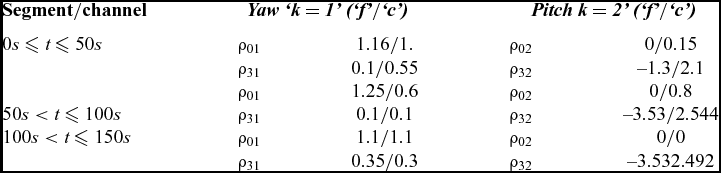
The gains of the controllers were tuned by segment of the reference signals for both free-noise and corrupted-noise trackings as shown in Table 5.
Controller gains for scenario 3
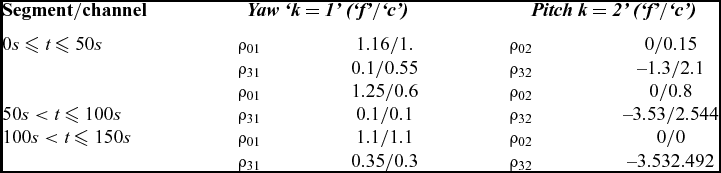
‘f’ and ‘c’ denote free-noise and corrupted-noise tracking, respectively.
Following the different simulation scenarios, the main advantages of the Hybrid-SMC law can be summarised as follows:
-
1. In the absence of external disturbances and measurement noises, the hybrid-SMC law achieved smooth tracking with free chattering control inputs.
-
2. In the presence of external disturbances or measurement noise (Gaussian white noise), the tracking was achieved with very low chattering levels.
6.0 CONCLUSIONS
In this paper, a hybrid variable structure control has been developed for multivariable cross-coupling nonlinear systems. A hybrid sliding mode control (hybrid-SMC) scheme was built combining properties of continuous and high-order discontinuous sliding mode controllers. Weighting coefficients were considered to weight and combine both control components. High-order sliding regimes were introduced in the continuous control component through dynamic constraints using high-order time derivatives of the sliding variables. Hybrid-SMC establishes r-sliding mode feedbacks with finite-time stabilisation of continuous SMC and robustness of discontinuous HOSM control.
Hybrid-SMC was applied to designing the flight control system for a highly nonlinear cross-coupling scale-laboratory helicopter system. A fast and accurate setpoint tracking was achieved while the conventional SMC and HOSM-based control laws exhibited slow convergence rate or high-frequency oscillations of trajectories.
Interesting future applications may come out using hybrid-SNC on nonlinear dynamic systems. In connection with HOSM-based observers, hybrid-SNC would provide a promising control framework for uncertain systems and systems driven by unknown inputs and disturbances. The future works will focus also on the application of hybrid-SMC to the problem of filter design for nonlinear switched systems and on the use of fuzzy SMC for uncertainties and disturbances estimation for stochastic systems.
ACKNOWLEDGEMENTS
This project was funded by the Deanship of Scientific Research (DSR), King Abdulaziz University, Jeddah, under grant no. (G /620/135/1437). The authors acknowledge with thanks for DSR's technical and financial support.