The library and the changing landscape of higher education
Colleges and universities across the globe are subject to budget cuts, rising costs and changing priorities of higher education. Libraries and librarians are under increasing pressure to demonstrate relevancy in the digital age. Increasingly, libraries are looking inward and considering how existing legacy collections no longer provide a holistic and inclusive view of society. The movement to de-colonize the library is gaining momentum and librarians have an opportunity to contribute to the scholarly canon by proactively building collections that represent the diversity of our multicultural world. Artists’ books offer the library the opportunity to build collections that represent distinct points of view and contribute new voices to scholarly discussions. They encourage viewers to engage with complex social themes as well as offer a unique and intimate format for personal narrative and storytelling.
In addition, throughout higher education there is an increasing emphasis on diversity and inclusion. The University of Puget Sound has established a number of programs to support students as well as to educate faculty and staff on diversity and inclusion. The Race & Pedagogy Institute (RPI) is a collaboration of the University of Puget Sound and the community to educate students and teachers at all levels to think critically about race, to cultivate terms and practices for societal transformation, and to act to eliminate racism.Footnote 1 Under the auspices of the RPI is the Courageous Conversations program that is designed to engage staff, faculty and students in confronting difficult issues head on and to embrace cultural competency as a core value of the university.
As these conversations grew on campus, I begin to think about the opportunity to use the Library's collection of artists’ books to help foster increased dialog about difficult issues.
By taking artists’ books into the community, it offers librarians the opportunity to raise the profile of these unique and important publications and contribute to conversations associated with diversity and in doing so demonstrate the value of the library in the digital age.
Artists’ books as primary sources
Student engagement is enhanced by exposure to primary sources.Footnote 2 When we work with primary sources, whether historical or contemporary, there is an opportunity to make a connection. It is standard practice to integrate historic documents and books within the curriculum to provide students with a real-world connection to the past and to promote inquiry and critical thinking. Artists’ books can serve the same function by sharing the voice of contemporary artists and serving as resources that provide new narratives and interpretations. This view is embraced by Marshall Weber, founder of Booklyn, an organization that helps artists document, exhibit, and distribute their artwork. Weber advocates that by collecting artists’ books institutions can begin to shift the dialog away from the antiquarian Anglo centric collections to contemporary work by diverse artists which will in turn build library collections that promote new narratives and give voice to unrepresented groups.Footnote 3
Artists’ books as catalysts for starting the conversation
As educators we know that it is often difficult to talk about controversial issues. Artists’ books can serve as a powerful catalyst; a starting point of discussion to help foster dialog in a manner that can defuse tension. Using the book as the focus for reflection and discussion removes the issue from the personal and allows discussion to focus on the message of the creator. This approach parallels a technique called Reflective Structured Dialog (RSD) which encourages reflection prior to conversations. This technique has been gaining interest in libraries across the United States as a method for fostering open and honest discussion in our increasingly polarized society. RSD is a process that deepens understanding of conflict, diffuses the stuck conversation and seeks to understand many points of view. RSD serves to improve communication, enhance curiosity, foster mutual understanding and reflect on new perspectives.Footnote 4
Approaching conversations about difficult issues using the artists’ book as a jumping off point causes us to slow down, reflect and to think deeply. Artists’ books force the reader to interact and in turn, contemplate, think and move towards deeper understanding. Artists’ books give voice to forgotten or otherwise excluded and undocumented voices.
Artists’ books in the classroom and the community
Whether a classroom, community or professional development session, a combination of personal reflection and small and large group work has proven to be effective when using artists’ books in events focused on social justice. Using books to start the discussion takes the pressure off the individual and group discussion offers a chance to respond to the content that will then serve as the catalyst or spark for further reflection. Sessions provide time for individuals to examine and reflect upon the books, before moving into small groups of 3–5 to respond to prompts based on the theme of the class.
This method has been used in a University of Puget Sound graduate class focusing on cultural competency for students seeking a Master of Arts in Teaching. All teachers have to be able to deal with diverse student groups, handle difficult situations and be prepared to address current events no matter what subject they teach. Students examine and reflect upon a number of books that address themes such as racism, bullying, hate crime and gender inequality. The first half of the class provides students with the opportunity for personal reflection and then they join in group discussions to address a series of questions:
What issues of identity are being explored?
How is cultural competence being developed?
How is the book structured to engage readers?
What message is the creator trying to get across?
How does this book make you feel about the topic?
How would you describe this book to someone?
Feedback from the students demonstrate the value of this type of learning experience:
‘The artist book exhibit was very striking. These artists were able to take topics we have heard about many times and to do something intentional that reformed the way I thought about these topics’.
‘When using the format of books as an alternative medium to express themes of social justice, it caused me to reflect on how this format is advantageous in causing the reader to be closely attuned to the artists’ message’.
‘The books helped me see new ways to present my project – something different than a linear narrative such as a research paper’.Footnote 5
This method of reflection and discussion has resulted in students creating their own work, which in turn, has been added to the library collection and used in classes to inspire other students. The following are two examples.
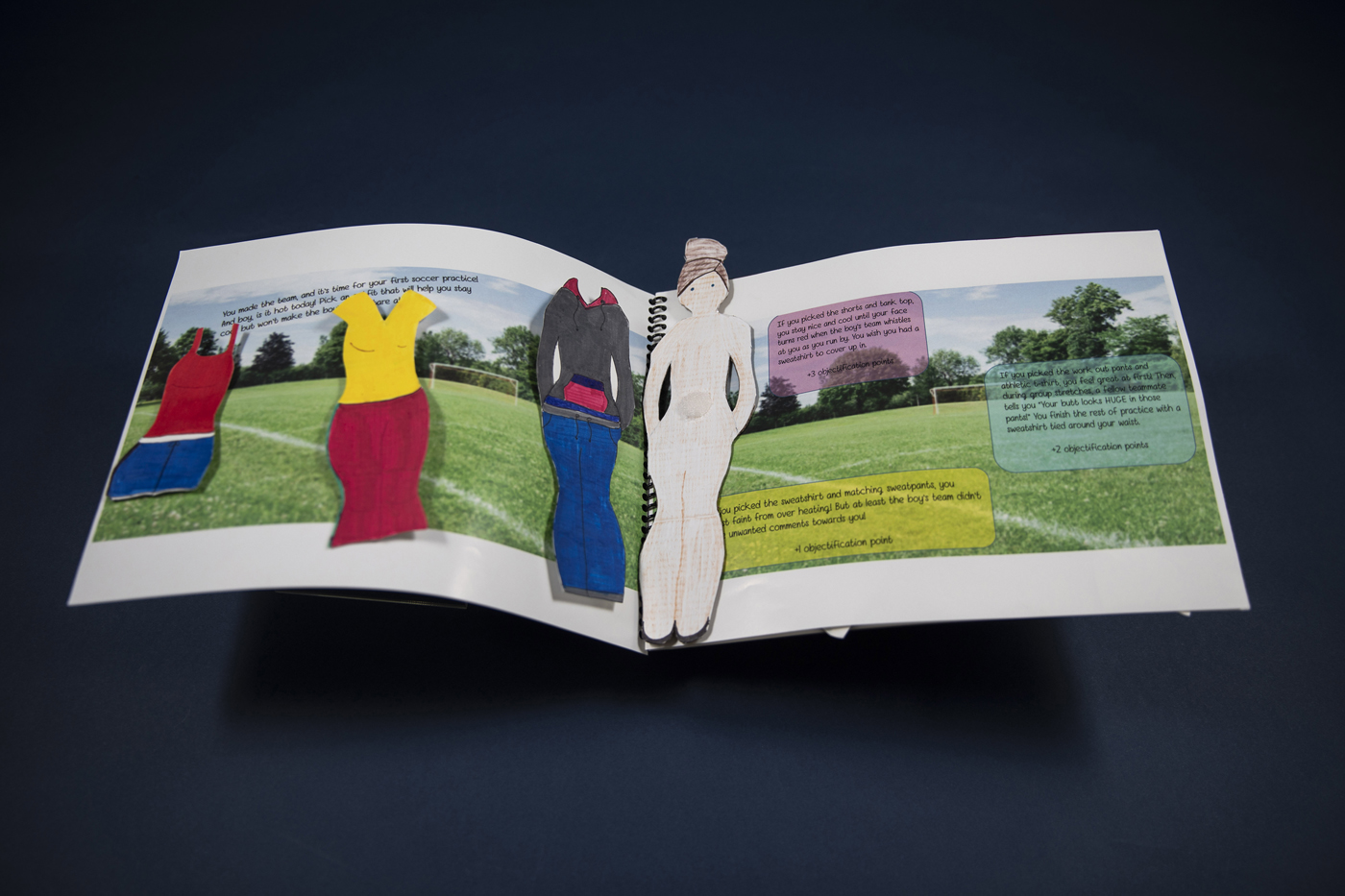
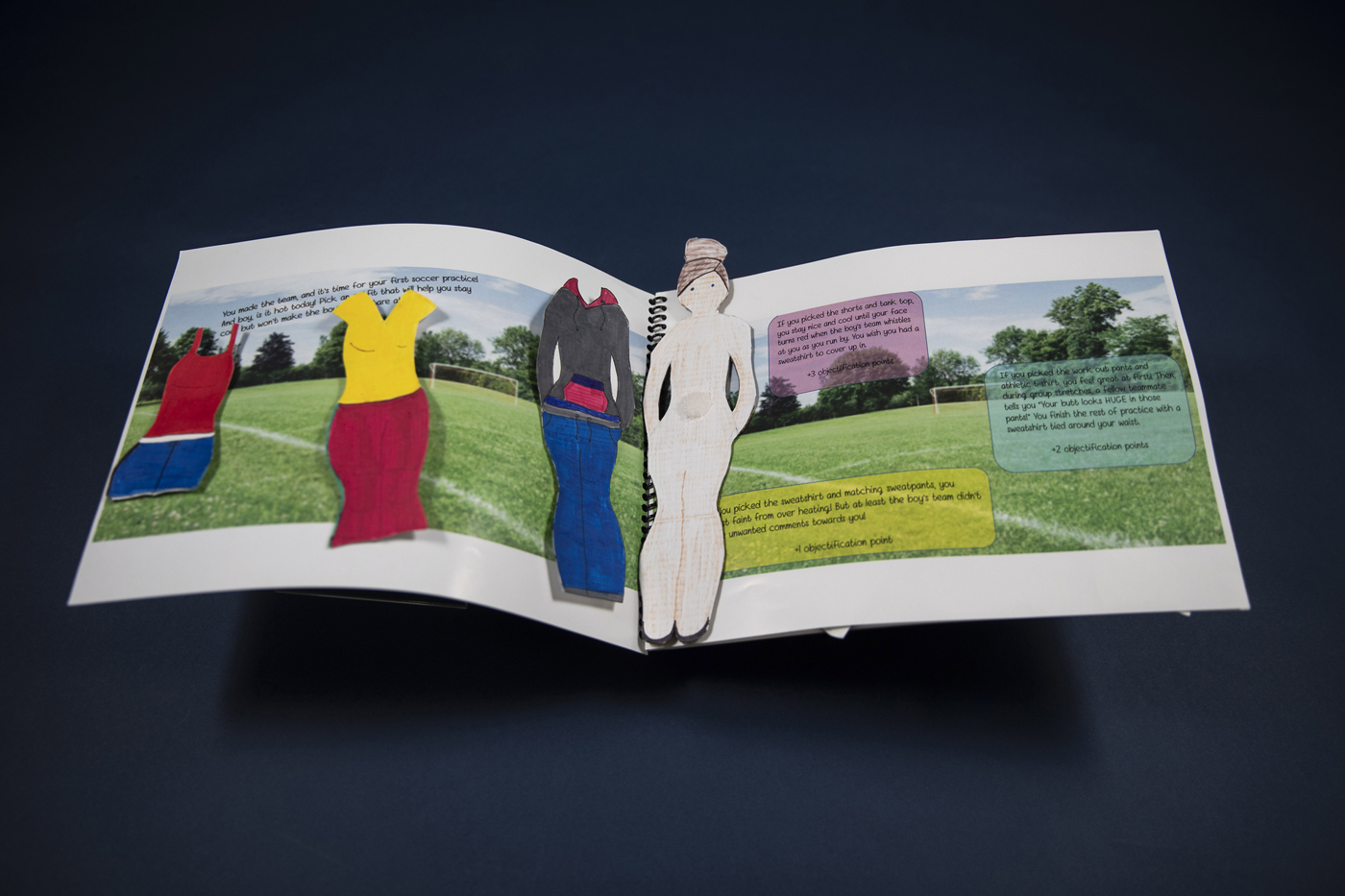
Megan Miller completed her student teaching at Lincoln High School in Tacoma, Washington. Her book But what should I wear?: a choose your own outfit adventure (University of Puget Sound, 2017) uses a paper doll theme to address issues of gender identify. During her student teaching tenure, she encountered a generous amount of instances of female objectification. These instances ranged from her own personal experiences, experiences of her students, and stories shared by colleagues. Megan chose to represent the objectification that women face by forcing the reader to choose their own objectification.Footnote 6
Miller, Megan. But What Should I Wear?: A Choose Your Own Outfit Adventure. University of Puget Sound, 2017. Photo by Sy Bean, University of Puget Sound.
Lipstick on a pig: an artist book by Kyle Buchberger (University of Puget Sound, 2017) is a highly personal account of his coming to terms with his family's discriminatory housing practices. His statement below demonstrates how his experience of working with the artists’ books moved him to create his own personal narrative.
Developing into adults is a complex and dynamic process. Within this process is our socialization. Influencing how we think and act is a series of conscious and subconscious information that flows directly from those we love and trust. As we get older, we often partake in this cycle of socialization through our influence over the young people under our care. But how often do we stop and analyze this socialization? How often do we consider our past, in an attempt to better understand our present, to create a better future? This artist book is an attempt at this reflective process. Through an analysis of my socialization, I ask myself meaningful questions to better understand my future teaching. Hopefully, this reflective analysis of my socialization challenges you to do the same.Footnote 7
Buchberger, Kyle. Lipstick on a Pig: An Artist Book. University of Puget Sound, 2017. Photo by Sy Bean, University of Puget Sound.

Examples of books that have been used in student diversity training, community conversations, and staff development programs
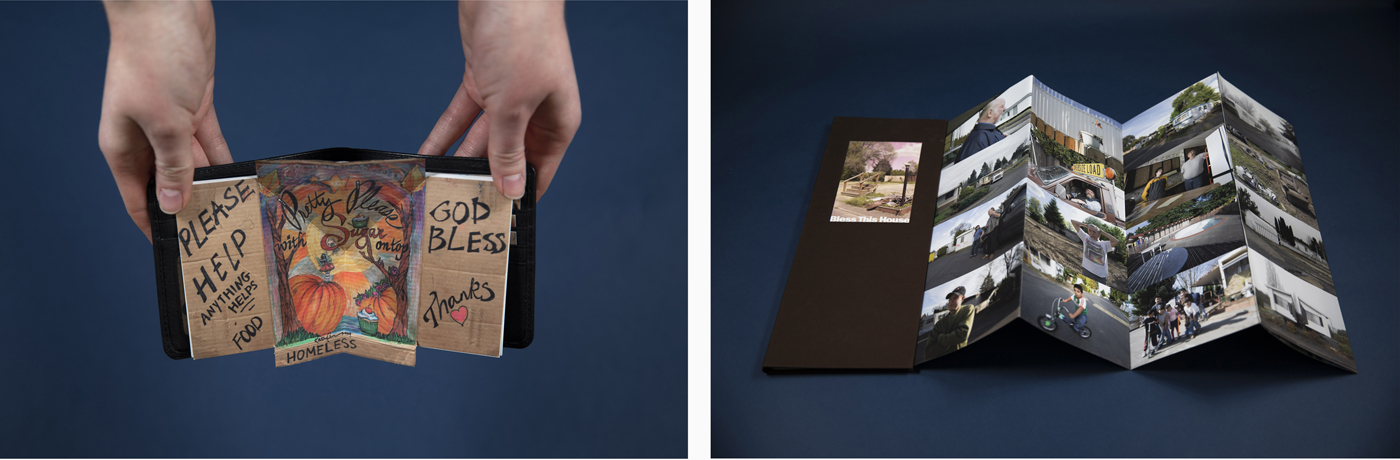
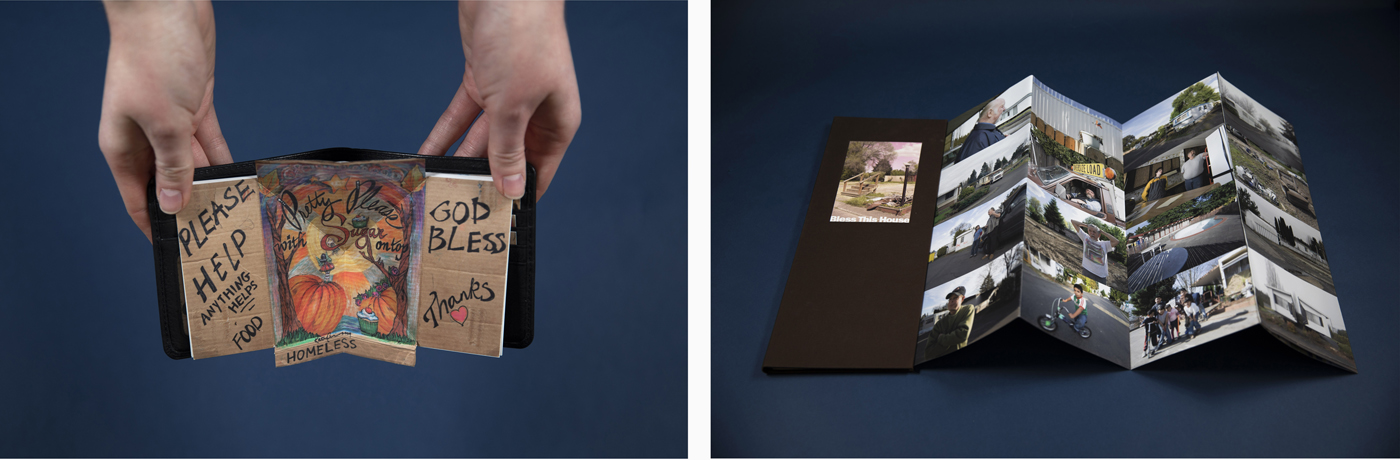
Laura Russell is a Portland, Oregon based artist/photographer. Two books, Bless this house and Anything helps have been used in classes to address the issue of homelessness in our society. Bless this house (Portland, OR: Simply Books, 2010) is a collection of photographs that document a community on the brink of extinction and Anything helps (Portland, OR: Simply Books, 2013) is a limited edition book reflecting on the homeless crisis in Portland. Her work reflects her commitment to her community as she states:
My goal as an artist is to open our minds to the urban landscape we look at every day but never really see. If we pay attention, we find that our landscape has a story to tell about our culture and our communities.
Shooting daily on my morning walks or during frequent travels near and far, I consider my work both documentary and preservation of our visual and social landscape. Subjects I photograph include: burned-out houses, vacant retail spaces, trailer parks, vintage neon signs, brick wall ghost signs, homeless signs, graffiti and other forms of language in the environment.
Eventually, a body of work emerges from my wanderings and a story evolves to supplement the photographs. I then create limited edition, hand-bound artist books that are either an examination of a social issue or a celebration of the vernacular. All are my own small effort to preserve our social, cultural and commercial landscape.Footnote 8
Russell, Laura, and Simply Books, Ltd., publisher. Anything Helps: A Limited Edition Artist Book. Simply Books, Ltd., 2013 and Fig. 3b. Bless This House. Simply Books, 2010. Photos by Sy Bean, University of Puget Sound.
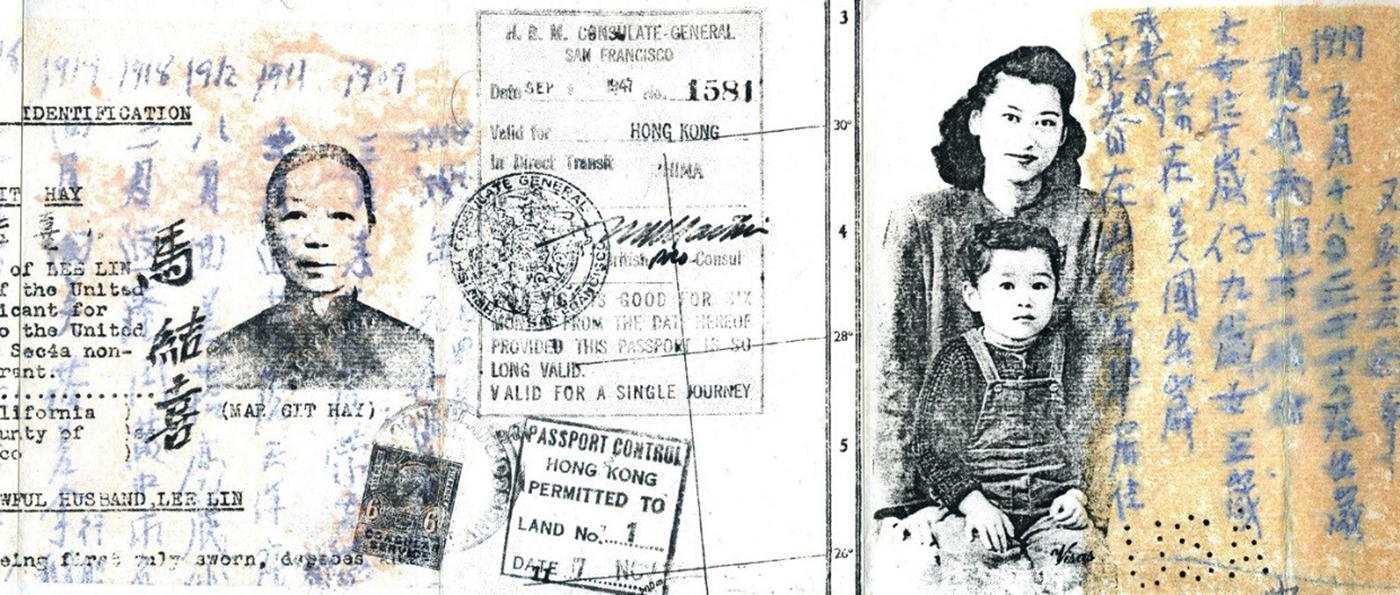
MalPina Chan is an artist based in Olympia, Washington whose work addresses questions of identity, race and family. The coaching book (Olympia, WA: M.P. Chan, 2004) has been used in classes that explore these issues.
Chan, MalPina. The Coaching Book. Olympia, WA: M.P. Chan, 2004. Image supplied by MalPina Chan.
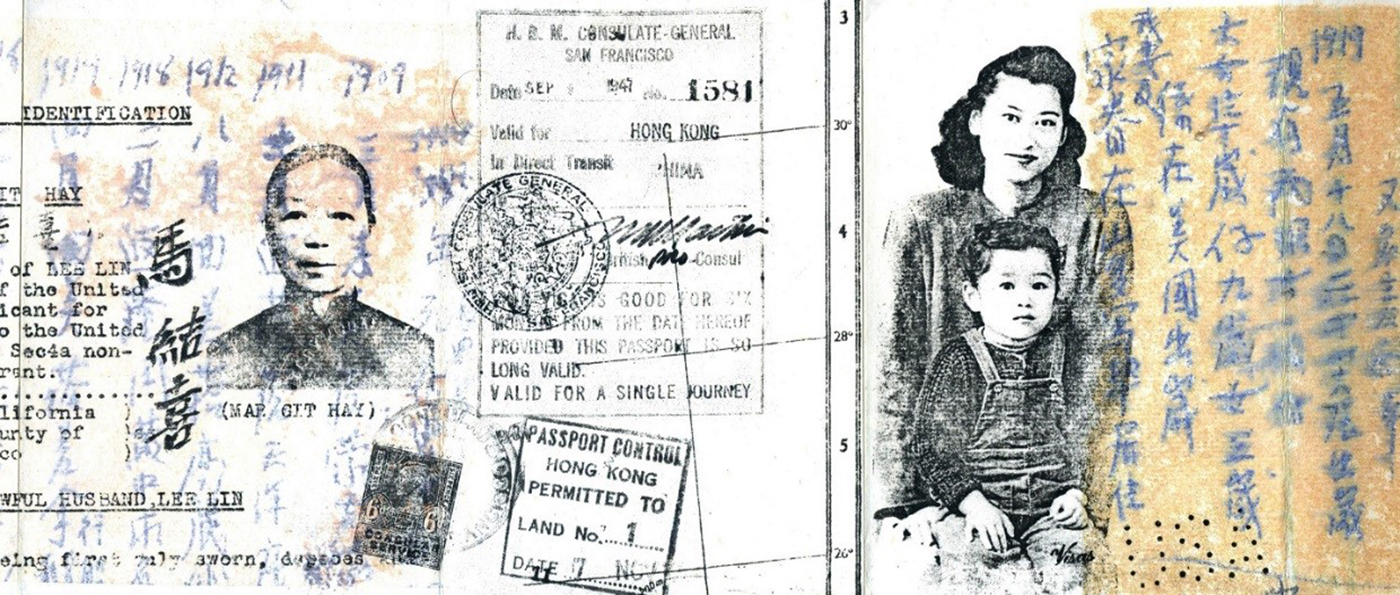
These themes are reflected in her personal statement:
The context of my work is woven together from my identity as an Asian American, a woman, and a mother. I am interested in cultural inheritance, cultural shifts, and societal pressures on personal culture. It is my exploration of social justice, history and current discourse that inspires my work. I want to question, investigate and generate a dialogue as I explore immigration, race, identity, diversity, inclusion, gender and equality in the context of history, our memories and today.
To tell the story of my family's immigrant experience in the early 1900s, I incorporate imagery drawn from a rich resource of old family photos, immigration documents, letters, and cultural icons. Critical immigration issues summon childhood memories of relatives who lived in fear of the government and deportation due to their “paper son” status. It is an agonizing existence that takes a toll on the families who are affected for generations.Footnote 9
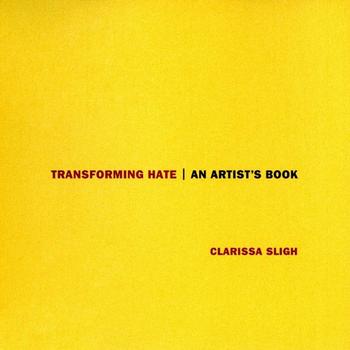
Clarissa Sligh's work is a powerful statement about racism, narratives of power, and has been used in discussions associated with racism and hate. Transforming hate (self-published, 2016) is a personal narrative in which the artist shares her experience of working with white supremacist materials. Clarissa participated in the exhibition Speaking volumes: transforming hate in which artists transformed thousands of anti-sematic and racist books into an uplifting exhibition sponsored by The Holter Museum in Helena, Montana and The Montana Human Rights Network.
Sligh, Clarissa T., et al. Transforming Hate: An Artist's Book. Self-published, 2016. Photo by the author from the artist's website: http://clarissasligh.com/.
In her own words:
I was trying to look at what it was like for me to turn hateful words into a beautiful art object. What actually evolved from that exploration helped me understand more fully the many levels of oppression and violence at the intersections of race, gender, class and sexual orientation … We make decisions about who gets to have rights and who is marginalized in our society. From the place I now stand, I can see the courage and strength of my grandmother and mother and the path they made for me. I ask the viewer to question her or his perceptions about history, reality, identity and voice.Footnote 10
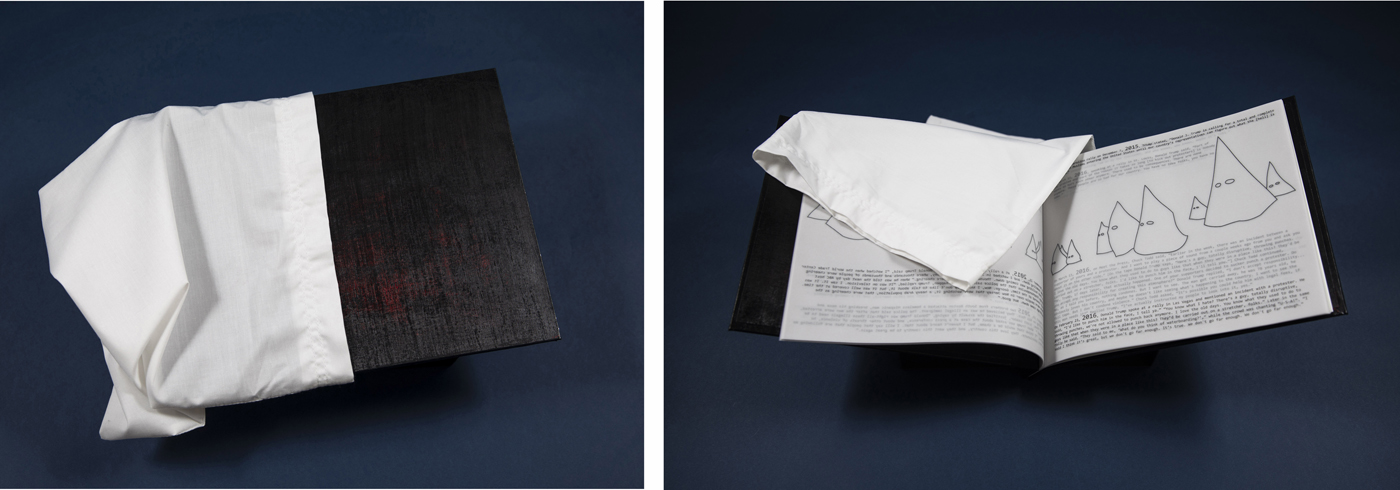
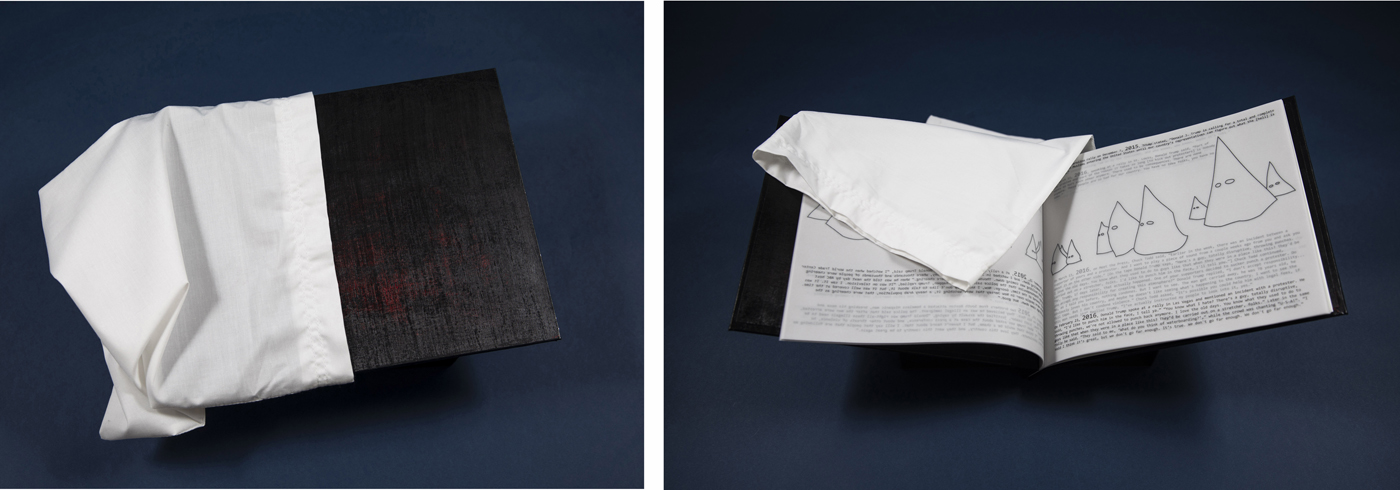
Ginger Burrell's work Un[Hood]ed (Morgan Hill, CA: Midnight Moon Press, 2017) is a reaction to contemporary political events. Un[Hood]ed examines the alarming audacity demonstrated by white supremacists in the United States. ‘Once hidden under homemade white robes, today's alt-right members feel emboldened, empowered, and unafraid of the consequences of their racism. They no longer feel that they have to hide their identities. Un[Hood]ed looks at the direct and indirect messages from President Donald Trump to white nationalists. While he frequently claims ignorance of such a movement, his behavior and language tell another story’.Footnote 11
Burrell, Ginger R., Un[Hood]Ed. Midnight Moon Press, 2017. Photos by Sy Bean, University of Puget Sound.
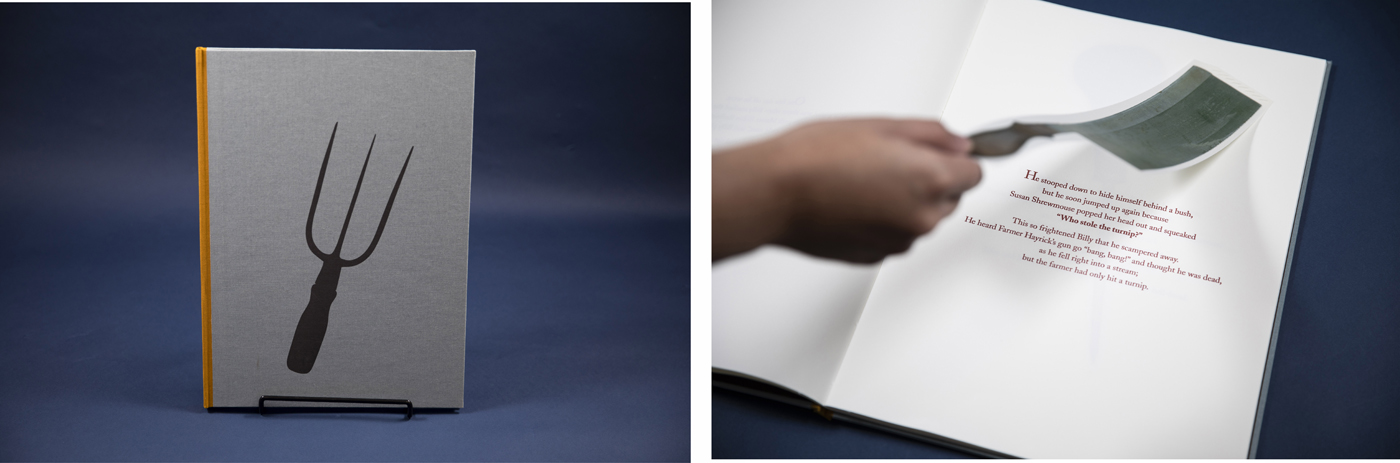
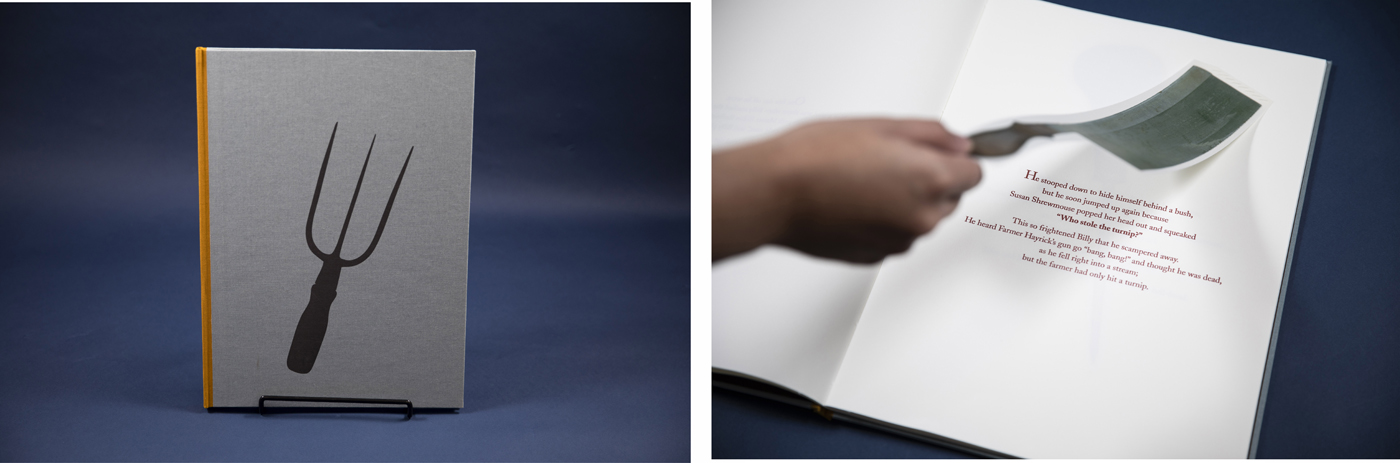
Ann Tyler's book Billy rabbit: an American adaptation. (Self-published, 2007) is one of a series of books about lynching. In this book the viewer must lift images of tools used to torture and thus becomes part of the process. Using historical resources, Tyler's book makes the viewer face the legacy of the past and she states—
Because of the ritualized aspects of lynching, the same acts of torture described here were perpetrated on many lynching victims. These descriptions should, therefore, not be seen as limited to the individuals listed.Footnote 12
Tyler, Ann. Billy Rabbit: An American Adaptation. Self-published, 2007. Photos by Sy Bean, University of Puget Sound.
Jessica Spring, a Tacoma, Washington artist and educator uses humour to diffuse the current political situation. Her book Trump and Judy: a dissolving comedic farce in four short-sighted acts (Tacoma, WA: Springtide Press, 2017) features four sets of pages containing three rhyming couplets accompanied by an illustration, originally by George Cruikshank, of a British Punch and Judy puppet show. The pull down tab on the page reveals a quotation by Donald Trump.
Spring, Jessica, et al. Trump and Judy: A Dissolving Comedic Farce in Four Short-Sighted Acts. Tacoma, WA: Springtide Press, 2017. Photos by Sy Bean, University of Puget Sound.

As the artist states, ‘I like making work that draws in the reader with texture, color, even humor. Then I give a little twist (or a kick), offering the opportunity to see things in a new way. Artist's books can be so engaging and intimate, it's an ideal format for my message’.Footnote 13
Conclusion
The following comments demonstrate the impact that artists’ books have had in our community centred discussions.
’These books allow for a personal way to work things through’.
‘They give voice to often forgotten or passed over issues’.
‘Artists’ books help process difficult issues and force you to confront issues through an often very personal and intimate form of expression’.
‘Clearly, artists’ books can serve as catalysts of social change and can be used to foster meaningful conversations as well as greater understanding and awareness of social justice issues’.
‘Librarians can facilitate conversations across a wide spectrum; in classes, in training programs for staff and students, and by partnering with community organizations’.
‘Artists’ books offer libraries the opportunity to serve as both a resource and forum for exploration of different perspectives and to support and promote diversity and inclusion’.
‘Artists’ Books are catalysts of social change’.