Introduction
The genus Memecylon L. (Melastomataceae) was established by Linnaeus in 1753 since when more than 250 species have been added to it, mainly from the paleotropics (Mabberley, Reference Mabberley2005). A total of 67 taxa of Memecylon (40 species and 27 varieties) were included in the Flora of British India (Clarke, Reference Clarke and Hooker1879) of which nine species and three varieties are from modern-day India. Recent enumeration reveals that 39 taxa of this genus are now reported from India, of which 21 are endemics (Murugan & Gopalan, Reference Murugan and Gopalan2006). In India, the Western Ghats is the major centre of diversity with 27 species, including 20 endemics confined to this ‘hotspot’ of biodiversity (Gamble, Reference Gamble1919; Mohanan et al., Reference Mohanan, Ravi, Kiran Raj and Shaju2001; Viswanathan & Manikandan, Reference Viswanathan and Manikandan2001; Santhosh Kumar et al., Reference Santhosh Kumar, Raju Antony and Shanavas Khan2003; Manickam et al., Reference Manickam, Murugan, Jothi and Sundaresan2007).
Wayanad District in Kerala is a ‘hotspeck’ of biodiversity in the Nilgiri phytogeographical region of the Western Ghats. Recent floristic explorations in this region (Ratheesh Narayanan, Reference Ratheesh Narayanan2010) led to the collection of a narrow-leaved Memecylon which is quite different from hitherto-described species. On detailed examination, combined with a study of the pertinent literature (Clarke, Reference Clarke and Hooker1879; Gamble, Reference Gamble1919; Henry & Subramanyam, Reference Henry and Subramanyam1971; Bremer, Reference Bremer1979, Reference Bremer, Dassanayake and Frosberg1987; Balakrishnan & Nair, Reference Balakrishnan and Nair1982; Mohanan et al., Reference Mohanan, Ravi, Kiran Raj and Shaju2001) and type material, these collections turned out to represent a new species.
Species Description
Memecylon wayanadense Ratheesh, Sivu & Pradeep, sp. nov.Figs 1–3.
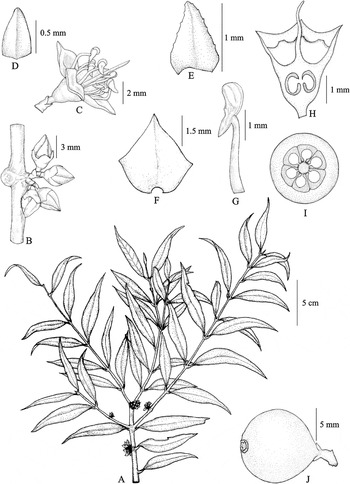
Fig. 1.Memecylon wayanadense Ratheesh, Sivu & Pradeep. A, flowering twig; B, inflorescence; C, flower; D, bract; E, bracteole; F, petal; G, stamen; H, flower L.S.; I, ovary; J, fruit.
 Fig. 2.
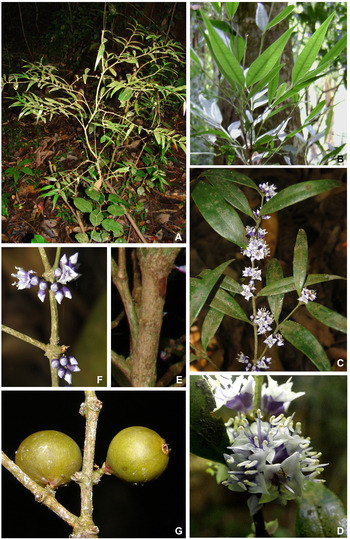
Memecylon wayanadense Ratheesh, Sivu & Pradeep. A, habit; B, leaves; C, flowering branch; D, inflorescence; E, bark; F, buds; G, fruits.
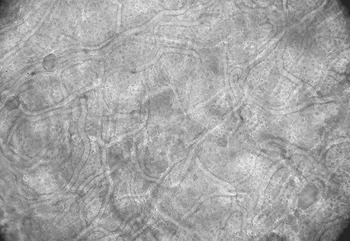
Fig. 3.A portion of cleared leaf of Memecylon wayanadense showing filiform branched sclereids.
Affinis Memecylon sivadasanii N.Mohanan et al. sed habitu fruticoso, caule breviore prope terram ramificanti, foliis latioribus (1–1.5 cm non 0.6 cm latis), petiolis foliorum brevioribus (0.5 mm non 2 mm longis), inflorescentiis plerumque in axillis foliorum (non in fasciculis ad truncum principalem versus basin), pedicellis florum longioribus (6–7.5 mm non 2–3.5 mm longis), fructibus obovatis differt. – Type: India, Kerala, Wayanad District, Chembra-Vellarimala hill ranges, Kallady forest, 11°30′N, 76°06′E, c.1200 m, evergreen forest, 12 xi 2006, M.K. Ratheesh Narayanan 1010 (holo MH; iso MSSFootnote 1, TBGT).


Shrub, 1.5–2 m tall, repeatedly branched, branchlets slightly quadrangular when young, terete on maturity. Leaves opposite, narrowly lanceolate, 5–8 × 0.7–1.3 cm, coriaceous or subcoriaceous, glabrous, shining above, pale below, base acute, margins entire, apex long acuminate; midrib prominent, secondary nerves obscure; foliar sclereids filiform and branched (Fig. 3); petiole 0.4–0.5 cm long, pink when young, sulcate. Inflorescence a few-flowered cyme; peduncles axillary, 0.8–1 cm long; pedicels 0.6–0.75 cm long, glabrous; bracts 2, ovate, 0.7–0.8 × 0.4–0.5 mm, entire, apex obtuse; bracteoles broadly ovate, c.1.1 × 0.8 mm long, margin serrate, apex acute, glabrous. Flowers bisexual; calyx deeply 4-lobed, lobes broadly triangular, apex acute to subacute, persistent; tube campanulate, 2–2.3 × 0.8–1 mm, violet; petals 4, broadly ovate, clawed, 0.5–3 × 0.5–3 mm, white with violet tinge; stamens 8, incurved in bud; filaments 2–3 mm long, glabrous, violet; anthers 2, c.1.5 mm long, opening by terminal slits, yellowish white, connectives attached ventrally with anthers, with a gland on dorsal middle surface. Ovary inferior, c.2 mm across, unilocular, ovules 6 with central placenta; style simple; stigma pointed. Berries obovate, c.1 cm across, greenish yellow, glabrous with persistent calyx lobes.
Distribution. Known only from three localities in the Chembra-Vellarimala hills of the Meppady forest range of Wayanad, Kerala, India.
Habitat and ecology. The new species is distributed in the lower stratum of evergreen forests at an altitude of 800–1400 m. The other species commonly found in this habitat include Glyptopetalum grandiflorum Bedd., Justicia santapaui Bennet, Psychotria globicephala Gamble, Miliusa nilagirica Bedd., Meiogyne ramarowii (Dunn) Gandhi, Orophea uniflora Hook.f. & Thoms., Agrostistachys borneensis Becc., Dimocarpus longan Lour., Drypetes venusta (Wight) Pax & Hoffm., Epiprinus mallotiformis (Müll.Arg.) Croizat and Palaquium ellipticum (Dalz.) Baill.
Phenology. Flowering from October with a peak in December. Fruit matures in March.
Etymology. The specific epithet denotes the type locality, a floristically rich region in the southern Western Ghats.
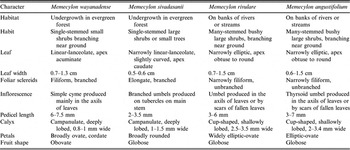
Taxonomic note. Memecylon angustifolium Wight, M. rivulare K.Bremer and M. sivadasanii N.Mohanan et al. are also narrow-leaved species described from the Indo-Sri Lankan region. Memecylon wayanadense is allied to these species but differs in habit, leaf shape, sclereid type, inflorescence type and position, and the shape and size of the sepals and petals. A more detailed morphological comparison of these species is given in Table 1.
Comparison of Memecylon wayanadense, M. sivadasanii, M. rivulare andM. angustifolium

Additional specimens examined. India. Kerala State, Wayanad District, Chembra-Vellarimala hill ranges, Kallady evergreen forest, 11°30′N, 76°06′E, c.1200 m, 30 xii 2007, Ratheesh Narayanan, Sivu & Pradeep 61770 (MH, TBGT); Kattimattam, 11°30′N, 76°08′E, c.1400 m, 12 xi 2009, Ratheesh Narayanan & Sivu3454 (MSS).
Molecular Data Analysis
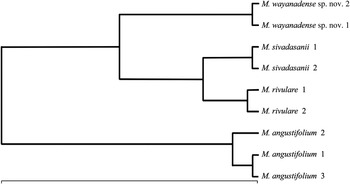
In order to quantify the similarities and differences of the proposed new species to allied species, genetic data analysis was carried out using 20 RAPD (randomly amplified polymorphic DNA) primers. Total genomic DNA was isolated from samples following a modified method based on Murray & Thompson (Reference Murray and Thompson1980). RAPD reactions were carried out in a 25 μl volume containing 50 ng of template DNA, 2.5 μl of 10 × reaction buffer, 50 μM of each dNTP, 20 pmol of random primer, and 0.75U Taq DNA polymerase. The PCR reaction followed an initial denaturation for 5 minutes at 95°C, followed by 34 cycles of 1 minute at 95°C, 30 seconds at 36°C and 1 minute at 72°C and a final extension at 72°C for 5 minutes. Ten base pair primers were used (Biogen, USA) for the amplification and 20 μl of the amplicon was resolved on a 1.2% agarose gel (Sigma, USA). The gel was stained using ethidium bromide and the DNA bands were visualised under UV light. Amplification with each random primer was repeated three times and those primers that produced reproducible and consistent bands were selected for data generation. Bands were scored as present (1) and absent (0). An UPGMA dendrogram was constructed based on Nei’s genetic distance figure 2 (Nei, Reference Nei1972), using POPGEN ver. 3 software. This groups the nine samples into two major clusters. In cluster A are two accessions of Memecylon wayanadense sp. nov., two accessions of M. sivadasanii, and two accessions of M. rivulare. In cluster B are three accessions of Memecylon angustifolium. The dendrogram (Fig. 4) shows that Memecylon sivadasanii and M. rivulare are closely allied, M. wayanadense is then allied to that species pair, and M. angustifolium is different from all the others.
UPGMA dendrogram based on Nei’s genetic distance.

Acknowledgements
The authors are grateful to the Executive Director of the M. S. Swaminathan Research Foundation, Chennai and the Director of the Tropical Botanic Garden and Research Institute (TBGRI), Thiruvananthapuram for providing facilities and support. The logistics provided by the Kerala Forest Department for the fieldwork are gratefully acknowledged. Sincere thanks are expressed to Dr M. P. Nayar for the Latin diagnosis, Dr Anil Zakharia, Mr P. Prajeesh, Ms K. A. Sujana, Mr T. Raveendran for field support, and Ms Meera Raj for the illustrations.