INTRODUCTION
Religionization is a process by which individuals become more religious. However, it could also pertain to growing religiosity in the public sphere.Footnote 1 This article centers on an important manifestation of the latter phenomenon: the religionization of public organizations. I ask what the forces that drive and shape religionization are and, relatedly, what explains differences in religionization across different types of public organizations. While this study does not pretend to provide a comprehensive answer to these questions, it does present and analyze “bottom-up” causal paths driving organizational religious change that hitherto have largely been ignored.
Based on a comparison of three major public institutions — the military, schools, and the healthcare system — in a single country (Israel), this study first describes how religionization is manifested in these different domains and then explains its development. The three case studies demonstrate that public sphere' religionization is linked to social/individual religionization trends. The religionization of workers and consumers creates two different paths by which social religionization trends influence public organizations often absent direct political intervention. While organizational religionization cannot be explained without reference to agency, it also cannot be understood without consideration of structures and institutional mechanisms. This work emphasizes the role that institutional structure plays in determining the extent and form of organizational religionization. Government efforts to change the formal religious status-quo in public organizations are more than likely to encounter fierce opposition due to their controversial nature. Change that is driven from below, in contrast, tends to be less visible and for this reason less likely to encounter pushback. This study indicates that when religionization pressure is applied from below, an important distinction should be drawn between low visibility religionization efforts that proceed through institutional layering (i.e., the co-existence of separate religious and non-religious layers) and those that advance through institutional conversion (i.e., an internal religious re-orientation of the entire institution). While both processes are likely to provoke less opposition than highly visible attempts to change formal institutional arrangements, this study's findings suggest that religionization through institutional layering is less contested than that which proceeds through institutional conversion. As a result, institutional layering constitutes the “path of least resistance” for institutional change. This novel observation is of value not only to social science scholarship that deals with religion, but also to the institutional development literature more generally.
A study of the impact of social/individual level religionization on public organization' religionization might appear to be of limited relevance to countries in which the dominant religious trend over the last few decades was secularization (Bruce Reference Bruce2013; Norris and Inglehart Reference Norris and Inglehart2004; yet also see Casanova Reference Casanova1994). Nevertheless, given that religionization is often local — i.e., local social/individual religionization influence religionization in public organizations at the sub-national level — the main insights of this study apply to numerous local level developments in countries that are not undergoing social/individual religionization on the national level. In relatively secularized countries, organizational religionization necessarily occurs via bottom-up mechanisms, as described in the Israeli case studies, and is manifested in both institutional layering and conversion.
In what follows, I first present the literature that speaks to the religionization/secularization of the public sphere and its relationship to beliefs and practices at the social/individual level. I introduce the two bottom-up religionization processes and also discuss the significance of institutional structure for religionization. Next, case selection and methodology are discussed. This is followed by a section in which the religionization experiences in three different Israeli public institutions — the military, schools, and healthcare — are discussed with a special emphasis on religionization protagonists and antagonists and the specific forms that religionization takes in the three domains. In the discussion, I compare the experiences of the three institutions and draw general lessons.
FROM SOCIAL TO INSTITUTIONAL CHANGE
Contrary to the predictions of classical secularization theory, religion in the modern world has neither disappeared on the personal level, nor vanished as a force in the public sphere (Casanova Reference Casanova1994; Berger Reference Berger1999; Minkenberg Reference Minkenberg2002; Fink Reference Fink2009; Monsma and Soper Reference Monsma and Soper2009). However, how religion influences public policy is still an open question. Recent studies often focus on religion's impact on specific policy issues such as abortion (Minkenberg Reference Minkenberg2002) or stem cell experimentation (Fink Reference Fink2009; Engeli, Green-Pedersen, and Larsen Reference Engeli, Green-Pedersen and Larsen2013). In some studies religious influence in the public sphere — for example, restrictive abortion policies — is more common in Catholic countries than in others (Minkenberg Reference Minkenberg2002; Fink Reference Fink2009), and “secular” policy is slower to develop in predominantly Catholic societies (Knill, Preidel, and Nebel Reference Knill, Preidel and Nebel2014). The level of social/individual secularization is oft-times linked to secularization in the public sphere. Increasing levels of social/individual secularization make secularization of the public sphere more likely in general (Minkenberg Reference Minkenberg2002; Karpov Reference Karpov2010), or at least where the political system is aligned on religious lines (Engeli et al. Reference Engeli, Green-Pedersen and Larsen2013).Footnote 2
While the aforementioned studies differ in their conclusions regarding which religious factors (e.g., party structure, general religiosity) are influential, they share in common a focus on politics and policy at the macro level, or on “formal” policy: i.e., policy that is shaped via legal instruments in a publicly visible manner. Also, because these studies primarily examine West European countries, the relevant backdrop is mostly social/individual secularization, not religionization.
Change through Politics and Institutional Rigidity
The different studies present several explanations for how social/individual religiosity levels influence policy. Minkenberg (Reference Minkenberg2002) claims that high social religiosity strengthens church involvement in the political sphere. Karpov (Reference Karpov2010) emphasizes the role of agency in de-secularization processes (specifically in Russia) and argues that the process could begin from below due to the mobilization of religious grassroots organizations and their impact on policymakers. Zehavi (Reference Zehavi2012) argues that social religious change — whether secularization or religionization — is likely to diminish/increase religious politicians and confessional parties' power and this in turn would influence policy. These processes of religious change in the public sphere share an emphasis on politics as a mediating factor between social/individual religious levels and official policy.
Clearly, the “social religious change” → “politics” → “policy/institutions” causal chain is far from straightforward or exhaustive of all explanations of religiously-associated policy change. Political elites, for instance, might instigate such change regardless of religious social trends (see Lisovskaya and Karpov Reference Lisovskaya and Karpov2010). Religionization of public institutions could also result from non-political paths. Indeed, as will be argued below, under circumstances in which formal institutional change is difficult, non-political change processes are central to understanding institutional change.
Public organizations are not impervious to change, but a well-established body of work suggests that institutional stability is the norm. Historical institutionalist studies argue that public organizations are set in specific paths and leaving these paths often involves overcoming high legal hurdles (e.g., constitutional separation of Church and State), the resistance of entrenched interests, and economic costs that make dramatic change unlikely (Thelen Reference Thelen1999; Pierson Reference Pierson2000). Given that church-state relations are historically contentious it is unsurprising that once relations crystalized into status-quo arrangements, these are not easily transformed. In Europe, despite considerable social/individual level secularization — i.e., a decline in levels of religious observance and its significance at a personal level (Bruce Reference Bruce2013) — state-level institutional arrangements governing church-state relations have proven to be remarkably durable (Fox Reference Fox2006; Reference Fox2008). Conversely, in the comparatively religiously observant American society, religious involvement in public services is restricted by a strict interpretation of the First Amendment (Hays Reference Hays2012).
Low Visibility Change: Workers and Consumers
This might suggest that public institutions change little in spite of social religious change. Nevertheless, I argue that considerable change could occur, but it is not detectable in investigations of organizations’ legal framework and official policy. A critical key for successful change is its relatively low visibility. One process of change linking social religious levels to organizational religious practices was developed by Karel Dobbelaere (Reference Dobbelaere1979) who studied secularization in Belgium. Dobbeleare argued that while Catholic schools, rarely changed their nominal religious status, school practices were gradually becoming less religious (e.g., subjects were increasingly taught from a secular perspective). This internal secularization of schools occurred on the backdrop of a society that was steadily becoming less religiously observant. Catholic school teachers, who were increasingly likely to be lay persons, were straying from Catholic doctrine and nudging school practices away from religion. Religious change among an organization's workers was driving change in organizational behavior.
In a study of changes in public practices heavily regulated by religious dictums (e.g., commerce on the Sabbath), Ben-Porat (Reference Ben-Porat2013) notes a path by which a change in the religious composition of consumers brings about a corresponding change in public practices (also see Ben-Porat and Shamir Reference Ben-Porat and Shamir2012). In Israel, the massive 1990s' immigration from the Former Soviet Union created demand for products (e.g., pork) and services (e.g., non-religious burial), which were previously proscribed by the State. Ben Porat stresses that a frontal assault on the “status-quo” arrangements generally encounters the status-quo defenders and fails. Secularization instigators were successful to the extent that they pursued change through informal channels: primarily by taking advantage of legal loopholes and gray areas.
While the Dobbeleare and Ben Porat studies explain how changes in the religious composition of workers or consumers could ultimately lead to institutional secularization, a study by Zehavi (Reference Zehavi2012) investigates how these changes might lead to religionization. Zehavi in an exploration of how social level religious change affects the religious character of welfare state services (specifically personal social services and hospitals) argued that demographic changes that shift the balance between religious and non-religious in society are likely to exert an effect on welfare organizations. This occurs via three different actor-based causal paths. First, Zehavi shows that the religious composition of an organization's workforce is likely to affect the religious character of its work. Second, in similar vein to Ben-Porat, service consumers could influence the nature of services, and changes in the religious composition of service consumers Footnote 3 are likely to move the religious character of social services in a direction parallel to social/individual change. A third process that links social/individual level religious change to welfare services works through the political domain: an increase/decline in religious observance is likely to affect the relative power of religious politicians and parties. This, in turn, is related to the degree of political pressure on welfare services to conform to specific religious/secular worldviews. Zehavi finds that these three causal paths help explain how and why welfare services in the Netherlands and Belgium experienced secularization in recent decades where a general secularization trend on the social/individual level religious transpired. Conversely, in Israel, in which the social share of the religious grew, welfare services became more religious. Based on this theory, religionization effects are likely to be strongest in instances in which the public organization is situated in a locale that has undergone considerable religionization on the social/individual level, and as a result, the composition of workers, clients, and voters changed accordingly (which is likely, but not necessarily the case).
In Zehavi's tri-path explanation of how religious change at the social level affects religious behavior at the institutional level, only the political path corresponds to change explanations that focus on formal policy at the macro level (e.g., Minkenberg Reference Minkenberg2002). The worker' and consumer' paths, quite differently, affect informal organizational change. Zehavi finds that religious change in welfare state services often goes undetected because it occurs absent a notable change in the legal-institutional framework.
Formal Institutional Change, Layering, and Conversion
Different agents are at work in each of the three change processes — workers, consumers, and voters/politicians — but clearly institutions matter as well. What actors are able to do hinges on the institutional structure within which they operate. “Religionization from below” would move via the worker and consumer paths (the political path even if it begins from below ultimately moves through formal political channels) and is likely to garner little attention and provoke scant opposition because it is “off the radar.”
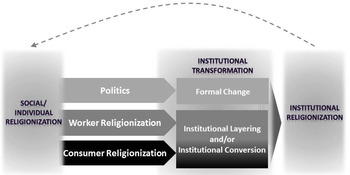
Organizational change from below can take different institutional forms. More specifically, two distinct institutional change mechanismsFootnote 4 are pertinent in the context of low-visibility change: “institutional conversion” and “institutional layering” (Hacker Reference Hacker2004; Streeck and Thelen Reference Streeck and Thelen2005). Institutional layering takes place when new institutional arrangements emerge alongside established ones: For instance, the emergence of publicly funded religious shelters for at-risk youth are added to a system dominated by non-religious shelters. Institutional conversion occurs in instances in which organizational structure and its nominal status (religious or non-religious) do not change, but its internal practices are transformed. For instance, Catholic schools that dedicate little time to religious studies without changing their formal Catholic status. As shown in Figure 1, the bottom-up change processes move through layering and conversion while the political pathway operates primarily through formal institutional change. Both bottom-up processes, precisely because they do not involve a frontal assault on well-established formal arrangements, offer relatively low-resistance paths to change.
From social/individual to institutional religionization.

However, the literature that discusses these two processes is silent on possible differences between the two. This work could serve not only as an investigation into mechanisms of religious change at the institutional level, but also as an exploratory comparative study of institutional layering and conversion. The exploratory nature of this work implies that its goal is to generate valuable theoretical insights based on case studies, but it does not formally test them.
CASE SELECTION AND METHODS
A clear advantage of choosing Israel as a case study is that significant religious changes are occurring on the social/individual religious level, something which, based on the “bottom-up” argument, is expected to fuel change at the public organization level. According to the Israeli Census Bureau, the share of Jews who self-identify as ultra-orthodox has steadily increased since the end of the immigration wave from the Former Soviet Union in the 1990s: an increase from 5.9 to 9.4% between 2002 and 2012 (Central Bureau of Statistics 2014). Although the “modern orthodox” category remained stable over this period (a modest increase from 13 to 13.6%), Cohen and Susser (Reference Cohen and Susser2012) argue that the general trend within the modern orthodox camp is toward greater religious strictness.Footnote 5 This change is significant because although the share of the modern orthodox has not changed much, their expectations of public organizations' behavior could shift with changes in their own religious outlook.
The demographic figures presented here are for religionization at the national level and a growing share of religious individuals could certainly exert an influence through national-level organizations. In the 20 plus year period between the elections of 1992 and 2013, the number of Israeli parliament (“Knesset”) members from ultra-orthodox parties increased from 10 to 18 while the number from modern orthodox parties grew from 6 to 12. In general, the political power of the religious block in the Knesset is considerable and, more often than not, government coalitions depend on religious participation for their survival. Yet as argued above, the relevant environment for public organizations is no less local than national. In some municipalities, the population composition has not changed substantially, in others — most notably Jerusalem, Israel's largest city — the population has undergone considerable religionization and this is likely to affect public organizations.
The study focuses on three types of public institutions: the military, healthcare services, and public schools. The primary reason for this choice is that they constitute the largest public services in Israel: in terms of manpower and budget. Differences across the organizations, in terms of centralization-segmentation, also played a role in their selection to serve in a conversion-layering comparative exploration. The military provides a public good (national security) and is governed in a highly centralized manner. This implies that there is limited room for segmentation and layering. It is expected that religionization in the military would primarily take the form of institutional conversion. Schools provide opportunities for religionization through institutional layering given that the Israeli school system is divided along religious lines to begin with. The separate religious and non-religious school systems (“layers”) are expected to evolve differently. Finally, the nature of healthcare services allows for certain segmentation (i.e., it is possible to create religiously oriented health services alongside non-religious ones). Nevertheless, unlike the school case, there is little significant institutional history of such layering. The healthcare system is likely to feature conversion, but layering is also possible.
All three cases could also feature important variation in terms of the significance of the two bottom-up processes that are predicated on consumer' and worker' religionization. While, all else being equal, we would expect that a social/individual national religionization trend would culminate in public organization religionization, the impact of such religionization is unlikely to be uniform for at least three reasons. First, geographical variation in religionization levels would create differential religionization pressure on public organizations depending on their location (e.g., hospitals in more religious cities would face greater religionization pressure than those in less religious environments). Given that public organizations often serve specific locales (e.g., schools, hospitals), local social/individual religious trends could be no less important to organizational religionization than national trends. Second, social/individual religionization is likely, but not necessarily, mirrored in parallel trends among workers (e.g., the share of religious physicians might grow at a far slower — or faster — pace than that of the religious in society in general). And finally, the preferences of the religious related to a specific service might not significantly differ from those of the non-religious. For these three reasons, it is important to move beyond general social/individual levels and examine religionization trends among workers and consumers and take into account specific religion-based differences in public service delivery preferences.
This study is comparative across different types of public services and is qualitative in its methodological orientation. The qualitative approach, which relies primarily on document analysis and semi-structured interviews, is appropriate given the complex nature of the religionization process in public organizations. Gauging the direction and magnitude of this type of dependent variable (i.e., religionization) is no simple task. Devising “objective” measures (e.g., the degree of separation between male and female soldiers) is never easy. The process-tracing required for unearthing the causal links between social and organizational trends, and understanding how institutional structure affects the form that organizational religionization takes, require an in-depth knowledge of institutional dynamics in these three public organizations (Bennett and Checkel Reference Bennett and Checkel2014).
The different events examined in the three types of public organizations are from the 2000s although, at times, a comparison is drawn with earlier years. Document analysis relied on minutes from relevant Knesset' committee sessions, government reports, and newspaper coverage of relevant events. This study also relies on secondary sources: this is especially true of the military case study that was explored in different academic publications in recent years. Finally, a set of 25 semi-structured interviews was conducted with a former health minister, senior civil servants, hospital managers and physicians, Jerusalem-based school principals and teachers, and military personnel. Interviewees were asked about manifestations of religion in relevant organizations, whether they witnessed any trends, and the different types of actors involved in the process and their effect.
RELIGIONIZATION: THREE INSTITUTIONS
The Military
Since its establishment in 1948 amid war, Israel's military played a critical role in Israeli public life. The military budget is considerably larger than any other public organization's budget (and largest as share of government budget among organization for economic co-operation and development countries) and its workforce also surpasses by far that of any other organization. Given near-universal Jewish conscription and the central role that the military plays in Israel's war-checkered history, it is of little surprise that the military strongly influences Israeli society and culture.
The demographic growth in the share of the ultra-orthodox in society has little direct effect on the military. The main reason for this is that the ultra-orthodox are mostly exempt from military' service, and although two ultra-orthodox units were established since 2002, their share is still too small to have much of a general effect. Social/individual religionization, however, did have a major effect on the military workforce, especially among combat units. Modern orthodox men, unlike the ultra-orthodox, serve in the military. This group has undergone two concomitant trends that combine to produce a strong religionization effect. First, modern orthodox soldiers are far more likely than in the past to join combat divisions and to enlist as officers. The share of modern orthodox infantry officer cadets increased by one order of magnitude — from 2.5 to 26%— in less than 20 years since the early 1990s (B' 2010). It should be stressed that the infantry is considered the backbone of the Israeli military: almost all Israeli Chief of Staffs served in the infantry. This impressive increase could be explained ideologically: the modern orthodox have become more nationalistic and so the appeal of the military increased. It is also associated with an institutional change: the creation in 1987 of religious pre-military academies that motivate and channel large cohorts of modern orthodox to enlist in combat units and pursue a military career (B' 2010). These academies stress the importance of having their graduates integrate into regular military units and not into separate units for the modern orthodox. This drove the military toward institutional conversion and not layering.
Second, the modern orthodox have undergone an internal religionization process by which they have become stricter in their adherence to religious rules (Cohen and Susser Reference Cohen and Susser2012). Combined these two trends entail that the share of religiously strict officers and soldiers in what are considered to be the military's core units has increased substantially.Footnote 6
In terms of consumers of the military product, given that national security is a pure public good, whatever change occurred in consumer composition should simply reflect the general religionization trend in society.
Finally, politics could also affect organizational change. As mentioned in the previous section, the share of religious political parties in the Knesset increased in recent decades. Much of this increase is attributable to the growing strength of the ultra-orthodox parties. These parties are generally silent on military affairs, in part because their constituents rarely serve, and in part because security issues are relatively low on their agenda.
Has religionization advanced on an organizational level in the military? Several publications in the field of state-military relations attest that this indeed is the case. This change was reported in a collection of essays dedicated specifically to this issue (Gal and Libel Reference Gal and Libel2012) and a recent book (Levy Reference Levy2015). Religionization is manifested in several different ways such as an increased adherence in military bases to Jewish dietary (Kosher) laws and an expanded role for the military rabbinate (a unit in charge of religious services) in the task of educating and motivating soldiers. While the growing strictness in enforcing Kosher laws (e.g., soldiers that bring non-Kosher food into a military base are thrown into detention) is interesting, the growing role of the military rabbinate has even drawn the critical attention of the State Comptroller who voiced concern that the Rabbinate has overstepped its authority by taking upon itself to educate soldiers — including non-religious ones (The State Comptroller 2012). The former Chief Rabbi of the military who led this transformation was unapologetic: as far as he was concerned, religion enhanced soldier's motivation to engage in combat and demand for it followed naturally from the increase in the share of modern orthodox soldiers, and especially officers, in combat units (Levy Reference Levy2010). This form of religionization has not gone uncontested. Recently, the military's Manpower Directorate has proposed to close a branch of the military rabbinate whose activities focus on boosting motivation, in order to keep in check the Rabbinate's influence. This move appears to be supported by the Chief of Staff (Cohen Reference Cohen2015).
The military manifestation of religionization that received the most public attention involved the separation of female and male soldiers. One event in particular in which officer cadets walked out of a military ceremony because it featured female singers provoked public ire (Cohen and Susser Reference Cohen and Susser2012).Footnote 7 This incident is indicative of a far more serious problem of accommodating simultaneously religious soldiers and women — especially given the military's internal religionization trend. Following the voicing of religious concerns that male religious soldiers are being over-exposed to women, in 2002, the military issued “the appropriate integration” guidelines. These were intended to help govern female-male interactions in the military in a way that would limit the exposure of religious soldiers to women. The guidelines included measures which guaranteed that religious soldiers would not be required to serve under female officers and that in training courses in which the units were of mixed sex, religious soldiers would be guaranteed a separate single-sex unit. However, given the large and growing share of religious soldiers in the military's core units, questions arise about the extent to which these arrangements impede women's advancement (Levy Reference Levy2015). In 2011, Gila Kalifi-Amir, the Women's Affairs Advisor to the Chief of Staff, argued that the growing insistence of many religious soldiers to minimize interaction with women is effectively marginalizing women in the military. She wrote:
“The order originally was intended to create a comfortable and respectful environment for all soldiers, but the way it is being implemented in practice is causing a double loss: Women's actions are being limited, and appropriate integration rules are being interpreted in an increasingly extreme manner, to the point where they are becoming untenable and impose religious extremism” (Kalifi-Amir in Harel Reference Harel2011).
The “appropriate integration” measures, given religious influence within the military, are interpreted in such a way that in effect often prevents women from serving in units in which there is a large share of religious soldiers — and these are the most important units in terms of long-term promotion.
What has led to this form of religionization in the military? There is little to indicate that social/individual religionization trends exerted much of an effect either through the consumer' or the political' paths. As claimed before, neither did the modern orthodox' share in society — i.e., the consumers of the military public good — change, nor did the political power of their representative party strengthen. The one clear change was by way of the worker' path. The dramatic rise in the religious share among infantry soldiers and officers coupled with an increasingly strict interpretation of religion affected a significant change in the military.
Although the military allowed for some layeringFootnote 8 formal separation was limited. The Israeli military, for both organizational and ideological reasons, is less than keen to create distinct religious units at all levels. Hence, religionization often takes the form of institutional conversion: the entire military must adhere more than in the past to the laws governing Kosher food and all soldiers are subjected to religious messages delivered by military rabbis. The fact that religionization affects all — primarily women soldiers but also non-religious men — increases the likelihood of opposition to religionization. Indeed, as demonstrated by the frank and public criticism of female marginalization by senior military officers, it is clear that an internal struggle is taking place against religionization.Footnote 9
Schools
The Israeli education system, from its very beginning, was divided along religious lines. Beyond separate school systems for Jews and Arabs, the Jewish school system was divided into three streams: the non-religious stream (the largest), modern orthodox, and the non-public ultra-orthodox.
The modern orthodox school system is clearly influenced by the growing religious fundamentalist trends, something that is manifested in religious schools embracing strict separation of boys and girls from an early age. Between 2001 and 2010, the share of students studying in mixed-gender public religious primary schools dropped from 50 to 37%. Gender segregation usually leads to smaller classes something that requires higher per-student public outlays than would otherwise be the case (Shir Reference Shir2014).
In terms of consumers, the non-religious school system caters almost exclusively to the non-religious. The vast majority of its personnel are non-religious, but precise figures are unavailable. Politically, beyond the general strengthening of religious parties over time, it should also be noted that two former education ministers belonged to the main modern orthodox party as is true of the current (circa 2017) minister. So were non-religious schools affected by social/individual religionization trends?
Despite some parental complaints about creeping religionization, the short answer is “no.” In Israel there is no strict separation of Church and State. Given that Zionism, Israel's nationalist movement, is inherently associated with Judaism it is unsurprising that bible lessons are taught in non-religious schools. Since Israel's establishment all students are required to pass a bible matriculation exam. Nevertheless, the weight of bible studies in non-religious schools has diminished over time. There has been a clear decline in weekly school hours dedicated to the bible/heritage/civics subjects across different age groups. For example, fifth and sixth grade students studied nine weekly hours in 1988, six in 1998, and only five in 2004. In contrast, the required total weekly hours — for all subjects — moderately increased from 30 to 32 during the corresponding period (Blass, Zussman, and Tsur Reference Blass, Zussman and Tsur2012). In 1991, the Ministry of Education convened the Shenhar Committee to study and make recommendations regarding instruction of Jewish studies in non-religious schools. The Committee found that the number of hours dedicated to Jewish studies declined considerably over the years, fewer students chose to specialize in Jewish studies, and there was a need to strengthen this subject and re-orient it in a direction that would be more appealing to non-religious youth (Shenhar Committee 1994). The Committee, however, did not envision in its recommendations any type of religious awakening. Its report stressed that Jewish subjects were to be taught from a distinctly humanistic, non-religious, and even critical, perspective.
In 2010, a parliamentary investigative report concluded that the status of the Jewish subjects was not improving in the public non-religious schools. In some schools, principals decided that certain grades would “skip” one year of bible studies: a move that is at odds with official policy. In general, Jewish studies were considered as low priority by both principals and students: only 11% of students chose to specialize in a Jewish subject in their matriculation exams (beyond the compulsory bible exam). Ministry of Education officials argued that the sorry state of the three Jewish studies subjects is, in part, the result of budgetary cuts targeted at the instruction of these subjects in recent years. The report also mentioned the growing polarization between religious and non-religious in Israeli society as a major reason for the deterioration in the stature of Jewish studies in non-religious schools (Valler Reference Valler and Kreisel2006; Fiedelman Reference Fiedelman2010).
In a set of five in-depth interviews conducted with teachers in different Jerusalem (a city chosen because of its rapid pace of social/individual religionization) non-religious secondary schools, the general sense among teachers was that there were no significant signs of religionization in their schools. The interviewees did not sense a rising tide of religion in their schools — either as part of the regular instruction hours or in extracurricular activities.
An explanation of the continued marginality of religion in non-religious Jewish schools should begin with the obvious: these schools are non-religious and they constitute a distinct layer separate from religious schools. Religious presence, either as parents or as workers, in non-religious schools is marginal. Non-religious parents care little about religious subjects and, accordingly, school principals view these subjects as low priority. The growing share of the religious in the general public implies that a growing share of students will attend religious schools — as is indeed the case — and not that the character of non-religious schools would transform. Moreover, religious political leadership finds little interest in schools that are not attended by their constituency. Finally, as noted in the parliamentary report, social polarization also plays a role. Some non-religious Jews are estranged from religion and are averse to its manifestations in the public school system. For example, in a Knesset committee meeting that discussed the state of the Jewish subjects in non-religious schools, several legislators noted that suggestions to strengthen Jewish subjects are regularly met with a vocal opposition objecting to religious involvement in schools (Knesset 2010). Indeed, in interviews, a couple of teachers argued that some parents opposed any teaching of religion-related studies: perhaps as a response to Jerusalem's general religionization, which the parents found threatening.
Undoubtedly, in a country in which the specter of religion looms large there will always be some who fret over a possible religious takeover of schools. For the time being, such a trend cannot be detected in non-religious public schools.
Healthcare
Institutionally, the Israeli healthcare system is comprised of a nationwide network of publicly funded local clinics managed by four different health funds. In addition, the vast majority of hospitals are publicly funded, if not publicly-owned. Both hospitals and local health clinics do not have a formally defined religious character apart from three religious hospitals that serve a small minority of the religious public. The Department of Health is responsible for regulating all healthcare facilities.
Primary care clinics, hospitals, and other healthcare services are generally public — both in terms of funding streams and consumers. Nevertheless, given that both clinics and hospitals could be situated in areas with a high share of religious consumers, there is a distinct possibility of religionization occurring in some facilities located in religious areas and much less so in others.
Figures that break down the medical workforce by religiosity are unavailable due to privacy issues. However, based on interviews with hospital managers across the country, the clear majority of doctors are non-religious and ultra-orthodox physicians are rare: in part, because the ultra-orthodox infrequently pursue higher education. Even in a Jerusalem public hospital with a distinct (and uncommon) Jewish character, according to the hospital manager, the majority of physicians are non-religious (Interview, February 26, 2015).
In political terms, unlike the case of the Ministry of Education, religious parties do not appear to have any special affinity to the Ministry of Health. Nevertheless, two former health ministers belonged to an ultra-orthodox party as is true of the current minister (circa 2017). Is the healthcare system undergoing religionization and, if so, what form does it take?
On the formal policy level, there is little change. Most medical issues are not subject to religious contention.Footnote 10 In hospitals, however, religionization is manifested in various ways, albeit the extent of religionization depends on whether the hospital is situated in a locale with a high share of ultra-orthodox. Zehavi (Reference Zehavi2012) reports that hospitals that cater to a public that is increasingly religious have progressively embraced various practices favored by this demographic: a high level of strictness in enforcing Kosher dietary laws on their premises; the use of special equipment on the Sabbath so as not to violate the holy day; synagogues have been opened and renovated on hospital grounds; and ultra-orthodox — are sometimes separated from other patients and offered de-facto religious person-only rooms in which they would not be exposed to practices and speech that they find offensive. The latter religionization manifestation is especially pronounced in the case of maternity wards in which religious mothers deliver a very high share of births and hospitals consider government compensation lucrative. Although there is no legal basis for setting separate rooms aside for the religious, some hospitals adopt this practice to attract customers (Zehavi Reference Zehavi2012).
Separation for religious reasons could also exact a price, not just attract more customers. In a parliamentary hearing that dealt with the practice of gender-based separation in a psychiatric hospital, the hospital's deputy manager testified that the ultra-orthodox conditioned hospitalization on sex separation. Hence, the increasing share of ultra-orthodox patients in the hospital led to the creation of sex-separate wards. Such separation, however, increased the workforce required for serving each ward by 50%: a significant additional expense (Shelfman Reference Shelfman2009).
One important religionization incident related to an Emergency Room's (E.R.) location offers some insight in regard to the limits of religionization. An ancient burial ground was found during excavations on a site designated for the construction of a new E.R. Ultra-orthodox Jews were concerned that the burial ground was Jewish and in a rare case of political intervention, the ultra-orthodox deputy minister in charge of the Department of Health pushed the government to move the E.R.: this despite the fact that such a relocation was expected to create logistic problems for the hospital and significantly increase building costs. Ultimately, critical media coverage and popular protests led to a reversal of this government decision. Opposition to this relocation was anchored by leading physicians and the Israeli Medical Association (Sofer Reference Sofer2010).
Religionization effects are hardly limited to hospitals. In 2012, Magen David Adom (the Israeli equivalent of the Red Cross) established a supervisory rabbinical committee for the organization after pressure from non-political religious ultra-orthodox leadership. The main problem was in Jerusalem in which the growing demographic share of the ultra-orthodox was expressed in growing numbers of religious female and ultra-orthodox men volunteers — primarily as paramedics. Following ultra-orthodox criticism, Magen David Adom established the committee to govern gender relations and other issues associated with religion (Levinson Reference Levinson2012).
To conclude, in healthcare, some religionization took place. In hospitals, religionization is manifested in multiple ways; mostly in issues that are not directly medical (e.g., Kosher food). The driving force behind such religionization is clearly the growing share of religious patients concentrated in specific areas. There is no distinct change in the religious makeup of medical personnel — especially physicians — and hospital managers interviewed were generally in agreement that political intervention was not significant. In Magen David Adom, however, religious leadership, and especially the workforce, brought about the establishment of the supervisory rabbinical committee. The organization could not ignore the demands of religious leaders given its considerable reliance on religious volunteers. The healthcare study also provides an example of politically driven religionization, and its failure. A highly visible government decision to relocate an E.R. for religious reasons was overturned due to protests led by physicians and their representative body.
RELIGIONIZATION EXPLAINED
This article explains variation in the extent and form of institutional religionization with a special emphasis on bottom-up driven change. Insights from the three institution-specific case studies are compared below.
Religious change at the social/individual level is likely to impact religionization on the organizational level via the bottom-up workforce' and consumer' paths. The degree of such change varies across organizations and with it the process and extent of organization-level religionization. The workforce path proved to be highly significant for religionization in the military. The main driving force behind religionization was the rising share, and intensified religious fundamentalism, of modern orthodox soldiers. While workforce religionization was not a factor in hospitals, the high share of ultra-orthodox volunteers in Magen David Adom led to the establishment of a supervisory rabbinical committee.
The consumer path proved important in healthcare: hospitals cater to the increasing demand for religious accommodation. This is a localized effect. Hospitals situated in areas in which religious presence is relatively low are exposed to less religious consumer-driven pressures and as a result experience little organizational religionization. In the case of schools, the significance of consumers was also evident. Stricter religiosity in the religious layer led to growing gender segregation in religious schools. As will be argued below, the localized nature of religionization implies that the Israeli cases possess theoretical value beyond Israel's borders: even in more secularized countries.
This study also explored the obvious alternative to bottom-up religionization: religionization through politics. Religionization through politics was generally absent except in the healthcare domain. Yet even there the political channel of religionization appeared to be of minor importance. In the Magen David Adom case, religious leaders threatened a boycott of the organization unless the organization dealt with gender separation issues. However, leadership leverage was only significant because of the prior religionization of the workforce. The E.R. location affair provides the one example of top-bottom political religious pressure to change policy: an attempt that ultimately failed due to worker mobilization against visible religious interference with professional decisions. In general, organizational religionization proceeded through the worker and consumer paths. Where neither path was relevant — the non-religious schools case — no significant religionization transpired.
This study speaks to the institutional form that religionization takes: formal legal transformation, institutional layering, or conversion. Because of the generally controversial nature of religionization and the high degree of difficulty involved in highly visible formal institutional change, it is unsurprising that the study fails to find examples of this form of change in the three institutions. Indeed, the one clear attempt at such a centralized and straightforward assault on the status-quo — the government decision to relocate an E.R. for religious reasons — failed due to opposition. Public attempts at secularization (e.g., legislation that relaxes restrictions on euthanasia — fn. 10) also tend to fail for the same reason. Successful religionization occurred through the less visible institutional mechanisms of institutional layering and conversion.
Religionization often took the form of institutional conversion: in the stricter application of Kosher laws in both the military and in hospitals; in the marginalization of women soldiers in what are supposedly mixed sex units; and in the delivery of religiously-based lessons and messages by military rabbis to all soldiers. Layering was evident in the creation of separate men-only training units in the military; in the healthcare system in the establishment of separate post-partum recovery rooms for the ultra-orthodox; and in gender separate wards in psychiatric hospitals.
Non-religious public schools represent a “null” case in which religionization is insubstantial, but they exemplify how layering works. In the formally non-religious school layer religionization is absent. This is the case because both workforce and consumers are largely non-religious and religious political parties are hardly interested in non-religious constituencies. However, one should not forget that there is also a religious layer. The share of religious students out of all Jewish students is growing: it increased from 39.6 to 47.8% in primary schools between 1999/2000 and 2013/2014 (Israel Central Bureau of Statistics 2014). Moreover, due to growing religious strictness within the modern orthodox camp, religious schools are also undergoing an internal religionization process. Institutional layering implies a process in which religionization applies to the system as a whole — the overall share of religious students in religious institutional settings is increasing — but the non-religious segment within it is largely left untouched.
This study not only compares formal institutional change, on the one hand, to institutional layering and conversion on the other, but also allows for a novel comparison of the two latter institutional change mechanisms. Based on a comparison of layering' and conversion' religionization cases one major finding arises: the form that organizational religionization takes — institutional layering or conversion — is associated with different levels of opposition intensity and backlash. A reasonable assumption is that opposition is particularly fierce when non-religious populations are directly affected and sense that religious practices are imposed on them. This is more likely to be case with institutional conversion than with layering because of conversion's generalized effect. In the military, for instance, some demands made by religiously strict soldiers led to women's marginalization, therefore provoking opposition. Or the growing prevalence of religious messages directed at all soldiers induced pushback by military personnel who try to limit the contact of the military rabbinate with the troops. While institutional conversion might not provoke the type of opposition that formal legal efforts to change the status quo usually encounter, its generalized effect still generates considerable opposition to religionization. With layering-based religionization, however, the non-religious are not directly affected so opposition is weak. Thus, growing gender segregation within the religious school layer encounters little opposition as is equally true of the informal hospital practice of allotting “religious only” maternity ward rooms. Clearly, the path of least resistance moves through layering.
CONCLUSION
Societies that undergo religious change are likely to experience corresponding change in their public organizations. However, a uniform process of religionization is unlikely. First, the link between religionization at the social/individual level and the organizational level moves through two different bottom-up paths — workers and consumers — and the extent to which these actors are influenced by social religionization varies across organizations and locale. Second, variation in organizational religionization could also be expressed in the institutional form that religionization takes: formal change, institutional layering, or conversion. Institutional form, in turn, is likely to affect the ease and extent of organizational religionization because institutional conversion provokes greater opposition than layering-based change. And highly visible formal change incurs the greatest opposition of the three institutional change forms.
The greater ease by which layering-based religionization proceeds begs the question why religionization entrepreneurs do not always opt for layering. Perhaps the best way to allow for organizational religionization is to employ layering in which much of the religious tension is diffused because the non-religious layer is mostly insulated from unwelcome religious influence. Indeed, the historic model of pillarization along religious and ideological fault lines in the Netherlands offers a model for such a development (Lijphart Reference Lijphart1975). Nevertheless, there are practical reasons why this might be difficult to affect. In some cases, the public product is indivisible (e.g., national security). In other cases, the cost of layering could be considerable. The creation of parallel layers pushes against the administrative logic of achieving cost efficiencies through economies of scale. Indeed, in Israel, gender-separation in religious schools and in psychiatric wards significantly increased costs. Religionization in times of austerity therefore is likely to take the more confrontational form of institutional conversion even if its initiators appreciate layering's political advantages. Comparisons of the three institutional change mechanisms (formal change, layering, and conversion), in terms of economic and political practicability, should be part of the future research agenda of institutional scholars. This work constitutes a pioneering effort in this respect.
Israel provides an appropriate setting for studying how agency (i.e., workers, consumers) and institutional structure (fragmented-layering, unitary-conversion) interact in creating religious change in public organizations. The possibility that Israel holds important lessons for other countries is not obvious given the fact that in many countries the aggregate religious trend is not religionization, but secularization (Norris and Inglehart Reference Norris and Inglehart2004). Nevertheless, for decentralized public organizations, the relevant social/individual trend is primarily local. For this reason, the Israeli bottom-up institutional dynamics are likely to apply in local settings that are increasingly religious even in relatively secularized countries. For example, while at the national level, England is relatively secular; at the local level one can find considerable religionization. The framework presented here could be usefully employed to explain why some Birmingham public schools, for example, which operate within predominantly Muslim communities, embraced practices and messages that conform to a fundamentalist interpretation of Islam. A report commissioned by the British education secretary found that increasingly fundamentalist school staffs were driving such organizational religionization. The conversion of these public schools resulted in, among other things, female staff not being treated equally (Bennhold Reference Bennhold2014). In Toronto, widespread protests, student walkouts, and a steep decline in enrolment figures forced the hand of a school principal to water down compulsory sexual education classes in a school with many Muslim children, often newly-arrived immigrants. Unlike the Birmingham case, consumers (i.e., parents) were behind religionization and the principal settled for a form of layering. Students were separated into two groups: one that was taught according to the proper curriculum and the other that learnt the sanitized version (Rushowy Reference Rushowy2016). In similar vein, it is possible to explain efforts to open religion accommodating health clinics for Muslims in Stockholm with reference to the changing consumer composition in specific neighborhoods (Westerlund Reference Westerlund, Adogame, Echtler and Freiberger2013).
In societies that are increasingly religiously heterogeneous, it is likely that local religious pressures on public institutions would emerge, despite the secularized nature of the state in general, and would result in locale-specific religionization.Footnote 11 Analysis of the three Israeli case studies suggests that such religionization, however, would take different institutional forms. Religionization's reach in public institutions would both depend on social actors and the different institutional dynamics associated with formal change, layering and conversion.