

The current public sector reform agenda introducing markets and competing providers into the NHS, including private non-profit providers, has to contend with a tradition of public provision and growing public anxiety about the privatisation of clinical services. Privatisation attempts have already been repudiated in Scotland and Wales. There is the fear that efficiency is being traded off against quality when profit-making firms compete for contracts. The non-distribution constraint of non-profit organisations, or the ‘third sector’ as it is usually known in Britain, is assumed to prevent such quality-shaving (Hansmann, Reference Hansmann1980). But what is the evidence in support of the non-profit sector as a provider of health care and to what degree is such evidence relevant in the context of a universal and comprehensive system of healthcare such as the NHS?
This article, using the method of a systematic literature review, investigates the international research evidence on the relative performance of the non-profit sector with both the for-profit and public sector. We first present the theoretical justification for using the non-profit sector in the delivery of health care. We then present the recent UK policy reform agenda of bringing in non-public providers into the NHS. We briefly describe the methodology of our systematic literature review before presenting the findings from this review and discussing a number of concerns about the literature. We conclude that the evidence does not support the claims about the superior performance of the non-profit sector or therefore a switch to a provider-based system, based upon market principles, even where the providers are non-profit organisations.
Theories of ownership effects on efficiency and the particularities of the health and social care services
The introduction of non-profits in NHS market reforms are informed by economic theory about the benefits of competitive markets. Economists advocate competitive markets as a means of containing costs by substituting competing providers for public monopolies. This policy has been a priority of health system reform in Britain and elsewhere in Europe (Mossialos and Le Grand, Reference Mossialos, Le Grand, Mossialos and Le Grand1999). Under New Labour's ‘Third Way’ welfare reform project, the Third Sector has played a pivotal role (Haugh and Kitson, Reference Haugh and Kitson2007). It is argued that, while markets can provide an incentive to cut costs at the expense of quality, non-profits, defined as firms that are not motivated by profit maximisation, are more focused on patients than on their own self interest, and therefore are less likely to sacrifice quality in the pursuit of efficiency (Chalkley and Malcolmson, Reference Chalkley and Malcomson1998). Thus, from an economic theory perspective, this is a claim about the relative likelihood of principal-agent problems giving rise to market failure.
Agency problems are the subject of transaction cost economics (Williamson, Reference Williamson1985). Economic theory predicts that the benefits of private ownership and competition (Demsetz, Reference Demsetz1967; Alchian and Demsetz, Reference Alchian and Demsetz1973) will lead to greater consumer choice, more innovative services, more efficient management, a leaner public workforce and thus lower costs (Mossialos and Le Grand, Reference Mossialos, Le Grand, Mossialos and Le Grand1999). However, in the case of health care, transaction cost economics also predicts accompanying agency problems because managers of for-profit organisations have an incentive to exploit two fundamental weaknesses of the market: information asymmetry and incomplete contracts. Asymmetric information in health, childcare and nursing services leaves the potential ‘customers’ vulnerable to supplier exploitation because of their lack of knowledge and the non-availability of relevant information on quality. Thus, patients or GPs who recommend/commission treatments on their behalf cannot contract for quality because they are unlikely to be aware of all its aspects (Arrow, Reference Arrow1963; Chalkley and Malcolmson, Reference Chalkley and Malcomson1998), which is why, in practice, most treatments are recommended and/or commissioned by the GP on behalf of patients. Furthermore, the complexity and uncertainty of service requirements mean that it is difficult to specify the precise requirements, and thus contracts between the purchaser and provider are deemed to be ‘incomplete’, in the sense that not all possible eventualities can be written into a contract. In other words, there is a risk that profits will be maximised by reducing service quality, known as ‘quality shaving’, or by displacing costs on to staff, users and their families, known as ‘externalising’ the costs.
According to Hansmann (Reference Hansmann1980), the theory underpinning non-profit organisations is that in public services, where quality is at a premium, the non-distribution constraint prevents efficiency being traded off against quality when firms compete for contracts. In effect, firms without owners who benefit financially from surplus generation are deemed more trustworthy and less likely to exploit purchasers and patients.
The literature is dominated by an economic focus on principal-agent problems and the comparative cost of controlling them using different governance models, such as markets or hierarchies (Williamson, Reference Williamson1985). Much less attention has been given in the regulatory literature to analyses of non-profit, non-governmental bodies taking over the health care functions of governments, which is the British and European focus of interest (Saltman et al., Reference Saltman, Busse and Mossialos2002).
Background
Until recently, the non-profit sector played a marginal role in the provision of health services in the UK NHS (see, for example, Mohan, Reference Mohan1984, Reference Mohan1985). In 2000, the ‘NHS Plan’ pledged a major policy shift to non-state provision of healthcare, with the New Labour government declaring its intention to develop partnerships with the independent sector (both private for-profit and the voluntary sector) (NHS, 2000: 5).
Building on the purchaser provider split of 1991, the government introduced the 2003 Health and Social Care (Community Health and Standards) Act, which allows commercial contracting for mainstream hospital service and established a new type of non-profit company called foundation trusts. Foundation trust hospitals are independent of government and have greater autonomy than their predecessor, the NHS trust established in 1991. By 1 May 2008, there were 96 NHS foundation trusts in total (Monitor, 2008). The introduction of foundation trusts was accompanied by a programme of commercial contracting for elective care under the Independent Sector Treatment Centre programme. In 2004, primary care was also opened to competing commercial providers, including a new non-profit body corporate, the ‘community interest company’, which the government advocated for GP practices.
The government introduced a range of other measures to lower the barriers to entry for voluntary agencies (also called ‘Third Sector’) and to abolish the public sector's monopoly (see Department of Health, 2006; HM Treasury, 2002, 2006; NHS Primary Care Contracting, 2006).
A Third Sector Commissioning Task Force was established in 2005 (Third Sector Commissioning Task Force, 2006) and the government made available start-up funds to enable the non-profit sector to compete on a ‘level playing field’ (Department of Health, 2006: 175–6). In August 2007, the Minister for Care Services for England announced the launch of the Department of Health's £73m Social Enterprise Investment Fund to support and encourage the development of a social enterprise sector in the delivery of health and social care services. In February 2008, the fund was increased by £27m to £100 over four years from 2007/08.Footnote 1
Her Majesty's Treasury (2004: 3) states that non-profits have ‘the capacity to build users’ trust’, while the Department of Health (DoH) has presented the policy of favouring social enterprises over for-profit providers as a means of enhancing community-based care. The DoH describes non-profits as having better relations with particular patient groups, and expertise in specific areas, and praises them as innovative providers of primary care and as value-driven (Department of Health, 2006). However, the government cites no evidence in support of these advantages. In this paper, we examine the theory and evidence behind the claim that non-profit corporate behaviour is more benevolent than for-profit corporate behaviour by drawing on a range of systematic literature reviews and conducting our own systematic literature review.
Methods
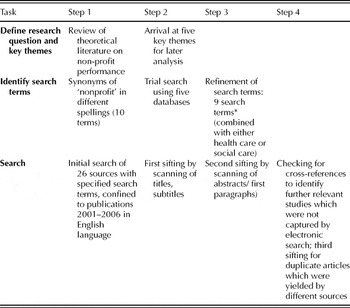
In 2006, we undertook a systematic literature review on the performance of the non-profit sector in health and social care, searching 26 sources with nine specified search terms, which were various synonyms and spellings of ‘not-for-profit’. This reflects the absence of a universally agreed terminology of not-for-profits, which include unincorporated community and voluntary groups, co-operatives, registered charities and friendly societies. Not-for-profit is used synonymously with the voluntary sector, the third sector, the community sector and sometimes the independent sector. The UK Department of Health most recently introduced the term ‘social enterprise’ to describe organisations that do not distribute any profits to the owners or stakeholders.
The initial search covering the period 2001–06 yielded over 14,000 hits, including duplicates. This period was chosen in order to review the most up-to-date evidence that had not been covered in previous systematic reviews. In the final analysis, we included 163 studies that met the criterion of having compared the performance of different ownership types of health and social care providers (see Table 1 for our research protocol and search strategy). The review builds on three authoritative previous systematic literature reviews on non-profit sector performance conducted by the New York Academy of Medicine (1999), Devereux et al. (Reference Devereaux, Choi, Lacchetti, Weaver, Schünemann and Haines2002) and Currie et al. (Reference Currie, Donaldson and Lu2003) by posing similar research questions in relation to more recent studies.
Research protocol and search strategy

Note:* The following nine terms were used: ‘not for profit’, ‘non profit’ (first two terms allowing for different spellings), ‘social enterprise’, ‘co-operative’, ‘foundation trusts’, ‘community owned’, ‘independent sector’, ‘voluntary sector’ and ‘third sector’.
The selected studies were then thematically analysed according to five performance measures chosen on the basis of the theoretical assumptions about non-profit performance and the discussions in previous literature reviews on this topic.
Key findings
Country background
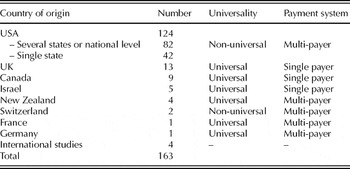
The vast majority, 124 of the 163 studies, were US studies, four studies were cross-national, and the remaining 35 studies from a variety of industrialised countries as Table 2 shows.
Country of origin of papers and health care system

Note: * A full review of all 163 studies is available from the authors on request.
Canada, New Zealand, the UK and Israel have universal systems, while the US and Switzerland have non-universal health systems. Yet, even universal systems vary in the range of services covered, and the extent of coverage. For example, most long-term care for older people in the UK is not included in the NHS. Another difference between the countries is the payment systems, which can be multi-payer or single payer. In multi-payer systems, health care is funded by a variety of public and private contributions and there is no one central organisation that administers the collection of fees and payment of health care costs. These three dimensions, universality, coverage and payment system, need to be taken into account when comparing health systems.
For the UK policy context, the comparison between non-profits and the public sector is the most important one. However, due to the US-dominance of the literature, the comparison was mainly between non-profit and for-profit institutions. Only 22 of the 163 studies included the public sector in their comparisons.
Themes in the literature
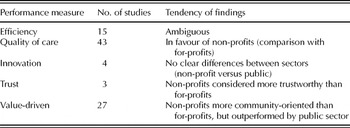
We then examined the studies in terms of claimed advantages of the non-profit sector: quality, efficiency, innovation, trust and the emphasis on values in the non-profit sector. Table 3 shows the findings of the studies in terms of these five factors, in so far as the studies explicitly compare performance along these dimensions. While some have examined several dimensions, others have examined none. We consider each of these dimensions in turn.
Performance measures, frequency of studies and findings

Efficiency and quality of care. The performance literature was mainly preoccupied with the two themes of efficiency and costs on the one hand and quality of care on the other hand. Forty studies dealt with financial performance indicators in the broad sense, usually focusing on the analysis of health care affordability and cost containment strategies. These included measuring the impact of changes in reimbursement methods on providers and the impact of conversions or mergers on costs, profits and efficiency.
Only 15 studies dealt with efficiency in the strict sense (meaning the ratio of the output to the input). Efficiency studies usually employed some form of regression analysis or specific data analysis techniques, such as Data Envelopment Analysis (DEA). The overall findings relating to efficiency were inclusive: while six studies did not find any difference between ownership forms, four studies found non-profits more efficient and five studies found for-profit organisations more efficient.
As one would expect, for-profit hospitals were more likely to offer the more profitable medical services and were more responsive to changes in service profitability, while government hospitals were more likely to offer the less profitable services. Non-profits often fell in the middle (Hansmann et al., Reference Hansmann, Kessler and McChellan2002; Horwitz, Reference Horwitz2005). Becker and Potter (Reference Becker and Potter2002) concluded that there appears to be an inverse relationship between hospital efficiency and social responsibility.
Quality of care was the outcome variable in 43 studies. Studies often reviewed differences in quality of care on the basis of staff/patient ratios, user satisfaction, mortality and hospitalisation rates or the Health Plan Employer Data and Information Set (HEDIS) index, a widely used standardised health care performance instrument in the US, the skill level of staff and various other indicators. There was considerable support for the contention that the growth of the for-profit sector led to declining service quality (32 of 43 studies), with only one study finding that the for-profit sector performed better in this respect and another 14 studies detecting no differences in the quality of care between the non-profit and the for-profit sectors. Only studies using staff ratios as the indicator for quality of care consistently revealed that both the skill level and the staff/patient ratio were better in non-profit than for-profit institutions. Crucially for the UK health care context, the two studies that included government-run facilities found that these had the best staffing ratios (Harrington et al., Reference Harrington, Woolhandler, Mullan, Carillo and Himmelstein2001; Berta et al., Reference Berta, Laporte and Valdmanis2005).
Innovation, trust and values
Studies looking at innovation by the non-profit sector were rare, probably due to the difficulty in measuring this concept. The four studies we identified relied mainly on self-reports by staff, thus introducing a likelihood of bias, or else used indicators such as diversification, growth in clientele and user involvement. The literature found a general tendency towards organisational isomorphism. Attempts to include non-profits as innovative providers of care may be undermined by institutionalisation, professionalisation and bureaucratisation. By competing for contracts, the non-profit sector has been forced to adopt government norms and subjected to standardisation and thus had lost its niche character and innovativeness, some of the alleged advantages of non-profits (Rathgeb Smith and Lipsky, Reference Rathgeb Smith and Lipsky1993).
There were even fewer studies looking at the trustworthiness of the non-profit sector. These used a national opinion poll or a survey among physicians. The three studies we found considered non-profits more trustworthy than for-profits, in line with the theoretical prediction. However, the US work also highlights the public's ignorance of what a non-profit actually is and how it is distinctive from other ownership forms, making it difficult to place much reliance on the results.
Studies looking at the value-driven character of non-profits were more frequent. We included all studies under this category that looked at the provision of community benefits including uncompensated care and community services. Nine of 124 US studies dealt with the issue of uncompensated or charitable care, that is the extent to which health care organisations provided care for which they received no reimbursement. This reflects the preoccupation with the 47 million people who are uninsured and ineligible for treatment (see US Census Bureau, 2007) and the requirement to treat some patients without charge to qualify for non-profit status and thus tax exempt bond finance. The main thrust in the literature was that non-profits are more community oriented and provide more uncompensated care, whereas for-profit firms seek profits and avoid unprofitable services (Castle, Reference Castle2005; Dellana and Glascoff, Reference Dellana and Glascoff2001; Sikorska-Simmons, Reference Sikorska-Simmons2005). When the public sector is included, however, non-profits often only fall in the middle, being outperformed by the public sector. Although, as presented above, there was no unanimous support for concerns that non-profits were less efficient than for-profit organisations, there seems to be an inverse relationship between hospital efficiency and social responsibility (see also Becker and Potter, Reference Becker and Potter2002). As one would expect, for-profit hospitals were more likely to offer the more profitable medical services and were more responsive to changes in service profitability, while government hospitals were more likely to offer less profitable services (Horwitz, Reference Horwitz2005).
The importance of the regulatory framework
The majority of studies concluded that ownership form was not important in determining performance in a market. The regulatory framework under which hospitals and health insurance providers operate proved much more important in explaining the performance of different medical care providers (e.g. Berta et al., Reference Berta, Laporte and Valdmanis2005). In a hostile market environment, there was little to distinguish non-profits from for-profit organisations. The findings seemed consistent with a growing suspicion about the increasing commercialisation in the health care sector and the view that many not-for-profit institutions were for-profits ‘in disguise’. It is therefore crucial to consider the market conditions under which non-profit organisations operated and the requirements of the regulatory framework.
Discussion
We have many concerns with this literature as most studies are characterised by methodological problems, including the definition and measurement of the key variables, quality and efficiency, and the omission of control variables and context and regulatory framework. Still less do they consider universal health care systems. We consider each of these in more detail.
A particularly serious shortcoming of the quantitative literature was the failure to define key terms and establish valid measures of key variables. While many of the studies purported to measure efficiency, that is the relationship of inputs to outputs, most studies were in fact measuring economy as reflected in operating costs. Furthermore, the data sets were usually aggregated hospital statistics, created and generated for other purposes, resulting in some of the measures having little sensitivity or specificity. Some of the quality of care measures relied on only imperfect measures or did not include any objective assessment of quality. Cost comparisons were difficult to undertake on the basis of the available data.
According to Currie et al. (Reference Currie, Donaldson and Lu2003), the difficulty of assessing efficiency due to the lack of appropriate outcome measures and the fact that information on cost differences cannot be meaningfully interpreted in the absence of information on service quality means that results may not be interpretable and explains the many conflicting findings in the literature.
The studies largely focused on the US. A major limitation was their focus on providers within a market for healthcare. Furthermore, their main concern was to identify behavioural changes on the part of healthcare providers when reimbursement systems, ownership form or the regulatory framework changed.
Much of the research comparing provider performance omitted the basic descriptive data including population coverage, services provided, and access criteria, including the regulatory framework. Because of the absence of a universal base in the US, the measurement of performance is difficult as it is confounded by issues of adjustment for case-mix, selection bias, etc. Studies comparing non-profits across countries or even in the US across states did not take sufficient account of differences in population access and coverage in market oriented versus universal, integrated non-market systems. For example, while a few US studies concluded that the public sector seems to be the provider of ‘last resort’ in a mixed economy of health care providing for those who cannot afford other forms of health care (e.g. Horwitz, Reference Horwitz2003; Green et al., Reference Green, Showstack, Rennie and Goldman2005), this was often not incorporated into the study design.
A necessary corollary of the fact that most of the studies were from the US, which does not provide universal care, is that they rarely dealt with universal and comprehensive systems as in most Western European countries. Surprisingly, there were no US studies comparing non-profits, for-profits with the two publicly funded and owned systems of integrated health care provision in the US, namely the Department of Veterans Affairs and the native American indigent health service. This therefore raises concerns about the relevance of such US-based studies to a system such as the NHS with universal and comprehensive coverage.
What conclusions can we draw from this for UK policy?
The key criticism of the literature is that the studies are not designed to address the core values of national health systems, namely universal access, coverage and distribution of resources and services on the basis of need. The wider system analysis is absent.
Quite clearly the US focus of the literature helps to explain this omission. But its economic focus is another limitation. Hansmann's (Reference Hansmann1980) and other's characterisation of non-profits as constitutionally less prone to agency problems is usually interpreted as a market failure analysis, that is as an analysis of the economic efficiency of contracting in which market relations are assumed. Public administration questions about the effects of contacting out on the infrastructure and objectives of health care planning are rarely posed. From this perspective, Hansmann-like claims about trust and organisational values have limited relevance.
The evidence from this plus other systematic literature reviews (New York Academy of Medicine, 1999; Devereux et al., Reference Devereaux, Choi, Lacchetti, Weaver, Schünemann and Haines2002; Currie et al., Reference Currie, Donaldson and Lu2003) shows that there is no consistent evidence that non-profits perform better than the private sector in either non-universal or universal health systems, and the review of the literature shows that in a competitive environment non-profit providers behave much like for-profit providers, which raises considerable doubts regarding the role of trust and benevolence in non-profit organisations. As such, therefore, the evidence does not support a policy of using non-profits in a switch from an integrated, publicly owned and provided system to a provider-based system with market incentives and principles.
Although the UK policy guidance emphasises the ‘value-driven’ character of not-for-profits and the mission statement of such organisations is, according to theory (Hansmann, Reference Hansmann1980), crucial for their trustworthiness, the role of the non-profits’ mission is increasingly questioned in the US. Bennett et al. (Reference Bennett, Iossa and Legrenzi2003: 342) point out that ‘the vagueness of NPs’ missions gives managers an almost unmatched degree of autonomy’. While they cannot redistribute profits to any stakeholders or owners, they can make a surplus. Indeed, a surplus is required for making new investments to stay in the market or paying back loans and necessarily entails the risk of service cuts if financial demands cannot otherwise be met.
Non-profits are also making increased use of performance-related pay, which is seen as an incentive to align the interests of non-profit managers with those of their stakeholders (Bennett et al., Reference Bennett, Iossa and Legrenzi2003). A recent volume of Health Affairs devoted entirely to this debate concluded that when it came to ‘mission versus market’, the market ruled. In the US, contracting and the incorporation of non-profit organisations as mainstream providers made non-profits more business-like, focusing on their financial position at the expense of flexibility and responsiveness. Finally, this need for financial viability in a system aiming first and foremost at cost containment tended to reduce their value-driven character.
Historical literature from the UK shows that the pre-NHS hospital system, largely based on non-profit organisations, failed to achieve any correspondence between provision and health needs (Mohan, Reference Mohan2002). The NHS was established to deal with a number of serious weaknesses of the non-profit health care system. The criticisms need to be considered in a back-to-the-future scenario of increasing dependence on non-profit involvement in health care.
Data issues are a further problem. Currently the data returns from private providers in the UK are extremely poor, making it difficult to monitor quality and performance let alone access and equity. This is compounded by the fact that as yet the government does not require the independent sector to provide data on beds, staff, administrative costs and their cost structure.
To conclude, the evidence does not support the policy of a larger role for the third sector in healthcare, including the establishment of foundation trusts, let alone a switch to a market-based system. This is a crucial finding, given the emphasis that the UK government places on evidence-based research that, as we have shown, challenges the a priori beliefs about the advantages of non-profits and market oriented health care. Some years ago Watson and Hay (Reference Watson and Hay2003) challenged New Labour's presentation of globalisation as an unbudgetable constraint on social policy. Policy was not inevitably determined by the constraints of globalisation, they argued; instead, the government's interpretation of globalisation was conditioned by a predetermined choice of policy direction. In the context of the present article, it could be argued that we are not seeing an evidence-based policy; instead, interpretation of evidence about non-profit provision is similarly conditioned by a prior decision to move provision out of the public sector.
Acknowledgements
This article is based on research commissioned by the NIHR Service Delivery and Organisation Programme (project SDO/106).