1. European Law in Context
The search for European Union law can be quite daunting for researchers. Precise and accurate information may prove difficult to locate due in part to the complex legislative framework, the lengthy legislative process and the sheer volume of material produced. The purpose of this paper is to provide a simple introduction at novice or introductory level to the laws of the European Union. It is not intended to be a detailed research guide. Many excellent examples of these guides are listed in the appendix to this paper. While technically the laws and legislative acts referred to are those of the European Communities, for the sake of convenience the term European Union is used throughout this paper.
Robert Schuman's concept of a unified grouping of nation states addressed the immediate strategic concerns of post-war Europe, on the basis of a modest initial goal – the creation of a single authority to oversee coal and steel production in the former adversary states of France and Germany. There was little doubt that this concept had wider objectivesFootnote 1 and the building of today's European Union has been largely achieved on the basis of market freedoms, equal rights and harmonisation of law. The development of the European Union has been propelled on the back of constant market development, of continuing expansion and on harmonisation of laws. In recent times, a Europe seeking to maintain the momentum of change has sought to substantively deal with political issues on a more fundamental constitutional basis. For example, consider the ongoing debate regarding a proposed European Constitution and the difficulties faced in adopting the Lisbon Treaty.Footnote 2
The European Union now comprises the world's largest trading bloc with 27 Member States.Footnote 3 Within the Union there exists a virtual free market for movement of capital, establishment of business and freedom of work. These elements underpin the ability of the Union to operate effectively as a global trading giant. The European Union describes itself as a family of “democratic European countries committed to working together for peace and prosperity.”Footnote 4 The Union extends beyond the boundaries of an international organisation and is based on an expectation of a limited pooling of sovereignty by its Member States. The latter has been evidenced by a wide range of developments, including the introduction of the euro as a common currency under Economic and Monetary Union in 2002.
In addition, the European Union operates at a supra-national level through a series of key institutions which propose, examine and adopt law. The development of the European Union has seen the movement of a grouping of singular states operating in a co-operative economic and trading environment towards a more unified political entity.
Law of the European Union means laws of the European Communities. The European Union is a creature of the Union Treaty (Maastricht 1992). It comprises three pillars. The European Communities operating as the membership bloc at supra-national level provides the institutional framework to the Union. The two other pillars under the Union Treaty operate at inter-governmental level – Justice and Home Affairs ( JHA) and Common Foreign and Security Policy (CFSP). The Treaty of Lisbon proposes further consolidation of structures and confirmation of an overall legal status for the European Union. This would see the European Union itself become a juristic law making entity.
Primary legislation is to be found in the Treaties.Footnote 5 Secondary legislation is subject to the Treaties and takes its authority from them.Footnote 6 The Treaties provide the key legal concepts and framework for the laws of the European Union. It is within the Treaties that the principal legal rights conferred on members and citizens of the European Union are found:
• Citizenship
• Freedom of goods
• Freedom of services
• Freedom of capital
• Equality
• Freedom of establishment
In general, by virtue of judicial interpretation and a series of measures at national level, the Treaties are viewed as having primacy over the national laws of the Member States.Footnote 7 Secondary legislation is in the form of regulations, directives and decisions. Secondary legislation provides the substantive detail of European Union law. The legislative principles laid down in the various treaties are supported by this substantive secondary layer.
Both primary and secondary legislation will impact on the legal and regulatory systems of all Member States. National courts may be required to seek interpretation of these laws by reference to the European Court of Justice.Footnote 8 Treaties may require constitutional approval at national level in some Member States. Secondary legislation in the form of directives will require transposition into the national law of each individual Member State.
The volume of legislative materials, proposals and commentaries is expanded further by the requirement that legislation and documents of major importance must be published in each of the 23 official languages of the European Union.Footnote 9
2. Treaties – primary legislation
The primary legislation of the European Union is found in the Treaties and Primary Acts (“the Treaties”). This body of law provides the constitutional basis and the overall framework for the legislative operation of the European Union. The evolution of the European Union can be viewed historically as a linear movement from the initial ECSC Treaty of 1951 to the Treaty of Lisbon 2007 – a movement from economic pragmatism to proposals for political union.
In addition to the main policy driven treaties, an Accession Treaty will set out the basis on which new Member States join the European Union. Accession Treaties will contain specific provisions, protocols, derogations and transitory arrangements applicable to the accession of a particular Member State.Footnote 10
The principal TreatiesFootnote 11 in chronological order are:
• European Coal and Steel Treaty (ECSC) Paris 1951
• European Economic Community Treaty (EEC) Rome 1957
• European Treaty (Rome) 1957
• Single European Act (Luxembourg) 1987
• Treaty on European Union (Maastricht) 1992
• Treaty of Amsterdam 1997
• Treaty of Nice 2001
• Treaty of Lisbon 2007
It is worth noting that the text of the treaties has been consolidated on a number of occasions.Footnote 12 The Treaty of Amsterdam (1997) renumbered the articles of the original treaties. This can lead to some confusion or difficulty when using text books or other source materials which were published prior to 1997 and use the old numbering system.Footnote 13
It is also worth noting that some reference sources organise materials under a hierarchical classification system based on the key provisions of articles of the treaties. Familiarity with this hierarchical structure can assist research.Footnote 14
3. Secondary legislation – regulations, directives and decisions
Legal principles and the general frameworks are contained in the treaties. The detailed legislative and regulatory provisions are contained in the secondary legislation made in conformity and under the authority of the treaties. Secondary legislation takes the form of a legal instrument which sets out detailed provisions to be adopted by the Member States. Secondary legislation of the European Union is analogous to the statutes and regulations enacted or made within any national jurisdiction. The principal difference is the need for this secondary legislation to be capable of implementation in each Member State and to allow for specific jurisdictional or transitional measures.
There are four types of legal measure or quasi-legal measure at secondary level. They constitute the most common types of legislative material required for research purposes.
• Regulations which have general application in all Member States are binding in their entirety and are directly applicable as to their purpose and their specific contentFootnote 15
• Directives which are binding as to the result to be achieved for each Member State but leave a choice to the Member State as to the form and methods for implementationFootnote 16
• Decisions which are binding in all respects on the addressee and which may be addressed to Member States, corporate entities and individualsFootnote 17
• Recommendations, Communications and Opinions. These are not legislative acts as they are not binding.
The official texts of the legislative acts follow a particular style and structure. They are identified by their year and a numerical number and are usually cited by short title, year and number and their publication details in the Official Journal.Footnote 18 Regulations, directives and decisions are each numbered in individual sequence and consequently a directive, regulation or decision may have similar numeric citations.Footnote 19 The long title of the regulation, directive or decision will identify its purpose and where appropriate its connection to earlier actsFootnote .20 The preamble section of these legislative acts (and in particular the preamble of a directive) forms an integral part of the act and it will set out the relevant Treaty provisions, the consultation and preparatory work, the background objectives and purpose. Directives and regulations are laid out by articles and more complex ones will have detailed technical schedules and appendices attached. Directives will contain details of the required implementation measures and implementation dates to be adopted by Member States along with any transitional measures and derogation applicable. These details are normally contained towards the end of the directive.Footnote 21
It should be noted that legislative acts will be published in the Official Journal and will also be published in the official languages of the European Union.Footnote 22 All of the legislative acts will also be published on Eurlex - the portal website for all European Union legal materials.Footnote 23
4. Law making institutions
Four bodies within the European Union can be identified as players in the legislative process – the European Commission, the European Parliament, the Council and the Court of Justice.Footnote 24
The European Commission is normally charged with the initial drafting of legislative proposals particularly in respect of common policy matters and the internal market of the European Union. The four main functions of the European Commission are:
• To propose legislation to Parliament and the Council;
• To merge and implement EU policies and budget;
• To enforce European law jointly with the Court of Justice;
• To represent the European Union on the international stage.
The Commission acts on behalf of the European Union as a whole and is answerable to the European Parliament. The Commission is also responsible for implementing decisions of the Parliament and the Council. In addition to its central role in the legislative process, the European Commission provides the executive structure through which laws are administered.
This is achieved through the Directorates-General and their associated agencies. There are 28 Directorates-General (DG) which are organised on particular policy areas. Until 1999, they were organised by departmental number, but are now referred to by their policy area name (thus DG IV became the Competition DG). The Directorates-General (DGs) are important as the initiators and administrators of proposals for legislative acts, as well as being the responsible bodies for implementation of measures once legislation has been adopted. As a consequence, the relevant DG can be a significant source of materials and documentation on proposals and legislative acts.Footnote 25 Once adopted by the Commission a proposal is published as a Commission document with a COM reference. Most proposals are also published in the Official Journal.Footnote 26
The European Parliament is comprised of 624 elected members who sit in European wide political groups. The three main functions of the European Parliament are:
• To legislate in conjunction with the European Council;
• To exercise democratic supervision over all EU institutions, including a right of approval on appointment of Commissioners and a right to censure the European Commission;
• To exercise joint authority over the EU budget with the European Council.
Following a series of reforms (most notably those introduced after the Single European Act), Parliament is now more involved in the legislative process through a series of procedures – consultation, cooperation, co-decision and assent.Footnote 27
The Council of the European Union is the representative body for the Member States. Appropriate government ministers from each of the Member States attend the relevant meetings of the Council. The main responsibilities of the Council are:
• To legislate jointly with the European Parliament;
• To co-ordinate economic policies;
• To conclude international agreements;
• To approve the EU budget;
• To develop policies under the CFSP and JHA pillars of the Union.
The Court of Justice has the primary function of ensuring that EU law is observed in the interpretation and application of primary and secondary law and in all related activities. It comprises one judge representative for each Member State, assisted by eight Advocates General, who present reasoned opinions on cases brought before the Court. The primary functions of the Court of Justice are:
• To adjudicate in disputes involving European Union law, including disputes between Member States, between individuals and the EU and between institutions;
• To issue rulings on breaches of European Union law;
• To issue rulings on cases referred by national courts.
Part of the Court's jurisdiction is exercised by the Court of First Instance, which was established in 1989 and deals with particular types of cases, notably those taken by private individuals and companies against decisions of the European Commission.
5. Using Europa as a research tool
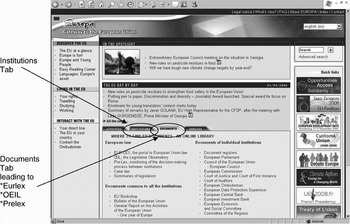
One of the most significant resources available to researchers is the Europa portal website. It provides the means to access all of the websites and documentation produced by the institutions of the European Union. Due to the scale of the Europa website and the volume of documentation available, it can prove difficult to navigate. In addition to various peripheral informational items and background on the European Union, Europa is divided into four main sectors:
• Activities
• Institutions
• Documents
• Services
The two sections of most relevance to researchers are “Institutions” and “Documents”. The “Institutions” section provides portal access to the websites of the key players in the legislation process, including the European Commission, the European Parliament, the Council of the European Union and the Court of Justice. Under the “Documents” section, access is provided to Eurlex the portal for all European Union law and within Eurlex, access is available to OEIL (the Legislative Observatory) and Prelex (which provides monitoring of the decision-making process between the institutions).
Locating Eurlex

There is a search engine which can be used to search across Europa. However, due to the volume of the materials available and the fact that they may be published in all of the 23 official languages of the European Union, this search facility can prove quite meaningless in terms of finding a reasonable and focussed search result. It is usually far better to use individual search engines within each of the component websites.
Due to the number of individual websites, the volume of material available and the permutations resulting from publication in each of the official languages, text searching in Europa is unlikely to provide valid or useful results. The optimum information to have when beginning research is a document reference (e.g. the number of a directive or regulation or a COM document number). If this is not available it can be useful to check the relevant DG website, as it may contain either the document itself or an overview containing a document reference. There is also the option of conducting a text search within the relevant DG website. It may also be possible to locate the item by “burrowing down” through the classification structures available.Footnote 28
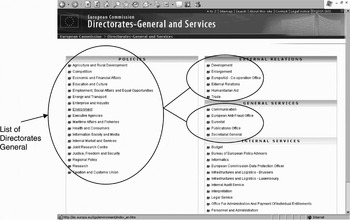
Within the “Institutions” section of Europa access is available to the component parts or departments of the European Commission. Within the European Commission website, access to the list of Directorates-General is available through the “who's who” option on the navigation bar. There are 29 sectors of responsibility mirroring the work of the Directorates-General.Footnote 29
European Commission website – Directorates – General Page

The various Directorates-General websites are important, as it is often here that the most effective access is available to materials produced under their area of responsibility, including proposals for legislation and the texts of various legislative acts for which the Directorate is responsible. The comprehensiveness of the material available tends to vary between each Directorate-General. It is a fair criticism to say that the layout and navigation of most DG websites is not user friendly and it is often difficult to locate the relevant policy area within a particular DG website. This problem is compounded by a tendency to regularly revamp the format and look of individual DG websites.
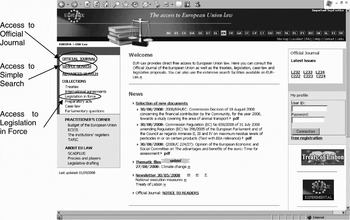
Under the “Documents” section of Europa, access is available to EurlexFootnote 30 the portal to all of the legal documentation of the European Union. Eurlex includes the text of the Treaties in consolidated form and access to the Directory of Community Legislation In Force.Footnote 31
Using Eurlex to search and locate the Official Journal

The “Legislation In Force” section of Eurlex provides access to the various legislative acts (regulations, directives, decisions and other acts). The documents available are referenced by their document number, title and bibliographic reference (i.e. publication details from the Official Journal). Where relevant the document number for any amending acts, together with a hyperlink to the amendment, is given. This section also contains a detailed overview of the structure and presentation details of the documents available.Footnote 32
It is also possible to search in Eurlex using the “Simple Search” or “Search in Legislation” feature. As already indicated, the most effective way of searching for documents within Europa is where the researcher already knows the document number. Nonetheless, it is possible to text search within Eurlex with some reasonable level of success, although the text search facility is relatively basic.
Eurlex also provides access to preparatory acts (i.e. COM documents). Again, it is best to use this facility if the COM document reference has already been obtained, although the text search facility (particularly if limited to searching of the title field) can be used with some likelihood of success.
6. The Official Journal
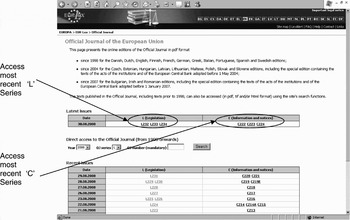
Finally, also contained within Eurlex is the full text of the Official Journal L and C Footnote 33Series for the years 1998 onwards together with a selection of material from earlier years.Footnote 34
Using the Official Journal

The Official Journal (OJ) has been published throughout the existence of the EEC, the EC and the European Union, although prior to 1973, it was published in a limited number of languages, notably French but also on occasions in German and possibly Dutch and Italian. The OJ is published daily and the electronic version (from 1998 onwards) provides easy access to all of its issues and is particularly useful as a primary source of material if the relevant references are known.Footnote 35
The paper edition is also still published and circulated on a subscription basis. It may be possible to source content prior to 1998, and not available in electronic form, from Eurlex on microfile from a European Documentation Centre.Footnote 36
7. Tracking secondary law and legislative procedures
In the normal course, the European Commission will draw up a proposal in the form of a “Green Paper” or a “White Paper.” The Commission proposals are normally published as COM documents. Once allotted a COM reference, the proposal will usually be published:
• In Prelex and OEIL
• On the website of the appropriate Directorate General
• In the Official Journal CEFootnote 37 Series
Proposals will move according to the relevant procedure adopted between the Parliament, the Commission and the Council.Footnote 38 During this time, provided a COM reference is obtained, it is relatively easy to track progress of the legislative proposal between the various institutions and to obtain up to date copies of the material online.
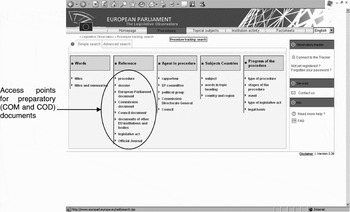
OEIL (the “Legislative Observatory”) provides a tracking mechanism for documentation moving through the European Parliament (Figure 5). It is accessed through the “Documents” section of the Europa website. OEIL is particularly useful for confirming the current status of legislative proposals moving between the European Commission, the Council and the Parliament. Again, it is most useful if the relevant COM document is known to the researcher.
Using OEIL “the Legislative Observatory”

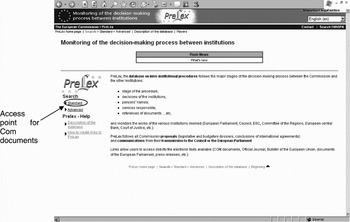
Prelex, which is also accessible through the “Documents” section of Europa, provides a similar checking facility for legislative proposals moving between the European Commission and the other institutions (Figure 6). OEIL and Prelex should be used as complementary services. It is always prudent to check the results between the two, im order to obtain the most up-to-date progress of a proposal and/or copies of the most recent revisions or commentaries.
Using Prelex

When a legislative proposal is adopted (i.e. finalised and approved) by the Council and the European Commission, it will be assigned a reference number and published in the Official Journal L Series. This publication constitutes promulgation and the Official Journal L Series text is the official text of the legislative act.
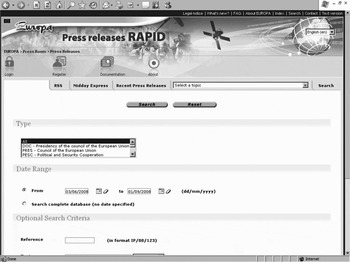
Finally, with regard to Europa it is worth mentioning the Press Centre material which is available and which can provide useful current awareness update on developments. The Press Centre of the European CouncilFootnote 39 is particularly useful for minutes and confirmation of approvals taken at European Council level. Given its key role in the publication of legislative proposals and its role in progressing proposals through the various institutions, the Press Release Database (“Rapid”)Footnote 40 of the European Commission can be a particularly fruitful source of background information (Figure 7). It contains access to all the press releases of the European Commission and also includes the Mid-Day ExpressFootnote 41 service whereby detailed press overviews are published at noon (Brussels time) each day, with press releases and background material on that day's developments within the European Commission. (See further article by Clarke at p. 84 in this issue).
Using Rapid - the Press Release Database

Directives will set out requirements for their transposition into national law of the Member States. Each Member State is required by the date or dates set out in the Directive to have made implementation measures at national level. Where implementation measures are not made in time, or are not adequate or correct, the European Commission is charged with ensuring compliance. Nonetheless after the due implementation date, any rights accruing under the terms of the Directive take effect and a number of well known cases have confirmed that tardiness or delay or inadequate transposition or implementation by a Member State does not deny any rights arising under the Directive.Footnote 42
8. Implementing measures in member states
One of the most common enquiries is to try and identify whether or not a measure has been transposed in a national jurisdiction.
Member States are required to notify the European Commission with details of their implementing measures. Unfortunately, this procedure is not entirely effective and details on implementing measures are not easily available from official sources. Matters have improved in the recent past however. Eurlex now has a search option which allows you to check National Implementing Measures – where these have been notified to the European Commission. Use the “Simple Search” option in Eurlex, then choose “Search by Natural Number”. The screen gives an option to enter a Directive number and check for National Implementing Measures.
A number of commercial “added value” suppliers of European legal information will also include details on implementing measures (although these details have usually been derived from the Eurlex or Celex databases).
Amongst the commercial suppliers of this information are:
• Eurolaw (www.ili.co.uk);
• Justis EU (www.justis.com)
• Better Regulation for specific topic/subject areas (www.betterregulation.co.uk)
9. European Court of Justice
The power to interpret European legislation ultimately rests with the European Court of Justice (ECJ). The ECJ is not an appeal court – it can only answer questions referred to it from the national court on a point of European law. In addition the ECJ has exclusive jurisdiction for some direct actions, most notably actions for the failure of a member to fulfil its obligations – for example by failure to transpose a Directive properly or to transpose it on time. All decisions of the ECJ having binding force across the European Union.
The Court consists of 25 judges drawn from the Member States assisted by eight Advocates General. The Court of First Instance also has 25 judges. The role of the Advocates General is to assist the ECJ by delivering an opinion (in the form of a proposed draft decision) in advance of the final decision of the Court. The opinion of the Advocate General is not binding on the court but may provide some indication of the likely outturn of the Court's decision.
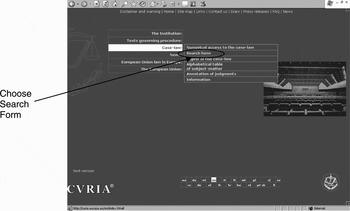
Locating the search form on Curia (Courts of Justice)

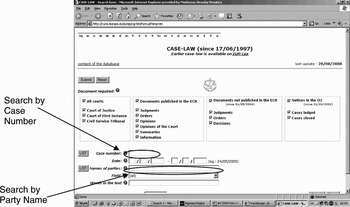
Access to the decisions of the Court of Justice is available on its website.Footnote 43 The search form facility provides a number of ways in which to locate a case, most notably by either the party name of most efficiently by the case number. It should also be noted that decisions of the Court of Justice are also available through BAILII.
Using the search function on Curia (Courts of Justice)

Bear in mind that the original decision of the Court may be in the language appropriate to the parties to the case and that an English language version of a decision may not be available for some time. Initially, for the Court of Justice decision the non-binding opinion of the Advocate General will be published. This will be followed at a later point by the final binding decision of the Court which may or may not follow or concur with the Advocate's opinion.
Appendix
Biography
John Furlong is Director of Legal Resources, Matheson Ormsby Prentice, Dublin. He is a past Chairman of the British and Irish Association of Law Librarians and is currently Chair of its Conference Committee.