


Introduction
People with paranoia and social phobia share a common fear of others. The respective cognitive models suggest that both groups are characterized by expectations of social threat, and beliefs about the self as bad or flawed (see Clark and Wells, Reference Clark, Wells, Heimberg, Liebowitz, Hope and Schneier1995; Freeman, Garety, Kuipers, Fowler and Bebbington, Reference Freeman, Garety, Kuipers, Fowler and Bebbington2002). Paranoia refers to interpersonal fears ranging in cognitive content from social-evaluative concerns through to persecutory delusions in which the person anticipates and attempts to manage fears about physical, social or psychological harm (Freeman and Garety, Reference Freeman and Garety2000; Freeman et al., Reference Freeman, Garety, Bebbington, Smith, Rollinson and Fowler2005). Social phobia is characterized by a fear of negative evaluation, leading to anxiety and avoidance of social situations (Clark and Wells, Reference Clark, Wells, Heimberg, Liebowitz, Hope and Schneier1995). Recent cognitive models of social phobia emphasize the role of problematic views of the self, and fears that the person will do something embarrassing or humiliating, as key maintaining factors (Clark and Wells, Reference Clark, Wells, Heimberg, Liebowitz, Hope and Schneier1995; Hofmann, Reference Hofmann2007; Rapee and Heimberg, Reference Rapee and Heimberg1997).
As cognitive behavioural therapists, we base our interventions on psychological formulation of the development and maintenance of distress and disability. Accurate understanding of the processes maintaining an individual's presenting problems is key to case conceptualization and effective therapeutic work. When working with people with persecutory delusions there is good reason to consider social anxiety processes in the maintenance of distress. The comorbidity literature, the cognitive models and clinical experience all suggest that there is significant overlap between psychosis and social anxiety.
The lifetime prevalence of anxiety disorders is greatly increased for people with psychosis (Cassano, Pini, Saettoni, Rucci and Dell'Osso, Reference Cassano, Pini, Saettoni, Rucci and Dell'Osso1998), and social phobia is a particular risk for those with a diagnosis of schizophrenia (Cossoff and Hafner, Reference Cossoff and Hafner1998; Michail and Birchwood, Reference Michail and Birchwood2009). Social anxiety in childhood has also been identified as a risk marker for schizophrenia spectrum disorders in adult life (Olin and Mednick, Reference Olin and Mednick1996). Despite evidence of an epidemiological relationship, the extent to which these presentations overlap in terms of cognitive and behavioural processes remains a question for debate. The cognitive models indicate some similarities in the content of cognition, as well as in the processes maintaining distress (described below), but the extent to which people with persecutory delusions report the specific cognitions and behaviours that are typically associated with socially phobic individuals has not been clearly established.
The cognitive model of social phobia
The predominant cognitive model of social phobia (Clark and Wells, Reference Clark, Wells, Heimberg, Liebowitz, Hope and Schneier1995) proposes that when a socially phobic individual enters a social situation, a set of assumptions and beliefs are activated that produce anxiety. These include unrealistic standards for social performance, for example “I must be completely fluent all the time”, and catastrophic beliefs about the consequences of failing to meet one's performance standards. People with social phobia often hold beliefs about the self such as “I'm weird”, “I'm odd”, “I don't fit in” and “I'm not like other people”; in other words they have a fundamental belief about being flawed in some way, which is activated in social situations. Once these underlying assumptions and core beliefs have been triggered, a series of processes are initiated that maintain and exacerbate the individual's anxiety. These include streams of automatic thoughts about performance and the self (e.g. Norton and Hope, Reference Norton and Hope2001; Rapee and Lim, Reference Rapee and Lim1992; Stopa and Clark, Reference Stopa and Clark1992), avoidance and safety behaviours that prevent the individual from disconfirming negative expectations, and changes in interpretational (Amir, Foa and Coles, Reference Amir, Foa and Coles1998; Stopa and Clark, Reference Stopa and Clark2000) and attentional processes (Amir, Freshman and Foa, Reference Amir, Freshman and Foa2002; Pishyar, Harris and Menzies, Reference Pishyar, Harris and Menzies2004; Spector, Pecknold and Libman, Reference Spector, Pecknold and Libman2003). According to the model, individuals become highly self-focused in social situations and construct a distorted image of the self that is seen from the perspective of an observer (Hackmann, Surawy and Clark, Reference Hackmann, Surawy and Clark1998; Hackmann, Clark and McManus, Reference Hackmann, Clark and McManus2000). This image maintains the anxiety because the person believes that this is what others actually see. In fact the image, which is based on subjective feelings of anxiety, sensations and memories, is rarely veridical and is likely to contain a number of idiosyncratic but highly relevant distortions, for example, appearing as red as a beetroot or visibly shaking.
Cognitive models of paranoia
Within the cognitive-behavioural literature, three models of paranoia predominate. Bentall and colleagues (Bentall, Kinderman and Kaney, Reference Bentall, Kinderman and Kaney1994; Bentall, Corcoran, Howard, Blackwood and Kinderman, Reference Bentall, Corcoran, Howard, Blackwood and Kinderman2001) argue that paranoia acts as a defence against low self-esteem reaching conscious awareness. The Attribution Self Representation Model (Bentall et al., Reference Bentall, Corcoran, Howard, Blackwood and Kinderman2001) assumes that people vulnerable to paranoia hold latent negative beliefs about the self. In social threat situations, an exaggerated self-serving bias is triggered, and external personal attributions are made (others are blamed for negative events). In this way, negative beliefs about the self, and associated affect, remain outside conscious awareness, and the discrepancy between representations of “actual self” and “ideal self” is minimized. The model assumes that this process serves to maintain overt self-esteem, but leads to appraisals of others as hostile and malevolent. The research base is equivocal, however, with studies of self-esteem yielding inconclusive results to date (see Garety and Freeman, Reference Garety and Freeman1999; MacKinnon, Newman-Taylor and Stopa, Reference MacKinnon, Newman-Taylor and Stopa2010; McKay, Langdon and Coltheart, Reference McKay, Langdon and Coltheart2007; Moritz, Werner and von Collani, Reference Moritz, Werner and von Collani2006).
Trower and Chadwick (Reference Trower and Chadwick1995) also argue that paranoia is a defence against threats to the self. Social threat situations activate negative evaluative beliefs about the self and others, and trigger fears of being harmed. These authors distinguish “persecution paranoia”, in which core beliefs about the self as bad or flawed are held out of awareness (as Bentall describes), and other people's malevolent intentions are seen as unjustified, eliciting angry condemnation, from “punishment paranoia”, in which automatic thoughts directly reflect negative core beliefs and associated guilt, and other people are seen as superior, powerful and threatening, and justifiably punish the person. While these types of paranoia are consistent with clinical experience, the model currently lacks empirical support.
Finally, Freeman, Garety and colleagues focus on persecutory delusions specifically, defining these as involving the beliefs (i) that harm is occurring (or is going to occur) to the person, and (ii) that the persecutor intends to cause harm (Freeman and Garety, Reference Freeman and Garety2000). These authors propose a social-cognitive processing account that emphasizes the central role of anxiety in persecutory delusions, and the impact of high arousal states on the cognitive processes activated in the search for meaning (see Freeman and Garety, Reference Freeman and Garety1999; Freeman and Garety, Reference Freeman and Garety2004; Freeman et al., Reference Freeman, Garety, Kuipers, Fowler and Bebbington2002). The Threat Anticipation Cognitive Model (Freeman et al., Reference Freeman, Garety, Kuipers, Fowler and Bebbington2002) suggests that stressful situations trigger arousal and generate anomalous cognitive experiences in vulnerable individuals, such as thoughts being heard as voices, and actions experienced as unintended. These anomalous experiences may be (i) the direct result of the triggering event (e.g. voice activity), (ii) caused by the level of arousal, or (iii) due to the cognitive biases associated with paranoia, including (a) biases in decision making by “jumping to conclusions” (Bentall, Kaney and Dewey, Reference Bentall, Kaney and Dewey1991; Garety, Hemsley and Wessely, Reference Garety, Hemsley and Wessely1991), (b) the self-serving attributional bias described above, (c) selective attention towards threat related material (Bentall, Kaney and Bowen-Jones, Reference Bentall, Kaney and Bowen-Jones1995; Fear, Sharp and Healy, Reference Fear, Sharp and Healy1996), and (d) difficulties interpreting the intentions of others (Frith, Reference Frith1992). The person then attempts to make sense of these experiences, and it is this meaning (which is in fact a causal attribution) that constitutes the persecutory delusion. The search for meaning is influenced by the person's core beliefs and the state of anxiety itself, the cognitive component of which is the anticipation of danger, thus increasing the likelihood of a persecutory explanation being reached. The cognitive biases and behavioural responses common to the anxiety disorders then maintain the belief through a combination of confirmatory and disconfirmatory processes (following Clark, Reference Clark1999). This model offers an explanation of persecutory delusions without recourse to the notion of unconscious defence on which Bentall's model depends, but does not explain Trower and Chadwick's (Reference Trower and Chadwick1995) punishment paranoia.
Together, the three models suggest that people with paranoia, including people with persecutory delusions, hold core beliefs about the self as bad or flawed (that may or may not reach conscious awareness), and see other people as powerful and threatening. This is supported by a body of research examining self-concept representations in psychosis, indicating an association between paranoia and problematic beliefs about the self, e.g. in terms of acceptability (Rector, Reference Rector2004) and the “need for love and approval” (Moorhead, Samarasekera and Turkington, Reference Moorhead, Samarasekera and Turkington2005), as well as negative beliefs about others (Fowler et al., Reference Fowler, Freeman, Smith, Kuipers, Bebbington and Bashforth2006).
At the level of automatic thought, the person is persecuted or punished, and in the case of persecutory delusions other people are perceived as intending to cause the person harm. Mechanisms common to the anxiety disorders (e.g. anxiety-driven avoidance and other safety behaviours, selective attention and interpretational biases) maintain the paranoia by confirming or preventing disconfirmation of threat beliefs (e.g. Freeman, Garety and Kuipers, Reference Freeman, Garety and Kuipers2001).
Cognition and behaviour in the maintenance of paranoia and social phobia
The current psychological literature agrees that paranoia lies on a continuum from normal social concerns through to persecutory delusions of intended harm to the person (e.g. Johns and van Os, Reference Johns and van Os2001). This is clearly and helpfully articulated in the hierarchy of paranoia developed by Freeman and colleagues, who propose five levels of threat associated with increasing distress and disability: (i) social evaluative concerns (e.g. fears of rejection); (ii) ideas of reference (e.g. people talking about you); and (iii) mild (e.g. people trying to irritate you); (iv) moderate (e.g. people going out of their way to get at you); and (v) severe threat beliefs (e.g. people trying to cause you significant harm) (Freeman et al., Reference Freeman, Garety, Bebbington, Smith, Rollinson and Fowler2005). Within this continuum, persecutory beliefs build on common social evaluative beliefs and ideas of reference, typical of the fears held by people with social phobia. It would be expected, therefore, that people with persecutory delusions would report automatic thoughts commonly associated with social phobia, but not vice versa.
The cognitive models predict core beliefs about the self as bad or flawed in both social phobia and persecutory delusions (Clark and Wells, Reference Clark, Wells, Heimberg, Liebowitz, Hope and Schneier1995; Freeman et al., Reference Freeman, Garety, Kuipers, Fowler and Bebbington2002). As well as the content of cognition, current cognitive models of social phobia (Clark and Wells, Reference Clark, Wells, Heimberg, Liebowitz, Hope and Schneier1995; Rapee and Heimberg, Reference Rapee and Heimberg1997) highlight the role of self-focused attention in the maintenance of anxiety, and point specifically to the construction of an observer perspective where the individual sees him or herself from an external or third-person perspective. There is no such suggestion in the models of paranoia or persecutory delusions.
Metacognition is not specifically named in the Clark and Wells’ (Reference Clark, Wells, Heimberg, Liebowitz, Hope and Schneier1995) model of social phobia, but there is increasing recognition of the importance of being able to stand back or “decentre” from internal experience, which is thought to be problematic for people with clinical problems (see Teasdale et al., Reference Teasdale, Moore, Hayhurst, Pope, Williams and Segal2002; Wells, Reference Wells2000). It would be expected then, that all three clinical groups would be less able to decentre from distressing experience than those in the non-clinical control group.
Finally, the literature supports the idea that behavioural processes associated with the maintenance of anxiety disorders, such as avoidance and other safety seeking behaviours, also operates in people with persecutory delusions (Freeman et al., Reference Freeman, Garety and Kuipers2001).
Aims
This research examined cognition and behaviour typically associated with social phobia, in people with persecutory delusions. Automatic thought level cognition, underlying assumptions, core beliefs, particular cognitive processes and aspects of metacognition, and behaviour, were compared in people with persecutory delusions (without social phobia) and social phobia, which were in turn compared to a clinical (panic disorder) and a non-clinical control group. We wanted to explore the extent to which cognition and behaviour associated with social phobia are also experienced by people with persecutory delusions. Biases in decision making, attention and attribution were not the focus of this study, and are well documented elsewhere (see Bogels and Mansell, Reference Bogels and Mansell2004; Garety and Freeman, Reference Garety and Freeman1999; Taylor and Wald, Reference Taylor and Wald2003).
Hypotheses
The following hypotheses and exploratory questions were investigated:
Content specificity in automatic thought
1. Participants with social phobia and persecutory delusions will score higher on the Social Cognitions Questionnaire (frequency and belief subscales) than people in the panic and the non-clinical control groups.
2. Participants with persecutory delusions will score higher on the Paranoia Scale than people in the social phobia, panic and the non-clinical control groups.
Content specificity in underlying assumptions
1. Participants with social phobia will score higher on the Social Attitude Questionnaire-Revised than people in the panic and non-clinical control groups.
2. How will participants with persecutory delusions score on the Social Attitude Questionnaire-Revised compared with people in the social phobia, panic and non-clinical control groups?
Content specificity in core beliefs
1. Participants with social phobia and persecutory delusions will score higher on the Evaluative Beliefs Scale than people in the clinical and non-clinical control groups.
Differences in attention, process and metacognition
1. Participants with social phobia will report higher levels of self-consciousness and self-focused attention, and will be more likely to recall distressing events from the observer perspective than people in the persecutory delusions, panic and the non-clinical control groups.
2. Participants with social phobia, persecutory delusions and panic will be less likely to adopt a metacognitive stance following incidents of distress compared with the non-clinical control group.
Differences in behaviour
1. Participants with social phobia and persecutory delusions will score higher on the Social Behaviour Scale than people in the panic and non-clinical control groups.
Method
Design
We used a cross-sectional between-subjects design to compare participants with paranoid delusions and social phobia. A clinical control group with panic disorder was selected because the cognitive model of panic (Clark, Reference Clark, Rachman and Maser1988) indicates that the problem is characterized by the misinterpretation of bodily sensations rather than any interpersonal threat beliefs. A non-clinical control group was drawn from an opportunity sample. We referred to the literature to determine sample sizes, and found that other work examining cognition in clinical groups had used samples of 12 people in each group (e.g. Stopa and Clark, Reference Stopa and Clark1992). We aimed to recruit 12 people to each group in this study.
Participants
Ten to 15 people were recruited to each of the four groups, with an initial total of 51 participants. The Structured Clinical Interview for DSM-IV-TR Axis I disorders (First, Spitzer, Gibbon and Williams, Reference First, Spitzer, Gibbon and Williams2001) was used to confirm the DSM-IV diagnostic criteria. Thirteen people met criteria for social phobia; 13 met criteria for schizophrenia (but not social phobia), all with persecutory delusions; 10 met diagnostic criteria for panic disorder; 12 were recruited into the non-clinical control group. One person in the social phobia group was excluded after declining to complete part of the SCID, and two people recruited for the persecutory delusions group did not in fact meet criteria for schizophrenia and so had to be excluded. This left a total of 48 participants with mean ages of 39.38 years (paranoia), 35.69 years (social phobia), 40.80 years (anxious control) and 35.92 years (non-clinical control). The majority of participants were female in all but the paranoia group (38% female/62% male in the paranoia group, 77% female/23% male in the social phobia group, 70% female/30% male in the anxious controls, and 58% female/42% male in the non-clinical controls). There were no significant differences in age (F (3,44) = .39, p = .76) or in gender (χ (3, 48) = 4.51, p = .21) between the four groups.Footnote 1
Measures
Social Cognitions Questionnaire (SCQ; Wells, Stopa and Clark, Reference Wells, Stopa and Clark1993). The SCQ measures negative automatic thoughts about social situations. The scale consists of 22 self-report items. Respondents rate frequency and belief conviction associated with each thought. Frequency is rated on a 5-point scale from 1 (never occurs) to 5 (always occurs). Belief is rated on a scale from 0 (I do not believe this thought) to 100 (I am completely convinced this thought is true). The scale has good internal consistency for three factors: negative self-beliefs (α = 0.72); fear of performance failure (α = 0.84); and fear of negative evaluation (α = 0.81); and good test–retest reliability over 4–6 weeks (r = 0.79, p < .001).
Paranoia Scale (PS; Fenigstein and Vanable, Reference Fenigstein and Vanable1992). The PS measures paranoid ideation and was designed to be sensitive to non-clinical levels of paranoia. The scale consists of 20 items rated on a 5-point scale from 1 (not at all applicable to me) to 5 (extremely applicable to me). The scale was has good test-retest reliability and internal consistency (α = 0.84).
Social Attitudes Questionnaire, Revised (SAQ-R; Clark, Reference Clark2001). The SAQ-R is a 50-item self-report measure of dysfunctional assumptions relevant to social situations. Respondents rate items on a 7-point scale from 1 (totally agree) to 7 (totally disagree). The scale has excellent internal consistency for both the full scale and without the reverse scored items (α = 0.95: D.M. Clark, personal communication, 10 January Reference Clark, Wells, Heimberg, Liebowitz, Hope and Schneier2005).
Evaluative Beliefs Scale (EBS; Chadwick, Trower and Dagnan, Reference Chadwick, Trower and Dagnan1999). The EBS was designed to measure underlying beliefs about the self and others, specifically person evaluations. It consists of 18 items and produces three subscales: self-self; other-self; and self-other. Respondents rate items on a 5-point scale from 3 (agree strongly) to 0 (disagree slightly) and 0 (disagree strongly). Good levels of internal reliability were found for all subscales (self-self r = 0.90; other-self r = 0.92 and self-other r = 0.86) and the scale was also found to discriminate well between people with depression and anxiety.
Self-Consciousness Scale Revised (SCS-R; Scheier and Carver, Reference Scheier and Carver1985). The SCS-R is a self-report measure of public and private self consciousness. The 20 items yield three subscales: public self-consciousness, private self-consciousness and social anxiety. Items are rated on a 5-point scale ranging from 0 (extremely uncharacteristic of me) to 4 (extremely characteristic of me). The scale has good levels of internal consistency (private: α = 0.75; public: α = 0.84; social anxiety: α = 0.79) also good test retest reliability (private: r = 0.76; public: r = 0.74; social anxiety: r = 0.77).
Cognitive Profiling Interview – Revised (CPI-R; adapted from Wells, Reference Wells2000). This semi-structured interview was adapted from the Cognitive Profiling Interview for the purpose of the present study. The CPI was developed to assess processing routines and metacognition associated with distress. The interview asks people to recall a recent and typical incident associated with distress. The person is then prompted to describe the appraisals, attentional processes and beliefs about the thoughts and feelings experienced in the situation. As an interview, there is no reliability of validity data for the original measure. Some adaptations were made to the wording of items for the purpose of the present study, and 7-point rating scales with variable anchors were added to assess degree of belief or other aspects of experience. The adapted measure is available on request.
Social Behaviour Scale (SBS; Stopa, Reference Stopa1995). The SBS is an adapted version of the Social Avoidance and Safety Behaviours Questionnaire (Stopa, Reference Stopa1995). Participants rate 28 safety behaviours on a 4-point scale (always, often, sometimes, never) according to how often they use each behaviour in social situations where they feel anxious or anticipate being anxious.
Social Interaction Anxiety Scale (SIAS; Mattick and Clarke, Reference Mattick and Clarke1998) and Social Phobia Scale (SPS; Mattick and Clarke, Reference Mattick and Clarke1998). The SIAS and SPS are both 20-item self-report measures designed to assess behaviours and fears about social situations. Items are rated on a 5-point scale from 0 (not at all characteristic of me) to 4 (extremely characteristic or true of me). Both the SIAS and the SPS have good internal consistency (SAIS α = 0.94; SPS α = 0.94) and test-retest reliability over both 4 weeks and 12 weeks (SAIS r = 0.92; SPS r = 0.93). The scales also discriminated between people with social phobia and non-patient controls. The SIAS and SPS were used to give an overall indication of interaction anxiety and phobic avoidance related to social situations, in the four groups.
Hospital Anxiety and Depression Scale (HADS; Zigmond and Snaith, Reference Zigmond and Snaith1983). The HADS is a 14-item self-report measure of anxiety and depression. Items are rated on a 4-point scale of variable anchors from 0 (e.g. most of the time) to 3 (e.g. not at all). The scale has good internal consistency (anxiety: α = 0.80; depression α = 0.76) and principal components analysis yielded a two-factor structure accounting for 57% of variance (Mykletun, Stordal and Dahl, Reference Mykletun, Stordal and Dahl2001). The HADS was used to compare levels of anxiety and depression in the four groups.
Procedure
Participants in the two experimental groups were recruited through their Consultant Psychiatrists on the basis of current diagnosis and anticipated willingness to take part in the study. These people were then contacted directly, given verbal information about the study and asked if they would like to participate. The clinical control group was recruited through a local newspaper advert, and the non-clinical control group was drawn from an opportunity sample. All participants were invited to university or hospital settings to complete the assessments. At this session participants were given written information about the study and asked to sign a consent form if willing to take part. The SCID overview (for patients/non-patients) and SCID modules (psychosis screen/modules B and C, mood episodes and anxiety disorders) were then completed to confirm diagnosis, presence of persecutory delusions, and group allocation. Participants completed the nine questionnaires and semi-structured interview for the present study, and a computer task for a separate study. Participants were then given the opportunity to ask any questions.
Results
Statistical analysis
The groups were compared using analyses of variance. Where comparisons between the groups involved multiple tests, we applied a Bonferroni corrected p value in order to judge whether the result was significant. We also calculated effect sizes in order to estimate the size of the effect where we obtained significant results.
Overview of mood and social distress
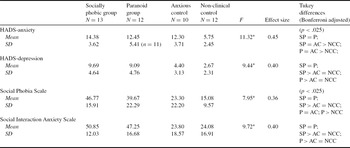
Table 1 shows mood and social distress measures for the four groups. The persecutory delusions, social phobia, and anxious control groups reported more anxiety than the non-clinical control group (HADS-anxiety). The paranoia and socially phobic groups reported more depression (HADS-depression) than the anxious and non-clinical control groups. These results indicate that, in this sample at least, individuals with persecutory delusions and social phobia experience similar levels of anxiety and depression. The results of the HADS-anxiety subscale confirm that the anxious control group was experiencing general symptoms of anxiety at the same level as the two target clinical groups. The persecutory delusions and social phobia groups did not differ on measures of phobic avoidance or interaction anxiety. The social phobia group scored higher than both controls on these measures. The persecutory delusions group scored higher than the non-clinical controls on the measure of phobic avoidance, and higher than both control groups on the social interaction scale.
Anxiety and depression

*p < .001.
Surprisingly, we did not find a difference between the two target groups on our measure of paranoid thinking (the PS), where both groups scored higher than the two control groups. The PS does contain items that directly reflect social anxiety (e.g. “I have often felt that strangers were looking at me critically”) so it may be that this absence of a difference between the paranoia and the social phobia groups simply reflects the fact that there is a generally high correlation between measures of social anxiety such as the SIAS and the PS. Although this was true for the whole sample (r (47) = 0.7, p < .001) the picture was rather different for correlations between SIAS and PS within each group. There was no correlation within either the non-patient (r (47) = 0.09, p = .79) or the anxious control group (r (47) = 0.36, p = .31). However, there was a significant correlation between the two measures in both the socially phobic group (r (47) = 0.77, p < .001) and the persecutory delusions group (r (47) = 0.6, p < .001).
Automatic thoughts, underlying assumptions and schema
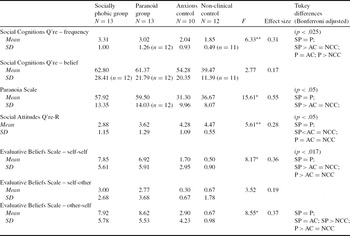
Measures of automatic thoughts, underlying assumptions and schema across the groups are given in Table 2. The persecutory delusions and social phobia groups did not differ on the frequency with which they experienced socially anxious cognitions, or in their belief in these cognitions. This is perhaps not surprising considering that the two groups reported the same level of social anxiety on the SPS. The social phobia group reported more frequent socially anxious cognitions than the anxious control group, who did not differ from non-clinical controls. The persecutory delusions group only differed from the non-clinical control group.
Automatic thoughts and underlying cognition

*p <.001, **p < .005.
Table 2 also gives scores for the measures of underlying cognition. On the measure of underlying assumptions (SAQ-R), the persecutory delusions and socially phobic groups did not differ from one another. The socially phobic group scored lower (indicating more problematic assumptions) than the two control groups, who did not differ from each other. The persecutory delusions group did not differ from the two control groups.
On the EBS, the persecutory delusions and socially phobic groups did not differ from each other on any of the subscales. On the “self-self” subscale, the two target groups scored higher than both control groups who did not differ from each other. On the “self-other” sub-scale there were no differences between any of the four groups, and on the “other-self” sub-scale the social phobia group scored higher than non-clinical controls, but did not differ from anxious controls. The persecutory delusions group scored higher than both control groups.
Overall, these measures of cognition suggest that people with persecutory delusions may have similar overt concerns to those reported by people with social phobia, and may hold comparable underlying assumptions and core beliefs.
Process and metacognition
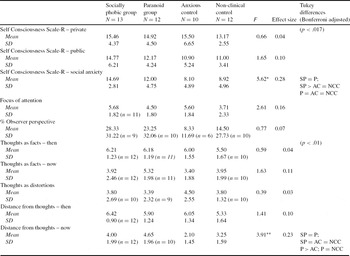
The two tests of process and metacognition that reached or approached significance were comparisons on the social anxiety sub-scale of the Self-Consciousness Scale (SCS-R) and the ability to distance oneself from distressing thoughts in retrospect (on the Cognitive Profile Interview, CPI).
Consistent with the findings on the SPS, the social phobia and persecutory delusions groups did not differ on the social anxiety subscale of the SCS-R. The pattern of differences was similar to the SPS, although on the SCS-R-social anxiety scale the persecutory delusions group did not differ from the non-clinical controls (see Table 3 for details).
Process and metacognition

*p < .005, **p <.05.
The adapted Cognitive Profile Interview (CPI) measured the degree to which participants perceive their thoughts while in an anxious situation as factually based or as distortions, and asked them to distinguish between appraisals while in the situation, and appraisals looking back at the situation. It is of note that there was more missing data for this measure that others. This was because a number of people across the groups were not able to identify or recall these particular processes during interview. The only difference that emerged was a trend towards people in the persecutory delusions group being less able to distance themselves from their distressing thoughts in the present, compared with the anxious controls.
Behaviour
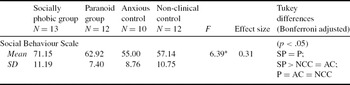
As expected, there were comparable results for the persecutory delusions and social phobia groups on the Social Behaviour Scale (SBS). The social phobia group scored higher on this measure than the two control groups. There were no differences between the persecutory delusions group and the controls (see Table 4).
Behaviour

*p < .005.
Discussion
This pilot study was designed to examine cognition and behaviour typically associated with social phobia, in people with persecutory delusions. As predicted, measures of cognition and behaviour distinguished the persecutory delusions and social phobia groups from one or both control groups. Perhaps surprisingly, however, measures of automatic thought and underlying assumptions yielded no systematic differences between people with persecutory delusions and social phobia. Interestingly, there was a trend towards people with persecutory delusions being less likely to be able to distance themselves from their thoughts after distressing events compared with the clinical control group. In summary, on measures of automatic thought, underlying assumptions, core beliefs, process and behavior, we found no systematic differences between people with persecutory delusions and social phobia.
The aim of the study was to explore social anxiety processes in paranoia, and persecutory delusions specifically. The results indicate: (i) that larger scale research is now warranted in order to draw firm conclusions about social anxiety processes in paranoia; (ii) more specific hypotheses need to be tested; and (iii) a clinical model of paranoia, based on the cognitive model of social phobia, which might now be validated.
Research implications
The findings require replication. The hypotheses addressing content specificity in automatic thoughts, underlying assumptions and core beliefs will remain. However, those examining differences in attention, process and metacognition require further development. Self-consciousness, self-focused attention and observer perspective should be examined separately, and the relationship between these processes clarified. Similarly, metacognitive awareness should be assessed more thoroughly, and links to attentional processes anticipated and tested. The very nature of metacognitive or decentred awareness presents challenges for the researcher, and direct measurement of the process remains elusive. The work of Teasdale, Moore, Williams and colleagues (Teasdale et al., Reference Teasdale, Moore, Hayhurst, Pope, Williams and Segal2002) relies on a complex and time consuming approach to assessment, and although Wells’ (Reference Wells2000) interview (and our adapted version) includes clinically valuable questions about the ability to “step back” from distressing experience, it may be that there are no short cuts to accurate assessment of implicational level experience such as decentred awareness. It may also be that other methodologies would be effective in assessing differences in metacognition between groups. Given the relative novelty of this area of research, qualitative studies may prove more useful in exploring such differences in the first instance (see Stopa, Denton, Wingfield and Newman Taylor, in press).
Theoretical implications
People with persecutory delusions and social phobia share a common fear of others characterized by expectations of social threat, and beliefs about the self as bad or flawed (Clark and Wells, Reference Clark, Wells, Heimberg, Liebowitz, Hope and Schneier1995; Freeman, Reference Freeman2006). Our measures were selected to begin to explore components of social anxiety, and therefore to assess a particular subset of possible thoughts and behaviours in people with persecutory delusions. The finding that none of our measures distinguished the two target groups is consistent with the hierarchy of paranoia proposed by Freeman and colleagues (Freeman et al., Reference Freeman, Garety, Bebbington, Smith, Rollinson and Fowler2005) in which paranoid threat beliefs build on more common social evaluative concerns. Furthermore, the results of the present study indicate that people with persecutory delusions may experience a range of thoughts, beliefs and behaviours that are characteristic of social phobia. This adds to the growing body of literature supporting a continuum model of psychosis (e.g. Combs and Penn, Reference Combs and Penn2004; Freeman et al., Reference Freeman, Garety, Bebbington, Smith, Rollinson and Fowler2005; Johns et al., Reference Johns, Cannon, Singleton, Murray, Farrell and Brugha2004, Johns and van Os, Reference Johns and van Os2001) and indicates that, on the one hand, common psychological processes contribute to the maintenance of distress in psychosis and, on the other, psychotic experiences are distinct from anxiety disorders in particular ways.
The failure to find a difference between people with social phobia and persecutory delusions on the measure of paranoia (the PS) also suggests that individuals with social phobia may move up this continuum from social-evaluative to more paranoid thinking, perhaps when most anxious, and this shift could add significantly to their distress. Indeed, for many people seen in clinical settings, the presenting problem can certainly be recognized in terms of thought content, but there are some people with psychotic diagnoses whose thought content – being the target of bullying, humiliation or ridicule – seems much more akin to the concerns typically expressed by people with social phobia. Similarly, some individuals with social phobia describe thoughts with a decidedly paranoid flavour, for example believing that others are targeting and taunting them, particularly when they are experiencing very high levels of anxiety.
An experimental study by Freeman and colleagues (Freeman et al., Reference Freeman, Gittins, Pugh, Antley, Slater and Dunn2008) is relevant here. In an examination of the factors distinguishing social anxiety and paranoid thoughts in a non-clinical group broadly representative of the UK general population, the presence of perceptual anomalies distinguished risk of paranoid reactions from risk of social anxiety. Consistent with the results of the present study, measures of mood and cognition were similar for people with paranoia and social anxiety. A measure of anomalous experience (such as the CAPS; Bell, Halligan and Ellis, Reference Bell, Halligan and Ellis2006) would be valuable in a larger scale replication of the present study.
Clinical implications
If people with persecutory delusions experience a range of thoughts and engage in behaviours typical of social phobia, it may be that we can draw on the clinical work developed and well evidenced for people with social anxiety (e.g. Clark et al., Reference Clark, Ehlers, Hackmann, McManus, Fennell and Grey2006) to improve interventions for people with paranoia. Psychological formulation forms the basis of cognitive behavioural interventions, and so accurate understanding these processes is essential to effective therapeutic work. Given the present findings, it may be useful to draw on the cognitive model of social phobia (Clark and Wells, Reference Clark, Wells, Heimberg, Liebowitz, Hope and Schneier1995) to conceptualize the maintenance of persecutory delusions. The model presented in Figure 1 draws on current cognitive theories of paranoia (Bentall et al., Reference Bentall, Corcoran, Howard, Blackwood and Kinderman2001; Freeman et al., Reference Freeman, Garety, Bebbington, Smith, Rollinson and Fowler2005, Reference Freeman, Gittins, Pugh, Antley, Slater and Dunn2008; Morrison, Reference Morrison2001; Trower and Chadwick, Reference Trower and Chadwick1995) and structures these within the model of social phobia. We suggest that this is a clinically accessible and therapeutically useful heuristic for patients and clinicians.
A cognitive model of the maintenance of paranoia

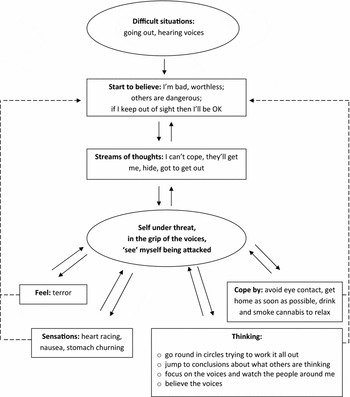
This model places the “processing of the self as an object of interpersonal threat” as a central and driving component of the maintenance of paranoia. This is intended to represent the “felt sense” of paranoia: how the person experiences him or herself in relation to others. This is likely to be characterized by an implicational level experience of what Freeman and colleagues describe as “interpersonal sensitivity” (Freeman and Garety, Reference Freeman and Garety2004, following Derogatis, Reference Derogatis1994): the felt sense of being a “soft target”, centring on perceptions of personal inadequacy, inferiority, particularly in comparison with others, and heightened self-consciousness.
In line with the model of social phobia, early experiences and memories relevant to the impression of self in relation to others are included. This is consistent with the growing evidence of traumatic or stressful events in the early lives of people who develop psychosis.Footnote 2
Following current cognitive theory, “processing of the self as an object of interpersonal threat” represents the metacognitive process in which thoughts, images and other internal events are experienced as necessarily accurate reflections of the self or reality, in contrast to a decentred awareness of internal experience as transient events of the mind (following Teasdale et al., Reference Teasdale, Moore, Hayhurst, Pope, Williams and Segal2002). This mode of processing is associated with affective, cognitive, bodily and behavioural changes. In particular, it is likely to influence attentional focus and initiate “strategic cognition”, the internal strategies that influence the allocation of resources to manage distress, such as rumination, worry, and experiential avoidance (see Newman Taylor, Graves and Stopa, Reference Newman Taylor, Graves and Stopa2009). This processing of the self may be represented verbally or imaginally, though it is interesting that the examination of imaginal experience is largely neglected in the area of psychosis, with notable exceptions (e.g. Morrison et al., Reference Morrison, Beck, Glentworth, Dunn, Reid and Larkin2002). Feedback loops are marked with dotted lines to indicate that these may be direct or indirect processes, and should be subject to further investigation.
The model is consistent with (but not proven by) the current findings. We found comparable thoughts, assumptions, core beliefs and behaviours in people with social phobia and persecutory beliefs, and these aspects of the social phobia model are replicated. Certain cognitive processes did not distinguish the two target groups, but also failed to distinguish these from the control groups quite as expected, and require further investigation. These processes are named in the model to prompt individual assessment and intervention as appropriate. “Processing of the self as an object of interpersonal threat”, as well as the relationships between components of the model, clearly require further investigation.
An example may help to illustrate the model (see Figure 2). Denise, a woman in her early thirties, was referred to the first author, struggling with persecutory delusions and malevolent voices. Whenever she left her home or thought about going out, core beliefs about herself (“I'm bad, worthless”) and others (“others are dangerous”) were activated, along with a long-held assumption that if she kept “out of sight” then she would be safe. These beliefs were also activated when she heard voices, inferred to be those of her neighbours through the walls. Once activated, these beliefs elicited streams of automatic paranoid thoughts, which in turn rapidly developed into a powerful sense of being under threat or in the grip of the voices. Denise also saw an image (in her “mind's eye” rather than a hallucinatory experience) of herself cowering under attack. This felt sense of her own vulnerability and the powerful threat of others filled Denise with terror. She would actively worry (in an attempt to make sense of her experience and its meaning), focus on the voices, and remain hypervigilant of the people around her. She jumped to conclusions about others’ thoughts and intentions, and reported high levels of belief conviction in the meaning ascribed to the voices, despite being skilled in re-evaluating these thoughts when she was at home and feeling safe or indeed in therapy sessions. Behaviourally, Denise avoided leaving the house as much as possible. When she did go out, she went to the local shops via a well known route, avoided eye contact with other people, and returned home as swiftly as possible. Once home she often relied on alcohol and cannabis to relax. While entirely understandable, each of these components of her experience served to maintain her overwhelming sense of threat and vulnerability, as well as her core beliefs and assumptions, either directly or through the absence of disconfirmatory experience. By formulating Denise's experience in this way, the focus for therapeutic work is clearly mapped out. In addition to content of cognition and behavioural change, this formulation would indicate that intervention might usefully focus on developing a decentred awareness of internal experience, as well as the cognitive processes of strategic cognition, decision making biases and attentional focus.
Illustrative example

Limitations
It is important to note that the study is limited by our choice of measures, not all of which have been validated for each of the clinical groups participating. There is also a question of the validity of the instruments across the two target populations, and whether similar scores necessarily indicate comparable psychological processes. For example, while people with paranoia and social anxiety may both endorse items such as “I get nervous that people are staring at me as I walk down the street”, we cannot assume that the processes underlying their social discomfort are the same. It will be necessary to run validity tests within each group to show that the cognitive, behavioural and symptom measures generally inter-relate in the same way in each of the clinical groups assessed.Footnote 3 We also relied on an unvalidated measure of attention; further studies should use established measures of attention, particularly given their availability and the central role of attention in cognitive models of social phobia.
Conclusion
People with persecutory delusions may experience overt and underlying cognition typically associated with social phobia, and behave in similar ways in response to perceived social threat. The proposed clinical model is offered as a clinical heuristic to emphasize processes common to the anxiety disorders, in particular social anxiety, in formulating persecutory delusions. Implicational level experience and cognitive processes (e.g. strategic cognition) are represented as well as the more familiar focus on affect, content of cognition and behaviour. Further work will determine whether the constructs and relationships are robust, and whether the model is useful clinically.




Comments
No Comments have been published for this article.