I. INTRODUCTION
Metal matrix composites (MMCs) have a great potential to be used in transport applications due to their improved and tunable properties. Reference Chaubey, Scudino, Mukhopadhyay, Samadi Khoshkhoo, Mishra and Eckert1–Reference Tang, Han, Hagiwara and Schoenung5 The properties of metallic matrices can be significantly improved by introducing hard reinforcing particles. Reference Chaubey, Scudino, Mukhopadhyay, Samadi Khoshkhoo, Mishra and Eckert1–Reference Basariya, Srivastava and Mukhopadhyay9 A typical example is given by the Al-based composites, whose hardness, strength, and Young's modulus can be effectively enhanced by the addition of small amounts of nanocrystalline ceramic/intermetallic particles. Reference Kang and Chan3–Reference Basariya, Srivastava and Mukhopadhyay9 The improvement of the properties is attributed to the dislocation strengthening, grain size reduction, and increase of load bearing efficiency of the matrix. Reference Chaubey, Scudino, Mukhopadhyay, Samadi Khoshkhoo, Mishra and Eckert1–Reference Hsu, Chang, Kao, Ho and Chang4
Different types of reinforcement materials, ranging from the typical ceramic, such as Al2O3, AlN, and SiC, Reference Liua, Conga, Wanga, Sun and Cheng10–Reference Kanga and Lap-Ip Chan12 to more unconventional reinforcements, such as quasicrystals Reference Schurack, Eckert and Schultz13,Reference EI Kabir, Joulain, Gauthier, Dubois, Bonneville and Bertheau14 and complex metallic alloys, Reference Scudino, Liu, Sakaliyska, Surreddi and Eckert2 have been successfully used as reinforcements in MMCs. Other possible candidates as reinforcing agents in MMCs are amorphous, partially amorphous, and nanocrystalline Al-based alloys, which have attracted widespread attention as potential candidates for structural as well as functional applications due to their high strength combined with low density. Reference Inoue15,Reference Inoue and Kimura16
During the past years, several methods have been used for the production of MMCs. Among these, powder metallurgy (PM) through solid-state sintering is found to be one of the most versatile methods, providing a number of advantages for the synthesis of composites over other processing routes. Reference Chaira, Sangal and Mishra17,Reference Prashanth, Kumar, Scudino, Murty and Eckert18 For example, PM shows excellent control over the microstructure, including size, morphology and volume fraction of matrix and reinforcement. Reference Chaubey, Scudino, Mukhopadhyay, Samadi Khoshkhoo, Mishra and Eckert1,Reference Scudino, Liu, Sakaliyska, Surreddi and Eckert2,Reference Moazami-Goudarzi and Akhlaghi19 In addition, powder sintering by hot consolidation process breaks the typical oxide layers that coat the powder particles, and hence gives improved bonding between the particles. Reference Chaubey, Scudino, Mukhopadhyay, Samadi Khoshkhoo, Mishra and Eckert1,Reference Scudino, Liu, Sakaliyska, Surreddi and Eckert2 In particulate composites, the reinforcement particles are added to strengthen the metal matrix. The mechanical properties of the MMCs strongly depend on the properties of the matrix and reinforcement, their distribution, volume fraction, and size as well as on the interfacial strength between the matrix and reinforcement. Reference Moazami-Goudarzi and Akhlaghi19
The superior properties of a MMC synthesized by using nanosize reinforcement have attracted considerable attention. Reference Gleiter20 However, the synthesis of nanomaterial and retaining its size is a big change for the material scientists. Among the different processing routes for the production of nanomaterials, cryomilling is one of the effective methods. The cryomilling is a mechanical attrition technique in which the powders are milled in the cryogenic liquid or by chilling a milling vessel from outside without contact with the milling media. During milling, the deformation of the powder particles occurs at cryogenic temperatures. Reference Witkin and Lavernia21 There are several advantages of cryomilling over room temperature milling: (i) suppression of powder agglomeration and welding, (ii) reduction of oxidation reaction, and (iii) significant reduction of milling time to attain a nanostructure. One of the challenging tasks in the fabrication of the composites is to disperse the reinforcing particles homogeneously since small powder particles are very active and prone to agglomerate to reduce their overall surface energy. Reference Schurack, Eckert and Schultz13 However, the uniform dispersion of the reinforcement in the matrix can be achieved by ball milling of the powder mixtures. Reference Chaubey, Scudino, Mukhopadhyay, Samadi Khoshkhoo, Mishra and Eckert1,Reference Liua, Cong, Wang, Sun and Cheng22–Reference Lu, Lai and Zhang26
In this work, MMCs consisting of pure Al reinforced with different volume fractions of mechanically alloyed Mg–7.4%Al particles have been produced by PM, and their mechanical properties have been investigated under compressive loading. The Mg–Al reinforcement was selected because of its attractive properties, including low density (∼1.79 g/cm3), high room temperature strength (∼700 MPa), and high hardness (170 HV). Reference Chaubey, Scudino, Samadi Khoshkhoo, Prashanth, Mukhopadhyay, Mishra and Eckert27
II. EXPERIMENTAL
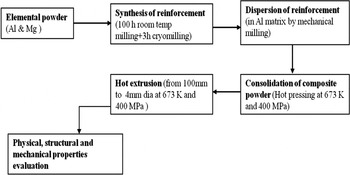
Mg–7.4%Al (wt%) powder was produced by mechanical alloying of elemental Mg and Al powders in a planetary ball mill for 100 h at room temperature followed by 3 h cryomilling using a Retsch PM400 planetary ball mill (Haan, Germany) with hardened steel balls and vials. Cryomilling was carried out in a sequence of cooling–milling steps. For this, the vial was first cooled down to cryogenic temperatures by immersing it in a liquid nitrogen bath for 30 min and then milling was performed for 15 min. To minimize possible atmosphere contamination during milling, vial charging and any subsequent sample handling were carried out in a glove box under purified argon atmosphere (less than 1 ppm O2 and H2O). The milled powder contains Mg(Al)ss and small amount of the equilibrium γ-Al12Mg17 phase. The detailed production and characterization of the Mg–7.4%Al powder has been reported elsewhere. Reference Chaubey, Scudino, Samadi Khoshkhoo, Prashanth, Mukhopadhyay, Mishra and Eckert27 To produce Al-based MMCs, the pure Al powder was mechanically mixed by ball milling with 10, 20, 30, and 40 vol% Mg–7.4%Al particles in same Retsch PM400 planetary ball mill. The composite powders were consolidated by hot pressing followed by hot extrusion at 673 K and 400 MPa. Structural characterization was performed by x-ray diffraction (XRD) using a Philips PW 1050 diffractometer (FEI Company, Almelo, The Netherlands, Co Kα radiation; λ = 0.17889 nm) and by scanning electron microscopy (SEM) using a Gemini 1530 microscope (Göttingen, Germany). The density of the bulk samples was measured using Archimedes principle. Cylinders having a length/diameter ratio of 2.0 (6 mm length and 3 mm diameter) were prepared from the hot consolidated samples in accordance with the ASTM standard for compression testing. 28 The strain during the compression tests was measured directly on the specimen using a Fiedler laser-extensometer (Lützen, Germany). The specimens were tested at room temperature using universal testing machine (Instron 8562, Darmstadt, Germany) under quasi-static compressive loading (strain rate ∼ 1 × 10⁻⁴ s−1). The whole experimental procedure is also described in proper sequence and shown by the flow diagram in the Fig. 1.
Process flow diagram, showing detail procedure used for synthesis and characterization of the composites.

III. RESULTS
A. Structural and microstructural analysis
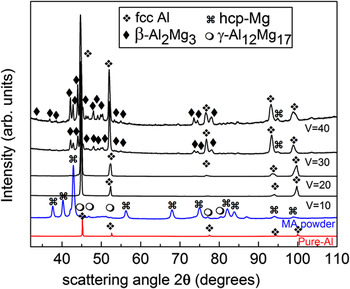
The XRD patterns of the consolidated composites reinforced with different volume percentages of Mg–7.4%Al particles along with pattern of reinforcing powder are shown in Fig. 2. The pattern of the reinforcing powder shows two phases, Mg(Al)ss along with γ-Al12Mg17. The pattern for the composite with 10 vol% reinforcement (V = 10) shows only sharp fcc (face centered cubic) Al peaks and does not display the presence of the Mg or γ-Al12Mg17 peaks, which characterize the reinforcement particles before consolidation.
Reference Chaubey, Scudino, Samadi Khoshkhoo, Prashanth, Mukhopadhyay, Mishra and Eckert27
This may be attributed to the low volume fraction of reinforcement in this composite, below the detection limit of the XRD equipment. Similar results can be observed for the sample with V = 20 except for one small peak at 2θ = 40.6°, which corresponds to the highest intensity peak of the β-Al3Mg2 intermetallic phase (cubic system with space group
 $Fd\overline 3 m$
, giant unit cell (a = 2.8 nm) containing 1168 atoms
Reference Bauer, Kaldarar, Lackner, Michor, Steiner, Scheidt, Galatanu, Marabelli, Wazumi, Kumagai and Feuerbacher29
). The detection of the β-Al3Mg2 phase implies that a phase transformation takes place during the consolidation process.
XRD patterns (λ = 1.79 Å) of Mg–7.4%Al mechanically alloyed powder and hot-consolidated composites with 10, 20, 30 and 40 vol% of reinforcing particles showing the phase transformation in the composite samples during hot consolidation.

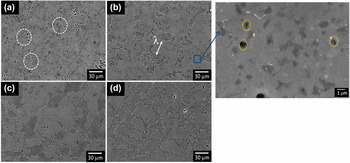
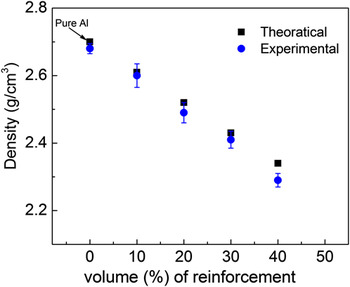
The SEM micrographs taken from the cross-section of the consolidated composites are shown in Fig. 3. The composite samples with 10 vol% reinforcement [Fig. 3(a)] shows the homogeneous distribution of the Mg–7.4%Al particles (dark contrast) in the Al matrix (bright regions). As the volume percentage increases to 20%, the microstructure shows clusters of agglomerated particles [Fig. 3(b)]. With further increase of the vol% of the reinforcement to 30 and 40%, the cluster areas increase and become more interconnected, but the overall distribution of the reinforcement in the matrix remains fairly uniform. The microstructure also shows a few submicron size pores at the particle–matrix interface [magnified view of the selected area of Fig. 3(b)], as usually interfaces are most preferred site for the porosity. Reference Saha, Morris and Chawla30 The porosity in the sample is corroborated by the density measurements in Fig. 4, which shows a decrease of the relative density from about 99.2 to 97.8% with increasing reinforcement content from 10 to 40 vol%.
SEM micrographs for the consolidated composites with (a) 10, (b) 20, (c) 30 and (d) 40 vol% of Mg–Al reinforcement particles, shows distribution of the particles in the matrix. The dark areas correspond to the reinforcement and the bright areas to the Al matrix.

Density of the consolidated samples in the figure clearly indicates almost full densification: experimental (circle) and theoretical (square) as a function of the volume fraction of the Mg–Al reinforcing particles.

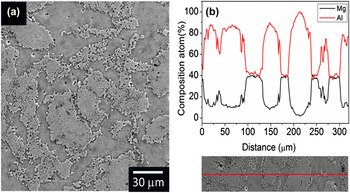
The SEM micrographs of the composites with 40 vol% reinforcement are shown in Fig. 5(a) and 5(b) along with the energy-dispersive X-ray spectroscopy (EDX) line scan. The line scan reveals that the bright areas are the Al matrix and diffused regions (gray regions) are Mg–Al areas with almost equal composition. Comparing with the XRD results, the gray areas can be ascribed to the β-Al3Mg2 phase. The line scan also shows the variation of composition at the particle–matrix interfaces is moderately steep, and occurs at a distance of about 20 μm, indicating that physical mixing and/or atomic interdiffusion occur at the interfaces. This may lead to a strong interface bonding. Reference StJohn, Dahle, Abbott, Nave and Qian31
(a) SEM micrographs and (b) composition profiles obtained from linear EDX analysis for the composites reinforced with 40 vol% Mg–Al particles, which clearly shows the particle matrix diffused regions.

B. Mechanical properties
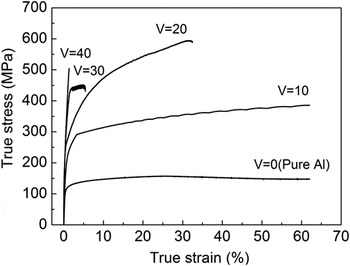
The room temperature compressive stress–strain curves of the composites and unreinforced Al matrix are shown in Fig. 6. The addition of the Mg–7.4%Al particles to the Al matrix increases the strength of the samples remarkably. Among the different composites, the materials with 10 and 20 vol% reinforcement show a remarkable combination of high strength and large plastic deformation. The composite with V = 10 exhibits a yield strength of 212 ± 4 MPa and a compressive strength (the maximum compressive stress which the material can withstand) Reference Biner32 of 465 ± 2 MPa along with plastic strain exceeding 60%. Increasing the reinforcement content to 20 vol% raises the yield and compressive strengths to about 266 and 595 MPa, respectively, while reducing the plastic deformation to about 30%. Additional increase of the reinforcement to 30 and 40 vol% further raises the yield strength to 280 and 290 MPa; however, the compressive strength as well as the plastic strain are drastically reduced. This can be attributed to the observed particle agglomeration and clustering [Fig. 3(c) and 3(d)], and to the increase of effective vol% of the reinforcement due to the transformation of the Mg–7.4%Al particles to the β-Al3Mg2 phase (see Fig. 2), which may on one side provide additional strengthening to the material but it also may favor the brittle behavior in the composites with larger reinforcement content. Reference Mcdanels33,Reference Hall34
Room temperature compression stress–strain curves for the hot pressed and hot extruded pure Al (V = 0), composites with 10 vol% (V = 10), 20 vol% (V = 20), 30 vol% (V = 30), and 40 vol% (V = 40) of Mg–7.4%Al particles.

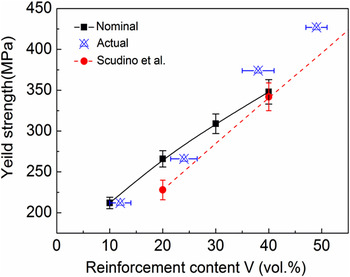
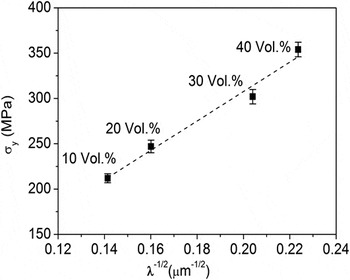
The effect of the effective reinforcement content on the mechanical behavior of the composites is evident in Fig. 7, which shows the yield strength of the composites as a function of the nominal and actual vol% of Mg–7.4%Al reinforcing particles. The nominal vol% corresponds to the initial added amount of Mg–7.4%Al particles, whereas the actual vol% is the volume fraction after the phase transformation to the β-Al3Mg2 phase evaluated from several SEM micrographs. After the phase transformation, the volume fraction of the reinforcing phase increases from 10, 20, 30, and 40 vol% to 12, 26, 38, and 49 vol%. After the correction for the actual vol% of reinforcement, the yield strength of the present composites also follows similar trend as the data reported by Scudino et al. Reference Scudino, Liu, Sakaliyska, Surreddi and Eckert2 for Al-based composites reinforced with different amounts of β-Al3Mg2 particles. This indicates that high strength Al/β-Al3Mg2 composites can be synthesized in situ through the reaction between matrix and reinforcement during consolidation, providing a new root for the production of this type of lightweight materials. Figure 8 shows the relationship between yield strength and λ−1/2. The correlation is approximately linear, corroborating the validity of Eq. (1), further demonstrating that the metal ligament size effect plays a central role in the strengthening of the composites.
Yield strength of the consolidated composites as a function of the nominal and actual volume fraction of Mg–7.4%Al reinforcement along with the data from Scudino et al. Reference Scudino, Liu, Sakaliyska, Surreddi and Eckert2 Indicates the volume change after phase transformation during consolidation.

Shows the inverse relation of the yield stress (0.2% offset) of the composites and inter particle distance similar to Hall–Petch relationship generally observed in alloys.

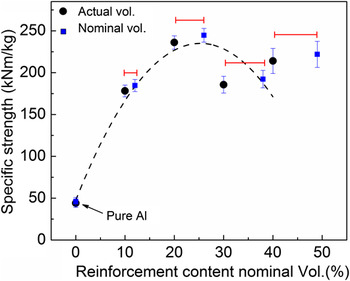
In the selection of lightweight material for engineering applications, high priority is given to the specific strength of the material. In the present composites, the Mg–7.4%Al mechanically alloyed particles contribute significantly to the strengthening of the Al matrix as shown in Fig. 9. Furthermore, the addition of the low-density Mg–7.4%Al particles reduces the density of the composites below the value for pure Al (Fig. 4). In addition to the above, increase of the effective volume fraction of the reinforcement (as marked by red colored arrow in Fig. 9) due to phase transformation also as one of the factor, contributed to strengthening the composite. This all gives rise to a remarkable increase of specific strength of the present composites, which drastically increases from about 45 kN m/kg for pure Al to 240 kN m/kg for the composite with 20 vol% of Mg–Al particles (Fig. 9). Further increase of the volume fraction of the reinforcement leads to the decrease of the specific strength to 186 and 215 kN m/kg for the composites with V = 30 and V = 40, as at this composition the composite becomes brittle and fails early after yield point.
Specific strength of the composites as a function of the amount of Mg–Al mechanically alloyed reinforcement.

IV. DISCUSSION
A. Interface diffusion and phase transformation
Diffusion and phase transformations at interfaces can occur at any of these stages. Interface is the region that lies between the matrix and the reinforcement. It plays a crucial role in determining the properties of MMCs. By the use of thermodynamic and kinetic concepts, changes in the interface morphology in composite systems can be predicted and thus controlled. Reference Handwerker, Cahn and Manning35 The main features which govern interfacial reactions, compositions, phases and structures are: (i) surface energy effects at interfaces, including nucleation, and (ii) stress effects accompanying diffusion at interfaces. Reference Handwerker, Cahn and Manning35 Reactions between the matrix and the reinforcement generally deteriorate the properties of the composites. For example, in Mg/Al2O3 composites, the interfacial reaction between Mg and the oxide creates a brittle interface that decreases the strength of composites beyond acceptable limits. Reference Handwerker, Cahn and Manning35 In Al18B4O33w/MB8 magnesium matrix composites, mechanical property of the composite decreases due to the formation of MgO at the interface by interfacial reaction. Reference Mingyi, Kun, Hancen, Kamado and Kojima36 However this is not always true, for example, in the Al/Mg2Si composite system, the interfacial reaction between the Al matrix and the Mg2Si reinforcement has been used to enhance the bonding strength of the composites using solid-state diffusion bonding and by the formation a new microstructure consisting of the Al matrix and mixture of Al–Mg intermetallic phases. Reference Atabaki and Idris37
The XRD results in Fig. 2 show that the Mg–7.4%Al particles, which consist of a Mg(Al) solid solution (ss) along with the γ-Al12Mg17 phase, transform to the β-Al3Mg2 phase in the composites after consolidation. According to the Al–Mg binary phase diagram two phase pure Al and Mg(Al)ss or pure Al and γ-Al12Mg17 cannot co-exist. Reference Zhang, Tan, Yang, Xu and Wang38 Instead, the stable cubic β-Al3Mg2 phase exists between the ε(R) phase and aluminum at room temperature as well as at elevated temperatures. Therefore, during sintering at high temperature, atomic diffusion takes place leading to the transformation of Mg–7.4%Al particles to the β-Al3Mg2 phase. The SEM micrographs of the composites with 20 and 40 vol% of the Mg–7.4%Al reinforcement [Fig. 5(a) and 5(c)] display the evidence of such diffusion as diffused regions around the reinforcement and dark small areas are the core of the particles. EDX line analysis, as shown in Fig. 5(a) and 5(b), reveals that these black areas are rich in Mg and the diffused regions (gray regions) are Mg–Al areas with almost equal composition. Comparing with the XRD results, the gray areas can be ascribed to the β-Al3Mg2 phase. The line scan also shows that the elemental distribution at the interfaces are not strictly steep, and occurs at a distance of about 10 μm, indicating physical mixing and/or atomic interdiffusion at the Mg/Al interfaces. This leads to a strong interface bonding. 39
B. Mechanical behavior
The strengthening effect of hard particles in MMCs generally depends on two factors Reference Lloyd40 : (i) the load bearing effect of the reinforcement, in which the reinforcement can share the applied stress directly by stress transfer from the matrix Reference Piggot41–Reference Scudino, Ali, Surreddi, Prashanth, Sakaliyska and Eckert43 and (ii) the dislocation strengthening in the matrix, which is related to the nucleation of additional dislocations in the matrix due to the introduction of the reinforcement. Reference Ramkrishnan44,Reference Shi, Wilner and Arsenault45 For composites consisting of a soft matrix reinforced with hard particles, the distance between the particles, also referred to as the matrix ligament size λ, is a key parameter. This is particularly important for composites containing large volume fractions of reinforcement, where the matrix is constrained by the hard particles into regions (i.e., the matrix ligament size) having size that decreases with increasing volume fraction of reinforcement. Reference Kim, Scudino, Kim, Lee, Kühn and Eckert46
It has been reported that the strengthening effect of the reinforcing particles in Al-based MMCs can be accurately described by considering the influence of the inter particle distance of the reinforcement or matrix ligament size λ. Reference Scudino, Liu, Sakaliyska, Surreddi and Eckert2,Reference Ali, Scudino, Liu, Srivastava, Mukhopadhyay, Surreddi, Sakaliyska, Samadi Khoshkhoo, Uhlenwinkl and Eckert7,Reference Kim, Scudino, Kim, Lee, Kühn and Eckert46,Reference Clyne and Withers47 This is particularly important for composites containing large volume fractions of reinforcement, where the matrix is constrained by the hard particles into regions. The microstructure of the composites consists of regions of Al matrix, partitioned by the reinforcing particles into discrete regions, which become progressively separated with increasing amount of reinforcing particles (Fig. 3). The dimension of these regions, i.e., the matrix ligament size λ [see arrow in Fig. 3(b)], decreases with increasing the reinforcement content Reference Scudino, Liu, Sakaliyska, Surreddi and Eckert2 and may be reduced to a few micrometers, such as in the present composite with V = 40 [Fig. 3(d)].
In analogy with materials strengthening by grain refinement, the decrease of the matrix ligament size can positively influence the strength of particulate composites because the increased extension of the matrix/particle interface can effectively inhibit dislocation movement. Reference Scudino, Liu, Sakaliyska, Surreddi and Eckert2,Reference Clyne and Withers47 This size-induced strengthening effect can be expressed by a Hall–Petch-type relationship Reference Hirth and Lothe48 as
 $${\rm{\Delta }}{\sigma _{\rm{s}}} = k{\lambda ^{{{ - 1} \mathord{\left/ {\vphantom {{ - 1} 2}} \right. \kern-\nulldelimiterspace} 2}}}\quad ,$$
where Δσs is the strength increase and k is a strengthening constant. Reference Scudino, Liu, Sakaliyska, Surreddi and Eckert2,Reference Ali, Scudino, Liu, Srivastava, Mukhopadhyay, Surreddi, Sakaliyska, Samadi Khoshkhoo, Uhlenwinkl and Eckert7,Reference Kim, Scudino, Kim, Lee, Kühn and Eckert46
V. CONCLUSIONS
The following conclusions can be drawn from the present investigation:
-
(1) Mechanically alloyed Mg–7.4%Al particles have been uniformly dispersed in the Al matrix by ball milling.
-
(2) Highly-dense Al-based composites reinforced with 10, 20, 30, and 40 vol% of Mg–7.4%Al particles have been prepared by hot consolidation (hot pressing followed by hot extrusion).
-
(3) The reinforcement remarkably improves the mechanical properties compared to pure Al. In particular, the composites with 20 and 40 vol% reinforcement display yield and compressive strengths exceeding that of pure Al by a factor of 3 to 4 respectively, while retaining significant plastic deformation.
-
(4) The increase of the reinforcement to 30 and 40 vol% further increases the yield strength; however, it reduces the compressive strength as well as the plastic strain.
-
(5) The experimental results reveal that the reduction of the matrix ligament size is the main strengthening mechanism in the composites developed in the present investigation.
ACKNOWLEDGMENT
The authors are thankful to DAAD for their financial support to carry out this work.