Introduction
One of the most pressing problems facing policy-makers in the advanced welfare states in recent years has been high levels of incapacity benefits receipt. By incapacity benefits we mean income replacement benefits for people of working age who are long-term sick or disabled. As the OECD (2003) has pointed out, in many advanced economies public expenditure on incapacity benefits exceeds the amount spent on unemployment insurance and assistance programmes. In Britain, the number of people claiming incapacity benefits increased very sharply between the late 1970s and mid-1990s and has remained at very high levels since then. Currently, 2.6 million people are claiming incapacity benefits.Footnote 1
Not surprisingly, the rapid growth and subsequent persistence of high levels of incapacity benefits receipt have attracted considerable scholarly attention in Britain. For example, Nickell (Reference Nickell2003) has examined the reasons for the growth of economic inactivity among men since the late 1970s, the majority of whom are long-term sick and in receipt of incapacity benefits. Economic inactivity has remained at high levels despite the fall in unemployment and rise in employment rates from the mid-1990s (see also Faggio and Nickell, Reference Faggio, Nickell, Dickens, Gregg and Wadsworth2003).
The seminal works of Beatty and Fothergill (Reference Beatty and Fothergill1996, Reference Beatty and Fothergill2002) and their collaborators (Beatty et al., Reference Beatty, Fothergill and Macmillan2000; Alcock et al., Reference Alcock, Beatty, Fothergill, Macmillan and Yeandle2003) have shed much light on the factors that account for the growth in incapacity benefits claims among men in areas of high unemployment. Their research has shown that industrial decline in the 1980s led to a process of labour market detachment, especially among older men, in the industrial and former coalfield areas of the north of England, south Wales and Clydeside. The lack of jobs in these areas of high unemployment diverted men with poor health onto incapacity benefits, even though the majority of them would have preferred to work, thereby creating a problem of ‘hidden unemployment’ (Beatty and Fothergill, Reference Beatty and Fothergill2005; Beatty et al., Reference Beatty, Fothergill and Macmillan2000).
The scholarly research on incapacity benefits in Britain has been very largely focused on male claimants (cf. Anyadike-Danes, Reference Anyadike-Danes2007).Footnote 2 As a result, there is now a considerable body of academic knowledge about men who claim incapacity benefits in Britain. In contrast, relatively little is known about the specific characteristics and circumstances of female claimants (Grover and Piggott, Reference Grover and Piggott2007) or about how gender might structure routes onto incapacity benefits.Footnote 3 The Women's Budget Group has recently drawn attentionto this lack of information and called for new research ‘in order to understand the different reasons why men and women might come to rely on incapacity benefits’ (Deacon et al., Reference Deacon, Fitzpatrick, Howard and Land2007: 21).
This knowledge gap is surprising given that women account for as many as two out of five claimants. Incapacity benefits, in other words, are not an especially male-dominated part of the social security system in Britain and yet women have been largely written out of the script. Indeed, Grover and Piggott (Reference Grover and Piggott2007: 741) have argued that ‘disabled women are invisible in the analysis of, and solutions to, the problems with IB [Incapacity Benefit]’ presented in New Labour's Green Paper, A New Deal for Welfare: Empowering People to Work (Secretary of State for Work and Pensions, 2006). This article seeks to address that knowledge gap. Drawing on empirical data from a national survey, it compares men and women aged under 60 who have recently claimed Incapacity Benefit (IB). In doing so, it sheds new light on the characteristics of male and female claimants and their routes onto IB.
The article is organised as follows. The next section draws on Department for Work and Pensions (DWP) administrative statistics to present a brief overview of gendered trends in IB claims in Britain. It shows that, while the number of female claimants has increased by a third, the number of men claiming this income replacement benefit has barely risen over the past decade. The following section presents details of a new survey of recent IB claimants and describes key characteristics of the sample. Subsequent sections present findings from the survey and consider the health of recent claimants, their employment characteristics and work history. This is followed by an analysis of gendered routes onto IB. The final section presents some conclusions.
Gendered trends in Incapacity Benefit
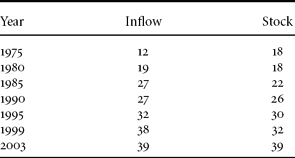
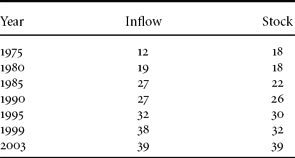
Alcock et al. noted that the detachment of men from the labour market and their diversion onto IB constitutes ‘one of the most significant social changes of the last twenty years or so’ (Reference Alcock, Beatty, Fothergill, Macmillan and Yeandle2003: pxiii) and stands in stark contrast to increasing female labour force participation. However, it would be wrong to assume that growth in IB receipt is largely confined to men. The proportion and number of women in Britain claiming IB (or its predecessor, Invalidity Benefit) are substantial and have been rising for many years. Indeed, women have accounted for an increasing proportion of both the inflow and the stock of IB claimants since the 1970s. Their share of the inflow, for example, rose from 12 per cent in 1975 to 39 per cent in 2003 (Table 1). Moreover, a growing proportion of women of working age (16–59 years) have been claiming IB. Thus, whereas in 1985 only 1.5 per cent of working-age women were claiming IB, by 2004 it had more than trebled, reaching 5.5 per cent (Kemp and Thornton, Reference Kemp, Thornton, Kemp, Sunden and Bakker2006). The rate of growth in female claimants has therefore been quite rapid. Indeed, between 1995 and 2004 the number of working-age women claiming IB increased by over a third (35 per cent), rising from 702,000 to 947,000. In contrast, the number of working-age men claiming IB increased by only 2.5 per cent over the same period (DWP, 2005).
Females as a percentage of the inflow and stock of Incapacity Benefit claimants*.
Note: * Invalidity Benefit prior to 1995.
Source: Kemp and Thornton (Reference Kemp, Thornton, Kemp, Sunden and Bakker2006) calculated from data supplied by DWP.
Thus, although the majority of claimants are men, there has been an increasing feminisation of IB. Among other things, this development is in part related to the increase in female labour force participation in recent decades.Footnote 4 IB is a contributory benefit to which people are entitled by virtue of their national insurance payments while in work. Thus, as more women enter the labour market and pay national insurance contributions, they are increasingly entitled to claim IB if they subsequently become long-term sick or disabled (Walker and Howard, Reference Walker and Howard2000).
Although the female employment rate has increased substantially in recent decades, there nonetheless exists considerable gender segmentation in the labour market. Moreover, women still carry a disproportionate share of caring and housework tasks, which continue to have implications for their participation in the labour market (Crompton, Reference Crompton2006). For these reasons, we might expect to see differences between men and women claiming IB, just as we do in many other areas of the welfare state. Indeed, as the Women's Budget Group (Deacon et al., Reference Deacon, Fitzpatrick, Howard and Land2007) has pointed out, because of the prevalence among women of low pay and interrupted work histories, a higher proportion of women than men claiming IB are not entitled to receive a payment, but are instead awarded only national insurance credits (‘credits-only’ cases).
There is also a growing body of evidence concerning health differences between women and men. For example, women are more likely than men to report suffering from anxiety and depression, while men have a greater propensity to develop heart disease early in life and to have occupational or sporting accidents (Doyal, Reference Doyal2001; Sen et al., Reference Sen, Piroska and George2007). We would therefore expect to find gender differences in health among recent claimants of IB.
The study
The survey of recent claimants of IB was conducted between September 2006 and January 2007 (see Kemp and Davidson, Reference Kemp and Davidson2008). It was funded by the DWP. Face-to-face, structured interviews were completed with a representative sample of 1,843 people who had made a new claim for IB in the previous three months. It was thus a survey of the inflow, rather than the stock, of IB claimants. The sample was drawn from the DWP administrative database of IB claimants. As well as people receiving IB payments, the sample includes ‘credits-only’ IB claimants, many of whom will be in receipt of means-tested income support with a disability premium. Thus, ‘claimants’ refers to people who claimed IB and were awarded either payments or national insurance credits.
The interviews were conducted in respondents' homes using CAPI (Computer Aided Personal Interviews) by the survey firm Ipsos MORI approximately six months after their IB claim. The adjusted response rate (taking account of invalid addresses, ineligible respondents and so on) was 56 per cent. In line with the national figures for IB, 59 per cent of recent claimants were men and 41 per cent were women. Because IB is a working-age benefit, the inflow includes men aged from 16 to 64 and women aged from 16 to 59. In order to compare like with like, the analysis that follows is based upon men and women aged 16 to 59 only. Thus, the paper examines gender differences among recent claimants of IB who are aged below 60. Men aged 60 or over are excluded from the analysis.Footnote 5 The sample of recent IB claimants aged from 16 to 59 years includes 965 men and 747 women.
Recent IB claimants
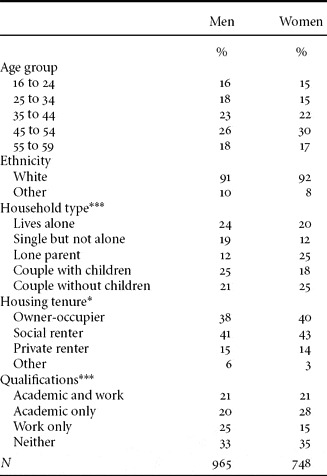
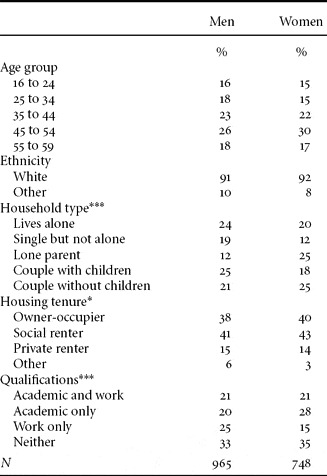
Table 2 summarises the personal and household characteristics of recent IB claimants. There were no statistically significant differences by age group or ethnic background between men and women aged 16–59. However, there were gender differences in relation to household types. In particular, women were less likely than men to be a single person living on their own, more likely to be a lone parent and less likely to have a partner living with them. In line with gendered divisions of labour, women's partners were more likely to have been in paid work (64 per cent) than were men's (50 per cent) in the week prior to the interview. Meanwhile, men were more likely to report that their partner was looking after children or the home (28 per cent) than were women (5 per cent).
Characteristics of recent claimants of Incapacity Benefit.
Notes: Totals may not sum to exactly 100 due to rounding.
Significance: *p < 0.05; **p < 0.01; ***p < 0.001.
Base: recent IB claimants aged under 60.
There was no statistically significant gender difference in housing tenure when the analysis was confined to owner occupation, private renting and social housing. However, when other housing situations were taken into account, there was a difference, with men more likely than women to be living in hostels and related types of accommodation. Recent IB claimants, both women and men, were much more likely than the general population to be renting from a social housing landlord and less likely to be owner-occupiers. The high level of social housing among recent IB claimants is not surprising given that about half of the adults living in that tenure are economically inactive (Hills, Reference Hills2007).
Women were as likely as men to have qualifications, but there was a difference between the genders in the type of qualification held (Table 2). Women were more likely to have only academic qualifications, while men were more likely to have only work-related ones (‘work-related’ includes apprenticeships, secretarial, nursing and professional qualifications). A somewhat similar pattern emerged in relation to literacy and numeracy. Women were as likely as men to report not having such problems. However, a higher proportion of women than men said they had numeracy problems. Meanwhile, more men than women reported having problems with their literacy.
Two-thirds of the respondents were first-time claimants and a third had claimed on a previous occasion. Among repeat claimants, 58 per cent had previously claimed IB within the last two years and 42 per cent had claimed two or more years before their recent claim. Thus, there is a considerable degree of ‘churning’ among the claimant population. This may occur because, for example, many new claimants (55 per cent of women and 48 per cent of men) have a health condition that fluctuates over time. In addition, some claimants leave IB to take up work but are unable to keep the job because of their poor health. Whatever the reason, a higher proportion of female than male respondents were first-time claimants (72 per cent compared with 65 per cent respectively).
Health
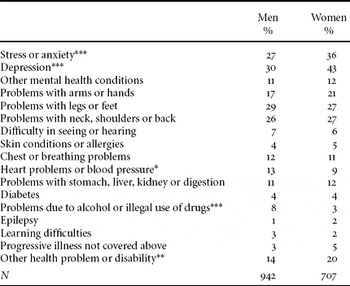
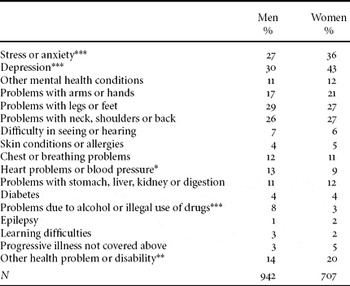
Almost all respondents (96 per cent) reported that they currently, or in the previous 12 months, had a health condition or disability that affected their everyday activities (hereafter referred to as ‘health conditions’ for ease of exposition). People who had a health condition were asked to say what conditions they had at the time of their recent claim for IB. As Table 3 indicates, both male and female respondents reported a great variety of health conditions and impairments.
Health condition or disability.
Notes: Respondents could cite more than one health condition or disability.
Significance: *p < 0.05; **p < 0.01; ***p < 0.001.
Base: recent IB claimants aged under 60 with a health condition.
The prevalence of particular health conditions was in fact broadly similar by gender, but some differences did exist. In particular, women were significantly more likely than men to report that they were suffering from stress, anxiety and depression. Thus, 36 per cent of women said they suffered from stress or anxiety and 43 per cent from depression; the figures for men were 27 per cent and 30 per cent respectively.Footnote 6 Meanwhile, a smaller proportion of women than men reported having heart problems or high blood pressure. Logistic regression analysis (results not shown) revealed that women had odds of having a mental health condition that were almost double (1.9) those of men, holding other factors (such as age, ethnicity and household type) constant. This might raise the question of whether this difference exists because women have a higher rate of depression than men or simply a greater willingness to seek treatment. In fact, as Bird and Rieker report, it is now ‘well established that women's higher rates of depression reflect a real gender difference in health, rather than [only] an artefact of help-seeking behaviour or willingness to report symptoms’ (Reference Bird and Rieker2008: 32).
Respondents were also asked to say what was their main health condition or disability, which we defined as ‘the one that most affects your everyday activities’. Here again, gender differences were apparent. Women were more likely than men to say that their main health problem was to do with their mental health (33 per cent compared with 24 per cent respectively). They were less likely than men to report that their main condition was a musculo-skeletal problem of some kind (33 per cent compared with 41 per cent). These differences in gender and health reflect those found in the general population (Doyal, Reference Doyal2001; Sen et al., Reference Sen, Piroska and George2007).
The survey also found significant gender differences in the self-reported causes of their main health condition. A significantly higher proportion of men than women reported that their main health problem was related to their work. In contrast, women more often than men said that their main condition was a non-work-related disease or illness. Meanwhile, a higher proportion of men reported that it was the result of a non-work-related accident or injury, a result that reflects the fact that men are more likely to engage in physically risky behaviours than women (Sen et al., Reference Sen, Piroska and George2007).
Among recent claimants whose condition did not begin at birth, women were more likely than men to report that it came on gradually and less likely to say it occurred suddenly, a result that in part reflects the lower prevalence of accidents and injuries among women. Finally, although women were less likely to suffer from a non-work-related health problem, they were no less likely than men to report that their main condition affected their ability to do their job: for both genders, about four-fifths of respondents said that it did so.
Employment
As noted above, academic debates about incapacity benefits have focused particularly on ‘hidden unemployment’ and loss of jobs associated with industrial restructuring and decline. It is argued that men in poor health who were made redundant in the former coalfield areas and old manufacturing regions, and were unable to find a new job, ended up on IB rather than jobseekers allowance (Beatty and Fothergill, Reference Beatty and Fothergill1996, Reference Beatty and Fothergill2005; Alcock et al., Reference Alcock, Beatty, Fothergill, Macmillan and Yeandle2003). Deindustrialisation disproportionately affected men, but most of the new jobs that have been created in recent decades have been in the service sector and have disproportionately been taken by women (Sunley et al., Reference Sunley, Martin and Nativel2006). This reflects the fact that there is considerable gender segregation in the labour market (Robinson, Reference Robinson, Dickens, Gregg and Wadsworth2003; Crompton, Reference Crompton2006).
For these reasons, we should expect to find gender differences in employment among recent IB claimants. Before exploring these differences, however, it is important to point out that recent IB claimants, both male and female, were relatively disadvantaged in the labour market compared with the general population. For example, they were more likely than the general population to have: worked in unskilled or low-skilled occupations, been low paid in their most recent job, have no academic or work-related qualifications and have literacy and numeracy problems. Recent IB claimants were less likely to have a full driving licence, and, if they did have one, were less likely to have access to a car (Kemp and Davidson, Reference Kemp and Davidson2008). These are all factors that can affect labour market opportunities and life chances (see Berthoud, Reference Berthoud2003; Bonney, Reference Bonney2007).
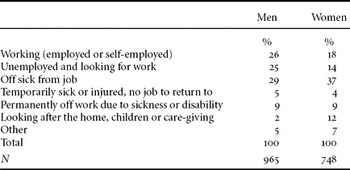
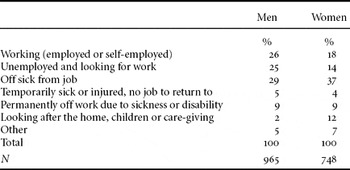
As expected, though, there were significant differences in the employment situation of women and men immediately prior to their recent claim for IB. Men were more likely than women to have been in work, either as employed or self-employed, immediately prior to their claim, but women were more likely to have been on sick leave from a job. Men were also more likely to have been unemployed and looking for work. In contrast, women were much more likely than men to report that they were looking after the home or children prior to their IB claim (Table 4). Drawing on the findings of Cragg and Dawson's (Reference Cragg and Dawson1984) study of unemployed women, Edgell (Reference Edgell2006) has suggested that many women reject the label ‘unemployed’ if they have domestic responsibilities, even if they are actively seeking work. Because of their domestic role, they are more easily able to define themselves as looking after the home instead of unemployed. It is possible, therefore, that this may account for some of the differences in the proportions of men and women on IB who described themselves as unemployed.
Employment situation immediately prior to recent claim***.
Notes: Totals may not sum to exactly 100 due to rounding.
Significance: ***p < 0.001.
Base: recent IB claimants aged under 60.
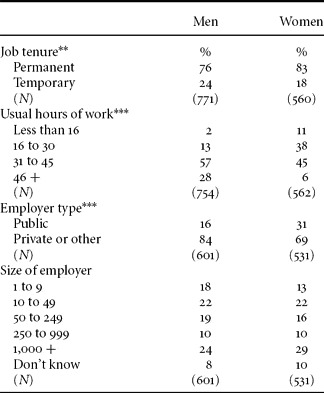
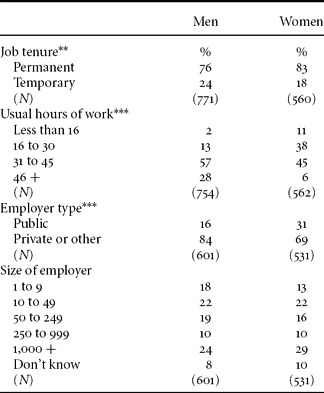
Among recent claimants who had been in paid employment within the previous two years, there were significant differences in the characteristics of women's and men's current or most recent job. As expected, women were more likely to have worked in service sector jobs and men in manufacturing. Women were more likely than men to have been in unskilled or low-skilled occupations. They also had lower average hourly rates of pay (£5.94 compared with £6.93 respectively) in their current or most recent job. As with the general population of working age (Crompton, Reference Crompton2006), women were much more likely than men to have been in part-time employment. They were also more likely to have been employed in the public rather than the private sector (Table 5).
Current or most recent employment.
Notes: Totals may not sum to exactly 100 due to rounding.
Significance: *p < 0.05; **p < 0.01; ***p < 0.001.
Base: recent claimants of IB aged under 60 who had worked in the previous two years.
More surprisingly, perhaps, a higher proportion of women than men had a permanent job in their current or most recent employment. This may explain why a higher proportion of women had previously been on sick leave immediately prior to their claim (Table 4). Temporary employees are less likely than permanent ones to have access to occupational sick pay (McGovern et al., Reference McGovern, Smeaton and Hill2004) and, indeed, ‘temps’ working for employment agencies are not even entitled to statutory sick pay. Consequently, people with temporary contracts, and especially those working for employment agencies, are likely to move onto IB sooner than people in permanent jobs. For them, IB is working as a functional equivalent to sick pay (Davidson and Kemp, Reference Davidson and Kemp2008).
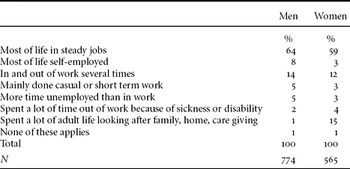
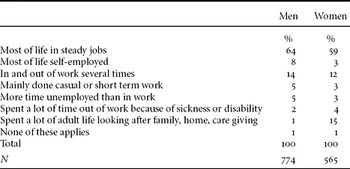
Gender differences were also apparent in relation to recent IB claimants' work history. People who had ever worked were asked which of a series of statements best described their overall work situation since they had left school or college (Table 6). This revealed two main differences between men and women. First, women were less likely than men to report that they had spent most of their life in steady jobs or self-employment. Second, women were much more likely than men to say that they had spent a lot of their adult life looking after their family or the home. Both of these differences reflect the gender division of domestic labour and the (albeit declining) prevalence of the male breadwinner model (Crompton, Reference Crompton2006). However, it is also notable that, even when those who had never worked are taken into account, almost half (47 per cent) of all women in the sample reported that they had spent most of their working life in steady jobs or self-employment.
Work history***.
Notes: Totals may not sum to exactly 100 due to rounding.
Significance: ***p < 0.001.
Base: recent claimants aged under 60 who had ever worked.
Routes onto IB
Because it is a contributory benefit, it might be expected that most people on IB will have been in work, or on sick leave from their jobs, immediately prior to their claim. In fact, as we have seen, many of them were not working immediately prior to their recent claim for IB. Arguably, people who moved onto IB from a non-work situation are likely to be more distant from the labour market than those who were working, or on sick leave from their job, immediately prior to their claim for IB.
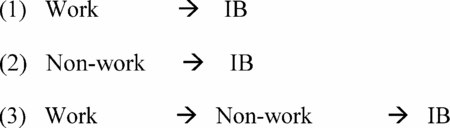
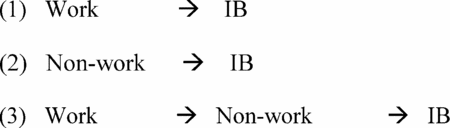
A qualitative study by Sainsbury and Davidson (Reference Sainsbury and Davidson2006) identified three main routes onto IB, which they labelled: (1) ‘Work to IB’, (2) ‘Non-work to IB’ and (3) ‘Work to non-work to IB’ (Figure 1). First, as expected, some people had moved onto IB after having been in work or on sick leave from their job (the ‘Work to IB’ route). Second, other people had moved onto IB from a non-paid work status (the ‘Non-work to IB’ route). These ‘non-work’ situations included being unemployed, early retired and looking after the children or home.Footnote 7 Third, some of the ‘non-work’ group had previously been in employment or self-employment. The people in this group include those who are caught up in the ‘low pay, no pay’ cycle, moving between unemployment and work (Stewart, Reference Stewart, Gregg and Wadsworth1999). It also includes people who had lost their jobs after becoming ill but did not immediately claim IB. An example of this situation would be ‘discouraged workers’ who, having been unable to find a job, had given up looking for work and claimed IB instead. Discouraged workers are therefore members of the ‘hidden unemployed’. Whatever the reason, this third group had moved from paid work to a non-work situation before claiming IB (the ‘Work to non-work to IB’ route).
Routes onto Incapacity Benefit.
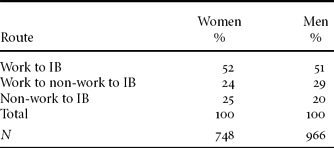
In order to quantify the relative importance of the three routes onto IB identified by Sainsbury and Davidson (Reference Sainsbury and Davidson2006), we allocated people to the ‘Work to IB’ route if they were in paid work, or on sick leave from their job, immediately prior to their claim for IB.Footnote 8 They were allocated to the ‘Non-work to IB’ route if they were neither in work nor off sick from their job immediately prior to their claim and had not worked in the previous two years. People were allocated to the ‘Work to non-work to IB’ route if they were neither in work nor off sick from their job immediately prior to their recent claim, but had been in a paid job in the previous two years.
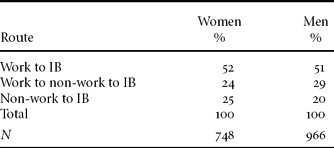
On these definitions, about half of recent IB claimants had come from the ‘Work to IB’ route, a quarter from the ‘Work to non-work to IB’ route and a fifth from the ‘Non-work to IB’ route (Table 7). Men and women were equally likely to have moved onto IB directly from paid employment or self-employment (the ‘Work’ route). A higher proportion of men had moved onto IB indirectly from paid work (the ‘Work to non-work’ route). Women were more likely to have moved onto IB via the ‘Non-work’ route, a result that reflects the gendered division of care work. However, when personal and household characteristics were controlled for using multinomial logistic regression (results not shown), these gender differences disappeared.Footnote 9 Other things being equal, whether recent claimants moved onto IB from the ‘Work’ route, when compared with either of the other two routes, was unaffected by their gender.
Routes onto Incapacity Benefit*.
Notes: Totals may not sum to exactly 100 due to rounding.
Significance: *p < 0.05.
Base: recent IB claimants aged under 60.
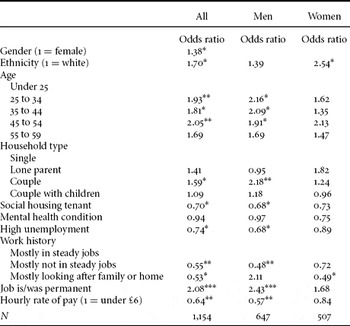
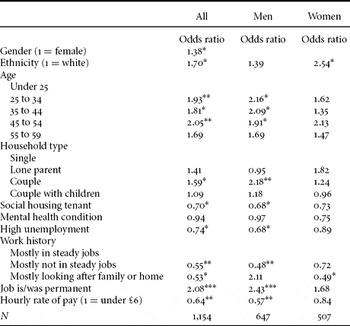
In order to further explore the possibility of gender differences in routes onto IB, variables on recent work experience and work history were included in the analysis. Because these survey questions were only asked of claimants who had worked in the previous two years, this additional analysis was confined to respondents who moved onto IB from the ‘Work’ or the ‘Work to non-work’ routes.Footnote 10 In other words, only IB claimants who had recent work experience were included in these models. The analysis was conducted using binary logistic regression. The ‘Work to IB’ route was coded as 1 and the ‘Work to non-work to IB’ route was coded as 0. The results in Table 8 are shown first for all claimants together (including gender as a variable) and then separately for men and women respectively.
Logistic regression estimates of the odds of moving onto IB from paid work.
Notes: Significance: *p < 0.05; **p < 0.01; ***p < 0.001.
Base: recent claimants of IB aged under 60 with a health condition who had worked in the previous two years.
It turns out that gender was significant, other things being equal, when the employment and work history variables were included in the analysis (Table 8). Surprisingly perhaps, the odds of having moved onto IB from the ‘Work’ route (as opposed to the ‘Work to non-work’ route) were higher for women than for men. Moreover, when the logistic regression models were run separately for each gender, the results were different for women than for men (Table 8). Only two of the variables included in the model were significant for women: ethnic background and whether respondents had spent most of their adult life looking after the family or home. Interestingly, neither of these two variables was significant for men. Among women, the odds of moving onto IB from the ‘Work’ route were higher for those whose ethnic background was white than for those from other ethnic backgrounds. The odds were lower for women who had spent most of their adult life looking after the family or home than for women who had spent most of their adult life in steady jobs. But the employment variables – whether or not they lived in an area of high unemployment, had a permanent or a temporary job and their hourly rate of pay – were not significantly related to women's routes onto IB.
By contrast, recent employment experience and work history were significantly related to men's route onto IB. Other things being equal, men living in areas of high unemployment had significantly lower odds of moving onto IB from work than those living elsewhere.Footnote 11 Men whose job was permanent had odds of moving onto IB from the ‘Work’ route that were nearly two and a half times higher than for men whose job was temporary. The odds were also lower for men whose current or most recent job was low paid. Men who had a chequered employment history had significantly lower odds of moving onto IB from the ‘Work’ route than men who had spent most of their adult life in steady jobs. In addition to these work variables, the odds of moving onto IB from the ‘Work’ route were lower for men who were living in social housing, but not for women (Table 8).
Conclusions
The high level of IB receipt in Britain has been the focus of considerable scholarly attention. Whether examined in relation to the growth of economic inactivity in the face of falling unemployment and rising rates of employment (Nickell, Reference Nickell2003), or in terms of hidden unemployment (Beatty and Fothergill, Reference Beatty and Fothergill1996), the research has been almost entirely focused on male claimants of IB. Although women account for two-fifths of both the stock of IB claimants and the inflow onto this benefit, very little research has examined their characteristics and circumstances or looked at differences that might exist between men and women in their routes onto IB. The research on hidden unemployment has undoubtedly provided important insights into the processes by which men claim incapacity benefits in areas of high unemployment. However, the neglect of women in academic research on IB is an important gap in our knowledge and understanding of the role of this benefit.
This article has highlighted the substantial growth in IB claims by women since the 1970s and the relative stability in the number of male claimants since the mid-1990s. It also presented data, for people aged under 60, from a nationally representative survey of recent IB claimants in Britain. In doing so, it has provided new information about the characteristics and circumstances of the women claiming this benefit and compared them with men. The article has shown that there are indeed significant differences between male and female claimants of this benefit.Footnote 12 Not only their characteristics and circumstances, but also their routes onto IB, differ in important ways. Among women, for example, only their ethnic background and whether they had spent most of their adult life looking after their family or home were significantly related to whether or not they had moved onto IB directly from paid work. By contrast, among men, the characteristics of their most recent job were significantly related to whether or not they had moved onto IB directly from paid work. Likewise, for men but not for women, the odds of moving onto IB via the ‘work’ route were also significantly lower if they lived in an area of high unemployment.
It is not clear why the characteristics of people's most recent job and living in an area of high unemployment have a different impact on men and women. But one possible explanation is that, in areas of high unemployment, men are less well able to compete with women in the labour market for service sector jobs. Many of these jobs are part-time and require the kind of ‘soft skills’ that women are arguably more likely to possess; or involve manual work for which men with health problems are at a competitive disadvantage compared to other low-skilled men. These gender differences may be a more powerful factor affecting the ability of long-term sick and disabled people to compete for jobs in localities where unemployment is high than in areas of labour shortage. Whatever the explanation, the results of this survey demonstrate that it is essential to consider women as well as men in order to have a more complete understanding of the role of incapacity benefits in the post-industrial economy.
Acknowledgements
We are very grateful to the Department for Work and Pensions for funding the survey on which this article is based. For helpful comments on an earlier draft, we would like to thank Professor Joanne Neale, the anonymous referees, and participants in our Social Policy Association conference session at the University of Edinburgh in June 2008. Responsibility for the contents of the article rests solely with the authors.