All the hinchas (soccer or football supporters) were checking their phones while talking and drinking wine in the dark and cold Parque Forestal, an iconic urban park in the historical downtown of Santiago de Chile. These hangouts were common after the weekly meetings in which the hinchada (group of organized hinchas) of football club Universidad de Chile (henceforth U. de Chile) discussed their social and political activities. With his hands inside his pockets due to the freezing temperature, Miguel asked me to explain my research to him one more time.Footnote 1 I said that I was studying the circulation of football chants and sonic practices of fandom throughout Chile, Argentina, and Uruguay – a region known as the Latin American Southern Cone.Footnote 2 ‘I've sent a couple of chants to the hinchada's WhatsApp group’, he proudly replied, ‘everyone is always sending chants so that the group could arrange them’.Footnote 3 I was not surprised by the centrality of this ubiquitous messaging app in the collaborative composition of chants, as I had heard similar statements elsewhere. As a piece in the popular Argentine newspaper Clarín pointed out, ‘football chants are now written on WhatsApp’.Footnote 4
In a previous meeting, I had overheard Miguel vocalizing the melody of Bad Bunny's hit ‘Callaíta’ (roughly, ‘Little Quiet One’) with lyrics celebrating the loyalty and passion of the U. de Chile hinchada. I asked him if this was one of the chants he sent to the WhatsApp group. He confirmed it while lamenting that only a few hinchas engaged with the contrafactum, either texting edits to the lyrics or sending audio messages with some melodic alterations.
At the time, he added, the WhatsApp group was mostly focused on a more hostile contrafactum of ‘Imposible’ (‘Impossible’) by Argentine rock band Callejeros. Originally adapted by the hinchada of Argentine team River Plate, an U. de Chile hincha modified the chant to blast their arch-rivals Colo-Colo – a club named after a Mapuche warrior from the colonial era:Footnote 5

The chant underscores the radical alterity of Colo-Colo and its fanbase. U. de Chile hinchas claim that their rivals lack their resolute steadfastness and unwavering loyalty. They also posit that Colo-Colo has been historically supported by hegemonic powers, including the right-wing president Sebastián Piñera and the infamous dictator Augusto Pinochet, who brutally ruled the country from 1973 to 1990.Footnote 6 A couple of weeks later, the chant's final audio was circulating widely on WhatsApp and other social media, eventually reaching the stadium's stands.
I open with this ethnographic vignette to foreground the significance of the sonic and the digital in the transnational culture of football fandom of the Southern Cone. Accompanied by drums and rhythms taken from the Buenos Aires carnival, hinchas vocalize football chants non-stop during games. These compositions range from liminal speech utterances – rhythmic expressions with little to no variation in tone and pitch (see Example 1) – to contrafactum compositions involving verses, bridges, and choruses. The melodies of the song-like chants range from political marches to jingles to the latest hits circulating on mass and social media.
Non-melodic football chant.

Although scholarship on sports has slowly begun to pay attention to how sound shapes football experiences,Footnote 7 the role of technology in the mediation of fan sociality remains unexplored. The aforementioned practices of fandom originally crystallized in Argentina in the 1960s, but they have long circulated throughout the region via television broadcasts, cassettes, and compact discs. The transnationalization of this fan style has intensified in the last couple of decades thanks to the expansion of digital technologies, especially social media. Even though stadiums are still central spaces for fan sociality, Facebook, Instagram, Twitter, and especially WhatsApp have become key sites for creative and social relationality.
Yet digital circulation has also advanced the fandom's violent dynamics. Since the culture's emergence, hinchadas have brawled to defend the honour and prestige of their clubs and peers.Footnote 8 Today, violence functions as a form of social capital that can be transacted in larger networks with players, coaches, administrators, politicians, and the police. The primary trope to conceptualize the positivity of violence is aguante (roughly, ‘endurance or stamina’), a concept that, signifying the fandom as a whole, receives significant attention in this article. If the circulation of chants has helped transnationalize the fandom, the discriminatory slurs, death threats, and stories of combat present in the lyrics have crucially mediated the dissemination of aguante's violent potentialities.
Drawing on virtual and in-site ethnographic work in Chile, Argentina, and Uruguay, this article examines uses of WhatsApp in aguante. I argue that the messaging app has fostered social and anti-social relations within and between hinchadas. Hinchas employ its creative affordances to digitally decentre creativity from individuals through the distribution of inventive tasks between geographically distant people. However, WhatsApp has also contributed to football violence by intimately spreading hate memes, aggressive chants, and videos of torture, among other forms of violent media. In illustrating that the messaging app can immerse and infect subjects in productive and destructive relationalities, this article ultimately underlines the social and anti-social potentialities of viral media and digital technologies.
Music scholars have amply discussed digital media's musical affordances – that is, the ‘functional and relational aspects which frame, while not determining, the possibilities for agentic action in relation to an object’.Footnote 9 Studies on fandom note that, bridging the virtual and visceral realms, social media has nurtured sonic ecosystems that promote intimate relations, engender novel genres, and nurture participatory cultures.Footnote 10 In positing that the production, consumption, and dissemination of digital media have encouraged musical interaction, this body of literature has ultimately married virality to sociality.
But while scholarship on the sociality of viral music media expands speedily, (ethno)musicological writings on the anti-social affordances of digital technologies remain scarce. Media scholars have noted the dangers of social media, but they have paid little attention to how digital sounds contribute to the violent erosion of social relations.Footnote 11 Even if some studies have examined hate speech utterances in multiplayer online video games, they have failed to theorize how digital media can negatively affect sociality.Footnote 12 Highlighting the socially destructive potentialities of WhatsApp, this article argues that sonic virality has fostered sociality and anti-sociality within and between hinchadas. The messaging app has not only facilitated the creation and socialization of chants but also the dissemination of violent media, which has contributed to the erosion of social relationality in the digital and visceral realms. All in all, this article foregrounds that the virological metaphors commonly employed to analyse digital circulation also present a deadly dimension.
Visceral and digital aguante
Sports ethnographers have stressed the radical worldview of football supporters, distinguishing them from fans based on their active engagement during matches and sociopolitical involvement in their clubs.Footnote 13 Supporters see themselves as neither consumers nor devotees of athletes but as the central constituent of their clubs’ social fabrics. Being more important than players, coaches, and directors, supporters claim that their practices of fandom are the fundamental component of the football spectacle. As Cachila, a Uruguayan hincha, once told me, ‘We all believe that we're the spectacle and not those twenty-two fuckers on the field.’Footnote 14
Social scientists have convincingly argued that a discourse known as aguante informs Argentina's culture of football.Footnote 15 Even though aguantar (the infinitive of aguante) means to endure or support something or someone, the concept also points to a hyper-masculine honour code and prestige system that marks hinchas as tough, loyal, and passionate men. Although these scholars have noted that aguante sometimes signify expressions of loyalty and passion outside hinchadas, they emphasize that hinchas mostly prove and accumulate it through violent practices. Enduring fights, displaying bravado, and exhibiting combat knowledge mark hinchas as real men, bestowing them with notoriety and reputation. Those who actively participate in this violent mode of sociality have developed illegal networks with club workers, police, and politicians where they exchange their aguante for economic, social, and political goods.
Despite this increasing interest in the specificities of aguante, how sound mediates football experiences remains largely unexplored. Through sound and music, hinchas not only cheer for their teams but also compete internationally, promote stranger-sociality, stage ideological messages, and engage in conflict. Vocalizing football chants is the most conspicuous sonic practice of aguante. The content of these contrafacta ranges from expressions of camaraderie to the total dehumanization of rivals. Through sexist, homophobic, and racist profanities, the most aggressive types of chants depict rivals as men unable to fulfil heteronormative conceptualizations of manhood.Footnote 16 In their lyrics, hinchas pit themselves against these allegedly failed embodiments of masculinity by presenting themselves as tough, loyal, and passionate subjects. The often-aggressive performance and vocalization of these chants play a key role in validating and giving meaning to the hostile values of aguante. As Eduardo Herrera writes, ‘participatory moving-and-sounding in synchrony creates a performative social space that both enacts and gives frames of interpretation to manifestations of aguante’.Footnote 17
Yet aguante can no longer be circumscribed to Argentina as it has taken over the entire Southern Cone.Footnote 18 In the 1980s, this set of sonic practices began to circulate throughout the region at continental tournaments and via television broadcasts, putting geographically distant fans in dialogue and conflict both viscerally and analogically. If the regional Copa Libertadores de América (America's Liberators Cup) had already configured an imagined Latin American football community in the 1960s,Footnote 19 the massification of television channels and devices reinforced this transnational public in the 1980s,Footnote 20 allowing Chilean and Uruguayan hinchas to consume and hear Argentine hinchadas on a weekly basis.Footnote 21 Migratory processes, cable shows dedicated to specifically broadcasting the sounds of aguante, and DIY cassettes and compact discs densified these transnational networks in the 1990s. The growth of social media, expansion of continental championships, and proliferation of cable and streaming services fortified aguante's transnationalization in the twenty-first century. Today, hinchas outside Argentina not only consume but also adapt and repurpose practices of aguante, sometimes bypassing or influencing Argentine hinchadas in the process.
Digital media has also facilitated the collaborative creative processes favoured by hinchas. Chants have never been created by only one individual; artistic tasks have always been distributed equitably among members of hinchadas. Historically, these collaborations occurred in the cavernous spaces underneath the stands. Hinchas got to these spaces hours before games so as to mingle and discuss potential sources for chants. Once they found a suitable melody, everyone started to propose stanzas. When the chants were finally composed, they were taught to other hinchas. With the emergence of social media, these creative and pedagogical processes have shifted from the visceral to the digital world. Hinchas now create chants outside of co-present groupings at stadiums, putting them into circulation on Facebook pages, YouTube channels, Twitter accounts, and Instagram profiles before games. They interconnect these spaces via trans-platform hashtags labelling clubs, musicians, and hinchadas. The most popular sites accrue millions of views and followers, turning their administrators into transnational trendsetters of aguante. It is in the geographically distant distribution of creativity that WhatsApp has become the main medium to create football chants.
The affordances of WhatsApp
Created in 2009 and acquired by Facebook in 2014, WhatsApp is the default mode of message communication outside Canada and the United States, averaging two billion users worldwide. As SMS messages have never been free of charge in the Southern Cone, the app has conveniently filled this communication vacuum, becoming the default ‘passage point for the management of friendship, family, and work routines’.Footnote 22 Although it emerged as a messaging network, it has rapidly evolved into a form of social media. South Americans perceive WhatsApp ‘as a highly versatile, all-encompassing space of encounter, meaning-making, and coordination where entrance barriers are low and exit costs are high’.Footnote 23 It has gradually moved away from simple one-to-one text exchanges, affording the sharing of videos, images, sounds, emojis, stickers, GIFs, geolocation, and the forwarding of media taken from other digital ecosystems, both in group and in person. Developers have recently created a desktop version that, including all the aforementioned sharing capacities, allows users to access and put into circulation files from their computers.
Legal scholar Chinmay Arun notes that WhatsApp presents ubiquitous, private, and data-tracking affordances.Footnote 24 In addition to mediating friends, family, and professional networks, users understand the app as secure and private, mainly due to its end-to-end encryption. Per developers, only the person sending the message and those receiving it can read it; not even WhatsApp can see these exchanges. The fact that the app removes metadata when compressing information enhances its perceived privacy. All in all, WhatsApp allows users to privately, securely, and intimately craft and share discrete forms of media, thus functioning as a formidable technology for content creation and dissemination.
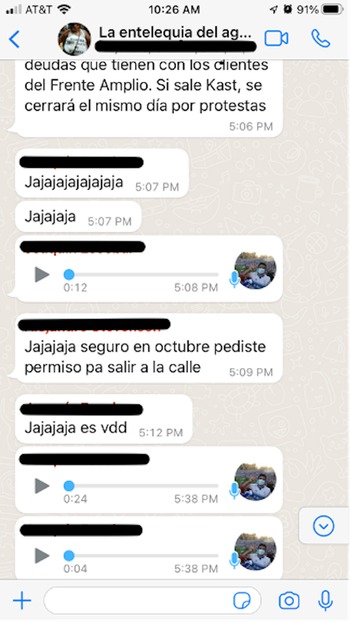
WhatsApp contains a plethora of sonic affordances. In addition to allowing the viral circulation of sonorous media such as songs and music videos, it facilitates the creation of sonic content through its live audio recording option – a feature that was later imitated by iPhone and other messaging apps such as Signal and Telegram. Pressing the microphone icon at the interface's bottom right, users can record sounds and immediately share them with individual people and groups (see Figure 1). Although WhatsApp crystallized as a text messaging app, people in the Southern Cone use this recording option extensively – sometimes even more than texting. These recordings range from sung melodies to voicemail-style missives, being used while walking down the street or simply to avoid the rather small smartphone keyboards. Figure 1 illustrates how these audio recordings are embedded in group conversations, with users freely responding via text or audio. Since some people tend to share long audios – larger than a minute, sometimes – developers have introduced a feature that allows their acceleration by 1.5 and 2.0 times. For example, listening to the 24-second recording of Figure 1 takes 16 seconds with the 1.5 option or 12 seconds with the 2.0 option.
(Colour online) Screen capture of a WhatsApp group.

Since the implementation of audio recording and sharing, WhatsApp has become the central space for musical creativity among hinchadas. It has allowed geographically distant hinchas to share musical ideas, collaboratively work on chants, and ultimately craft and distribute content.
Media, creativity, and circulation
Although hinchas interact on Twitter, Instagram, and Facebook, WhatsApp is the default space for digital sociality. ‘It's where everything is organized and shared’, Miguel once told me. In fact, everyday interactions mostly occur through the messaging app – especially through groups, where hinchas debate ideas, organize political activities, and develop meaningful connections regardless of physical place. The translocality of WhatsApp is particularly useful in distributing creative tasks, fostering artistic interactions, and creating media content. The following ethnographic vignette illustrates its creative affordances.
I had been following the Facebook page Trovazules (‘Blue Troubadours’) for a while when I decided to message them requesting an interview. Many of the chants they had uploaded to social media had gone viral among U. de Chile hinchas. Unlike most of the contrafacta sung by the hinchada, their lyrics tend to avoid violent and disorderly utterances, focusing instead on group belonging and club loyalty. See, for instance, their contrafactum of ‘20 Veces’ (‘20 Times’) by Chilean cumbia star Américo:

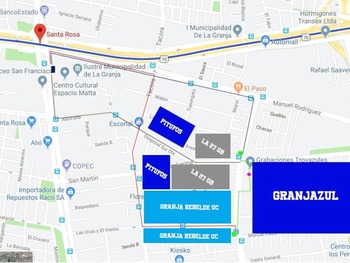
Joaquín, the project's organizer, replied to my message almost immediately, sending me his phone number so that we could chat on WhatsApp. He invited me to his house on Saturday morning because they were going to record some chants before the U. de Chile game. Like most young proletarians, he still lived with his parents. As he knew that I was not familiar with La Granja (an impoverished neighbourhood in southern Santiago), he attached a map alongside the address so that I could avoid the turfs dominated by rival hinchadas (Figure 2).
(Colour online) Map shared by Joaquín.

It was a cold morning, and his room – a homemade second floor filled with musical instruments – was freezing. For different reasons, the other members of Trovazules did not show up, so we ended up talking for hours. Joaquín told me that, although he has come up with most of their chants, they are always collectively arranged and finalized on WhatsApp. To do so, they make extensive use of its audio recording option. He even told me that one of the most popular videos on Facebook was a mashup of different WhatsApp recordings. He then pulled up his phone and showed me the Trovazules group, which interwove text messages with audio recordings of a contrafactum of the cumbia ‘El Club del Amigo’ (‘The Friend's Club’) by the local band Guachupé:

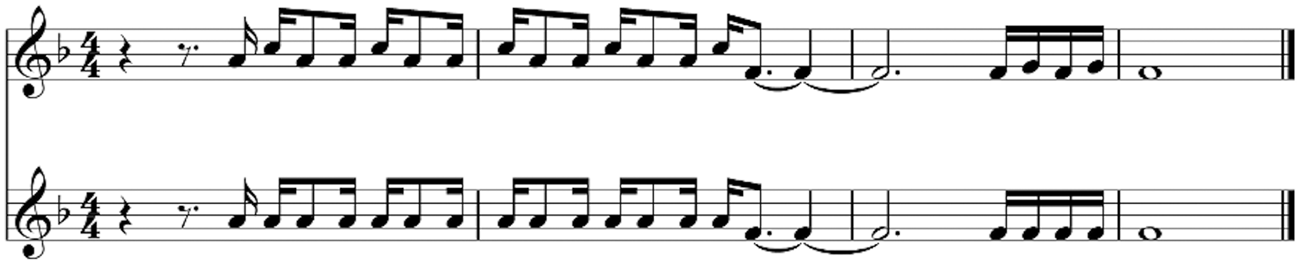
While the texts were lyrical amendments, the audios were mainly melodic alterations. Some members considered the melody of ‘El Club del Amigo’ unsuitable for collective singing, suggesting an intervallic simplification (see Example 2). The final version ended up respecting the original melody.
Melodic simplification of ‘El Club del Amigo’.

I have observed similar uses of WhatsApp throughout the entire Southern Cone. In fact, when I began my preliminary fieldwork in 2016, a journalistic piece on the Argentine newspaper Clarín titled ‘The New Poets of the Stands’ caught my attention.Footnote 25 The article was based on an interview with Escuela de Tablones (‘The Schools of the Stands’), a group of hinchas of the Argentine team San Lorenzo that is often signalled as the most creative collective in the region. Indeed, most of the chants sung in South American stadiums are adaptations of their contrafacta. In the Clarín piece, an Escuela de Tablones member explained how the creative process functions:
I was on the bus, for example. While traveling on the 126, a musician got onto [the bus] and began to sing ‘Mi historia entre tus dedos’ [‘My Story In Between Your Fingers’] by [Italian balada singer] Gianluca Grignani with a ukulele, and I thought that it would be a great football chant. During the trip, which lasted half an hour, I came up with two stanzas. Once at my place, and for three weeks, I finished it and sent it to the WhatsApp group, where we all fixed it.Footnote 26
When I eventually met Escuela de Tablones a few years later, they confirmed to me the centrality of WhatsApp in their creative process, explaining that it allows them to engage in creative collaborations while geographically distant. Although the inventive process is enacted when one specific member sends an audio recording, colleagues immediately upload recordings with changes to lyrics and melody. Once they are done with the chant, they record it, upload it to social media, and share it with other San Lorenzo hinchas. Today, they rarely compose chants in stadiums.
These statements resonate with writings discussing the contingency and sociality of creativity. Ethnocentric accounts often define it as a ‘solitary, ex-nihilo’ process carried out by ‘highly exceptional and gifted individuals’.Footnote 27 Grounded on Romantic thought, however, these understandings tend to obscure the relationality and cultural contextuality of creativity.Footnote 28 Involving interactive, communicative, distributed, and improvisational dynamics, creativity is rarely fully located in one individual, involving many subjects and processes. Shaped by contingent frameworks, moreover, ingenious thought and praxis vary greatly depending on time and space. As anthropologist Eitan Wilf points out, ‘the ethnographic record suggests that creative agency results from socially informed and consequential, albeit always contingent, processes of socialization that can take many forms and that find expression in a broad spectrum of institutional sites’.Footnote 29 Informed by local conventions and relations, aguante conceives of creativity as a social practice. Creating chants is a collaborative process in which creative tasks are equally distributed among hinchas. Since these practices have traditionally occurred in physical spaces of fan socialization, they have played a key role in reinforcing communal bonds within hinchadas.
A trans-spatial, immediate space, WhatsApp has facilitated the distribution of creative tasks among distant peers, thereby affecting the sociality of aguante. Until recently, the creation of chants depended heavily on face-to-face encounters: hinchas discussed individual contributions, melodic alterations, and lyrical amendments for hours before games. After creating a chant, they had to introduce it to their peers, first under and then in the stands. The process of composing a chant, teaching it to others, and finally reaching the stadium could last months. WhatsApp has allowed hinchas to bypass these barriers of mediation. Like in other South American participatory cultures, the messaging app has limited the number of necessary rehearsals and face-to-face encounters.Footnote 30 Social media platforms, and especially WhatsApp, have become central arenas for communal expressions of creativity, digitalizing aguante's collaborative dynamics. Stadium interaction is now about practising chants, collectively enjoying sound practice, and competing with rival hinchadas.
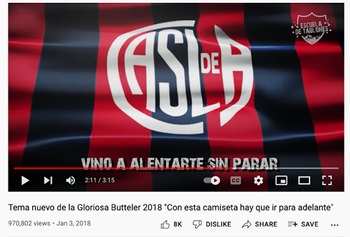
Social media has thus sustained and expanded the sociality of aguante's creativity. This digital relationality has nurtured processes of remediation – the act of repurposing media across different platforms.Footnote 31 In fact, many contrafacta have become media content that is consumed exclusively online. For example, Escuela de Tablones have videos with almost one million views that have never reached the stands (see Figure 3). In other words, hinchas flock to social media not only to learn but also to listen to chants.
(Colour online) Escuela de Tablones's YouTube video.

However, the messaging app has disruptive potential, too. As Arun writes, ‘it is possible that WhatsApp exacerbates and amplifies harmful speech’, thereby inciting violence.Footnote 32 In the aguante world, it has helped curate and make violent content viral.
The virality of violent media
I immediately regretted not having turned off the auto-download option while I shakily paused and deleted the video someone sent to the WhatsApp group. I had assumed that it was connected to the group's main purpose: coordinating the activities of an educational project for the children of Puente Alto, an impoverished neighbourhood in Santiago. Instead, the shared media showed U. de Chile people torturing a Colo-Colo hincha. It was the source of the memes of a naked, beaten-up man that had been circulating within the U. de Chile hinchada over the past couple of days. Like on Facebook, many hinchas celebrated the video and torture on the WhatsApp group. Some even asked why the tormentors did not kill the brutalized hincha – a member of a violent collective of the Colo-Colo hinchada. A,Footnote 33 a female hincha, eventually complained about the torture video, respectfully yet forcefully asserting that the WhatsApp ‘group was not created for sharing violence’. B, a male hincha notoriously known for his involvement in criminal and violent activity, defiantly responded, ‘Do you think they shouldn't have done it?’ C and D backed B, as the following exchange illustrates:
C: Glad those dogs got what they deserved.
D: More than happy. Actually, they should've got more.
C: I've fought face to face with those morons and they're pussies. I was lucky to make it [alive], otherwise who knows what would've happened.
B: [Clap emojis] That's why I asked. I don't know who sent that [message].
D: They should've stabbed his bare ass.
B: That fucker stabbed the guys in Russia during the World Cup. That fucker kidnaped X years ago and dropped him on the highway. That's why I'm asking the person who sent that message [why they said that].
C: I understand the way of thinking of those who don't share our way of living and that they would be surprised that something like this could happen. But you must understand that those morons are worse than that, brother.
B: I don't understand it. I think it sucks. [The person who sent the message] could snitch on us. Or something else.
A did not back down and kept condemning the act, adding that she did not want to get those kinds of videos on her phone. Nevertheless, the hinchas kept harassing A, who eventually decided to exit the WhatsApp group permanently, terminating her participation in the community project.
This pithy digital exchange illustrates that WhatsApp can help infect intimate spheres with destructive media. Focusing mainly on cyberbullying, media scholars have noted that the messaging app has contributed to violence by allowing abusers to intimately harass victims.Footnote 34 In the preceding instance, WhatsApp forced A to deal with the torture video and subsequent distressing conversation in the intimacy of her phone. Yet this violent intimacy not only infested her digital but also visceral world. After the digital conflict sparked by the polluted video, A left the group and ceased her participation in the educational initiative. She had previously told me that, until finding this fan project, she had found it difficult to navigate the hinchada's hyper-masculine networks. After finally carving a space for herself within the U. de Chile fanbase, she was once again ostracized due to the digital violence that intimately infested her phone.
The vignette also foregrounds that WhatsApp has permitted the aestheticization and virulent spread of violent media. Hinchas have taken advantage of the app's content-creation affordances and have turned warfare acts into finite expressions of expressive culture. While fights, tortures, and other violent practices used to be experienced only by perpetrators, bystanders, and targets, hinchas can now record and live stream these events, using them to later create memes, videos, and other forms of media content. It is well known that social media networks have contagiously platformed misinformation and hate speech despite, and sometimes because of, its algorithms and moderators.Footnote 35 Yet unlike other digital platforms, WhatsApp is an unmoderated network, allowing the free circulation of violent texts, images, memes, audios, and videos.Footnote 36 In so doing, the messaging app has created a digital infrastructure in which aestheticized expressions of aguante warfare have gone viral.
WhatsApp's unmoderated, creative, and repurposing affordances have also facilitated the infection of non-violent contrafacta with hostile meanings. David Novak has noted that remediation can unpredictively feed circulating media into new practices and expressions.Footnote 37 K. E. Goldschmitt has similarly highlighted the decontextualizing affordances of transmedia, showing that circulation can infect musical and football media with new meanings.Footnote 38 Although Trovazules and Escuela de Tablones, the two collectives discussed in this article, do not employ aggressive utterances in their lyrics, most hinchas in the Southern Cone do so – even when adapting the contrafacta of these non-violent groups. See, for instance, this arrangement made by the hinchada of Boca Juniors of one of Escuela de Tablones's chants:

Some contrafacta have been infected with discriminatory expressions, as well:

Thanks to digital media, hinchadas endlessly consume, recreate, and repurpose chants, inserting hate slurs, stories of combat, death threats, and other destructive utterances into originally non-violent compositions.
Although it may be tempting to assert that these utterances remain in the symbolic realm, they do have sociosonically destructive effects. In May 2017, for instance, the Afro-Colombian player Frank Fabra left the game between his squad Boca Juniors and Estudiantes de la Plata after the rival hinchada sang a racist chant against him for several minutes. As he later recognized in an interview, the sonic intensity and aural immersion created by the collective vocalization of the disruptive contrafactum overwhelmed him, breaking his poise.Footnote 39 Unfortunately, this is not an isolated case as several athletes have reacted similarly after being sonically targeted through discriminatory chants.
Although infected content is not always sonorous, chant remediation has uniquely contributed to the digital and material metastasis of aguante's lethal potentialities. The reflexive circulation of the aguante discourse has been significantly mediated by the consumption and repurpose of contrafacta – many of them contaminated with death threats, hatred slurs, and stories of combat, among other violent utterances. In resonating with contingent conditions of violence and alienation, sonic media has helped exacerbate local hostilities and subjectivities. When vulnerable organisms have reflexively engaged in the aguante discourse, they have frequently been sickened with extreme views – many of which portray others as radical alterities that must be violently dominated, if not exterminated. These radicalized groups engage in sonic and material conflict not only with rivals but also with peers – clashes that end up eroding both inter- and intra-group relationality. This virulent process began with analogue and face-to-face sonorous exchanges, but digital sounds have played an essential role in turning aguante into a pandemic force with the potential to destructively infect fan sociality both digitally and viscerally. The violent virality of aguante, in other words, is significantly sonic.
Divergent digital and legal infrastructures between the Global North and South partly inform aguante's destructive virality. Arun argues that weak legal safeguards and forms of conflict alien to northern developers make the southern populations vulnerable to the implementation of Artificial Intelligence (AI).Footnote 40 She writes:
[I]f privileged white men are designing the technology and the business models for AI, how will they design for the South? The answer is that they will design in a manner that is at best an uneasy fit, and at worst amplifies existing systemic harm and oppression to horrifying proportions.Footnote 41
The articles by Mike Levine and Anaar Desai-Stephens in this volume illustrate that uneven technological conditions in Cuba and India have enacted forms of virality that differ from those in Euro-America. Regretfully, creators in the Global North have designed their technologies without taking into account conditions of digital and material scarcity and inequality in the Global South. As Arun points out, tools such as WhatsApp, when ignoring contingent dynamics of hate, can exacerbate and amplify local inequities and modes of violence.Footnote 42 In the aguante context, the messaging app has created unmoderated channels where remediated tortures, unruly chants, death threats, and other forms of hostile content have infected disparate smartphones. WhatsApp's ubiquitous, unmoderated, and data-tracking affordances have intersected with larger dynamics of inaudibility in impoverished spaces – a disregard for the lives of the poor that has caused conflict to erupt into violence.Footnote 43 In this process, aguante's virality has become infectiously deadly – a destructive contagion that has eroded and sometimes destroyed social relationality not only digitally but also viscerally.
Digital violence underscores the destructive dimension of the virological metaphors commonly employed to discuss media circulation. Digital violence, like digital sounds, can be viral, contagious, infectious, and even pandemical. Martin Daughtry argues that ‘like sound, and in part through sound, violent acts are immersive and omnidirectional, enveloping perpetrators, bystanders, and targets into a single, expansive field of variegated and unpredictable effects’.Footnote 44 The resonance between sound and violence noted by Daughtry can also be expanded to social media, which can epidemically spread violence in myriad and unpredictable ways. As Manuel Castells aptly points out, the productive affordances of technology should not obscure its destructive potentialities.Footnote 45 In making this argument, I do not seek to excuse subjects from their role in the production and dissemination of violence, but rather underline the fact that social media has configured digital infrastructures upon which human-created content can easily go viral and contaminate social relationality both digitally and viscerally.
Conclusion
This article has discussed the social and anti-social affordances of WhatsApp. I have shown that the messaging app mediates musical creation in aguante, illustrating that a significant portion of the sociocreative relations involved in chant-creation occurs digitally nowadays. It affords the socially distanced distribution of creativity among hinchas, decentring it from solitary geniuses. In promoting sociocreative relations, WhatsApp has digitally expanded the musical sociality of hinchadas.
Yet the messaging app has also fostered anti-sociality in viral and intimate ways. Violent sounds, images, and videos have spread widely on WhatsApp. In many ways, WhatsApp has become more unmanageable, infectious, and ultimately more dangerous than any other social media. It is telling that most of the current disinformation circulating throughout Latin America spreads through the messaging app. WhatsApp illustrates that digital violence, like digital sounds, can be infectious.
This dialectic of sociality and anti-sociality departs from existing trends in sports and media studies. While football scholarship has overwhelmingly focused on the more violent aspects of supporter cultures, studies on digital music have mainly examined the socially productive potentials of circulation. If football fandom can be about sociality, digital contagion can also be about violence. Digital aguante ultimately illustrates the destructive and productive, social and anti-social, utopian and dystopian potentials of virality.