I. INTRODUCTION
Undoubtedly, steels are dominating industrial materials. Among them, stainless steels with notable mechanical properties and corrosion resistance are completely essential for using in tools, structural, and energy applications. These are due to the presence of alloying elements such as chromium and nickel, which make stainless steels quite distinct and superior from other grades of steels, especially at the harsh atmosphere and elevated temperature. Reference Plaut, Herrera, Escriba, Rios and Padilha1,Reference Movahedi-Rad, Plasseyed and Attarian2 Among the different grades of stainless steels, austenitic stainless steels such as AISI 321 and AISI 316 with high contents of Cr and Ni are wildly used in the industries at intermediate temperature (923–1073 K). Reference Peckner and Bernstein3 Recently, ferritic stainless steels like AISI 409 by offering lower costs than austenitic grades, due the absence of nickel element and offering lower expansion coefficient than austenitic steels, as a great advantage when temperature cycling resistance is needed, have been developed. Reference Badin, Diamanti, Forêt and Darque-Ceretti4–Reference Huntz, Reckmann, Haut, Sévérac, Herbst, Resende and Sabioni6
The presence of heavy oxidation at the elevated temperature can cause degradation of the materials and excessive metal temperature during the operation. It is because of the lower thermal conductivity of oxides in comparison to the steels and may cause creep damage and structural degradation. Reference Movahedi-Rad, Plasseyed and Attarian2,Reference Becker and Shipley7 In addition to the temperature, there are some other factors, which are effective on the oxidation behavior of steels. For example, chemical composition of material and gas, the rate of gas flow, surface preparation, and pretreatment, which are effective on the oxidation behavior of steels. Reference Von Fraunhofer and Pickup8 Therefore, attempts have been made to identify the oxide behavior at different conditions. In Fe–Cr alloys, oxide layers of Cr2O3 and Cr2O3/Fe2O3 are formed, which are the main protective factor. Reference Kvernes, Oliveira and Kofstad9 There are researches in the literature, which studied the high-temperature oxidation behavior of the stainless steels. Reference Huntz, Reckmann, Haut, Sévérac, Herbst, Resende and Sabioni6,Reference Von Fraunhofer and Pickup8,Reference Kvernes, Oliveira and Kofstad9 High-temperature oxidation in air of Fe–13Cr–xAl alloys containing up to 4.5Al has been studied in the temperature range 953–1253 K studied by Kvernes et al. Reference Kvernes, Oliveira and Kofstad9 They showed that additions of Al modify the oxidation behavior and at sufficiently high Al concentrations, protective scales of Al2O3 are found. Recently, the oxidation behavior of the stainless steel 441 was investigated at a temperature range of 873–1223 K. Reference Chen, Wang, Li, Chou and Sun10 It was observed that the initial kinetic oxidation process of stainless steel 441 in pure oxygen atmosphere could be divided into a quick linear oxidation stage, followed by a diffusion-controlled stage at 873–1073 K and an interface reaction controlled stage at 1173–1223 K. The influence of the oxidation environment on oxidation behavior has been considered as objective in some papers. Reference Sabioni, Huntz, Luz, Mantel and Haut11–Reference Carvalho, Costa, Cota and Rossi13 Sabioni et al. Reference Sabioni, Huntz, Luz, Mantel and Haut11 reported a comparative study of high-temperature oxidation behavior in AISI 304 and AISI 439 stainless steels performed between 1123 and 1223 K, in oxygen and Ar–H2–H2O atmospheres. Based on their experiments it was shown that oxidation resistance of the AISI 439 does not depend on the atmosphere, however, the oxidation behavior of AISI 304 is temperature dependent and at temperatures higher than 1223 K, the oxidation rate dramatically increases in oxygen atmosphere, in comparison to that observed in Ar–H2–H2O atmosphere. In the other studies by Huntz et al. Reference Huntz, Reckmann, Haut, Sévérac, Herbst, Resende and Sabioni6 and Carvalho et al., Reference Carvalho, Costa, Cota and Rossi13 the kinetics and oxide morphology of ferritic and austenitic stainless steels in a temperature range of 1123 K and 1223 °C, in two atmospheres of oxygen and Ar were investigated.
To the best knowledge of the author, the comparative study of AISI 321, AISI 316, and AISI 409 at high temperatures during prolongated periods has not yet been reported. Therefore, the aim of this work is to study the high-temperature oxidation behavior of two austenitic stainless steels of AISI 304 and AISI 304, and one AISI 409 ferritic stainless steel at 873 K by measuring the variation of mass and thickness of oxides during the oxidation for kinetic studies. In addition, the formation of oxide layers is explained from thermodynamical perspectives. Furthermore, scanning electron microscope (SEM) and corresponding energy dispersive x-ray spectroscopy (EDS) are used to evaluate the thickness and chemical composition of oxide layers. At the ends, the diffusion reaction of oxides is also studied to justify the difference in the thickness of oxide layers.
II. EXPERIMENTAL
To compare the oxidation behavior of three commonly used stainless steels (AISI 321, AISI 316, and AISI 409), at first, their actual chemical compositions were determined by using spectroscopy method. After that, three steel samples with the dimensions of 7.5 mm × 10 mm × 1 mm were prepared. Then, the samples were cleaned by acetone, weighted, and placed in the furnace for 72, 342, 1022, and 1202 h and then left out. The temperature of furnace was 873 K and remained constant during the tests at air atmosphere. Subsequently, to measure the oxide weight, the samples were cleaned with 10% chloride acid solution until their weight did not change significantly. In this case, to prevent possible corrosion of steels, hexamine was used as an inhibitor. Some samples were prepared for oxidation characterization by polishing technique. To do so, samples were sectioned and mounted by epoxy resin. Afterward, they were subjected to a fine abrasive lap grinding and subsequent 1 μm diamond paste polishing. To observe the oxide layers and determine the evolution of oxide formation at different holding times by means of SEM and EDS.
III. RESULTS AND DISCUSSION
A. Kinetic of oxidation (oxidation resistance)
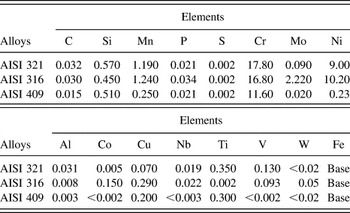
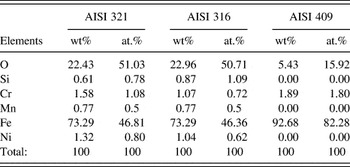
To study the kinetic of oxidation of stainless steels, at first, the actual chemical composition of two austenitic stainless steels (AISI 321 and AISI 316) and a ferritic stainless steel (AISI 409) is determined by spectroscopy method and summarized in Table I. As can be seen, the Cr content is higher in austenitic stainless steels and AISI 321 has the highest Cr content. In addition, the Ni content is also very much higher in two austenitic stainless steels in comparison to the ferritic one. Chemical composition of AISI 321, AISI 316, and AISI 409 stainless steels.
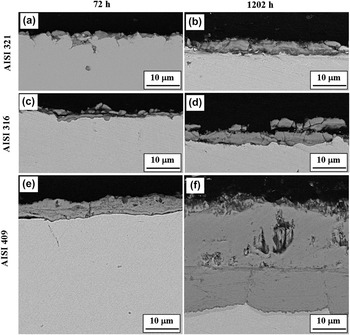
As a next step, all samples were placed in the furnace for 72, 342, 1022, and 1202 h at the temperature of 873 K in air atmosphere. According to SEM observation, oxide layers were formed with different thicknesses, depending on the alloy type and oxidation time. Figure 1 shows the SEM micrographs of oxide layer of three stainless steels after 72 and 1202 h holding under oxidation conditions. It is seen that the oxide thickness is thicker in AISI 409 ferritic stainless steel in comparison with two other austenitic stainless steels at both 72 and 1202 h oxidation times. In addition, the presence of cracks is evident in oxide layers of austenitic stainless steels, which can be related to their low thermal shock resistivity. On contrary, due to the lower coefficient of thermal expansion in ferritic stainless no significant crack is observed. Reference Huntz, Reckmann, Haut, Sévérac, Herbst, Resende and Sabioni6
SEM micrographs of oxide layer after 72 and 1202 h holding under oxidation conditions, (a and b) AISI 321, (c and d) AISI 316, and (e and f) AISI 409 stainless steels.

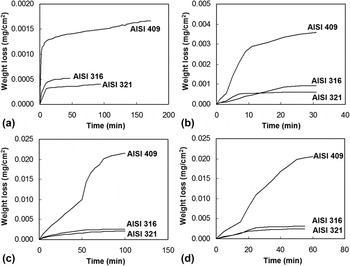
As already explained, the weight of oxide layers was measured. Figure 2 shows the variation of weight loss against cleaning time for all alloys. As can be seen, the curves reach steady state and become straight, which shows that there is no oxide layer on the surface of samples. However, in the case of ferritic stainless steel, the data present a slope which becomes lower with the increase of the time, and at the end a small slope is observed. SEM observation after the clearing process shows that there are some very thin (≈1 μm) oxide layers, which are distributed sparsely in intrusion parts of surface. It is suggested that this small slope in ferritic stainless steel can be attributed to very gradual cleaning of this part of oxide layers. However, it is thought that weight of such thin oxide layers is negligible.
The variations of weight loss per surface area against cleaning time at different holding times of (a) 72, (b) 342, (c) 1022, and (d) 1202 h in three stainless steels.

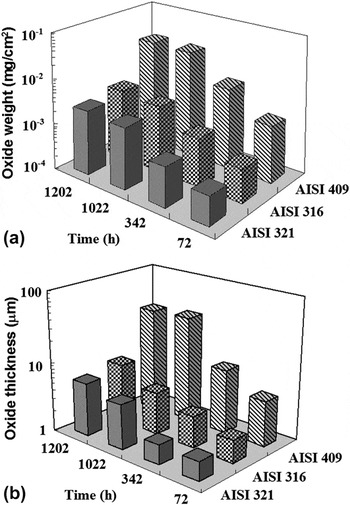
Based on the SEM observations and weight measurements, the variation of oxide mass and thickness for three alloys at four holding times are illustrated in the three-dimensional plots in Figs. 3(a) and 3(b), respectively. In all samples, with increasing holding time, the thicker and heavier oxide layers are formed. It is seen, there is a huge difference in the thickness and mass of oxide layers between austenitic stainless steels and ferritic stainless steel. In this case, the thicker and heavier oxide layers are related to the ferritic stainless steel after 1202 h. Therefore, it is clear that the oxidation resistance of ferritic stainless steel is much lower than austenitic ones. These results are further used to determine the kinetic behavior of oxide layers in stainless steels.
Three-dimensional plots of (a) oxide mass variations and (b) oxide thickness variations at different oxidation times in three stainless steels.

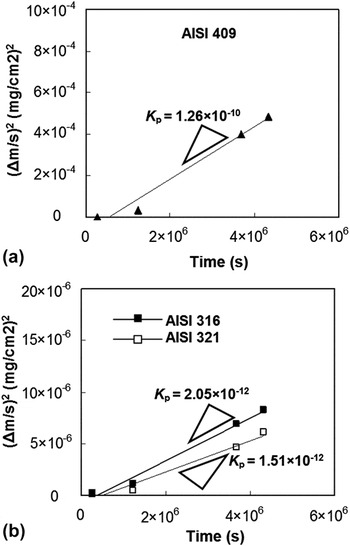
In this research, to find the oxidation mechanism, the best fit of the experimental data has been found in quadratic coordinates. Figures 4(a) and 4(b) show the square variation of mass per surface area (Δm/s)2 versus oxidation time (t) for ferritic and austenitic stainless steels. It is seen that there is a linear relationship between (Δm/s)2 and (t) in all cases. This demonstrates that the kinetic of oxidation for three stainless steels follows a parabolic relationship based on the Eq. (1):
 $${\left( {{{\Delta m} \over s}} \right)^2} = {k_{\rm{p}}}t\quad ,$$
where k p is parabolic oxidation constant. The k p can be obtained by using of least squares method as a procedure to determine the best fit line to experimental data. Accordingly, the k p values for AISI 321, AISI 316, and AISI 409, are 1.51 × 10⁻¹², 2.05 × 10⁻¹², and 1.26 × 10⁻¹⁰ (mg2/cm4 s), respectively. So, AISI 409 shows the highest and AISI 321 shows the lowest k p values. The parabolic oxidation rate law suggests that the oxidation behavior of three alloys is ionic diffusion-controlled oxidation as a non-steady-state diffusion-controlled reaction. This behavior corresponds to ohmic related mechanism in which ions diffuse thorough the point defects and the thickness of the formed oxide layer is directly proportional to oxidation time. Similarly, Huntz et al. Reference Huntz, Reckmann, Haut, Sévérac, Herbst, Resende and Sabioni6 reported that AISI 439 ferritic stainless steel obeyed parabolic relationship from 1123 to 1223 K. However, Carvalho et al., Reference Carvalho, Costa, Cota and Rossi13 reported a linear relationship for both AISI 304 austenitic stainless steel and AISI 430 ferritic stainless steel in the temperature range of 1373–1473 K.
The square variation of mass per surface area (Δm/s)2 versus oxidation time (t) in (a) AISI 409 ferritic stainless steel and (b) AISI 316 and AISI 321 austenitic stainless steels.

B. Characterization of oxide layers
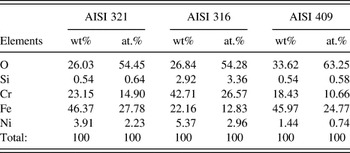
The EDS analysis of oxide layers in samples after 72 h of being under oxidation condition are listed in Table II. It is clear that the oxidation films are mainly composed of iron oxide. However, a little Cr in three alloys and Ni in two austenitic stainless steels are also detected. Regarding the chemical composition of oxide films, it should be noted that quantitative EDS results may be over estimated for the Fe, Cr, and Ni elements in all cases. This can be due to the large interaction volume of electron beam with the substrate, which leads to the emission of x-ray from material from both substrate and oxide layer.
Chemical composition of oxide layers after 72 h holding under oxidation condition.

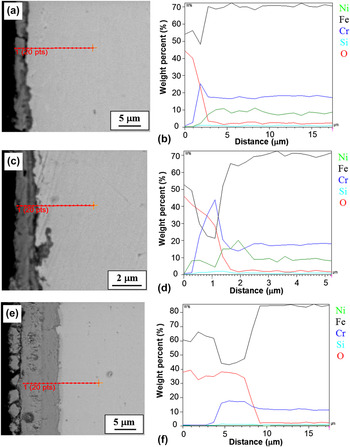
Further investigation of Fe, Cr, Ni, Si, and O elemental distributions from the matrix to oxide layers after 342 h of being under oxidation condition was performed by SEM and corresponding and line scan analysis as presented in Fig. 5. It is seen in the SEM micrographs, unlike the previous conditions, the oxide layers are composed of two internal and external oxide layers in three alloys. However, both oxide layers in AISI 409 are much thicker than two oxide layers in austenitic stainless steels. The result of the line scan shows uneven distribution of atoms in the oxide layers. In all cases, by proceeding from the metallic substrate toward the internal oxide layer, at first, the concentration of Fe element decreases and the concentration of Cr element increases. By conditioning and approaching to the external oxide layer, the concentration of Fe element increases, and the concentration of Cr and Ni elements reaches zero. Furthermore, in austenitic stainless steels, a slightly higher concentration of Ni is observed near the oxide/metal interface in non-oxide area. The detailed chemical composition of internal oxide layers for three stainless steels is summarized in Table III. Based on the EDS results of the three alloys, (Fe,Cr) spinal composition with a chemical composition of (Fe,Cr)2O3 is suggested for the internal oxide layer in three alloys. Cr2O3 is the most stable oxide for enhancing oxidation resistance, however, to have a continuous oxide film of Cr2O3, a minimum Cr concentration is required, which will be discussed in Sec. III. C. In addition, a small amount of Ni and Si is detected in the internal oxide layers. The formation of oxide layer with similar chemical composition has been reported in the literature. Reference Huntz, Reckmann, Haut, Sévérac, Herbst, Resende and Sabioni6,Reference Kvernes, Oliveira and Kofstad9,Reference Knoll, Smigiel, Broll and Cornet14 According to the EDS results, iron oxide (Fe2O3) is proposed for external oxide layer of stainless steels. By comparing the chemical composition of oxide layers at 72 and 342 h, it can be concluded that the chromium oxide in the internal oxide layer has been formed during the oxidation and after iron oxide formation.
SEM micrographs and corresponding line scan analysis results of (a and b) AISI 321, (c and d) AISI 316, and (e and f) AISI 409 stainless steels, after 342 h holding under oxidation condition.

Chemical composition of internal oxide layers after 324 h holding under oxidation condition.

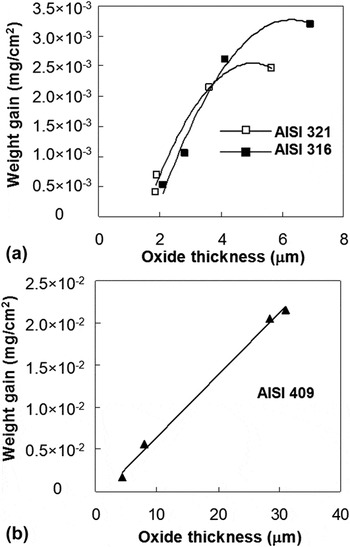
Figure 6 shows the variation of oxide weight against oxide thickness. As can be seen, in the austenitic stainless steels, there is not a linear relation between oxidation thickness and oxidation weight, but it is linear in ferritic stainless steel. This nonlinear relationship in austenitic stainless steels can be related to the crack formation during the cooling process. However, there is no significant crack in ferritic stainless, as shown in Fig. 1, which causes a linear relationship between oxidation thickness and oxidation weight.
The variations oxide weights against oxide thickness in (a) AISI 316 and AISI 321 and (b) AISI 409 stainless steels.

C. Oxidation mechanism
Concerning the oxidation of stainless steels, several mechanisms have been suggested. Reference Knoll, Smigiel, Broll and Cornet14 It has been generally accepted that the initial step in the oxidation is metal-oxygen reaction in which some gases are adsorbed on the metal surface. Then, individually separated oxide nuclei are formed and laterally grown to form a continuous oxide film on the metal surface. At this stage, the metal and gas have been separated by oxide layer and reaction mechanism totally changes and proceeds by solid-state diffusion. Reference Knoll, Smigiel, Broll and Cornet14 Based on the EDS results, after 72 h of being exposed at 923 K, iron oxide is formed in the three stainless steels. Due to the presence of diverse alloying elements in alloys, the oxidation of alloys generally produces more than one oxide. In this case, first, the least noble alloying element is oxidized as a result of selective oxidation. The formation of iron oxide can be explained by Ellingham diagram as a very helpful display for comparing the preferentiality of one oxide over others. With increasing oxidation time, internal Cr-rich oxide layers are observed in all alloys as shown in Fig. 5. However, the thickness of internal oxide layer in ferritic AISI 409 stainless steel is much thicker in comparison to other austenitic stainless steels. The formation of internal oxide layer can be related to occurrence of selective oxidation, which leads to IOZ formation. Selective oxidation is a process in which oxygen diffuses into an alloy and causes subsurface precipitation. Reference Birks, Meier and Pettit15
To certify the formation of IOZ, some necessary conditions should be fulfilled. First, from the thermodynamical perspective, the value of standard Gibbs free energy (ΔG 0) of formation (per mole O2) for the solute metal oxide must be more negative than ΔG 0 of formation (per mole O2) for the base metal. Reference Birks, Meier and Pettit15 The oxide formation reactions and corresponding ΔG 0 values are given in Eqs. (2)–(4).
 $${4 \over 3}{\rm{Fe}}{}_{{\rm{(s)}}} + {{\rm{O}}_{\rm{2}}}_{{\rm{(g)}}} = {2 \over 3}{\rm{F}}{{\rm{e}}_{\rm{2}}}{{\rm{O}}_{\rm{3}}}_{{\rm{(s)}}},\quad \Delta {G_0} = - 385.55\;{\rm{kJ/mol}}\quad {\rm{,}}$$
 $${4 \over 3}{\rm{Cr}}{}_{{\rm{(s)}}} + {{\rm{O}}_{\rm{2}}}_{{\rm{(g)}}} = {2 \over 3}{\rm{C}}{{\rm{r}}_{\rm{2}}}{{\rm{O}}_{\rm{3}}}_{{\rm{(s)}}},\quad \Delta {G_0} = - 593.78\;{\rm{kJ/mol}}\quad {\rm{,}}$$
 $${2 \over 3}{\rm{Cr}}{}_{{\rm{(s)}}} + {2 \over 3}{\rm{Fe}}{}_{{\rm{(s)}}} + {{\rm{O}}_{\rm{2}}}_{{\rm{(g)}}} = {1 \over 3}{{\rm{(Fe,Cr)}}_{\rm{2}}}{{\rm{O}}_{\rm{3}}}_{{\rm{(s)}}},\quad \Delta {G_0} = - 489.66\;{\rm{kJ/mol}}\quad {\rm{,}}$$
As can be seen, the Cr-containing oxides are more negative than Fe2O3. Secondly, the formation free energy of (Fe,Cr)2O3 oxide formation (
 $\Delta {G_{{{{\rm{(Fe,Cr)}}}_{\rm{2}}}{{\rm{O}}_{\rm{3}}}}}$
) must be negative. The value of ΔG is calculated for
 $2{\rm{Cr}}{}_{{\rm{(s)}}} + 2{\rm{Fe}}{}_{{\rm{(s)}}} + 3{{\rm{O}}_{\rm{2}}}_{{\rm{(g)}}} = {{\rm{(Fe,Cr)}}_{\rm{2}}}{{\rm{O}}_{\rm{3}}}_{{\rm{(s)}}}$
reaction as shown in Eq. (5) for three stainless steels.
 $$\Delta G = \Delta {G_0} - RT\,{\rm{ln}}\left( {{{{a_{{{{\rm{(Fe,Cr)}}}_{\rm{2}}}{{\rm{O}}_{\rm{3}}}}}} \over {{a_{{\rm{Cr}}}}^2{a_{{\rm{Fe}}}}^2{p_{{{\rm{O}}_{\rm{3}}}}}^3}}} \right)\quad ,$$
where R is gas universal constant, T is temperature,
 ${P_{{{\rm{O}}_{\rm{2}}}}}$
is the oxygen pressure, and a is the activation for indexed materials. The calculated values are −67399.91, −64972.80, and −63964.10 (kJ/mol) for AISI 409, AISI 316, and AISI 321, respectively. It should be stated that the mentioned thermodynamical calculations refer to the equilibrium not for our experiments. However, due to the very long oxidation time, it can be assumed that oxidation has happened close to equilibrium condition. Moreover, these calculations can be considered as an explanation, which is in good consistence with experiments. Another point is the minimum chromium content in steels for having a protective continuous stable oxide film. Wagner
Reference Wagner16
derived an equation to determine minimum chromium content in steels for leading to the formation of a protective film as an essential factor for improvement oxidation resistance. In other words, the formation of a continuous film of Cr2O3 is possible if the Cr content is higher than a critical point (
 $N_{{\rm{Cr}}}^{{\rm{min}}}$
), which is described by the following equation
Reference Huntz17
:
 $$N_{{\rm{Cr}}}^{{\rm{min}}} = F{\left( {{1 \over 2}{{{K_{\rm{c}}}({\rm{C}}{{\rm{r}}_{\rm{2}}}{{\rm{O}}_{\rm{3}}})} \over {\tilde D}}} \right)^{1/2}}\quad ,$$
in which F is:
 $$F(x) = {\pi ^{1/2}}x(1 - {\rm{erf}}(x))\exp ({x^2}),\;{\rm{and}}\;{\rm{erf}}(x) = {2 \over {\sqrt \pi }}\int_0^x {{{\rm{e}}^{ - {x^2}}}{\rm{d}}x} \quad ,$$
and K
c(Cr2O3) is the oxidation constant and
 $\tilde D$
is the interdiffusion coefficient in the FeCr based substrate. The diffusion coefficients for ferritic and austenitic stainless steels are calculated from the equation, which has been suggested by William and Faulkner.
Reference Williams and Faulkner18
They determined the chemical diffusion coefficients for chromium in austenitic and ferritic steels by using electron probe microanalysis techniques as shown for ferritic stainless steel [Eq. (8)] and austenitic stainless steel [Eq. (9)].
 $${\tilde D_\alpha } = 0.15\,\exp \left( {{{ - 210 \pm 15} \over {RT}}} \right)\;{\rm{c}}{{\rm{m}}^{\rm{2}}}\;{\rm{s}}{{\rm{}}^{ - 1}}\quad ,$$
 $${\tilde D_\gamma } = 0.15\,\exp \left( {{{ - 246 \pm 16} \over {RT}}} \right)\;{\rm{c}}{{\rm{m}}^{\rm{2}}}\;{\rm{s}}{{\rm{}}^{ - {\rm{1}}}}\quad .$$
In which
 ${\tilde D_\alpha }$
and
 ${\tilde D_\gamma }$
are the diffusion coefficient Cr element in ferritic and austenitic steels, respectively. Another term in Eq. (6), K
c, is calculated according to the Eq. (10) for chromium oxide (Cr2O3):
 $${K_{\rm{c}}} = {\left( {{{{M_{{\rm{C}}{{\rm{r}}_{\rm{2}}}{{\rm{O}}_{\rm{3}}}}}} \over {b{\rho _{{\rm{C}}{{\rm{r}}_{\rm{2}}}{{\rm{O}}_{\rm{3}}}}}{M_{\rm{O}}}}}} \right)^2}{K_{\rm{p}}}\quad ,$$
where
 ${M_{{\rm{C}}{{\rm{r}}_{\rm{2}}}{\rm{O}}{}_{\rm{3}}}}$
and M
O are, respectively, the molar mass of the chromium oxide and the oxygen atom; b is the number of the oxygen atoms, and
 ${\rho _{{\rm{C}}{{\rm{r}}_{\rm{2}}}{\rm{O}}{}_{\rm{3}}}}$
is the oxide density (5.21 g/cm3). Our calculation shows that the ratio of minimum chromium content in ferritic stainless steel over austenitic stainless steel (
 ${{N_{{\rm{Cr}}}^{{\rm{min(}}\alpha {\rm{)}}} } \mathord{\left \sol {\vphantom {{N_{{\rm{Cr}}}^{{\rm{min(}}\alpha {\rm{)}}} } {N_{{\rm{Cr}}}^{{\rm{min(}}\gamma {\rm{)}}} }}} \right. \kern-\nulldelimiterspace} {N_{{\rm{Cr}}}^{{\rm{min(}}\gamma {\rm{)}}} }}$</tex-math>$
) is equaled to 1.23. Therefore, it can be concluded that for having a continuous film of chromium oxide in AISI 409 ferritic stainless steel, higher amount of chromium is needed. In other words, the reaction front should penetrate more for providing enough amount of Cr content, which resulted in thicker oxide layer. This is in consistent with the thickness of oxide layers as shown in Fig. 1 in which the penetration depth of IOZ in AISI 409 stainless steel is much higher than two other austenitic stainless steels. The main reasons for thicker oxide layer are attributed to the lower Cr content and higher diffusion coefficient in ferritic stainless steel. Therefore, it can be suggested that in austenitic stainless steels due to the lower
 $N_{{\rm{Cr}}}^{{\rm{min}}}$
value, the continuous oxide Cr2O3, which is the main key for enhancing the oxidation resistance, is formed faster than ferritic stainless steel. As a result, in these alloys, the external oxide layers do not considerably grow. Consequently, the superior oxidation resistance of austenitic stainless steels in comparison to the ferritic stainless steel is related to the higher Cr content.
The thicker oxide layer in ferritic stainless steel can be also explained by using quasi-steady-state approximation, in which the concentration of oxygen obeys a linear relation across the IOZ in the planar specimen geometry. In this case, it is rational to take the flux across the given plane to be proportional to the concentration gradient across the IOZ and this can be described by using empirical equation of Fick's first law.
Reference Shewmon19
If the x axis is taken parallel to the concentration gradient of component i,
 ${{\partial C} \mathord{\left/ {\vphantom {{\partial C} {\partial x}}} \right. \kern-\nulldelimiterspace} {\partial x}}$
, the flux of component, J
i
, can be described by the Eq. (11),
 $${J_i} = - {D_i}\left( {{{\partial {C_i}} \over {\partial {x_i}}}} \right)\quad ,$$
where D i is the diffusion coefficient. For our case, the oxygen flux through the IOZ can be obtained by rewriting Fick's first law equation, in following form. Reference Birks, Meier and Pettit15
 $${J_{\rm{O}}} = {D_{\rm{O}}}{{N_{\rm{O}}^{{\rm{Matrix}}}} \over {x{V_{\rm{m}}}}}\quad ,$$
where D
O is the diffusivity of oxygen in the ferritic or austenitic steel (cm2/s),
 $N_{\rm{O}}^{{\rm{Matrix}}}$
is the oxygen solubility in ferritic or austenitic steel, V
m is the molar volume of the solvent metal or alloy (cm3/mol), and x is the penetration depth of the IOZ. By assuming that the counter diffusion of the Cr atoms is negligible, the penetration depth of IOZ can be demonstrated as the following equation
Reference Birks, Meier and Pettit15
:
 $$x = {\left( {{2 \over \nu }{{N_{\rm{O}}^{{\rm{Matrix}}}{D_{\rm{O}}}} \over {N_{{\rm{Cr}}}^{{\rm{Initial}}}}}t} \right)^{1/2}}\quad ,$$
where t is time, the ν is the coefficient of oxygen in oxidation reaction of B + νO = BOν, and
 $N_{{\rm{Cr}}}^{{\rm{Initial}}}$
is the initial solute concentration. So, the proportion of penetration depth of IOZ in ferritic and austenitic stainless steels can be expressed by Eq. (14).
 $${{{x_\alpha }} \over {{x_\gamma }}} = {\left( {{{N_{\rm{O}}^{{\rm{Matrix(}}\alpha {\rm{)}}}N_{{\rm{Cr}}}^{{\rm{Initial(}}\gamma {\rm{)}}}} \over {N_{{\rm{Cr}}}^{{\rm{Initial(}}\alpha {\rm{)}}}N_{\rm{O}}^{{\rm{Matrix(}}\gamma {\rm{)}}}}}{{D_{\rm{O}}^\alpha } \over {D_{\rm{O}}^\gamma }}} \right)^{1/2}}\quad ,$$
where
 $N_{\rm{O}}^{{\rm{Matrix(}}\alpha {\rm{)}}}$
and
 $N_{\rm{O}}^{{\rm{Matrix(}}\gamma {\rm{)}}}$
are the oxygen solubility in ferritic and austenitic matrix, and
 $N_{{\rm{Cr}}}^{{\rm{Initial(}}\alpha {\rm{)}}}$
and
 $N_{{\rm{Cr}}}^{{\rm{Initial(}}\gamma {\rm{)}}}$
are the initial concentration of Cr element in ferritic and austenitic alloys. These values can be estimated by using EDS results. Furthermore, it is assumed that the diffusion coefficient of oxygen in ferritic stainless steel is approximately 10 times greater than austenitic matrix.
Reference Sabioni, Huntz, Luz, Mantel and Haut11
Our calculations show that the proportion of penetration depth of IOZ in AISI 409 over AISI 316, and AISI 409 over AISI 321 are 3.21 and 3.46, respectively, which are in good agreement with our SEM observations (Fig. 1). However, the reasons for differences between calculations and observations might be the detachment of loose sheets of scales during preparation process of samples. In addition, this can be related to the ignorance of Ni effect and other elements on the diffusion process.
IV. CONCLUSIONS
In this paper, the oxidation behaviors of AISI 321, AISI 316, and AISI 409 stainless steels were studied at 873 K for 72, 342, 1022, and 1202 h. The mass and thickness of formed oxides were compared. It was observed that their masses and thicknesses increased with oxidation time. In addition, among them, it was observed that the oxidation rate and oxide thickness of the AISI 409 ferritic stainless steels were considerably higher in comparison with two other AISI 316. Moreover, AISI 321 austenitic stainless steels and AISI 321 demonstrated the lowest oxide mass and thickness, which showed the higher oxidation resistance. These data were taken into account for further kinetical and thermodynamical calculations. From the kinetical point of view, the ionic diffusion-controlled oxidation due to the parabolic oxidation relationship was suggested as an oxidation mechanism for three stainless steels. In all cases, two oxide layers were identified, which showed the formation of the IOZ. It was observed that the IOZ was Cr-rich and its formation was explained based on the Gibbs free energy expressions. However, it was observed that in the ferritic stainless steel, IOZ layer was thicker than austenitic stainless steels. To justify this observation, the minimum chromium content for having a continuous film of protective oxide was calculated. It was shown that in ferritic stainless steel, it was higher than that in austenitic stainless steels, which meant more penetration of the reaction front for providing enough amount of Cr content. This finding was also supported by quasi-steady-state approximation based on the Fick's first law.