Introduction
The adenoids are a single, pyramid-shaped aggregation of lymphoid tissue in the nasopharynx which is present at birth. This lymphoid structure undergoes hypertrophy until about seven years of age, at which point it begins to atrophy and continues to do so until it almost invariably disappears in adulthood.
When enlarged, adenoids can obstruct the nasopharyngeal airway, and cause nasal obstruction, mouth breathing, rhinorrhoea, snoring and hyponasal voice. Obstructive adenoids also cause cough, restless sleep, enuresis, daytime sleepiness, morning headache, dry mouth, halitosis, swallowing difficulty, behavioural difficulties and craniofacial growth abnormality (adenoid facies). In more serious cases, obstructive sleep apnoea (OSA) may result, which carries the potential risk for neurocognitive disturbance, growth failure and cor pulmonale.Reference Guilleminault, Korobkin and Winkle1 It has been estimated that 71.43 per cent of children younger than three years of age may experience apnoea or hypopnoea associated with obstructive adenoids.Reference Bitar, Rahi, Khalife and Madanat2 The incidence of obstructive adenoids among children referred with chronic nasal obstruction to a specialist has been estimated to be 57.7 per cent.Reference Bitar, Berawi, Youssef and Fuleihan3
Mometasone furoate is a potent 17-heterocyclic corticosteroid formulated in an aqueous suspension for intranasal use. Mometasone has lower bioavailability, extensive first-pass metabolism and a relatively higher binding affinity for the glucocorticoid receptor than other intranasal corticosteroids.Reference Zitt, Kosoglou and Hubbell4 There is no clinical evidence that mometasone furoate nasal spray suppresses the function of the hypothalamic–pituitary–adrenal axis when administered at clinically relevant doses of 100–200 µg per day.Reference Zitt, Kosoglou and Hubbell4 The most common local adverse effects associated with mometasone intranasal spray are irritation of the nose and throat, crusting, transient dryness, and epistaxis. The incidence of epistaxis in children and adolescents ranges from less than 2 per cent to 12 per cent.Reference Sastre and Mosges5
A double-blind, prospective, randomised study was carried out in light of the potential clinically relevant benefits and relatively good tolerability of mometasone intranasal spray.
Materials and methods
This prospective, randomised, double-blind, interventional placebo-controlled study comprised 100 patients with symptoms of adenoidal hypertrophy who attended the Department of Otorhinolaryngology and Head and Neck Surgery, Lady Hardinge Medical College and associated Kalawati Saran Children's Hospital, New Delhi, India. The study was approved by the institutional ethical committee.
The patients (consisting of both sexes) were aged 2–12 years. All had grade 3 or 4 adenoidal hypertrophy according to the Cassano et al. classification.Reference Cassano, Gelardi, Cassano, Fiorella and Fiorella6 The patients had suffered with symptoms for at least three months, with no response observed to medical treatment. The patients were enrolled between November 2011 and March 2013. Written informed consent was obtained from the parents or caregivers prior to enrolment.
The exclusion criteria were: previous adenoidectomy; use of intranasal topical or systemic steroids in the previous year; associated marked tonsillar hypertrophy; anatomical deformity of the nose, or sinonasal disease such as nasal polyposis or inferior turbinate hypertrophy; craniofacial abnormalities such as cleft lip or cleft palate; genetic diseases such as Down syndrome; acute upper respiratory infection within two weeks of enrolling in the study; and any clinically significant metabolical, cardiovascular, neurological, haematological, gastrointestinal, cerebrovascular or respiratory disease.
A detailed history was obtained and ENT examination performed at the first visit. Clinical grading of symptom scores was conducted, with grades ranging from 0 to 3 (0 = absent, 1 = occasional, 2 = frequent, and 3 = daytime and night-time symptoms). This enabled assessment of the degree of nasal obstruction, rhinorrhoea, cough, snoring and OSAReference Berlucchi, Salsi, Valetti, Parrinello and Nicolai7 at the first, pre-treatment visit, and at the 8-week and 24-week post-treatment visits.
Patients were subjected to nasopharyngoscopy conducted under local anaesthetic (lignocaine spray, 15 per cent) or sedation with midazolam if required, using a rigid (2.7–4 mm diameter) Karl Storz nasal telescope. The endoscopy was videotaped and stored (using the Advanced Interface Database Application), and still photographs were taken from the video. The grading of adenoidal hypertrophy was performed as described by Cassano et al.Reference Cassano, Gelardi, Cassano, Fiorella and Fiorella6
The children included in this study were randomly divided into two groups (study group and control group) by chit selection. The study group received an initial treatment of two puffs of mometasone furoate nasal spray (50 µg per puff) in each nostril once a day, a total of 200 µg per day for the first eight weeks. This was followed by a maintenance dose of 2 puffs of mometasone furoate nasal spray in each nostril on alternate days for 16 weeks. The control group received an initial treatment of 2 puffs of saline nasal spray in each nostril once a day for 8 weeks, followed by 2 puffs of saline nasal spray on alternate days for 16 weeks.
Patients were followed up every 2 weeks for the first 8 weeks, and were subsequently followed up monthly for the next 16 weeks. Patients' medication bottles were checked at each visit for compliance with therapy, and any local adverse effects were recorded.
After completion of therapy, the clinical outcome was assessed in terms of changes in symptom scores and adenoid size. Quality of life was assessed using the Glasgow Children's Benefit Inventory at the 24-week post-treatment visit.Reference Kubba, Swan and Gatehouse8
Statistical analysis
Observations were recorded on a pre-designed proforma and these data were subsequently transferred to a Microsoft Excel spreadsheet. After verification, data analysis was conducted using SPSS® 19.0 software. Observation findings were described in terms of mean, median, standard deviation and 95 per cent confidence interval for the continuous data. Symptoms and nasopharyngoscopic grade (quantitative data) were compared between groups using the Student's t-test. The qualitative data, adenoidal-nasopharyngeal (AN) ratio, nasopharyngoscopic value and change in quality of life, were compared between groups using the chi-square test and Fisher's exact test. A p value of less than 0.05 was considered statistically significant.
Results
Initially, 120 patients between the ages of 2 and 12 years were enrolled in this prospective, randomised, double-blind study. Of these, 20 children were lost to follow up and their data were not included in the analysis. Of those 20 children, 9 were in the study group while 11 were in the control group. Twelve of the patients opted out of the study in the first month, five patients were not compliant with the therapy, two patients stopped treatment after three months when the symptoms resolved and one patient suffered a road traffic accident.
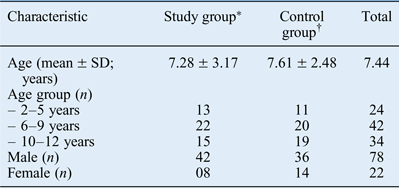
The maximum incidence of adenoidal hypertrophy for the remaining 100 children was seen in the 6–9 year age group (42 per cent), with a mean age of 7.4 years (Table I).
Patient distribution according to age and sex

*n=50; †n = 50. SD = standard deviation
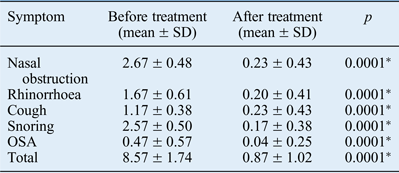
In the study group, after 24 weeks of treatment, there were statistically significant reductions in symptom scores for nasal obstruction (2.67 to 0.23; p = 0.0001), rhinorrhoea (1.67 to 0.20; p = 0.0001), cough (1.17 to 0.23; p = 0.0001), snoring (2.57 to 0.17; p = 0.0001), OSA (0.47 to 0.04; p = 0.0001) and total symptom score (8.57 to 0.87; p = 0.0001) (Table II and Figure 1).
Mean symptom scores for the study group, before and after treatment. OSA = obstructive sleep apnoea
Study group mean symptom scores before and after treatment
*P value significant. SD = standard deviation; OSA = obstructive sleep apnoea
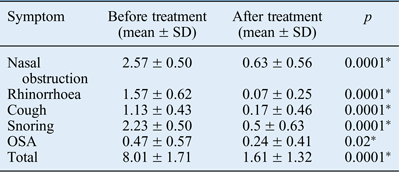
In the control group, after 24 weeks of treatment, there were statistically significant reductions in symptom scores for nasal obstruction (2.57 to 0.63; p = 0.0001), rhinorrhoea (1.57 to 0.07; p = 0.0001), cough (1.13 to 0.17; p = 0.0001), snoring (2.23 to 0.5; p = 0.0001), OSA (0.47 to 0.24; p = 0.02) and total symptom score (8.01 to 1.61; p = 0.0001) (Table III and Figure 2).
Mean symptom scores for the control group, before and after treatment. OSA = obstructive sleep apnoea
Control group mean symptom scores before and after treatment
*P value significant. SD = standard deviation; OSA = obstructive sleep apnoea
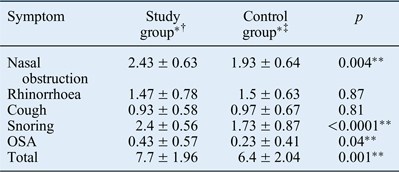
When the symptom score changes for the study group (after 24 weeks of treatment) were compared with those for the control group, there were statistically significant differences for nasal obstruction score (p = 0.004), snoring score (p < 0.0001), OSA score (p = 0.04) and total score (p = 0.001). However, there were no statistically significant differences between the two groups in terms of rhinorrhoea score changes (p = 0.87) or cough score changes (p = 0.81) (Table IV).
Group comparison of change in symptoms
*Mean change in symptoms (± standard deviation) after 24 weeks of treatment. †n=30; ‡n = 30. **P value significant. OSA = obstructive sleep apnoea
Nasopharyngoscopy was tolerated well by 93 of the children when 15 per cent lignocaine spray was used. Oral midazolam (0.5 mg/kg of body weight) was used for sedation in five patients, and two patients required intravenous midazolam (0.05 mg/kg of body weight).
Nasopharyngoscopy was conducted using a 0°, rigid 4 mm endoscope in 93 patients; a rigid 2.7 mm endoscope was required for only 7 patients. Only 6 per cent of nasopharyngoscopy procedures entailed decongestion of the nose; no decongestion of the nose was required in 94 per cent of procedures. Figures 3–6 show pre- and post-treatment nasopharyngoscopic views of patients with obstructive adenoids treated with either mometasone nasal spray (study group; Figures 3 and 4) or saline nasal spray (control group; Figures 5 and 6).
Nasopharyngoscopic view of a patient with obstructive adenoids treated with mometasone nasal spray (a) before and (b) after treatment.
Nasopharyngoscopic view of another patient with obstructive adenoids treated with mometasone nasal spray (a) before and (b) after treatment.
Nasopharyngoscopic view of a patient with obstructive adenoids treated with saline nasal spray (a) before and (b) after treatment.
Nasopharyngoscopic view of another patient with obstructive adenoids treated with saline nasal spray (a) before and (b) after treatment.
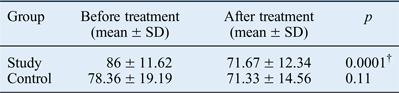
A reduction in adenoid size was observed with both mometasone furoate and saline nasal spray treatments (Figure 7); however, the reduction was statistically significant only for the study group (p = 0.0001) and not for the control group (p = 0.11) (Table V and Figure 8).
Demonstration of adenoid size (green line) and nasopharynx size (blue line) measurements on nasopharyngoscopy.
Group comparison of adenoid size (determined via nasopharyngoscopy) before and after treatment.
Group comparison of adenoid size before and after treatment*
* Determined via nasopharyngoscopy (size reported as percentage of adenoid size to choanal size). †P value significant. SD = standard deviation
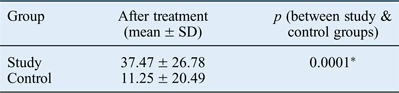
A statistically significant difference in terms of the change in quality of life scores was seen between the study group (37.47 ± 26.78) and the control group (11.25 ± 20.49) (p = 0.0001) (Table VI and Figure 9).
Group comparison of changes in quality of life after treatment. QoL = quality of life
Group comparison of change in quality of life
*P value significant. SD = standard deviation
On each visit, patients were queried regarding irritation of the nose and throat, crusting, transient dryness, and epistaxis, and examinations were made. Two patients in the study group reported minor nasal bleeding, while three patients in the control group reported nasal bleeding. These patients were reminded of the correct method of spraying (patients were instructed to spray away from the septum). The symptoms subsequently subsided, with no recurrence in nasal bleeding.
Discussion
Adenoidal hypertrophy in children is a global health problem because of its negative impact on quality of life. In recent years, the medical treatment of obstructive adenoids has developed. Many studies have demonstrated the usefulness of steroid sprays in patients with adenoidal hypertrophy; thus, adenoidectomy can be avoided.
The mechanism of steroids in this context is unclear. A high level of expression of the human glucocorticoid receptor-alpha (vs beta) in the adenoids and tonsils of patients with OSA (vs those with recurrent throat infections) suggests a possible positive response for these patients to topical steroid therapy.Reference Goldbart, Veling, Goldman, Li, Brittian and Gozal9
Fluticasone,Reference Demirhan, Aksoy, Özturan, Yildirim and Veyseller10 flunisolide,Reference Ciprandi, Varricchio, Capasso, Varricchio, De Lucia and Ascione11 beclomethasoneReference Lepcha, Kurien, Job, Jeyaseelan and Thomas12 and mometasoneReference Berlucchi, Salsi, Valetti, Parrinello and Nicolai7, Reference Cengel and Akyol13–Reference Rezende, Silveira, Barbosa, Menezes, Ferriani and Rezende15 nasal sprays have been used previously in the treatment of adenoidal hypertrophy. We chose mometasone furoate nasal spray because of its favourable benefit-risk ratio.
Our study included children of both sexes aged 2–12 years, as the size of adenoids regresses with age. The mean age of presentation in our study was 7.4 years. The study sample consisted of 78 (78 per cent) males and 22 (22 per cent) females. This sex predilection cannot be generalised as our sample size is small.
In our study, mometasone nasal spray treatment was associated with greater improvements in symptom scores. There were statistically significant differences between the study and control groups in terms of improvements in nasal obstruction (p = 0.004), snoring (p < 0.0001), OSA score (p = 0.04) and total symptom score (p = 0.001). These findings are comparable to those of most other relevant studies.Reference Berlucchi, Salsi, Valetti, Parrinello and Nicolai7, Reference Demirhan, Aksoy, Özturan, Yildirim and Veyseller10, Reference Cengel and Akyol13, Reference Bitar, Mahfoud, Nasar and Dana14, Reference Criscuoli, D'Amora, Ripa, Cinquegrana, Mansi and Impagliazzo16 However, one study reported no statistically significant reduction in symptom scores (compared with a placebo group) following beclomethasone treatment.Reference Lepcha, Kurien, Job, Jeyaseelan and Thomas12
In our study, we observed statistically significant improvements in symptom scores associated with saline nasal spray treatment, despite no significant reduction in the size of the adenoids. This symptomatic improvement in nasal obstruction may be a result of improved nasal clearance, decreased mucosal oedema and/or increased nasal permeability. Many studies have used saline nasal spray as the control group treatment; however, with the exception of a recent study by Rezende et al.,Reference Rezende, Silveira, Barbosa, Menezes, Ferriani and Rezende15 none have reported any significant improvement in symptom scores.Reference Rezende, Silveira, Barbosa, Menezes, Ferriani and Rezende15
We used a 0°, rigid (2.7 or 4 mm diameter) endoscope to assess adenoid size. Most of the children (93 per cent) tolerated it well, and only seven patients required sedation. Most previous studies have used a flexible nasopharyngoscope for this purpose.Reference Berlucchi, Salsi, Valetti, Parrinello and Nicolai7, Reference Demirhan, Aksoy, Özturan, Yildirim and Veyseller10, Reference Ciprandi, Varricchio, Capasso, Varricchio, De Lucia and Ascione11, Reference Cengel and Akyol13–Reference Criscuoli, D'Amora, Ripa, Cinquegrana, Mansi and Impagliazzo16
In our study, decongestion of the nose was required in only 12 of 200 nasopharyngoscopy procedures (6 per cent). Decongestion of the nose is thought to be a confounding variable and can result in false positive improvement post-treatment.Reference Rezende, Silveira, Barbosa, Menezes, Ferriani and Rezende15
In our study, there was a statistically significant reduction in the size of the adenoids on nasopharyngoscopy only with mometasone nasal spray treatment (p = 0.0001); the reduction observed with saline nasal spray treatment was not statistically significant (p = 0.11). Similar objective observations of a reduction in adenoid size pre- and post-treatment have been reported by most other relevant studies.Reference Berlucchi, Salsi, Valetti, Parrinello and Nicolai7, Reference Demirhan, Aksoy, Özturan, Yildirim and Veyseller10, Reference Ciprandi, Varricchio, Capasso, Varricchio, De Lucia and Ascione11, Reference Cengel and Akyol13–Reference Rezende, Silveira, Barbosa, Menezes, Ferriani and Rezende15 However, in one study there was no significant reduction in adenoid size associated with either beclomethasone or saline nasal spray treatments.Reference Lepcha, Kurien, Job, Jeyaseelan and Thomas12
• This prospective, randomised, double-blind study comprised 100 children aged 2–12 years
• Six months usage of mometasone nasal spray was effective in treating children with symptomatic obstructive adenoids
• Six months of treatment with saline nasal spray also reduced symptom scores; however, no significant reduction in adenoid size was observed
• Mometasone nasal spray improved quality of life
• We advocate six months usage of mometasone nasal spray for obstructive adenoids to achieve a desirable outcome
• Mometasone nasal spray can be considered an alternative to surgical intervention for patients with obstructive symptoms due to adenoid hypertrophy
In our study, mometasone nasal spray was associated with a statistically significant improvement in quality of life (37.47 ± 26.78) as compared with the control group (11.25 ± 20.49) (p = 0.0001). This positive change is attributed to the marked improvements in obstructive symptoms secondary to a reduction in the size of the adenoid tissue. To the best of our knowledge, no other study has assessed the change in patients' quality of life post-treatment.
There is no consensus regarding the optimal dose and duration of treatment. We gave mometasone in the dose of 200 µg per day for a period of 2 months, followed by a maintenance dose of 200 µg every 2 days for 4 months. This resulted in significant improvements in symptom scores and quality of life scores, and a reduction in adenoid size. Previous studies have used mometasone nasal spray in a dose of 100 µg per day for a variable period, ranging from 40 days to 4 months and 10 days.Reference Berlucchi, Salsi, Valetti, Parrinello and Nicolai7, Reference Cengel and Akyol13–Reference Rezende, Silveira, Barbosa, Menezes, Ferriani and Rezende15
Our series is among the largest series employing mometasone nasal spray for the treatment of adenoidal hypertrophy. Unlike previous studies, we examined the changes in quality of life post-treatment. In addition, we used a rigid endoscope (rather than a flexible nasopharyngoscope) for nasopharyngoscopy, which provides better image quality.
Conclusion
This prospective, randomised, double-blind study comprised 100 children aged 2–12 years. Six months usage of mometasone nasal spray was found to be effective in treating children with symptomatic obstructive adenoids. Six months of treatment with saline nasal spray also reduced the symptom scores; however, no statistically significant reduction in adenoid size was observed in those treated with saline nasal spray. Mometasone nasal spray improved the quality of life of patients.
We advocate the use of mometasone nasal spray for patients with obstructive adenoids; we recommend that treatment continues for at least six months in order to attain a desirable outcome. Mometasone nasal spray can be considered as an alternative to surgical intervention in patients with obstructive symptoms due to adenoid hypertrophy. More robust evidence is needed on the long-term follow up of patients after discontinuation of therapy, in order to formulate a formal regime.