INTRODUCTION
Visceral leishmaniasis (VL) also known as kala azar, is a vector-borne parasitic disease caused by Leishmania donovani in the Indian subcontinent and East Africa (Lukes et al. Reference Lukes, Mauricio, Schonian, Dujardin, Soteriadou, Dedet, Kuhls, Tintaya, Jirku, Chocholova, Haralambous, Pratlong, Obornik, Horak, Ayala and Miles2007). In the Indian subcontinent, the parasites are transmitted by the bite of infected female Phlebotomus argentipes and the disease is fatal if left untreated. About 90% of the estimated 500 000 annual VL cases occur in India, Nepal, Bangladesh, Sudan and Brazil (Desjeux, Reference Desjeux1996). In Nepal, VL is endemic in the southern and central parts of the Terai region with an incidence of 184 cases per 100 000 people in the most affected districts (Joshi et al. Reference Joshi, Sharma and Bhandari2006).
In contrast to other areas (i.e. Euro-Mediterranean, Latin America), in the Indian subcontinent VL is described as anthroponotic (Desjeux, Reference Desjeux1996). Nevertheless, the role of domestic animals in the L. donovani cycle in the Indian subcontinent remains controversial. The ownership of cows and buffaloes was found to be protective for VL in Nepal (Bern et al. Reference Bern, Joshi, Jha, Das, Hightower, Thakur and Bista2000) but not in Bangladesh. However, a higher density of cows in the proximity of households (not necessarily related to ownership) reduced the risk for VL in Bangladesh (Bern et al. Reference Bern, A. Hightower, Chowdhury, Ali, Amann, Wagatsuma, Haque, Kurkjian, Vaz, Begum, Akter, Cetre-Sossah, Ahluwalia, Dotson, Secor, Breiman and Maguire2005). The role of domestic and wild animals in L. donovani transmission in the Indian subcontinent has been postulated and investigated by several scientists since 1928 (Bhattacharya and Ghosh, Reference Bhattacharya and Ghosh1983). To date, direct observation methods have failed to detect L. donovani bodies (amastigotes) in dogs, rodents (Srivastava and Chakarvarty, Reference Srivastava and Chakarvarty1984), bats (Rajendran et al. Reference Rajendran, Chatterjee, Dhanda and Dhiman1985) or cattle, other than a rare cutaneous case described in an old bullock in Assam, India in 1942 (Killick-Kendrick, Reference Killick-Kendrick1990). However, serological studies have shown some positive reactions in rodents using enzyme-linked immunosorbant assay (ELISA) in India (Srivastava and Chakarvarty, Reference Srivastava and Chakarvarty1984) and cattle using rK39 dipstick and ELISA tests in Bangladesh (Alam et al. Reference Alam, Khan, Ghosh, Mondal, Jamlil and Haque2009). A more recent study detected L. donovani PCR-positive goats, cows and buffaloes in Nepal (Bhattarai et al. Reference Bhattarai, Van der Auwera, Rijal, Picado, Speybroeck, Khanal, De Doncker, Das, Ostyn, Davies, Coosemans, Berkvens, Boelaert and Dujardin2010). However, the implications of those results in the transmission of L. donovani are not yet well understood.
Elucidating the role of animals in the Leishmania cycle is crucial for the design of control programmes for VL. The current strategy of early diagnosis and treatment of humans together with vector control in the Indian Subcontinent (Guerin et al. Reference Guerin, Olliaro, Sundar, Boelaert, Croft, Desjeux, Wasunna and Bryceson2002) may not be optimal if animals play a significant role. Serological tools allow assessment of contact between L. donovani and human and animal populations and, since P. argentipes is the sole vector in the region (Pandey et al. Reference Pandey, Pant, Kanbara, Shuaibu, Mallik, Pandey, Kaneko and Yanagi2008), they can also be used as a proxy measure for vector exposure. In this study we combined serological data in humans and domestic animals from a recent VL focus in Nepal and Geographic Information Systems (GIS) to evaluate the association between human and domestic animal exposure to L. donovani.
MATERIALS AND METHODS
Study site
The study was conducted in Dharan-17, a peri-urban ward of Dharan municipality in the VL endemic district of Sunsari in Nepal. Dharan-17 had 467 individuals (105 households) living in 2 populated areas physically separated by a forest island of 57 000 m2. Dharan-17 had an annual VL incidence rate of 1·61% based on VL cases from 2004 to 2006 (Rijal et al. Reference Rijal, Uranw, Chappuis, Picado, Khanal, Paudel, Andersen, Meheus, Ostyn, Das, Davies and Boelaert2010).
Selection of participants
All individuals above 2 years of age, living in Dharan-17, were asked to provide a blood sample collected by finger prick in a Whatman #3 filter paper in November 2007. Filter papers were kept at −20 °C until the serological test was carried out.
Selection of domestic animals
In October 2007, blood from the jugular vein was collected from all goats, buffaloes and cows present in Dharan-17. In February 2008, samples from the same species were obtained in Dhankuta-3, a ward located 60 km from Dharan-17 in a non-endemic area for VL. Those samples were used as controls in the serological analyses. Blood samples were centrifuged at 3000 rpm for 10 min and the supernatant containing the serum was stored at −20 °C until the serological test was carried out.
Direct agglutination test
The direct agglutination test (DAT) was used to assess L. donovani infection in humans and animals. DAT was performed as described elsewhere (Jacquet et al. Reference Jacquet, Boelaert, Seaman, Rijal, Sundar, Menten and Magnus2006) using a freeze-dried antigen suspension of trypsin-treated, fixed and stained promastigotes of L. donovani (Institute of Tropical Medicine, Antwerp) prepared as described by el Harith et al. (Reference el Harith, Kolk, Leeuwenburg, Muigai, Huigen, Jelsma and Kager1988) . For humans, an eluate from filter paper was processed as described elsewhere (Bhattarai et al. Reference Bhattarai, Van der Auwera, Khanal, De Doncker, Rijal, Das, Uranw, Ostyn, Praet, Speybroeck, Picado, Davies, Boelaert and Dujardin2009). For animals, sera were thawed and homogenized by gentle mixing: 1μl of serum was used to start the serial dilutions from 1:200 to 1:12 800. Human samples that agglutinated at a dilution of 1:1600 or higher were considered sero-positive (Bhattarai et al. Reference Bhattarai, Van der Auwera, Khanal, De Doncker, Rijal, Das, Uranw, Ostyn, Praet, Speybroeck, Picado, Davies, Boelaert and Dujardin2009). In animals, the cut off was determined as the mean end-titre among control animals plus 2 standard deviations (Mukhtar et al. Reference Mukhtar, Sharief, el Saffi, Harith, Higazzi, Adam and Abdalla2000).
Data
The households in Dharan-17 and the limits of the forest dividing the ward were geo-referenced using a Global Positioning System (GPS) device in the field. The longitude and latitude coordinates of the households and forest limits were imported to ArcGIS 9.2 (ESRI, Redland, CA, USA) and projected (WGS_1984_UTM_Zone_45N). The area of interest, in which the analysis results are presented, was defined as a 50 meter buffer zone around the households in the ward. The total number of people and domestic animals with a DAT result per household were recorded. For the spatial analyses, only the results from goats are presented. The results on cows and buffaloes are available as additional material (available online only). Past history of VL, house structure and distance to the limits of the forest, identified as potential factors related to L. donovani infection, were also collected.
Spatial exploration
Extraction maps, defined as the ratio of the Gaussian kernel density surfaces of DAT-positives to the total population at risk, were used to visually explore areas of excess risk of L. donovani exposure in Dharan-17 (Lawson and Williams, Reference Lawson and Williams1993). Kernel smoothing methods allow representation of point data (i.e. households) as a continuous surface by applying a kernel structure (i.e. Gaussian) and a smoothing parameter (aka bandwidth) to locations in a space (i.e. ward) (Bailey and Gatrell, Reference Bailey and Gatrell1995). Meaningful kernel density estimates require the selection of a correct bandwidth. The normal optimal method (Bowman and Azzalini, Reference Bowman and Azzalini1997) was applied to determine the bandwidths to be used in Dharan-17 for both human and domestic animal datasets. The same bandwidth for the numerator and denominator in the extraction maps was used as suggested by Kelsall and Diggle (Reference Kelsall and Diggle1995) .
In Dharan-17, edge-corrected kernel density maps of DAT-positive and total population at risk were created using the household locations weighted by the number of serologically positive and total individuals per household respectively. The bandwidths and the extraction maps were produced using the packages sm (Bowman and Azzalini, Reference Bowman and Azzalini2007) and spatstat (Baddeley and Turner, Reference Baddeley and Turner2005) in R 2.9 software (www.R-project.org) respectively. The extraction maps obtained were represented using ArcGIS 9.2. An analogous methodology was used to create the extraction maps for goats, buffaloes and cows.
Spatial clustering
The spatial scan statistic was used to assess whether DAT-positive individuals (and domestic animals) were spatially clustered in Dharan-17. A discrete Poisson model was implemented in SaTScan version 8.0 (www.SaTScan.org) considering the number of DAT-positive and total individuals per household (people and domestic animals separately) (Kulldorff, Reference Kulldorff1997). The spatial scan statistic can detect spatial clusters by using a variable circular window size while controlling for the underlying population. The size of the circular windows was limited to 50% of the population at risk and 999 Monte Carlo simulations were used to assess the statistical significance of the spatial clusters detected. The risk associated to the spatial clusters is presented as the relative risk (RR), i.e. the ratio of estimated risks inside and outside the cluster. Further technical details and references on the methodology and software used are described elsewhere (Kulldorff, Reference Kulldorff2009).
Multivariate model
A Poisson regression model was used to investigate whether the presence of DAT-positive animals was associated with increased L. donovani seropositiviy in humans. The number of DAT-positive individuals per household was the response variable. The explanatory variables were the proportions of DAT-positive animals (goats, cows and buffaloes) in the proximity or each household. These proportions were obtained from the corresponding goat, cow and buffalo extraction map and dichotomized taking 50% as cut-off value. Possible confounders for VL in the region where considered in the model (Bern et al. Reference Bern, Joshi, Jha, Das, Hightower, Thakur and Bista2000, Reference Bern, A. Hightower, Chowdhury, Ali, Amann, Wagatsuma, Haque, Kurkjian, Vaz, Begum, Akter, Cetre-Sossah, Ahluwalia, Dotson, Secor, Breiman and Maguire2005; Schenkel et al. Reference Schenkel, Rijal, Koirala, Koirala, Vanlerberghe, Van der Stuyft, Gramiccia and Boelaert2006; Bhattarai et al. Reference Bhattarai, Van der Auwera, Rijal, Picado, Speybroeck, Khanal, De Doncker, Das, Ostyn, Davies, Coosemans, Berkvens, Boelaert and Dujardin2010). The presence/absence of past VL cases per household, the type of household (i.e. mud vs other) and the household distance to the border of the forest island (i.e. <50 m, 50–100 m or >100 m) were included as covariates. The total number of individuals in the household (for whom a DAT result was available) was considered as the total number of persons at risk per household. Robust variance estimates were used and the interactions among the different variables in the model were assessed using the Wald test. Variables with P<0·1 in the univariate analyses were included in the multivariate model. The results were presented as Incidence Rate Ratio (IRR) and their 95% Confidence intervals. Stata 10 (StataCorp LP, College Station, TX, USA) was used to fit the Poisson regression model.
Ethical aspects
Ethical clearance was obtained from the Ethical Committee of the B.P. Koirala Institute of Health Sciences (BPKIHS), Dharan, Nepal and the corresponding bodies at the Institute of Tropical Medicine Antwerp (ITM-A), Belgium and the London School of Hygiene and Tropical Medicine (LSHTM), UK. Written informed consent was obtained from individuals (or guardians for individuals less than 18 years old) and animal owners before including them in the study. International animal experimentation guidelines were followed.
RESULTS
DAT results in humans
In November 2007, 328 individuals from Dharan-17 (70% of the total population) provided a blood sample. The median age of the study population was 20 (range 2 to 73) years old and there were slightly more females (53%; n=174) than males. The prevalence of L. donovani infection was 16·1% (53/328). The individuals with a DAT titre ⩾1:1600 had a median age of 22 years old (range 2 to 72) and 60% (32/53) of them were female. In the study population, 11 people were identified as past VL cases. All of them were relatively recent cases: 3 in 2004, 6 in 2005 and 2 in 2006 affecting mainly females (63%; n=7). All past VL cases had a positive DAT result.
DAT results in animals
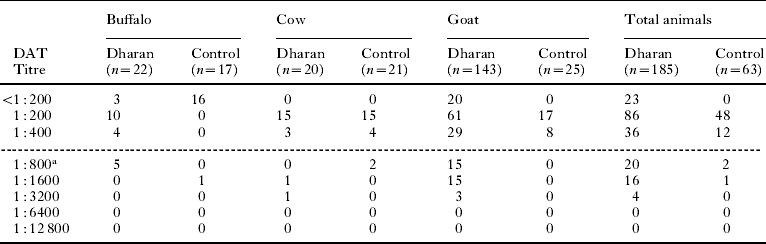
Blood was obtained from 143 goats, 22 buffaloes and 20 cows in Dharan-17; and 25 goats, 17 buffaloes and 21 cows in Dhankuta-3. The DAT results: number of animals per agglutination titre is presented in Table 1. The 63 control samples had, in general, low agglutination titres: 95·2% (60/63) of them showed an end-titre ⩽1:400 and only 1 animal – a buffalo – had a titre ⩾1:1600. All goats (n=25) had a titre ⩽1:400. The mean-titre+2 standard deviations was 1:504 and 1:454 when considering all animals or only goats from the non-endemic ward. Therefore, animals with a titre ⩾1:800 were considered DAT-positive.
Agglutination of Leishmania donovani antigen by sera of buffaloes, cows, goats and all domestic animals from Dharan-17 and Dhankuta-3 (control samples) using the direct agglutination test (DAT)
(The cut off used as serological Leishmania infection marker (⩾1:800) is identified with a dotted line in the table.)

a Cut off for DAT in animals.
In Dharan-17, 21·6% (40/185) of the total number of animal samples were DAT-positive. A higher proportion of goats were serologically positive (23·1%; 33/143) than buffaloes (22·7%; 5/22) and cows (10·0%; 2/20) (Table 1).
Spatial analysis
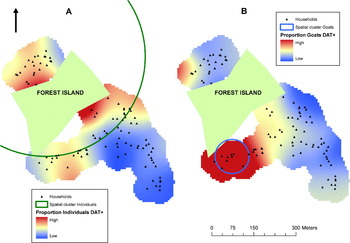
When DAT results for individuals and domestic animals were grouped per household (n=105), 33 and 23 of them had at least 1 person or animal with a DAT-positive result respectively. Eight households had both serologically positive individuals and animals and 52 households, 8 of them owning domestic animals, have only negative results. The extraction maps used to spatially extrapolate the household data were built using bandwidth values of 46 meters for individuals (Fig. 1A), 44 for goats (Fig. 1B) and 38 meters for cows and buffaloes respectively as determined by the normal optimal method. The excess risk areas (in red) for DAT-positive individuals were mainly located around the forest island that divides the ward. A high proportion of DAT-positive goats were localized in the southern part of the forest. It was in that same area where SaTScan identified a spatial cluster (circle in blue) involving 8 households which had a higher proportion (RR=4·1) of serologically positive goats compared to the households outside the cluster. The cluster was borderline statistically significant (P=0·054). The spatial cluster identified for humans (circle in green) was much larger and involved 38 households from both sides of the forest with higher risk (RR=3·0 P=0·028) of having DAT-positive individuals. See the additional material presented in the Online version only for the results of cows and buffaloes.
Map of households in Dharan-17 and the extraction maps presenting the excess risk areas (colour gradient) of DAT-positive individuals (A) and DAT-positive goats (B) using a bandwidth of 46 and 44 meters respectively. The spatial clusters of DAT-positive individuals and goats detected by SaTScan are also presented as green and blue circles in maps A and B respectively.

Based on the univariate analyses, the presence of past VL cases in the household (P<0·001), the proportion of DAT-positive buffaloes (P=0·010) and goats (P=0·063) and the distance to the forest (P=0·034) were included as covariates in the multivariate mode. The final Poisson regression model showed that being close to serologically positive goats (proportion of DAT-positive goats >50%) was strongly associated to an increased number of DAT-positive individuals in the household (IRR=9·71, 95% CI: 4·99 18·92). Similarly, but with a lower IRR, the presence of past VL cases in the house (IRR=2·62, 95% CI: 1·46; 4·70) and being less than 50 meters (IRR=3·67, 95% CI: 1·54; 8·73) or between 50 and 100 meters (IRR=2·74, 95% CI: 1·09; 6·90) to the forest were also associated to a higher number of DAT-positive individuals. The interaction term between proportion of DAT-positive goats and distance to the forest was statistically significant (P<0·05 by Wald test) and was kept in the final model. The variable on DAT-positive buffaloes was not statistically significant and therefore removed from the final multivariate model.
DISCUSSION
Almost 22% of the domestic animals sampled in Dharan-17 had a significant level of L. donovani antibodies as their serum agglutinated at a titre of 1:800 or above. All 3 species tested positive to DAT: buffaloes, cows – which were also found to be L. donovani positive in Bangladesh (Alam et al. Reference Alam, Khan, Ghosh, Mondal, Jamlil and Haque2009) – and specially goats – which have been linked to Leishmania transmission in Kenya (Williams et al. Reference Williams, Mutinga and Rodgers1991). The cut off used in animals was lower than that (1:3200) applied in a similar study in Sudan (Mukhtar et al. Reference Mukhtar, Sharief, el Saffi, Harith, Higazzi, Adam and Abdalla2000) and to detect L. donovani infection in humans in a previous study in Nepal (Schenkel et al. Reference Schenkel, Rijal, Koirala, Koirala, Vanlerberghe, Van der Stuyft, Gramiccia and Boelaert2006). However, it was based on animal samples from a non-VL area in Nepal and was higher than that used to diagnose canine leishmaniasis (Oskam et al. Reference Oskam, Slappendel, Beijer, Kroon, van Ingen, Ozensoy, Ozbel and Terpstra1996). Even if a more stringent cut-off had been applied (i.e. 1:1600) 10·8% (20/185) of animals would be considered positive which is similar to the prevalence found in people living in VL endemic villages in Nepal: 9·1% (Rijal et al. Reference Rijal, Uranw, Chappuis, Picado, Khanal, Paudel, Andersen, Meheus, Ostyn, Das, Davies and Boelaert2010) but 6 points below the prevalence in humans in Dharan-17. The fact that a significant number of animals – 16% of the goats – from the same group were PCR positive to a Leishmania specific test (Bhattarai et al. Reference Bhattarai, Van der Auwera, Rijal, Picado, Speybroeck, Khanal, De Doncker, Das, Ostyn, Davies, Coosemans, Berkvens, Boelaert and Dujardin2010) reduces the risk that the DAT-positive results reported here were due to cross-reactivity with other trypanosomatids (Mahmoud and Elmalik, Reference Mahmoud and Elmalik1977).
The spatial distribution of DAT-positive individuals and goats did not overlap perfectly but were spatially clustered at the border of the forest island dividing the study area as shown by the extraction maps and the SaTScan statistic results. This spatial aggregation was already observed by Bhattarai et al. (Reference Bhattarai, Van der Auwera, Rijal, Picado, Speybroeck, Khanal, De Doncker, Das, Ostyn, Davies, Coosemans, Berkvens, Boelaert and Dujardin2010), when PCR results were analysed in the same population, and was confirmed by the Poisson regression model that identified proximity to the forest island as a factor increasing the proportion of L. donovani-infected individuals. Interestingly, proximity to the forest interacted with the proportion of DAT-positive goats suggesting that there is a ‘synergy’ between positive animals and proximity to the forest, which increases the risk of having DAT-positive individuals by a factor of 9·71 (compared to an IRR of 2·62 associated to past VL cases). Our results contrast to some extent with the protection effect associated with the high density of cows in the proximity of households described in Bangladesh (Bern et al. Reference Bern, Joshi, Jha, Das, Hightower, Thakur and Bista2000). However, our study used a different end-point (i.e. infection in humans and animals vs VL) and analysed the L. donovani infection epidemiology in a particular setting (i.e. recent peri-urban VL focus). The increased risk of VL related to goats, compared to the rest of the domestic animals, was also reported by Bhattarai et al. (Reference Bhattarai, Van der Auwera, Rijal, Picado, Speybroeck, Khanal, De Doncker, Das, Ostyn, Davies, Coosemans, Berkvens, Boelaert and Dujardin2010) when the same samples were analysed by PCR. However, any interpretation of the results should take into account that the number of samples collected per species was unbalanced. Goats represented 77% (143/185) of the total animal samples in Dharan-17.
The serological results presented in this study are insufficient to infer any claims about infection establishment, let alone infectivity, and the possible role of domestic animals as reservoirs of L. donovani. However, they indicate that, at least in Dharan-17, domestic animals are in contact with L. donovani and have a significant role in the spatial distribution of the parasite and thus on the risk of infection in humans, by attracting infected P. argentipes. The role of domestic animals, especially goats, in the L. donovani cycle and distribution should be re-assessed as it could have an impact on the effectiveness of the current VL control strategy in the region.
ACKNOWLEDGEMENTS
We thank Dr Ganesh Prasad Regmi from the Veterinary Department of Panmara, Dharan Tikaram Khatri, Ram Bahadur Lama and Thule from Dharan-17. We also thank Mr Surendra Uranw who supervised the blood collection and Mr Ganesh Prasad Sah and Mrs Ichchha Ghale who performed the DAT analyses. Finally, we would like to thank the people from Dharan-17 and Dhankuta-3.
FINANCIAL SUPPORT
The work was financially supported by EU-funded INCO-DEV KALANET project (EU contract no 015374).