INTRODUCTION
The European sea bass (Dicentrarchus labrax L.) is one of most emblematic commercial and recreational fish species in the Mediterranean Sea. Landings in the Mediterranean Sea vary between 7000 and 8000 tons per year (FAO, 2007). Throughout the distribution range, adults are found in a large variety of habitats such as open sea, rocky shores, coastal lagoons, estuaries and even lower parts of some rivers (Pickett & Pawson, Reference Pickett and Pawson1994). Outside the Mediterranean waters, spawning occurs offshore (Thompson & Harrops, Reference Thompson and Harrop1987; Jennings & Pawson, Reference Jennings and Pawson1992). The eggs appear scattered throughout the water column and the buoyant larvae seem to move close to the coastline within a month after hatching (Jennings & Pawson, Reference Jennings and Pawson1992). They then enter inshore waters (=larval nurseries) where they stay until reaching the juvenile stage (2–3 months). At that time they move into juvenile nurseries habitats such as estuaries, harbours, embayments, etc. (see Pickett & Pawson, Reference Pickett and Pawson1994 for a detailed account of the life cycle).
Despite the relative importance of this species and the abundant literature based on Atlantic/North Sea populations (see review; Pickett & Pawson, Reference Pickett and Pawson1994), several life history traits remain largely unknown for the Mediterranean sea bass. Hatching occurs at sea in winter, presumably in the coastal sea (Barnabé, Reference Barnabé1973) and juveniles are mostly found in coastal lagoons during summer (Guérin-Ancey, Reference Guérin-Ancey1973; Dulcic et al., Reference Dulcic, Matic and Kraljevic2002; Cantou & Quignard, personal communication). However, the abundance and distribution of the intermediate stages, specifically the pelagic larval stage and the settlement stage, are unknown.
Most of the data published on sea bass nurseries were based on observations made on Atlantic populations and principally those of the United Kingdom (Claridge et al., Reference Claridge, Potter and Hardisty1983; Dando & Demir, Reference Dando and Demir1985; Kelley, Reference Kelley1986, Reference Kelley2002; Jennings & Pawson, Reference Jennings and Pawson1992), the Netherlands (Beyst et al., Reference Beyst, Mees and Cattrijsse1999), the French Atlantic coast (reviewed by Fritsch, Reference Fritsch2005) and the Portuguese coast (Cabral & Costa, Reference Cabral and Costa2001). In these regions, sea bass nursery areas are typically located in shallow estuaries and tidal marshes with mud flats. Sea bass larvae and juveniles are usually captured at a size ranging between 20 to 60 mm standard length (SL) (Kelley, Reference Kelley2002). Larvae less than 20 mm SL are rarely seen; the few observations were made when sampling with towed nets in large estuaries (Dando & Demir, Reference Dando and Demir1985; Jennings & Pawson, Reference Jennings and Pawson1992).
The patterns and process occurring during the early life history stages are likely to be distinct in the Mediterranean Sea because of environmental differences, such as the absence of significant tides and the lower productivity of the Mediterranean Sea, and the distinct ecology of the Mediterranean Sea population relative to the Atlantic population (Naciri et al., Reference Naciri, Lemaire, Borsa and Bonhomme1999; Lemaire et al., Reference Lemaire, Allegrucci, Naciri, Bahri-Sfar, Kara and Bonhomme2000; Bonhomme et al., Reference Bonhomme, Naciri, Bahri-Sfar and Lemaire2002). The major difference involves the presence of ecotypes that exploit either lagoons or the open sea (Allegrucci et al., Reference Allegrucci, Caccone and Sbordoni1997; Lemaire et al., Reference Lemaire, Allegrucci, Naciri, Bahri-Sfar, Kara and Bonhomme2000). It has been proposed that strong selective forces acting in these habitats were responsible for the genetic differentiation existing between lagoon and sea populations (Lemaire et al., Reference Lemaire, Allegrucci, Naciri, Bahri-Sfar, Kara and Bonhomme2000). This apparent genetic differentiation may come from either the differential survival of early stages within different habitats (larvae originating from a unique population) or from the sympatric coexistence of two cryptic populations (larvae originating from two populations).
The objectives of this study were: (1) to identify and describe the nursery areas colonized by settlement stage sea bass in the Gulf of Lion (north-western Mediterranean Sea); (2) to monitor the settlement patterns of sea bass; and (3) to estimate the abundance and distribution of the late larval and early juvenile stages in these nurseries. We surveyed two years of settlement, spanning between March 2005 and June 2006.
MATERIALS AND METHODS
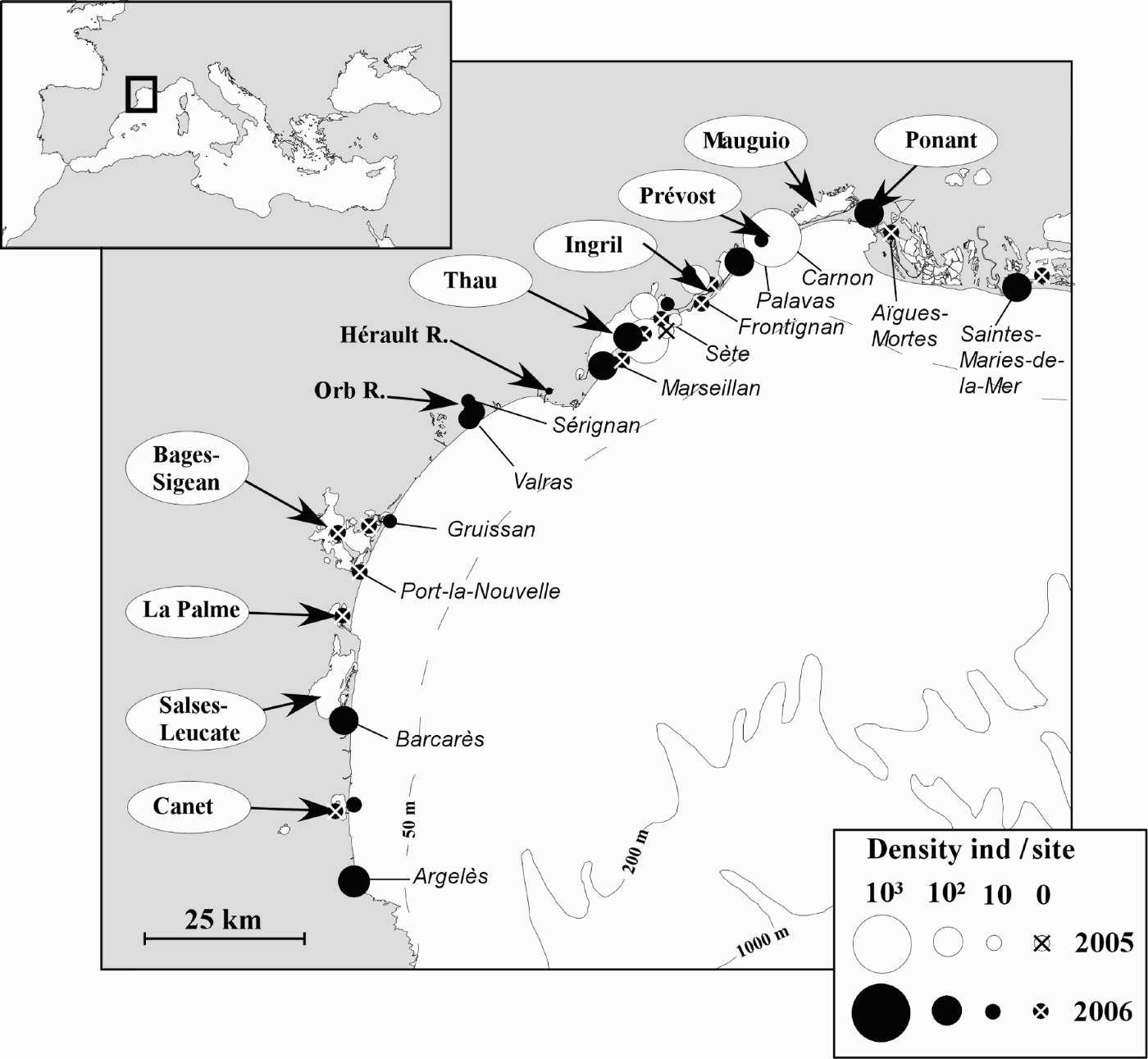
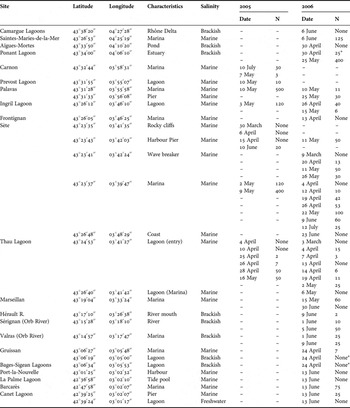
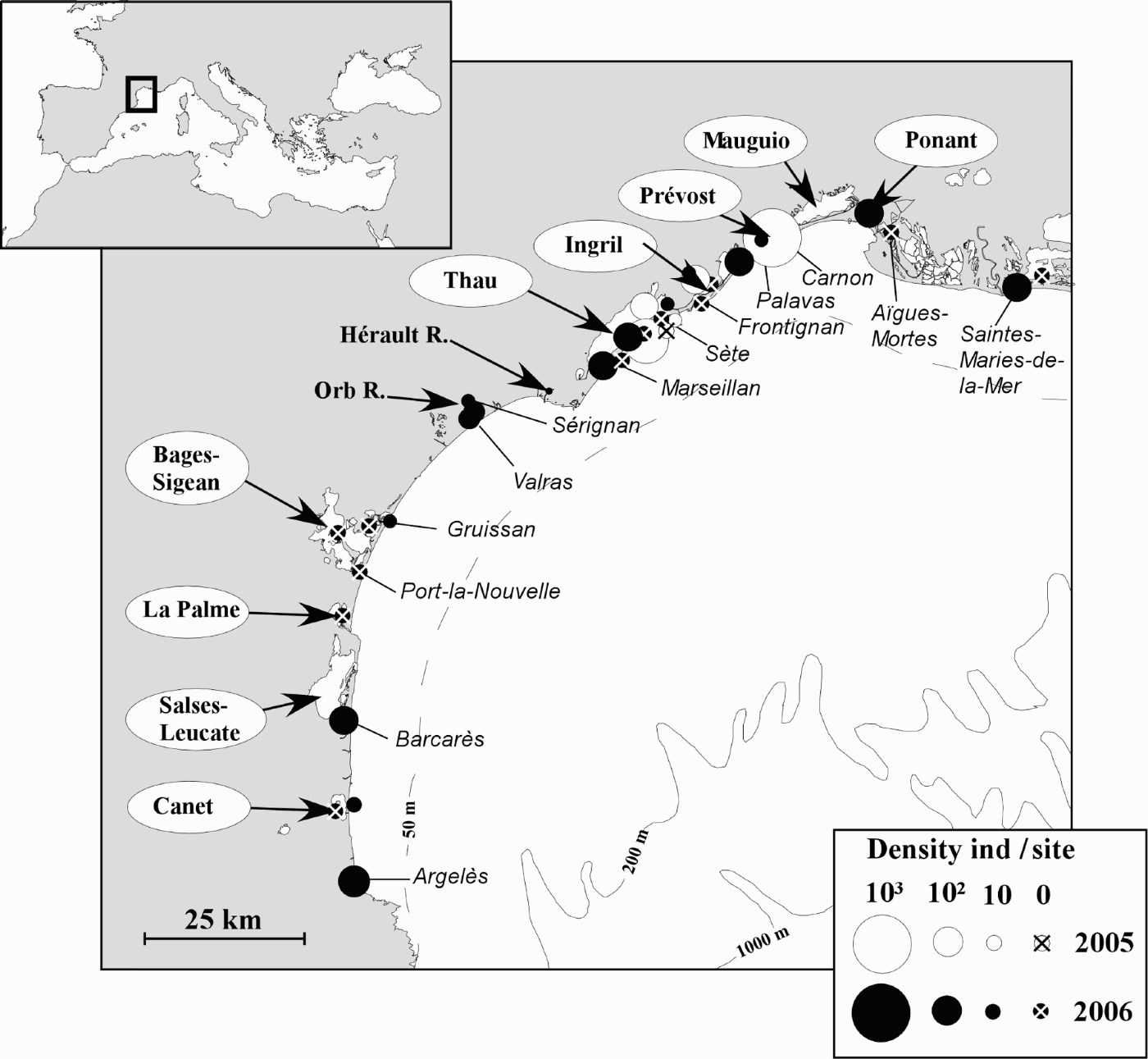
Sampling along the Gulf of Lion coast (Figure 1) was conducted from 10 March 2005 to 10 July 2006 both in natural areas and at sites strongly impacted by human activity. During 2005, six sites located between Sète and Palavas-les-Flots were sampled (Figure 1; Table 1). Three sites were located in coastal lagoons and three sites were located along the seashore. In 2006, we expanded our survey to include fifteen new sites covering 200 km of coastline; from Argelès-sur-mer (located near the Pyrénées Mountains) to Saintes-Maries-de-la-Mer (located in the Rhône delta). We included in 2006 three sites located in the estuarine portions of the Orb (Valras and Sérignan sites), the Hérault and the Vidourle (=Ponant lagoon) Rivers (Figure 1).
Location of the study area and sampling sites of the two years surveyed (2005 and 2006). The abundance refers to the number of individuals observed (2005) or collected (2006) during our underwater visual census (UVC). Rivers, lagoons and cities are indicated in bold, in bubbles and in italics respectively.
Summary of the number of larvae observed during the two years surveyed, position and general characteristics of the sites. Number (N) is standardized for a 2 hour underwater visual census (UVC).

* turbid water may have altered the efficiency.
At each site, surveys were performed by snorkelling. Underwater visual census (UVC) was achieved by swimming 2 hours at regular speed on a return pathway by one diver. However, as the UVC was done, in part, in areas where human activities are important (marinas, harbours, etc.), the number of larvae observed for 2 hours should be seen as a measure of the relative abundance as conditions were not always homogeneous (e.g. disturbance by the passing boats). UVC values reported on Table 1 were nevertheless standardized for a 2 hour census to minimize bias. To collect settlement stage sea bass alive for further laboratory measurements (length at settlement and growth rate), without interfering with the UVC, a second diver swam a hundred metres away from the census pathway. Abundance of settling individuals and early juvenile sea bass was estimated by in situ counting of individuals following abundance classes. Individual estimates were made for groups of up to 30 individuals, estimated to the nearest group of 10 individuals for schools of 30 to 100 individuals and by counting groups of 100 individuals in schools of 100 to 1000. The second diver collected live individuals using hand nets of 25 × 25 cm with 1 mm mesh size. Samples were brought to the laboratory and were reared in small tanks filled with recirculating natural seawater (fed with live brine shrimps).
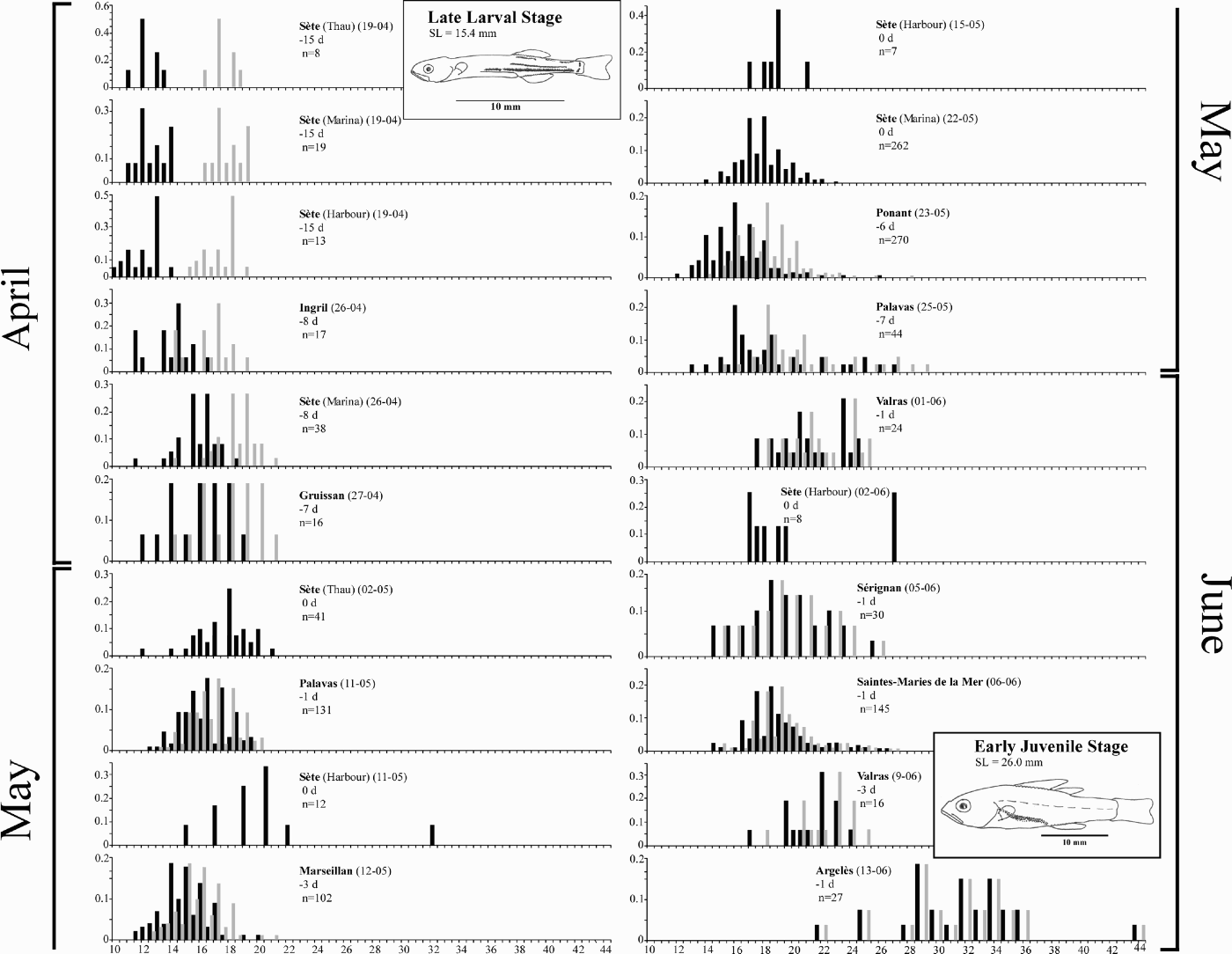
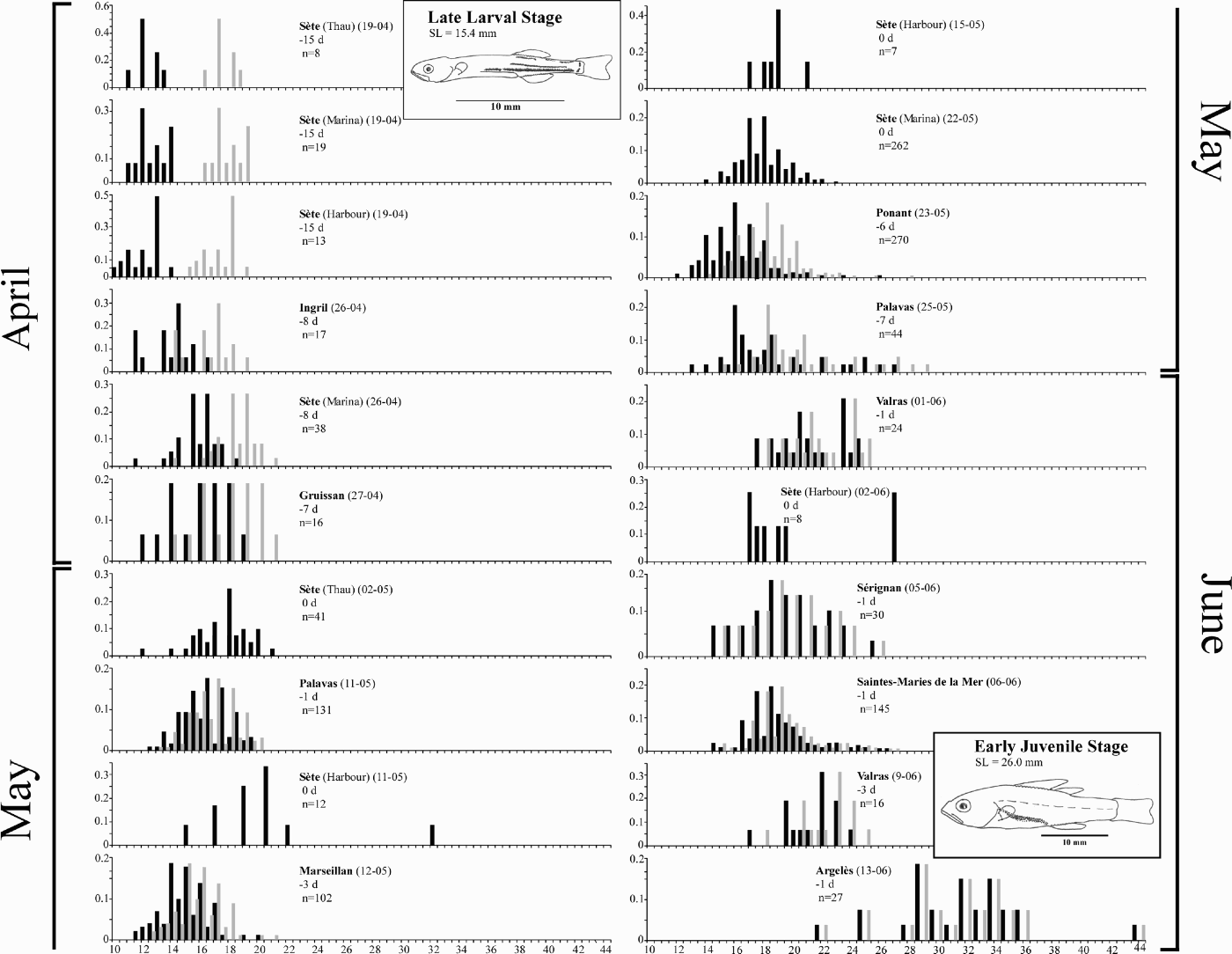
At the time of settling, the small individuals clearly exhibited a larval morphology. Larvae were typified by a very narrow translucent body, small fins and an elongated gut (Figure 2). This shape strongly differed from the juvenile stage (Figure 2). The juvenile stage is reached between a total length (SL) of 22 mm–26 mm (see Barnabé, Reference Barnabé1976).
Frequency distribution of 2006 samples. The lengths at measurement are represented in grey while the back-calculated lengths (estimate of length at settlement from larger individuals actually measured up to 15 days after collection) are illustrated by black bars. For each site, we indicated the sampling date, the number of days between capture and measurement, and the number of larvae measured. In the two inserts are depicted a typical settling individual sea bass and an early juvenile stage. In our surveys, individuals over 24 mm TL may be considered as juvenile. The drawings are based on two individuals collected in 2005.
Since sea bass larvae are translucent with a lightly pigmented body and a conspicuous yellowish spot on the caudal peduncle, they were easily distinguished from similar larval fish (e.g. Atherina spp.). At the juvenile stage, they acquire adult morphology while exhibiting, at this stage only, the black spotted colour pattern typical of the conspecific D. punctatus (up to 200 mm or 1+). Some samples were nevertheless brought to the laboratory for formal identification; the only real potential misidentification may occur with the conspecific D. punctatus, however, the latter is absent from the study area.
Individuals were measured in samples collected in 2006 (SL). Because of time limitation, some larvae were not measured within 24 hours of capture. As larvae were kept in laboratory conditions at low density to prevent aggressive interactions, it is likely that growth rate in the tanks was different from what is found in the wild (e.g. Jennings, Reference Jennings1992) or from optimized intensive aquaculture facilities. Thus, to minimize errors, we back-calculated their size at capture with an estimated growth rate obtained on successive measurements of individuals raised in our own tanks (13 tanks, time interval ranging from 14 to 50 days, total number of individuals = 340). We measured the growth rate for individuals of the same size-range as the individuals collected in the wild (SLt=0 = 13–26 mm and SLt=final = 21–48 mm).
Two complementary tests were used to detect pulses of settling larvae on the basis of objective criteria rather than relying on the visual interpretation of graphs. First, the normality of the size distribution was tested using the Kolmogorov–Smirnov (K-S) test. Normally distributed samples were regrouped according to Scheffé's post-hoc test. Second, the modality of the distribution was tested using the bimodality coefficient. This coefficient uses the value b = [(m 32 + 1)/(m 4 + [(3(n − 1)2)/((n − 2)(n − 3))])], where m 3 and m 4 are the skewness and the kurtosis of the distribution, respectively, and n is the number of observations. Values below 0.555 indicate unimodal distributions (SAS, 2005).
RESULTS
Settlement patterns
Settling individuals of D. labrax were observed throughout the coastal area of the Gulf of Lion from April to June of both years surveyed (Figure 1). No settling individuals were observed before April; the first sightings were made earlier in 2006 (5 April) than in 2005 (25 April) (Table 1). After June, all individuals observed in nurseries were juveniles. We observed a total number of 2100 individuals in 2005 and 2300 individuals in 2006. The number of larvae observed locally was relatively small (87.5 on average, SD = 168.7, for ≈2 hours count), but high densities were observed on some occasions (e.g. >1000 in the marina of Palavas on 10 May 2005). We were unable to find sea bass on only 20 occasions among the 63 surveys we performed.
We back-calculated their size at capture using our estimated average daily growth rate (in our tanks) of 0.32 mm.day−1 (SD = 0.07 mm.day−1). This value was obtained using linear regressions as they best explained the relationship. The size at the beginning of the interval (15.8 to 22.9 mm), the duration (time interval ranging between 14 to 50 days) and the interaction of both did not significantly affect the slope of larvae length versus time (=average daily growth rate) (AMOVA, P value = 0.699). Not surprisingly, the value of 0.32 mm.day−1 is higher than the daily growth rate of 0.2 mm.day−1 reported for early pelagic larval sea bass (see Jennings, Reference Jennings1992).
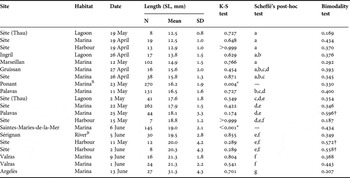
A total of 1296 individuals were measured in 2006. The size pattern of larval pulses collected in the studied nurseries increased in size during the settlement season; both the average length and the variance increased with time (Figure 2). The mean SL increased from April to late June from a mean value of 12.5 mm (SD = 0.8) to 31.3 (SD = 4.3). The K-S test identified two samples as not normally distributed (Table 1: Ponant, 23 May 2006; Saintes-Maries-de-la-mer, 6 June 2006). The Sheffé's post-hoc test illustrates the increase of the mean size through time (see Figure 2 & Table 2). The K-S test revealed that some samples were not normally distributed (i.e. skewed); three samples where further identified as bimodally distributed according to the bimodality coefficient (Table 2). Thus, it appears that recruitment within sea bass nurseries was characterized by pulses of new arrivals.
Characteristics and statistics of 2006 samples. Back-calculated mean values (mm), standard deviation, and number of individuals measured (standard length) at each site. Kolmogorov–Smirnov (K-S) test compares the samples distribution to a normal distribution (α = 0.05). Groupings obtained for the Scheffé's post-hoc test are indicated by letters. Values above 0.555 for the bimodality test typify samples not normally distributed.

*, distribution significantly different (α = 0.05) from a normal distribution; B, brackish water; †, distribution is not unimodally distributed (value above 0.555).
The early settlement size, as estimated using the 19 April 2006 samples, ranged between 10.2–14.2 mm SL (mean = 12.6, SD = 1.0, N = 40). The first juvenile (1 individual) was found on 11 May in Sète (Figure 2), three weeks after the first settlement larvae were observed.
Habitat description of sea bass nurseries
Although habitat types were not recorded in a detailed manner (see Table 1), settlers had sufficiently marked habitat preference to be reported without much difficulty by divers. The nursery habitat appeared restricted to shallow waters, usually with fine sandy or muddy bottoms and located in areas protected from breaking waves. This probably represented an active orientation toward suitable nursery habitat (Jennings & Pawson, Reference Jennings and Pawson1992). The sea bass settlement stage has seldom been observed along beaches or seaward of rocky areas. Settlement stage sea bass in some lagoons or rivers were found several kilometres inshore (e.g. Valras, Serignan and Ingril). Some of the inshore areas exhibited high variation of salinity, ranging from 10 psu at Sérignan to 35 psu in Ingril lagoon and temperature variation ranging from 13°C in coastal waters to 27°C in lagoons (data from Ifremer, Sète). We also observed high numbers of settling sea bass in highly anthropized areas such as harbours (Sète) and marinas (Palavas-les-Flots). On a finer scale, we found that individuals or schools of settlement stage sea bass were usually associated with various sheltering features, either floating or fixed. In marinas, settlement stage sea bass were often observed in confined areas such as in the corner of quays, in dead ends, in still water adjacent to algal mats or beneath boat hulls.
DISCUSSION
Size at settlement
Our study revealed that in the north-western Mediterranean Sea, most sea bass settle at a size varying between 10 mm and 14 mm SL and settling individuals arrive in nursery areas from early April to the beginning of June (Figure 2). Previous studies described early settlement stage sea bass as individuals measuring 15 mm SL (Jennings, Reference Jennings1992) or 24–28 mm SL (Kelley, Reference Kelley2002). The sampling gears used by Jennings (Reference Jennings1992) were plankton nets, while Kelley (Reference Kelley2002) used seine nets. This could explain the discrepancy in the estimated settlement size between these two studies (Jennings, Reference Jennings1992). Our collection method allowed us to retrieve unbiased samples as our hand nets possess a mesh size of only 1.5 mm which can retain every individual. Moreover, in most cases we are sure that we have captured almost all individuals and no escapees were left (=too small individuals) as we directly observed underwater the capture in clear water and compared the number of captures versus observations.
Thus, settlement may occur earlier in the Mediterranean Sea bass population than the Atlantic/North Sea population. This discrepancy may be caused either by methodological bias or may reflect a real difference in the biology of the various lineages. As settlement stage sea bass are mainly sampled using size-selective gears (e.g. beach seine; Guérin-Ancey, Reference Guérin-Ancey1973; Kelley, Reference Kelley2002), the smallest individuals may in fact be overlooked. On the other hand, the well-studied British populations are known to spawn around the British Islands (Pawson et al., Reference Pawson, Kelley and Pickett1987). As such, the time to reach the settlement areas might be longer than for the Mediterranean populations who were thought to spawn closer to the areas where settlement larvae were found (Barnabé, Reference Barnabé1973). Studies using unbiased sampling methods to assess the size at settlement in the British Isles population are thus required to answer this question.
The difference in the size/ontogenetic stage at settlement observed between Mediterranean and Atlantic populations of sea bass may in part explain the existence of a lagoon ecotype of sea bass in the Mediterranean Sea. The observed dispersion into heterogeneous coastal habitats all along the Gulf of Lion may be explained by the relatively small size (and hence weak swimming capacity relative to current speeds) of larvae before settlement. Our observations confirmed that sea bass larvae were effectively dispersed in a large number of nurseries along the coast and these nurseries may include various coastal bodies of water (Figure 1; Tables 1 & 2). This diversity in nursery habitat was more likely to reflect the high adaptive range of the sea bass at this stage (e.g. salinity from 35 psu to 10 psu) rather than a random pattern of dispersion along the shore.
The molecular divergence existing between the sympatric ecotypes found in the Mediterranean Sea implies a strong selective regime between open sea versus lagoon habitats (e.g. more variable, less saline) (Lemaire et al., Reference Lemaire, Allegrucci, Naciri, Bahri-Sfar, Kara and Bonhomme2000). It is known that 25–50% of the sea bass do not survive freshwater acclimatization (Nebel et al., Reference Nebel, Romestand, Nègre-Sadargues, Grousset, Aujoulat, Bacal, Bonhomme and Charmantier2005). Thus, selection acting in such habitats may well explain the formation and maintenance of the lagoon ecotype. As we have found larvae in lagoons and estuaries with salinities below 10 psu (e.g. Sérignan, Orb River and in the Ponant Lagoon) in 2006, it suggests that despite their weak swimming capacity their settlement occurs in these presumably suboptimal habitats (considering the mortality rate associated with low salinity) or conversely favourable habitats (if productivity is considered). Either case should favour a better habitat selection capacity by larvae. However, whether the larvae: (1) select currents to favour the advection within these low salinity/high productivity areas; or (2) are inadvertently advected in such areas still must be determined.
Larval fish behaviour in nurseries
Our observations of sea bass larvae, both in the wild and in captivity, revealed some important differences between the behaviour of settling individuals compared to that of juvenile fish. Settling individuals usually swim steadily with some burst swimming for capturing small planktonic prey or for escaping predators. Although their swimming capacity is low, Mediterranean Sea bass larvae may be able to resist a current speed of a few cm/second (Chick & Van Den Avyle, Reference Chick and Van Den Avyle2000). Their position in the water column is usually a few centimetres below the surface and they avoid contact with the substratum. They remain in schools of up to several hundred individuals. Sea bass settlement stages were usually found within (or underneath) schools of other fish larvae/juveniles; the most common associated species were Sparus aurata, Mugil spp. and Sarpa salpa. All these latter species usually exploit a wider variety of habitats. This suggests that sea bass settlement stages actively selected, at a fine scale, their nursery habitat rather than being passively dispersed throughout sheltered areas. Moreover, considering the highly localized distribution within nurseries, a better capacity for orientation than previously thought may allow microhabitat selection at settlement (Pickett & Pawson, Reference Pickett and Pawson1994).
Role of harbours and marinas as nursery grounds
This study suggested that sea bass nurseries were spatially localized and included highly anthropized areas such as marinas and harbours. Since larvae continuously exploited the same locations throughout the growing season, it implied that the non-homogeneous distribution of sea bass larvae along the Gulf of Lion coast resulted from either an active selection of settlement sites or was the result of differential survival in the early phases of the settlement. The advection of larvae in relation to the currents would have favoured the dispersion while active selection for a specific habitat (or selective survival in such areas) would have favoured their accumulation in specific areas.
Although we also surveyed natural coastlines and beaches, we have found a much higher abundance of settlement sea bass in marinas than in any other area. Observations made in the British Isles also found that sea bass settled preferentially in sheltered areas such as estuaries or tidal pools compared to exposed areas (Kelley, Reference Kelley2002). Coastal infrastructures including quays, harbours and marinas are known to host settlement stages of several fish. Ruitton (Reference Ruitton1999) has shown that several Diplodus spp. (e.g. D. sargus and D. vulgaris) were commonly observed along quays and pontoons in southern France. In a previous study, we collected the settlement stages of several fish species in marinas such as in Palavas (Dufour et al., Reference Dufour, Galzin, Chatain, Romans and Schrimm2003). Some settlement stage sea bass were already reported from shallow artificial coves in the Adriatic Sea (Dulcic et al., Reference Dulcic, Matic and Kraljevic2002). Clynick (Reference Clynick2006) suggested that juvenile and adult fish assemblages in coastal marinas do not differ from adjacent natural rocky reefs. In the present study, despite being likely for Diplodus spp. and several other species, we showed that it was not the case for sea bass.
Whether marinas and harbours were selected for their habitat characteristics (T°, currents speeds, etc.), or acted as traps (e.g. luminosity and current patterns) or simply improved survival (e.g. fewer predators), we must consider such habitats as important nursery areas because larvae accumulated there, resulting in settlement and juvenile production. This unsuspected function for marinas necessarily raised a question concerning habitat quality within these heavily anthropized areas. This was reinforced by the location of sea bass schools in corners or dead ends of marinas where detritus and pollution may be maximal. This may have reduced the survival of sea bass as they are known to be sensitive to pollution (Reynolds et al., Reference Reynolds, Lancaster and Pawson2003). This observation must be taken into consideration for an integrated management of coastal marinas and harbours. The reduction of pollution in these areas and the development of public awareness of the potential impact of marinas on recruitment are two aspects that should be addressed by managers.
Methodological approach
Underwater visual census (UVC) together with underwater (e.g. snorkelling) sampling of settlement stages in nursery areas appeared to be a promising complementary method to study the dynamic of settlement for fish in coastal nurseries. Our observations would not have been possible without using UVC, arguing for a more common utilization of the method to discover hidden aspects of the biology of temperate fish species. However, a word of caution must be said before sampling settlement stage sea bass. The removal of individuals from the nursery site may create an important bias if the collection area is included in the census area. Site fidelity appeared to be a common characteristic of the sea bass larvae we surveyed and the average density is relatively low (few per linear m). Thus, the number of larvae collected must be kept as low as possible in the census area. Despite the relative simplicity and the utility of the visual census, this method yielded satisfactory results only when the water was clear and calm. Turbidity may thus prevent the utilization of the UVC along muddy coastlines. For more turbid areas, such as rivers, lagoons and estuaries, we were nonetheless able to observe and capture larvae. However, our observations for those areas should be considered as more conservative relative to clear coastal waters. We therefore suggest that UVC may be well adapted for Mediterranean Sea bass nurseries but may not be suitable for Atlantic Sea bass nurseries assuming that these areas have a low visibility. Finally, as swimming capacity significantly improves after metamorphosis into juveniles, the underwater sampling technique is not recommended for fish greater than 30–40 mm in length as these fish could easily escape hand nets.
ACKNOWLEDGEMENTS
We thank Dr François Bonhomme and Dr Julian Dodson for helpful comments on earlier drafts of this paper. F. Lecomte was financed by post-doctoral grants of the NSERC (National Science and Engineering Research Council of Canada). V. Dufour was funded through CNRS grants for UMR 5554 GPIA and E.P.H.E. We thank Sophie Collet for her careful maintenance of fish larvae in the rearing facility and for her work in measuring fish. We also thank the staff of the Station Méditerranéenne de l'Environnement Littoral (SMEL) for their kind help during this study.