Taking time into account
Certain aspects of temporal injustice are familiar enough. We are familiar with notions of justice across time: demands that we rectify historical injustices; demands that we practise justice between generations. This article concerns instead the justice of the distribution of time (or, more precisely, discretionary control over one's time) among people within the same timeslice.
In one way, the distribution of time among people looks like a non-issue. It is firmly fixed in the fabric of the universe that everyone has exactly 24 hours in their day: no more, no less. Some people's lives last longer than others’, but that is an across-time issue of the other sort. Some people might use their time better than others, or derive greater rewards or satisfaction from the same unit of time; but surely how effectively you use a good to which you are justly entitled has nothing to do with your just entitlement to it.
What I shall be focusing on here, however, is not the distribution of time tout court, but rather of ‘discretionary time’. That is time over which you have autonomous control, after satisfying the demands of necessity in three dimensions: securing at least a minimal income necessary to avoid poverty; doing as much unpaid household labour (shopping, cooking, cleaning, child care) as is strictly necessary to keep your household functioning; and doing the minimum necessary to keep your body functioning (eating, sleeping, grooming and so on). How much time it is necessary for a person to spend in those three activities varies substantially across people (depending primarily on their wage rates and household structures) and to a lesser extent across countries (depending in part on social influences and in part on legal and welfare provisions).
The time left over, after you have done the minimum necessary in all those dimensions, is ‘discretionary time’. That represents the scope within which agents can exercise their agency, pursuing projects of their choosing rather than bowing to the dictates of physiological, social or economic necessity.
Social policy-makers should, I suggest, prioritise ‘discretionary time’ for the same reason that Rawls says that they should prioritise ‘self-respect’ as ‘primary among primary goods’ (Reference Rawls1971: sec. 67). Without self-respect, one does not have the psychological wherewithal to make effective use of any of the other primary goods. Similarly, whatever plans or projects one might care to pursue, without time to devote to them an absolutely essential input would be missing.
The temporal welfare divide, and how to close it
Thus, the central proposal of this article is that we consider a new distribuendum of social justice: discretionary time.
First, I define that concept, and describe how it can be operationalised. I then go on to describe how discretionary time is distributed in each of six countries. Two are liberal welfare regimes with ‘market-oriented’ gender regimes: the US and Australia. Two are conservative-corporatist welfare regimes with male-breadwinner gender regimes: Germany and France. Two are social-democratic welfare regimes with dual-earner gender regimes: Sweden and Finland (Esping-Andersen, Reference Esping-Andersen1990; Lewis, Reference Lewis1992, Reference Lewis1997; Goodin et al., Reference Goodin, Headey, Muffels and Dirven1999; Korpi, Reference Korpi2000; Orloff, Reference Orloff2002).
As a particularly salient indicator of temporal injustice, I focus on the gap in discretionary time in each of those countries between the most temporally privileged type of person in society (a person in a dual-earner household with no kids) and the most temporally under-privileged type of person (a lone mother). I measure that gap, and go on to calculate what different governments have done to help close that gap, through financial contributions (taxes, transfer payments and support for child care) and what they could do through changing the terms of divorce; and I gesture toward what more government might be doing through other public policies (especially labour market interventions).
Empirical analyses reported here are based on 1990s data from the Luxembourg Income Study (www.lisproject.org) and the Multinational Time-Use Survey (www.timeuse.org/mtus/). Full results are reported elsewhere (Goodin et al., Reference Goodin, Rice, Parpo and Eriksson2008), and when I say ‘we’ in what follows I shall be alluding to results derived from that joint work. This article is devoted to drawing out the issue of temporal justice in its most pointed form, by focusing specifically on the comparison between the temporally most- and least-advantaged groups across these six countries.
Defining and operationalising ‘discretionary time’
By ‘discretionary time’, I mean time over which you have discretionary control. That is distinguished from time that it is strictly necessary to spend in three categories of activities that it is necessary to perform:
• paid labour, sufficient to secure at least a poverty-level income;Footnote 1
• unpaid labour, sufficient to maintain a household like yours; and
• personal care, sufficient to meet your bodily needs.Footnote 2
How much discretionary time you have is simply 24 hours a day, minus ‘necessary time in paid labour’, minus ‘necessary time in unpaid labour’, minus ‘necessary time in personal care’. Discretionary time, in other words, is the realm of temporal autonomy that remains, after the claims of necessity in these three realms have been met.
Of course, most people will want to spend some of their discretionary time doing more than strictly necessary in each of those dimensions. Most people want more than a poverty-level income and spend extra time in paid labour to achieve that. But poverty is ‘necessity’; any time they spend to earn more than that is discretionary. Likewise, people generally want a tidier house than the minimum that would be socially acceptable, and they spend more time than strictly necessary in unpaid labour in the household to achieve that: but again, anything beyond the strictly necessary is discretionary. Likewise all those extra hours, beyond the strictly necessary, that people enjoy spending in bed or over the dinner table.
My measure of ‘discretionary time’ is importantly different from the standard time-use category of ‘free time’. Free time, as time-use research (and the popular press) ordinarily construes it, is time not actually spent in any of those three core activities (Robinson and Godbey, Reference Robinson and Godbey1999; Gershuny, Reference Gershuny2005). But if (as typically they do) people actually spend more time than strictly necessary in those activities, ‘free time’ underestimates, perhaps badly, how much ‘discretionary time’ people actually have. And it is discretionary time – temporal resources over which people have discretionary control – that should concern a theorist of social justice. In temporal terms as in monetary ones, what ought concern us is how much people have to spend, not what they have left over after their spending. This distinction becomes vitally important in my discussion below.
The operationalisation of all the key variables involved in the calculation of discretionary time is discussed in depth in Goodin et al. (Reference Goodin, Rice, Parpo and Eriksson2008: ch. 2 and Appendix 1). Here I describe that methodology only very briefly.
In calculating ‘necessary time in paid labour’, we determine how long it would take each person in each of the Luxembourg Income Study files under study to earn a poverty-level income at his or her existing wage rate. ‘Poverty’ is defined, per the ‘old OECD poverty line’, as ‘half the median equivalent income in the country as a whole’; and we use the ‘square root of the number of persons in the household’ as the equivalence scale to adjust for household size (Atkinson, Reference Atkinson1998: lecture 1; Goodin et al., Reference Goodin, Headey, Muffels and Dirven1999: ch. 8). In households with multiple earners, responsibility for getting the household income up to the poverty line is apportioned among them in the same proportion as the ratio of their current earnings. Adjustments are made for the time that it is necessary to spend travelling to work and to pay for child care, if necessary, while working.Footnote 3
‘Necessary time in unpaid household labour’ is specified analogously. How much time you strictly need to spend in unpaid labour at home is crucially dependent on the size and structure of your household. The indicator of ‘necessary time in unpaid household labour’ is thus indexed to three things: the number of people in the household; whether or not there is a preschool-aged child in the household; and, in households with preschool-aged children, whether or not there is a stay-at-home adult to mind them. ‘Necessary time in unpaid household labour’ is estimated separately for each of those groups, taking as the measure of necessity ‘half the median equivalent unpaid household labour time that is actually done in households of that type across the country as a whole’ (with households of different sizes once again being rendered equivalent by dividing by the square root of number of persons in the household).Footnote 4 Where there are multiple adults in the household, responsibility for unpaid household labour is again apportioned among them in the same proportion as the time they are currently spending in unpaid household labour.
When it comes to ‘necessary time in personal care’, the ‘half median’ methodology would yield estimates of necessity that are implausibly low. (Surely, people need more than five hours a day to sleep, eat, groom and so on.) Instead we specify ‘necessity’ in this dimension as ‘four-fifths the median amount of time actually spent in personal care across the country as a whole’. We deem that specification to be most plausible, on the grounds it yields about the same proportion of people doing less than ‘necessary’ in this dimension as the half-median standard does in the other two dimensions.
Note that ‘necessity’ here relates to what is socially unacceptable, not what is literally impossible. Around 10 per cent of people actually spend less time than here deemed necessary in each of these three realms across the six countries under study. Still, the poverty line ought not be set so low that literally no one in the country falls below it (convenient though politicians might find that). The poverty line, in money and all these other dimensions as well, ought to represent not a threshold below which it is physically or logically impossible to fall, but rather a threshold below which it is socially unacceptable for people to fall.Footnote 5
Discretionary time, as I have said, is just 24 hours a day minus the amount of time that it is ‘necessary’ (thus calculated) to spend in all of those three core activities. How much discretionary time you have varies across countries. Among the six countries under study, it ranges from lows of around 73 to 74 hours a week in France and the US to highs of around 82 to 84 hours a week in Sweden and Finland, averaging across everyone of prime working age (25 to 55) in those countries.
Those overall differences in themselves are of considerable interest, of course. But from the point of view of temporal justice, of particular interest is the differential impact of any given set of policies and practices on the temporal autonomy of different groups of people. Hence, I now turn to focus on differences in discretionary time between two different groups within and among countries.
Temporal inequality
To put the ‘social justice’ question in its most pointed form, I here concentrate on the discretionary time available to the most temporally privileged compared to the most temporally underprivileged.
Across the six countries under study, the type of person with the most discretionary time on average is almost invariably a person in a dual-earner household with no kids (DINKs). Invariably, the type of person with least discretionary time on average is the lone mother.Footnote 6
Figure 1 shows the mean discretionary time of each group in all six countries. To compare like with like, Figure 1 concentrates on the female member of childless dual-income households, and compares her discretionary time to lone mothers’.Footnote 7
Mean discretionary time, lone mothers compared to female DINKs

As we see in Figure 1, the magnitude of the inequality in discretionary time between these best-off and worst-off groups varies from country to country. At its lowest, the gap is around 26 hours a week in Sweden, France and Australia (thus cutting across all the traditional welfare and gender regime types). In Germany and Finland it is only a little over 30. The real outlier is the US, where the gap is fully 42 hours a week.
I shall return to those country differences shortly. The first thing to notice, however, is what is common across all the countries. There is an absolutely huge inequality in discretionary time between lone mothers and DINKs, wherever we look.
One of the great advantages of expressing these differences in temporal terms is that time is a universal metric, immediately accessible and interpersonally comparable. An hour is an hour, identically for everyone worldwide. So when we say that even in the best case (Sweden) lone mothers have 26 hours a week less discretionary time than DINKs, we all know what that means. Thinking of the ordinary workday as eight hours, that is like lone mothers having to work more than fully three days a week more than DINKs. That's a big difference, by anyone's standards. And the 42 hour differential in the US is even worse; it is like lone mothers having to work five days a week more than DINKs.
Above I emphasised the importance, in assessing the justice of temporal distributions, of looking at ‘discretionary time’ instead of the more common time-use category of sheer ‘free time’. The former represents the total stock of resources over which you have discretionary control. The latter represents the amount of resources remaining, after you have spent some of your stock.
In the popular press and even in some of the academic time-use literature, when we hear stories of ‘the time bind’ (Hochschild, Reference Hochschild1997) and ‘the overworked American’ (Schor, Reference Schor1991) it is invariably the latter (‘free time’) to which that refers. The existing time-use literature is based purely on surveys asking how people use their time, with no assessment of whether they ‘strictly need’ or ‘merely choose’ to spend their time in those ways (Robinson and Godbey, Reference Robinson and Godbey1999; Gershuny, Reference Gershuny2005).
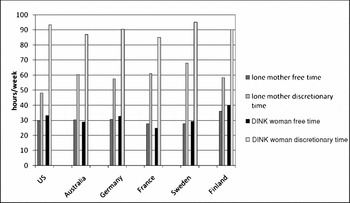
Distinguishing between the two proves crucial in differentiating the situations of lone mothers versus DINKs. As Figure 2 shows, were we to judge purely in those traditional terms of ‘free time’ (time not actually spent in paid or unpaid labour or personal care), it would seem that the two are temporally pretty much on a par. DINKs have a little – but only a little – more free time than lone mothers, looking at the darker first bars in each suite of bars in Figure 2. Looking at the lighter bars showing ‘discretionary time’ (how much time it is not strictly necessary for them to spend in those activities), however, it is clear that DINKs are very, very much better off than lone mothers.
Mean discretionary time compared to free time, lone mothers and female DINKs

It is no mystery why that should be so. DINKs do indeed spend long hours at the office. The difference is that they do not strictly need to do so (to earn a poverty-level income anywayFootnote 8), whereas the lone mother genuinely has to spend a much larger proportion of time in core activities in order to meet the bare necessities.
What can government do?
In discussing what can governments do to help close that gap, I begin by canvassing two sorts of contributions (one financial, the other socio-legal) whose relative importance I can directly calibrate. I shall then go on to discuss other ways in which governments might contribute to discretionary time, albeit in ways not so readily assessable using the present methodology.
In all cases, I shall be analysing the effects of such policies one by one, holding all else constant. In practice, of course, the more a government does in one direction, the less it might be able to do in some other.
Financial contributions
Government taxing and spending can obviously help reduce inequalities, both monetary and temporal. Here we simply rely upon LIS data on taxes and public transfer payments in each of these countries, converting those cash values into temporal ones by reference to each person's current wage rate. Free or subsidised provision of in-kind goods and services is important as well, but those values are not included in the LIS dataset. One such in-kind provision – that of publicly support for child care – is, however, of such signal relevance to the inequality under discussion that we attempt to infer its value and distribution from such other sources as are available (Goodin et al., Reference Goodin, Rice, Parpo and Eriksson2008: 46–7, 53). Again, those imputed cash values are translated into temporal terms in turn by reference to each person's current wage rate.
In principle, inequalities can be reduced either (or both) by taking from the rich or giving to the poor. In the comparison under discussion the ‘well off’ are DINKs, blest with vastly more discretionary time than lone mothers. In all six countries under consideration, governments’ tax-and-spend policies have the effect of reducing the discretionary time of DINKs. But they pretty much all do so by the same modest amount (an hour or two a week, even less in Australia, compared to what DINKs would have had in the absence of those policies). For that reason, in searching for the real drivers of difference among welfare-gender regimes I shall henceforth focus exclusively on the state's treatment of the temporally worst off: lone mothers.
In those terms, Figure 3 shows Germany to be the odd state out. There, the state's impact on discretionary time of lone mothers is actually negative. Germany levies high taxes on lone mothers, makes relatively low transfers of state benefits to them and provides them with only very negligible support for child care (Goodin et al., Reference Goodin, Rice, Parpo and Eriksson2008: 189). The net result of all those policies is to leave German lone mothers with over six hours a week less discretionary time than they would have had in the absence of those policies.
Impact of taxes, transfer payments and child-care subsidies on lone mothers’ discretionary time

In the other five countries under study, the story is just the opposite. There, the states’ tax-transfer and child-care systems contribute positively – between five and seven hours a week – to the discretionary time of lone mothers. Which of those components contributes more varies from country to country, even within regime types. In Australia, child-care assistance comes primarily through a tax rebate, whereas in the US it primarily takes the form of in-kind provision through Headstart and other such child-care programmes. In France, while both are positive (unlike GermanyFootnote 9), the contribution of the tax-transfer system to lone mothers’ discretionary time is nearly three times that of state support for child care. In Sweden the contributions of these two sorts of policy are about equal to one another, whereas the Finnish state's contribution to the discretionary time of lone mothers comes exclusively through support for child care (the impact of its tax-transfer system is actually negative for lone mothers’ discretionary time) (Goodin et al., Reference Goodin, Rice, Parpo and Eriksson2008: 189). Those differences are interesting, of course, but the larger point remains: in one way or another, all of these five states manage to give lone mothers between five and seven hours a week more discretionary time than they otherwise would have had.
Setting the terms of divorce
The other big thing the state can do to affect the discretionary time of lone mothers is to dictate, or anyway influence, the terms of their divorce. How much discretionary time a lone mother has depends crucially upon how much help she gets from her ex-partner with (a) the costs and (b) the care of the children of their marriage.
Having children increases the amount of money that is necessary for a wage-earner in a household to earn to avoid poverty, and the amount of time that it is necessary for someone to spend earning it. Having children also increases the amount of time it is necessary to spend doing unpaid labour around the house. That extra amount of ‘necessary time’ in each or both of those dimensions can either be shared among ex-partners upon divorce, or not.
In the results reported below, we calculate how much discretionary time, on average, a lone mother would have under three scenarios:
• if she bore full financial and caring responsibilities for her children, with no assistance from her ex-partner (the ‘no help’ scenario);
• if she bore full caring responsibilities for her children, but her former partner split the costs of the kids equally with her (the ‘share costs’ scenario); and
• if both financial and caring responsibilities for the children were shared equally between ex-partners (the ‘share costs and care’ scenario).Footnote 10
In surmising the effects of imposing alternative divorce regimes, we start by selecting everyone in the dataset who is presently living as a couple with children in their household. We then ask how much discretionary time the women in those households would have if they divorced in each of the alternative ways outlined above. Hence, the same individuals, with the same wage rates, are involved in each of those three projections. The only thing that alters, moving from one scenario to the next, is the divorced mother's necessary time in paid (or in scenario 3, paid and unpaid) labour.
In the ‘no help’ scenario, we calculate how much discretionary time the lone mother would have, after doing the ‘necessary time in paid labour’ and ‘necessary time in unpaid household labour’ (as well as, of course, the ‘necessary time in personal care’, which is the same in all these scenarios) for a household consisting of herself and the children she currently has. In the ‘share costs’ scenario, we vary that basically by ascribing to the lone mother only half the difference between ‘necessary time in paid labour’ for a household consisting of herself and the children she currently has and for a household consisting of herself alone. In the ‘share costs and care’ scenario, we vary the ‘share costs’ scenario basically by also ascribing to the lone mother only half the difference between ‘necessary time in unpaid household labour’ for a household consisting of herself and the children she currently has and for a household consisting of herself alone.Footnote 11 ‘Necessary time’ is here calculated precisely as before.
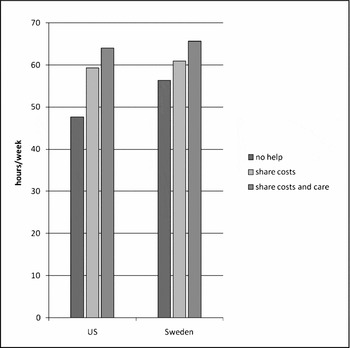
To keep the presentation simple, I shall focus on just two of the countries: the US and Sweden, representing the ‘most different’ cases among the six under study. The average discretionary time of lone mothers in each of those countries, under each of the above divorce scenarios, is shown in Figure 4.
Impact of alternative divorce rules on discretionary time of lone mothers

Unsurprisingly, Figure 4 shows that lone mothers have least discretionary time when their ex-partners do not help at all with the kids, and that they have more discretionary time the more the ex-partners help. Having her ex-partner share the costs of the kids gives the lone mother more discretionary time than if he did not help at all; and having her ex-partner share both the care and the costs of the kids gives the lone mother more discretionary time yet again. That is true in both countries (and all others under study), but the magnitudes of the effects differ between countries.
The big difference between the US and Sweden comes in what it is worth to the lone mother to have her ex-partner share the costs of the kids. That gives the lone mother over 11 hours more discretionary time a week in the US than she would have had if he had not helped at all. That compares to just over four hours more in Sweden. That is mostly due to the fact that lone mothers in Sweden tend to have higher wage rates relative to the national average than in the US.
The gain in discretionary time that comes with having her ex-partner share the care as well as just the costs of the kids is pretty similar in both countries. That gives the lone mother on average about five hours more discretionary time in both the US and Sweden (and all the other countries under study).
The thing to note is just this. Either of those changes in the divorce regime alone would provide lone mothers with nearly as much (in the case of sharing the costs of kids in the US, far more) gain in discretionary time as do most generous states’ financial contributions. Both those changes together would double that (or far more, in the US).
Realistically, it is easier to see how divorce law might impose the ‘equal sharing of costs of kids’ rule than the ‘equal sharing of care of kids’. The latter may have to be left as a social norm, extra-legally enforced.
Still, if we can somehow bring about a state of affairs such that divorcing parents share equally both the costs and care of children, that would increase the discretionary time of lone mothers enormously, compared to what it would have been if they had to bear the financial and caring responsibilities for the kids alone. Sharing costs and care would give lone mothers over nine hours more discretionary time a week in Sweden, and fully 16 in the US. That would eclipse the six hours a week that the financial contributions from the tax-tranfser system and support for child care buy lone mothers in each of those states.
Other things government can do
There are big differences between countries – particularly in the total discretionary time available to the worst-off (lone mothers) – that inevitably remain unexplained looking through the lens of the LIS data in this way alone. Many of those differences are quite likely the product of government interventions. They are simply ones that lie outside the scope of the data and methodology upon which I have been relying up to this point.
We know from Figure 1 that lone mothers have fully 20 hours a week more discretionary time in Sweden than in the US, for example. But we know from Figure 3 that government taxes, transfer payments and support for child care have about the same impact on lone mothers in both places, increasing their discretionary time just over six hours a week. So where does that 20-hour difference between the two countries come from?
It is not from any differences in the amount of time that it is necessary for lone mothers to spend in unpaid household labour or in personal care in those two countries. Those, by our calculations, are almost identical in both countries (Goodin et al., Reference Goodin, Rice, Parpo and Eriksson2008: Appendix 2). Instead, the difference is almost wholly attributable to the differing amounts of time it is necessary for lone mothers in those two countries to work in paid labour in order to earn a poverty-level income.
A smaller part of that difference is attributable to the differing divorce rules and practices that are actually extant in the two countries. The costs of divorce are slightly more equally shared in Sweden than the US. The average lone mother in Sweden gets ‘private transfers’ from her ex-partner that take her over 13 per cent of the way to the poverty line, whereas in the US they take the average lone mother under 9 per cent of the way there. That feeds into discretionary time in turn: the more money the lone mother gets from an ex-partner, the less time she needs to spend in paid labour to get an income above the poverty line, and the more discretionary time she therefore enjoys.
The larger part of the story lies in the relatively higher wage rates of lone mothers in Sweden compared to the US. The higher your wage rate, the less time you need to spend in paid labour to get any given (for example, poverty-line) amount of money. And the less time that is necessary for you to spend in paid labour, the more ‘discretionary time’ you have, other things being equal.
In Sweden, the mean wage rate of lone mothers is 87 per cent of the national mean for all prime-aged workers. In the US, it is only 66 per cent. Wage compression in Sweden has many sources, of course. But the policies of a long succession of social democratic governments have surely contributed something to wage equality. Calibrating that effect of government policy requires a study organised along different lines. Here I merely want to emphasise that the results of such studies would feed directly into this one: anything that increases the mean wage rate of lone mothers, relative to the national mean wage rate, will directly increase their discretionary time as well.
Summing up
Pulling all these strands together, the conclusions I draw from this empirical research are as follows:
• Discretionary time is a crucial resource and of central social justice concern.
• The distribution of discretionary time is very unequal, with the most temporally privileged (childless women in dual-earner couples) enjoying 26 to 42 hours a week more discretionary time than the most temporally underprivileged (lone mothers).
• It would be more unequal still if it were not for the state's financial (tax-transfer and child-care support) interventions, which have the effect of reducing the discretionary time of the privileged group by two hours a week and increasing that of the underprivileged one by six hours a week.
• A potentially even larger contribution the state could make to equalising the discretionary time of these two groups could come with changes to divorce regimes, inducing ex-husbands to share the costs and care of the children of their former marriages.
• A further contribution – not directly measurable within this study, but potentially even larger yet again – is policy designed to raise the wage rates of the worse off (lone mothers especially).
• Finally, all those contributions only help ameliorate temporal inequalities, not eliminate them: even after all those contributions have been made, lone mothers still have substantially less discretionary time than DINKs.
Responsibility for choice?
One obvious reply to the arguments above for helping single parents is to say that parents should be responsible for their choice to have children. That choice imposes costs on them, reducing their subsequent discretionary time. But that should be seen as a choice over how to use some of their subsequent discretionary time, which is in itself an exercise of discretionary choice rather than a constraint on it. Or so the reply might go.
It is not (certainly not always, probably not usually) just plain bad luck that people have children. They (often, probably usually) chose to conceive them, or anyway did not take due precautions against conceiving them if they did not want them; they chose not to abort them once conceived, and not to give them up for adoption once born. Likewise with divorce. It's not (certainly not always, probably not usually) just plain bad luck that parents divorce. They (often, probably usually) chose to divorce, or anyway did not take due precautions to avoid their relationship deteriorating to the point that divorce was inevitable.
Social commentators do often suppose that people should be responsible for their choices.Footnote 12 In so far as lone parents are indead largely responsible in those ways for being parents without partners (and most, if by no means all, probably are), such ‘responsibility for choice’ commentators might insist that they have no just claim to social assistance with the consequences of their being lone parents. In so far as they have only themselves to blame, they have no claim on the rest of us for assistance.
Of course, you can always ask just how many lone parents have done just how much to deserve their plight. Some of them did not do anything wrong or reckless, at all. Many of them might have done something that was somewhat wrong or reckless, but whatever slight wrong they did is out of all proportion to the hardships they are bearing in consequence. All that is true, and important.
Beyond that, however, one might well ask whether having children really is ‘wrong’ or in any sense something for which people should justly be expected to bear unnecessarily great hardships? Or is it something that is good for society, and hence something that ought to be socially rewarded and supported? I would suggest the latter is true, even if only (but surely not only) in the pecuniary sense that we all need a next generation to engage in productive labour in order to support us in our old age.Footnote 13
The critic might persist, however, saying that even if having kids is good, divorcing when you have kids might be bad – wrong or anyway reckless, in ways deserving of moral censure. ‘Responsibility for choice’ commentators might deem lone parents to deserve to suffer at least some hardships, in consequence of those bad choices.
Perhaps the best reply at this point is simply that raising good kids is a social good, too. There are of course many determinants of how kids turn out. But the resources – time and money – that their parents have available in raising them is one important determinant (Folbre, Reference Folbre2008). So even if ‘responsibility for choice’ commentators say that it would be just for the parents to bear extra time as well as money costs when divorcing, it would not be in the social interest for the children also to suffer. Indeed, it would not be just; whatever the sins of their parents in divorcing, the kids have not done anything wrong or reckless, the costs of which they ought be expected to bear.
Acknowledgements
This article forms part of a larger project on ‘Discretionary Time’ funded by Australian Research Council Discovery Grant DP0450406. I am indebted to my collaborators on that project (James Rice, Antti Parpo and Lina Eriksson) for invaluable discussions of these issues and for assistance with the data analyses reported in here. For comments on earlier versions of this paper, I am also grateful to Kieran Healey, Christopher Jencks, Susan Mendus, Axel West Pedersen, Adam Swift and audiences in Canberra, Helsinki, Oslo and Turku.