Introduction
Issues related to older adult caregiving will become profoundly important in China during the first-half of the 21st century. In China, the size and proportion of the population age 80 years and older (the oldest old) is rapidly and dramatically growing. By 2050, the size of the oldest old population is projected to grow to 98.40 million, over 5 times as high as in 2010. The percentage of the oldest old in China has climbed from 0.3% in 1950 to 1.4% in 2010 and it is projected to reach 7.6% by 2050 (United Nations, 2011). The growth of the oldest old population is likely to be accompanied by an increase in the need for long-term care, and if current expectations prevail, families will provide the majority of care despite the current development of residential long-term care options. Finding ways to support family caregivers is imperative at the individual, family and societal levels. The purpose of this manuscript is to build knowledge that can be used to identify caregivers who are at risk for stress and negative health consequences.
Cultural context of family caregiving in China
In China, families, especially adult children, bear the primary responsibility of caring for older adults. Filial piety, a core familial norm in the Chinese social value system, teaches that elders are to be respected, supported, and taken care of by their adult children (Ikels, Reference Ikels2004). From an early age, adult children are socialized to expect to provide care for their parents in old age, such as providing food, emotional support, and economic assistance (Yue and Ng, Reference Yue and Ng1999; Cheng and Chan, Reference Cheng and Chan2006). This expectation is also operationalized in the law. According to the Constitution of the People's Republic of China, it is the legal duty of adult children to care for their parents (The National People's Congress of the People's Republic of China, 2004). During socialization, children internalize cultural expectations about what they ought to do for their parents (Tsai, Reference Tsai1999). However, as documented in many US and Chinese studies, providing care for frail elders can be physically and mentally intensive work, which can produce feelings of satisfaction, as well as feelings of entrapment and burden (Chou et al., Reference Chou, Lin and Chu2002; Etters et al., Reference Etters, Goodall and Harrison2008), and may contribute to ill-health and depression (Schulz and Beach, Reference Schulz and Beach1999; Sherwood et al., Reference Sherwood, Given, Given and von Eye2005). Because of high-social expectations for filial piety, Chinese adult children may be at increased risk for worrying about their caregiving performance.
Worry about performance
The Zarit Burden Interview (ZBI) is a commonly used scale to measure how caregivers feel about caregiving involvement. This scale was developed in the U.S. based on research conducted with caregivers of persons with dementia (Zarit et al., Reference Zarit, Reever and Bach-Peterson1980), and has been found to have strong psychometric properties (Hébert et al., Reference Hébert, Bravo and Préville2000; Bédard et al., Reference Bédard, Molloy, Squire, Dubois, Lever and O’Donnell2001; Schreiner et al., Reference Schreiner, Morimoto, Arai and Zarit2006). ZBI has been translated into many languages, including Chinese.
Recent studies that examined the factor structure of ZBI items in different countries (i.e. Canada, France, People's Republic of China, Singapore, and US) have consistently noted that two of the 22 ZBI items cluster together in the factor that has been referred to as “worry about performance” (Ankri et al., Reference Ankri, Andrieu, Beaufils, Grand and Henrard2005; Lai, Reference Lai2007; Ko, Yip, Liu and Huang, Reference Ko, Yip, Liu and Huang2008; Lu, Wang, Yang and Feng, Reference Lu, Wang, Yang and Feng2009; Leggett, Zarit, Taylor and Galvin, Reference Leggett, Zarit, Taylor and Galvin2010; Lim, Cheah, Ali, Han, Anthony, Chan and Chong, Reference Lim, Cheah, Ali, Han, Anthony, Chan and Chong2014). The two ZBI items are “do you feel you should be doing more for your relative?” and “do you feel you could do a better job in caring for your relative?” WaP is considered a unique dimension of caregiver burden because caregivers consistently reported higher levels of worry about their performance compared with other ZBI items and because WaP is poorly correlated with other ZBI factors (Leggett et al., Reference Leggett, Zarit, Taylor and Galvin2010; Lim et al., Reference Lim, Cheah, Ali, Han, Anthony, Chan and Chong2014). Different from other ZBI dimensions that disclose experienced burden (e.g. exhaustion, financial strain, loss of control, and embarrassment), WaP reveals caregivers’ self-appraisal of their caregiving performance (Lawton et al., Reference Lawton, Kleban, Moss, Rovine and Glicksman1989). Self-appraisals, a type of self-criticism or value judgment about oneself, can influence individuals’ well-being (Swann et al., Reference Swann, Chang-Schneider and Larsen McClarty2007; Annesi and Unruh, Reference Annesi and Unruh2008), as explained in the following section.
The only published study examining WaP in caregivers of Chinese cultural background identified as part of the literature review is that conducted by Lim and colleagues (Lim et al., Reference Lim, Cheah, Ali, Han, Anthony, Chan and Chong2014). They found younger caregivers reported higher levels of WaP in their sample of 130 caregivers in Singapore. Another two studies using samples from France and the US also explored WaP (Ankri et al., Reference Ankri, Andrieu, Beaufils, Grand and Henrard2005; Leggett et al., Reference Leggett, Zarit, Taylor and Galvin2010) and suggested caregiver's higher levels of WaP is related to their age, isolation, and being care recipient's child rather than spouse as well as care recipient's physical and cognitive impairments. These descriptive studies are helpful to learn about the distinctiveness of WaP in caregiver burden. Beyond describing the presence of the factor, it is important to be able to explain which variables are associated with WaP.
Conceptual frameworks identify key ideas and how they are related so that underlying assumptions can be systematically tested. A review of the literature did not identify any scholarship that applies a conceptual framework to explaining the variation in WaP. The purpose of this study is to test whether applying concepts from Pearlin's Stress Process Model can help explain the variation in WaP. Enhanced understanding of what contributes to WaP can help to identify caregivers at increased risk for health problems related to caregiving.
Pearlin's Stress Process Model
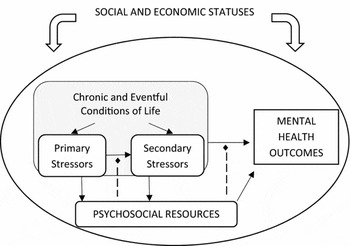
Pearlin's Stress Process Model (Pearlin, Reference Pearlin19891989; Pearlin, Reference Pearlin, Aneshensel and Phelan1999; Pearlin and Bierman, Reference Pearlin and Bierman2013) is one of the most commonly used frameworks to explain caregiver burden in long-term care studies. The model has been used to help explain the variation in caregiver health outcomes, including mental health outcomes. In the model, primary stressors and secondary stressors affect caregiver mental health outcomes (see Figure 1). Psychosocial resources can influence the effect of the primary and secondary stressors on caregiver health status. Furthermore, social and economic statuses are understood to affect all aspects of the stress process (2013).
The stress process model.

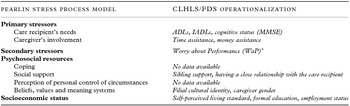
In Pearlin's Stress Process Model, secondary stressors refer to stressful experiences triggered by primary stressors, although secondary stressors are not directly rooted in the caregiving situation. In this study, we consider WaP a secondary stressor. We then set WaP as the dependent variable, with the aim of explaining the variation in WaP by examining primary stressors, psychosocial resources, and social and economic statuses. In the remainder of this section, key concepts from Pearlin's model are presented and how these concepts are operationalized in the current study is mentioned. The explanation of the variables is included in the Methods section. Table 1 includes key concepts from the Pearlin Stress Process Model and indicates which concepts were able to be operationalized using the dataset in this study.
The operationalization of selected concepts from the Pearlin stress process model using data from the Chinese longitudinal healthy longevity survey (CLHLS) and the family dynamic survey (FDS) module

*Note: In this study, WaP is the dependent variable.
Primary stressors
Primary stressors are directly rooted in the caregiving situation. There are two categories of primary stressors. One type of stressor reflects the level of care needed by the care recipient and the other reflects the extent and type of caregiving involvement by the caregiver. Characteristics of the care recipient such as cognitive impairment, problematic behavior, and functional limitations are considered primary stressors (Pearlin et al., Reference Pearlin, Mullan, Semple and Skaff1990). Because care needs resulting from impairment in physical and cognitive functions are not desired or scheduled by families, they often contribute to caregiver stress (Pearlin et al., Reference Pearlin, Mullan, Semple and Skaff1990). Previous studies have suggested a positive relationship between care recipients’ physical and cognitive decline and caregiver burden (Sherwood et al., Reference Sherwood, Given, Given and von Eye2005). The higher the care needs, the more likely caregivers may worry about their caregiver performance. In this study we include variables representing care recipient cognitive status (Mini-Mental Status Exam) and functional status (ADL, IADL).
Caregiver involvement is the other category of primary stressors. Zhan (Reference Zhan2005) found that the caregivers who performed more frequent personal care reported lower subjective burden, and the caregivers who provided more instrumental care reported higher-subjective burden. Her study indicated that the type of care provided is related to caregiving burden, but the distinction of personal and instrumental care does not clarify what resources (e.g. money or time) the caregivers use to accomplish the caregiving tasks. In this study, we include measures of caregiving involvement represented by the amount of time and money the caregivers reported spending in caring for their elders. Although the eldest son is traditionally expected to assume overall responsibility for the elders’ well-being, it is common for all adult children to share the caring responsibilities (Zhan, Reference Zhan2006). Siblings may provide different types of care (Wang and Schneider, Reference Wang and Schneider2000).
Psychosocial resources
Pearlin and Bierman (Reference Pearlin and Bierman2013) reported that four categories of variables constitute psychosocial resources which may mediate or moderate the relationship between primary and secondary stressors. These variables may also have a direct effect on health status, as shown in Figure 1. The four categories are coping, social support, self-perception of the caregiver's ability to control the circumstances that confront them, and the caregiver's belief system which includes values and meanings (Pearlin and Bierman, Reference Pearlin and Bierman2013). As shown in Table 1, we were not able to operationalize coping in our study, nor self-perception of the ability to control caregiving circumstances. The two concepts we had measures for were social support and belief system.
We operationalized social support with two items; a variable related to sibling support and a variable that asks caregivers to report the extent to which they have an emotionally close relationship with the care recipient. Caring for elders is culturally expected to be a team effort of all adult children in a family. Thus, sibling support can be an important type of social support for adult-child caregivers. Given the distribution of filial responsibilities, many researchers (Zhu and Xu, Reference Zhu, Xu and Kosberg1992; Guo, Reference Guo1996; Guo and Zhang, Reference Guo and Zhang1996) agree on the important effects of sibling support on caregivers’ strain. In addition to sibling's support, the emotional relationship with care recipients is also important for caregivers, because the primary relationship in their caregiving experience is the one with their care recipients. Though there is no concerted explanation about how the relationship between caregivers and care receivers influences caregiver strain, most researchers agree with the importance of this relationship in the caregiving experience (Spaid and Barusch, Reference Spaid and Barusch1994; Magai and Cohen, Reference Magai and Cohen1997).
Belief system and values are potential psychosocial resources in Pearlin's Stress Process Model. In this study we include two variables, a measure of filial cultural identity, and gender. As mentioned earlier, a core value in Chinese culture is filial piety in which sons are expected to be responsible to provide or to coordinate the care for older parents. Recent studies have reported that daughters are more likely to provide instrumental support (e.g. assistances with ADL and IADL) and sons in China are more likely to offer monetary support (Zhan and Montgomery, Reference Zhan and Montgomery2003; Song et al., Reference Song, Li and Feldman2012). However, it is not clear whether the different role expectations are related to distinct levels of WaP between daughters and sons.
Social and economic statuses
In order to fully appreciate the Stress Process Model, it is important to recognize the strong and pervasive influence that social and economic statuses play in every aspect of the model (Pearlin, Reference Pearlin1989; Pearlin Reference Pearlin, Aneshensel and Phelan1999; Pearlin and Bierman, Reference Pearlin and Bierman2013). Socioeconomic status (SES) is an indicator of the amount of power, resources, opportunities, and privileges available to an individual based on the person's status in society. For family caregivers, SES can greatly influence the resources available to provide for family members. For example, caregivers with higher SES may have more economic resources to purchase services outside the families to meet their relatives’ care needs (Kincannon, He and West, Reference Kincannon, He and West2005). In this study, we operationalize caregiver SES with self-perceived living standard, education attainment, and employment status.
Methods
Sample
This study used data from the 2005 Chinese Longitudinal Healthy Longevity Survey (CLHLS) and one of its modules, the Family Dynamic Survey (FDS) with the permission from the Center for Healthy Aging and Development Studies, Peking University. The CLHLS was designed to investigate how healthy longevity is related to social, behavioral, biological, and environmental factors in Chinese elders, particularly the oldest-old population. All Chinese aged 100 years or older living in randomly selected counties and cities within 22 (out of the 31) provinces were identified and invited to participate in the study. Once the 100 year olds were identified, the CLHLS increased the sample size by selecting elders in their 60s, 70s, 80s, and 90s who lived in the same community as each 100 year old. The survey selected approximately equal numbers of male and female elders younger than 100 years old in each identified community to have comparable numbers of males and females in the sample (Zeng et al., Reference Zeng, Liu and George2003). For a more detailed explanation of the sampling, refer to CLHLS website http://centerforaging.duke.edu/programs.
The 2002 and 2005 CLHLS waves included an extra module called the FDS in eight coastal provinces: Liaoning, Shanghai, Jiangsu, Zhejiang, Fujian, Shandong, Guangdong, and Guangxi. Among the proximate children of each elder, one adult child was randomly sought for the sample. Adult children who lived with or close to the elders in the CLHLS were more likely to be invited to participate in the study because they were more easily accessed by the researchers. In the 2005 FDS, those respondents who stated that they provided care for their older parents were asked to report their caregiving stress using the ZBI. Trained interviewers administered the survey questionnaire in person. All data describing the caregivers are self-reported. Data for this study were obtained by merging the 2005 CLHLS data from elders and FDS caregiver data through matching the identification number of the CLHLS participants. The sample of this study was composed of 895 dyads of adult-child caregivers and their oldest-old parent, the care recipient. We excluded 2,016 out of a total of 2,911 dyads from this study for the following reasons: the adult children reported they did not provide care for their elders (n = 817); the elderly parents were deceased by the time of survey (n = 728); and the parents were younger than 80 years old (n = 381). More details about the CLHLS and FDS were reported elsewhere (Gu and Vlosky, Reference Gu, Vlosky, Garner and Christiansen2008; Zhang, Reference Zhang, Zeng, Poston, Vlosky and Gu2008).
Measurements
Dependent variable
WaP was measured by combining the scores from these two items from the ZBI: “Do you feel you should be doing more for your parent” and “Do you feel you should do a better job in caring for your parent” (0 = never, 1 = rarely, 2 = sometimes, 3 = usually, 4 = nearly always). In the analysis, the dependent variable was computed by adding the scores of these two items. The sum score ranged from 0 (never feeling they should be doing more and never feeling they should do a better job) to 8 (nearly always feeling they should be doing more and nearly always feeling they should do a better job).
Independent variables
Independent variables in this study included three indicators of SES, five indicators of primary stressors, and four indicators of psychosocial resources.
SES of caregivers was indicated by caregiver's self-evaluation of living standard, education, and work status. Given the large variations of economic development across the eight provinces, self-evaluation of living standard was used instead of actual individual or household income. The self-evaluation of living standard was measured by the question “compared to the living standard in your community, how do you assess your family economic status?” We recoded it to a dichotomous variable (1 = rich or very rich) because of the skewed distribution (0.1% very rich, 13.7% rich, 66.1% fair, 16.1% not rich, and 3.9% poor). Caregiver's education was also coded as a dichotomous variable (1 = having high school and higher degree) given the skewed distribution of caregivers’ highest level of education (9.8% illiterate or semiliterate, 33.3% elementary school, 34.3% middle school, 16.8% high school, and 5.8% college). We created a three category variable to indicate caregiver's work status (1 = retired or not working, 2 = part-time working, 3 = full-time working).
Caregivers’ primary stressors were indicated by care recipient's self-reported physical and cognitive health status, and caregiver's self-reported time assistance and monetary assistance. Care recipient's physical health status was measured by care recipients’ limitations in six Activities of Daily Living (ADL) (bathing, dressing, toileting, mobility, continence, and feeding) and four Instrumental Activities of Daily Living (IADL) needs (doing laundry, preparing meals, visiting neighbors, and shopping). Care recipients’ assistance needs in each ADL and IADL task were assessed by three categories (1 = without assistance, 2 = with some assistance, 3 = being totally dependent on assistance). We summed the scores producing ADL limitations (Cronbach α = 0.90) which ranged from 6 to 18 and assistance needs in IADL limitations (Cronbach α = 0.91) which ranged from 4 to 12 with higher scores indicating greater assistance needs in both variables. Cognitive status was assessed by the Mini-Mental State Examination (MMSE), which is a standard tool for cognitive assessment with high reliability (Cummings, Reference Cummings1993). Instead of using the full version, CLHLS used 19 items and the MMSE score can range from 0 to 23, with higher scores indicating higher cognitive function (Cronbach α = 0.85). Time assistance was measured by a caregiver's report of the amount of days he or she spent taking care of the care recipient in the past 12 months. Caregivers were also asked to report the amount of money that they gave to their parents, and used to purchase healthcare services, food, and other living materials for their parents in the past 12 months. To make the coefficients easier to interpret, we recoded time assistance in month and monetary assistance in 1,000 Renminbi (RMB, the official currency of the People's Republic of China) yuan.
The two elements of psychosocial resources, belief/value and social support, were indicated by four variables: filial cultural identity, being a daughter or son, caregiver's perception of emotional closeness and sibling's support in caregiving. One of the important filial expectations is worshiping ancestors. In the survey, caregivers were asked how often they participated in the activity of sweeping graves or worshiping ancestors with the family or extended family. Based on this item, we created a dichotomous variable with 1 = often participate in the activity of sweeping graves or worshipping. As discussed above, filial culture have different expectations for daughters and sons, so another variable indicating belief/value is being a daughter or son (1 = daughter).
Social support was represented by caregiver's perception of emotional closeness and sibling's support in caregiving. Caregivers were asked to respond to what extent they agree with the statement based on their experience with their care recipients: “I have a close relationship with my parent.” The distribution of caregivers’ response to this question was highly skewed (25.5% completely agree, 70.3% agree, 2.3% disagree, and 1.9% completely disagree). Assuming that the social and cultural pressure to report “completely agree” is strong, all answers other than “completely agree” were combined and recoded into one level of the variable, (1 = completely agree, 0 = completely disagree, disagree and agree) (Liu et al., Reference Liu, Guo and Bern-Klug2013). In the survey, caregivers were also asked to evaluate the importance of their sibling's support in caregiving. Sibling support was measured by responses to this question, “how important is your sibling's help in taking care of your parents?” Possible responses were not important, slightly important, important, fairly important and very important. A categorical variable was coded with 1 = not or slightly important, 2 = important, 3 = fairly or very important.
Control variables
Control variables were social demographic characteristics of caregivers and care recipients. Age was measured in years for both caregivers and care recipients. The care recipients’ gender was considered as a dichotomous variable (1 = male). We create three categories of care recipient's living arrangement: 1 = living with caregivers, 2 = living with other family relatives, and 3 = living alone. Caregiver's marital status (1 = married, 0 = never married, being divorced or widowed), rural/urban residence (1 = living in rural areas), self-rated physical health status (1 = health is good or very good), and parenting or grand-parenting role (1 = parenting or grand-parenting young children or grandchildren) were recoded into dichotomous variables. We assume a caregiver had a parenting or grand-parenting role if he or she was living with child(ren) or grandchild(ren) 16 years old or younger.
Data analysis
The data analyses were designed to compare and contrast seven different regression models aimed at explaining the variation in WaP. The first three models represent each set of conceptual variables (primary stressors, psychosocial resources, and SES tested separately). Other models included all the conceptually inspired variables, control variables only, and conceptually inspired variables and the control variables combined.
To prepare the data for moderation test, we centered all the continuous variables. We addressed missing data with listwise deletion, for there were minimal (1.90%) amount of missing values in the dependent and independent variables. The statistical analyses were conducted in Stata 13.0.
Results
The caregivers in this study reported higher levels (t = 25.10, p < 0.001) of concern regarding the caregiving performance (mean = 2.90) than other items in ZBI (mean = 0.84). About one third of adult children reported nearly always feeling they “should be doing more” (31.3%) or “should do a better job” (32.7%) for their elders. Slightly over 15% of adult children reported never perceiving they should be doing more and/or should do a better job in caring for their parent and about 40% reported some levels of WaP (more care: 14.1% seldom and 28.9% sometimes, better care: 12.1% seldom and 27.2% sometimes).
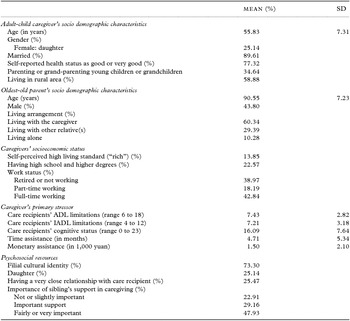
Table 2 reports the demographic characteristics of the adult-child caregivers and their oldest-old parents. The mean age of caregivers was 55.83 years (SD = 7.31) and three-fourths (74.86%) of the sampled caregivers were males, which is not surprising given the traditional family culture that encourages sons to live close to their parents and daughters to move to their husbands’ communities after they marry. Almost nine in ten (89.61%) caregivers were married and lived with their spouse and most caregivers (77.32%) rated their health as good or very good. More than one-third of caregivers (34.64%) had a parenting or grand-parenting role and over half (58.88%) of caregivers were living in rural areas. Among the oldest-old care recipients, the average age was 90.55 years (SD = 7.23) and female elders comprised a slightly larger proportion (56.20%) than males. Most care recipients (90%) lived with family members: about 60% lived with caregivers in the sample and almost 30% lived with other family members.
Descriptive statistics of the adult-child caregivers and their oldest-old parents in the sample, the FDS & CLHLS data, 2005 (n = 895)

Table 2 also shows the descriptive results of independent variables of SES, primary stressor and psychosocial resources. More than three quarters of caregivers (77.43%) lacked a high school education and 13.85% of caregivers perceived their living standard as rich or very rich. Over 40% caregivers reported having a full-time job and less than 20% were working part-time. The physical and cognitive functional scores (i.e. ADL, IADL, and MMSE) indicate that in general this sample of elders had low care needs both in terms of ADL and IADL, and that the majority of elders were not cognitively impaired. On average, caregivers spent 4.71 months and ¥1500 RMB yuan (≈ 241 US dollars) in caring for their parents during the past 12 months. More than 70% caregivers had filial cultural identity to some extent and one quarter of caregivers (25.14%) were daughters. More than one-fourth of caregivers reported a very close relationship with their parent and over three quarters of caregivers perceived their sibling's support in caregiving important or very important.
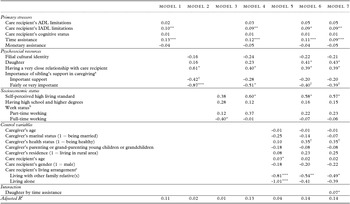
Table 3 reports the results of linear regressions of Chinese adult-children's WaP of providing care for their oldest-old parents. Model 1 tested whether primary stressors were related to WaP. The results indicate that the caregivers who provided care for elders with higher levels of IADL needs (B = 0.10, p < 0.01) and who spent more months in caregiving (B = 0.13, p < 0.001) had significantly higher levels of WaP. That means one score increase of care recipient's IADL limitations is related to 0.1 higher score of caregiver's WaP and one month more a caregiver spent for the care recipient is associated with 0.13 higher score of caregiver's WaP.
Linear regressions on Chinese adult-children's worry about performance in providing care for oldest-old parents (care recipients), CLHLS and FDS, 2005 (n = 895)

Note.
a The reference group was composed of the adult-child caregivers who perceived as their sibling's support as not or slightly important.
b The reference group was composed of the adult-child caregivers who were retired or not working.
c The reference group was composed of the adult-child caregivers living with care recipient.
† p<0.1;* p< .05; ** p< .01; *** p< .001.
The results of Model 2, which examined the relationship between the psychosocial resources and WaP, suggest the importance of emotional closeness and sibling's support in predicting WaP. Emotional closeness with care recipients was significantly related to higher level of caregiver's WaP (B = 0.61, p < 0.05). The caregivers, who perceived sibling's support in caregiving as fairly or very important (B = −0.87, p < 0.001), reported lower level of WaP.
Model 3 tested the relationship between SES and WaP. We found the caregivers who worked full-time reported lower level of WaP (B = −0.40, p < 0.05). However, when we put all three sets of conceptual inspired variables in Model 4, the coefficients and significance of two SES variables changed. In Model 4, full-time working was not significantly related to WaP, but self-perceived high living standard was significantly associated with higher level of WaP (B = 0.60, p < 0.05).
Among the control variables in Model 5, care recipient's living arrangement and care recipient's age were significantly related to WaP. The caregivers whose care recipients lived with other family members (B = −0.81, p < 0.001) or lived alone (B = −1.01, p < 0.001) reported lower levels of WaP than the ones living with their care recipients. Care recipient's age was related to slightly higher level of WaP (B = 0.03, p < 0.05).
Model 6 included all the conceptually inspired variables and control variables and Model 7 is the final model including the significant interaction as well as other independent variables. We tested 16 interactions between variables representing primary stressors and the variables representing psychosocial resources. The interaction terms were used to assess the moderating effects of psychological resources on the relationship between primary stressors and WaP. We identified only one interaction term, and it was added to the model. The coefficients and significances of most conceptual variables in Model 6 and 7 were similar to the results in the prior models. The importance of sibling's support was moderately significant (0.05 < p < 0.10) in Model 6 and 7, which is not surprising given more independent variables added to the regression. It is interesting to find that being a daughter, which was not significant in prior models, became significant when control variables were added in Model 6 and 7. When caregiver's and care recipient's socio-demographic characteristics were controlled for, daughters reported significantly higher levels of WaP than sons (B = 0.41 in Model 6, B = 0.43 in Model 7, p < 0.05). We carried out further tests to understand such change of results across the models and found the significance of being a daughter is associated with adding care recipient's living arrangement in the regression. The result of post-hoc test indicates that among the caregivers, sons are more likely to live with their older parents than daughters (χ2 (2) = 64.95, p < 0.001). As shown above, the caregivers living with care recipients reported significantly higher level of WaP comparing to the ones whose care recipients were living with other family members. The lower likelihood of living with care recipients among daughters and the significant association between living arrangement and WaP may neutralize the association between being a daughter and WaP. When care recipient's living arrangement was controlled for, the relationship between being a daughter/son and WaP was somewhat clarified.
The interaction tests indicate that being a daughter changed the relationship between time assistance and WaP. As shown in Table 3, the results of Model 7 show that the influence of time assistance is stronger in daughters than in sons. The change of WaP score associated with one month more care is 0.07 higher in daughters than the change in sons (B = 0.07, p < 0.05).
The model tests have shown the usefulness of Pearlin's Stress Process Model in explaining the variation of caregiver's WaP. Among the three sets of conceptual variables, the primary stressors explained the highest variation of WaP (Adjusted R2 of Model 1 = 0.11) and SES contributed the least (Adjusted R2 of Model 3 = 0.01). Model 4, which included all the conceptual variables, explained 13% of WaP variation (Adjusted R2 of Model 4 = 0.13). Including the control variables in Model 6 only increased 0.01 in adjusted R2 (Adjusted R2 of Model 6 = 0.14), which indicates that the caregiver's and care recipient's socio demographic characteristics were not very useful in understanding WaP. Though the interaction of being a daughter and time assistance was significant, it doesn't improve the model fit (Adjusted R2 of Model 7 = 0.14).
Discussion
The purpose of this study is to build understanding of factors that contribute to Chinese caregivers reporting high levels of WaP measured by two items on the Zarit Burden Inventory. We turned to Pearlin's Stress Process Model to guide our selection of independent variables found in the CLHLS dataset to test their ability to explain variation in WaP. Seven regression models were tested using different sets of variables: sets of conceptual variables only, control variables only, control and conceptual variables and then all the independent variables with the interaction term. As far as we can tell, this is the first study to use a conceptual framework to guide variable selection in explaining variation in WaP among caregivers.
Our main finding is that using Pearlin's Stress Process Model as a guide for variable selection was useful in explaining variation in WaP compared to the model with control variables only. Of the sets of conceptual variables in the regression models (primary stressors, psychological resources and SES), the set representing primary stressors explained the most variation—indeed three fourths of the variation we found in this study can be accounted for by two primary stressor variables (discussed below). The “control variable only” (Model 5) explained four percent of the variation. By adding the conceptual variables and interaction term (Model 6 and 7), we were able to increase the amount of variation explained by three fold to 14% (Adjusted R2 ). We conclude that adding independent variables inspired by Pearlin's Stress Process Model is beneficial in understanding the variation in WaP among Chinese caregivers of parents age 80 years and older. Although we are pleased to report the increase in explanatory power, we recognize that most of the variation in WaP remains unexplained.
Our final model (Model 7), which includes the three sets of conceptual variables, the set of control variables and an interaction term, reveals that the presence of the following variables increases caregiver's WaP: care recipient's IADLs, the amount of time a caregiver spend in caregiving (primary stressors); being a daughter, reporting a close relationship with the care recipient (psychosocial resources), self-perceived higher living standard (SES), and co-residing with the care recipient (control variable). Each is discussed below.
Primary stressors variables
Caregivers whose care recipients had greater IADL limitations reported higher levels of WaP; the same is not true for ADLs. While on the surface it seems odd that IADLs and not ADLs would be related to increased WaP, Zhan (Reference Zhan2005) found a similar relationship in her study of Chinese caregivers. She reasoned that caregivers providing IADL support may not have yet made the necessary adjustments at home and at work to accommodate the caregiving role, whereas by the time a caregiver is assisting with ADLs, he or she may be more accustomed to the role and may have had enough time to re-arrange the other parts of life.
The caregivers who spent more time in the role reported higher levels of WaP. When the caregivers had more opportunities to spend time with the care recipients, they may have gained a better understanding about the care recipients’ need for care. A greater understanding of the elder's care needs may cause caregivers to hold a higher expectation of the quality of care they should provide.
Psychosocial resources variables
Our results indicate that caregiver's gender was an important variable. Daughters reported higher levels of WaP than sons even though filial culture expects sons to hold primary responsibility for elder care in China. We did not find significant difference of time or money assistance between daughters and sons. However, we found daughters were more likely to report having a very close relationship with the older parents they provided care for than sons (χ 2 = 6.74, p = 0.009). In a close relationship, daughters may have more efficient communication with older adults regarding the care needs and may hold higher expectations of caregiving performance for themselves. In addition, we also found a significant interaction of daughter and time spent in caregiving.
The interaction indicates that being a daughter changed the relationship between time assistance and WaP. As shown in Table 3, the results of Model 7 show that the influence of time assistance is stronger in daughters than in sons. The change of WaP score associated with one month more care is 0.07 higher in daughters than the change in sons (B = 0.07, p < 0.05). This relationship became more clear once the control variables were added to the model, and it was determined that by controlling for co-residence, the effects of being a daughter on WaP were clarified; daughters report higher levels of WaP, especially the daughters spending more time in the caregiving role.
The increase in WaP among daughters could be a reflection of the role of women in China. While sons are expected to hold the primary responsibility for coordinating care for parents, they are not expected to provide the care alone. In some Chinese families, the children pool financial resources so that one of them can leave the workforce to stay home and care for the parent; that one child is typically a daughter (Zhan, Reference Zhan2005). Investigation into the WaP reported by daughters is called for. Is it related to the quality of their relationship with their brothers? Is WaP more likely in families with no sons present or no sons able to assume responsibility for care? Perhaps the caregiving daughter is also helping with caring for her husband's parents. More research is needed to illuminate the relationship between WaP and being a daughter and also being a daughter-in-law.
Having a very close emotional relationship with the care recipient was related to reports of increased WaP. Other studies have also reported the importance of the quality of the relationship on caregiver burden, although there is no consensus about whether the quality of this relationship has positive or negative influences on caregivers (Heru et al., Reference Heru, Ryan and Iqbal2004; Heru and Ryan, Reference Heru and Ryan2006; Lea Steadman et al., Reference Lea Steadman, Tremont and Duncan Davis2007). Some US researchers emphasize that high-quality relationships may increase the caregivers’ perceptions of the reward from caring for their parents (Heru et al., Reference Heru, Ryan and Iqbal2004; Heru and Ryan, Reference Heru and Ryan2006; Lea Steadman et al., Reference Lea Steadman, Tremont and Duncan Davis2007). In contrast, a Chinese study indicated that the better the relationship, the more burdened the caregiver may feel due to higher expectations for their caregiving performance (Tang, Reference Tang2006).
Socio-economic status variables
Reporting a self-perceived high living standard increased WaP. This is inconsistent with previous studies which have suggested that caregiver's SES is negatively related to caregiver stress in China (Davis et al., Reference Davis1998; Zhan, Reference Zhan2005, Reference Zhan2006; Qiu and Li, Reference Qiu and Li2008; Liu et al., Reference Liu, Guo and Bern-Klug2013). This may be related to the Chinese cultural context. Under the filial culture, the caregivers who rated their living standard as “rich” or “very rich” may have higher expectations of themselves and may feel they have no excuse for providing inadequate care for their elders. Filial culture socializes children with the belief that no gift could pay parents back sufficiently for having raised them. Thus, caregivers’ higher self-evaluation of living standard may reinforce their WaP.
Control variable: co-residence
We also found that caregivers living with care recipients reported higher levels of WaP compared to caregivers whose care recipients lived with other family relatives. This finding is consistent with previous studies which concluded that co-residence was related to higher caregiver stress (Cohen et al., Reference Cohen, Colantonio and Vernich2002; Pinquart and Sörensen, Reference Pinquart and Sörensen2007). Many US and Chinese studies have indicated that co-residence decreases the opportunity for regular release from the caregiving involvement and thus increases caregiver stress (Cohen et al., Reference Cohen, Colantonio and Vernich2002; Pinquart and Sörensen, Reference Pinquart and Sörensen2007). Also, the caregivers living with care recipients may be more likely to view unmet needs of care and therefore WaP.
The results from this study differ somewhat from what Lim and colleagues (Reference Lim, Cheah, Ali, Han, Anthony, Chan and Chong2014) found in their convenience sample of 130 caregivers in Singapore, perhaps because of the difference in samples. Their main finding was that younger caregivers reported higher levels of WaP than did older caregivers. In our study, when we tested control variables only, we also found that age was a significant variable in explaining WaP, but in our study it was age of the care recipient, not the caregiver. In our final model, age was no longer significant. On the other hand, our findings are consistent with Lim et al's assessment that “the relative lack of influence of disease characteristics on WaP differs from total ZBI and other factors, which are heavily influenced by behavior and to a lesser extent, physical function” (p. 683).
Limitations
Although we were fortunate to have a large sample size to test our models, limitations of the study exist. Aside from the data being collected ten years ago, with an unusual sampling plan and the fact that China continues to undergo rapid social and economic changes that can be expected to affect caregiving, one of the major limitations of the study was that the sample of oldest old care recipients had very low levels of care needs. There were unexpectedly low levels of cognitive impairment, ADLs and IADLs for a sample of 80+ year olds. It is also noted that the sex ratio of the older old in the sample of this study does not represent the statistics of older population in China because the survey selected the elders younger than 100 years old based on a the predefined age and sex (Zeng et al., Reference Zeng, Liu and George2003). There was also not a lot of variation in WaP to explain in this mostly male (75%) sample of adult child caregivers. Also, while we successfully used concepts from Pearlin's Stress Process Model to explain variation in WaP, the CLHLS set of cross-sectional data did not contain variables representing all the measures needed to fully test the Pearlin model, and some of the variables we did include such as time spent and money spent on caregiving may not be the strongest representation of Pearlin's concepts.
Another limitation to consider is that some self-reported measures may be influenced by perceived caregiver burden. For example, caregiving involvement was measured by caregivers’ assessment about the amount of time and money they spent in providing care for their older parents, which may be biased because of the caregiving burden they perceived. To obtain more accurate measures, future research should assess caregiving performance from multiple sources, such as caregivers, care recipients and other family members, and at multiple times. Despite the limitations, the findings shed light in an understudied area and do suggest practice and research implications.
Practice implications
The findings suggest that certain groups of people could be considered at higher risk for reporting WaP including Chinese persons who perceive themselves as having a higher living standard, daughters, persons who report a close emotional relationship with the care recipient, and persons devoting more time to caregiving. It is of interest to note that none of these factors are characteristics of the care recipient. As programs to support caregivers continue to be developed, it is important to recognize that the gap between performance and self-expectations can occur regardless of actual behavior. In other words, caregivers who are doing a good job may still feel they are not meeting their own expectations and these feelings can have negative health consequences. Helping caregivers to recognize the important difference they are making may be beneficial. In particular, culturally appropriate ways to support daughters in the caregiving role are called for.
Research implications
Research is needed to understand to what extent and how WaP influences caregivers’ emotional and psychological well-being and overall health. In other words, what is the mechanism? Longitudinal data with more complete measures are called for to explain the relationship between primary stressors, SES and psychosocial resources and their effect on WaP and eventually on caregiver health outcomes. Data should be collected from all adult children as well as children-in-law to develop a more complete understanding of the caregiving situation. The extent to which siblings, friends and neighbors are assisting with caregiving is also important to understand.
In conclusion, these results indicate that using a conceptual framework can increase the ability to understand the variation in caregiver's WaP. The findings suggest that knowledge of primary stressors, psychosocial resources, and socio-economic status can help explain the variation in caregivers’ worry about their performance. Helping caregivers reduce caregiver burden is an important goal for all societies. Finding ways to anticipate, assess and address caregiver worry, and stress in cultures with strong filial expectations of adult children are called for, especially in light of rapid rural to urban migration of younger people and globalization.
Conflict of interest
None.
Description of authors’ roles
Dr. Liu, formulated the research questions, designed the study, carried out data analyses and wrote the first draft of the paper. Dr. Bern–Klug, helped with formulating the research questions, drafted the discussion section and provided comments on all sections of the paper.